The Measured Siege: How One Man Dismantled a Corrupt HOA Through the Precision of Federal Law
CHAPTER 1: The Weight of Steel
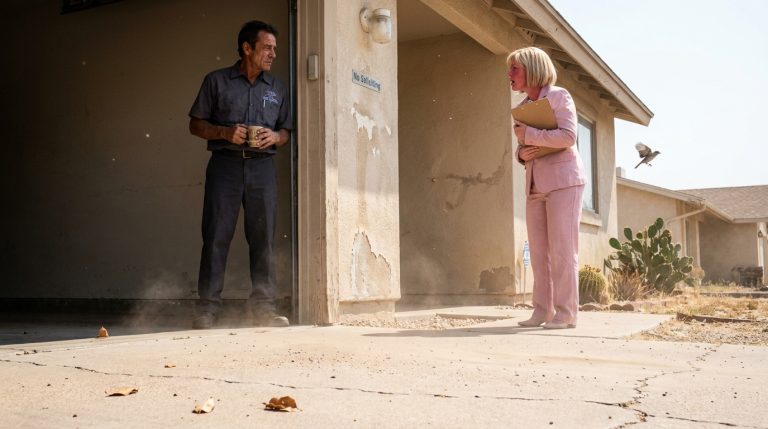
The desert sun had not yet reached its peak, but the asphalt in the driveway was already leaching heat through the soles of my work boots. I stood there, arms crossed, watching the yellow arm of the Southwest Towing truck descend like a predatory insect. It gripped the tongue of the fire response trailer, lifting it with a mechanical shriek that set my teeth on edge.
Priscilla Hartwell stood five feet away, her white BMW X5 idling behind her, its engine barely a whisper compared to the grinding gears of the tow truck. She looked as cool as the vanilla-scented air freshener she favored, her clipboard pressed to her chest like a shield of righteousness.
“Should have read the rules, Logan,” she said, her smile not reaching her eyes. It was a practiced expression, the kind she’d perfected over six terms of HOA presidency. “No fire equipment on residential property. Community standards are the only thing keeping this place from becoming a scrap yard.”
I didn’t answer immediately. I was watching the chains. They scraped against the asphalt, leaving deep, jagged gouges in the surface—a perfect metaphor for the way she was tearing through the neighborhood’s quiet order. I reached out and took the invoice she held out. It was crisp, laminated, and entirely wrong.
“You’re making a mistake, Priscilla,” I said, my voice steady, stripped of the frustration she clearly craved. I wasn’t angry anymore. Anger was a variable she could calculate. I was observing. “That equipment isn’t mine to move, and it’s certainly not yours to seize.”
“File an appeal if you disagree,” she snapped, checking a box on her clipboard with the obsessive intensity of a clerk auditing a dying empire.
Jimmy Rodriguez, the tow operator, wiped grease from his forehead with the back of a stained glove. He looked from me to her, his gaze shifting to the trailer’s side panels, where the official insignia of the Fire District was starting to fade under the relentless UV rays. He looked nervous, his movements hurried.
I walked toward the trailer. As I passed Priscilla, I caught the faint, cloying scent of her perfume—a sharp, artificial vanilla that fought against the acrid stench of diesel exhaust. I placed a hand on the cold steel of the trailer. It was a heavy, grounded sensation. It was a mobile command center, capable of coordinating evacuations, sustaining communication when the world went dark, and keeping people breathing during a flash flood.
I looked at the padlock that held the communications array inside. It was a heavy-duty master lock, and behind it lay documentation that would turn this neighborhood dispute into a logistical nightmare for her. She thought she was clearing a commercial nuisance. She had no idea she was about to pull the thread that would unravel her entire existence.
I stepped back, letting the tow truck driver do his work, but as the trailer lurched toward the street, I noticed something. A small, secondary sticker I’d never seen before, plastered near the trailer’s VIN plate—a tracking tag from the federal agency that had funded the grant. It was invisible to the casual observer, but to a contractor who spent his life studying technical schematics, it was a blinking red light.
Priscilla stepped into the street, watching the trailer roll away with the triumph of someone who believed the law ended at the property line. She didn’t notice the black SUV pulling slowly into the far end of the cul-de-sac. She didn’t notice the silence that suddenly descended on the neighborhood as the tow truck dragged the weight of federal jurisdiction down the road.
I watched it go, feeling the weight of the coming storm. I had the evidence, the chief was on speed dial, and for the first time in three years, I knew exactly how this was going to end.
CHAPTER 2: The Geometry of a Paper War
The silence in the cul-de-sac was absolute, a heavy, airless vacuum left behind by the hydraulic whine of the tow truck. My driveway, usually anchored by the matte-grey bulk of the emergency trailer, felt unnervingly exposed. It was a rectangle of oil-stained concrete that now looked like a crime scene where the body had been removed.
I didn’t storm the HOA office. I didn’t shout at the sky. I walked back into my house, the screen door clicking shut with a dry, metallic snap that echoed the friction of the world outside. The air inside was cool, kept at a precise seventy-two degrees by the unit I’d serviced myself, but it couldn’t dampen the thrumming in my chest—a rhythm of calculation, not rage.
Janet was already in the kitchen, her eyes sharp, reflecting the fluorescent glow of the under-cabinet lights. She’d heard the commotion. She was a nurse; she understood the difference between a crisis and a procedure.
“She took it, didn’t she?” she asked, not looking up from her phone. She was already pulling up the HOA bylaws on the community portal.
“She did,” I said, pulling out a chair at the kitchen table. The wood felt rough, worn by a decade of blueprints and emergency rosters. “She thinks she’s clearing a residential nuisance. She doesn’t know she’s committing a felony.”
I opened my laptop. The screen flickered to life, illuminating the stack of documents I had spent the last three years meticulously organizing. I had folders for every volunteer call, every grant application, every piece of correspondence with the Fire District. I was a man of maintenance—that was my business, my hobby, and my nature. Everything had a place, a code, and a paper trail.
I pulled up the HOA Covenant 14B, the very text Priscilla had cited with such self-important glee. I began to strip it apart. The document was riddled with vague, bloated phrasing, designed to grant her total discretion, but it lacked the specific legal override for municipal emergency services. It was a flimsy, laminated cage built on the assumption that no one would ever look closely at the locks.
I found the clause regarding “commercial equipment.” I compared it to the Arizona Revised Statutes I’d bookmarked years ago. My eyes tracked the fine print, the language becoming a map of leverage. It wasn’t about the trailer anymore. It was about the fact that Priscilla Hartwell, in her hunger for order, had violated the Stafford Disaster Relief Act.
Every minute that trailer sat in that impound lot, she was racking up a federal liability that no HOA insurance policy could cover. I began to build a spreadsheet. Column A: The violation notice. Column B: The timestamp. Column C: The associated federal statute.
I looked up at the window. The heat shimmer was already distorting the horizon, making the neighborhood look like a mirage. I saw Dave Morrison across the street, peering from behind his curtains. He looked scared. He’d lived here twenty years; he’d seen the neighborhood grow from raw desert to this manicured sanctuary, and he’d seen it rot from the inside out under Priscilla’s tenure.
I had a flash of the trailer’s underside—that small, jagged tracking tag I’d caught a glimpse of before the truck pulled away. It was a piece of federal hardware, a silent beacon. The trailer wasn’t just a container for medical gear; it was an extension of federal infrastructure.
I grabbed a notepad and began to map the next forty-eight hours. Not a counter-attack, but a containment strategy. I needed to document everything: the towing invoice, the timeline of the seizure, the specific names of the board members who had stayed silent, and the exact moment she had been notified of the trailer’s status.
I was building a structure out of paper, something that could withstand the desert wind of her whims. I wasn’t going to fight her with sound or fury; I was going to bury her in the weight of the truth.
I felt the metallic taste of dust in the back of my throat, the scent of the dry earth outside, and the cold, unyielding reality of the law. Priscilla wanted to turn our home into a showroom, a place of silent, compliant surfaces. She didn’t realize that in her pursuit of the perfect neighborhood, she had built a trap for herself.
The clock on the wall ticked. 7:15 a.m. The day was young, the sun was climbing, and the paperwork had only just begun. I could hear the distant, faint sound of the sprinklers kicking on—a rhythmic, artificial rain that signaled the start of a day where everything would look normal, even as the foundation of our community started to crack.
I reached for my phone, but I didn’t call the Fire Chief yet. I called Jimmy Rodriguez at the tow yard. It was time to see just how much Priscilla had paid for her little exercise in power.
CHAPTER 3: The Fortress of Laminated Rules
Priscilla’s home was not a house; it was a calibrated environment. As I stood in her entryway, the air was unnervingly still, scrubbed clean by high-end HEPA filters and scented with that same cloying, chemical vanilla. The walls were adorned with framed photographs of community events—neatly aligned, perfectly lit, and utterly devoid of anything resembling genuine human mess.
She didn’t invite me in. She stood in the doorway, her heels clicking on the imported slate tiles, the clipboard still clutched to her chest like a weapon. Behind her, a security monitor glowed with the feed from her perimeter cameras, showing my empty driveway in a distorted, fisheye lens.
“You’re trespassing, Logan,” she said, her voice dropping into that practiced, patronizing register she reserved for the non-compliant. She glanced down at her watch, a sharp, metallic movement that caught the light. “I have a scheduled conference call in five minutes. Make it quick, or I’ll have the county sheriff explain the concept of private property to you.”
“I’m not here to argue the covenants, Priscilla,” I said, my voice intentionally flat, devoid of the defensiveness she clearly expected. “I’m here to talk about the Southwest Towing invoice.”
Her smile didn’t waver, but her fingers tightened on the edge of the clipboard. I watched the movement—a subtle, almost imperceptible twitch. “Standard enforcement protocol. Everything is handled by the book.”
“Is it?” I took a step forward, forcing her to hold her ground. I didn’t look at the decor; I looked at her eyes. They were guarded, flickering toward the security monitor and back to me. “Because I just got off the phone with Jimmy. He mentioned that the work order didn’t originate from the board. It originated from you, personally. And he mentioned something about a ‘convenience fee’ for priority service.”
The air in the room seemed to sharpen. A small, blue light on her printer pulsed in the corner—it had been running, humming with the heat of a machine that had been working late into the night. She’d been printing documents, building her own defense, or perhaps erasing the tracks of something else.
“I have the authority to manage community vendor relations,” she snapped. “If I prioritize the removal of a code violation, that is a function of my office. You’re grasping at straws, Logan. It’s pathetic.”
“Is it grasping?” I leaned in, keeping my voice low, weaponizing the silence. “Because I’ve looked at the financial filings for the association. I’ve looked at the towing contracts. There’s a discrepancy in the remittance. Every time Southwest Towing hauls a vehicle from this neighborhood, there’s an extra line item that doesn’t appear in the master ledger.”
She stiffened. The mask was still there, polished and impenetrable, but I could see the cracks—the rapid blink, the slight flush rising at her collar. She knew. She didn’t know how much I knew, but she knew the ground was no longer steady.
“You’re accusing the HOA president of embezzlement,” she said, her voice dropping to a whisper that was meant to be threatening but sounded remarkably like fear. “Do you have any idea how fast a defamation suit would bankrupt you? I’ll take your house. I’ll take your shop. I’ll leave you with nothing but the clothes on your back.”
“I’m not accusing you of anything, Priscilla. I’m just asking about the invoice.” I didn’t back down. I kept my posture relaxed, my hands visible, the calm, methodical presence of a man who had already anticipated her reaction. “You see, the trailer you took this morning? It’s registered as federal emergency equipment. Number A7749. I suggest you check your laminated rule books to see what the penalty is for obstructing a federal disaster response contract. Because I don’t think you’ll find a clause for that.”
The mention of the number hit her. I saw it in the sudden stillness of her features. She hadn’t expected the specificity. She had expected a shouting match, an emotional outburst, the kind of scene she could easily document and twist. She hadn’t expected a cold, data-driven confrontation.
She glanced at the printer again. The hum had stopped, leaving a silence that felt like the moment before a circuit blows.
“Leave,” she said, her voice brittle. “I have nothing to say to a man who’s clearly losing his mind over a storage shed.”
“I’m not losing anything, Priscilla. I’m just taking inventory.”
I turned and walked back out into the blistering Arizona sun. The heat felt like a physical weight, but it was nothing compared to the clarity of the moment. She wasn’t just a tyrant; she was a predator, and she was already cornered. I could feel the adrenaline, not as a surge, but as a steady, focused current.
As I walked back to my house, I saw Dave Morrison standing in his yard, clutching his garden hose. He looked at me, then at Priscilla’s house, his expression a mix of terror and emerging hope. He didn’t speak. He didn’t need to. The neighborhood was watching, and for the first time in six terms, the woman in the fortress was the one who looked exposed.
I pulled my phone out as I reached my porch. The next step wasn’t a question. I called the Fire Chief.
“Chief,” I said, as he answered on the first ring. “The trailer’s in the yard, but she’s doubled down. We’ve got the invoices, and I’ve got confirmation of the unauthorized seizure. It’s time to escalate.”
I hung up, looking back at the house one last time. The curtains moved—just a fraction. She was watching, measuring, and for the first time, she was afraid of what she saw.
CHAPTER 4: The Impound Lots Ledger
The Southwest Towing yard was a graveyard for forgotten utility and broken aspirations. Rows of impounded vehicles sat under the beating desert sun, their windows caked in a fine, rust-colored grit that seemed to permeate the very air. The smell here wasn’t the manicured perfume of Priscilla’s world; it was the sharp, honest stench of burnt rubber, stale transmission fluid, and dry, sun-baked earth.
I stepped through the chain-link gate, the metal gate groaning on its hinges. Jimmy Rodriguez was hunkered over the hood of a repossessed Lexus, his face slick with sweat. He didn’t look up until my shadow fell across the engine block.
“Logan,” he said, his voice clipped. He wiped his hands on a rag that had long ago given up the ghost of being clean. “You’re not supposed to be back here. HOA rules, right? No access to impounded commercial property without authorization.”
“I’m not here for the trailer, Jimmy. Not yet,” I said. I kept my voice steady, the calm, measured tone of a contractor dealing with a sub-tier supplier. I moved past him, scanning the lot. The trailer sat in the far corner, wedged between a rusted-out van and a sedan that looked like it had been pulled from a flash flood. It looked abandoned, its sleek, industrial lines jarring against the surrounding decay.
I turned back to him. “Priscilla called you personally for this job, didn’t she?”
Jimmy stiffened. He looked toward the office—a modular trailer that looked about as sturdy as a cardboard box—and lowered his voice. “She calls for a lot of jobs, Logan. She’s the president. I just move the metal.”
“And you get a little something extra for the trouble, right?” I took a step closer, watching his pupils dilate. “A ‘priority handling’ fee. Fifty bucks a pop. I’ve checked the ledger, Jimmy. I’ve seen the invoices you’re submitting to the association versus what’s being recorded in the general budget. That’s not a service fee. That’s a kickback scheme.”
Jimmy’s face went pale. He dropped the rag, the sound of it hitting the gravel muffled and soft. “I don’t know what you’re talking about.”
“You’re a small operator, Jimmy. You run a lean business. If federal investigators come sniffing around for evidence of corruption, you think they’re going to start with the HOA president who’s insulated by three layers of lawyers, or the guy who’s signing off on the fraudulent invoices?”
I pulled out a small notebook and flipped to a page where I’d transcribed the numbers. The friction of my thumb against the paper felt like the only real thing in the yard. “This trailer is federal property. It was purchased with FEMA disaster grants. The moment you hooked it, you didn’t just participate in an HOA covenant enforcement; you participated in the theft of federal emergency assets. That’s a five-year minimum, Jimmy. Do you really want to do five years in a federal facility for fifty bucks a tow?”
He looked at the trailer, then back at me. The bravado he’d carried in the driveway was gone, replaced by the hollow, frantic energy of a man realizing the walls were closing in. “She told me it was just an unauthorized storage violation. She said she had the authority to clear the lot.”
“She lied to you. And she’s going to let you be the one to pay the tab.” I leaned in, keeping my voice low. “I can help you, Jimmy. I can ensure that if you cooperate—if you provide the documentation of her solicitation and the financial records—that you’re seen as a witness, not a conspirator. But I need the paperwork. I need the trail.”
He hesitated. The wind kicked up, blowing a cloud of silt across the lot. It coated my skin, a fine layer of grit that felt like the weight of the investigation.
“She has an office folder,” he muttered, his eyes darting toward the main gate. “She keeps the ‘special’ authorizations there. She thinks they’re protected by the board’s approval, but half of them don’t even have board signatures. She just stamps them.”
“Give me the names of the other jobs,” I said. “And the dates.”
He wiped his forehead again, leaving a smear of grease across his brow. He didn’t look like a co-conspirator; he looked like a guy who’d been caught in a landslide he didn’t realize he’d started. He reached into his pocket, pulled out a stack of loose papers, and held them out.
“Don’t tell her I gave you these,” he pleaded. “She’ll destroy me.”
“She’s already destroyed you, Jimmy. You just haven’t looked at the balance sheet yet.”
I took the papers. They were crisp, clean, and utterly damning. As I walked back to the gate, the trailer still sat there, a silent, grey monument to a bureaucracy that had forgotten how to serve. I had the missing link. The paper war was shifting from a skirmish into a full-scale tactical operation.
I didn’t stop to look back. I got into my truck, the engine turning over with a familiar, mechanical growl. As I pulled away from the lot, I caught my reflection in the rearview mirror. My face was lined with the grit of the yard, my eyes focused and cold. Priscilla was sitting in her fortress, measuring the grass and plotting her next move, never realizing that the most dangerous thing in her community wasn’t an emergency trailer—it was a man who knew how to read the fine print.
The road ahead was paved and quiet, but for the first time in years, the silence didn’t feel like peace. It felt like the calm before a storm that would change everything.
CHAPTER 5: The Gathering Storm
The air inside the community center felt thick, laden with the damp, heavy scent of a pending monsoon. I pushed the double doors open, and the sound of the room hit me instantly—a low, discordant hum of voices that cut off the moment I entered. These weren’t the voices of neighbors discussing tomato patches or holiday lights. These were the voices of the besieged.
Eleanor Vasquez sat in the front row, her hands trembling as she smoothed a letter across her lap. Beside her, Sarah Kim looked exhausted, the kind of deep-seated fatigue that comes from pulling back-to-back shifts at the ER, only to return to a home under aesthetic siege.
“Logan,” Dave Morrison said, stepping forward. He looked worse than he had that morning. His shirt was wrinkled, and there was a dark, jagged smudge on his collar, as if he’d spent the last hour scrubbing something off his garage door. “You need to see this.”
He handed me a flyer. It was printed on high-gloss cardstock, professionally designed, and stamped with the official HOA seal. Community Integrity Notice: Unauthorized Coalition Activities. It listed my name, Eleanor’s, and Sarah’s, labeling our gathering an “organized criminal conspiracy” designed to undermine the property value of the entire subdivision.
I looked up at the room. People were watching me, their expressions shifting from fear to a fragile, desperate expectation. I was the one with the evidence. I was the one who had spoken to the tow yard. I had become the lightning rod.
“She’s escalating,” I said, my voice cutting through the silence. I set the stack of papers I’d retrieved from Jimmy onto the folding table. “She knows we’re organizing. She’s trying to isolate us before we can reach the board.”
“She’s already succeeded with half the street,” Sarah said, her voice tight. “My landlord got a call today. They told him that if I kept participating in these ‘illegal meetings,’ he’d be subject to fines for harboring a code-violator. He’s already told me I have to stop, or he’s raising the rent.”
The room flared with indignation, but underneath it, the fear was palpable. The friction of the situation was grinding us down. Priscilla wasn’t just enforcing rules; she was weaponizing our survival. Every neighbor in this room had something to lose—a home, a reputation, a job—and she was counting on the fact that we’d value those things more than we valued the truth.
I walked to the table and spread out the documents. “Look at these,” I commanded, my voice dropping into the steady, authoritative cadence of a site foreman. “These are the invoices from the impound lot. These are the unauthorized authorizations, stamped with the HOA seal but missing the second-board-member signature required by the bylaws. She’s been signing for the entire board, funneling money into shell companies disguised as ‘consulting fees’ for her brother-in-law. This isn’t community governance. This is a private tax on every one of you.”
I pointed to the names on the invoices. I didn’t see the expressions of my neighbors anymore. I saw the case. I saw the evidence. But as I explained the discrepancies, I noticed something that stopped me cold.
A shadow moved outside the frosted glass of the double doors. A silhouette. A flash of white—a BMW X5 pulling up to the curb, its headlights cutting through the darkening afternoon like the eyes of a predator.
“She’s here,” Dave whispered.
The doors swung open. Priscilla stood there, not with a clipboard this time, but with a camera slung around her neck, its lens pointing directly at us. She wasn’t alone. Behind her stood two men in windbreakers—private security, the kind that didn’t work for the community. They had the hard, flat eyes of people who weren’t there to talk.
“This meeting is officially dissolved,” she announced, her voice projected with the practiced, effortless volume of a stage performer. “Any further gathering constitutes a breach of the community safety covenant. You are all officially on notice.”
She snapped a photo. The flash blinded us, a harsh, electric sting that lingered in the retinas. It was a tactical, aggressive act—a way to catalogue us, to mark us, to turn us into assets for her own files.
The room erupted. People began to shout, a chaotic, disorganized tide of protest. I moved toward the table, trying to protect the files, trying to keep the evidence from being swept away in the madness. But the security guards were already there, moving with practiced efficiency, their hands on their holsters, their bodies forming a barrier between us and the door.
I looked at the documents—my foundation, my proof—and then I looked at the door. I had failed to move fast enough. I had assumed the truth was a shield, but here, in the dim, buzzing light of the community center, I realized that truth was just a target.
Priscilla smiled, a sharp, thin line of victory. She didn’t need the board. She didn’t need the law. She had the intimidation, the infrastructure, and the fear. And as I watched my neighbors begin to back away, one by one, leaving their chairs empty and their faces averted, I realized that the trap hadn’t just been set. It had been sprung.
The storm wasn’t coming, I realized with a sudden, sinking weight in my gut. It was already here.
CHAPTER 6: The Ransacked Foundation
The silence of the cul-de-sac was different now. It wasn’t the peaceful, desert-quiet of a suburban morning; it was the tense, vibrating silence of a crime scene. As I turned into my driveway, the sight of my garage stopped me cold. The heavy aluminum door had been warped, the bottom panel jaggedly pried upward like a tin can opened by an amateur.
I killed the engine and sat in the dark cab of my truck, my hands gripping the wheel until my knuckles turned white. My first thought wasn’t of the stolen tools or the missing equipment; it was of the archive. The back wall of the garage housed the filing cabinets—eighteen months of chronological, documented proof of the Metobrook corruption.
I kicked the door open and sprinted. The interior was a shambles. My workbench, usually a masterpiece of orderly precision, had been swept clean. Power drills, soldering irons, and precision calipers were strewn across the concrete floor like discarded trash. But the filing cabinets were the worst. The locks hadn’t been picked; they’d been hammered through. Papers—my life’s work, my evidence, the foundation of the case against Priscilla—lay scattered in the dirt, mixed with hydraulic fluid and wood shavings.
I didn’t yell. I didn’t break down. I knelt on the concrete, the abrasive grit digging into my knees, and started to sort. My movements were automatic, the calculated, rhythmic motion of a man who’d spent his life maintaining systems.
They had taken the binders. The ones with the color-coded tabs, the ones that mapped out the kickbacks and the discriminatory enforcement patterns. They had left the trivial stuff—the receipts for potting soil, the manuals for the lawn mower—but the core of the case was gone.
I picked up a stray sheet of paper, an invoice from the towing company I’d retrieved from Jimmy just hours ago. It was torn in half. I looked at the floor, then at the workbench. Someone had been thorough. Someone had known exactly what to look for.
A crunch of gravel behind me made me freeze. I turned, my hand instinctively grasping a heavy wrench from the floor.
Dave Morrison stood in the doorway, his face pale in the dim light of the overhead bulb. He wasn’t looking at me; he was looking at the carnage. “They came an hour after you left the community center,” he said, his voice a ghost of a whisper. “Three men in grey shirts. They didn’t even try to hide it. They told me they were ‘official inspectors’ conducting a health and safety sweep.”
“They weren’t inspectors, Dave,” I said, rising to my feet. The wrench felt heavy in my hand—a cold, grounding weight. “They were cleaners.”
“Logan, what are we going to do?” He gestured to the scattered papers. “Everything’s gone. If they have the evidence, they have the leverage. We’re finished.”
I looked at him, really looked at him. He was a retired teacher, a man who believed in the inherent goodness of systems and the reliability of rules. He was broken by the sheer, unvarnished ugliness of what had happened in his garage.
“They have the binders, Dave. But they don’t have the cloud backups,” I said, a grim, sharp resolve cutting through the exhaustion. I had learned early in my career that the physical world was vulnerable. Anything made of paper could be burned, torn, or stolen. But the digital infrastructure? That was a different beast. I’d spent months syncing everything to an encrypted, off-site server the moment the threats began.
But that wasn’t the real problem. The real problem was the target they’d put on my back. This wasn’t a neighborhood dispute anymore. This was a war for territory, and they had just crossed the Rubicon.
I walked to the back corner of the garage, behind the heavy shelving unit where I’d hidden the one thing they wouldn’t have thought to look for. I pulled back a loose panel of drywall. Inside was a small, black drive—a redundant backup of every conversation, every recording, and every bit of financial data I’d scraped from the public records.
“They think they won,” I said, my voice echoing in the hollow, ransacked space. “They think they’ve erased the past. But they didn’t realize that in this neighborhood, the truth isn’t something you keep in a cabinet. It’s something you build.”
I turned to Dave. “We’re not finished. We’re just moving to the final phase. Tell the coalition to go dark. No more meetings. No more flyers. Priscilla thinks she’s seized the evidence, which means she’s going to get cocky. She’s going to stop watching the shadows. And that’s when we strike.”
I felt the adrenaline—a cold, metallic hum in my blood. I had lost the paper, but I’d gained something far more valuable: I had forced her to reveal her hand. She hadn’t sent inspectors; she had sent thieves. And thieves, by definition, have something to hide.
I stepped out of the garage, the desert air hitting me with a cool, dry intensity. The sun had dipped below the horizon, and the sky was a bruised purple. The quiet of the street felt like a trap, but I walked through it, my footsteps steady, my mind already calculating the next move. Priscilla had torn my world apart, but she’d left me the only thing I needed to rebuild it: a motive to finish what I’d started.
CHAPTER 7: The Final Assessment
The community center smelled of stale coffee and the damp, electric ozone of the storm that had finally broken. Outside, the rain lashed against the windows, a relentless drumming that provided a chaotic soundtrack to what was supposed to be Priscilla’s crowning achievement. She stood at the front of the room, her silhouette sharp against the projection screen where she had prepared a PowerPoint presentation titled “Community Restoration and Compliance.”
I sat in the back row, my hands buried in my jacket pockets. Beside me, Dave Morrison and Eleanor were silent, their expressions somewhere between terror and the hollow resolve of the condemned. The room was packed; Priscilla had made attendance mandatory, threatening fines that most of the residents in this room couldn’t afford to ignore.
“We have identified the sources of the recent civil disruption,” Priscilla said, her voice amplified and echoing against the high ceiling. She clicked a remote, and a slide appeared: a grainy photo of me standing in my driveway, followed by a list of names—the coalition. “These individuals have attempted to subvert the governance of this community for their own gain. They have trafficked in misinformation and harassment, and tonight, the board will vote to enact permanent measures to protect the integrity of your investments.”
She sounded powerful. She sounded like a ruler. But as I watched her, I noticed the slight tremors in her hands. She was exhausted—a brittle, fraying exhaustion that no amount of foundation or expensive skincare could hide. She knew the files were gone, but she didn’t know I had the drive. She thought she was performing the final act of a play she had written, oblivious to the fact that the stage was already rigged to collapse.
“All in favor of the immediate suspension of residency rights for the named parties?” she asked, turning to Elizabeth and Robert, who sat at the long, polished table beside her.
Elizabeth looked down at her papers, her face a mask of pale, frozen panic. Robert was staring at his hands, his knuckles white as he gripped the edge of the table.
“Wait,” I said, standing up.
The room went silent. Priscilla’s head snapped toward me, her eyes widening. “You have no right to speak, Logan. Security, remove him.”
The two men in the grey windbreakers moved toward me, but they stopped halfway. Their movements were jerky, unnatural. They weren’t looking at me; they were looking at the door.
The double doors at the back of the room burst open. But it wasn’t the security guards. It was a wave of movement—crisp, synchronized, and utterly cold. Three men in dark tactical gear, followed by Agent Sarah Story, whose presence seemed to suck the oxygen right out of the room.
Priscilla froze. The clicker in her hand fell to the floor, the plastic casing shattering with a sound that felt like a gunshot.
“Priscilla Hartwell,” Agent Story said, her voice clear and devoid of any emotion. She didn’t shout; she didn’t need to. “You are under arrest for conspiracy, wire fraud, and the obstruction of federally protected emergency operations. Remain where you are.”
The room erupted. It wasn’t the chaotic, angry shouting from before; it was a confused, stunned roar. People stood up, chairs clattering against the concrete. Priscilla stood still, her mouth parted, her eyes darting between the agents, the board members, and finally, me.
She looked at me, and for a fleeting second, the mask dissolved entirely. There was no arrogance, no entitlement, only a terrified, raw realization that the world she had built—the rules, the covenants, the laminated order—had been nothing more than a fiction.
“This is a mistake,” she whispered, the words barely audible. “I… I was protecting the values. I was protecting the homes.”
“You were protecting a crime,” Story said, closing the distance. She reached out, the steel cuffs appearing like magic in her hands.
As the agents moved in, the board members scrambled to get away from the table, as if distance alone could scrub the association from their skin. Robert looked like he was about to be sick, and Elizabeth had simply sat back, her eyes fixed on the ceiling.
I stood there, watching the transition. The flash of the handcuffs—a cold, silver glint in the harsh fluorescent light—was the final punctuation mark on eighteen months of grinding, meticulous work. I didn’t feel triumph. I didn’t feel the rush of victory. I felt the profound, heavy relief of a project nearing completion.
The room was a mess of shouting, cameras, and confusion, but I walked toward the back, toward the exit. I had played my part. I had built the case, bit by bit, layer by layer, until the weight of it was too heavy for even a fortress to hold.
As I reached the door, the rain outside intensified, a torrential deluge that threatened to wash the entire neighborhood into the desert floor. I stepped out into the dark, the cool, wet air hitting my face. The trailer was gone, the files were destroyed, and the president was in cuffs. For the first time in years, there was no list of things I needed to fix.
But as I looked back at the glowing, chaotic heart of the community center, I knew it wasn’t the end. The corruption had been a pattern, and patterns have a way of repeating themselves. I had the drive in my pocket, the evidence of the wider web, and I knew that tomorrow, the work would simply start again, somewhere else.
CHAPTER 8: The Weight of the Horizon
The desert floor was still steaming when the flatbed pulled into the driveway, the metallic groan of the hydraulics finally sounding like a return to order rather than a threat. Jimmy Rodriguez stepped out of the cab, his face etched with the exhaustion of someone who had spent the last few weeks navigating the sharp edges of federal subpoenas. He didn’t smile, but he didn’t look at the ground either.
“She’s all yours, Logan,” he said, unclipping the safety chains. The sound of steel on steel—a bright, percussive chime in the morning air—felt like the closing of a long-drawn-out chapter.
I watched as the trailer settled back onto the oil-stained concrete. It was the same trailer, the same heavy-duty, industrial-grey shell, but it felt heavier now. It was no longer just equipment; it was an artifact. It was the physical manifestation of eighteen months of granular, systematic labor.
I walked over, the grit of the driveway crunching under my boots, and laid my hand against the cold metal. Inside, the radio arrays were silent, but they were ready. The fire season was approaching—the heat was already climbing toward the triple digits—and the coverage gap in our area was once again secured.
Dave Morrison walked over from his yard, his coffee mug in his hand. He didn’t look like the man who had been terrified by a flyer just a week ago. He looked like a neighbor. “It’s quiet,” he said, looking at the empty street. “For the first time in three years, it’s actually quiet.”
“It’s not quiet, Dave,” I said, looking out toward the I-10 corridor, where the distant, rhythmic rumble of traffic provided the heartbeat of the desert. “It’s functional.”
That was the truth of it. Priscilla had wanted the neighborhood to be a gallery, a static display of property values and curated aesthetics. She had tried to turn life into a photograph. But life wasn’t a photograph; it was a structure. It required maintenance, it required attention to the invisible, and it required the occasional, heavy-duty repair.
The legal fallout was still unfolding. The news had moved on, the cameras had packed their gear and driven back to the city, but the reality remained. The restitution orders were being filed, the insurance premiums were being audited, and the new board was currently meeting in the community center, replacing the laminated rule books with something that looked suspiciously like a set of actual, functional bylaws.
I spent the rest of the morning checking the gear. I popped the locks, checked the battery levels on the industrial generators, and verified the radio signal integrity. My hands worked with the muscle memory of a decade of service. This was the work. This was the point. The rest—the lawsuits, the threats, the bureaucratic posturing—had been a detour, a necessary friction that had to be overcome to get back to the job of keeping people safe.
As the sun hit its peak, a pair of fire district trucks rolled slowly down the street, their emergency lights flashing in a silent, respectful gesture as they passed. I nodded to the Chief, who gave a sharp, appreciative wave from the lead vehicle. The trailer was back. The coverage gap was closed.
Janet came out onto the porch, a cup of coffee in her hand. She stood beside me for a long time, watching the heat waves dance off the asphalt. She didn’t say anything about the stress, or the threats, or the months of late nights spent staring at spreadsheets until my eyes burned. She just leaned her shoulder against mine.
“You look like you’ve been carrying this for a hundred years,” she said softly.
“I’ve been carrying it for three,” I corrected. “But it was worth it.”
I looked down the street at Priscilla’s house. The FOR SALE sign was already up, a bright, optimistic placard on a manicured lawn that no one was watering anymore. It was just a house now. The fortress was gone, the security cameras were dark, and the person who had tried to impose her own brittle geometry on our lives was nothing more than a case study in a federal training manual.
I stepped back from the trailer, the metallic tang of the desert air filling my lungs. The, work was done. The trailer was in its place, the radio was set to the district channel, and the horizon, for the first time in a long time, looked exactly like it was supposed to: vast, demanding, and waiting for the next call.
I walked back to the house, leaving the trailer parked in the sun. The shadow it cast on the concrete was sharp and dark, a solid, unwavering mark on the landscape. I was tired, my bones ached with the weight of the last few weeks, but as I reached for the door handle, I realized that I wasn’t just walking into a home. I was walking into a community that was finally, after all this time, starting to breathe again.