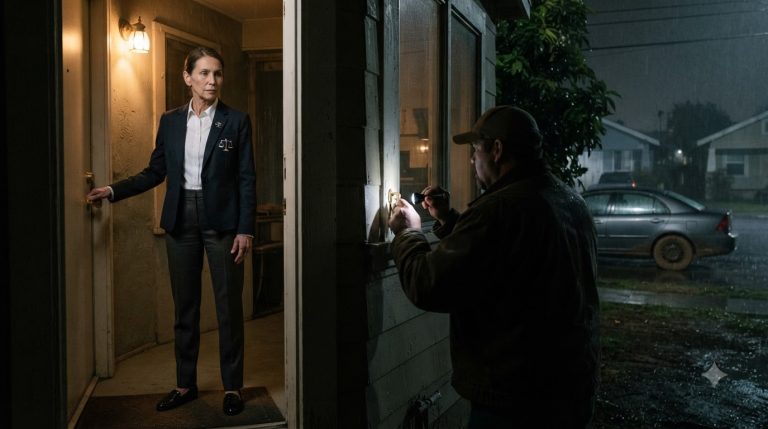
The Land He Left Behind: A Widow’s Cold Vindication Against Her Entitled Family
CHAPTER 1: SHADOWS ON THE GRAVEL
The gravel dust had barely settled behind Lucas’s sedan when the front porch light flickered and died.
I stood on the bottom step, the chill of the late Oregon November biting straight through my cardigan. Across the yard, the treeline pressed close, dark and thick with damp pine. Forty-one years on this land, and I’d never known the silence to feel quite so heavy.
I turned the brass key in the deadbolt—a habit I’d only picked up since Arthur passed eight months ago—and stepped into the mudroom. The air inside carried the faint, familiar scent of dried apples and cedar wood. I set my handbag on the butcher block table in the kitchen, my fingers brushing against the stiff paper of the envelope I’d hidden in the side pocket.
The woman in the diner hadn’t used my full name out of warmth. Her voice had been flat, clipped, the tone of a person delivering a subpoena. You will need this tonight.
I pulled the envelope out and laid it under the yellow glow of the stove lamp. It was unsealed, thin, and unmarked. Inside rested a heavy brass key, its head smoothed by decades of thumbs, its blade notched with three fresh file marks along the spine. Wrapped around the bow was a scrap of blue-lined paper.
11:32 p.m. Answer. Do not call back.
My throat went bone-dry. I picked up the key, rolling the cold metal across my knuckles to steady my hands. The kitchen clock clicked—a harsh, mechanical snap every sixty seconds.
8:47 p.m.
I didn’t turn on the living room lamps. I sat at the kitchen table with a mug of black tea I had no intention of drinking, watching the headlights of distant logging trucks sweep across the canopy of the north woods. Every creak of the floorboards felt amplified, like the house itself was holding its breath.
By 11:30, the house was entirely dark save for the stove light. The air smelled of cold copper and old pine. I laid my palm flat on the linoleum, feeling the tiny vibrations of the wind against the outer foundation.
11:31.
My phone vibrated on the formica table. No caller ID. No number. Just a blank screen pulsing against the dark.
I picked it up on the second ring, pressing the glass to my ear without speaking.
For three long seconds, there was only the low, static hum of a bad connection and the heavy rhythm of someone breathing into a receiver.
“Eleanor,” the voice whispered.
The mug in my hand tilted, hot tea spilling over my wrist, but I couldn’t feel the burn. My knees locked against the table leg. The voice was thin, rasped around the edges by an electronic filter, but the cadence was a rhythm I had lived with for over forty years.
“Arthur?” I breathed.
“Do not trust Lucas,” the filtered voice rasped, cutting through my words with brutal speed. “Do not trust Marissa. And whatever you do, stay away from the county sheriff’s office.”
“Who is this?” My voice shook, raw and thin in the empty kitchen. “Arthur died in the river. Who are you?”
“The land is why they’re coming,” the voice pressed, ignoring my plea. The line crackled violently, a burst of white noise tearing through the speaker. “The truth is buried under your feet, Eleanor. Look at the north slope before they—”
The line went dead.
I sat frozen, the dark phone held against my ear, listening to the hollow silence of my own house. Outside, high in the canopy of the fir trees, the wind began to howl.
CHAPTER 2: PAPERWORK AND PRESSURE
Lucas pulled his sedan right up to the porch steps, the engine idling with a wet, rattling knock that Arthur would have fixed three years ago.
He stepped out carrying two paper coffee cups, a tight, practiced smile stretched across his mouth. Marissa followed from the passenger side, her heels snapping against the damp wood of the porch like small pistol shots. She didn’t look at the trees or the sky. She looked at the peeling white paint on the doorframe.
“Morning, Mom,” Lucas said, reaching the screen door first. He didn’t wait for an invitation. He pushed past me into the kitchen, setting the cups down on the formica table right over the dark stain where my tea had spilled eight hours ago. “You look like you didn’t sleep a wink.”
“I slept enough,” I said, keeping my thumb tucked over the brass key in my pocket. “You didn’t call before driving out.”
“Since when do I need an appointment to see my own mother?” He turned, pulling out a chair with a sharp scrape. He looked at Arthur’s old cedar office door down the hall, his eyes lingering on the brass knob before flicking back to me. “We need to address the reality of this place, Mom. Marissa and I stayed up half the night going over the property tax assessments.”
Marissa didn’t sit. She stood near the sink, tapping her polished fingernails against a beige manila folder she’d brought under her arm.
“The numbers simply don’t add up, Eleanor,” Marissa said, her voice dropping into that smooth, rehearsed register she used when she was managing her salon staff. “The maintenance alone on forty acres of timberland is bleeding your savings dry. You’re dipping into capital just to pay the county road fees.”
“I know what my accounts look like, Marissa,” I said. “And I didn’t give you access to my statements.”
“Lucas is your next of kin,” she replied, not missing a beat. She slid the folder onto the table, flipping it open to reveal a single typed page topped with a legal header. “As your family, we have a moral obligation to intervene before grief completely ruins you. This is a voluntary guardianship agreement.”
I looked down at the document. The bold print at the top read PETITION FOR TEMPORARY CONSERVATORSHIP.
“Guardianship,” I repeated. The word tasted like lime dust. “You want me to sign away my signature on my own land.”
“It’s a safeguard, Mom,” Lucas insisted, leaning forward. His knuckles were white against his coffee cup, a nervous sweat gleaming on his upper lip despite the chill in the room. “If you suffer a fall out here, no one finds you for days. You’re seventy. It’s time to move into the town townhouse where people can keep an eye on you.”
“Farms are dangerous places for people living alone,” Marissa added softly, her eyes narrowing as she stepped closer to the table. “Accidents happen on old properties all the time, Eleanor. It would be an absolute tragedy if something happened out here before this was legally settled.”
The threat was buried under three layers of velvet, but it hit me with the force of a crowbar. I thought of the voice on the phone at 11:32 p.m.—the distorted rasp warning me that they wanted the land empty.
“Get out of my kitchen,” I said. I didn’t raise my voice. I kept it as flat and heavy as an iron skillet.
Lucas blinked, caught off guard. “Mom, don’t be unreasonable—”
“I said get out,” I walked to the back door and threw it wide open, letting the freezing mountain air flood the room. “Both of you. Right now.”
Marissa snapped the folder shut, her polite smile vanishing completely, replaced by a cold, sharp disgust. “We tried doing this the gentle way, Eleanor. But if you force our hand, we will file the petition with the county court by Friday without your consent.”
They walked out into the gray fog, Lucas glancing back just once—not with worry, but with the tight, calculating glare of a man who had already spent the money he hadn’t yet stolen.
CHAPTER 3: THE DESK IN THE CEDAR ROOM
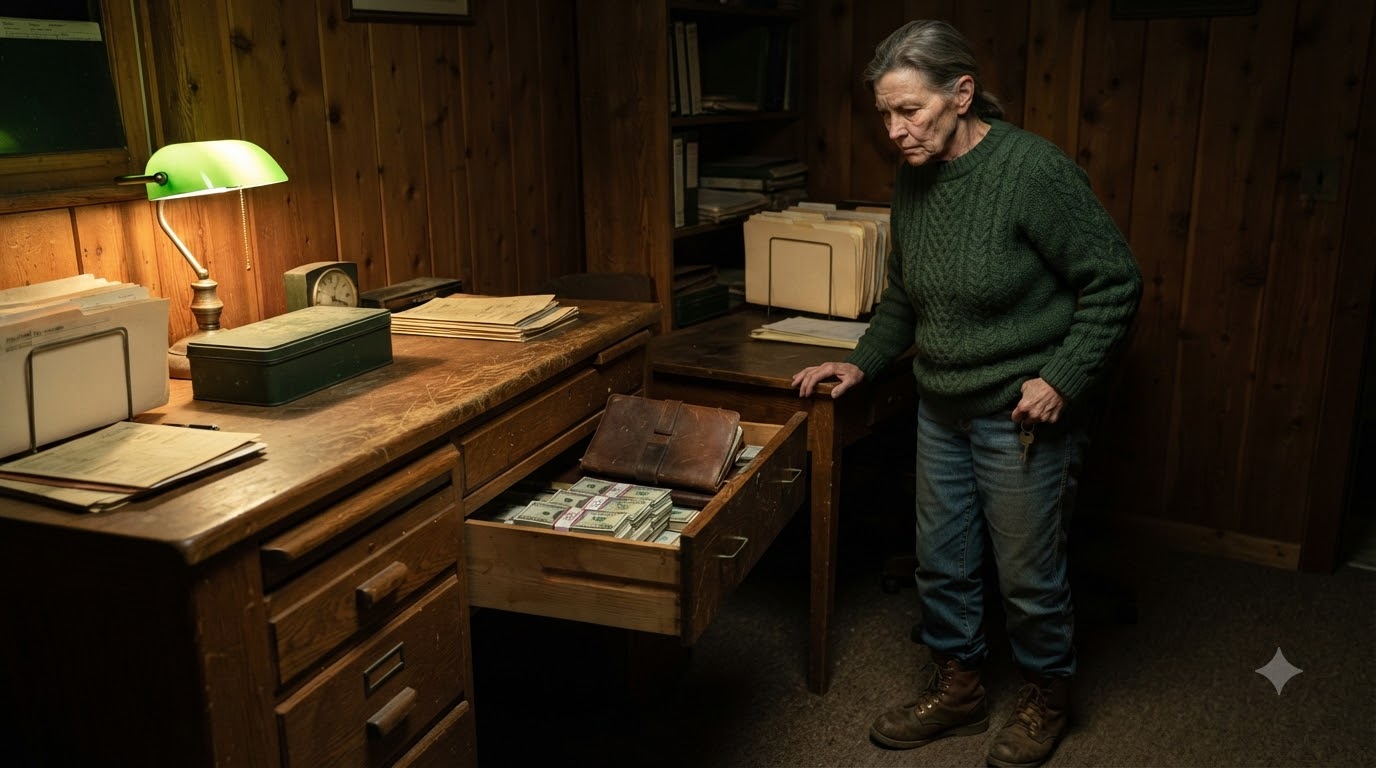
The key didn’t turn easily. The tumbler resisted, choked with years of dust, until I leaned my hip against the frame and forced the metal home with a dull, heavy click.
The bottom drawer slid forward on greased steel tracks.
Inside sat three thick, accordioned folders labeled with parcel tax receipts going back thirty years. I pulled the first two out, setting them on the blotter. Behind them, wedged flush against the rear panel, rested a flat tin box painted dark green.
I lifted the lid.
Stacks of hundred-dollar bills, bound in plain paper bands, filled the left compartment. My fingers hovered over the paper bands. Arthur hated cash. He’d spent forty years keeping every receipt, every tax voucher, every fence-line survey clipped and cataloged in triplicate. Yet here was forty thousand dollars in physical currency, pulled out in identical eight-thousand-dollar increments across the six months leading up to his death.
Layered beneath the cash sat a thin leather-bound journal. I flipped it open to the final entries.
The handwriting wasn’t Arthur’s usual tidy script. It was sharp, jagged, pressed so hard into the paper that the pen had nearly torn through.
Lucas bought the north pasture access code without my knowledge, the entry read, dated three weeks before the river accident. He thinks the old limestone drainage vault is unmonitored. He’s taking payments to route heavy transports through the rear gate at midnight. If I cut the lock, he’ll just break the chain. I have to let the paper trail build until the federal tax auditors take the jurisdiction out of local hands.
My breath hitched.
Arthur hadn’t been hiding a crime. He’d been building a cage.
He knew the local authorities were turned around—he knew every deputy in this county answered to the same local political interests Lucas was running with. So he’d systematically withdrawn his own funds, creating a deliberate financial paper trail to trigger an automatic federal forensic audit on the farm’s holdings the second he died.
A quiet sound rasped from the floorboards directly above my head—a slow, deliberate step in the upstairs hallway.
I froze, locking my elbows against the oak desk.
I hadn’t heard a car door. I hadn’t heard the screen latch click. But someone was standing in the dark right above Arthur’s office, waiting for me to move.
CHAPTER 4: MIDNIGHT AT THE FENCE LINE
The oak tread groaned under a heavy, deliberate boot—too heavy to be Lucas, too steady to be Marissa.
I didn’t wait for the figure to clear the bottom landing. I shoved the green tin inside my wool coat, grabbed Arthur’s brass key off the desk blotter, and slipped out through the side mudroom door before the latch upstairs could click open.
The night air hit my face like wet ice.
Flashlights cut through the fir trees near the front gate, two sharp beams slicing the drizzle into yellow ribbons. I stayed low along the cedar fence line, my rubber boots sinking three inches into the mud with every step. Behind me, the front door burst open against the house siding.
“Eleanor!”
It was Deputy Collins’s voice—booming, professional, carrying that rehearsed weight he used at city council meetings. “Mrs. Hayes, step out into the light. We have a welfare hold issued by the county court.”
“Mom, stop!” Lucas screamed from the porch. His voice cracked, high and desperate. “You don’t know what you’re holding! Just leave the box on the hood of the car!”
I didn’t answer. Calling for help from the county dispatcher was out—Collins was the county dispatcher’s boss tonight.
I reached the edge of the north slope, where the pasture dropped off into the old limestone drainage wash. My lungs burned, the weight of the tin box digging hard into my ribs as I slid down the muddy embankment. Roots snatched at my coat sleeves.
A spotlight mounted on Collins’s cruiser swept across the canopy overhead, illuminating the mossy mouth of the old culvert thirty feet below.
I dropped to my knees in the wet gravel, pulling Arthur’s notched brass key from my pocket. Embedded in the rock wall sat a heavy iron access door, rusted red around the hinges but fitted with a clean, stainless-steel padlock that Arthur had installed six months ago.
“She’s down by the wash!” Marissa’s voice echoed from the top of the ridge, sharp and triumphant. “Collins, cut her off at the gate!”
My hands trembled violently as I forced the key into the lock. The three file notches along the blade caught the interior pins with a sharp, mechanical snick. The padlock popped open in my palm.
Heavy boots crashed through the brush behind me, sliding down the gravel slope.
“Don’t turn that handle, Eleanor!” Collins called out, his flashlight beam catching my face, blinding me in the dark.
I dragged the iron door open, shoved the green tin box into the dry concrete recess inside, and slammed the latch home just as a hand grabbed my shoulder.
CHAPTER 5: THE TRAP AT THE KITCHEN TABLE
“Where’s the key?” Lucas panted, dropping to his knees in the wet silt, his fine wool trousers ruined with black grease. He reached frantically for the stainless steel padlock hanging from the iron latch. “Mom, open it! Give me the key!”
I stood up slowly, shoving Collins’s hand off my shoulder with a sharp, backward movement of my elbow. I didn’t reach for my pocket. I turned my back on the vault entirely and walked straight up the muddy incline toward the house.
“It’s already locked,” I called back over my shoulder, my voice carrying clear through the trees. “And the key isn’t in my coat.”
Lucas froze on the slope. Collins looked between Lucas and the steel door, his flashlight beam wavering in the rain.
“She’s bluffing,” Marissa shouted from the top of the embankment, her jacket collar pulled high against her chin. “Search her!”
“Touch me again, Deputy,” I said, stopping at the edge of the porch, “and you’ll be explaining to the state prosecutor why a county deputy was helping a private citizen break into a sealed federal tax audit vault at midnight.”
Silence fell across the yard, heavy and sudden, save for the steady drip of rain off the gutters. Collins lowered his hand slowly, his mouth setting into a hard, sour line.
“Inside,” I said, pushing open the kitchen door. “All three of you. Let’s finish this where Arthur left it.”
They followed me in, trailing mud across the clean linoleum. Lucas paced near the stove, his skin gray, a bead of cold sweat running down the side of his jaw. Marissa remained standing near the hall doorway, her chin tilted up in defiant fury, her purse clutched like a shield.
I pulled out Arthur’s old chair at the head of the formica table and sat down. From my cardigan pocket, I laid three items flat under the yellow stove light: Arthur’s leather journal, a certified copy of the federal audit notice mailed two days before his death, and the heavy brass key.
“You thought Arthur died because he was careless on the river road,” I said, looking straight at my son.
Lucas didn’t meet my eyes. He stared at the brass key. “He was interfering with business, Mom. He didn’t understand how the world works now—”
“He understood completely,” I interrupted, tapping my finger on the leather journal. “He knew you took sixty thousand dollars in unregistered transit fees through the north pasture. He didn’t call the county sheriff because he knew Collins was taking ten percent off the top.”
Collins shifted his weight near the refrigerator, his leather belt creaking in the small room, but he didn’t speak.
“So Arthur spent six months transferring his own money into that green tin down in the wash,” I continued, laying my palms flat on the table. “He made sure every single withdrawal triggered an automated red flag with the IRS criminal investigation division. The moment that vault was locked tonight, the digital log transmitted directly to the regional field office in Portland.”
Marissa’s face went entirely white. She took one sharp step toward the table, her fingernails digging into her leather bag. “You’re lying. You don’t have the technical ability to—”
The heavy crunch of multiple vehicle tires rolling onto the gravel driveway cut her off. Headlights flooded through the kitchen window, stark and blinding, throwing long shadows across the walls.
Lucas bolted for the back door, but the lock was already set.
CHAPTER 6: THE QUIET HARVEST
I caught Marissa’s wrist against the edge of the table before her fingers could clamp over Arthur’s journal.
She twisted hard, her face red, screaming that I was senile, that I was destroying Lucas’s future, that I had lured them out here under false pretenses to stage a family dispute.
“The federal auditors aren’t here for a family dispute, Marissa,” I said, holding her hand pinned until two plainclothes investigators stepped through the front doorway, badges unclipped and visible on their coats.
Lucas didn’t fight. When the lead agent asked him to step away from the deadbolt, he slid down the wall until he was sitting on the muddy floorboards, his face buried in his hands. Collins handed over his sidearm without a word, his mouth pressed into a tight, gray line as the second agent secured his wrists behind his back.
“Mrs. Hayes,” the lead agent said, stepping over to the table and reviewing the certified audit notices and Arthur’s leather journal. “We’ve had the drainage vault under remote monitoring since 9:00 p.m. Your husband’s documentation was thorough.”
“He was a thorough man,” I said.
The kitchen cleared out slowly. The heavy boots, the flashing emergency lights, the harsh shouting—all of it receded down the gravel driveway, leaving the house in a silence deeper than any I had known since Arthur passed.
The green tin remained on the table alongside the brass key with its three notched teeth.
Arthur hadn’t left me a fortune, nor had he left me a simple farm to tend. He had left me a boundary—forty acres of timberland held together by forty-one years of quiet work, completely free of debt, free of liens, and stripped clean of the rot that had tried to eat it from the inside.
I stood up, walked to the stove, and turned on the kettle.
Outside the window, the first pale blue light of dawn began to break through the pine canopy, casting long, clean shadows across the wet gravel. I picked up my mug, poured the boiling water over the tea leaves, and watched the steam rise into the cool morning air.
The house was cold, but the floor beneath my feet was entirely solid.