Destiny arrives in tactical black vehicles to reclaim the dignity of a warrior silenced by time
CHAPTER 1: THE BANKING OF THE EMBERS
The smell of wet iron and dying oak bark always settled into the low draws of the Pisgah forest by seven o’clock. At exactly 7:19 p.m., the wind shifted from the northeast, carrying the distinct, sharp hiss of cold mountain air hitting heated stone. Owen Matthews did not look up from his work. His palms, calloused from three seasons of clearing trail with his father’s old True Temper axe, slid down the smooth hickory handle as he knelt. With a flat piece of local slate, he systematically scraped the dry topsoil over the remaining red center of his campfire. One stroke. Two. The orange glare vanished beneath a blanket of gray dust. The forest became instantly, aggressively dark.
He did not use his flashlight. His father had drilled the rule into him until it was as natural as breathing: When the woods change, you change first. Make yourself a shadow before you try to see one.
Owen reached into his left pocket, his fingers brushing the cool, coarse knurling of his aluminum red-filter headlamp. He didn’t click it on. Instead, he slipped behind the massive, rotting trunk of a fallen hemlock that had been reclaiming the forest floor since the winter freezes of 2011. The bark was rough against his cheek, smelling of damp earth and slow decay. He waited.
Thirty seconds passed in absolute stillness. The only sound was the distant, metallic gurgle of Deep Creek half a mile down the ridge. Then came the crunch.
It was fifty yards out, moving along the unmaintained survey line where the limestone outcrops broke through the thin soil like old teeth. A man’s stride—heavy, uneven, carrying more than his own weight. The footsteps were accompanied by the erratic snapping of dry laurel branches, the kind of reckless movement that only happened when someone was blind to the terrain or running out of time.
Owen tilted his head, adjusting his perspective through a fork in the hemlock branches. His eyes, fully adapted to the deep October dusk, caught the shape exactly ninety seconds later.
The man was broad-shouldered but leaning forward, his center of gravity thrown off by the mass draped across both his forearms. He wore a dark, cheap canvas jacket that caught the faint moonlight like old sheet metal. Over his left shoulder hung a modern nylon backpack, its straps straining against the seams. But it was the bundle in his arms that made Owen’s chest tighten until his ribs ached against his scout shirt.
It was a child. A little girl, her head lulling backward against the man’s sternum like a broken branch. Even in the desaturated gray of the woods, the bright, pale purple of fleece pajamas stood out against the dark loam. One of her feet was bare, a tiny, pale shape reflecting the stars. The other was covered by a white sock, gray with mud around the toes.
The man stopped forty yards from Owen’s log. His breath came in ragged, metallic gasps that sounded like a crosscut saw hitting a knot. He shifted his grip, his large, rough hand tightening around the girl’s knee. When he turned his head to scan the dark treeline behind him, the faint light caught the hard, white ridge of his jawline. He was looking for followers.
“Almost there,” the man muttered into the silence. His voice was thin, reeking of old copper and old resentment. “One more mile.”
Owen didn’t breathe. He watched a single dry leaf detach from a black oak and slide down the man’s shoulder, sticking to the damp canvas of his coat. The man didn’t notice. He adjusted the girl’s weight with a short, brutal hitch of his elbows and pressed deeper into the unBlazed thicket toward the high ridge.
Owen reached down, his fingers locking onto the nylon strap of his own pack. The canvas was stiff with dried sweat and mountain rain. He didn’t think about the trailhead three miles behind him. He didn’t think about his father waiting at the ranger station. He only looked at the single white sock disappearing into the dark laurel.
CHAPTER 2: THE SOFT STEP
The white cotton knit of the girl’s remaining sock vanished into the tangled black mesh of the rhododendron canopy like grease dissolving in an iron skillet. Owen didn’t wait for the cold air to settle into the empty space the man left behind. His boots, stiffened by the red clay mud of the lower draws, swung over the rotting hemlock log with a small, flat scraping sound that was instantly buried by the rushing drone of Deep Creek. The weight of his pack—twelve pounds of structured canvas, aluminum water containers, and the small magnesium block in his pocket—hit his shoulder blades with a familiar, rhythmic dullness.
He took his first step where the ground was blackest. His father had shown him the technique on the high granite ridges above the Davidson River: you don’t drop your heel on the dry mast of the forest floor; you roll the outer edge of your sole through the damp moss, feeling for the hidden limestone fragments before you commit your weight. The earth here was choked with iron-heavy gravel that ground together under the slightest pressure, a gritty, metallic friction that would signal his position across forty yards of open timber if he miscalculated.
Upward, the slope rose at a thirty-degree angle, a wall of desaturated gray soil held together by the ancient, exposed root systems of stunted white oaks. The man was moving fast, driven by the frantic, ragged momentum of his own lungs, but the mass of the girl kept his stride short. Owen stayed precisely thirty yards behind him, matching the uneven hitch of the man’s gait. When the man’s canvas coat brushed the dry, papery leaves of a low-hanging beech branch, Owen would pause, his body leaning into the shadow of the nearest trunk, his breath held behind his teeth until the vibration died out.
The red filter headlamp remained cold against his chest, its elastic strap cutting a thin line into the skin of his forehead. He kept his eyes fixed on the low-tier branches where the man passed. The forest was unBlazed here; there were no neat yellow paint rectangles or aluminum markers pinned to the bark to indicate a maintained trail. This was old timber company land, abandoned after the selective cuts of the late seventies, leaving behind a maze of choked logging skids that had long since filled with briars and the rusted, collapsing remains of wire cable loops buried in the dirt.
A sudden, sharp metallic ping echoed from the ridge line above. It was a clean, high-frequency strike—iron hitting flint.
The man had stumbled. Owen dropped instantly into a low crouch, his right hand extending automatically to steady himself against a limestone outcrop. The rock was cold, its surface pitted and rough like old slag from a furnace. Thirty yards ahead, the man let out a thick, wet curse that hung in the freezing air. The pale purple fleece of the girl’s pajamas shifted violently as the man rolled his weight back onto his left hip, his boot kicking a loose fragment of ironstone down the incline.
The stone rattled down the draw, striking a dead laurel root three feet from Owen’s left hand. The sound was flat, deadened by the thick mud, but the silence that followed it was absolute.
Owen stayed motionless, his spine curved to mimic the sweep of the hemlock roots behind him. Through the dark branches, he could see the silhouette of the man’s head turning slowly from left to right, his jaw thrust forward as he listened to the dark. The man didn’t move for sixty seconds. In the deep woods, sixty seconds was long enough for the cold to seep through the thin denim of Owen’s scout trousers, long enough for the salt sweat on his collar to turn to an icy film against his neck.
Then came the scrape of a match.
It wasn’t a modern survival match; it was the cheap, sulfur-heavy strike of a paper book match. A brief, greasy yellow flare illuminated the man’s face—the deep, vertical lines running from his nostrils to the corners of his thin mouth, the oily sheen of his forehead, and the flat, pale skin of the child’s cheek resting against his collarbone. He wasn’t checking on the girl. He was looking at a crumpled piece of paper held against his thumb, his eyes tracking a rough line before the flame scorched his fingers and went out with a tiny, wet hiss.
“Still there,” the man muttered, his boots grinding into the gravel as he turned back toward the northeast. “Just above the gap.”
Owen waited until the heavy, irregular rhythm of the canvas coat against the briars resumed before he straightened his knees. His joints made a slight, dry click that felt dangerously loud in his own ears, but the man was already moving into the rougher limestone shelf where the grade leveled out into a high basin.
The tracking became harder here. The soil gave way to sheets of cold, gray stone covered in a thin skin of dry lichen that crumbled like iron filings under pressure. There were no clear footprints to follow, no broken branches in the dense rhododendron thickets that grew out of the rock fissures. But the man left a different kind of trail—the smell of cheap kerosene and the dark, wet smears where his greasy canvas jacket rubbed against the white bark of the yellow birches.
Owen tracked the smears. He moved with a systematic, calculated patience, his mind operating in ninety-second increments. Every time his boots found a solid, moss-covered pocket of dirt, he would look down, verify the absolute edge of the next three steps, and then raise his eyes to lock onto the purple shape ahead. The distance between them didn’t change, but the air did. It was growing thinner, sharper, smelling less of decaying vegetation and more of the old, dry dust that accumulated in places where the sun never cleared the mountain walls.
By 7:45 p.m., the grade ended in a narrow, level shelf that smelled heavily of wet iron and charcoal. The man stopped again, the dark nylon backpack slipping from his shoulder to hit the stone floor with a dull, heavy thud. Owen slid behind the gray trunk of a lightning-killed chestnut tree, his fingers tracing the deep, spiraled ridges of the dead wood as he watched the man reach down to handle a rusted iron latch.
The Earned Rule: Every yard of progress through the Pisgah draws requires a physical calculation of weight, friction, and wind direction. The forest does not offer free passage; any movement made without testing the soil underfoot results in an immediate acoustic penalty that can expose a trailing position across open timber.
CHAPTER 3: THE ROTTEN SILLS
The heavy, dry iron rattle of the latch sliding through its corroded housing sent a vibration straight through the limestone shelf, hummed along the ground, and rattled the brass buckle of Owen’s scout belt. He remained frozen behind the dead chestnut tree, his boots locked into the dry lichen, his palms absorbing the cold, flaking dust of the trunk. Forty feet ahead, the door of the structure ground open against a warped oak sill, producing a high-pitched, structural groan that cut through the constant drone of the water below.
The man reached down, his fingers hooked into the grime-stiffened webbing of the backpack straps, and dragged the nylon container across the threshold. The bottom of the bag scraped over the rough grit of the entry with a harsh, scratching sound. He didn’t lift the child. He bundled her across his forearms again with an awkward, heavy shift of his hips, his shoulder checking the unpainted wooden door frame as he slid into the black interior.
Owen didn’t run. He took three silent, calculated steps forward, his soles rolling through the iron-rich soil at the margin of the clearing, keeping his profile aligned with the thickest clusters of the rhododendron perimeter. The air here was heavy with the greasy scent of kerosene and old dampness, a pocket of trapped air that hadn’t cleared out since the previous winter. He stopped sixty feet from the front wall, his knees sinking into the soft, unmapped floor of the draw, his eyes assessing the geometry of the building.
The cabin was a simple square, twelve by twelve, constructed from rough-sawn pine timbers that had turned the color of wet slag under decades of mountain rain. The roof was sheet iron, corrugated and heavily pitted with bright orange pockets of active rust that flaked off in small scales along the eaves. On the southeast corner, the ground fell away slightly into a dry erosion ditch, leaving a gap between the lowest timber sill and the foundation rocks.
The door hung crookedly on its hinges inside, leaving a three-inch vertical slot of black space even when pulled shut. A low, amber glow flickered against the unglazed window frame a moment later. A match strike, then the slow, smoky climb of a kerosene wick inside a glass chimney. The light didn’t reach the clearing; it stayed confined within the small space, casting the jagged shadow of the man’s shoulders across the gapped boards of the western wall.
Owen dropped onto his stomach. The ground was freezing, the grit of the red clay embedding into the coarse weave of his uniform sleeves. He didn’t use his red headlamp. He crawled through the fringe of the laurel thicket, his hands moving systematically to test for dry twigs before he shifted his weight. His target was the southeast corner where the foundation wood had rotted clear of the limestone footing.
When his fingers reached the base of the structure, they hit something hard and flat that didn’t belong to the natural geology of the mountain.
It was a piece of square-cut slate, eight inches wide, wedged tightly into the rotted cavity under the corner timber. The surface was dry, but the edges were clean, free of the green lichen that covered the rest of the rock base. Someone had handled it recently. Owen extended his fingers into the narrow gap above the slate, his knuckles scraping against the fibrous, crumbly texture of the rotted pine sill. The wood was damp, smelling of wood-boring beetles and stagnant moisture.
He pulled back his hand. A single white thread was caught in the splintered grain of the lower board. It was a loop of heavy, synthetic cord, distinct from the natural cotton fibers of his own gear or the girl’s clothing. It was clean, untarnished by the mold that choked the under-floor space.
Inside the cabin, the man’s voice broke the silence, muffled by the thickness of the timbers but carrying a sharp, rhythmic edge.
“Stay down,” the man said. The sound was flat, stripped of the ragged breath from the climb. “Don’t touch the knots. If you move your hands, the cord bites. I didn’t spend three weeks tracking your daddy’s routes just to have you slip out before the wire clears.”
A low, stifled whimper followed, a small, wet sound that was cut short by the scrape of a wooden chair leg over the floorboards. The vibration traveled down the vertical corner post, through the rotted sill, and straight into Owen’s forearms. The man was moving a heavy object into the center of the room, directly above the central joists.
Owen shifted his hips, clearing his pack from his shoulder blades as he slid his torso into the eighteen-inch crawlspace beneath the floor. The darkness under the cabin was absolute, smelling of dry soil, dry rot, and old mouse nests. The space was tight; his scout uniform shirt dragged against the raw underside of the oak flooring planks, the rough-cut joists passing inches from his spine.
He moved on his belly, his elbows drawing his weight forward across the cold dust. Through the inch-wide gaps between the floorboards above him, the amber light of the lantern cast long, thin bars across his face. He could see the bottom of the wooden chair legs—old pine, painted a peeling green, one leg shorter than the others and shimmed with a folded piece of thick cardboard.
Above his head, the man’s shadow moved across the planks, blocking out the bars of light one by one as he paced from the door to the unglazed window. Each step caused the old floorboards to flex, the rusty nails creaking within their holes with a small, dry screech. Owen held his position between two floor joists, his fingers locking into the cold dirt as he looked through the widest gap.
Two small, bare feet dangled six inches above his eyes. The white sock on the left foot was gone now, dropped somewhere along the limestone shelf, leaving the pale skin exposed to the drafts rising through the floorboards. The skin was covered in a network of fine, gray mud lines, the toes curling inward against the cold. Around the ankles, a length of yellow polypropylene rope was wrapped three times, its rough, braided fibers biting into the flesh until the skin turned a dark, bloodless white.
Owen reached up slowly, his fingers stopped an inch short of the wood. The man’s heavy boots ground into the floor two feet away, the leather creaking as he knelt to check the low knots.
The Sovereign Protector Rule: In the deep draws of the mountain, survival is not a function of speed; it is an accounting of material constraints. A twelve-year-old body cannot alter the physical presence of an adult threat, but it can occupy the silent spaces beneath the structure, mapping the seams where the old construction fails.
CHAPTER 4: THE INCHWIDE GAP
The compressed dry earth beneath the cabin floorboards didn’t yield an inch as David’s boots shifted again, the heavy rubber treads grinding a stray piece of limestone gravel directly above Owen’s right ear. A small cascade of gray grit fell through the gap, hitting the collar of Owen’s khaki uniform shirt with a faint, papery rustle. Owen flattened his cheek into the dirt, freezing his chest mid-breath. His fingers remained perfectly static, suspended an inch below the unpainted oak planking where the dark line of the yellow polypropylene rope bulged downward through the seam.
Above, the creak of the floorboards slowly drifted toward the western corner of the room. The rhythmic clank of a metal kerosene can being set against a zinc sheet echoed down into the crawlspace, followed by the dry friction of an iron hinge swinging back. David was sorting through his gear.
Owen waited for the pacing to reach the furthest corner before he allowed his lungs to expand. The air down here was thick with fifty years of trapped mountain soot and the sharp, alkaline smell of dry-rotted sills. He tilted his head slightly, aligning his right eye with the widest gap between the central joists. The bars of amber lantern light split his vision into precise, narrow increments. Through them, he tracked the small, purple-clad legs dangling from the green chair.
The girl’s toes were blue-veined and twitching against the steady draft rising from the dirt floor. The rough fibers of the rope had already raised dark red wheals around her small ankles, the skin tight and shiny from the constriction.
Owen shifted his weight with absolute micro-precision, sliding his left elbow three inches forward through the fine dust until his fingers could clear the edge of the joist. He reached up, his fingertips touching the rough, cold underside of the floorboard plank, then sliding into the gap. He brushed the skin of her bare heel first—it felt like wet river stone in December.
A sharp, vertical intake of air came from the room above as the girl felt the contact. Her feet jerked backward an inch, the green chair legs groaning against the cardboard shim.
“Don’t make a sound,” Owen whispered. The words were nothing more than a tiny compression of air behind his teeth, pushed through the one-inch slit. “Down here. Don’t look down.”
The legs went entirely rigid. The bare toes curled tight into the dust falling through the seam. Owen stretched his hand further through the gap, his knuckles scraping the jagged iron edge of an ancient square-cut nail that stuck out from the joist. His fingers found the coarse, stiff knot of the cloth gag tied behind her neck. The fabric was saturated with sweat and mountain moisture, the cotton fibers swollen and locked into a tight square knot.
He worked his thumb into the first loop, his fingernails digging into the rough weave. The friction of the cloth against his skin felt loud, a scraping hiss that seemed to synchronize with David’s heavy boots moving across the cabin floor forty square feet away.
“My name is Owen,” he breathed, his fingers working the knot loose millimeter by millimeter. “I’m twelve. I’m a boy scout. I followed you from the lower clearing. I know your name is Lily.”
The knot gave way with a silent, sliding release. Owen pulled the heavy wet strip of cloth downward through the floorboard gap, draping it over his own shoulder. Above him, a small, ragged gasp came from the chair. Lily turned her head slightly, her small chin tilting down toward the floorboards, though the narrowness of the seams kept her from seeing anything but the dark shadow of Owen’s eye.
“Uncle David,” her voice was an unstable, dry rattle, no louder than the wind passing through the corrugated iron roof. “He… he said my dad won’t pay. He said he’s going to bury me near the creek.”
“Your dad is searching,” Owen whispered, his fingers moving to the rope wrapped around her ankles. The yellow polypropylene was stiff, slick with mineral oil, and knotted with a tight, double-hand cinch. His fingers weren’t strong enough to break the binding without an iron tool. He stopped pulling, his palm resting against the cold skin of her left foot to stop the shivering. “My father is a ranger. He knows every draw from here to the Parkway. I’m leaving trail markers every fifty yards. Stacking rocks. Breaking laurel. They’ll follow the blazes straight to the sills.”
“It’s so cold,” she muttered. A single hot drop of moisture fell through the gap, striking Owen’s thumb. “The water’s dripping from the roof onto my neck.”
Owen reached into his side pocket with his left hand, his fingers bypassing the red headlamp and locating the smooth, heavy plastic cylinder of his aluminum water filter pump. He unhitched the primary intake tube—four feet of clear silicone hose—and carefully pushed the brass nozzle up through the floorboard seam.
“Drink,” he whispered. “Slowly. It’s fresh from the draw.”
The clear tube kinked slightly against the edge of the wood, but Owen held the line steady until he heard the small, rhythmic swallowing sounds from above. He counted the drops of water that spilled onto his face—three, four—each one carrying the metallic taste of the copper filter screen. When the swallowing stopped, he pulled the tube back down, archiving it into his pack by feel alone.
“I have to put the cloth back,” Owen said, his hand rising with the damp cotton strip. His fingers were shaking now, the deep, internal chill of the crawlspace settling into his wrist joints. “If he sees the knot altered, he’ll pack you out deeper into the wilderness where the blazes don’t reach. Can you hold out?”
The small bare feet didn’t move. The toes flattened against the old pine plank. “Yes,” she whispered. “He’s coming back from the door.”
Owen slid the cloth up through the gap, his fingers working blindly behind her neck to loop the cotton into a standard, loose slipknot that looked identical to the original cinch from above. He had just tucked the stray thread into the knot when the floorboards directly over his face sagged three inches under a sudden, massive weight. David had returned to the center of the room, his heavy canvas coat smelling of stale grease and burnt matches as he stood over the chair.
The Sovereign Protector Rule: A promise made across an iron-rimmed barrier is not maintained by emotional statements; it is preserved through the cold, real-time maintenance of the decoy appearance. The line between detection and survival is exactly one inch of gapped pine.
CHAPTER 5: THE WHITE COLUMN
The pressure on the old tongue-and-groove flooring shifted toward the eastern timber post as David grunted, lifting a heavy iron bar that clanked sharply against the rusty tin stove shield. Owen kept his stomach pressed flat into the soot-choked earth, waiting for the floor joists to stop flexing. Millimeter by millimeter, he slid backward toward the rotted corner sill. His fingers crawled through the loose, gray dirt like spiders, testing the cold edges of the foundation rocks before shifting his hips. The synthetic slipknot he had just verified on Lily’s gag was hidden behind the green chair legs above; it would hold up to a casual visual check, but the real-time window for building a secondary rescue baseline was shrinking.
He squeezed his shoulders through the eighteen-inch crawlspace opening, his uniform shirt catching a sharp zinc splinter from the lower siding before his boots cleared the exterior timber. The cold outside hit him with a physical slap. The temperature had plunged past the low forties, and the wind coming off the high ridge carried the wet, iron-heavy scent of a low-pressure front locking down over the Pisgah draws.
A heavy, soaking mist was already thickening through the branches of the pitch pines, turning the loose red clay around the cabin foundation into a slick, cold paste. It was a dynamic shift—the kind of sudden weather variance that could smother a low smoke fire or erase physical footprints within forty minutes.
Owen did not drop into a run. He stayed inside the shadow of the rhododendron fringe, his compass locked against his palm as he navigated the sixty-degree slope heading toward the high eastern ridge line. His breath came in shallow, controlled spurts that he buried behind his hand whenever the wind dropped. The grade was slick with gray lichen and wet slate fragments that sheared off under his soles with a glassy, scratching hiss. Every step had to be paid for with a conscious counter-balance of his pack weight; a single uncontrolled slide down the shale draws would split the silence and bring David to the door with his folding blade unclasped.
He reached the crest of the ridge exactly twenty-two minutes later. The summit was a narrow spine of exposed granite, pitted by ancient lightning strikes and covered in a thin, rusted carpet of dry pine needles. The wind here was relentless, screaming through the stunted oak branches with a metallic drone. From this height, the mountain dropped away into five hundred thousand acres of desaturated, gray timber, the valleys already filling with pools of cold white fog.
Owen dropped his pack against a sheltered rock face. His hands were stiffening from the raw moisture, the joints turning a dark, bloodless white that made handling the small tools difficult. He reached into the side pocket, his fingertips finding the smooth, scratched magnesium block.
He didn’t look for dry tinder; the approaching rain had already turned the surface mast into a wet sponge. He targeted the interior heart of a fallen white pine knot—wood saturated with volatile resin that resisted the dampness. Using the square back of his utility knife blade, he began shaving the gray metal block, his strokes slow and calculated. The small, silvery flakes fell into a compact mound onto a flat, dry piece of shale he had anchored between his knees.
The wind tried to catch the shavings, but Owen used his orange rain jacket as a physical shield, his torso curved over the stone ledger like an iron hoop.
When the pile was the size of a nickel, he turned the block over to the flint stripping. He struck the iron rod once. A jagged blue spark hissed through the gray mist, illuminating the wet bark of the laurels for a fraction of a second, but the cold metal didn’t take. He adjusted the angle of his knife, his jaw locking until his teeth ground together against the chill. He struck it a second time, harder, drawing the steel down the flint with a harsh, scraping screech.
The spark caught the magnesium with an intense, blinding white glare that smelled of burnt iron and chemistry. The resin-rich pine shavings bubbled, turned black, and then threw up a sharp, hot yellow flame that licked against the wet green pine boughs Owen had systematically piled over the stone base.
He didn’t let the fire climb into a clear blaze; that would reveal his precise position to David down in the draw. Instead, he reached into the damp loam, pulling up handfuls of wet moss and decayed white oak leaves, packing them directly over the hot center of the flame. The fire gasped, choked under the weight of the moisture, and then began to vent.
A dense, greasy column of bright white smoke erupted through the green boughs, rising straight up into the mountain wind like a white iron pillar. The column was thick, smelling of green sap and damp earth, a stark, unnatural geometry cutting through the horizontal layers of the grey fog. It rose three hundred feet before the high-altitude wind sheared the top into a long white banner pointing directly toward the highway eight miles north.
Owen stood at the absolute edge of the granite spine, his orange rain jacket flared open between his hands to act as a manual shutter, cutting the column into rhythmic, irregular segments that no forestry worker could mistake for a casual campfire. He stayed on the ridge line for twenty minutes as the first cold drops of the heavy rain began to pit the stone around his boots, his arms aching from the weight of the fabric, his eyes locked on the gray northern horizon where the search grids were supposedly turning.
The Sovereign Protector Rule: A signal fire in the deep draws is not an emotional appeal for rescue; it is a physical calculation of volume and contrast against a deteriorating environment. When the rain closes the visibility window, the thickness of the column must compensate for the loss of light.
CHAPTER 6: THE SYSTEMATIC BLAZES
The cold water coming off the high granite spine didn’t just drip; it ran in small, gritty channels down the orange nylon of Owen’s rain jacket, collecting along the stiff hem before dropping into the wet rust of his pack buckles. He took his arms down from where he had held the fabric flared as a shutter. The white column of smoke was already established, a dense, greasy cord anchored into the heart of the resin knot, slicing through the freezing mist with mechanical precision. He didn’t look back to see if the canopy had swallowed the signal. He reached down, his numbed fingers tracing the rough weave of his pack straps, and hoisted the twelve-pound canvas load back onto his shoulders.
The descent was a matter of testing the friction coefficients of wet slate. Owen moved down the narrow northern draw, away from the ridge crest and back toward the level basin where the old timber cabin lay hidden. The rain was changing the texture of the soil, softening the red clay into a slippery paste that stripped his boots of their purchase. To maintain a constant velocity without creating a sliding gravel tail, he kept his center of gravity low, his knees bent at a forty-five-degree angle, his right hand using the rough, flaking bark of the stunted mountain oaks as an anchor.
Exactly one hundred yards from his observation post, he stopped. The air here was sheltered from the ridge wind, smelling of damp moss and old rot. He unclasped the small folding knife from his belt pocket. The steel was cold, the blade catching a faint, grey reflection from the low sky.
He reached out to a young yellow birch tree growing along the obsolete survey line. With three measured, vertical strokes, he stripped a four-inch section of the papery white bark, exposing the dark, wet orange layer of the inner wood beneath. The cut was clean, pointing directly northeast toward the clearing. He didn’t leave the debris at the base; he took the loose curls of birch bark and stuffed them into his pocket, ensuring the ground remained clear of obvious signs for anyone tracking from the cabin.
Fifty yards further down the draw, where the timber thickened into an old-growth stand of hemlock, the stone floor broke into a series of jagged limestone ledges. Owen knelt in the mud, his uniform trousers instantly soaking through to the knee. He selected three flat fragments of ironstone from the stream bed—each the size of his palm, heavy and encrusted with dark rust scales.
He stacked them methodically on top of a moss-covered boulder. One base stone. A middle spacer. The top stone was long and narrow, its sharp, broken point oriented precisely toward the rotten sills of the cabin. He pressed the top piece down until the grit between the stones ground together and locked. It was a structural compass, built from the very debris David had kicked aside during his climb.
As he reached for his pack to stand, his fingers brushed against something half-buried in the wet oak mast near the baseline of the marker.
It wasn’t a stone. It was a strip of blue plastic tape, two inches wide, wrapped around the trunk of a low laurel root. The plastic was brittle, its surface covered in a film of gray slime from years of exposure, but the edge had been sliced recently with a sharp blade. Owen cleared the leaves away with his boot sole. Beneath the mast lay a small, zinc-plated ground stake, the kind used by utility companies or land surveyors to map corporate boundaries before a selective timber clearance.
He didn’t touch the metal. He leaned closer, his eye three inches from the stake. Stamped into the cold zinc were the letters W-I-S-Inc. followed by a string of faded serial numbers. The iron around the letters had rusted into a dark brown ring, but the cut where the spade had driven the stake into the soil was fresh, the red clay still clingy and unwashed by the morning rain.
David hadn’t just chanced upon this unmapped valley. He had followed an old industrial grid, using the corporate remnants of a long-dead logging operation to mask his trajectory.
Owen memorized the alignment of the stake against his compass face, then stood up, his joints popping with a dry, mechanical click. He didn’t waste time tracing the line further; the primary layout required twenty more blazes before the rain completely saturated the undergrowth. He moved forward, his knife blade leaving a silent trail of broken laurel stems—each branch snapped at eye level, the clean white pith of the wood exposed and pointing like a continuous index finger toward the basin.
The work was transactional, calculated by the square yard. He did not let his mind drift to the child under the floorboards or his father’s search party three miles south. He focused entirely on the resistance of the wood against his blade, the texture of the stone blazes, and the diminishing daylight. Every marker was an asset added to the balance sheet of the rescue, an physical thread tying the forgotten cabin back to the organized world.
By the time he reached the final rhododendron thicket sixty feet from the cabin’s western wall, the rain had turned into a steady, freezing drone that rattled against his orange hood like birdshot. He dropped into his belly crawl, his elbows checking the mud for loose sticks as he worked his way back to his primary observation post behind the fallen hemlock. Through the gapped frame of the cabin window, the amber lamp still flickered, casting a low, greasy light over the rusted tin stove shield. David was still inside, the heavy scrape of his boots against the pine flooring indicating he was pacing the same six-foot track, oblivious to the white column still venting into the sky above the ridge.
The Sovereign Protector Rule: An extraction path is not constructed by hope; it is engineered through the continuous replication of physical indicators across an unmapped terrain. If the search teams intersect even one broken branch or stacked stone, the geometry of the entire valley resolves itself.
CHAPTER 7: THE BLUE TINT
The rhythmic, freezing slap of the rain against the orange nylon of Owen’s hood didn’t mask the sudden stillness that dropped over the cabin draw at 6:30 p.m. Inside the window frame, the amber glow of the kerosene lantern flickered once, then dimmed as the wick was turned down to a minimal, smoky stub. The door ground open against its warped oak sill with a flat, structural shriek that was instantly chopped short by the drone of the storm. David walked out onto the crooked step, an empty plastic water jug swinging from his left hand, his face masked by the deep shadow of his canvas collar. He didn’t look toward the hemlock log; his chin was tucked against the freezing downpour as he turned his boots toward the eastern creek draw.
Owen waited until the wet crunch of David’s soles had faded completely into the noise of the rushing water two hundred yards away. Thirty minutes. His father’s tracking manuals listed thirty minutes as the baseline for a perimeter water run in a steep draw.
Owen rose from the clay loam, his joints locking with a cold, hollow ache that spread straight up his forearms. He didn’t drop his pack. He unzipped the primary compartment by feel, his numbed thumbs bypassing the metal match case to track the heavy wool lining of his standard-issue scout fleece jacket. He pulled the garment out—it was dry, thick, smelling of cedar shavings and laundry soap from his mother’s bin.
He slid under the rotted corner timber of the southeast sill, his shoulders dragging through the cold paste of the erosion ditch. The darkness of the crawlspace hit him like a physical vault, the air choking with old soot and the bitter smell of damp spiders. He scrambled on his belly, his elbows working the dry dust into a cloud that stuck to the salt sweat on his neck.
Through the inch-wide gaps between the joists, the light was nothing more than a thin gray thread. He reached the central posts where the green chair legs cut down through the bars of grey light.
“Lily,” he breathed, his teeth chattering against the wood. “It’s Owen. I’m coming through the sill.”
The legs of the chair didn’t rattle. A weak, scraping gasp came from the boards above. Owen reached his hand through the seam, his fingers sliding over the side of her bare ankle. The skin was no longer cold like river stone; it was stiff, non-yielding, and felt like dried tallow. The small toes were motionless, locked into a blue-tinted curve that didn’t flex even when his thumb pressed into the heel. Stage-one hypothermia. The wilderness first aid manuals had a red line under the systemic warning: When the chattering stops and the skin turns blue, the cellular core is shutting down.
Owen didn’t ask her for permission. He moved toward the rotted seam at the base of the eastern wall where three pine floorboards had pulled clear of the rim joist due to old foundation settling. He hooked his fingers under the loose edge of the planking, his muscles straining until the ancient iron nails gave way with a wet, wooden groan that stayed trapped beneath the structure. He squeezed his head and shoulders up through the eighteen-inch opening, entering the interior of the cabin room for the first time.
The air inside smelled heavily of burnt sulfur, cheap lard, and the greasy canvas of David’s pack. Lily sat in the center of the floor, bound to the green chair with five distinct loops of yellow polypropylene cord that ran from her upper chest down to the rungs. Her face was gray, her lips split and covered in a thin, pale crust where the salt from her tears had dried against the gag cloth. Her eyes were half-closed, the pupils slow and glassy as they tracked Owen’s muddy orange silhouette.
He reached behind her neck, his fingers slick with freezing rain as he unfastened the synthetic slipknot. He pulled the wet cotton gag down around her throat.
“Don’t try to speak,” Owen muttered. His own voice sounded thick, stripped of its resonance by the drafts rising through the floor. “Keep your breath inside your chest.”
He took his dry fleece jacket and draped it completely over her shoulders. Because her arms were pinned tight against the wooden backrest by the yellow cord, he couldn’t slide her limbs into the sleeves; instead, he tucked the heavy wool fabric under her chin and around her flanks, creating a complete manual envelope that sealed her core away from the rain dripping through the holes in the sheet-iron roof.
He reached into his side pocket and pulled out his last granola bar—the wrapper was crinkled and stained with red clay grit—along with a two-inch strip of dried beef jerky from his survival kit. He didn’t give her the food to hold. He broke the oats into small, thumb-sized fragments, pushing them past her blue lips one by one.
“Chew it,” he said, his hand resting against her jawline to manual-start the movement. “The body needs the fuel to make heat. Wiggle your fingers inside the wool. Do it now.”
Lily’s jaw moved twice, a dry, mechanical grinding that sounded like gravel shifting in a stream bed. A small line of dark saliva trickled from the corner of her mouth, but she swallowed, her eyes opening another fraction as the sugar hit her tongue. “The paper,” she whispered, her voice a flat, non-vibrating thread. “In his coat… before he left. He was talking to the phone. He said the numbers match the old policy from the house. He said thirty-five years means nothing if the liquidation clears.”
Owen froze, his thumb still holding the last piece of jerky. Liquidation. The word didn’t belong to a family grievance or a bitter brother’s ransom demand. It was a legal term, the kind his father used when timber companies dissolved their assets along the county borders.
A heavy splash of muddy water hit the crooked exterior step outside the front wall.
David was back from the draw, five minutes early. The plastic water jug clanked against the external log face as he cleared the threshold.
Owen didn’t try to squeeze back through the floorboards; the time-distance calculation was zero. He dropped flat onto the oak planks, sliding his lower torso and legs through the eighteen-inch rotted gap at the wall seam, leaving only his head and shoulders hidden behind the heavy canvas drape of David’s spare pack which hung from a nail on the lower studding. He reached up, his fingers catching the edge of the loose floorboard, and pulled the wood down over his spine just as the iron latch on the main door ground open.
The Sovereign Protector Rule: When the active threat re-enters the structural frame, the agent must separate his physical existence into distinct sectors. One half belongs to the freezing mud beneath the joists; the other half remains inside the room, maintaining the illusion of an empty perimeter.
CHAPTER 8: THE SIGHTING HOLE
The wet, flat crunch of David’s rubber boots on the pine threshold vibrated directly through the gapped board resting over Owen’s lower ribs. Owen held his torso rigid, his face turned sideways into the cold clay dust of the rim sill. Above him, David dropped the sloshing plastic water jug onto the zinc stove plate with a heavy, hollow thud. The smell of cold grease and rain-soaked canvas billowed downward through the seam, masking the faint, earthy scent of the wood-boring beetles in the joists.
“Still shivering,” David muttered. His voice was rough, a grating string of syllables that vibrated the green chair legs three feet away. “The blanket’s in the truck by the gap. It doesn’t change the execution window anyway. Sixty-seven hours is sixty-seven hours.”
The scrape of a canvas zipper followed, harsh and rhythmic. Above the floorboards, David was shifting through the primary compartment of his heavy pack. Owen remained perfectly static, his right arm extended under the rotting rim timber, his fingers resting on a piece of thick, folded paper that had been stuffed between the log foundation and the lower oak plate. It wasn’t natural debris; the texture was smooth, heavy-gauge bond paper that hadn’t yet absorbed the greasy dampness of the room.
Millimeter by millimeter, while David’s heavy boots moved back toward the unglazed window to check the dark perimeter, Owen drew the paper down into the crawlspace.
The gray light filtering through the exterior erosion ditch was just sharp enough to pick out the typed characters along the top margin. It was an insurance certificate from a commercial carrier out of Charlotte, dated three weeks prior. The name in the primary beneficiary slot wasn’t Jake Walsh; it was David M. Walsh. The insured party was listed as Lily Walsh, Minor. The face value of the policy was typed in clean, unsmudged ink: $250,000.
Owen’s thumb pressed into the cold, crisp bond paper. This was the decoy secret Lily had hinted at through the floorboards—the financial liquidation infrastructure. The kidnapping wasn’t an erratic act of sibling retribution; it was a deliberate corporate transaction designed to clear a quarter-million dollars under the cover of a familial blood feud.
Inside the room, David struck another paper match, the smell of sulfur drifting down through the floorboards. “He won’t pay the ransom,” David said into the empty space, his voice dropping into a rhythmic, cold cadence. “He thinks his club protects his perimeter. But the policy clears regardless of his signature. The filing is already verified.”
The heavy canvas jacket creaked as David sat down on a wooden crate near the door, his boots stretching out across the planks. The weight of his heels pressed the loose board directly down onto Owen’s shoulder blades, pinning him against the cold grit of the sill with a dull, constant ache.
Owen didn’t move his legs. He waited forty-five minutes, tracking the slow deceleration of David’s breath until it turned into a heavy, wet snore that synchronized with the steady rattle of the rain on the sheet-iron roof.
The tracking window for the ridge was opening. Owen slid his torso out from beneath the rim timber, his hands checking the mud of the erosion ditch before he stood up in the deep shadow of the rhododendron fringe. The storm had passed its peak, leaving behind a cold, desaturated mist that hung three feet off the forest floor like gray fleece.
He didn’t return to the eastern ridge line; the smoke column was already spent, smothered by the freezing downpour. He moved northwest along the obsolete survey line, his boots rolling over the limestone grit until he reached an exposed rock shelf that faced the northern highway eight miles away.
He unclasped his scout survival kit by feel. His numbed fingers bypassed the magnesium block and pulled out the small, square signal mirror—three inches of polished steel with a precise, one-eighth-inch sighting hole drilled through the geometric center. The metal was freezing, sticking slightly to the raw skin of his thumb as he raised it to his eye line.
The sun was a pale, non-vibrating disc behind the northern fog bank, barely striking the horizon with enough force to cast a shadow. Owen braced his left shoulder against the cold trunk of a yellow birch, using the bark to steady the tremor in his arm. He brought the sighting hole to his right eye, tracking the distant grey line of the state highway where it cut through the lower gaps.
He didn’t flash at random. He aligned the small indicator bead of light on the back of the mirror with the dark wedge of the gap, then tilted the steel plate with a short, rhythmic flick of his wrist.
Dot. Dot. Dot. Dash. Dash. Dash. Dot. Dot. Dot.
The mechanical friction of his wrist joint felt loud in the silence of the shelf. The polished surface caught the weak, gray light, compressing it into a sharp, silver needle that cut through the fog layers toward the northern corridor. He repeated the pattern five times, his arm aching from the static posture, his lungs burning from the thin, rain-washed air.
There was no answering flash from the dark timber below. The highway remained a distant, motionless line of gray asphalt, empty of the blue and white search lights his father had promised would be moving along the boundary markers. Owen adjusted his stance, his boot sole pressing into a rusted iron survey pin buried in the lichen. He held the mirror steady, his eye locked through the sighting hole as he began the sixth sequence, his teeth grinding together against the deep, cellular chill that had settled into his collarbone.
The Sovereign Protector Rule: A signaling operation from a high rock shelf is not an exercise in visibility; it is a mathematical projection of light through a fluid barrier. If the angle of the steel changes by even half a degree, the needle of light passes over the search vehicles without registering on the glass.
CHAPTER 9: THE RAGING HEAT
The cold vibration of the steel mirror slowly left Owen’s thumb as he lowered the square plate from his eye line, his skin tearing away from the frozen metal with a faint, stinging hiss. On the rock shelf below, the northern highway remained an unmoving streak of gray grit, entirely vacant of the blue and white emergency strobes he had spent ninety minutes tracking through the sighting hole. The fog was thickening now, shifting from a loose gray fleece into a dense, wet wool that settled into the draws, choking off the horizontal sightlines with clinical efficiency.
He didn’t stick the mirror back into his kit at random. He secured the metal between two layers of dry cedar bark inside his inner lining, ensuring the polished surface wouldn’t fog from his breath as he shifted his weight back toward the baseline of the survey markers.
The air was changing its density, dropping three degrees in fewer than ten minutes. The wind off the high ridge had turned flat, deadened by the mass of the moisture rolling in from the lower county borders. Owen moved down the northern draw, his boots working through the red clay paste, his hands tracking the cold, flaking bark of the laurels to maintain his trajectory. He didn’t rush. A single uncontrolled slide on the slick limestone shelves would leave a bright red scar in the mud, an obvious tracking lead for David if the man woke to check the perimeter before dawn.
Exactly three miles south, a different kind of noise cut through the low drone of the creek draws. It wasn’t the cracking of dry timber or the rumble of shale; it was a rhythmic, high-frequency thwop-thwop-thwop that hummed through the ironstone formations, vibrating the brass buckle of Owen’s scout belt before the acoustic wave hit his ears.
A helicopter.
Owen stopped, his torso leaning into the deep hollow of a lightning-scarred oak. He didn’t use his red headlamp to signal. He angled his chin upward, his eyes tracking the dark canopy where the white oak branches knit together like rusty iron fingers. The sound was broad, flattening out over the valleys as the machine fought the low-pressure front, its rotors biting into the cold, heavy fog with a heavy, mechanical labor.
It was Eagle 2, the search and rescue unit from Asheville County. Owen recognized the specific frequency of the turbine from the mountain safety exhibitions his father organized at the ranger station every spring. But the craft wasn’t banking north toward his rock blazes; it was circling three miles wide, its trajectory locked on a standard search pattern that cleared the lower drainage basin but left the forgotten timber grid completely locked in the gray shadow of the high ridge.
They were using standard optical search grids. They didn’t know the cabin existed. In their manuals, this entire quadrant was marked as exhausted company land, a blank space of rotted sills and dry wells that had been closed to public entry for fifteen years.
Through the window frame of the canopy, a pale, green-tinted beam of light swept across the ridge face half a mile to the west. It wasn’t a standard spotlight; it was the high-intensity sweep of a forward-looking infrared sensor, scanning the mountain floor for the distinctive, white-hot signatures of living tissue. But the canopy here was thick, the layers of wet hemlock boughs and iron-sheet roofs acting as a physical shield that compressed the heat signatures of the cabin interior down into the floorboards.
Owen dropped onto his knees, his hands digging into the wet oak mast. He needed to alter the thermal equation of the draw before the pilot completed the loop and banked south toward the primary highway grids.
He reached into his canvas pack, his fingers passing the empty filter tubes to locate his emergency space blanket—a thin, two-ounce sheet of vacuum-metallized polyethylene that felt like cold tin foil against his thumbs. He didn’t unfold it to wrap around his chest. He dragged three large, water-soaked logs of dead white oak across the rock ledger, stacking them into a tight, triangular crib over a small pocket of remaining red embers he had preserved inside an old kerosene tin from his previous position.
He pinned the silver sheet directly behind the crib, using two ironstone fragments to anchor the corners against the granite wall. The reflective surface faced the sky, angled at forty-five degrees to act as a physical heat mirror that captured the minimal infrared output of the small ember bed and focused it into a sharp, concentrated column that cut straight up through the gap in the hemlock branches.
It was a tactical gamble built on pure physics. To an optical sensor, the wet oak log crib looked like a dead stump; but to the thermal imaging deck of Eagle 2, the silver plate focused the heat into a clean, geometric point—a precise square of white light standing out against the desaturated gray of the frozen mountain floor.
The helicopter hummed directly overhead two minutes later, the rotor wash hitting the high pines with a sudden, violent roar that showered Owen’s orange hood with wet needles and cold bark dust. The machine hovered for forty seconds, its nose tilting slightly down toward the rock shelf as the sensor operator stabilized the imaging deck. Through the mist, Owen could see the faint, red indicator lights of the camera gimbal rotating beneath the fuselage, locking its iron eye onto the silver reflection before the turbine whined, banking hard to the northeast to relay the coordinate fix to the ground teams converging on the lower trailhead.
The Sovereign Protector Rule: A technical rescue is not initiated by shouting into the draw; it is commanded by altering the sensory inputs of the tracking machinery until the logic of their instrumentation forces a change in their flight path. If the signal doesn’t conform to the geometry of their search grid, the monitors remain blind to the threat.
CHAPTER 10: THE HINGES YIELD
The thrumming vibration of Eagle 2’s turbine blades hadn’t completely died out along the limestone ridges before a sharper, linear friction cut through the baseline drone of the rain. From the southern boundary of the survey grid, where the old logging road dissolved into the briars, came the unmistakable, heavy splintering of dead pine limbs under massive physical momentum. It wasn’t the slow, exploratory step of a standard wilderness search team; it was a synchronized, aggressive advance that ignored the environmental layout entirely.
Owen kept his torso low behind the fallen hemlock trunk, his fingers tracing the cold grit of the bark as he turned his head five degrees toward the sound. Through the gray fleece of the fog, dark silhouettes broke into the basin.
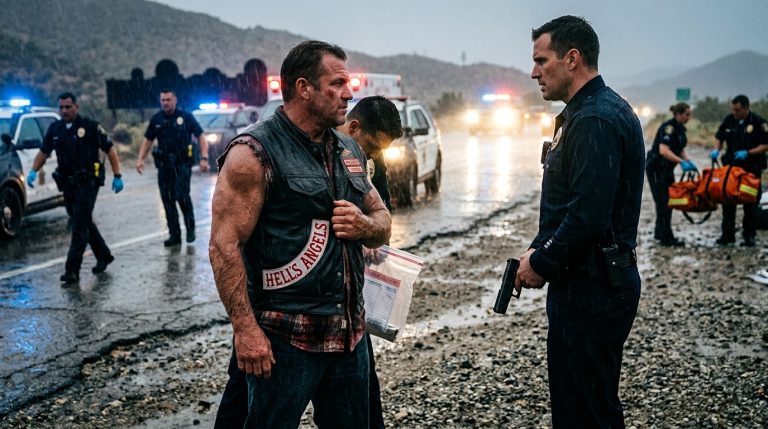
The first man through the laurel thicket was Jake Walsh. He stood six feet two, his broad shoulders tearing clear through the tangled rhododendron branches with a raw, mechanical force that left pieces of his heavy leather cut snagged on the thorns. His boots—thick-soled, reinforced with steel toes—ground the limestone fragments into powder with every stride. Behind him came a phalanx of twelve riders from the Asheville chapter, their faces flat, desaturated by the grey rain, their movements operating under a silent, military discipline that left no gaps in their line. From the flanking draws, six uniformed officers from the county department closed the pocket, their hands resting on the cold iron grips of their sidearms.
Inside the cabin, the heavy pacing stopped instantly. The creak of the floorboard planks gave way to a sudden, violent scuffle as David realized the perimeter was compromised. Through the unglazed window frame, the amber lantern light glared against the rusted tin shield as a large shadow lurked over the green chair.
“Exit the cabin with your hands up now,” a megaphone amplified from the treeline, the voice flat, authoritative, stripping the mountain air of its natural resonance. “This is the Asheville police. The structure is completely contained.”
David didn’t shout a villain speech through the timber slots. He didn’t monologue. He operated with the frantic, calculating intellect of a cornered predator trying to shift the terms of his execution. Through the three-inch slot in the crooked door, the dull scrape of steel against synthetic fiber echoed down—the lockback blade on his pocket knife clicking into place as he lunged toward Lily’s restraints.
He didn’t make the cut.
The entry wasn’t a loose, chaotic scramble; it was an industrial fracture. Jake Walsh hit the exterior door with two hundred and twenty pounds of absolute momentum, his shoulder taking the center panel where the dry-rotted pine gave way from the framing. The ancient iron hinges didn’t bend; they sheared completely clear of the cedar posts with a high, snapping crack that sounded like a rifle shot inside the basin. The door exploded inward, flaking layers of rusted scale from its iron latch across the room.
Before the dust from the rotted sill could hit the floorboards, Jake was through the frame. David lunged with the four-inch locking blade, his arm swinging in a short, diagnostic arc designed to find a seam in the heavy leather of the leather cut, but his velocity was zero compared to the linebacker strike that met him.
Jake’s forearm caught David across the throat, the impact driving the smaller man backward into the western timber wall with a dull, structural crunch that cracked the exterior siding boards. The knife flew from David’s grip, its iron spine bouncing off the cold zinc of the stove plates before sliding down through an inch-wide floorboard gap into the mud below.
“That’s my daughter,” Jake said. His voice wasn’t a roar; it was a low, freezing vibration that stayed trapped inside the small room, flat and lethal. “Touch her again, and the law won’t have an asset left to clear.”
Two massive, leather-clad prospects closed the distance, their arms locking onto David’s elbows with transactional efficiency. They wrenched his wrists behind his hip blades, the metallic click of county-issued handcuffs snapping shut over the bone with a sharp, definitive bite. David’s face was forced down onto the rough oak planks, his cheek catching the gray soot and match debris he had dropped during his watch.
Police poured through the ruptured threshold, their flashlights slicing the amber lantern light into frantic, white-hot cones. But the threat had already been neutralized, the perimeter locked down by the raw physics of the entry team.
Jake dropped to his knees beside the green chair, his hands—stiff with gray grease and rain—sliding into his pocket to retrieve his own utility blade. He didn’t use force against her skin; he slipped the smooth steel edge beneath the yellow polypropylene rope at her ankles, slicing the tight knots with a single, controlled draw that smelled of fresh synthetic polymer. The cords fell away like dead vine wood, hitting the floorboards with a soft, hollow slap.
Lily tried to pitch forward, her limbs completely drained of circulation after sixty-seven hours of constant binding, but Jake caught her torso against his sternum, his heavy leather coat absorbing the first dry, hacking sob that tore through her chest.
Owen stayed motionless behind his log for thirty seconds, watching the officers clear the threshold before he allowed his spine to straighten. His own uniform was soaked through, the red clay paste caking his knees as he walked slowly out of the rhododendron shadow. He stood in the broken doorway, a small, twelve-year-old figure weighing ninety-four pounds, his orange rain jacket torn at the cuff, his red headlamp still cold against his chest. When Lily’s glassy eyes cleared the edge of her father’s shoulder, she pointed a single, blue-tinted finger through the white dust of the frame.
“He stayed,” she whispered into the leather of Jake’s jacket. “He didn’t leave the sills.”
CHAPTER 11: THE CLEAN IRON
The white plaster dust shaken loose from the door frame had not yet settled into the wet red clay on Owen’s boots when the two deputies pivoted David Walsh toward the threshold. David’s heels dragged through the grit, leaving two deep, dark lines in the dirt floor that quickly filled with water dripping from the corrugated sheet-iron roof. His face remained pressed into a neutral, tight lock, his skin grey under the high-intensity beams of the tactical flashlights. He didn’t look at his brother Jake or the twelve prospects standing in the laurel perimeter; his eyes were fixed entirely on the floorboards, tracking the tiny, mechanical trickles of grease leaking from the cold tin stove shield.
Owen stood perfectly rigid in the broken frame, his canvas pack-straps cutting into his collarbone with a dull, familiar friction. As David passed within two feet of his shoulder, Owen’s left hand—still cold and stained with birch sap—tightened around the heavy bond insurance paper hidden inside his inner coat lining.
The man was led out into the freezing downpour, his cuffed wrists clicking against the heavy iron rings of a transport belt with a sharp, transaction-like cadence. The ground team didn’t delay the extraction to celebrate. They moved in an organized, industrial sequence, four officers flanking the prisoner while the remaining riders from the Asheville chapter formed a physical barrier against the thickets, their heavy leather cuts catching the slate-grey light of the dawn.
At the edge of the clearing, where the unmaintained survey line met the mud of the lower draw, a deputy coordinator was logging the physical assets seized from David’s pockets onto a zinc-plated clipboard.
“Burner unit secured,” the officer muttered, his pen leaving a scratching trail on the waterproof paper. “One folder containing land maps. One utility pocketknife, four-inch lockback steel.” He paused, his thumb shifting a small, clear plastic folder that had been retrieved from the interior of David’s canvas jacket. “Anomalous item. A duplicate corporate identity card for WIS-Inc. issued out of the Charlotte regional office. Expiration date listed as November 2011.”
Owen’s ears locked onto the serial number. 2011. The exact winter the dead hemlock log had fallen across his camp baseline, the exact year the source transcript noted David’s ex-wife Rebecca had died from what the regional coroner had filed as complications from pneumonia. The corporate grid was expanding; it wasn’t just a map David had stolen to navigate the Pisgah draws—it was a legacy infrastructure he had used before.
Jake Walsh didn’t look at the corporate card. He remained knelt on the oak planks, his massive arms supporting Lily’s torso as the helicopter medic, Sarah Chen, swung a heavy canvas trauma case onto the floorboards beside the green chair.
The room smelled of stale sulfur, wet wool, and the sharp, chemical tang of the saline lines Sarah was setting up by feel alone. She didn’t waste time with anti-expository questions. Her fingers—stiff but precise—slid over Lily’s wrist bone, calculating the capillary refill time against the cold iron click of her watch. “Core temperature is ninety-six point eight,” Sarah said, her voice dropping into a flat, professional register that stayed trapped inside the logs. “Dehydration is advanced. The rope burns along the ankles require an immediate sterile layout before the clay paste sets into the dermis.”
She turned her eyes to Owen, her flashlight catching the torn cuff of his orange jacket and the fine tremor in his knuckles. “You too, Scout. Sit on the chest. Your vitals are dropping through the same baseline.”
Owen didn’t sit. He slid his pack off his shoulders, setting the canvas down against the rotted sill with a slow, controlled movement that didn’t disturb the floor joists. His agency wasn’t driven by exhaustion; it was driven by the strict maintenance of the trail logic. He reached into his pocket, retrieved his waterproof notebook—the one where he had archived his survival decisions for the merit badge test—and handed it directly to his father, Mike Matthews, who had just cleared the threshold with the remaining members of the ground search unit.
The three sentences he had written by the red headlamp glow were open on the page: I found a kidnapped girl. Her uncle is going to kill her in 67 hours. I’m not leaving her.
Mike’s large hand, scarred from eighteen seasons as a park ranger, closed over the paper. He didn’t offer an emotional speech or an unearned breakdown; his jaw tightened until the bone showed white against his tanned cheek. He looked from the notebook to the broken iron hinges of the door, then down at his son’s mud-caked uniform. “The blazes were perfect, Owen,” his father said, his voice rough like coarse gravel shifting in a draw. “The stacked stones at the mile marker—the ground team intersected the orientation line exactly where you set the point. If the top ironstone hadn’t been locked into the moss, we’d have drifted forty yards west into the deep gorge.”
Outside, the distinct, metallic sound of a county transport van engine starting up echoed from the lower access skid. The legal machinery was already moving, transferring David toward the Buncombe County Detention Center where the prosecutor, Margaret Reeves, would initial the formal filing by 3:47 p.m. No bail would be granted; the presence of the pre-arranged insurance document and the sixty-seven-hour written execution window on the burner phone established an irreversible pattern of pre-meditated capital extortion.
Owen watched the red taillights of the transport unit disappear through the gray columns of the hemlocks, his fingers still tracing the clean, unyielding iron edge of his utility knife inside his pocket. The immediate tactical phase was closed, the asset secured, but the deeper architecture of the corporate filings remained locked within the regional office files, waiting for the legal discovery layers to strip the mask from the ultimate reality.
The Sovereign Protector Rule: A successful extraction does not dissolve the physical ledger of an event; it merely transfers the custody of the assets from the wilderness environment to the structured domain of the court sills. Every broken branch and corporate marker left in the mud remains an unalterable piece of evidence that cannot be compressed by time.
CHAPTER 12: THE PARALLEL CORDS
The twin points of red light from the county transport van’s rear lamps fractured through the low hemlock mist until they were nothing more than silent, horizontal streaks dissolving into the dark timber. Owen did not move his palm from the cold iron spine of his folding knife. The rumble of the shifting gears was quickly replaced by a closer, sharper sound—the mechanical whine of an electric winch unspooling from the undercarriage of Eagle 2 as it stabilized over the clearing’s margin.
He turned his boots away from the ruptured threshold, his soles grinding a thin glaze of clay paste into the threshold timber. The physical transition wasn’t an explosive jump; it was a slow, exhausting march through thirty yards of saturated red earth toward the grass landing lane where the emergency basket was descending.
His father, Mike Matthews, walked precisely two inches to his left, his heavy utility belt clanking with every step, his hand anchored onto the canvas frame of Owen’s pack. Neither spoke. The language of the draw remained transactional, governed entirely by the physical scope of the extraction.
By 11:15 a.m., the layout had shifted to the sterile steel interior of Mission Hospital’s trauma block in Asheville. The desaturated gray of the Pisgah limestone was replaced by the cold, zinc-white glaze of institutional tiles, but the structural density remained identical. The room smelled of iodine, cold laundry bleach, and the flat, chemical trace of the copper-filtered water dripping into the drainage lines.
Two identical stainless-steel mobile beds had been locked into the geometric center of Room 304, separated only by a low, track-mounted canvas curtain that had been pulled back to the rim walls.
Owen lay flat on the left ledger, his uniform trousers replaced by a coarse cotton wrap that felt rough against his mud-chafed knees. His right arm was extended over a padded vinyl rest, a clear silicone intravenous line anchored into the vein with three strips of transparent medical tape. The plastic bag overhead was marked 0.9% Sodium Chloride; it dripped with a slow, mechanical precision—one drop every four seconds—reintroducing essential volume to his depleted cells.
Across the four-foot gap between the frames, Lily Walsh occupied the parallel matrix. Her small forearms were bound in thick envelopes of white sterile gauze to protect the deep, red ridges where the polypropylene cord had sheared into her skin. Her face was still shaded with a faint, blue tint around the jawline, but the glassy glaze in her pupils had cleared, replaced by a sharp, calculating focus as she watched the transparent fluid clear the plastic bubble of her own line.
Jake Walsh sat between the beds on a low, rusted iron stool, his massive leather cut draped over the backrest, his fingers tracing a gray, greasy grease spot on the cuff of his denim sleeve. His spine was curved, his center of gravity thrown forward as he listened to the low, flat voice of District Attorney Margaret Reeves, who was standing by the zinc utility sink with a legal folio unclasped.
“The filing is locked,” Margaret said. Her pen didn’t scratch; it stayed balanced between her index fingers, cold and motionless. “The burner phone logs from the cabin corridor show three independent transmissions to a commercial server in Charlotte. He wasn’t just checking the ransom response; he was verifying the clearance of the minor’s policy. The liquidation code was initialed forty minutes before the entry team breached the sills.”
Jake didn’t lift his chin. His teeth ground together with a dry, mechanical friction that sounded like ironstone shifting in a draw. “The policy wasn’t an anomaly,” he said, his voice dropping into the lower registers where the subtext lived. “He tried the same filing line in 2011 when Rebecca’s clearance came through. The records along the county line are still archived under the old timber company names.”
Margaret nodded, her hand shifting a legal document to expose a secondary layer of certified text. “The state is reopening the 2011 ledger. The financial tracking methods match the current layout down to the serial numbers on the certificates. He didn’t build a new asset code; he reused an old transaction path.”
Owen watched the clear drops drop through his line. Transaction path. The truth was decompressing, the decoy secret of the quarter-million-dollar ransom splitting apart to reveal the older, serial predation beneath. David Walsh didn’t fight for familial respect or the reclamation of a stolen birthright; he operated as a clinical liquidator who viewed the members of his own family as high-yield physical targets to be processed and cleared within an established calendar window.
Lily turned her head on the pillow, her gauze-wrapped hand moving two inches across the white cotton sheet toward Owen’s frame. “The markers,” she whispered, her voice no longer a dry rattle but a steady, flat thread that cut through the low hum of the medical monitors. “The ones you stacked along the stone shelf… I heard them grinding together when the boots passed. I knew the alignment was locked.”
Owen didn’t offer a dramatic confirmation. He shifted his thumb on the mattress, his skin absorbing the cold, institutional starch of the linen. “The top stone was narrow,” he said, his voice matching her register, transactional and clear. “It was pointed forty-five degrees northeast. The ground team couldn’t misinterpret the indicator if the moss held the base.”
The Sovereign Protector Rule: The recovery phase inside a locked matrix is not an emotional release; it is a mechanical recalibration of fluid balances and legal records. While the salt and water clear the cellular debt, the court sills are prepared to receive the evidence that permanently closes the tracking loop.
CHAPTER 13: THE FRAMED LOG
The low, dry click of the hospital monitor’s primary line relaying its final cycle faded entirely from the room as the calendar grid flipped over six complete months of structural transit. By April 2020, the desaturated white enamel of the trauma ward had given way to the rougher, zinc-scraped textures of the Asheville clubhouse perimeter. The air here was heavy with the smell of unwashed denim, wet gravel, and cold motor lubricant drifting from the service skids out front. The spring heat hadn’t cleared the corners; it stayed trapped within the low-tier ceiling joists where the old pine tongue-and-groove boards had stained black from years of stove grease.
Owen stood next to the central cedar counter, his palms absorbing the coarse grain of his honorary leather cut. The vest was small, kid-sized, but the thickness of the bull-hide was identical to the armor worn by the forty-seven riders occupying the perimeter. He didn’t adjust the brass buttons on his scout shirt. His fingers moved methodically across his left hip pocket, verifying the hard outline of his bronze civilian medal before his eyes lifted to lock onto the western wall frame.
Directly over the heavy pine bar, secured by four case-hardened iron lagging bolts, hung the waterproof notebook he had carried through sixty-seven hours of mountain saturation.
The glass face of the frame was clean, free of the grease film that coated the surrounding structural tin. The open page was exposed to the room’s amber bulb light, his three-sentence layout standing out against the grid paper: I found a kidnapped girl. Her uncle is going to kill her in 67 hours. I’m not leaving her.
Below the final line, where the waterproof paper met the binding seam, forty-seven distinct road names had been carved into the border with pocket knives and thick carpenter pens. Tiny. Reaper. Lawman. Doc. Wrench. The ink was black, industrial-grade, the characters non-yielding and flat.
Jake Walsh walked across the gravel floor, his heavy boots producing a rhythmic, grinding friction that ceased exactly two inches from Owen’s ledger. He didn’t offer a celebratory speech. He reached out his right hand, his knuckles—scarred by old iron wrenches and chain links—tapping the bottom of the frame where a secondary inscription had been added in a clean, clinical script.
“The trial archives were sealed yesterday afternoon,” Jake said. His voice was a low, flat rasp that didn’t pass the boundary of the counter. “Reeves cleared the 2011 files. The insurance company out of Charlotte didn’t contest the layout once the serial number on the corporate stake was logged into the evidence record. The judge stacked the counts consecutively. Thirty-five years federal on the minor’s policy, twenty-five state on the Rebecca baseline.”
Owen watched a stray drop of oil trace a line down a display carburetor on the shelf. “The stake was stamped with W-I-S-Inc.,” he said, his voice matching Jake’s register, stripped of its resonance by the thickness of the room’s timber. “The cut where the spade drove the zinc into the clay was less than three weeks old when I tracked the line. He didn’t change his infrastructure.”
Jake nodded, his thumb tracing the lower iron ridge of his belt buckle. “He didn’t change a frame because he thought the corporate mask locked the liquidation out of the tracking manuals. He thought a twelve-year-old scout only knew how to look for deer trails and identify poplar bark. He didn’t calculate the weight of a kept promise.”
Across the thirty-foot common space, near the long table where a cake decorated with a purple unicorn rose between two rusted gear assemblies, Lily Walsh turned her head. Her hair was brushed back, held by two steel clips that caught the grey light from the open bay doors. Her small wrists no longer carried the thick envelopes of white gauze; the skin was clear, marked only by faint, pale white lines where the yellow polypropylene fibers had sheared into her dermis six months prior.
She didn’t run across the floorboards. She moved with a calculated, steady step, her fingers clutching a small, stuffed rabbit that had been cleaned with industrial wash soap until the synthetic fur had turned the color of dry sand.
She stopped at the counter line, her elbow brushing Owen’s leather sleeve. She didn’t offer an emotional thank you; she reached into her pocket and retrieved a fresh sheet of grid paper she had drawn on with a fine-point drafting pen. It was the master layout for the Stay Found safety manual—a clean, geometric compass rose with a tiny silhouette holding an aluminum red-filter headlamp at the absolute center of the coordinates.
“The school district signed the clearance forms at ten o’clock,” she said, her voice flat and steady. “The logistics are locked for three regional counties. We start the orientation blazes at the Deep Creek trailhead on Saturday morning.”
Owen took the paper, his thumb checking the crisp edge of the sheet before sliding the asset into his inner vest lining. His father, Mike Matthews, watched from the bay door, his ranger uniform pressed and flat against the afternoon heat, his hand resting on the iron latch of his state truck. The immediate legal closure was complete, the record archived in the county vaults, but the tracking logic remained active, expanding its grid from a single forgotten cabin draw into a continuous baseline of defensive terrain.
The Sovereign Protector Rule: A narrative tracking loop is not resolved by emotional statements; it is permanently locked by framing the raw log of the event within the infrastructure of the community. When the signatures of the protectors occupy the same wood as the promise, the architecture of the defense remains unalterable across any duration.
CHAPTER 14: THE HORIZON ON THE RIDGE
The edge of the drafting paper was sharp, a clean, unyielding geometric line that Owen flattened against his collarbone beneath the heavy bull-hide lining of the honorary vest. He didn’t smooth the crease. He kept his fingers anchored to the document, his thumb feeling the faint, raised texture where the black ink of Lily’s compass rose had dried against the grid. Inside the clubhouse, the heavy, rhythmic vibration of forty-seven overlapping conversations hummed against the tin walls, but the sound didn’t reach the center of the room. It broke against the long cedar bar where the framed waterproof log hung under the amber bulb, its black, industrial signatures permanently etched into the boundary wood.
Jake Walsh stepped away from the counter, his massive shoulders blocking the grey light from the bay doors. The iron cleats on his boots ground a small fragment of limestone gravel into the floorboards—a single, harsh crunch that resonated through the floor joists. The physical transaction was complete. The evidence of David’s serial execution matrix was locked in the county vaults, the corporate liquidation mask permanently stripped away.
Owen let his hand drop from his vest. He turned away from the framed log, his boots moving through the heavy air of the common room, matching Lily’s steady, mechanical pace toward the open threshold where his father waited by the rusted fender of the state truck.
Four years later, the friction of the mountain hadn’t changed.
The October wind pushing over the high eastern ridge line of the Pisgah draws carried the same desaturated, metallic scent of wet ironstone and dying white oaks. Owen Matthews, now sixteen, stood on the exact granite spine where he had shaved the magnesium block. He didn’t wear the orange rain jacket; his shoulders had broadened, filling out a heavy, grey canvas chore coat that smelled of woodsmoke and dry earth.
He knelt on the stone ledger, his knees pressing into the thin, dry lichen. The shallow depression in the rock face was still there, marked by a permanent, dark carbon stain where the green pine boughs had burned down to white ash. He didn’t carry a magnesium starter this time. He reached into his coat pocket and extracted the small, square steel signal mirror. The one-eighth-inch sighting hole was clear, but the polished surface was lightly clouded, etched by the abrasive dust of the trails he had maintained over forty-eight months.
He didn’t raise it to his eye. He laid it flat against the cold stone, centering it directly over the old burn scar.
Footsteps crunched through the dry pine mast behind him—not the heavy, dragging step of a canvas coat, but a light, rhythmic cadence that understood the geometry of the slope. Lily Walsh stepped onto the granite shelf. She was thirteen, wearing a dark denim jacket over a grey sweater, her hair pulled back into a tight knot that defied the high-altitude wind. She carried a small, flat piece of slate in her left hand, its edges rough and unpolished.
She didn’t speak. She knelt beside Owen, her jeans scraping against the grit of the ridge. She placed the slate fragment precisely over the top edge of the steel mirror, anchoring the metal against the wind. It was the physical closure of the loop—the identical stone configuration Owen had used to build the directional blazes in the mud four years prior, now repurposed to seal the signaling point.
“The county cleared the lower draw yesterday,” Lily said, her voice flat, stripped of the dry rattle it had carried in the crawlspace. “The old sills finally gave way under the foundation rot. The sheet iron collapsed inward.”
Owen looked down at the dull reflection of the sky caught in the mirror’s surface. “The structure wasn’t meant to hold,” he said quietly. “The wood was dead before the grid was ever laid out.”
He reached out, his thumb tracing the cold, rusted edge of the slate fragment. It was a deliberate, tactile repair—not of a broken object, but of the space itself. The mountain had consumed the architecture of the threat, grinding the rotten pine and rusted tin back into the clay loam, leaving only the unyielding geography of the granite and the cold iron beneath the topsoil.
Lily shifted her weight, her shoulder pressing lightly against Owen’s canvas arm. The physical contact wasn’t dramatic; it was a simple, grounding pressure, a shared acknowledgment of the weight they both carried. The serial predation that had treated human lives as liquidation assets had been met and permanently halted by the relentless, grinding pragmatism of the mountain and the silent, unyielding accounting of a twelve-year-old scout.
Below them, the five hundred thousand acres of desaturated grey timber stretched out toward the horizon, the draws filling with the first low pockets of evening mist. Owen didn’t pull a compass to check the bearing. He knew the alignment. He stayed on the ridge, the cold iron wind against his face, watching the shadows lengthen across the basin where a promise had been locked into the earth and kept.