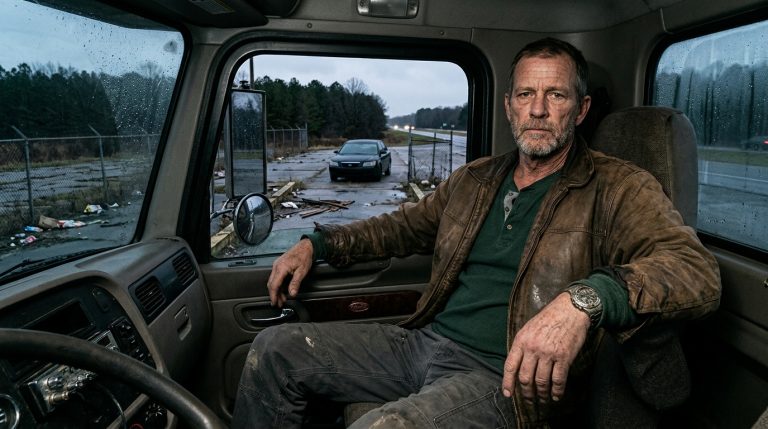
The Quiet Weight of Parcel Forty-Four: A Legacy Defended in the Iron-Scented Mud of Ohio
CHAPTER 1: THE WEIGHT OF STEEL
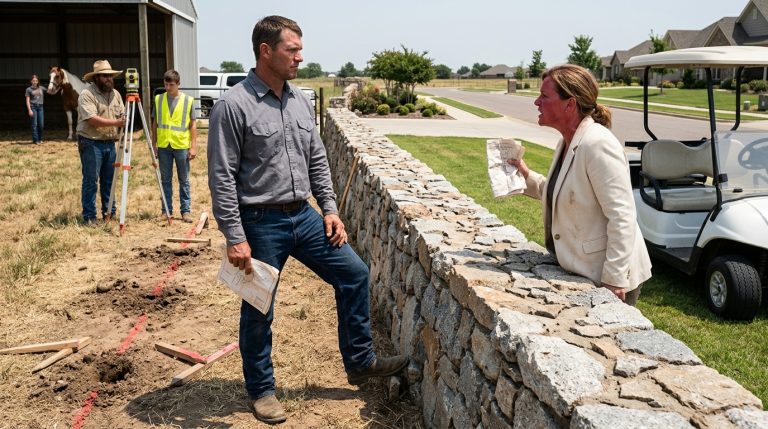
The post-hole digger bit into the Central Ohio clay with a rhythmic, gut-shaking thud that I could feel in the soles of my work boots. Hector Briggs didn’t talk much while he worked, which was why I’d hired him. He understood the gravity of a fence post. He knew that if you didn’t sink it deep enough, the frost would heave it out of the dirt by February, turning a statement of ownership into a leaning suggestion.
“Four feet,” Hector grunted, wiping a smear of gray mud across his forehead. “She ain’t going nowhere, Garrett.”
I looked down the length of the gravel lane. Parcel 44A was a narrow, ugly strip of earth, smelling of damp iron and the sweet, rotting scent of the creek bank. To anyone else, it was just a shortcut to the retention pond. To Beverly Strock, it was the front line of a war she thought she was winning because she had a louder voice and a more expensive printer.
I reached into my pocket and felt the weight of the new padlock. It was cold, industrial, and indifferent to the feelings of the Sycamore Ridge Board of Directors. The gravel under my feet felt different today. It didn’t belong to a dissolved LLC in a filing cabinet in Sarasota anymore. It belonged to the man holding the deed and the man digging the holes.
A white HOA maintenance truck rounded the corner of Lot 38, its engine a distant hum that sharpened as it approached the southern boundary. I didn’t move. I just watched the dust kick up behind its tires—dust that was, as of 9:42 AM yesterday, technically my property.
The truck braked hard ten feet from where Hector was pouring the first bag of sixty-pound concrete. The driver, a guy named Miller I’d waved at for three years, rolled down his window. He looked at the steel pipe gate lying on the grass, then at me, then at the hole.
“Gate’s gotta stay open, Garrett,” Miller said, though his heart wasn’t in it. “Beverly says it’s a maintenance corridor. You know the drill.”
“The drill changed, Miller,” I said, my voice as flat as the horizon. “Tell Beverly if she wants her trucks on this gravel, she can check her porch. There’s a letter waiting for her.”
I stepped toward the truck, handing him a small, laminated card. It wasn’t a flyer or a complaint. It was a formal notice of private property, backed by a recorded deed number. Miller took it, his eyes skimming the legal text before he looked back at the steel posts Hector was now plumbing with a level.
“She’s gonna lose her mind,” Miller muttered.
“She can lose whatever she likes,” I replied, “as long as she doesn’t lose it on my dirt.”
As the truck backed away, the tires spitting gravel that I would later have to rake back into place, I turned to Hector. The concrete was setting, a dull, wet gray that looked like the sky before a November storm. It was the color of a settled argument.
But as I reached down to help Hector lift the heavy steel gate onto its hinges, I noticed something caught in the brush just past the new post—a small, weather-beaten survey stake I hadn’t seen before. It wasn’t from my surveyor. The ribbon on it was fresh, a neon pink that screamed against the muted browns of the creek bank, and the coordinates written on the wood weren’t for the lane. They were for the land directly behind my grandfather’s house, a spot the HOA had no business marking.
CHAPTER 2: THE DOLLAR LICENSE
“Who the hell marks a riparian line in pink?” Hector asked, leaning on his shovel. The rhythmic thud of the digger had stopped, leaving a ringing silence in my ears that the distant wind through the willows couldn’t quite fill.
I knelt in the mud, my knees soaking up the cold dampness of the river bottom. The stake was fresh—untouched by the morning’s frost. The neon ribbon flickered like a warning light. “Not the county,” I said, my voice low. “And not the surveyor I hired last month. This is close-quarter work.”
I traced the coordinate scrawled on the wood. It was precise. Too precise for a volunteer beautification committee. This was a professional marker, placed within spitting distance of my grandfather’s foundation. It felt like a toothache—a sharp, localized throb of encroaching pressure. I stood up, the rusted hinges of my own patience grinding. “Hector, finish the concrete. I need to make a phone call.”
Back in the kitchen, the house felt too quiet, the way it always did when the ghost of my father’s radio wasn’t humming in the background. I sat at the table, the wood scarred by fifty years of coffee mugs and heavy decisions. I didn’t call Phyllis first. I called Dale Presser.
“You eating chips, Dale?”
“Pretzels today, Garrett. Hard sourdough. What’s the word from the front lines?”
“Beverly’s playing with neon,” I said, staring out the window at the lane. “I found a stake. Pink ribbon. Ten feet from my porch. You see any trucks in the neighborhood yesterday that didn’t have HOA logos?”
The sound of crunching stopped. Dale’s voice dropped into that gravelly register he saved for talking about township corruption. “Funny you mention it. A black Silverado, late model, spent about an hour parked near the common area cul-de-sac. Guy in a high-vis vest was out walking the line with a GPS unit. I figured he was one of yours.”
“He wasn’t.”
“Then you’ve got a leak, Garrett. Or a ghost. Beverly’s been chirping in the group chat about ‘reclaiming the vision.’ She’s got the board convinced that your gate is the only thing standing between Sycamore Ridge and a total collapse of property values.”
I hung up and looked at the three envelopes sitting on my counter. They were addressed to the landscaping company, the irrigation contractor, and the storm water crew. My “Dollar Licenses.” It was a passive play, a move designed to turn Beverly’s own aggression into a legal anchor. If they signed, they acknowledged my ownership. If they didn’t, they were trespassing.
The strategy was sound, but the pink stake bothered me. It was a move outside the rules of the board meetings. It was personal.
By three o’clock, the wind had picked up, carrying the scent of woodsmoke and the metallic tang of the creek. I drove the letters to the post office myself, feeling the weight of the stamps—the tiny, adhesive price of a paper trail. When I returned, the new gate was standing. Hector was gone, but the steel posts looked like they’d grown out of the earth itself, dark green and immovable.
I walked the length of the lane, the gravel crunching under my boots—a sound that used to mean home, but now sounded like a countdown. I stopped at the southern end, where parcel 44A met County Road 7. I ran my hand over the cold steel of the gate. It was rough, the paint still smelling of chemical solvents. This was the master switch. One turn of a key, and the maintenance of forty-two homes became a logistical nightmare.
My phone buzzed in my pocket. It was an email notification from the irrigation contractor’s office manager.
Mr. Voss, we received your notification regarding the access license. Our owner is a bit confused. We’ve had a standing agreement with Beverly Strock for years. She told us the lane was common ground. We’ll need to clear this with the HOA before we sign anything.
I smiled, a thin, joyless expression. “Clear it, then,” I whispered to the empty lane.
The trap was set. By asking for permission, the contractor would force Beverly to produce a right she didn’t have. She would have to lie in writing or admit she was standing on air.
I turned back toward the house, but the pink ribbon caught the corner of my eye again. It was dancing in the wind, a bright, artificial spark against the desaturated gray of the Ohio fall. I walked over to it, intending to rip it out of the ground, but as I reached for the wood, I saw a second set of markings on the back of the stake.
It wasn’t a coordinate. It was a date. November 14th.
The date of the Annual General Meeting.
Underneath the date, in a cramped, precise hand, were three letters: EDC.
I felt a cold prickle of sweat on the back of my neck despite the dropping temperature. EDC. Eminent Domain Commission. Beverly wasn’t just trying to fine me into submission anymore. She wasn’t playing the HOA game of mailings and liens. She was trying to bypass the association entirely and have the township seize the land for “public necessity.”
I reached for the stake, my fingers brushing the rough wood, but a sharp, metallic clack echoed from the direction of the lane.
I looked up. A black Silverado was idling at the edge of County Road 7. The driver was a silhouette against the late afternoon sun, but I could see the glint of a camera lens pointed directly at me. Before I could move, the truck accelerated, its tires screaming against the asphalt, leaving nothing but a cloud of blue smoke and the realization that the “beautification committee” was no longer interested in fences.
I looked down at my hand. A splinter from the stake had pierced my thumb, a small, dark bead of blood welling up against the rusted iron color of the mud.
The information gap I’d been trying to build for Beverly had just flipped. I knew about the land. I knew about the letters. But I didn’t know who was in that truck, and I didn’t know what they’d seen when I’d been tracing the lines of a property I thought I finally controlled.
I walked back to the porch, the weight of the padlock in my pocket suddenly feeling less like a tool and more like a target. I sat on the top step, watching the light die over the creek, waiting for the phone to ring with the first of the three calls that would change everything.
CHAPTER 3: BLUFFS AND BURIED BONES
“They sent it by courier, Garrett. Not the mail. They wanted to make sure you felt the wind off the hand-off.” Phyllis Dunmore’s voice sounded like it had been filtered through a lifetime of menthol cigarettes and courthouse dust.
I sat in my truck, the heater core whistling a high, lonely note against the October chill. In my hand, the heavy-stock envelope felt like a slab of cold marble. Hector’s gate was visible in my rearview mirror—a dark green line of defiance across the gravel lane. “Eminent domain, Phyllis. That’s what the stake said. EDC.”
“The Eminent Domain Commission doesn’t leave pink ribbons in the mud for a private driveway dispute, Garrett. That’s not how the state operates. But it is how someone who’s out of real bullets operates.” I heard the familiar squeak of her leather chair, a sound that usually preceded a tactical execution. “I’ve got the letter they sent me. It’s four pages of high-grade fiction. They’re claiming ‘public necessity’ for maintenance access. It’s a bill-padder, pure and simple. Their attorney is charging Beverly by the word to tell her exactly what she wants to hear.”
I looked at the pink stake I’d pulled from the ground. It was sitting on the passenger seat like a jagged bone. “And the truck? The Silverado?”
“Maybe a surveyor. Maybe just a scarecrow in a vest. Beverly’s playing asymmetric warfare, Garrett. She knows she can’t win on the deed, so she’s trying to make the cost of holding it higher than you’re willing to pay. She’s betting you’ll get tired of the shadow-boxing.”
“She’s betting on the wrong man,” I said. I shifted the truck into gear, the tires gritting against the very gravel the HOA claimed was their birthright. “I’m coming into Zanesville. I want to see the 2003 files again. Every scrap.”
The drive to Zanesville was a blur of desaturated grays—sky, road, and the skeletal remains of cornfields. Phyllis’s office was tucked away in a brick building that looked like it had been standing since the canal days. The air inside was thick with the scent of old manila and the kind of radiator heat that makes your skin feel tight.
Phyllis didn’t look up when I walked in. She was staring at a USB drive Bud Weston had sent from Florida, the one containing Clifton Hargrove’s digital ghost. “Sit,” she commanded, gesturing to a chair that had probably seen more property disputes than the local judge.
She turned the monitor toward me. “Look at the metadata on this acknowledgement letter from 2003. The signature isn’t just a scribble. It’s a formal board resolution. Beverly’s predecessor didn’t just sign a favor; he signed away any claim to a prescriptive easement. He admitted, in writing, that the HOA’s use of your lane was permissive. Meaning revocable. Meaning you own the master switch.”
I leaned in, the blue light of the screen reflecting in my eyes. “If she knows this exists, this whole Eminent Domain bluff is more than just a bill-padder. It’s fraud.”
“If she knows,” Phyllis cautioned, her eyes sharp behind her reading glasses. “But look at the mailing log from the special board meeting she held in April. The one where they tried to amend the CC&Rs without telling you. She left off three houses. Yours, and the two neighbors flanking the lane. That wasn’t a clerical error, Garrett. That was a surgical strike.”
I felt that cold, mechanical click again—the one that turned anger into utility. “She’s hiding the history from the rest of the board. She’s spending their reserve funds to fight a war she’s already lost on paper, and she’s doing it by keeping the 42 families in the dark.”
“Precisely. But here’s the complication.” Phyllis tapped the screen. “I did a deep dive on ‘EDC.’ It doesn’t stand for the Eminent Domain Commission. That doesn’t exist in this county. It stands for Eastern Drainage Corridor.”
I frowned. “The storm water system?”
“The very one. The township has an old easement—not for the road, but for the culvert your grandfather built. If that culvert fails, the township can come in and seize whatever they need to fix the drainage for the whole southeastern quadrant. Beverly isn’t trying to take your road for the HOA. She’s trying to provoke a drainage crisis so the township takes it for her.”
The smell of the room—the dust, the old coffee—seemed to sharpen. I thought about the Silverado, the man with the GPS, and the neon stake. They weren’t surveying the gate. They were surveying the culvert.
“She’s going to sabotage the drainage,” I whispered.
“She doesn’t have to sabotage it,” Phyllis said, standing up and crossing to the window. “She just has to stop the maintenance. The stormwater contract is up for renewal. If she blocks the crew from coming in because of your ‘illegal gate,’ the next heavy rain floods the common area. The township steps in. The lane becomes a public utility. And you lose your leverage.”
I looked down at my hands. The splinter wound was a dark, angry point on my thumb. The “Rusted Truth” of the situation was clearer now. This wasn’t a chess match about mailboxes and post colors. It was about the very infrastructure of the land.
“I need to talk to the contractors,” I said. “Before Beverly reaches them.”
“You already sent the letters,” Phyllis reminded me. “The ‘Dollar License.’ That was the right move. But you need more than a paper trail now. You need a witness.”
I left her office and walked out into the Zanesville evening. The sun was a bruised purple behind the clouds. I pulled out my phone and dialed a number I hadn’t called in years. Hector Briggs.
“Hector. I need you back at the creek. Bring the backhoe.”
“Something wrong with the posts, Garrett?”
“Posts are fine. I need to dig up the culvert. I want to see exactly what my grandfather buried in 1988 before someone else decides it’s broken.”
I drove back toward Sycamore Ridge, the weight of the day pressing into my shoulders. As I pulled onto County Road 7, the headlights of my truck swept over the new green gate. It stood silent and tall, but the black Silverado was gone. In its place, tucked into the crook of the fence post, was a single white envelope.
I didn’t get out of the truck. I sat there, the engine idling, the headlights illuminating the target. I knew what was in that envelope before I even touched it. It was the “Information Gap” closing—the HOA’s final, desperate attempt to reclaim the narrative before the November meeting.
I stepped out, the gravel crunching with a sound like breaking glass. I grabbed the envelope. It wasn’t a legal notice. It was a photo.
It was a picture of my grandfather’s gate, taken from inside my property. From my porch. And written across the back in the same cramped, precise hand I’d seen on the stake:
A legacy is only as strong as its foundation. We know what’s under the gravel.
I looked toward the dark outline of my house. The willows were swaying, their shadows long and skeletal against the siding. Someone had been on my porch. Someone knew about the 1988 culvert. And someone was counting on the fact that I wouldn’t want the township to see what was underneath it.
I gripped the photo, the paper crinkling under my thumb. The “Decoy Secret” was the road. The “Core Truth” was the water. And the war for Lot 43 had just moved from the courtroom to the dirt.
CHAPTER 4: THE WHISPER CAMPAIGN
The white envelope felt like a lead weight in my hand, but the vibration of my phone was what finally broke the silence of the driveway. It was Dale. He didn’t wait for a greeting.
“Garrett, you need to check the mailboxes on the north loop. Now.”
“I’m looking at something else right now, Dale. Someone was on my porch.”
“Screw the porch for five minutes,” Dale’s voice was strained, the usual sound of pretzels replaced by the sharp intake of breath. “The flyers. They aren’t just letters anymore. They’re professional. Color photos. They’ve got a picture of your grandfather’s old backhoe from the eighties and some headline about ‘Hazardous Infrastructure.’ They’re calling your property a liability to the community’s safety. Beverly’s not just talking about the road anymore. She’s talking about the water.”
I looked at the photo in my hand—the one taken from my own porch. The “Whisper Campaign” had graduated from the group chat to a physical assault on my family’s history. I climbed back into the truck, the heater still whistling, and backed down the gravel lane. I didn’t stop at my gate. I drove straight to the north loop.
The flyers were exactly as Dale described. They were tucked into the handles of the mailboxes, printed on high-gloss cardstock that felt slick and artificial against the grit of the Ohio morning. I pulled one out. There was a photo of the creek bank, zoomed in on a section of rusted corrugated pipe—the edge of the culvert. The text underneath was a masterpiece of “Mid-level HR” character assassination: Is your home at risk? Unpermitted legacy infrastructure is threatening our drainage. One resident’s refusal to comply puts your basement at risk of flooding.
It was a surgical strike on the one thing that scares a suburban homeowner more than a fee increase: a flooded basement.
I spent the next hour working the loop. I didn’t hide. I walked up to the porches. I knocked on doors. The air smelled like damp mulch and woodsmoke, a quiet autumn Tuesday that felt increasingly like a siege.
The first door was the Wakefield-Turners. They were a younger couple, the kind of people Beverly usually managed to intimidate with her “governance” speeches. When the door opened, they looked at the flyer in my hand, then at me. They looked uncomfortable, their eyes darting to the black Silverado parked three houses down—the same truck from the lane.
“Garrett, we don’t want any trouble,” the husband said, standing in the doorway. “But Beverly sent out a message saying the township inspector found a violation. She said you’re blocking the storm water crew from fixing a collapsed pipe under your road.”
“Did she show you the report?” I asked. My voice was low, regulated. I was the Sovereign Protector now, defending not just the dirt, but the truth of it.
“She showed us the pictures,” the wife added from behind him. “That pipe looks ancient, Garrett. If the retention pond overflows because that culvert is blocked…”
“That pipe has moved water for thirty-five years without a single back-up,” I said. “And the only person blocking the crew is Beverly. I offered them a license for one dollar. She told them not to sign it.”
I could see the gears turning. They wanted to believe me, but fear is a more potent currency than a one-dollar license. I handed them a copy of the 1974 building permit I’d pulled from the Zanesville archives. “Read the second page. My grandfather didn’t just bury a pipe. He built a reinforced concrete headwall that handles three times the township’s required flow. If there’s a blockage, it’s because someone put it there.”
I moved to the next house, then the next. The “Ghost Ratio” was shifting—I was spending more time listening to their fears than explaining my rights. By the time I reached the sixth house, I had a stack of flyers and four witness statements written on the back of my legal pad.
The “Consequence Loop” was tightening. Beverly’s move wasn’t just about winning the lane; it was about isolating me. If she could make me the villain of a natural disaster, the board would have no choice but to authorize the “EDC” seizure Phyllis had warned me about.
As I walked back to my truck, the black Silverado pulled out from its spot and idled in the middle of the road, blocking my path. The tinted window rolled down just two inches.
“Mr. Voss,” a voice said—a man’s voice, rough and transactional. “You’re making this harder than it needs to be. The association just wants to maintain the corridor.”
“The association doesn’t own the corridor,” I said, leaning against my truck door. I didn’t look at the camera I knew was pointed at me. “And you’re trespassing on a private residential loop. Does Beverly know you’re using her group chat to stalk neighbors?”
The window rolled up. The truck didn’t speed away this time. It moved slowly, a predatory crawl that matched my own pace as I drove back toward the southern corner of the development.
When I reached my house, the sun was a weak, pale disk behind a curtain of gray. I didn’t go inside. I went to the barn and pulled out a heavy iron probe—a six-foot rod of rusted rebar my grandfather had used to find tiles in the river bottom.
I walked down to the creek bank, the mud sucking at my boots. The willows were whispering, their long, yellow leaves shivering in the wind. I found the headwall. It was a solid block of concrete, etched with the date 1988 and my grandfather’s initials. I thrust the probe into the gravel just above the pipe.
Clack.
The sound was wrong. It wasn’t the hollow ring of the corrugated pipe, and it wasn’t the dull thud of a rock. It was the sound of wood.
I knelt down, the dampness of the bank soaking through my jeans. I cleared away the loose stones and the dead leaves. Buried just six inches under the surface, wedged tightly against the mouth of the culvert, was a sheet of heavy exterior plywood, braced with two-by-fours.
It was a man-made blockage. A “sabotage” designed to ensure that the next rain would back up into the HOA’s common area, exactly as Phyllis had predicted.
I felt the rusted truth of it settle in my gut. Beverly wasn’t just waiting for a crisis; she was manufacturing one. And the pink stake wasn’t a marker for the township—it was a marker for the “flood” she was about to trigger.
I didn’t pull the plywood out. Not yet. I reached into my pocket and pulled out my phone. I didn’t call Phyllis. I called Harriet Voss at the Muskingum County Courier.
“Harriet. You asked if I had a story. I have a crime scene.”
As I stood there by the creek, the weight of the labor felt heavier than ever. I wasn’t just defending a road anymore. I was defending the water. I looked back at the house, and for the first time, I saw a light on in the upstairs window—a window in a room I hadn’t used in six years.
Someone was inside.
I gripped the iron probe, my knuckles white against the rust. The “Master Switch” had been flipped, but I wasn’t the one holding the key.
CHAPTER 5: THE REPORTERS EYE
I didn’t run. Running makes you a target, and in the river bottom, it makes you a victim of the mud. I gripped the iron probe, the cold rust biting into my palm, and began the climb back up the bank. Every step was a calculation: the weight of my boots, the slip of the wet leaves, the exact distance to the porch where a light was burning in a room that should have been dark for six years.
My father’s old bedroom.
The wind shrieked through the skeletal willows, carrying the metallic tang of the creek and the coming rain. I reached the crest of the slope and stood in the shadow of the barn, my heart hammering a hollow rhythm against my ribs. The light upstairs wasn’t steady. It flickered—the frantic, erratic dance of a flashlight beam moving across shelves and old boxes.
I didn’t call the police. In Sycamore Ridge, the police were forty minutes away and usually friends with the HOA board. I moved toward the back door, the gravel of the lane under my feet sounding like crushed bone.
I didn’t use the key. I used the silence. I stepped onto the porch, the wood groaning under my weight—a sound I knew by heart. I reached for the handle, but before my fingers touched the metal, the door swung open.
I didn’t swing the probe. I froze.
“Garrett? Good god, you look like you’re about to bury a body.”
Harriet Voss stood in my kitchen, a heavy DSLR camera slung over her shoulder and a flashlight in her hand. She looked exactly as she had in Zanesville: sharp, unimpressed, and wearing boots that had seen more local government scandals than a precinct captain.
“How did you get in here, Harriet?” I lowered the probe, the tension in my shoulders releasing with a painful snap.
“The back window in the mudroom has a broken latch, Garrett. You really should fix that. Especially if you’re going to start an insurrection.” She set the flashlight on the counter, its beam illuminating a stack of papers she’d pulled from my kitchen table. “I’ve been here twenty minutes. I saw the black Silverado idling at the end of your lane when I drove in. Whoever was in it didn’t like my press credentials.”
“They’ve been stalking the loop,” I said, leaning the iron probe against the refrigerator. The smell of the house—old wood and cold air—seemed to settle around us. “Harriet, they sabotaged the culvert. I found plywood wedged into the headwall. Beverly’s trying to flood the common area to force a township seizure.”
Harriet’s expression shifted from professional curiosity to something colder. She didn’t say a word; she just picked up her camera and headed for the door.
We walked back down to the creek in the dying light. The mud was thicker now, the air turning into a fine, freezing mist. I pointed out the plywood, the way it was braced with two-by-fours that looked suspiciously like the material Hector had used for the fence posts.
Click. Whir. Click.
The flash of Harriet’s camera illuminated the rusted pipe and the man-made blockage. “That’s not negligence,” she muttered, adjusting her lens. “That’s intent. If I run this with the deed history and the 2003 letter, Beverly isn’t just losing an HOA seat. She’s looking at a criminal referral for property damage and endangerment.”
“She’s desperate,” I said, looking at the dark water swirling against the plywood. “She realized the ‘Dollar License’ letters were a trap. She knows if the contractors sign, her legal standing evaporates. She has to make the road a liability before they can acknowledge it’s mine.”
“It’s a ‘High-Start’ play,” Harriet said, standing up and wiping mud from her knees. “She’s betting the township will move faster than the courts. And she might be right. The Eastern Drainage Corridor guys don’t wait for a hearing when there’s three feet of water in a retention pond.”
We headed back to the house, the cold seep of the river bottom beginning to numb my feet. Inside, Harriet spread out her notes on the kitchen table, right next to the white envelope with the photo of my porch.
“She sent this?” Harriet asked, pointing to the picture.
“Left it on the gate tonight. They’re watching the house.”
“They aren’t just watching, Garrett. They’re digging.” Harriet pulled a manila folder from her bag. “I spent the afternoon at the County Auditor’s office. I didn’t just look at Parcel 44A. I looked at the historical plat from 1971—the one your grandfather bought.”
She laid out a faded blueprint. “Your grandfather didn’t just buy Lot 43. He bought the riparian rights to the entire creek bed for a quarter-mile in both directions. When the developer, Hargrove, carved up the farmland in the nineties, he never legally extinguished those rights. He just built on top of them.”
I felt a chill that had nothing to do with the Ohio weather. “What does that mean?”
“It means the ‘Core Truth’ isn’t just a road or a culvert,” Harriet said, her voice dropping. “It means the HOA’s common area—the pool, the community center, the loop road—is technically sitting on land where your family still holds the primary water and mineral rights. If you chose to enforce it, you wouldn’t just own the lane. You’d own the ground beneath their feet.”
I sat back, the wood of the chair creaking. The “Double-Layer Mystery” had just cracked open. The road was the decoy. The culvert was the escalation. But the ultimate reality was a legacy of ownership that stretched far beyond a sixty-foot strip of gravel.
“Beverly knows,” I whispered.
“She might not know the specifics,” Harriet said, “but she knows there’s a hole in the title. That’s why she’s so aggressive about ‘governance.’ She’s trying to build a cage of rules around you to keep you from ever looking at the foundation.”
The wind slammed against the side of the house, a sudden, violent gust that made the windows rattle in their frames. Downstairs, in the mudroom, the broken latch Harriet had mentioned clicked open.
We both went still.
The sound of boots on the floorboards wasn’t rhythmic or polite. It was heavy, wet, and fast.
I grabbed the iron probe from the side of the fridge. Harriet reached for her camera, the flash charging with a high-pitched whine.
“Garrett?”
The voice wasn’t Beverly’s. It was Frank Odenkirk. He stood in the kitchen doorway, his face pale and his breath coming in ragged gasps. He was soaked to the bone, his flannel shirt clinging to his chest.
“Frank? What the hell are you doing?”
“They’re coming, Garrett,” Frank said, leaning against the doorframe. “Beverly called an emergency board vote ten minutes ago. She told them the culvert collapsed and the road is washed out. She’s got the township engineer on the phone. They’re bringing a crew out tonight to ‘abate the nuisance.'”
“Tonight? In this weather?”
“She told them it’s an emergency,” Frank wiped water from his eyes. “She’s moving, Garrett. She’s not waiting for November. If they tear out that gate and the culvert tonight, the township takes the lane by morning. You have to stop them.”
I looked at Harriet, then at the iron probe in my hand. The “Rusted Truth” was about to meet the weight of the law in the dark.
“Harriet, get your camera,” I said, my voice turning into a serrated edge. “Frank, get in your car. We’re going to the creek.”
“What are you going to do?” Frank asked.
“I’m going to show the township engineer exactly what ‘nuisance’ looks like when it’s been manufactured by an HR manager.”
We moved out into the rain, the sky finally opening up in a cold, drenching downpour. As I reached the gate, the headlights of three heavy trucks appeared at the end of County Road 7. The amber lights of a township backhoe flickered against the trees, a predatory glow in the darkness.
The siege of Lot 43 had officially begun.
CHAPTER 6: THE KITCHEN TABLE COUP
The rain didn’t just fall; it hammered against the windshield of my truck like a volley of small stones. Ahead, the amber strobe lights of the township backhoe sliced through the darkness, turning the freezing mist into a rhythmic, predatory pulse. I didn’t wait for the engine to die. I shoved the door open and stepped into six inches of freezing slush, the weight of the iron probe in my hand the only thing keeping my center of gravity.
“Garrett, wait!” Frank shouted from his car behind me, but I was already at the gate.
A man in a yellow rain slicker stood by the backhoe, a clipboard tucked under his arm, shielded by the cab’s overhang. He looked tired—the kind of tired that comes from thirty years of responding to “emergencies” that usually turned out to be neighbor feuds.
“You the property owner?” he called out over the roar of the diesel engine.
“Garrett Voss,” I said, my voice cutting through the rain. “And you’re about to commit a felony trespass on a private road with no warrant and a defective emergency declaration.”
The man sighed, a plume of white breath disappearing into the strobe light. “Look, Mr. Voss, I’m Terrence Kolb. Township Engineering. We got an emergency call from your HOA president. Significant blockage in the Eastern Drainage Corridor. If this culvert isn’t cleared by midnight, we’ve got three basements on the north loop that are going to be swimming pools.”
“Beverly Strock doesn’t speak for the township, Terrence. And she doesn’t own this road.” I stepped into the light, letting the rain drench my flannel shirt until the wool felt like armor. “Did you see the ‘blockage’ yourself?”
“She sent photos. Professional ones. Showing a structural collapse.”
“She sent you photos of a crime scene she manufactured,” I said. I pointed the iron probe toward the creek bank. “I’ve got a reporter from the Courier and the HOA Vice President right behind me. We’re going down to that headwall. If you find a ‘collapse,’ you can tear out my gate. But if you find what I think you’re going to find, you’re going to help me document a fraud.”
Kolb looked at me, then at Harriet, who was already uncapping her lens, her camera body wrapped in a plastic rain-shield. He looked at Frank, who was nodding frantically. Kolb wiped a smear of grease from his clipboard and nodded to the backhoe driver. “Kill the engine, Mike. Give us the floods.”
The roar died, replaced by the hiss of the rain. Mike flipped the auxiliary work lights—four massive LED banks that turned the river bottom into a sterile, white operating room.
We descended the bank. The mud was a slurry now, sucking at Kolb’s professional-grade boots. I led them to the headwall. The water was rising, a dark, churning mass that was starting to swirl over the top of the concrete. I thrust the iron probe into the center of the intake.
Clack.
The sound of wood on iron was unmistakable. Kolb knelt down, the freezing water swirling around his knees. He reached into the dark current, his gloved hand searching the mouth of the pipe. He pulled back a handful of dead leaves, revealing the edge of the plywood I’d found earlier.
“Plywood?” Kolb muttered. “And two-by-fours?”
“Wedge-cut,” Harriet said, her flash firing in a rapid-fire burst that froze the scene in digital amber. “Look at the tension. Someone hammered those in from the dry side before the rain started.”
Kolb stood up slowly, his face no longer tired. It was hard. “This culvert didn’t collapse. It was plugged. If I’d brought the ram in here like Strock asked, I would have crushed the pipe myself trying to ‘clear’ it. I would have created the very emergency she was screaming about.”
“She’s at the community center right now,” Frank said, checking his watch. “The ‘Emergency Vote’ is in twenty minutes. She’s telling the rest of the board that the township is already on-site condemning the road.”
“Is she now?” Kolb looked at the plywood, then at me. “Mr. Voss, I don’t like being used as a wrecking ball for someone’s personal grudge. Mike! Get the winch cable down here. We’re pulling this trash out, and then I think I’d like to have a word with this board.”
The extraction took ten minutes. The cable groaned as Mike reversed the backhoe, the plywood popping out of the headwall with a sound like a gunshot. The water immediately surged into the culvert, a massive, thirsty gullet that swallowed the flood in seconds. The “Public Necessity” evaporated into the darkness of the pipe.
“We’re not going to the community center yet,” I said, looking at Frank and Kolb. “We’re going to my kitchen. Frank, I need you to call the other two board members—the ones who haven’t been drinking Beverly’s Kool-Aid. Tell them the township engineer has the ‘incident report’ ready.”
The “Kitchen Table Coup” was less of a meeting and more of a forensic audit. Kolb sat in my father’s chair, his wet yellow slicker dripping onto the floorboards. Harriet had her laptop open, scrolling through the 2003 acknowledgement letter and the title history.
When the other two board members—Sue Pallister and Roy Thatch—arrived, they looked like they’d seen a ghost.
“She told us the road was gone, Garrett,” Sue whispered, her hands shaking as she held a mug of coffee. “She said the liability would bankrupt the association if we didn’t authorize the township to take over the corridor.”
“She lied, Sue,” I said. I laid out the 2003 letter. “The HOA has known for twenty years that this lane is permissive use. Beverly knew it, too. She buried the letter so she could manufacture a dispute, and when that didn’t work, she tried to manufacture a flood.”
I leaned over the table, the rusted truth of the situation finally laid bare. “But here’s the part she doesn’t know. The part none of you know.”
I gestured to Harriet, who brought up the 1971 riparian plat.
“My family doesn’t just own Lot 43 and the lane,” I said. “We own the creek bed. Every square inch of the drainage infrastructure for the entire development is sitting on my family’s land. If Beverly wants to talk about ‘maintenance corridor’ rights, she’s picked the wrong fight. Because the moment the township or the HOA tries to seize this lane, I’ll exercise the underlying water rights. I’ll shut down the entire drainage system legally, and I’ll do it with a court order that will make her ‘governance’ look like a child’s game.”
The silence in the kitchen was absolute, save for the ticking of the clock on the wall and the rain against the glass.
“You’d do that?” Roy asked.
“I don’t want to,” I said. “I want to deed this land to the Muskingum County Land Trust. I want it protected so no one can ever play games with the water again. But I won’t do it as long as Beverly Strock is using the HOA treasury as a war chest.”
Frank looked at Sue and Roy. “The AGM is in three weeks. But we have a majority right here at this table. If we walk into that community center tonight with Terrence’s report and Harriet’s photos…”
“We don’t just vote her out,” Kolb added, his voice low. “I’m filing a formal report with the County Prosecutor for reckless endangerment. She tried to flood a neighborhood to win a property dispute. That’s not ‘governance.’ That’s a crime.”
I stood up, the weight of the iron probe no longer necessary. I had something heavier now: the truth.
“Let’s go,” I said. “Beverly’s waiting for her report.”
We drove in a convoy—the truck, the two cars, and the township backhoe bringing up the rear like a siege engine. As we pulled into the community center parking lot, I saw the black Silverado parked near the door. The driver was gone, but the lights in the center were blazing.
I walked through the double doors, the smell of burnt coffee and dry-erase markers hitting me like a physical blow. Beverly was at the front, her slide deck projected onto the wall. A map of my lane was highlighted in red.
“…and as we speak,” Beverly was saying, her voice calm and patient, “the township is abating the nuisance. We will be receiving a formal lien for the costs, but our homes will be safe.”
I didn’t say a word. I just walked to the center of the room and tossed the mud-stained piece of plywood onto the floor at the foot of her table.
The thud was the only sound in the world.
Beverly looked at the plywood, her face frozen in that patient, tilted smile. Then she looked at Terrence Kolb, who was walking in behind me, holding his official township clipboard.
The “Information Gap” didn’t just close. It collapsed.
“The nuisance has been abated, Beverly,” I said. “And the ‘Information Gap’ you’ve been living in is about to get very, very small.”
CHAPTER 7: THE NOVEMBER RECKONING
The double doors of the Sycamore Ridge Community Center didn’t swing so much as they surrendered, groaning on rusted hinges as I shouldered my way in. The air inside was a stagnant soup of burnt Maxwell House, damp coats, and the ozone hum of a flickering fluorescent tube that had been dying since the late nineties. It was a room full of people waiting to be told how to feel, their faces washed out in a sickly, clinical white.
At the front, behind a folding table that looked too flimsy to hold the weight of her certainty, sat Beverly Strock. She didn’t look up when the doors slammed. She was mid-sentence, her reading glasses perched on the end of her nose like a predator’s beak, her voice a patient, condescending trill.
“…and while we all value individual property rights, the collective security of our basements must come first. The township has already issued a verbal emergency order. The road will be cleared tonight, and the association will absorb the initial costs to ensure—”
I didn’t wait for her to finish. I walked down the center aisle, the mud from the creek bank still clinging to my boots, leaving a trail of dark, iron-scented grit on the industrial carpet. I didn’t say a word until I reached the front row, where I dropped the slab of water-logged plywood onto the floor.
The thud was dull, heavy, and final.
Beverly stopped. Her mouth stayed open for a fraction of a second—a tiny crack in the porcelain mask. She looked at the wood, then at me, her eyes narrowing behind the lenses.
“Mr. Voss,” she said, her voice recovering its practiced tilt. “This is a closed board session. You’ll have your time during the public comment period, provided you follow the—”
“The township isn’t abating anything, Beverly,” I said. My voice wasn’t loud, but in that buzzing room, it carried like a hammer strike. “Terrence Kolb is outside with a backhoe. Mike is with him. They didn’t find a collapsed culvert. They found this.”
I kicked the plywood. A spray of murky creek water hit the legs of the board’s table.
“They found a man-made plug, hammered into a reinforced concrete headwall that my grandfather built to township code in 1988,” I continued, stepping closer until I could see the fine mesh of the beaded chain around her neck. “And they found it right where your ‘professional photos’ claimed the structure had failed. Terrence is filing his report with the County Prosecutor tonight. Reckless endangerment. Falsifying an emergency. Fraudulent use of association funds.”
A murmur moved through the room—the sound of thirty households suddenly realizing the “community governance” they’d been promised was actually a suicide pact. Dale Presser stood up from the front row, a stack of manila folders in his hand. He began passing them out with the grim efficiency of a man delivering a verdict.
“What is this?” someone shouted from the back.
“That,” I said, pointing to the folders, “is the 2003 acknowledgement letter. The one Beverly decided you didn’t need to see. It’s the document where the HOA board formally admitted that they have no legal right to that road. It’s the reason she’s been trying to flood your loop—because she knew the only way to get that land was to break it.”
Beverly stood up, her sensible shoes clicking sharply on the linoleum. Her face wasn’t patient anymore. It was a mask of cold, concentrated fury. “This is a technicality! A legacy asset that should have been turned over decades ago! I am trying to save this neighborhood from your greed, Garrett! You’re holding a road hostage for a payout!”
“I don’t want your money, Beverly,” I said, and the truth of it felt like iron in my chest. “The board offered me $9,200 in legal fees to go away. I’m not here to collect.”
I turned to the room, to the 42 families who had been watching us like spectators at a car wreck. “There’s a second document in those folders. It’s a preliminary deed. I’m not keeping Parcel 44A. And I’m certainly not giving it to an association that uses sabotage as a management tool.”
I looked back at Beverly. Her hands were gripping the edge of the table so hard the wood was groaning.
“I’ve spent the last three days with the Muskingum County Land Trust,” I said, the words falling like stones into a well. “I’m deeding the lane, the creek bed, and the riparian buffer to them. Permanently. As a protected environmental corridor. The HOA will get a zero-cost access license, recorded and iron-clad, so your contractors can work without being bullied. But you, Beverly? You’re done.”
Frank Odenkirk stood up from the board table. He looked at Sue and Roy, then at the room. “The chair is out of order,” he said, his voice steady for the first time in years. “I move for an immediate vote of no confidence and the removal of the President for cause.”
“Seconded!” Roy and Sue shouted in unison.
Beverly didn’t move. She looked at the room, searching for a face that would still swallow the lie, but all she found were thirty people holding the 2003 letter and looking at a piece of mud-stained plywood.
“You can’t do this,” she whispered, her voice finally cracking. “The bylaws—”
“The bylaws don’t cover criminal fraud, Beverly,” Frank said, stepping around the table. “Terrence is waiting in the hall. He’d like to show you the GPS coordinates from the Silverado that was parked at the culvert this afternoon. The one registered to your husband’s consulting firm.”
The porcelain mask didn’t just crack; it shattered. Beverly sat back down, the projected map of my lane still glowing red across her face, a digital brand of the war she’d lost.
I didn’t stay for the vote. I didn’t need to. I walked out of the community center, the cold night air hitting my face like a benediction. The rain had turned into a soft, steady mist, the kind that settles the dust and washes the iron-scent from the air.
I walked to my truck, but as I reached for the handle, a light flashed from the back of the parking lot. A single, sharp burst of a camera flash.
I turned. Harriet Voss was standing by the backhoe, her camera lowered. She didn’t smile, but she gave a short, sharp nod—the acknowledgement of one professional to another.
“The front page is going to be a hell of a read, Garrett,” she called out.
“Make sure you get the initials on the headwall, Harriet,” I said. “My grandfather liked to sign his work.”
I drove home, the gravel of the lane singing under my tires. I reached my gate—my grandfather’s gate—and I didn’t just drive through. I stopped. I got out and walked to the posts Hector had sunk in sixty pounds of concrete. I ran my hand over the dark green steel, feeling the vibration of the earth, the slow, deep pulse of the creek that finally had nowhere to go but forward.
I reached for my keys to lock the gate, but my hand stopped.
There was a new stake in the mud. Not neon pink. Not professional. It was a piece of old cedar, hand-carved, with a single word burned into the wood in a script I hadn’t seen in six years.
Steward.
I looked toward the house, toward the upstairs window. The light was off. The house was dark. But the smell of woodsmoke was thick in the air, and for the first time since my father died, the silence of Lot 43 didn’t feel empty. It felt guarded.
The Master Switch was gone. The road was safe. But as I looked at the cedar stake, I realized the ultimate reality wasn’t about who owned the land. It was about who remembered it.
I turned the key in the lock, the sound a sharp, rusted click that echoed across the river bottom, and for the first time in two years, I went inside and slept without a hand on the iron probe.
CHAPTER 8: THE RIPARIAN PEACE
The lobby of the Muskingum County Recorder’s office smelled of floor wax and the weight of a century’s worth of paper. It was a sterile, quiet hum that didn’t care about neighborhood group chats or emergency board meetings. The fluorescent lights overhead didn’t buzz; they simply illuminated the process of the law, indifferent and absolute.
I stood at the counter, the manila folder in my hand feeling lighter than it had in months. Behind the glass, the clerk—a woman who had stamped my grandfather’s deed back when the ink was still wet—looked at the documents with practiced, neutral eyes. She didn’t see a war for a road. She saw a charitable conservation easement donation and a reserved access license.
“This is quite a gift, Mr. Voss,” she said, her voice soft in the cavernous room. “The Land Trust doesn’t get many riparian buffers this size anymore.”
“It’s not a gift,” I said, watching her hand reach for the heavy rubber stamp. “It’s a correction.”
The stamp came down with a sharp, rhythmic thud. It was the same sound I’d heard when I bought the lane, the same sound as the plywood hitting the community center floor, but this time it didn’t echo with conflict. It was a period at the end of a long, jagged sentence.
I walked out into the Zanesville afternoon. The sky was no longer the bruised purple of the siege; it was a vast, open gray that felt like it was finally catching its breath. I drove back toward Sycamore Ridge, passing the entrance where the “Governance” sign still stood, though the name Beverly Strock had been scrubbed from the digital directory by a new board majority.
When I reached the lane, I didn’t see the black Silverado. I didn’t see neon pink stakes. I saw Lucille Tram, the director of the Land Trust, standing by the creek bank. She had a pair of wood duck nesting boxes in the back of her SUV and a look of quiet satisfaction on her face.
“It’s official?” she asked, her boots crunching on the gravel.
“Stamped and recorded,” I said. “The HOA has their access. The land has its protection. And I have my peace.”
We spent the afternoon working along the bank. It was the kind of labor that leaves your hands smelling of cedar and wet earth, the kind of work my grandfather would have recognized. We installed the boxes on steel posts, sinking them deep into the mud where the willows hung low. The water was running clear now, the sediment from the “emergency” finally washed away by the steady, natural current.
As Lucille drove away, leaving me alone with the silence of Lot 43, I walked down to the headwall. I ran my hand over the concrete my grandfather had poured in 1988. I could still see his initials, faint but persistent under a layer of moss. I realized then that Beverly hadn’t just been trying to take the road; she’d been trying to erase the evidence that someone had cared for this dirt before her rules existed.
The $18,000 I’d spent was gone, partially recovered by a check from an HOA reserve fund that was finally being managed by adults, and partially by a tax deduction I didn’t really need. But the arithmetic of the heart was different. I’d paid for the right to look at this creek and know that no one would ever hammer plywood into its throat again.
I walked back up to the house. The cedar stake I’d found the night before was still there, tucked into the mud by the gate. Steward. I touched the burned wood, the grain rough and familiar. I didn’t know who had left it—maybe Dale, maybe a neighbor who had finally found their spine—but the identity didn’t matter. The word was the truth.
I reached for the padlock on the dark green gate. My hand lingered on the cold iron. For two years, this gate had been a shield, a weapon, and a point of pride. Now, it was just a gate. I turned the key, the rusted click echoing across the river bottom, but I didn’t feel the need to check the horizon for headlights.
I went inside. The house smelled of woodsmoke—real smoke this time, from the stove I’d finally cleared of ashes. I sat at the scarred kitchen table and looked at the last piece of paper in my folder. It wasn’t a deed or a letter. It was a photo Harriet had taken after the meeting.
It wasn’t a picture of me. It was a picture of the creek at dawn, the light hitting the wood duck boxes and the rusted headwall. You couldn’t see the property lines in the photo. You couldn’t see the “Eastern Drainage Corridor” or the CC&Rs. You just saw the water.
The “Rusted Truth” was that legacy isn’t something you own. It’s something you maintain. It’s the friction of the labor, the weight of the secret, and the willingness to stand in the mud until the current runs clear.
I turned off the kitchen light. The house was dark, but it wasn’t empty. I could hear the creek exhaling in the distance, a long, steady pull of water moving toward the river. The master switch was gone. The road was quiet. And for the first time in a generation, the land was finally, legally, and truly free.