The Architect of Silence: A Mathematical Correction of a Community’s Broken Foundation
CHAPTER 1: THE MATHEMATICS OF DEFEAT
The community center smelled of stale coffee and the damp, metallic tang of the lake, a scent that usually signaled peace but tonight felt like a countdown. Garrett Hollis sat at the edge of the board’s long, mahogany table, his hands resting flat against his thighs. He didn’t fidget. He didn’t look at the other board members. He looked at Barbara Windham.
She sat at the head of the table, a perfectly composed portrait of suburban authority. Her white Cadillac Escalade, parked diagonally across two spots outside, was a testament to her philosophy: the rules applied to the residents, but the geometry of the space belonged to her.
“Sixty-three thousand,” Garrett said. His voice was steady, stripped of the fatigue that had been gnawing at him since he discovered the spiderweb fractures in the spillway concrete. He had three copies of the engineer’s report neatly stacked. “The spillway is the heartbeat of this entire valley. If the mortar gives way, the integrity of every shoreline property is compromised. It isn’t a suggestion; it’s an engineering reality.”
Barbara tilted her head. She wore a string of pearls that caught the harsh fluorescent light, and her smile was practiced, polite, and entirely empty. She didn’t look at the report. She looked through it.
“Garrett,” she said, her tone the clinical, soft-spoken voice one uses to explain a simple mistake to a child. “We’ve seen the reports before. Maintenance is a personal responsibility. You inherited the dam, you inherited the costs.”
“The dam maintains the water level for one hundred and twenty homes,” Garrett countered. “It’s not just my property; it’s the community’s anchor.”
“Your dam, your problem,” she said, the words smooth as polished glass. She didn’t even look at the other board members, but she didn’t need to. They were nodding, heads bobbing in a rhythm of comfortable consensus.
Garrett looked down at his report. He didn’t see the numbers anymore. He saw the structure—the way the forces were calculated, the way the concrete was failing under the pressure of sixty years of standing water. Engineers didn’t get angry at the math. They simply adjusted the equation.
“Barbara,” Garrett said, and for the first time, he met her eyes. His own were devoid of the frustration she expected to see. They were analytical. “Are you absolutely certain that the covenant structure you’re relying on gives you the authority to dictate maintenance, while simultaneously ignoring the liability of the system that creates your property value?”
She let out a short, sharp laugh—a sound that echoed against the cinderblock walls of the gym. It was a dismissal, a finality. “We’re done here, Garrett. Let’s move on to the next item.”
She turned away to gather her papers, dismissing him as if he were a ghost, an inconvenience to be filed away. Garrett didn’t stand up. He remained seated, watching her movements. He didn’t know it yet, but he was holding a piece of paper in his grandfather’s cedar chest that would turn this entire room into a tomb for her influence. He didn’t feel the sting of the insult; he felt the cold, hard logic of the next move.
He stood, tucked his folder under his arm, and walked toward the exit. He didn’t look back when he heard her whisper to the board member beside her, a smug, satisfied comment about “keeping the riff-raff in line.” He reached the door, pushed it open, and stepped out into the night.
He didn’t realize until he reached his truck that he had forgotten his car keys on the table, right next to the rejected invoice. He turned back toward the gym, but stopped. He could hear Barbara laughing again, a sound of absolute, unearned confidence. He walked to the driver’s side door, leaned his forehead against the cool glass, and realized that she hadn’t just rejected a bill. She had unknowingly authorized the demolition of her own reality.
CHAPTER 2: THE SEDIMENT OF DEFIANCE
The silence of the house was not empty; it was heavy with the weight of things left unsaid. Garrett stood in the center of his grandfather’s study, the air thick with the smell of old paper and the dry, sweet scent of cedar. His grandfather, Everett, had been a man of steel and concrete, a man who believed that if you built something to last, you built it to withstand time and the people who would inevitably try to tear it down.
Garrett pulled the heavy lid of the cedar chest back. It groaned, the hinges complaining after years of disuse. Inside, tucked beneath a layer of woolen blankets that smelled faintly of mothballs, lay the heart of the valley. He didn’t find a map or a weapon. He found a leather-bound folder, the edges frayed and turning to gray dust.
His fingers trembled, not from fear, but from the sudden, sharp realization that he had been playing the game by their rules when he had held the board in his hands all along.
He flipped through the documents. There were property surveys, hand-drawn schematics of the dam’s internal structure—the spillway, the deep-earth footings, the drainage pipes that fed the lake’s artificial basin. And there, tucked into the back, was a letter. The letterhead was faded, the blue ink of the signature nearly vanished into the yellowed parchment. It was an HOA solicitation from 1972, a formal request for his grandfather to sign a document agreeing to abide by the community’s newly minted covenants.
Garrett traced the pencil marks in the margin with his thumb. Not interested in their rules on my private land.
The handwriting was jagged, urgent, and final. His grandfather hadn’t just ignored the request; he had weaponized his indifference. Garrett sat on the floor, the dust from the attic catching the single beam of moonlight cutting through the window. He began to calculate. If the land predated the HOA, and if the original owner had never consented to the jurisdiction of their rules, then the entire legal framework Barbara Windham had used to threaten him—the fines, the aesthetic violations, the “emergency” inspections—was a fiction.
It was a beautiful, elegant lie. And like all lies, it had a structural flaw.
He stood up, his joints popping in the quiet room. He walked to the window and looked out toward the lake. It looked serene, a silver mirror under the night sky, but he saw it differently now. He didn’t see a community asset. He saw a captive resource. He saw the stakes.
The phone in his pocket buzzed. A text from an unknown number: The board is voting on a lien against your property tomorrow at 8:00 AM. They’re claiming the brush overgrowth is a fire hazard. Barbara is pushing for a full inspection of the spillway interior.
Garrett didn’t reply. He put the phone back in his pocket and looked at his reflection in the window. He looked older, tighter, the fatigue replaced by a cold, sharp clarity. They were pushing him into a corner, hoping he would lash out, hoping he would show the desperation of a man who didn’t know the law.
He walked to the desk, pulled out a notepad, and began to draft a list. He didn’t list the HOA members. He listed the weaknesses. The legal jurisdiction. The deeded rights. The structural integrity of the concrete. He was an engineer. He knew that you didn’t win by fighting the current; you won by changing the course of the water.
He needed a lawyer who saw the world in the same sharp, angular lines as he did. He needed Marcus Chen. The local firms were all in Barbara’s pocket, bought and paid for by the illusion of community standards. But Marcus—Marcus was a man who understood the value of a buried secret.
Garrett grabbed his keys and the folder. He didn’t turn off the attic light. He left it burning, a beacon of activity in a house that the community thought was dead. As he walked out to his truck, the sound of the lake hitting the shoreline docks reached him—a gentle, rhythmic slosh. It sounded, for the first time, like the ticking of a clock.
He drove down the winding road toward the highway, the tires crunching on the gravel. He didn’t think about the fines or the threatening letters piled on his counter. He thought about the 1962 deed, the original foundation. Barbara Windham was playing a game of intimidation, but she was playing on a field that didn’t belong to her. She thought she was the architect of this valley. She had no idea that she was merely a squatter on his grandfather’s design.
As he pulled onto the asphalt, he realized the true nature of his inheritance. It wasn’t the land. It wasn’t the lake. It was the ability to withhold the very thing the entire community believed was their birthright. He pressed the gas, the engine roaring as he left the valley behind, leaving the HOA to their board meetings and their delusions of power, while he prepared the only response that mattered.
He wasn’t going to argue. He was going to revoke.
CHAPTER 3: THE ENCROACHMENT OF CLIPBOARDS
The morning mist still clung to the foothills like a damp shroud when the trucks arrived. Garrett was in the shed, re-checking the pressure seals on his own equipment, when the sound of heavy tires crunching over the gravel drive pulled him outside. Two vehicles—a flatbed loaded with orange survey tripods and a silver pickup with a professional firm’s logo—crawled toward the dam’s perimeter.
They didn’t stop at the main gate. They didn’t slow down to acknowledge the private property signage Garrett had bolted to the fence line three years ago. They simply rolled forward, their tires chewing into the soft earth of his pasture as if it were a public thoroughfare.
Garrett didn’t wait for them to park. He stepped out onto the driveway, his posture relaxed but his eyes scanning the vehicles like an engineer inspecting a failed joint. Four people emerged. They were dressed in uniform polo shirts, moving with the practiced, bureaucratic confidence of people who assumed they were legally untouchable. They began unloading the tripods, their movements precise and clinical.
He walked toward them, his boots silent on the packed dirt. As he approached, the leader of the group—a man with a neatly trimmed beard and a look of practiced annoyance—spotted him. He didn’t look worried. He looked like he was expecting a nuisance, a variable to be accounted for and dismissed.
“Who authorized this?” Garrett’s voice was low, devoid of heat, carrying the heavy, industrial stillness of someone who knew exactly how much pressure he was holding back.
The man turned, holding a clipboard like a shield. “HOA assessment, Mr. Hollis. We’re conducting a structural evaluation of the spillway. The board has requested a full impact study.”
“The board doesn’t own this land,” Garrett said, stopping five feet from the man. He noticed the equipment cases stacked near the dam’s concrete face. One of the cases was missing its seal, a small detail that screamed of corner-cutting, of a rushed, uncertified job meant to look official rather than be thorough. “And you didn’t ask for permission to be here. You are currently trespassing on private property.”
The man smiled—a thin, corporate exercise in condescension. “Sir, your property is subject to community oversight. We have an easement for maintenance assessments. If you’d like to take it up with the office, you’re welcome to, but we have a job to do.”
Garrett looked past him at the dam. The concrete was gray and porous, showing the hairline fractures he had identified months ago. He realized then that they weren’t here to fix anything. They were here to build a narrative. They wanted a paper trail that could lead to a condemnation, a document that could prove he was a danger to the very community he was trying to protect.
“There is no easement,” Garrett said, his voice flat. He felt the weight of the 1962 deed in his jacket pocket, a physical anchor for the legal reality he was about to impose. “There is a revocable license, which is currently being scrutinized by my counsel. And your presence here is a breach of both civil law and the boundaries of this property.”
“We were sent by the HOA president, Barbara Windham,” the man said, his voice hardening, his mask of corporate politeness beginning to slip. “If you try to obstruct us, I’ll call the Sheriff’s office. I don’t think you want to be the guy who starts a fight with the community over safety protocols.”
Garrett looked at the man’s eyes. He didn’t see a professional engineer. He saw a hireling who had been promised a quick contract and a clean exit. He wasn’t the enemy; he was a symptom of Barbara’s arrogance.
“Call him,” Garrett said. “Tell Deputy Reynolds you’re on the Hollis property without authorization. Tell him you’re placing equipment on a structure that hasn’t been cleared for structural stress testing. And then see how fast he tells you to pack up and leave.”
The man hesitated. His team had stopped moving, their attention shifting from the tripod legs to the escalating tension. The silence of the lake, usually so peaceful, felt strained, as if the water itself were waiting for a command.
“You’re making a mistake, Hollis,” the man muttered, but he didn’t pick up his phone. He looked at the clipboard, then back at Garrett. The arrogance was still there, but beneath it, there was the flicker of doubt that only comes when a plan hits an immovable object.
“I’m not making a mistake,” Garrett said. “I’m defining the boundaries. Pack your gear. Leave the property. And tell Barbara that the next person who steps onto this dirt without a court order isn’t going to be leaving with a clipboard.”
The man looked at the dam, then at Garrett, and finally, he gave a short, sharp nod to his team. They didn’t speak. They began the process of tearing down the tripods, their movements frantic now, stripped of the calm confidence they’d arrived with.
Garrett watched them until the last truck rolled back across the gravel and exited the property. He stood on the edge of the dam, the wind picking up, blowing across the surface of the lake. He walked to the spot where they had placed their equipment. The grass was flattened, crushed by their intrusion.
He pulled out his phone and made a single call. Marcus Chen answered on the second ring.
“They’re here, Marcus. They’re gone now, but they’re going to try again.”
“I know,” Marcus said. “I have the filing ready. If they come back, we don’t just call the Sheriff. We file for an immediate injunction. You’re doing the right thing, Garrett. Keep them off the land. The longer we hold this ground, the deeper their panic grows.”
Garrett hung up and stared out at the water. It was wide, deep, and silent. It felt heavier today. He looked at the spillway and realized that his grandfather hadn’t just built a wall of concrete; he’d built a point of leverage that could shatter this community’s sense of entitlement in a single afternoon. He didn’t feel the thrill of victory. He felt the cold, sharp focus of an engineer preparing for a demolition.
He knew what Barbara was planning next. She wouldn’t stop at surveyors. She would try to corner him socially, to isolate him from the neighbors who were still undecided. But every move she made was now just another entry in the timeline he was building, another piece of evidence for the inevitable.
He walked back to the shed. He had work to do. He had to ensure that when the time came, the mechanism wouldn’t just work—it would be undeniable.
CHAPTER 4: THE ARCHITECTURE OF A FALSE VERDICT
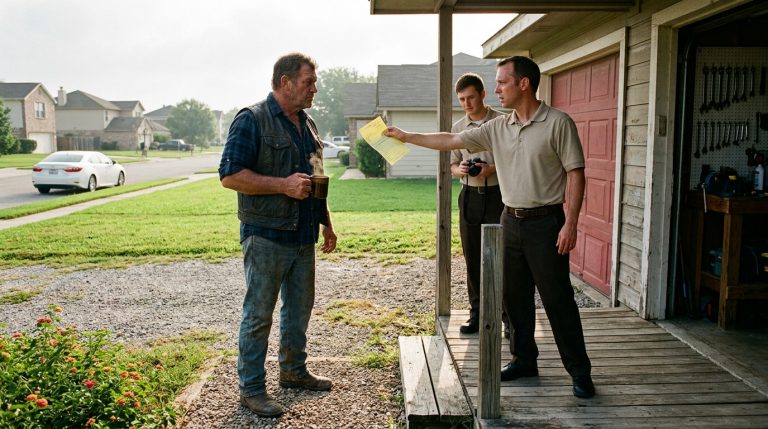
The knock on the door was different this time. It lacked the frantic, unpolished rhythm of an HOA enforcer. It was slow, methodical, and carried the crushing weight of municipal authority. Garrett opened the door to find Roland Stevens standing on his porch, a man whose presence in the county building department usually meant the end of a homeowner’s dreams.
Stevens didn’t offer a polite greeting. He held a thick manila envelope, its edges pressed sharp and crisp. He stepped inside without waiting for an invitation, his gaze sweeping the living room with the clinical indifference of an appraiser.
“Mr. Hollis,” Stevens said, his voice as dry as the dust he tracked across the hardwood. “I’ve spent the better part of the morning evaluating the dam’s structural integrity. I’m afraid I have a formal notice from the county health and safety commission.”
Garrett felt a cold, jagged spike of adrenaline in his chest. He stayed perfectly still, his hands loose at his sides, though his mind was already running through the structural schematics he had memorized years ago. “The spillway is weathered, Stevens. That’s not a secret. But ‘condemnation’ requires evidence of imminent failure. You don’t have that.”
Stevens handed him the envelope. Inside was a series of color photographs, their high-gloss finish catching the light. They showed the spillway blocks, zoomed in until the hairline fractures looked like gaping canyons. “The moisture meter doesn’t lie, Garrett. We’re seeing deep-seated seepage. If we get a heavy rain, the pressure differential could compromise the entire eastern earthen wall. The county has to act.”
Garrett flipped through the pages. The logic was sound, technically. It was a perfect, calibrated argument for disaster. He looked at the depth-gauge readings on the last page. They were precise, but they were also wrong. The gauge he had installed two weeks ago showed a variance of nearly three inches from what the county’s report claimed.
He looked up at Stevens. “These numbers are inflated. You’re measuring the standing water, not the structural deflection.”
“I’m following the protocol, Mr. Hollis,” Stevens replied, his tone chillingly neutral. “The HOA has filed an emergency petition claiming that your obstruction of their survey teams prevented them from performing routine maintenance. Given the risk to the community, the board has requested that the county take over the structural remediation under the ‘Public Hazard’ clause.”
The room seemed to shrink. The air grew thick, stifling. Garrett realized then that Barbara hadn’t just been bullying him—she had been building an elaborate theater of incompetence to force the county’s hand. She was using the county’s own bureaucracy to strip him of his property rights.
“The Public Hazard clause requires a declared emergency,” Garrett said, his voice dropping into a register that made Stevens pause. “There is no emergency. There is a disgruntled HOA president and a spillway that needs routine regrouting.”
“Not anymore,” Stevens said. “As of this morning, the lakefront property owners have initiated a class-action filing. They’re claiming the dam is a nuisance. The county is just the neutral third party here to ensure safety.”
Neutral. Garrett almost laughed. He leaned against the mantle, the rough, stone surface biting into his palms. The decoy secret—the idea that the HOA was just angry about aesthetic standards—had been shattered. This was about power. This was about stripping the property from his hands and reclassifying it as a public utility to be managed by a firm the HOA president just happened to be connected to.
He looked at the last document in the envelope. It was a formal order to cease all maintenance activities on the dam, effective immediately, until a county-approved contractor could take possession of the spillway controls.
“You’re not here to inspect, Stevens,” Garrett said, his eyes locking onto the man’s. “You’re here to facilitate a theft.”
“I’m here to fulfill my duty,” Stevens replied. He turned toward the door, his shadow long and dark across the floorboards. “You have forty-eight hours to vacate the dam perimeter, or the Sheriff’s department will be out to ensure compliance. I wouldn’t suggest making this difficult.”
The door clicked shut, the sound echoing like a final hammer blow in a courtroom. Garrett stood in the silence of the house, the manila envelope heavy in his hand. He hadn’t failed; he had been outmaneuvered, pushed by a system that favored the loudest voice over the most accurate data.
But he was an engineer. He knew that even the most solid foundations had stress points. If they wanted a public hazard, he would give them one—but it would be on his terms. He walked to the window. The lake sat below the house, seemingly perfect, but beneath the surface, the water was shifting. The pressure was building.
He grabbed his laptop and opened the digital files Marcus had sent over earlier that morning: the history of the lake’s construction, the original water rights, and the specific, forgotten clauses of the 1962 land grant. He started to type. He wasn’t going to fight the county in court. He was going to expose the rot underneath the entire community’s claim to the water.
He realized then that Barbara had made a fatal mistake. She had focused so hard on the surface, on the appearance of safety, that she had completely ignored the internal mechanics of the system. She thought she was condemning his property. She didn’t realize she was triggering the very mechanism his grandfather had designed to keep people like her away from the heart of this valley.
He sent the email to Marcus: They pulled the trigger. File the revocation. Now.
He waited for the reply, his heart hammering against his ribs. The silence in the room wasn’t heavy anymore. It was sharp. It was the sound of a system nearing its critical failure point. Barbara wanted a fight. She had it. But she didn’t realize that when the foundation of a house is rotten, you don’t need to rebuild it. You just need to pull the pin.
CHAPTER 5: THE ROAR OF INEVITABILITY
The rain had begun, a cold, needle-like drizzle that turned the earth around the dam into a slick, treacherous paste of gray mud. Garrett walked down the access path, his flashlight beam cutting a path through the dark. He wasn’t thinking about the county’s order or the Sheriff’s pending arrival. He wasn’t thinking about Barbara or her expensive lawyers.
He was thinking about the valve.
He reached the spillway control station—a small, reinforced concrete bunker that had sat silent for decades. The air inside smelled of stagnant water and cold, damp iron. He shone his light on the control panel. It was rudimentary, a mechanical relic of 1961, consisting of a heavy iron wheel connected to a series of subterranean gears.
He reached out and gripped the wheel. It was cold, the iron biting into his palms. He pulled, but it didn’t move. It was seized by rust and neglect, a locked jaw of metal that had surrendered its purpose to the long, quiet years.
“Don’t let them push you around,” he whispered, the sound barely audible over the growing roar of the wind.
He moved to the storage cabinet and retrieved a heavy steel wrench and a can of industrial penetrant. He sprayed the joints, the liquid hissing as it hit the oxidized metal. He worked the wrench, his muscles screaming as he applied leverage, forcing the gears to grind. There was a sound like a gunshot—a sharp, violent crack—as the rust seal shattered.
He leaned into the wheel, putting every ounce of his weight behind the rotation. With a slow, agonizing groan, the gears began to turn.
Outside, the world began to change.
The sound was instantaneous—a deep, low-frequency rumble that vibrated through the soles of his boots. He stepped out of the bunker just as the spillway gate began to lift. The water, held back for a generation, surged forward with a sudden, violent hunger. It didn’t trickle; it tore through the spillway, a roiling, white-capped mass of foam and fury that drowned out the rain.
Garrett stood at the edge, watching the water level at the intake begin to sink. It was happening faster than he had calculated. The sheer pressure of the lake, no longer contained by the sedimented silence of the dam, was reclaiming its path.
He checked his watch. He had initiated the drawdown, the legal equivalent of firing a warning shot, but the physical reality was far more terrifying than the legal one. The lake was a living thing, and he had just cut its tether.
By the time he climbed back up the ridge to his truck, the sound had become a constant, deafening roar. He could see lights flickering on in the distance—the expensive, sprawling homes of Hawthorne Lake. They were waking up to a world that was suddenly, visibly, failing. The water was receding, and with it, the artificial sense of security that had defined their lives for years.
His phone vibrated in his pocket. A text from Marcus: The county sheriff is on his way to the main gate. They have an injunction. They want the spillway closed.
Garrett didn’t stop. He turned his key in the ignition and started the truck. He didn’t head toward the main gate. He drove to the secondary access road, the one that led to the backside of the dam, where the drainage fields sat. If they wanted to stop the flow, they’d have to find him first. And he had a feeling that once the community saw the water dropping, once they smelled the exposed, rotting earth of the lake bed, the Sheriff wouldn’t be the one they were calling.
He stopped the truck near the spillway exit and looked out at the path of the water. It was a scar on the landscape, a dark, churning channel of mud and debris. It was a disaster. It was also, he realized, the only language the community understood.
He felt no joy. He felt a hollow, aching emptiness. He had saved his property rights, but he had destroyed the illusion of the valley. He had turned the dream of a private paradise into a mud-caked reality, and as he watched the water drop another two inches in the span of ten minutes, he knew there was no going back.
The phone buzzed again. This time it was a call from an unknown number. He answered it.
“Garrett?” It was Vince Windham. His voice wasn’t aggressive anymore. It was thin, frayed, terrified. “The docks are dry. My boat is sitting in the mud. What the hell did you do?”
“I fixed the problem,” Garrett said, his voice as cold as the rain hitting the windshield. “I told you what it would cost to maintain the dam. You chose not to pay. Now you’re finding out the price of everything else.”
“We’ll pay,” Vince said, his voice shaking. “Whatever you want. Just stop the water. Please. My entire portfolio is on that shore.”
Garrett looked at the dam. The concrete, the very structure he had fought to preserve, was shuddering under the immense, shifting pressure of the draining lake. He saw a new crack forming near the base, a fissure that hadn’t been there an hour ago.
The mechanism was working too well. The dam wasn’t just losing water; it was losing its foundation. He had calculated the stress, he had accounted for the weight, but he hadn’t accounted for the age of the structure itself.
He realized then that the decoy—the idea that this was just a game of leverage—was gone. The dam was failing for real. He had intended to create a controlled crisis, but he had triggered a collapse.
He hung up on Vince. He had to reach the bunker. If he couldn’t seal the gate, the entire eastern earthen wall would liquify under the pressure of the draining reservoir. He scrambled out of the truck, his boots sliding on the slick, treacherous mud, and sprinted back toward the roar of the water, a desperate, impossible race against a force he had set in motion but could no longer control.
The dam was screaming, the metal and concrete grinding together in a final, agonizing protest. He reached the bunker door, his hands trembling as he reached for the manual release.
It was gone. The entire control arm had snapped off, sheared clean by the weight of the water.
He was standing in the dark, the roar of the lake surrounding him, and the gate was wide open.
CHAPTER 6: THE SILENCE OF THE SPILLWAY
Garrett stared at the jagged, twisted metal where the control arm had been. The roar of the water was no longer a sound; it was a physical weight, a vibration that rattled his teeth and blurred his vision. The bunker felt small, airless, a tomb of his own making.
He didn’t panic. He moved with a cold, mechanical precision that felt alien to his own body. He wasn’t the man who had walked down this path an hour ago. He was the sum of his grandfather’s anger, a legacy of resentment that had waited sixty years to find a host.
He scrambled back outside, the rain freezing on his face. The dam was groaning—not a metallic screech, but a deep, structural tectonic shift. The water was tearing at the earthen embankment, eroding the very dirt he had walked upon as a child.
He saw a flash of light through the trees: the Sheriff’s cruiser, its blue and red strobes painting the woods in sickly, rhythmic pulses. They were too late. They were always too late.
He didn’t run to meet them. He ran to the emergency intake, the auxiliary sluice gate that Everett had designed as a secondary fail-safe, a manual, chain-driven brute-force override. He had never used it. He had never even seen it fully deployed. He tore the tarpaulin away, his hands slick with mud and oil, and found the heavy, rusted chain.
He hooked his weight to it, screaming as he forced the links to move. The chain bit into his shoulders, tearing his jacket, bruising his skin, but he pulled. He pulled until the world narrowed down to the sensation of iron on flesh.
Clang.
The auxiliary gate groaned, caught, and then dropped.
The water didn’t stop, but the volume shifted. The roar changed pitch, dropping from a scream to a heavy, turbulent churn. The pressure on the eastern wall leveled off, the vibration in the ground beneath his feet slowly fading, replaced by a rhythmic, heavy pulse.
Garrett collapsed, his back against the wet concrete, his lungs burning. He looked up at the sky. The rain had stopped. The moon had broken through the clouds, casting a silver, unforgiving light over the scene.
He could hear voices now. The Sheriff, shouting commands. The sound of heavy boots on gravel.
He didn’t move. He watched the lake. It was dying. The water was receding faster than it had in the morning, revealing the skeletal remains of what lay beneath: the rotting piers of old docks, the long-submerged stumps of oaks his grandfather had cleared, the debris of a community that had forgotten it was living on borrowed time.
Barbara Windham appeared at the crest of the dam, escorted by the Sheriff. She was wrapped in an expensive trench coat, her hair a mess, her face pale and drawn. She looked not at the Sheriff, but at Garrett, slumped in the mud by the intake.
She walked toward him, her steps hesitant. The arrogance was gone, replaced by a raw, naked horror. She looked at the decimated spillway, the broken controls, the raw, muddy scar of the dam’s earthen face.
“You killed it,” she whispered. Her voice was barely audible over the receding water. “You killed everything.”
Garrett looked at her, and for the first time, he saw her as she truly was—not a villain, not an antagonist, but a small, terrified woman who had tried to build a monument to her own importance on a foundation she didn’t understand.
“No,” Garrett said, his voice raspy, broken. “I just uncovered the truth of what you built. You didn’t own a paradise, Barbara. You owned a lie. And the water finally decided it was tired of holding it up.”
The Sheriff stepped forward, his hand on his holster, his face stern. “Garrett Hollis, you’re under arrest for reckless endangerment and the destruction of public-use infrastructure.”
Garrett stood up. His movements were slow, stiff, as if his bones had turned to lead. He didn’t fight. He didn’t try to explain. He held out his wrists, the mud on his sleeves caked dry.
As they walked him toward the cruiser, he looked back one last time. The lake was a shadow now, a dark, shrinking pool in the center of a muddy basin. The houses were silent, their windows staring back like dead eyes.
He realized then that he had saved the dam, he had saved the valley from a catastrophic structural collapse, but he had lost the home. He had become the man his grandfather had warned him about—the one who, in the pursuit of justice, had forgotten how to live in the world he was defending.
The cruiser door slammed shut, sealing out the smell of the mud and the roar of the water. As they pulled away, Garrett leaned his head against the glass. He could still hear the ghost of the water, a low, persistent hum in his ears.
He was going to prison. He was going to lose the land. But as the cruiser turned onto the main road, he looked at his hands—calloused, bleeding, stained with the rust of his grandfather’s legacy—and he knew one thing for certain.
The lake would never be the same. And neither would the people who had tried to build their lives upon it. They would always know, in the quiet of the night, that the water could disappear. They would always look at the shore and see the mud. They would always know, deep down, that they had never owned anything at all.
He closed his eyes. The roar was gone, replaced by the smooth, steady hum of the road.
He had done it. He had finally, completely, leveled the field.