The Iron Shore: A Tale of Stolen Inheritance, Federal Warfare, and the Grim Weight of Sovereign Ground
CHAPTER 1: THE RECKONING OF PINEREST DRAG
The iron-and-brass gears of Dutch’s old fishing reel didn’t turn with a clean hum anymore; they ground against seventy-five years of accumulated lake grit, clicking like a safety catch being pulled back in the dark. I didn’t drop the line into the water. The vibration traveling up the split-bamboo rod was entirely wrong—it wasn’t the slow, heavy pull of a bottom-feeding pike, but the rhythmic, low-frequency shudder of a twin-mix concrete truck down-shifting into low gear less than three hundred yards away.
The smell came next, cutting straight through the damp, cold morning mist that usually tasted of rotted pine and iron-heavy lake water. It was the sharp, synthetic sting of diesel exhaust and fresh concrete sealant.
I set the rod down on the graying wood of the original 1947 dock. Every plank under my boots was a piece of timber my grandfather had hauled out of the northern ridge with a single-axle truck and a pair of logging chains. The wood was notched with his specific, heavy hand-axe marks. But as I turned the corner of the shoreline path where the huckleberry brush grew thick, the silence of the three-thousand-acre inheritance didn’t exist anymore. It had been replaced by the high, metallic scream of a framing saw eating through green lumber.
The trees cleared, and the landscape turned desaturated, rutted, and raw.
Where there should have been an empty, clay-slick bank covered in wild rye, an entirely illegal village sat rising out of the dirt. Twenty-seven vacation cabins, built with premium hemlock and wrap-around cedar decks, stretched along my inherited shoreline like a row of teeth. Paved access roads cut gray ribbons through the moss. Private docks, welded from heavy galvanized steel, jutted into the water without a single state environmental tag on their piles.
“You’re trespassing on private development,” an elderly man called out. He was standing on a half-finished porch, a nail gun resting against his thigh like a cold-iron revolver. His skin was leathered from lake sun, his t-shirt stenciled with a stylized pine tree logo. “Best turn around before you cause yourself a legal headache, son.”
Before I could clear the gravel from my throat, two more doors swung open down the line. A young woman with crossed arms stepped onto a gravel driveway, her eyes tracking my mud-stained work boots with immediate, coordinated hostility. These people didn’t look like standard drifters or hidden squatters; they looked like investors who had cleared their bank accounts to buy a piece of paradise that didn’t belong to them.
“This community’s been under management for three years,” the man added, his voice carrying the hard, transactional edge of a person defending an invoice. “We don’t take kindly to outsiders wandering through the lots.”
The heavy crunch of oversized tires on gravel cut the conversation short. A white Escalade rolled down the freshly oiled dirt road, its front bumper coated in a fine layer of gray dust. The vanity plate read PINEREST HOA.
The door swung open, and Connie Blackwell stepped into the ruts. She was in her late fifties, her silver hair styled into an immutable shape that resisted the damp lake wind. Her designer hiking boots were pristine—completely untouched by the red clay clinging to my own heels—and she held a thick leather portfolio against her chest like a shield.
“You must be Dutch’s grandson,” she said, her voice dropping into a practiced, administrative cadence that sounded like it had been synthesized in an insurance office. She didn’t offer a hand. Instead, she adjusted her grip on the leather binder, the plastic sleeves inside rattling like dry leaves. “I suppose no one informed you about our established management structure here. Your grandfather was less… active in his later years. The community needed oversight.”
“Oversight,” I repeated. The word tasted like rust. My fingers traced the outline of the handwritten note tucked inside my canvas jacket—the one Dutch had left me six months ago, written with a failing ballpoint pen on the back of a tax receipt. Protect our land from those who would steal what we built.
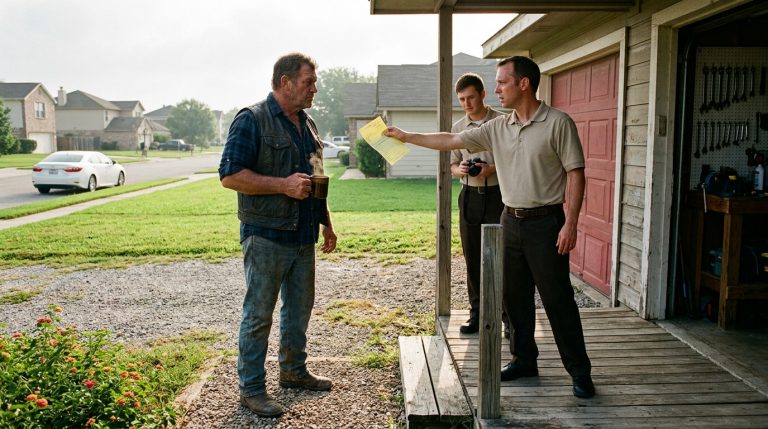
“As HOA president, I’ve spent thirty-six months coordinating infrastructure, septic layouts, and shoreline stabilization,” Connie said, her face completely empty of guilt as she slid a crisp, white sheet of paper from her portfolio. The cheap computer printout looked glaringly false against the dark backdrop of the timber line. She held it out, her manicured nail tapping the bottom line. “Your family’s parcel is three years behind on community assessment fees. That’s fourteen thousand dollars, including the late penalties. We need it cleared before the winter grading begins.”
CHAPTER 2: THE PAPER GRAIN AND THE LOCKS
“Fourteen thousand dollars,” I said, the words dry as the wood-ash coating the cabin stove. I didn’t take the paper from Connie Blackwell’s manicured fingers. Instead, I let my hand drop to my side, my knuckles brushing against the coarse canvas of my field jacket. “My grandfather didn’t pay for air, Connie. And he sure as hell didn’t pay people for digging up his ridges.”
Connie’s smile didn’t drop; it simply locked into place, the corners of her mouth tight and sharp like a staple driven into drywall. Behind her, the white Escalade ticked as its engine cooled, the heat rising from the grill carrying the chemical stink of fresh oil.
“Dutch was a traditionalist,” she said, her leather portfolio making a wet, sliding sound against her coat as she tucked the invoice back inside. “But tradition doesn’t grade roads, Mr. McKinnon. It doesn’t maintain the septic lines that keep this entire cove from smelling like an open sewer. Twenty-seven families depend on the infrastructure I’ve put into this ground. If you choose not to participate, the association will simply record a lien against the underlying acreage. It’s standard practice.”
“A lien on Dutch’s deed,” I said.
“On the property,” she corrected smoothly. She turned on her heel, her flawless boots pivoting on the sharp gray gravel without catching a single stone. “Think about it. We have a community meeting at the Grange Hall down the road on Monday morning. Most of your neighbors will be there. It would be a shame if the first impression they had of the new owner was… obstruction.”
I watched the Escalade back down the narrow, gravel-churned corridor of Pinerest Drive. The dust it kicked up hung in the damp air, settling over the wild fern and the freshly split hemlock logs stacked beside the nearest cabin. The silence that returned wasn’t the clean, mountain stillness Dutch had left me; it was a guarded, watchful quiet. From three separate windows down the shoreline, the glare of cheap glass reflected the morning light—eyes behind the curtains, tracking the outsider.
I walked back toward my grandfather’s original cabin, the soles of my work boots grinding against the iron-rich gravel. The structure sat on a low rise of exposed granite, its hand-hewn cedar logs dark with sixty years of linseed oil and creosote. It was the only building on the shore that didn’t look like it had been unboxed from a suburban shipping container.
Before I went inside, I stopped by the old tool shed tucked behind the kitchen wall. It was a small lean-to built from rough-sawn pine planks, its roof covered in green corrugated tin that had rusted down to a dull, bleeding brown at the eaves. Dutch had kept his old crosscut saws, his grease guns, and his property markers here. But as I reached for the latch, my hand stopped.
The heavy, blackened iron chain Dutch had used for forty years was still looped through the hasp, but the old brass Yale padlock—the one that required two turns of a flat iron key—was gone. In its place hung a bright, aggressive square of modern zinc. It was a cheap, hardware-store padlock, completely unweathered, its chrome shackle completely free of rust.
Someone had cut my grandfather’s lock and put their own security on my shed.
The friction of the new keyhole was stiff as I shoved a small screwdriver into the cylinder, applying pressure until the cheap internal pins sheared with a sharp, metallic snap. The zinc lock dropped into the dirt with a heavy thud. I yanked the chain clear, the rusted links scraping against my skin, leaving a dry, orange stain across my palm.
Inside, the shed smelled of rotted canvas and kerosene. Everything had been moved. The heavy cast-iron survey stakes Dutch used to mark the northwestern boundary line were gone from their corner. In their place sat three orange plastic road cones and a professional-grade survey transit mounted on a bright yellow aluminum tripod. A small, grease-smudged logbook lay on top of an upturned wooden crate.
I leaned down, the floorboards creaking under my weight as I flipped the cover open with a dirt-caked thumb.
The pages weren’t filled with Dutch’s looping, old-fashioned script. It was a neat, columned ledger written in blue ballpoint. Lot 14—Foundation pour complete, June 12. Lot 15—Septic line tie-in, June 14. Access road extension—cleared through McKinnon Ridge. The entries went back three full years, tracking every foot of the illegal subdivision with cold, mechanical precision.
But it was the notation at the bottom of the final page that made the skin across my jaw tighten until it ached.
McKinnon Parcel 1—Clearance pending title adjustment. Target date: July 5.
July fifth was less than three weeks away.
I closed the logbook, the paper grain rough against my skin, and shoved it deep into my coat pocket. The transit stayed where it was. I didn’t want them knowing I’d broken their cheap zinc lock just yet. I stepped back out into the gray light, the smell of the lake water rising as the wind shifted from the north, carrying the low, persistent whine of another chainsaw starting up down the shore.
I walked to the main cabin, pulled the iron key from my pocket, and unlocked the heavy oak door. The interior was cold, the air holding the faint, metallic scent of the wood-stove pipe and the musty wool of Dutch’s old army blankets. In the corner sat his heavy green field chest—a steel-reinforced military trunk that had survived the mud of the Ardennes before settling into the floorboards of this cabin.
The brass corner guards were pitted with green verdigris, and the iron handles were rough with scale. I knelt in the dust, my knees sinking into the worn rag rug, and lifted the lid. The hinges shrieked, a high, ungreased scream that filled the empty room.
Inside lay the real architecture of this land. Seventy-five years of meticulous, blue-ink receipts. The original 1947 deed, printed on heavy parchment that had turned the color of old horn, bearing the official embossed seal of the county recorder. Every property tax payment from the Truman administration to the previous winter was stacked in neat, twine-bound bundles.
As I pulled the deed from its leather sleeve, a certified mail envelope slipped from beneath the bundle and fell onto the floorboards. It was postmarked four days before Dutch died.
The return address wasn’t Connie Blackwell’s fake HOA office. It was printed in sharp, raised black lettering: Thompson & Associates, Legal Counsel, Suite 400, County Seat.
I tore the envelope open, the paper splitting with a loud rasp that sounded like dry brush snapping underfoot. Inside was a formal notice of intent to file for adverse possession under state code section 41-B. The language was cold, dense, and weaponized. It asserted that the clients—Bill Thompson, Marcus Williams, and twenty-five other named individuals—had maintained continuous, open, and notorious occupation of the shoreline parcels for a period exceeding twenty years.
Twenty years.
I looked out the small cabin window, my eyes tracking the raw, yellow clay cuts where the foundations of the closest cabins sat. The hemlock siding on those structures hadn’t even begun to turn gray from the winter storms. The asphalt on Pinerest Drive was so fresh the oil still shimmered in the ruts during the heat of the day.
They weren’t just building an illegal village on my land; they were preparing to use a high-priced legal firm to swear under oath that they had been living in the dirt since the late nineties. And they had timed it perfectly to hit the moment the old man’s heart finally gave out.
The floorboard behind me didn’t creak, but the air in the small cabin shifted. The smell of cold pipe tobacco and damp wool was suddenly cut by the sharp odor of damp earth and cheap cologne.
I didn’t turn around quickly. I let my fingers slide over the cold embossed seal of the 1947 deed, locking the parchment into my grip before I slowly rose to my feet.
A man was standing in the open doorway, his massive frame blocking out the gray morning light from the lake. He wore a red-and-black wool coat that had the sleeves cut off at the shoulders, exposing forearms that looked like knots of hickory wood. His face was wide, his nose broken and reset poorly at the bridge, and his eyes were bloodshot from a long night or a deep anger.
Bill Thompson. The patriarch of the first cabin down the line.
“You’re looking at things that don’t concern you, boy,” Thompson said. His voice was a low, gravelly rumble that vibrated through the small cabin’s log walls. He stepped over the threshold, his heavy mud-slicked boots leaving two black tracks across Dutch’s clean rag rug. He didn’t look at me; his eyes were fixed entirely on the iron chest open at my feet. “That old box doesn’t change the dirt outside. We’ve poured our sweat into this cove. We’ve made it something. A piece of paper from World War II doesn’t mean a damn thing to a bulldozer.”
CHAPTER 3: THE GRAIN OF THE RECORD
The steel binding of the county deed ledger was cold enough to sweat against my palms, leaving a faint streak of black rust across the yellowed edges of the 2019 property filings. Down here in the basement of the county courthouse, the air didn’t move. It smelled of dry ink degradation, old water pipes, and the fine limestone dust crumbling from the unpainted foundation walls. Every time a heavy truck rumbled on the street above, a thin shudder ran through the cast-iron shelving units, making the heavy volumes rattle in their slots like old teeth.
I turned the page, the dry fiber scraping loudly against the metal table.
Bill Thompson’s threats back at the cabin had been heavy, calculated to leave a bruise before any ground was broken. But weight on a gravel road didn’t mean anything if it couldn’t stand up to the county seal. My thumb traced down the columned ledger for Section 4, Township 12—the grid coordinates that contained every inch of Dutch’s three thousand acres.
According to the certified letter Thompson & Associates had sent, the community had held an open, continuous presence on the shoreline for two decades. But the ink on the pages in front of me didn’t lie.
There was no Pinerest HOA listed in the tax rolls for 2006. There was nothing in 2116. The land had remained an unbroken block of private timberland under the name McKinnon until the winter of 2019. That was the year the first structural assessment appeared—a single line item for an unapproved timber clearing on what they had labeled ‘Lot 1.’
I leaned closer, my eyes burning under the low-wattage fluorescent bulb humming directly above the table. The page numbers at the top of the ledger ran in sequence: 412, 413, 414. Then, a raw edge. The paper had been sliced out with a straight razor close to the heavy thread binding. Pages 415 through 417 were gone. The next visible sheet began cleanly at 418, dated mid-2020, right when the pandemic panic had sent city buyers running into the hills with pockets full of cash.
Someone had physically cleaned the record before I arrived.
“Looking for something specific, Mr. McKinnon?”
The voice came from the dark gap between the structural steel shelves. The county clerk, a thin man named Miller whose skin had taken on the desaturated gray hue of the basement walls, stepped into the light. He carried a small brass ring of keys that jingled with a flat, tinny rattle. His eyes didn’t look at my face; they fixed directly on the open ledger.
“Three pages are missing from the 2019 index,” I said, my finger resting on the jagged white line near the binding. “The year Connie Blackwell started collecting her first management fees.”
Miller didn’t flinch. He reached into his vest pocket, pulled out a small tin of oil-soaked rags, and began wiping down a set of metal calipers he’d been carrying. The sharp, mechanical smell of machine oil filled the small space between us. “Old books lose their glue, son. The moisture down here eats through everything given enough time. Iron rots, paper turns to ash. If it isn’t in the index, it doesn’t exist under county law.”
“The tax receipts exist,” I said, pulling the twine-bound bundle from Dutch’s green military chest out of my canvas sack. I dropped it onto the metal table with a heavy, metallic thud that sent a small cloud of limestone dust into the air. “Every dollar paid, year after year. Continuous title.”
Miller looked at the bundle, his jaw working silently over a piece of dry tobacco. “The law recognizes improvements, Mr. McKinnon. A man who lets a field sit wild for twenty years while someone else builds a roof and lays a pipe… well, the judges around here tend to look at the man holding the hammer, not the man holding an old piece of parchment.”
He turned and walked back into the shadow of the records stacks, his keys clinking against his belt like a loose tire chain.
I didn’t waste time arguing with a clerk who smelled like wet iron and old lard. I closed the ledger, the heavy steel cover slamming down with a sound like a rifle shot in the enclosed basement. Ten minutes later, I had the county building inspector’s phone number and a certified stack of cease-and-desist forms stamped by the notary on the first floor.
The drive back up Pinerest Drag was a slow grind through heavy clay ruts that had dried under the midday sun into hard, bone-colored ridges. When I reached the perimeter of the property line, I stopped the truck. I pulled three large, red-and-black steel signs from the bed—PRIVATE PROPERTY: NO TRESPASSING UNDER PENALTY OF LAW—and began hammering the steel fence posts into the hard packed earth with a five-pound sledge.
Each strike of the hammer sent a jarring vibration straight up my forearms, the iron-on-iron ringing out across the quiet water of the lake.
“You’re wasting your ink, boy.”
Bill Thompson had appeared from behind a stack of fresh foundation blocks twenty yards down the road. He didn’t have his nail gun this time, but he had two men behind him—younger versions of himself, their hands stained with gray cement dust and their boots caked in fresh mud. One of them carried a long iron crowbar across his shoulder like a walking stick.
“These signs don’t hold mud,” Thompson said, walking up to the edge of the road where the steel post sat crooked in the clay. He reached out with one massive, calloused hand, grabbed the top of the sign, and twisted. The steel post groaned, the iron bending until the red paint cracked and peeled away from the weld. “We’ve got forty-eight hours before our next framing inspection. If you think a piece of tin from the hardware store is going to stop twenty-seven families from securing their roofs, you’ve got a lot to learn about how things work out here in the gray.”
The young man with the crowbar shifted his weight, the heavy iron tool scraping against a loose stone with a dry, white shriek.
“The county records show you started building in 2019, Bill,” I said, keeping my grip low and tight on the wooden handle of the sledgehammer. The iron head rested against the toe of my boot, heavy and static. “The twenty-year rule doesn’t apply to a five-year-old lie. You’ve been paying Connie Blackwell for land she doesn’t own, and the building inspector is already pulling the permits.”
Thompson didn’t back down. His chest heaved against the wool of his cut-off vest, his face turning the dark, angry color of a rusted pipe left out in the rain. “Connie’s got the paperwork handled. We’ve got receipts from the association going back twenty years on paper that came straight from the county seat. If your grandfather’s book didn’t show it, that’s his failure of maintenance, not ours.”
He leaned in closer, the smell of stale coffee and dry sweat rising off his skin. “We’re not moving our walls. Tomorrow morning, we start the second story on Lot 12. If you want to pull these posts, you’d better bring something heavier than an old man’s memories.”
He turned, and with a single, heavy kick of his work boot, he struck the base of the steel signpost. The metal sheared at the ground level, the sign collapsing into the red dirt with a dull, hollow clang.
CHAPTER 4: THE BLUE WAX AND THE CEMENT LINE
The certified copy of the emergency restraining order felt heavy, stiff, and distinctly cold against my palms. It was stamped with a local magistrate’s signature that looked rushed, a blue ballpoint ink scribble that hadn’t even fully dried before the paper was shoved into my face. The concrete mixers were already churning at triple speed on Lot 12, the dull, wet roar of the rotating steel drums drowning out the natural lap of the water against the shore.
“You can’t be within fifty feet of active construction, Mr. McKinnon,” Connie Blackwell said, leaning against the hood of a county zoning truck. She held a fresh blueprint map pinned down with two pieces of rusted rebar to keep the wind from catching the edges. In the center of the document sat a large, round impression made of blue sealing wax. It was the county recorder’s official mark, but as I caught the light shifting across the crest, the edges looked blurred, the central seal off-center by a fraction of an inch. “The county commissioners are reviewing our residential emergency application on Monday. Until then, this injunction protects the investments already in the ground.”
The smell of fast-curing cement sealant was suffocating, a thick chemical vapor that mixed with the dust kicked up by a yellow skid-steer loader moving across the freshly cut sand ruts.
“This map doesn’t match the county ledger, Connie,” I said, my voice low, competing with the metallic rattle of rebar being thrown from the bed of a flatbed truck. I didn’t step back, despite the deputy sheriff standing twenty feet away, his leather utility belt creaking as he shifted his weight on the gravel. “The township line on this document covers three hundred acres of wet cedar swamp that my grandfather paid taxes on last November. You can’t rezone an open title.”
Connie didn’t flinch. Her eyes were hard, flat gray stones under her styled hair. “The law protects a growing community from intentional economic harassment. We have elderly residents down this line who are experiencing documented physical distress because you’re driving around posting illegal notices. The court agreed that status quo must be maintained.”
“Status quo means you keep pouring concrete while the title is locked,” I remarked, watching Bill Thompson’s son guide a long chute from the mixer truck straight into a deep trench lined with raw plywood forms. The wet gray sludge slid down the iron trough with a wet, heavy slap, filling the trench and drowning out the roots of the old-growth pines that had stood there for a century.
“It means the community survives,” Connie replied. She rolled the map up with a sharp, dry snap of the paper, the off-center wax seal disappearing into the cylinder. “You should check your own boundaries before Monday, Mr. McKinnon. You might find the ground under your grandfather’s cabin isn’t quite as stable as you think.”
I turned away from the noise, my boots sinking into the loose, torn earth of the new access road. Every step away from the shoreline felt like a tactical retreat, but the weight of the law was currently being used as a shield by an operator who knew exactly how to manipulate the gears of local bureaucracy.
I didn’t go back to the cabin. Instead, I walked down to the eastern cove where the old surveyor’s marker—a three-inch iron pipe driven deep into the granite bedrock by Dutch and the county engineer in 1952—was supposed to sit. The brush had been cleared by a machine, the ground scraped raw down to the grey stone.
When I reached the coordinates, the iron pipe was gone. In its place was a fresh drill hole, the rock around it still white with stone dust, and a new aluminum survey cap stamped with the initials P.H.O.A. They weren’t just waiting for a court date. They were physically moving the history of the shore, one inch of iron at a time, using the noise of the construction to mask the theft. I knelt by the hole, my fingers tracing the rough, freshly cut edges of the granite. The stone was cold, holding the damp chill of the deep lake winter, but the gray dust left a dry residue on my skin that smelled distinctly of industrial drilling lubricants.
As I stood up, a black sedan with out-of-county plates slowed down on the main perimeter road above the cove, its tinted windows rolled up tight against the dust. It didn’t belong to any of the vacationing families. It lingered for thirty seconds, the exhaust pipe coughing a dark plume of diesel smoke into the pine needles, before accelerating toward Connie Blackwell’s central compound.
The community wasn’t just expanding; it was closing ranks, building a legal and physical wall around my inheritance before the first gavel could fall at the county seat. The gray mask they were wearing was beginning to crack, but the intellect behind the defense was calculated, fast, and entirely prepared for a long war in the dirt.
CHAPTER 5: THE STORMWATER CRACK
The sky didn’t open up with a clean downpour; it dropped a heavy, sulfur-colored wall of water that turned the clay cuts of Pinerest Drive into a thick, sliding soup within twenty minutes. The rain hit the tin roof of Dutch’s cabin with the steady, deafening roar of gravel dumping from a truck bed. Out on the water, the visibility shriveled to less than fifty feet, turning the across-the-lake cabins into dark, shivering shapes that looked more like sinking barges than high-end real estate.
By the second hour of the deluge, the real infrastructure failures began to wash out from under Connie Blackwell’s feet.
I stood on the eastern ridge wrapped in a stiff, oil-tarred slicker, watching the hillside behind Lot 14 give way. The sand ruts, baked dry by three months of unpermitted machinery traffic, couldn’t hold the volume. A thick, brown tongue of saturated silt and gray gravel cut right through the newly poured retaining wall of the Williams cabin. The unreinforced block foundation groaned, a sharp crack-crack of breaking mortar echoing across the cove just before the ground beneath their lakeside porch liquefied entirely.
“The culvert’s blocked!” Marcus Williams shouted from his lower deck. He was soaked through to his skin, his hands slipping on the handle of a rusted iron trenching shovel as he tried to clear a pipe that had completely filled with mud. “The intake from the main road is backing up into our basement! Where the hell is the association truck?”
No truck was coming. Up on the perimeter road, the white Escalade was conspicuously absent, leaving only the sound of roaring water cutting new channels through the unauthorized asphalt paths.
I walked down the crumbling edge of the bank, my boots sliding in the loose grit until my heel hit a flat, iron grate. It was a makeshift drainage junction, crudely welded from scrap steel and hidden under a layer of river stone. The water rushing through it wasn’t clearing toward the valley—it was bubbling backward, a grey, foul-smelling soup that left a oily sheen on the flooded grass.
Tucked into the split boards of a nearby septic inspection box, a sodden plastic folder had been ripped open by the rising water. I leaned down, the rain lashing against the stiff hood of my slicker as I pulled out a handful of water-logged papers.
The documents weren’t standard residential manuals. Among the saturated sheets was a commercial-grade plumbing invoice from an industrial utility contractor based three states away, billed directly to Blackwell Holdings LLC. The line items detailed the installation of six large-capacity commercial holding tanks, far exceeding anything needed for a single-family vacation shack. Below the numbers was a handwritten note in the margin: Hide the overflow lines in the northern wetland shelf. Do not file with the county inspector.
They hadn’t just built a neighborhood; they had engineered a massive, high-turnover commercial commercial rental operation disguised as private cabins, running the heavy greywater lines directly into the protected lake bottom to save on legitimate utility costs.
A sharp, horn-like blast cut through the storm.
Down at the Williams place, Marcus was waving his arms at a flatbed truck trying to back down the shifting gravel incline. His roof was visibly sagging, water pouring from the eaves in an unbroken grey sheet that had already filled his living room up to the baseboards. The interior lights flickered twice, then died completely, plunging the house into a cold, dark stillness that smelled of wet insulation and raw river mud.
“The insurance company just denied the emergency claim,” a woman’s voice broke from the edge of the road.
It was Maria Martinez. She stood under a fraying umbrella, her face the color of old chalk as she stared down at the water pooling around her own foundation stones. Her husband stood behind her, his hands buried deep in his pockets, his shoulders hunched against the cold iron rain.
“What do you mean they denied it?” Marcus Williams yelled back, wiping wet hair from his eyes as he climbed the slick bank. “We’ve been paying our premiums into the Pinerest escrow since 2021! It’s covered under the master structural policy!”
“There is no master policy,” Maria said, her voice dropping into a flat, exhausted whisper that barely carried over the roar of the runoff. “The investigator called from the regional office ten minutes ago. He said our cabin doesn’t exist on the state insurance grid. The policy numbers Connie issued us are tied to an unmapped commercial agricultural lease. The second they checked the title and saw the land belonged to the McKinnon estate, they locked the file. They won’t pay a single dime for the storm damage.”
Marcus stopped, his trenching shovel dropping into the mud with a dull, heavy thwack. The iron blade sat crooked in the silt, the rust on its collar gleaming in the dull gray light.
The unified front that had faced me on the gravel road three days ago was beginning to dissolve into the wet earth. The families had thrown their life savings into an intentional community built on an elaborate, multi-layered fiction, and the first true mountain storm had just stripped away the paint. But as Marcus turned his angry, desperate gaze toward my grandfather’s cabin, the fear in his eyes didn’t turn to apology—it sharpened into a raw, defensive hatred. They were losing everything they had built, and the real owner of the ground was standing right in front of them, entirely dry under an old-world title.
CHAPTER 6: THE FORGOTTEN VAULT AND THE INDICTMENT
The rain had passed, leaving the lakefront a desaturated wasteland of washed-out ruts, gray silt deposits, and the exposed black plastic of ruined septic lines. The silence that followed was broken not by chainsaws, but by the low, synchronized hum of four black utility vehicles moving down Pinerest Drag in a tight, dust-choked formation. They didn’t slow down for the deep ruts. Their heavy-duty suspension systems compressed with a thick, mechanical grunt as they cleared the ridge and parked in a hard semicircle right outside Connie Blackwell’s central office cabin.
Doors slammed in precise, rapid succession—a sharp, metallic sequence that sounded like bolts locking home on heavy machinery.
Men and women in dark windbreakers stepped into the mud. They didn’t carry the loose, defensive posture of local deputies. Their movements were cold, efficient, and entirely transactional. One of them, a tall agent with sharp cheekbones and an iron-gray crew cut, walked up to the covered porch where Connie was standing. He didn’t say a word before pulling a heavy leather badge case from his coat pocket, the gold-embossed seal catching the gray glare of the overcast sky.
“Connie Blackwell,” the agent said, his voice flat, completely lacking the local cadence of the county seat. “I’m Special Agent Vance with the FBI Financial Crimes Unit. I have a federal warrant for your arrest, issued by the District Court, charging you with mail fraud, wire fraud, interstate racketeering, and federal tax evasion.”
Connie’s face went entirely white, the skin around her tight jaw tightening until the wrinkles showed like cracks in dry pottery. She made a single, instinctive step backward toward the threshold of her door, but two more agents moved past her flanks with the quiet, practiced speed of sheepdogs closing a gate.
“This is an incorporated homeowners association,” Connie said, her voice dropping its administrative polish, cracking at the edges. “We have pending county applications. Our legal counsel—”
“Your legal counsel withdrew their representation forty-eight hours ago, Ms. Blackwell,” Vance replied, his fingers already reaching for the heavy steel handcuffs hanging from his utility belt. The metal clicked with a dry, cold ring as he pulled the links apart. “And Thompson & Associates are currently reviewing their own files under a grand jury subpoena. Turn around and place your hands behind your back.”
From forty yards down the road, Bill Thompson stood like a statue carved out of old timber, his massive forearms hanging limp at his sides as the first pair of steel cuffs snapped around Connie’s wrists. The entire community had begun to gather along the gravel line, their boots caking in the red mud, their faces drained of the aggressive certainty that had driven their construction crews for three long years.
I watched from the bed of my truck, my fingers resting on the cold iron side-rail. The weight of the logbook I had pulled from the tool shed felt heavy in my canvas pocket, a small piece of a much larger machine that was finally grinding into motion.
Agent Vance walked away from the porch, leaving his team to systematically haul boxes of carbon-paper ledgers, cheap notary stamps, and electronic drives from the office into the back of the waiting utility vehicles. He stopped in front of my truck, his eyes tracking the mud on my boots before settling on my face.
“Mr. McKinnon,” Vance said, pulling a stiff envelope from his portfolio. The paper was heavy, stamped with an official federal judiciary seal. “This is a direct mandate from the Federal Court and the Environmental Protection Agency. Because these structures violate the federal Clean Water Act and sit on land under a disputed fraudulent title linked to an ongoing criminal enterprise, an absolute thirty-day demolition mandate has been issued for all twenty-seven unpermitted buildings.”
He handed me the document. The texture of the paper was thick, carrying the crisp, imposing weight of absolute authority.
“Thirty days,” I said, looking down the line at the cabins where families were standing in their doorways, watching the federal vehicles idle in the dirt.
“Thirty days,” Vance repeated. “The government will monitor the clearance. If the remaining residents attempt to obstruct the removal or continue to occupy the structures, they will be charged with federal obstruction of justice alongside the racketeering indictments. The scam is over, Mr. McKinnon. But your neighbors are about to find out exactly how much it costs to buy into a lie.”
He turned back toward his vehicle, the gravel crunching under his boots with a dry, final rhythm. The community front had completely shattered, but as I looked at the long row of hemlock walls and cedar decks, I knew the real friction hadn’t even begun. The families were trapped between a federal hammer and a frozen title, and the ground we were standing on was about to become a battlefield.
CHAPTER 7: THE RUSTED HORIZON AND THE AMBUSH
The acrid sting of combusting fuel didn’t wait for a warning; it tore through the floorboards of Dutch’s cabin with a sudden, localized pressure wave that rattled the old hand-poured glass windowpanes in their wooden frames. I was on my feet before the dry oak floorboards finished vibrating, my fingers locking around the heavy steel barrel of my grandfather’s rusted iron pry-bar resting beside the wood stove.
Outside, the midnight sky was an ugly, flickering orange.
The heat hit my face the moment I forced the heavy main door open—not the clean warmth of a wood fire, but the greasy, toxic heat of an industrial accelerant chewing through dry mountain grass. Three figures were moving fast across the granite ledge toward the perimeter road, their shapes desaturated silhouettes against the blooming glare. Near the corner baseboards of the 1940s stone foundation, a plastic utility jug sat melting into a black, bubbling puddle, its chemical fluid feeding a localized wall of fire that was hungrily licking up the dry creosote-treated pine logs.
“Move!” a voice barked from the darkness of the road ruts.
It was Thompson’s son, his hands slick with fuel residue as he tried to scramble over the collapsed steel fence posts we had fought over days ago. He didn’t look like a vacationer anymore; his eyes were wide with the manic exhaustion of a cornered animal realizing the trap was closing down hard.
I launched myself off the stone steps, my heavy work boots hitting the gravel with a blunt, jarring impact that radiated straight up my spine. The iron pry-bar swung low, striking the frame of the moving utility vehicle they had parked in the shadows with a sharp, metallic clang that sent a shower of rusted scale into the dirt. The impact jarred my shoulders, but the momentum carried me forward, cutting off the narrow corridor to the main access road.
“You’re done running lines on this shore, Thompson,” I said, my chest heaving as the thick black smoke drifted off the cabin wall, filling the air with the smell of scorched tar and unrefined gasoline.
The two men behind him didn’t back down. One of them shifted a heavy, rusted crescent wrench between his knuckles, the metal dull and cold under the firelight. “The federal marshals aren’t down here tonight, McKinnon. This land is our investment. We’re not letting some city heir lock the gates and walk away with our lives in his pocket.”
The physical friction was absolute. It wasn’t about titles or courtroom signatures anymore; it was about the raw, primitive maintenance of territory. The heavy iron wrench swung toward my shoulder, cutting the air with a short, heavy whistle. I slithered left, the iron bar in my hands rising instinctively to catch the blow. The collision of metal on metal was deafening in the enclosed space between the timber walls, a solid crack that left my palms stinging and vibrating against the iron grip.
Before they could reset their stance, the low, thudding rhythm of twin-propeller federal helicopters began to echo over the northern ridge, their high-intensity searchlights cutting through the pine canopy like long white knives. The beam swept across the granite clearing, pinning all four of us in a stark, blinding glare that turned the red clay ruts into stark ribbons of white dust.
“Federal agents! Drop the weapons and ground yourselves immediately!” the bullhorn roared from above, the downwash from the rotors ripping into the unpermitted hemlock structures down the shore, sending loose roofing tin clattering across the gravel paths.
Thompson’s son dropped his container, his knees hitting the wet silt with a heavy thud as the realization of domestic terrorism charges settled over his shoulders like a lead weights. The physical layout of the ambush had collapsed in a matter of seconds, but the heat from the cabin wall was still rising, a reminder of how thin the line was between a sovereign inheritance and a pile of ash.
I didn’t lower the iron bar until the first team of tactical marshals cleared the brush, their heavy utility boots crushing the dry pine needles with a rhythmic, mechanical cadence that signaled the absolute end of the local resistance. The decoy secret of their illegal neighborhood had been completely incinerated by their own desperation, leaving only the grim, unyielding framework of a multi-state operation that had finally run out of dirt.