The Paper Kingdom: A Former Marine Defends His Sovereignty Against a Corrupt Homeowners Association
CHAPTER 1: THE INTRUDERS
The Chevelle didn’t belong. It was a machine of chrome and deep, polished crimson, looking like a drop of spilled blood on the neutral gray of my workshop floor. A few feet away, a Thunderbird and a Jaguar E-Type completed the unauthorized gallery. They were beautiful, yes, but they were a violation, a physical manifestation of a boundary being crossed with calculated arrogance.
I didn’t yell. I didn’t reach for a weapon. I reached for the light switch, checked the lock on the heavy cypress sliding door, and took a breath. My grandfather had built this place with a stone foundation that held back sixty years of lake erosion. I wasn’t going to let a suburban power-player with a yoga-mat aesthetic erode it in a single afternoon.
I stepped out onto the crushed limestone drive. The air was biting, typical of a March afternoon in North Carolina. I pulled my phone from my pocket, my movements measured. I had spent eight years in the Corps learning that in any theater of operations, the first move isn’t the loudest—it’s the most observant. I took high-resolution photos of the cars’ license plates, the alignment, and the proximity to my tools. Then, I dialed the number on the welcome packet that had arrived in my mailbox like a threat.
“Colton,” Darlene’s voice chirped the moment she answered. It was a sound that didn’t reach her eyes, a predatory vibrato that suggested she had been expecting this call. “I was wondering when you’d reach out. Welcome to the neighborhood. Officially.”
“Darlene,” I said, my voice flat, holding back the urge to lean into the hostility I felt radiating from her. “I need you to come get those cars out of my lake garage. Today. If you’re not there by sunset, I’m calling a tow service and billing the removal to the address on file.”
There was a silence on the other end, long enough for her to process that I hadn’t asked for permission. When she spoke, the tone had shifted, shedding the fake hospitality for something territorial. “Those are in community storage, Colton. The boathouse is HOA property. Everyone knows that. You’re just a temporary occupant of the space.”
“It isn’t community property,” I corrected, my gaze fixed on the boathouse door. “It’s on my deed. My grandfather’s deed. It’s private land.”
“We can discuss this at the next meeting,” she said, her voice dropping into a dismissive register. “Don’t make a scene, dear. It would be a shame to start your time here with a violation on your record.”
The line went dead. I stared at my phone, the screen still illuminated in the cooling light. I wasn’t just dealing with a neighbor; I was dealing with a bureaucrat who had built a kingdom on the assumption that nobody would ever bother to check the paperwork. As I turned back toward my house, I saw a movement in the tree line—a flash of a blonde head, watching. She wasn’t just storing cars. She was measuring how much pressure it would take to crush me.
And that was when I saw it—resting against the base of a nearby pine, a tripod holding a camera aimed directly at my workshop. She wasn’t just playing a game of storage; she was building a file on me.
CHAPTER 2: THE COST OF COMPLIANCE
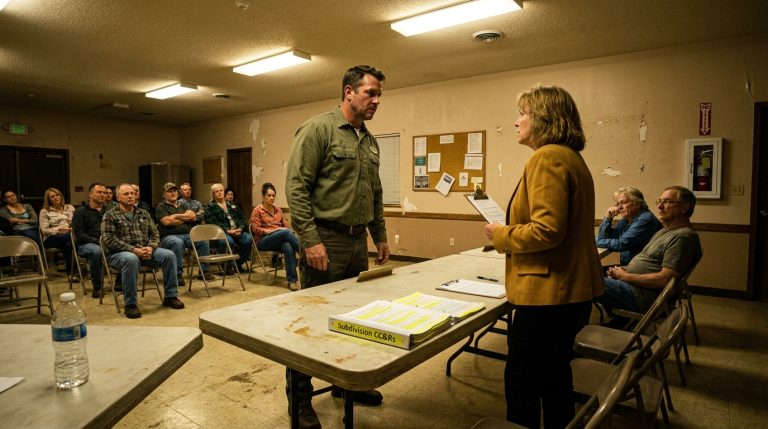
The clubhouse interior smelled of expensive air freshener attempting to mask the scent of damp wool. Sixty folding chairs were arranged in rows that felt more like a courtroom gallery than a community meeting. At the front, behind a table of polished mahogany that looked wildly out of place in the beige-on-beige decor, sat Darlene Whitford. She wasn’t smiling anymore. She was conducting business.
I didn’t take a seat. I stood near the back, my boots heavy on the synthetic carpet, watching the ripple of discomfort that moved through the room as people realized I had arrived. Darlene’s gaze snapped to me, sharp and predatory. She had a stack of cream-colored cardstock before her—embossed invitations to a dispute, masquerading as community governance.
“Colton,” she said, her voice projecting with the practiced clarity of a stage actress. “We were just about to move to the property concerns. I’m glad you could join us to address the board.”
I didn’t acknowledge the invitation to sit. I kept my hands visible, resting them on the back of a chair. “I’m here to discuss the property citation regarding my boathouse. I’ve reviewed your paperwork, Darlene. It’s light on facts and heavy on assumptions.”
A murmur rippled through the room. A man in the third row, someone I’d never seen before, shifted, his eyes darting between me and Darlene. The air in the room felt ionized, the kind of stillness that precedes a thunderstorm.
“This is a community meeting,” Darlene replied, her chin tilted up. Her husband, Vernon, sat to her left, his eyes fixed on a notebook, his posture collapsed. He looked like a man who had long ago resigned his soul to the maintenance of this suburban machine. “It is not a venue for you to dictate terms regarding association assets.”
“The boathouse isn’t an association asset,” I said, my voice steady, stripped of the anger she was fishing for. “It’s my property. You’ve issued a fine of three hundred and fifty dollars based on a claim of unauthorized commercial activity. I don’t operate a business out of that structure. I restore furniture as a personal pursuit. And even if I did, it wouldn’t be under your jurisdiction.”
Darlene tapped a pen against the mahogany. “The association maintains the right to monitor the aesthetic and commercial footprint of all lakefront properties to preserve value for our members. Your activities generate noise. Dust. Traffic.”
“There is no traffic,” I countered. “And if there were, it’s on a private drive that doesn’t touch your subdivision roads.”
She stood then, a deliberate movement meant to emphasize the physical gap between her position and mine. The overhead lights caught the gold of her watch, a flicker of light that seemed to underscore her self-appointed status. “We will be verifying the boundary status at the next executive session. In the interim, the fine stands, and the unauthorized equipment must be removed.”
She was moving too fast. That was the first sign. She was trying to box me in before I could produce a counter-argument. I noticed then, beneath the rhythm of her speech, a slight tremor in her hand as she moved the stack of citations. She wasn’t just annoyed; she was panicked.
I scanned the room, looking for allies. Most of the neighbors were staring at their laps. They were afraid of the cost of dissent—the social friction, the potential for targeted fines. I saw a woman near the exit, her hand gripping her handbag so tightly her knuckles were white. She looked like she wanted to stand up, but her feet remained rooted.
“I’m not paying the fine, Darlene,” I said, the words cutting through the artificial silence of the room. “And I’m not removing anything. If you want to escalate this, I’d suggest you make sure your legal foundation is stronger than a form letter.”
I didn’t wait for her retort. I turned and walked toward the exit, the heavy glass door offering no resistance. As I stepped out into the cool March night, the sound of the clubhouse meeting resumed behind me—a muffled, indistinct hum. But as I reached my truck, I saw someone standing by the shadow of a decorative hedge. It was Mark, the board member who had been quiet during the entire exchange.
He stepped out, his face etched with a mix of apology and exhaustion. “She’s not going to let this go, Colton,” he whispered, looking toward the clubhouse. “She’s leveraged the board’s approval for the new clubhouse renovation against the community account. If you don’t pay, if you keep this up… she’s going to come for everything.”
“With what authority?” I asked.
Mark looked at me, a flicker of something raw in his eyes. “She doesn’t care about the authority. She cares about the bank account. There’s a hole in the HOA funds, Colton. Fifty thousand dollars that shouldn’t be missing. She’s using these fines to fill it, one house at a time.”
He turned and walked back toward the clubhouse before I could respond, leaving me standing in the dark, the gravel crunching beneath my boots, the realization hitting me like a physical blow. This wasn’t about aesthetics. It was about theft, and I had just walked straight into the middle of a ledger that didn’t balance.
CHAPTER 3: THE DUST OF DEEDS
The county assessor’s office was a place where time didn’t so much pass as it did settle into layers of yellowed paper and fine, pulverized grit. I stood at the high counter, my hands flat against the worn laminate, staring at the woman behind the desk. Susan—her nametag caught the hum of the overhead fluorescent lights—looked back at me with the weary patience of someone who had spent decades helping people find the ghosts of their own property rights.
“You’re sure about the date?” she asked, her voice dry.
“1958,” I said. “And the Ridgewater plat, 2015.”
She disappeared into the back, the heavy thud of filing cabinets echoing like drumbeats. I leaned against the counter, the smell of damp cardboard and metallic dust filling my lungs. This was where the battle would be won or lost—not in the boardroom, not with posturing, but with the cold, hard geometry of land lines.
When she returned, she placed a thick, leather-bound volume and a rolled tube of oversized paper on the desk. “You’re lucky,” she said. “Most people don’t know that pre-existing parcels are excluded by default if the filing is correct. They just assume they’re part of the new subdivision because they pay the taxes.”
I unfurled the 2015 plat. It was a beautiful, idealized map of Ridgewater Estates, all neat rectangles and shared green spaces. I traced the perimeter of the lake with my finger, feeling the texture of the ink, until I found it—the tiny, jagged sliver of my grandfather’s land, isolated and marked with a faint, hand-written notation in the margin: Non-conforming parcel, excluded per owner request, 2014.
It was all there. The legal separation. The defiance of my grandfather, documented in a quiet office nearly a decade ago. But as I flipped through the supporting documents attached to the plat, my pulse hitched. There, at the bottom of an ancillary financial report attached to the Ridgewater development, was a signature—Darlene Whitford. She had signed the certification of the HOA boundaries. She had signed a document that explicitly excluded my land, yet she had spent the last two years treating it as her personal fiefdom.
“Susan,” I said, my voice quiet. “Can you look at the certification date here?”
She leaned over, adjusting her glasses. “April 2014. Before the first houses were even finished.”
I wasn’t just dealing with an aggressive manager. I was looking at a woman who had lied about the map she held in her own hand. I took a deep breath, the cold air of the office suddenly sharp. I pulled out my phone and took high-resolution photos of the notation and the signature, my fingers steady despite the mounting heat of the realization. Darlene knew. She had always known.
I left the office with a folder of copies, the weight of the paper in my hands feeling like an anchor. Outside, the parking lot was bathed in the harsh, flat light of mid-afternoon. My truck looked like an intruder among the polished sedans and SUVs. As I reached for the door handle, I noticed something—a small, dark smudge on the driver’s side window. I wiped it away, but it wasn’t dirt. It was grease, fresh and deliberate, shaped like a smear of intent.
I didn’t turn around, but I felt the weight of someone watching from the far end of the lot. I climbed into the cab, the engine turning over with a familiar, mechanical growl. I needed to see Robert. If she had signed that document knowing it was fraudulent, she wasn’t just overstepping—she was committing a crime.
I drove toward town, the rhythmic thrum of the tires on the asphalt grounding me. My mind went back to Mark’s words—the fifty thousand dollars. If she were siphoning community funds, this wasn’t just a dispute; it was a hemorrhage. The HOA fines were the bandage, a way to keep the accounts looking healthy while she gutted the reserves.
I stopped at a red light, watching the intersection. A black sedan, one I’d seen near the clubhouse, drifted into the lane behind me. It matched the pace of my truck. I turned left, then right, weaving through the suburban maze. The sedan stayed exactly two car lengths back.
She wasn’t hiding anymore. She was playing.
I turned down a side road that led to the boathouse, the trees thickening, the air turning cold with the approach of the lake. I parked, not at my house, but a quarter-mile away, behind a thicket of overgrown briars. I stepped out, my boots sinking into the soft earth, and slipped into the tree line.
I waited, my breath slowing, my instincts from the Corps taking over. Ten minutes passed in a silence broken only by the chirping of crickets. Then, the black sedan rounded the corner and crawled down the road, its headlights cut. It stopped in front of my driveway, the engine idling like a predator breathing in the dark.
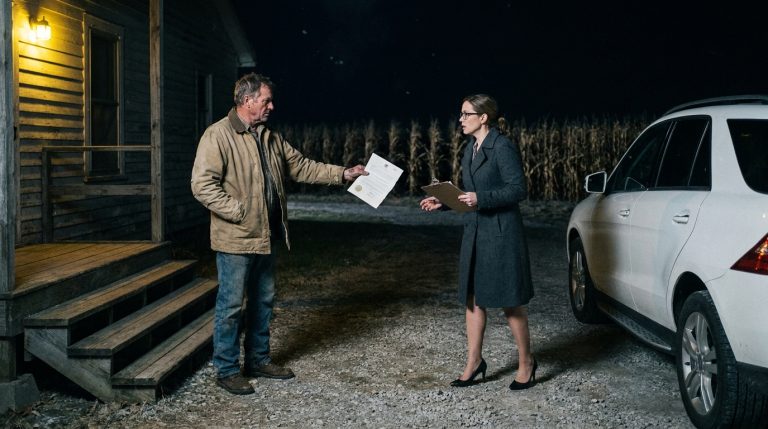
A figure stepped out. Even in the gloom, I recognized the silhouette—the expensive athleisure, the rigid, confident gait. Darlene. She walked toward my boathouse, a heavy, metallic object in her hand. She wasn’t here to talk. She was here to finish what she’d started. My hand moved to the heavy flashlight on my belt—a tool, a defense, a light in the dark. I watched her approach my property, the evidence of her fraud already sitting in my bag, and realized the game had changed. It wasn’t about fines anymore; it was about the truth she was desperate to bury in the dust of my own workshop.
CHAPTER 4: THE GATE OF BROKEN TRUST
I didn’t move. I watched from the shadows of the tree line as Darlene fumbled with the combination lock she’d installed on the gravel access road. Her movements were frantic, stripped of the polished, calculated grace she wore like armor in the daylight. She was sweating, the moonlight catching the moisture on her upper lip, and she kept glancing over her shoulder, her eyes darting like a trapped bird.
She wasn’t here to do maintenance. She was here to solidify a hold. The metal gate, gleaming with fresh paint, stood as a barricade between me and my own property, a physical manifestation of her delusion that she could own everything she touched.
I stepped forward, my boots crunching on the dry brush. The sound was distinct, and Darlene spun around, her flashlight beam sweeping wildly through the trees before catching my chest. She froze.
“Colton,” she hissed, the name sounding like a curse. “You have no business being out here.”
“This is my road, Darlene,” I said, my voice low. I didn’t reach for my light. I let the darkness work for me. “And that is a piece of property damage you’re standing in front of. I’ve already spoken to the county. They’re interested in why an HOA president is unilaterally blocking access to a non-conforming parcel.”
She recovered quickly, her face hardening into that familiar, unblinking mask of control. “You don’t understand the liability, Colton. This road is a safety hazard. The board voted to restrict access for the protection of the community. If you insist on operating a shop in a residential zone, you don’t get the luxury of a private entrance.”
“Show me the minutes,” I said, stepping closer. “Show me the board vote that authorized the installation of a two-thousand-dollar gate on a property line they don’t even have a survey for.”
She didn’t answer. She just tightened her grip on the padlock, her knuckles white. “You think you’re smart with your deeds and your little folders of paper. You’re just a man with a grudge who doesn’t realize he’s already lost.”
I stopped ten feet from her. I could smell the faint, sharp scent of ozone—the smell of the lake air, cold and unforgiving. “I’m not the one who signed a plat document in 2014 that explicitly excluded my property, only to turn around and act like I’m subject to your rules. I have the papers, Darlene. I have your signature.”
The effect was instantaneous. The air left her. She seemed to sag, just for a second, the bravado collapsing like a house of cards. She didn’t look at me; she looked at the gate, her gaze hollow.
“You don’t know what it takes,” she whispered, her voice cracking. “You think this is just a neighborhood. This is a portfolio. Everything here—the clubhouse, the trails, the lake access—it’s all balanced on a knife’s edge. If people stop paying the assessments, if the fines stop, the whole thing goes under. And if this development fails, I lose everything.”
She wasn’t talking about the community anymore. She was talking about her own survival. The $50,000 hole Mark had mentioned was just the surface-level symptom of a deeper, systemic rot in her personal finances. She had tied her solvency to the success of Ridgewater Estates, and my “non-conforming” property was a leak she couldn’t afford to let fester.
“That’s not my problem,” I said, my voice cold.
“It will be,” she shot back, her rage returning, sharper and more jagged than before. She swung the flashlight, the beam cutting through the dark like a blade. “Because if you think you’re walking away from this with your little boathouse and your pride, you’re wrong. I’ve already contacted the county zoning office. I’ve filed a formal complaint about your ‘hazardous’ chemicals and noise pollution. I’ll make it so expensive for you to keep that place, you’ll sell it to the HOA for pennies just to get out from under the debt.”
She slammed the gate shut, the sound echoing across the lake, and clicked the lock into place. It was a declaration of war, but as she turned and walked toward her sedan, her gait was uneven, hesitant. She had fired her best shot, and she knew it. But as she drove away, tires spinning on the gravel, I noticed something that turned the cold in my gut into ice.
She hadn’t just blocked the road. A heavy chain, cold and pitted with rust, was looped through the fence and around the trunk of an oak tree just inside the property line. It wasn’t just a gate. It was a trap.
I looked at the gate, then back toward the dark silhouette of the boathouse. I realized then that my victory at the county office had only pushed her to escalate. She was going to burn the whole development down before she admitted she was wrong. And she had already started by turning the community against me with a smear campaign I couldn’t even see yet. I walked toward the gate, my hands trembling slightly, and reached for the iron. It was rusted, jagged, and as I touched it, I realized it wasn’t just the gate that was broken. It was the entire foundation of the peace I’d spent my life trying to protect.
CHAPTER 5: THE WEIGHT OF EVIDENCE
The folder under my arm felt heavier than eighty pages of photocopied paper had any right to be. It was a dense, physical gravity, dragging my shoulder down as I navigated the winding suburban lanes toward Margaret’s home. The early June air was sticky, thick with the scent of mulch and the overly manicured hedges that defined the neighborhood’s aesthetic. My boots were dusty, the residue of the property line I’d spent all morning walking and documenting.
I wasn’t just a man defending a boathouse anymore. I was a repository of other people’s silenced frustrations.
Margaret opened the door before I even knocked. She looked like she hadn’t slept in weeks—her eyes rimmed with the redness of a woman who had spent too many nights staring at a ceiling, calculating the cost of a garden she’d been forced to destroy. Behind her, in the living room, the space where her meditation bench should have been sat empty, a stark, hollow patch on the carpet where the sun used to hit.
“You’re the one,” she said, her voice barely a breath. It wasn’t a question. “The one who refused the fine.”
“I’m the one who checked the deed,” I corrected, stepping into the foyer. I laid the folder on her coffee table, the sound of it hitting the wood a sharp, decisive crack.
For the next hour, we didn’t talk about my property. We talked about hers. She showed me the stack of citations she’d received—a paper trail of petty tyranny that stretched back three years. Every one of them was signed by Darlene. Every one of them used the same boilerplate language about “community cohesion” and “architectural integrity” to justify the extortion of hundreds of dollars. As I looked through her files, I saw the pattern—the same signature, the same predatory logic, the same systematic erosion of the homeowner’s agency.
But as I reached the bottom of her stack, I found something that didn’t fit. A letter, dated from four months ago, addressed to Darlene, not from a homeowner, but from a private equity firm. I scanned the lines. It wasn’t a fine; it was a demand for interest on an unsecured loan. A loan linked to the Ridgewater Estates development account.
“Where did you get this?” I asked, my blood running cold.
“It was in the mail, mixed in with my regular statements,” she said. “I thought it was junk, but I kept it. She’s been using the neighborhood’s master address for her own mail for a long time.”
I didn’t answer. I just folded the letter and slid it into my inner pocket. This was the missing piece—the decoy secret that Darlene had been trying to hide. She wasn’t just stealing from the community to cover a deficit; she was personally leveraged against the neighborhood’s assets. She was gambling with the property rights of ninety-four households to save a personal portfolio that was already under water.
I left Margaret’s house with the weight of her reality added to my own. As I walked to my truck, the silence of the street was interrupted by the high-pitched whine of a power drill. I turned, scanning the yards. Two houses down, I saw a crew installing a security camera on a light pole, pointing directly at my driveway. It was professional-grade gear, the kind used for surveillance, not security.
I didn’t drive home. I drove to the spot where I kept my own tools—my workshop, my sanctuary. The boathouse was silent, the lake lapping against the stone foundation with a rhythmic, indifferent pulse. I unlocked the heavy cypress door and stepped inside.
The workshop was a mess.
Drawers had been pulled out, their contents spilled across the floor. Chisels, sanders, hardware—everything was turned over, searched, and left in a heap. My master binder, the one containing the deeds, the plats, and the surveyor’s reports, was gone.
I stood in the center of the debris, the smell of sawdust now tainted by the metallic tang of intrusion. She hadn’t just been bullying me; she had been hunting for the one thing that could prove she had committed fraud. And she had found it.
I checked the workbench. My laptop was still there, but it was open, the screen black. I hit the power button. A message sat on the desktop, a simple text file: Everything is a matter of interpretation, Colton. Don’t make the mistake of thinking your truth matters more than mine.
I looked at the empty space where my binder had been, and then at the door, which had been perfectly locked upon my arrival. She hadn’t broken in; she had the key. She had moved the cars here in March to claim it was an HOA space, and she had kept a set of keys ever since.
The weight of the betrayal was physical, a tightening in my chest that had nothing to do with the physical danger. She hadn’t just stolen my documents. She had violated the sanctuary of my grandfather’s work. I walked to the edge of the boathouse and looked out at the lake. The water was dark, mirroring the empty, starless sky. I was exposed, my evidence gone, my movements tracked. She thought she had stripped me of my position. She didn’t realize that the binder was just a copy. The original truth was still back at the county office, sitting in the public record, waiting for a court to force the doors open.
But as I turned back to the ruined workshop, I saw something else—a small, crumpled piece of paper caught in the floorboards. I pried it loose. It was a receipt for the same private equity firm from the letter. It was dated for tomorrow.
She wasn’t finished. She was going to liquidate the community’s assets tomorrow morning, and she had used my documents to clear the path. I had to reach Mark, and I had to do it before the sun rose. If I didn’t, the neighborhood would be sold out from under us before the board even knew the accounts were empty.
CHAPTER 6: THE DECONSTRUCTION OF A KINGDOM
The clubhouse was suffocating. It was filled with the low-frequency hum of a hundred people waiting for the hammer to drop. I walked to the front, my boots marking time on the linoleum, each step heavy with the fatigue of the last forty-eight hours. My hands were empty of documents this time—I didn’t need them. I had the truth, and tonight, that was enough.
Darlene was already there, behind the mahogany table, her eyes frantic, darting toward the side exit. When she saw me, her mask didn’t just slip—it shattered. She stood up, her hand hitting the table with a sound like a gunshot.
“This meeting is adjourned!” she barked, her voice echoing off the high, vaulted ceilings. “The association has no business—”
“The association has every business,” Mark’s voice cut through her panic. He stood up from his seat on the board, his face pale, holding a thick folder he’d received from the auditor less than an hour ago. “We’ve seen the reports, Darlene. We know about the fifty-thousand-dollar deficit. And we know about the loan.”
A gasp moved through the room, a collective intake of breath that sounded like wind through dry leaves. Darlene turned to look at the crowd, her face a pale, strained canvas. She looked at Vernon, who was staring down at his hands, his head bowed as if waiting for a sentence.
“It was for the development,” she stammered, her voice losing its edge, becoming thin and reedy. “It was all for the development. If we didn’t have the cash flow, the value of the properties would have tanked. I was protecting the neighborhood.”
“You were protecting your own investment,” I said, my voice cutting through the space, calm and devoid of the anger that had driven me for weeks. I walked to the table and dropped the crumpled receipt I’d found in my workshop floorboards. It was the final, irrefutable proof—a link between the community’s reserve fund and her personal real estate holdings. “You were using our homes as collateral for a private portfolio that was already underwater.”
Darlene didn’t answer. She looked at the receipt, then at the hundred faces staring back at her—Margaret, James, the woman who had lost her garden, the man who had been fined for the color of his mailbox. They weren’t looking at her with fear anymore. They were looking at her with the cold, hard clarity of people who had been duped and were now fully awake.
The silence that followed was heavy, absolute, and agonizingly long. It was the silence of a house being demolished, beam by beam.
Darlene sank back into her chair. The power that had made her seem large, formidable, and untouchable evaporated, leaving behind only a woman who had bet everything on an assumption that we were all too scared to look closer. She looked old. She looked tired. She looked like she was finally realizing that the ground she had built her throne on was nothing more than shifting sand.
“I didn’t mean for it to get this far,” she whispered.
“It doesn’t matter what you meant,” Mark said, his voice flat. “It matters what you did.”
The officer at the back of the room shifted, his presence a final, bureaucratic punctuation mark on her reign. There was no shouting, no dramatic arrest, just the quiet, devastating sound of a reputation being erased in real-time. I watched as she was led toward the side exit, her head bowed, her expensive athleisure now looking like nothing more than a costume for a part she could no longer play.
As the door closed behind her, the clubhouse seemed to expand, the walls pulling back, the air clearing of the synthetic perfume and the stagnant, fearful tension that had choked us for years.
I walked out of the clubhouse and toward the lake. The sun was just beginning to touch the horizon, painting the water in long, liquid strokes of gold and copper. The boathouse stood on the far shore, solid, stone-founded, and mine. The air was cool, smelling of damp cedar and fresh, coming rain.
I sat on the dock, the wood warm beneath my palms. My phone buzzed—a text from Robert. The injunction is filed. The fraud charges are being prepared. It’s done.
I looked at the water. My hands, calloused and stained with sawdust, didn’t tremble. The conflict had been a fire, and it had burned through everything I thought I knew about my neighbors, my community, and the nature of power itself. I hadn’t just saved my property; I had helped restore the ground on which we all stood.
I leaned back, feeling the quiet rhythm of the lake. The structures of the HOA would be rebuilt, the records audited, the rules rewritten—but that was work for tomorrow. For now, there was just the silence, the light, and the simple, undeniable weight of a truth that, once spoken, could never be taken back. I had been a Marine, a furniture maker, and a neighbor, but standing here in the stillness, I knew I was something else, too. I was a man who had stood his ground, and for the first time in years, the ground felt entirely, permanently my own.