The Weight of Red Clay: A Legacy Defended Through Steel, Silence, and the Rusted Truth of the Law
CHAPTER 1: THE RADIUS OF THE FENCE
“You’re making a four-minute mistake, Mr. Wolfe.”
I didn’t look up. I kept the tape measure locked at sixteen feet, the yellow metal blade vibrating slightly in the wind. The air smelled of impending rain and the heavy, floral cloy of perfume that didn’t belong in a hay field.
“I’ve made plenty of mistakes, Delphine,” I said, my voice as dry as the red clay beneath my boots. “Most of them involved staying in places where I had to listen to people who weren’t invited.”
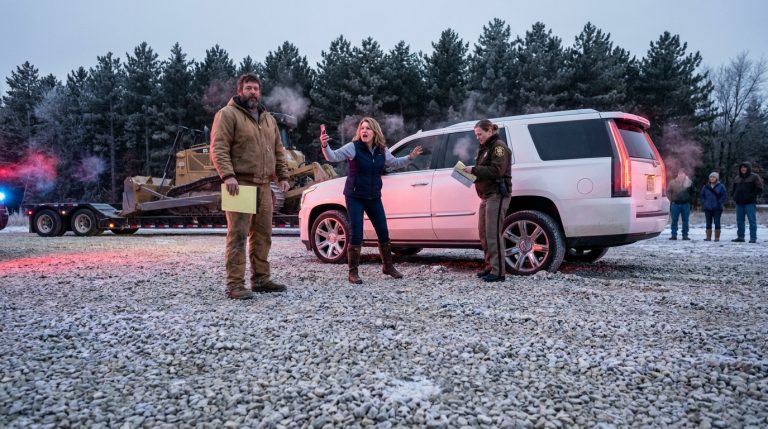
I let the tape measure snap back into its housing. The sharp crack of the metal against plastic was the only warning she got before I turned. She was standing by her pearl-white Escalade, the vehicle idling with a low, expensive hum that felt like an insult to the quiet of the post oaks. Her bedazzled sun visor caught the slanting Oklahoma light, throwing jagged sparks across her face.
“Walt Cavenaugh was a gentleman,” she said, her smile not reaching her eyes. “He understood that a community is a living thing. We’ve used this corner as a cut-through for fifteen years. It’s an informal easement. Paving it was actually on our three-year roadmap.”
I stepped toward the gap in the old wire fence. I could see the ruts where her neighbors had chewed into my topsoil, the grass dead and gray where they’d shaved those four minutes off their morning commute.
“Walt’s dead,” I said. “And the only roadmap that matters is the one filed with the county recorder. I checked it. There’s no easement. There’s just sixty-two acres of land and the man who paid for it.”
Delphine’s posture shifted. The “neighborly” mask didn’t slip—it curdled. She adjusted her visor, her rings flashing. “We have a legal fund, Garrett. And we have the county commissioners on speed dial. I’d hate to see you spend your retirement settlement on attorney fees before you even get your foundation poured.”
I looked past her, toward the Sycamore Ridge entrance half a mile up the road. I saw the manicured lawns, the black-painted mailboxes, and the Ring cameras watching the world inhale. Then I looked back at my cracked dashboard through the window of my truck, the jagged line across the plastic a map of everywhere I’d been and everything I wasn’t going back to.
“Gate goes up Friday,” I said.
“The community won’t be happy,” she whispered.
“The community can learn to enjoy the scenery on the main road,” I replied. “It’s a four-minute drive. Think of it as time to reflect on property lines.”
She didn’t argue further. She got into the Escalade, the door closing with a muted, vacuum-sealed thud. She drove off, her tires kicking up a plume of my dust that hung in the air long after she was gone.
I walked to the edge of the property line, where the gravel met the county road. Stooping down, I picked up a small, jagged piece of red plastic—a reflector lens from a neighbor’s car that must have clipped the old post a week ago. I turned it over in my hand. It was cold, sharp, and entirely out of place.
As the sun dipped behind the post oaks, turning the light into the color of a bruised peach, my phone buzzed in my pocket. A notification from the county planning portal. An anonymous “environmental concern” had just been logged against my parcel number.
The fight hadn’t even started, and she was already trying to poison the soil. I looked at the red plastic in my palm, then tossed it into the weeds. She thought she was protecting a shortcut. She didn’t realize she’d just handed me the first piece of evidence in a case she didn’t even know I was building.
CHAPTER 2: THE ANCHOR IN THE FLINT
The post driver hit the top of the steel pipe with a hollow, metallic thud that vibrated straight through my collarbones and into my teeth. It was a rhythmic, bone-jarring labor. Lift, slam. Lift, slam. The air was thick with the smell of scorched ozone and the dry, metallic tang of the rusted post driver’s handles. My palms were already beginning to blister beneath the leather of my work gloves, the grit of the Oklahoma red clay finding its way into every seam.
I wasn’t just setting a fence post; I was driving a stake into the earth to mark the exact limit of a woman’s reach.
The ground here was mostly flint and sun-baked silt. Every inch won was a victory of friction over stubbornness. I wiped the sweat from my eyes with my shoulder, looking down at the four-foot hole I’d already cleared. I’d mixed the first bag of Quikrete in a wheelbarrow that had seen better days, the rusted basin rattling with every stir of the shovel. The concrete was gray and thirsty, much like the land itself.
I heard the crunch of gravel before I saw the dust.
A white truck, not the Escalade this time, slowed to a crawl on the county road. It didn’t stop. It just drifted past, the driver’s side window opaque with reflection. I didn’t stop the driver. I didn’t even look up until the rhythm of my work was finished. I let the post driver rest against the steel, the metal singing a faint, dying note in the afternoon heat.
The silence that followed was heavy.
I walked over to the truck, reaching into the bed for a bottle of lukewarm water. As I tilted my head back, my eyes caught something tucked into the crook of a post oak branch near the gap—a small, white plastic flag on a wire stake. It hadn’t been there two hours ago.
I set the water down and walked toward it. The flag was printed with neon green ink: UTILITY MARKING – DO NOT EXCAVATE.
There were no utilities on this corner of the Cavenaugh parcel. Old Walt had kept his lines on the south side, near the creek. This flag was a phantom. I knelt, the dry grass crunching under my weight like old parchment. I pulled the flag from the dirt. The wire was clean, brand new. Beneath it, someone had spray-painted a single, jagged line of green across the red earth, cutting right through the center of where my gate track was supposed to run.
“You’re on a gas main, Wolfe.”
The voice came from behind me. I didn’t jump. I recognized the dry, gravel-grinder tone of Elton Briggs. He was standing by his aging flatbed, his hands shoved deep into the pockets of a pair of faded Carhartts. He looked like he’d been carved out of a piece of hickory and left in the sun too long.
“I’m on sixty acres of nothing, Elton,” I said, holding up the flag. “You surveyed this place twice. You see any high-pressure mains on the plat?”
Elton spat a dark stream of tobacco juice into the dust. “Not in 1997. Not in 2008. But Delphine Morecraft has a way of making things appear when she needs them to. She called the county inspector this morning. Told them she saw ‘unauthorized deep-earth disturbance’ near a critical junction.”
I stood up, the rusted wire flag bending in my grip. “She’s trying to tie me up in an administrative hold. If the county flags this as a utility conflict, I can’t pour the footings until a surveyor from the gas company signs off.”
“And the gas company takes three weeks to find their own feet,” Elton nodded. He walked over to the hole I’d dug, peering down into the dark throat of the earth. “She’s smart, Garrett. She knows you won’t fold on the law, so she’s going to drown you in the clock. She’s betting your contractors will walk if they have to keep rescheduling.”
I looked at the green paint on the dirt. It was a lie, but it was a lie with the weight of bureaucracy behind it. I felt a slow, cold heat rising in my chest—the kind of heat that comes when you realize the person you’re fighting doesn’t care about the truth, only about the friction they can create.
“I did the homework, Elton,” I said, my voice low. “I pulled the dig-tickets for the last decade. There’s nothing here but clay and limestone.”
“Doesn’t matter what’s in the dirt,” Elton said, looking toward the Sycamore Ridge fence line, where the grass was a suspiciously vibrant shade of emerald compared to the scorched pasture surrounding it. “It matters what’s in the file. Speaking of which… you ever wonder why that back common area of theirs stays so green in a drought?”
I followed his gaze. The HOA’s property line was marked by a expensive-looking wrought-iron fence. Just on their side of the line, a long, shallow depression in the earth ran parallel to my boundary. A drainage swale. It was choked with tall, woody brush—willow and buckbrush—that looked thirsty. But the grass around it was lush, almost boggy.
“Runoff?” I asked.
“Supposed to be,” Elton said. “But that swale is a county-mandated stormwater easement. If it’s not draining, it’s pooling. And if it’s pooling, it’s because it hasn’t been scraped in ten years. Delphine’s been telling the board they’ve been paying for maintenance on that channel since 2016.”
I looked at the lush grass, then back at the phantom utility flag in my hand. The friction was beginning to make sense. Delphine wasn’t just protecting a shortcut. She was protecting a perimeter.
“She wants me away from this fence line,” I realized aloud.
“If you build that barndominium right there,” Elton pointed to the rise of the hill where my stakes were set, “you’ll have a bird’s eye view of that swale. You’ll see exactly how much water sits there every time it sprinkles. You’ll see that the ‘maintenance’ they’re billing for is a ghost.”
I gripped the rusted handles of the post driver again. The metal felt heavy, solid—a physical truth in a world of bedazzled lies.
“Elton,” I said, “how much would it cost to get a certified elevation study of that boundary?”
The old man grinned, his face folding into a thousand weathered lines. “For you? A pot of coffee and the satisfaction of watching a queen lose her checkers.”
I didn’t wait for the county inspector to show up. I didn’t wait for the gas company to tell me what I already knew. I picked up the post driver and hoisted it high above my head. My muscles screamed, the hard miles of a pipeline career pushing back against the fatigue.
I brought the driver down with everything I had. The steel post bit another three inches into the flint.
The sound of the impact echoed across the valley, a declaration of war. If Delphine wanted to use the law as a weapon, she’d better make sure her own house was built on something stronger than a dry-rotted drainage pipe and a stack of forged invoices.
I worked until the sun was a sliver of fire on the horizon, until the holes were dug and the steel was set. As I walked back to my truck, my boots caked in the gray-white dust of the flint, I noticed a second white truck parked a quarter-mile down the road. This one had a logo on the door. Wagoner County Building & Planning.
The driver was watching me. He didn’t move. He was waiting for the concrete to set so he could tell me it was illegal.
I climbed into my truck and turned the key. The engine roared to life, the cracked dashboard rattling in a familiar, steady rhythm. I didn’t look back at the inspector. I looked at the GPS coordinates on my phone, marking the exact spot where the HOA’s “lush” grass met my property.
There was a micro-discrepancy in the soil there—a small, dark stain that didn’t look like water. It looked like oil.
I shifted the truck into gear. The fight was moving past the gate. It was moving into the roots.
CHAPTER 3: THE ZEROSUM ANCHOR
“The inspector is still sitting there, isn’t he?”
Vashti’s voice was a crisp, sharp contrast to the low thrum of the truck’s engine. I shifted into neutral, the dashboard rattling in its familiar, jagged rhythm. Through the rearview mirror, the white county truck remained a ghost in the dust, its headlights dark, its intent heavy.
“He’s waiting for the concrete to go hard,” I said, my voice sounding like iron dragged over stone. “Or for me to blink. Either way, he’s wasting his gas.”
“Don’t blink, Garrett. But don’t pour either. If he flags a conflict while the mud is wet, he can order an immediate extraction at your expense. Pull back to the house in Tulsa. Let the dirt settle.”
I looked at the post I’d just driven into the flint. It stood straight, a black steel middle finger to the Sycamore Ridge perimeter. The concrete at its base was already beginning to skin over, the gray slurry turning a dull, matte slate in the twilight.
“I’m already moving,” I said.
I hung up and pulled the truck away, the tires spitting gravel. I didn’t look back at the inspector. I didn’t need to. I knew the silhouette of a man bought and paid for by a “community leader.”
Two hours later, I was sitting at my kitchen table in Tulsa. The apartment felt too small, too quiet, the air conditioned hum a poor substitute for the wind through the post oaks. I’d poured a cup of coffee that had gone cold before the first sip, the black liquid reflecting the blue glare of my laptop screen.
The county recorder’s database was a labyrinth of scanned PDFs and poorly indexed digital deeds. It was the kind of work that required the patience of a site supervisor—tracing lines of succession and legacy through documents that smelled of damp basement and bureaucracy even in digital form.
I started with the Cavenaugh parcel. Walt had bought it in ’97, free and clear. I traced the title back to the original land run allotments. No road easements. No utility rights-of-way. No “informal public” anything. The land was a fortress of legal clarity.
Then I shifted the search to Sycamore Ridge.
The master plan was filed in 2003. It was an ambitious document, full of curving cul-de-sacs and “common areas” designed to lure in people like Delphine—people who wanted the illusion of nature without the grit of the dirt. I zoomed in on the northern boundary, the line where their wrought iron met my barbed wire.
There it was. A thin, hatched line along the edge. Stormwater Drainage Easement (Private Maintenance).
I leaned back, the chair creaking. Private maintenance meant the county didn’t touch it. It meant the HOA was responsible for every inch of that swale, keeping it clear, keeping it functional. If that water sat, it wasn’t a county problem—it was a liability.
I opened a second tab, pulling up the HOA’s last three years of public tax filings and the corporate registry. Delphine was listed as President, but the Treasurer was a name I didn’t recognize yet: Prescott Dunbar.
I searched for the utility dig-tickets Elton had mentioned. There was a request filed forty-eight hours ago for the Cavenaugh parcel. The applicant wasn’t the gas company. It was a private contractor: Dunbar Land Services.
The cold coffee tasted like ash.
Prescott Dunbar wasn’t just the treasurer; he was the one filing the phantom utility flags. It was a closed loop. Delphine creates the “environmental concern,” her brother-in-law’s company marks the phantom lines, and the county inspector—likely a man who enjoyed the occasional holiday at a Sycamore Ridge club member’s cabin—comes out to enforce the stall.
It was a beautifully rusted machine. Simple. Effective. And entirely illegal.
I took a photograph of the screen, the flash reflecting off the cold ceramic of my mug. Every piece of paper was a layer of armor. Every fraudulent flag was a crack in their foundation.
A notification popped up in the corner of my screen. An email from the firm I consulted for.
Garrett, we received a formal letter of complaint regarding your professional conduct on a private property matter. The sender is a Mrs. Delphine Morecraft. She’s alleging ‘litigious instability.’ We need to talk on Monday. — Croft.
I stared at the words until they blurred. She wasn’t just coming for the gate. She was coming for the hard miles. She was trying to strip away the career I’d bled for in the North Dakota winters, trying to paint me as a madman so no one would listen when I started talking about her drainage swale.
I didn’t reply to Croft. I didn’t call Vashti.
I walked to my hallway closet and pulled out a heavy accordion folder. It contained every site assessment I’d ever done, every environmental impact study, every regulatory hurdle I’d cleared for the pipeline. I knew how to read the earth. I knew how to find the rot that people tried to bury under pearl-white paint and bedazzled visors.
I went back to the computer. I didn’t look at my own deed this time. I looked at the Sycamore Ridge 2019 inspection records Elton had tipped me off about.
There was a discrepancy. The county had cited the swale for “insufficient depth” in October of that year. A follow-up report sixty days later showed the issue as “Resolved via Private Contractor.” The invoice attached to the digital file was for $12,400.
The contractor was Dunbar Land Services.
I zoomed in on the photograph attached to the “Resolved” report. It was a grainy shot of a cleared ditch. I recognized the trees in the background. Those weren’t post oaks. Those were pines.
Sycamore Ridge didn’t have pines on the northern boundary. They had them on the south side, near the main entrance.
They had used a photo of a different repair to clear a citation on the swale that bordered my land. The $12,400 had been paid out of the HOA’s common fund to Delphine’s brother-in-law for work that had never happened.
The “lush” grass I’d seen earlier wasn’t a sign of health. It was a sign of a bog. A bog that was currently rotting the foundations of the homes closest to my fence line—homes owned by people who had no idea their “President” was pocketing their maintenance fees while their property values slowly drowned in stagnant water.
I stood up and walked to the window. The Tulsa skyline was a grid of light and shadow, but all I could see was the red clay of the Cavenaugh parcel.
Delphine thought she was shaving four minutes off her drive. She didn’t realize she’d invited a site supervisor to perform a forensic audit on her soul.
My phone buzzed on the table. A text from an unknown number.
The mud is wet, Garrett. Accidents happen in the dark. Move the gate.
I didn’t delete the message. I forwarded it to Vashti and the county sheriff’s substation. Then I sat back down and opened a blank document.
I began to draft the first letter. Not to Delphine. To the Oklahoma Department of Environmental Quality.
The gate was just the radius. The center of the circle was the rusted truth she was trying to keep under the water. And I was about to pull the plug.
CHAPTER 4: THE METAL CRIME SCENE
The padlock didn’t just break; it had been executed.
I found it lying in the red slush of the driveway, the shackle severed clean by a pair of heavy-duty bolt cutters. The steel was cold and wet, filmed over with the morning’s gray fog. I picked it up, the rusted iron leaving a copper-colored stain on my palm. The cut was precise—one smooth, high-pressure snap that spoke of someone who knew exactly how much leverage it took to defeat sixty dollars of hardened security.
I looked at the gate. It stood wide open, swinging slightly in the damp breeze like a broken jaw.
Beyond the threshold, the gravel road—my road—was scarred with fresh tire tracks. They were deep and aggressive, the kind left by a heavy truck pulling a trailer or carrying a massive load. I followed them with my eyes. They didn’t go toward the rise where I’d planned the barndominium. They headed straight for the south edge, toward the stand of post oaks and the hidden drainage swale that sat like a secret between my land and Sycamore Ridge.
“You should have moved the gate, Garrett.”
The voice didn’t come from a phantom. It came from the shadows of the oaks.
I didn’t reach for a weapon. I didn’t have to. I stood my ground, the broken lock heavy in my hand. A man stepped out from the treeline. He wasn’t wearing a bedazzled visor. He was wearing a Sycamore Ridge Estates polo shirt, the white fabric pristine despite the mud on his boots. He was younger than me, maybe forty, with the soft, gym-toned build of a man who spent his days looking at spreadsheets and his evenings looking for things to control.
“Prescott Dunbar, I presume,” I said.
He stopped ten feet away. He didn’t look at the lock in my hand. He looked at the post I’d driven into the flint three days ago. “That post is a safety hazard, Mr. Wolfe. I told you we had a gas main through here. My crew came out to verify the markings this morning, and your gate was obstructing the county-mandated access.”
“Your crew?” I asked. “You mean the two guys in the silver F-250 who don’t work for the gas company, but for Dunbar Land Services?”
Prescott didn’t flinch. He had the practiced, impenetrable stare of a treasurer who knew how to hide a deficit in plain sight. “We’re contracted by the HOA to ensure the integrity of the perimeter. That includes utility oversight. You were warned.”
I walked toward him, my boots crunching on the gravel. I didn’t stop until I was inside his personal radius. Up close, I could smell the expensive coffee and the faint, chemical scent of new tires.
“Here’s how this works, Prescott,” I said, my voice barely above a whisper, vibrating with the low-frequency rumble of a site supervisor about to shut down a rig. “You broke a federal-grade lock on private property. That’s criminal trespass and destruction of property. And you did it to verify a utility line that doesn’t exist on any plat filed in this county since 1903.”
I held up the lock. “I’m not moving the gate. I’m reinforcing it. And every time you or your ‘crew’ touches my steel, I’m going to add a zero to the invoice I’m sending to the District Attorney.”
Prescott smiled. It was a thin, oily expression. “You’re a site supervisor, Garrett. You know how the world works. Files get lost. Markings get moved. And a man with a cracked dashboard usually doesn’t have the stomach for a five-year litigation cycle against a community with a seven-figure reserve fund.”
He turned to walk away, but I caught him by the shoulder. Not a shove—just a grip. The kind of grip that reminds a man that bone is harder than a polo shirt.
“That reserve fund,” I said. “Is that where the twelve thousand dollars went? The October 2019 invoice for the swale repair? The one you used a photo of the south entrance to justify?”
Prescott’s shoulder went rigid under my hand. The oily smile vanished, replaced by a sudden, sharp stillness. For a second, the fog seemed to thicken around us, the only sound the distant, rhythmic dripping of water from the oaks.
“I don’t know what you’re talking about,” he said, his voice tightening.
“I think you do. I think Delphine’s shortcut isn’t about Pilates. I think it’s about making sure nobody walks that fence line with a camera and a measuring tape. Because if they did, they’d realize that swale is a bog, and that the money meant to fix it is sitting in a Dunbar Land Services account.”
I let go of his shoulder. He took a step back, straightening his shirt, but the rhythm of his breathing had changed. He wasn’t the hunter anymore. He was the prey realizing the trap had teeth.
“Careful, Garrett,” he said, his voice dropping an octave. “Oklahoma is a big state. People get lost in the hill country all the time.”
“I’ve spent twenty years in the North Dakota oil fields, Prescott. I’ve seen things a lot colder and darker than you. You want to play at being a tough guy? Do it on your own dirt. Because the next time you cross this line, you aren’t meeting me. You’re meeting the Department of Environmental Quality.”
Prescott didn’t answer. He turned and walked back toward the treeline, his pace faster than it had been when he arrived. A few moments later, I heard the roar of a diesel engine and the scream of tires on the county road.
I stood alone at the gate, the fog beginning to lift as the sun struggled to break through the gray. I looked down at the broken lock. It was a piece of junk now, just rusted scrap metal. But as I turned it over, I noticed something caught in the mechanism—a small, bright blue fleck of paint.
It wasn’t from my gate. It wasn’t from my truck.
I took out my phone and snapped a macro photo of the fleck. Then I walked over to the tire tracks Prescott’s crew had left. I knelt in the mud, ignored the dampness seeping into my jeans, and looked at the tread pattern.
They weren’t standard truck tires. They were industrial-grade, heavy-tread mud tires, the kind used for heavy excavation equipment. And there, pressed into the soft red clay near the edge of the swale, was something else.
A brass casing. Spent.
I didn’t pick it up. I knew better than to touch evidence in a crime scene. I took a photo of it, GPS-tagged and timestamped.
The “shortcut” was a decoy. The “utility flag” was a stall. Prescott hadn’t come here just to break a lock. He’d come here to dispose of something, or to hide it. And the fact that he was carrying brass meant the stakes had shifted from a property dispute to something much louder.
I walked back to my truck, my heart hammering a steady, pragmatic beat against my ribs. I picked up my radio and dialed a frequency I hadn’t used in years.
“Elton,” I said when the old man picked up. “I need you to bring your drone. The one with the thermal optics. And I need you to do it before the sun hits the water in that swale.”
“What’d you find, Garrett?”
“A legacy of rot,” I said. “And a reason for Delphine to start packing her bags.”
I looked at the broken gate. Friday was coming. And this time, I wasn’t just hanging a farm gate. I was building a cage.
CHAPTER 5: THE EYES IN THE OAK
The solar panel caught the first weak rays of the morning sun, a dull blue glimmer against the rough, dark bark of the post oak. I tightened the mounting bracket until the rusted screw bit deep into the wood, the friction radiating a satisfying heat through my gloves. This wasn’t a farm tool. It was a sentinel.
I stood on the bed of my truck, the cracked dashboard behind me reflecting a sliver of the dawn. From this height, I could see the entire geometry of the conflict. To the north, the Sycamore Ridge houses sat like porcelain dolls in a window box, their morning sprinklers already hissing—wasting water to maintain a vibrant green that the Oklahoma sun was trying its best to kill. To the south, my land rolled away in waves of red clay and stubborn brush, honest and dry.
I climbed down, my boots hitting the gravel with a heavy, final thud. I pulled my phone from my pocket and opened the app. The screen flickered, then resolved into three crisp, high-definition windows.
“Testing line of sight,” I muttered to the empty field.
I walked toward the gate—the new one. It was a heavy tubular steel swing gate, powder-coated black, the kind of barrier that didn’t just suggest a boundary but enforced one. I swung it shut, the sound of the latch hitting the strike plate echoing across the creek. On my screen, the motion-trigger icon flared red. The infrared sensors mapped the heat of my body against the cold clay, a ghost in the machine.
“You’re late, Elton,” I said, not turning around as the sound of a rattling four-cylinder engine approached from the county road.
Elton Briggs pulled his flatbed onto the shoulder. He climbed out, carrying a heavy plastic case like it contained the crown jewels. He didn’t look at the new gate. He looked at the cameras I’d just mounted.
“Six hundred dollars of digital paranoia,” Elton said, his voice a dry rasp. “You expecting an army, Garrett?”
“I’m expecting a treasurer with bolt cutters and a president who thinks public records are suggestions,” I replied. “Did you bring the bird?”
Elton patted the plastic case. “Thermal optics, 4K resolution, and enough battery to map a small country. But the wind’s picking up. If we’re going to fly the swale, we do it now.”
We moved to the edge of the property, staying back from the wrought-iron fence of the HOA. Elton set the drone on a flat patch of red earth. The rotors began to spin, a high-pitched digital whine that cut through the morning quiet. It rose vertically, a black speck against the pale sky, then tilted toward the Sycamore Ridge boundary.
I watched the second screen Elton held out. The world turned into a map of heat and shadow. My property showed up as a cool purple, the dry clay holding the night’s chill. But as the drone hovered over the HOA’s drainage swale, the colors shifted violently.
“Look at that,” Elton whispered.
The swale wasn’t a purple line. It was a pulsing, neon orange. Heat.
“That’s not just standing water,” I said, leaning in. The thermal signature was too bright, too concentrated. “That’s active decomposition. Or a chemical spike.”
“Or a leak,” Elton added. “See that plume? It’s trailing off toward your creek. If that swale was maintained to county spec, the water would be moving too fast to hold that kind of heat signature. That’s a stagnant bog, Garrett. It’s a literal fever in the ground.”
I followed the trail on the screen. The orange bloom bled across the property line, soaking into the red clay near where I’d found the brass casing. In the thermal view, the tire tracks Prescott’s crew had left showed up as dark, cold gashes—compacted earth that didn’t breathe like the rest of the soil.
“Zoom in on the blockage,” I commanded.
The drone dipped lower. The high-definition camera cut through the morning haze. We saw the buckbrush and the willow, their roots tangled into a dense, impenetrable mat. But beneath the greenery, half-buried in sediment and old leaves, was something metallic.
It was a rusted culvert pipe, but it wasn’t round. It was crushed flat, the steel buckled under the weight of an old earth-moving job.
“There’s your twelve thousand dollars,” I said. “They didn’t clear the swale. They buried the problem. They pushed the sediment over the crushed pipe and called it a day. Dunbar Land Services probably billed for a full replacement and just used a bulldozer to hide the evidence.”
“And when the rains come,” Elton said, “that water has nowhere to go but up and out. Right into your topsoil.”
I looked back at my phone, checking the feed from my trail cameras. One of them, mounted low on a fence post, caught a sudden flare of light. A lens flare.
I frowned, zooming in on the recording. The light didn’t come from the sun. It was a sharp, focused glint from the thicket of oaks on the HOA side.
“Elton, bring the bird back. Low and fast.”
“What is it?”
“Someone else is watching the watchers.”
The drone screamed back across the line, hovering ten feet above the oak canopy. The camera panned, searching the shadows. For a moment, we saw nothing but leaves. Then, a branch shifted.
A man was perched in a deer stand, partially obscured by a camo net. He wasn’t holding a rifle. He was holding a professional-grade camera with a telephoto lens long enough to read the serial numbers on my gate actuator.
He saw the drone. For a split second, he stared directly into the lens—a face full of startled realization. Then he scrambled down, dropping his gear in his haste.
“That’s Gifford Alcott,” Elton said, recognizing the face. “Property Rights Subcommittee. He’s Delphine’s bird-dog.”
“He’s not a bird-dog,” I said, my heart rate steady but my grip tightening on my phone. “He’s a scout. They’re looking for a way around the gate, Elton. They aren’t going to stop at the locks.”
I walked back to the gate and touched the steel. It was cold, unyielding. But as I looked at the digital feed, I realized my tactical advantage was leaking. If they were documenting my movements, they knew my schedule. They knew when the land was empty.
I looked at the thermal map of the swale, then at the image of the crushed culvert.
“They think they’re documenting a nuisance,” I said. “But they’re just giving me more metadata for the DEQ. Elton, I need those thermal files on a encrypted drive by tonight. And I need the GPS coordinates for every orange plume on that map.”
“What are you going to do?”
I looked toward the Sycamore Ridge entrance, where the white Escalade was just pulling out of a driveway.
“I’m going to stop playing defense,” I said. “If they want to watch me work, I’m going to give them a show they can’t ignore. I’m pouring the footings for the equipment shed tomorrow. Right on the edge of that swale.”
“The ground is too soft there, Garrett. You’ll sink.”
“I’m not pouring it to hold a shed, Elton. I’m pouring it to force a measurement. If the county building inspector comes out to red-tag a foundation in a flood zone, he has to explain why the flood zone exists.”
I shifted my gaze to the oak tree where the scout had been hiding. The silence of the morning felt brittle, like rusted iron ready to snap. The shortcut was gone, but the war for the dirt was just beginning to breathe.
CHAPTER 6: THE SILVER GHOST
The video file scrubbed forward in a jittery, digital blur, the pixels struggling to reconcile the low-light infrared with the sudden flare of high-beams. I leaned in, my face inches from the laptop screen, the cool blue glow illuminating the grit on my skin. Outside, the Tulsa night was a humid weight, but in here, the air was sharp with the ozone of hardware and the high-frequency hum of a man nearing a truth.
There. 6:47 p.m. Tuesday.
The silver F250 rolled into the frame with the slow, arrogant crawl of a predator that owned the forest. It didn’t have its lights on. It relied on the fading golden-hour bleed to navigate the gravel road. The truck stopped at the gate—the heavy steel swing gate I’d sunk four feet into reinforced concrete.
The driver didn’t hesitate. He stepped out of the cab, his boots hitting the red clay with a sound I didn’t need audio to recognize. He was wearing a Sycamore Ridge Estates polo, the white fabric glowing like a beacon in the night-vision feed. It was Prescott Dunbar. He didn’t look at the cameras. He didn’t look at the house. He looked at the gate with the bored detachment of a man performing a chore.
He reached into the bed of the truck and pulled out a pair of long-handled bolt cutters. They were brand new, the factory stickers still gleaming on the red iron.
“Come on, Prescott,” I whispered. “Show me the brand.”
As he leaned into the cut, the camera caught it—the stamped logo on the handle. Industrial Grade. 42-inch. The same brand used for heavy pipeline demolition. Prescott threw his weight into the handles, the shackle of my backup chain snapping with a violent jerk that I could feel in my own marrow. He swung the gate open, the heavy steel creaking on its hinges.
But he didn’t drive through.
He walked back to the truck and pulled something else out of the bed. It wasn’t a tool. It was a heavy, olive-drab plastic container—the kind used for industrial hazardous waste. He carried it to the edge of the drainage swale, his gait heavy and awkward. He knelt at the lip of the bog, the tall buckbrush swallowing his lower half.
The thermal signature on Elton’s drone footage flashed in my mind—the pulsing, neon orange heat of active decomposition.
Prescott tipped the container. A thick, dark sludge glided out, disappearing into the stagnant water. He stayed there for exactly ninety seconds, watching the surface, before standing up and wiping his hands on a rag. He drove out, leaving the gate standing wide, a gaping wound in my perimeter.
I paused the video. My heart was a steady, heavy drum against my ribs. It wasn’t just embezzlement. It wasn’t just a shortcut. They were using the blocked swale as a private disposal site for something that couldn’t be traced through legal channels—something that explained the oil-like sheen I’d seen in the soil.
I leaned back, the kitchen chair creaking. The “Shortcut to Pilates” was the greatest piece of theater Delphine had ever staged. She didn’t want the road for convenience; she wanted the road to ensure a four-minute window where no one would be looking while her brother-in-law dumped the byproducts of Dunbar Land Services into the earth.
I pulled up the DMV records Deputy Holloway had forwarded earlier that day. The silver F250 was registered to the HOA, but the insurance was paid by a subsidiary of Dunbar’s firm. I zoomed in on the tailgate of the truck in the video. There was a distinctive, crescent-shaped dent in the left rear quarter panel, a scar of hard labor that matched the profile of a truck I’d seen parked outside the Sycamore Ridge clubhouse a week prior.
My phone buzzed on the laminate table. It was a text from an unknown number. No words this time. Just a photo.
It was a shot of my barndominium plans, spread out on a desk. There was a red ‘X’ drawn over the section labeled Equipment Shed. Beside the plans sat a single, brass casing—the same .30-06 caliber I’d found in the mud.
The message was clear: We’re inside your head. We’re inside your legacy.
I didn’t blink. I didn’t feel the cold spike of fear they were fishing for. In the North Dakota fields, you learn that the man who sends a photo is the man who is afraid to pull the trigger. You learn that threats are just noise meant to mask the sound of a crumbling foundation.
I forwarded the clip of Prescott and the container to Vashti and Holloway. Then I pulled up the map of the Sycamore Ridge board members. Seven names. Seven houses. I started a new spreadsheet. I didn’t look for property disputes this time. I looked for debt.
I looked for the friction that makes a good person turn a blind eye to a “neighborly” favor.
The Treasurer’s office was the key. If Prescott was dumping waste and Delphine was pocketing maintenance fees, they needed a majority to keep the audits buried.
By 3:00 a.m., I had it. Three of the seven board members had received “interest-free loans” from a Dunbar-affiliated holding company in the last eighteen months. One was facing a foreclosure on a vacation home; another had a son with a mounting legal bill in Oklahoma City. They weren’t co-conspirators. They were collateral.
Delphine was the architect. Prescott was the labor. And the rest of the board was the wall they’d built to keep the truth from leaking out.
I closed the laptop. The silence of the apartment felt heavy, rusted, like the air inside a decommissioned tank. I walked to the window and looked out at the Tulsa night. Monday morning was forty-eight hours away. My meeting with Croft was no longer about a letter of complaint. It was about an environmental disclosure that would trigger a federal-level response.
But before that, I had a Saturday. And on Saturday, I was going back to the land.
I picked up the broken padlock from the table, the rusted iron cold against my skin. I didn’t need to reinforce the gate anymore. I needed to let them think they’d won. I needed them to drive through that open jaw one more time, straight into the trap I was laying in the red clay.
I reached for my radio.
“Elton,” I said, my voice a low, pragmatically sharpened edge. “Tell Thaddeus to move his Angus to the south pasture tomorrow. I want the north fence empty. And tell Bernadette to keep her stand open late. We’re going to need witnesses who know how to tell the truth from the noise.”
“You’re going to bait them, Garrett?”
“I’m going to show them exactly what happens when you try to bury a secret in a man’s topsoil,” I said. “I’m pouring the footings at dawn. And I’m doing it with the high-definition eyes wide open.”
The shortcut was a lie. The easement was a ghost. But the felony Prescott had just recorded for me was as real as the grit under my fingernails.
CHAPTER 7: THE ARCHITECTURE OF A LIE
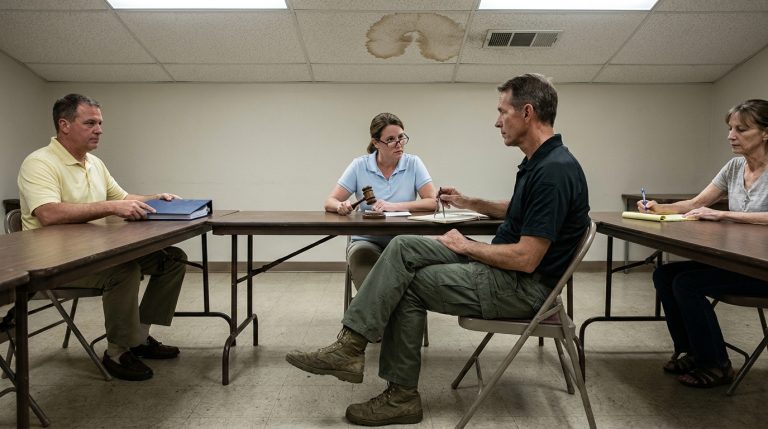
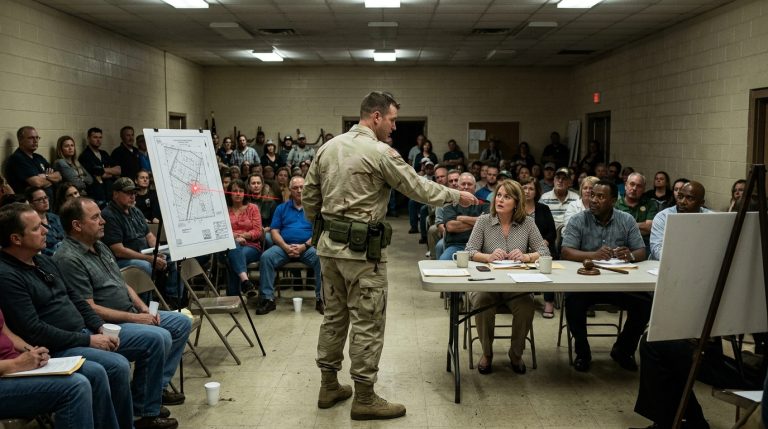
The fluorescent lights hummed with a low-frequency vibration that seemed to settle right behind my eyes. The room smelled of industrial floor wax and the stale, recycled breath of a building that hadn’t seen an open window since the Clinton administration. I sat in the third row, my back against the hard oak of the bench, feeling the grit of the morning’s work still etched into the lines of my palms.
Across the aisle, Delphine Morecraft was a study in artificial composure. She didn’t have her sun visor on today. Her hair was pulled back into a tight, professional knot, and her blazer was a sharp, clinical navy. She sat with her hands folded over a leather-bound folio, looking like a woman who was here to perform a civic duty rather than defend a crime.
“The chair recognizes Mrs. Morecraft,” the commissioner said.
The man in the center seat—Commissioner Vance—looked like he’d rather be anywhere else. He had the tired eyes of a career civil servant who spent his days refereeing disputes over fence heights and culvert drainage. He didn’t look at me. He looked at the clock.
Delphine stood. Her voice was a polished instrument, honeyed but firm. “Thank you, Commissioner. We are here simply to formalize what has been the status quo for nearly two decades. The Cavenaugh parcel has served as a critical connector for Sycamore Ridge. Safety, efficiency, and community connectivity are at stake. Mr. Wolfe is new to our soil. He doesn’t yet understand that in Oklahoma, we look after one another. We don’t block the paths our neighbors have walked for fifteen years.”
She laid a stack of papers on the table. “This is a petition signed by seventy-three residents. They aren’t asking for much. Just the formal designation of the northern strip as a public right-of-way. We’ve even included a preliminary survey provided by Dunbar Land Services showing the proposed easement won’t interfere with the primary build-site.”
She turned slightly, her gaze grazing over me like a cold wind. “We aren’t here to be adversarial. We are here to be neighbors.”
“Mr. Wolfe?” Vance asked, his voice flat. “Do you have a response?”
I stood up. I didn’t have a leather-bound folio. I had a manila envelope, the edges frayed from being carried in the door pocket of my truck. I felt the weight of the broken padlock in my pocket—a reminder of what “neighborly” looked like when the sun went down.
“I’m not a neighbor yet, Commissioner,” I said, my voice cutting through the hum of the lights like a dull saw. “I’m a landowner. And in this county, those used to be the same thing.”
I walked to the front and laid three documents on the table. They weren’t petitions. They were facts.
“The first is a certified copy of the Cavenaugh deed. It shows sixty-two acres of raw land, unencumbered. No easements. No rights-of-way. The second is a letter from the Oklahoma Department of Transportation. They have no record of this ‘informal path’ being designated for public use. And the third…”
I paused, looking at Delphine. She was still smiling, but the corners of her mouth were beginning to twitch.
“The third is a certified abstract of title. It shows that in 2003, when Sycamore Ridge was platted, the developer—Delphine’s husband’s firm—explicitly waived all claims to the Cavenaugh parcel in exchange for a density bonus on the south side. They traded the ‘connectivity’ they’re crying for now for three extra cul-de-sacs twenty years ago.”
Vance leaned forward, his interest finally piqued. He picked up the abstract, the old paper crinkling under his fingers.
“Is that right, Mrs. Morecraft?” Vance asked.
“That was a different era, Commissioner,” Delphine said, her voice sharpening. “Usage dictates reality. Prescription easements are a recognized legal—”
“Usage requires hostile, continuous use for fifteen years under a claim of right,” I interrupted. “Walt Cavenaugh gave you permission. He let you use it out of kindness. Permission defeats a claim of prescription. And when Walt died, the permission died with him. I bought the land, not the habits of the HOA.”
I leaned over the table, my shadow falling across her leather folio. “And while we’re talking about safety and community, maybe the commission would like to know why the drainage swale on the Sycamore Ridge side is currently three feet deep in stagnant water. Water that’s currently backing up onto my property because the ‘maintenance’ Dunbar Land Services billed for in 2019 never actually happened.”
The room went silent. The institutional hum seemed to grow louder.
Delphine’s smile didn’t just curdle; it vanished. Her face went a dangerous, pale shade of white. “That is an entirely separate, unrelated matter. We are here to discuss the road.”
“It’s not separate,” I said. “You want the road so you can keep the public away from that fence line. You want a buffer so no one sees the bog you’ve created while you’re pocketing the community’s dues.”
Vance cleared his throat. He looked at the abstract, then at the petition. He sighed—a long, weary sound of a man who had seen enough. “The commission will not be moving forward with the petition for a public right-of-way today. Mr. Wolfe, your deed is clear. Mrs. Morecraft, if you want a prescriptive easement, you’ll have to prove it in district court, not in this chamber. And as for the drainage issue…”
He looked at me, his eyes narrowing. “I’ll have a county inspector out there by Tuesday. If there’s standing water on an easement, that’s a code violation.”
Delphine didn’t say a word. She grabbed her folio, her knuckles white against the leather. She walked out of the room without looking back, her heels clicking a rapid, angry staccato on the tile.
I didn’t follow her. I stayed at the table, collecting my papers.
“You’ve got a long road ahead of you, son,” Vance said quietly as the room began to clear. “She doesn’t lose. Not in this county.”
“She’s already lost,” I said, sliding the abstract back into the manila envelope. “She just hasn’t checked the records yet.”
I walked out into the bright September afternoon. The air felt cleaner, the sun hotter. I reached into my pocket and pulled out a small, white slip of paper—a certified mail receipt I’d picked up on the way to the hearing. The ink was slightly smeared where I’d gripped it with sweaty hands.
It was the receipt for the letter I’d sent to the Oklahoma DEQ.
I looked toward the parking lot. The white Escalade was gone, but the silver F250 was there, idling in the corner. Prescott Dunbar was behind the wheel. He wasn’t watching the road. He was watching me.
He raised a hand—not a wave, but a finger pointed directly at my chest, like the barrel of a gun. Then he shifted into gear and tore out of the lot, his tires screaming.
The hearing was over. The “neighbors” had been told no. Now, the rusted truth was going to have to face the cold iron of the weekend. I got into my truck, the cracked dashboard a familiar, grounding sight.
I didn’t head home to Tulsa. I headed to the hardware store. I needed more than a farm gate now. I needed a barrier that could survive a collision.
CHAPTER 8: BLUEPRINTS OF THE RUSTED TRUTH
“She didn’t just build a fence, Garrett. She built a vault.”
Elton Briggs slid an accordion folder across the laminate table of the diner, the plastic surface scarred by decades of sliding plates and heavy mugs. The sound was a dry, rasping scrape that cut through the low hum of the midday rush. The air in the Wagoner diner was a thick soup of fry grease, burnt coffee, and the particular electric tension of a small town holding its breath.
I didn’t open the folder yet. I wrapped my hands around my mug, the ceramic radiating a heat that felt honest against the chill that had settled in my bones after the hearing. “A vault for what, Elton? We already know about the swale. We know Prescott is dumping. That’s enough to bury them.”
“Is it?” Elton leaned forward, his voice a gravelly whisper. The fluorescent light above us flickered, casting a sickly yellow strobe across the deep canyons of his face. “In this county, dumping is a fine. A slap on the wrist and a ‘don’t do it again’ from a judge who probably plays poker with Delphine’s husband. You want to stop her? You have to find the ledger. Not the one she shows the board. The one she keeps in the dark.”
I flipped the folder open. Inside lay a mess of blueprints, field notebooks, and hand-drawn plat drawings that looked like they’d been rescued from a flooded basement. The paper was stiff, smelling of damp earth and time.
“I surveyed the Cavenaugh parcel twice,” Elton said, tapping a yellowed sheet with a finger that looked like a piece of gnarled oak. “Once in ’97. Once in 2008. But look at the 2008 drawing. Look at the northern boundary.”
I leaned in. The line between my land and Sycamore Ridge was marked with the usual hatched lines for the stormwater easement. But there was a discrepancy—a small, penciled-in notation in the margin that hadn’t appeared on the official county filings I’d pulled from the digital database.
Ref: P-84. Concrete Encased.
“P-84,” I muttered. “That’s a pipeline designation.”
“Exactly,” Elton nodded. “There was a feeder line for the old Phillips gathering system that ran through Walt’s corner. It was decommissioned in ’92. Standard procedure is to purge and grout them. But the 2008 survey shows the pipe wasn’t just left there. It was used as the anchor for the HOA’s drainage swale.”
I felt the familiar, cold clarity of a site supervisor spotting a structural failure. I remembered the thermal signature from the drone—the pulsing orange heat. I remembered the oil-like sheen in the mud.
“They aren’t just dumping into the water, Elton,” I said, the realization hitting me with the weight of a sledgehammer. “They’re using the old P-84 line as a subterranean reservoir. They’ve got a bypass hooked into the swale inlet. When the swale ‘clogs,’ the runoff—and whatever Prescott is pouring out of those containers—gets diverted into a dead-end steel pipe four feet underground.”
Elton leaned back, the vinyl booth groaning under his weight. “Which explains why the DEQ never finds anything in the creek. The toxins aren’t flowing. They’re sitting. Slowly eating through the rusted casing right under your fence line.”
“And the twelve thousand dollars for ‘maintenance’?”
“Grout,” Elton said, his eyes hard. “They didn’t clear the ditch. They bought enough industrial grout to seal the ends of the pipe after they’d filled it to the brim. Only, grout doesn’t stop the pressure of a decade of trapped gas and chemical sludge. It’s a ticking bomb, Garrett. And it’s sitting right under the feet of those kids Delphine was so ‘concerned’ about at the hearing.”
I closed the folder, the rusted truth of it settling heavily in the pit of my stomach. This wasn’t just a neighborly dispute anymore. This was an environmental catastrophe wrapped in a fraud. Delphine hadn’t just been shaving four minutes off a commute; she’d been using my property line as a shield for a massive, unrecorded liability. If that pipe leaked—or worse, if the pressure caused a localized soil failure—the entire northern edge of Sycamore Ridge would be designated a superfund site. Property values wouldn’t just drop; they’d evaporate.
I looked out the diner window. Across the street, a red pickup truck was idling near the hardware store. It was the mid-2000s Chevy with the dented left rear quarter panel—Gifford Alcott’s truck. He wasn’t even pretending to hide anymore. He sat there, his silhouette dark behind the glass, a scavenger waiting for a carcass.
“They know you’re talking to me,” Elton warned.
“Let them watch,” I said. I stood up, grabbing the folder. “Elton, can you digitize these field notes? I need the exact GPS coordinates for the P-84 inlet. If I can find the physical junction where the swale meets that pipe, I don’t need a court order. I just need a shovel and a DEQ investigator.”
“I can get you the coordinates,” Elton said. “But Garrett… be careful. Delphine’s brother-in-law isn’t just a treasurer. He’s a man who handles ‘disposals.’ And you’re starting to look like a very loud piece of trash to them.”
I walked out of the diner into the blinding Oklahoma sun. The heat was a physical weight, the smell of hot asphalt rising in shimmering waves. I headed for my truck, my boots echoing on the cracked sidewalk.
As I reached for the door handle, I saw it. Tucked under my windshield wiper was a small, torn scrap of paper.
4 minutes isn’t a long time. But it’s long enough for a fire to start.
I looked across the street. Gifford Alcott shifted his truck into gear and slowly pulled away, his tires kicking up a defiant cloud of dust.
I climbed into the cab, the cracked dashboard a silent witness to the escalation. I didn’t feel fear. I felt the singular, focused pragmatism of a man who had spent twenty years suppressing empathy for the sake of the project. If they wanted to talk about fire, we could talk about fire. But I was the one with the maps.
I didn’t go back to the land. I drove to the county library. I needed the 2003 subdivision development permit—the original, unedited paper copy that existed before Delphine’s husband started “managing” the records.
If Layer 1 was the dumping, and Layer 2 was the embezzlement, I needed to find the bridge between them. I needed to see who signed the original inspection for the P-84 decommissioning.
By the time the sun began to set, casting long, blood-red shadows across the library’s stone steps, I had found the signature. It wasn’t Delphine. It wasn’t Prescott.
It was Commissioner Vance.
The man who had just told me I had a “long road ahead” had been the one to sign off on the fraudulent decommissioning twenty years ago. The vault wasn’t just built by the HOA; it was sanctioned by the county.
The circle was closing. The neighbors were complicit, the law was bought, and the ground beneath my feet was rotting. I gripped the steering wheel, the leather hot and slick.
“Okay, Delphine,” I whispered into the quiet of the cab. “Let’s see how many of your friends are willing to burn with you.”
I shifted into gear and headed for the property. I wasn’t going to wait for the county inspector on Tuesday. I was going to find the inlet tonight.
CHAPTER 9: THE BURIED INLET
The buckbrush clawed at my shins, the dry, brittle branches snapping with a sound like breaking bone. The air here, tucked into the low-lying shadow of the boundary fence, didn’t smell like the rest of the hill country. It didn’t have the clean, sharp bite of wild onion or the mineral warmth of sun-baked red clay. It smelled of stagnant vitamins and something sour—something that set the back of my throat on fire.
“Keep your boots out of the standing pools, Mr. Wolfe,” Patricia Sweeney said, her voice muffled by the heavy-duty respirator she’d pulled over her face.
The DEQ investigator moved with the practiced, clinical caution of a woman who had spent a career walking through the mistakes of men who thought they were clever. Her rubber boots were a vibrant, jarring yellow against the bruised purple and sickly orange of the bog. She carried a long, stainless steel sampling probe that looked like a surgical instrument.
I stopped at the edge of the fence line, the rusted iron bars of the Sycamore Ridge perimeter glowing in the low light of the afternoon. “It’s worse than the drone showed, isn’t it?”
Sweeney knelt, the wet ground sucking at her boots. She plunged the probe into the muck. When she pulled it back, the tip wasn’t covered in silt. It was coated in a thick, iridescent slime that shimmered with an oily, unnatural rainbow.
“The thermal signature we picked up yesterday wasn’t decomposition,” she said, her eyes fixed on the sample. “It’s an exothermic reaction. Something in this soil is reacting with the groundwater. It’s not just dumping, Mr. Wolfe. This is concentrated waste.”
I looked toward the spot Elton had marked on the 2008 field notes. “The P-84 inlet is right there. Under that clump of buckbrush.”
I didn’t wait for her to give me permission. I stepped into the bog, the water rising over the toes of my leather work boots. The fluid felt thick, viscous, resisting my movement. I reached into the tangled mat of willow and brush, my fingers searching for the cold, hard edge of steel.
My hand hit something. It wasn’t the rounded curve of a pipe. It was the jagged, buckled edge of a massive steel plate that had been welded over a vertical junction.
“I found it,” I said, my voice strained.
I grabbed the edge of the plate and pulled. The buckbrush groaned, the roots giving way with a sickening, wet pop. As the greenery cleared, the true architecture of Delphine’s vault was revealed.
It wasn’t just a blocked swale. Someone had cut a four-foot hole into the top of the old P-84 gathering line and installed a custom-fabricated steel hopper. The swale—the entire drainage system for the northern edge of the HOA—was designed to overflow directly into this hopper. When the rains came, the runoff would wash whatever had been dumped into the ditch straight into the decommissioned pipe.
It was a subterranean landfill. A five-mile steel tomb for everything Prescott Dunbar didn’t want the state to find.
Sweeney leaned over the hopper, her flashlight cutting through the dark throat of the pipe. The beam hit a surface ten feet down—a black, undulating pool of liquid that looked like liquid obsidian.
“This pipe was supposed to be purged and grouted in 1992,” she said, her voice trembling slightly. “The county records show it as a solid concrete plug.”
“Commissioner Vance signed the inspection,” I said, the words feeling like grit in my mouth.
Sweeney straightened up, her face pale behind the mask. “If this pipe is full… if the pressure from the groundwater has compromised the old welds… Mr. Wolfe, you aren’t just looking at a property dispute. You’re looking at a structural failure that could poison the watershed for three counties.”
I looked back at my gate. I could see the high-definition eyes of my cameras blinking in the oaks. I could see the silhouette of my truck, the cracked dashboard a silent witness to a reality that was far darker than a Pilates shortcut.
The “decoy” was the road. The “ultimate reality” was the vault. But the truth was even heavier: The man who was supposed to be the referee of this game was the one who had helped build the stadium.
“I need to call my director,” Sweeney said, already reaching for her radio. “We’re going to need a full containment team. And we’re going to need the Sheriff.”
“You won’t get the Sheriff,” I said. “Holloway is the only one who isn’t on the HOA’s Christmas card list. And he’s two hours away in Muskogee today.”
“Then who—”
A sound cut through the quiet of the creek. The heavy, rhythmic crunch of gravel.
A silver F250 was pulling up to my gate. It didn’t stop. It accelerated.
I saw the front bumper—the one Gifford Alcott had freshly replaced—hit the steel frame of my gate at fifteen miles an hour. The sound was a deafening, metallic scream that tore through the hill country. The gate held, the reinforced concrete footings I’d poured four feet deep anchoring it to the earth, but the actuator arm snapped like a dry twig.
Gifford didn’t get out. He shifted into reverse, his tires screaming on the gravel, and backed up for a second run.
“Get back!” I yelled at Sweeney.
I scrambled out of the bog, my boots heavy with toxic silt. I reached my truck just as the red Chevy rolled into the frame, pinning me between my own tailgate and the gate I’d built to keep them out.
Delphine Morecraft stepped out of the Escalade, which had pulled up behind the trucks. She wasn’t wearing a blazer. She was wearing a rain jacket, the bedazzled visor gone, her hair disheveled by the wind. She looked at the bog, then at Sweeney, then at me.
“You should have moved the gate, Garrett,” she said. Her voice was flat, devoid of the honeyed polish I’d heard in the hearing room. “Now you’ve made it everyone’s problem.”
“It was already everyone’s problem, Delphine,” I said, my hand reaching into the bed of my truck for the heavy post driver. “You just thought you could keep it buried.”
“The county isn’t going to help you,” she said, stepping toward the fence line. “Vance isn’t going to help you. And the DEQ… well, accidents happen in rural areas. Especially in stagnant water.”
Prescott Dunbar stepped out of the F250. He was holding something in his hand—not a bolt cutter this time. It was a heavy industrial flare.
“The P-84 line has a high methane concentration, doesn’t it, Garrett?” Prescott asked, a jagged, desperate grin on his face. “Site supervisor like you would know that. All it takes is one spark in the hopper to turn this property into a crater.”
I looked at Sweeney. She was frozen, her hand still on her radio.
“He’s bluffing,” I said, though the smell of the bog told me otherwise. The exothermic reaction Sweeney had mentioned… the chemical rot… it was a powder keg.
“Try me,” Prescott said, thumbing the ignition on the flare.
The “Escalation” had reached its peak. The “Double-Layer” had been shattered. I wasn’t fighting for a gate anymore. I was fighting to keep the ground I’d bought from becoming a tomb.
I gripped the post driver, the rusted steel cold and familiar. “Delphine,” I said. “Look at the cameras. I’m not the only one watching anymore. Elton’s drone is at four hundred feet. Everything Prescott does is being broadcast to a cloud server in Tulsa.”
Delphine paused. She looked up at the pale sky, her eyes searching for the black speck of the bird.
“You’re lying,” she whispered.
“Am I?” I asked. “Or are you just realizing that four minutes isn’t nearly enough time to clean up a twenty-year-old mess?”
The flare hissed, a bright, magnesium-white spark spitting onto the red clay.
The silence that followed was the loudest thing I’d ever heard.
CHAPTER 10: THE BENT CROSSBAR
The magnesium flare didn’t just burn; it screamed. A high-pitched, chemical hiss that ate into the humid Oklahoma air, casting a blinding, twitching white light over the red clay. Prescott Dunbar held it like a scepter, the sparks showering over his boots, his eyes reflecting a frantic, hollow desperation. The smell of sulfur and scorched metal began to crawl over the sour stench of the bog.
“Back up, Prescott,” I said. My voice was low, a jagged rumble that didn’t rise to match his panic. I didn’t move toward him. I shifted my weight, the soles of my boots grinding into the gravel, my hand tightening on the rusted steel of the manual post driver.
“You think I’m playing, Garrett?” Prescott’s voice was reedy, thin. He looked at the hopper, that jagged steel mouth leading down into the black obsidian of the P-84 line. “One drop. One spark into that vent and we all go up. The swale, the fence, your precious sixty acres. It all becomes a memory.”
Behind him, Gifford Alcott sat in the cab of the red Chevy, the engine idling with a rough, uneven lope. The front bumper was crumpled, the decorative crossbar of my gate now a mangled piece of scrap metal caught in his grille. The impact had left a spray of red plastic fragments across the drive—the same color as the shard I’d found weeks ago. It was a closed loop of arrogance and impact.
Delphine stood by her Escalade, her face a mask of calculated coldness. She wasn’t stopping him. She was waiting to see which way the wind blew.
“You’re not going to drop it,” I said. I took a slow, deliberate step forward, the post driver heavy in my grip. “Because if you do, the first thing the fire investigators find is the residue of whatever Dunbar Land Services has been pumping into this pipe for the last decade. They won’t just find a property dispute. They’ll find the signature of every dollar you’ve stolen from your neighbors.”
Prescott’s hand trembled. The flare spat a glob of white-hot magnesium onto the clay.
“Garrett, get out of there!” Patricia Sweeney’s voice came from behind me, sharp and terrified. She was back near her state vehicle, her radio keyed, her eyes wide behind the respirator.
I didn’t turn. I watched the way the white light danced on the rusted surfaces of the old pipeline inlet. This was the friction point. This was the moment where the “Sovereign Protector” logic met the “Predator” desperation.
“Look at her, Prescott,” I said, tilting my head toward Delphine. “She isn’t holding a flare. She isn’t driving a truck into a gate. She’s standing ten yards back, ready to tell the Sheriff that you went ‘unstable.’ She’s already building the wall between herself and the crater you’re about to make.”
Prescott’s eyes flickered to his sister-in-law. For a second, the mask of the HOA treasurer slipped, revealing the terrified labor beneath the architect’s shadow.
“Prescott, don’t listen to him,” Delphine called out, her voice regaining a sliver of its honeyed authority. “He’s an outsider. He’s trying to divide us. Just… finish it.”
‘Finish it.’ Not ‘we will finish it.’ Not ‘I am with you.’
“The drone is still up there, Prescott,” I said, my voice dropping to a near-whisper that carried through the hiss of the flare. “Elton’s recording every word. If you drop that, you aren’t just a dumper. You’re a domestic terrorist. And Vance can’t sign a paper to fix that.”
The mention of the Commissioner’s name hit the air like a lead weight. Delphine’s posture shattered for a split second. Her jaw didn’t just set; it locked.
“Vance has nothing to do with this,” she hissed.
“Vance has everything to do with the fact that P-84 was never grouted,” I countered, my eyes never leaving Prescott. “He signed the inspection. He’s the one who gave you the keys to the vault. And he’s the first one who’s going to deny he ever knew your name when the federal investigators start digging up this bog.”
Prescott looked at the flare. The magnesium was halfway gone, the white light beginning to sputter into a harsh, flickering orange. He looked at the hopper. Then he looked at the gate—the reinforced steel that had held against Gifford’s truck, the bent crossbar a testament to the endurance of something built to last.
He didn’t drop it into the pipe.
He threw it sideways, into the mud of the bog.
The flare hit the stagnant water with a violent, steaming hiss. For a moment, a cloud of foul, chemical-smelling steam rose into the air, obscuring the treeline.
“Gifford, go!” Delphine screamed.
The red Chevy roared, the tires screaming as Gifford Alcott tried to wheel the truck around the gate. But the mangled crossbar was hooked into his front suspension. The truck bucked, the metal groaning as the gate post—anchored four feet deep in reinforced concrete—refused to yield. The engine stalled with a violent, metallic shudder.
Prescott turned to run toward the F250, but I was faster.
I didn’t use the post driver as a weapon. I jammed the heavy steel tube through the spokes of the F250’s front wheel as he tried to shift into gear. The truck lunged forward six inches before the steel post hit the brake caliper with a sound like a gunshot. The steering wheel jerked out of Prescott’s hands, and the truck died.
Silence returned to the hill country, broken only by the ticking of cooling engines and the distant, rhythmic chirping of a mockingbird.
I stood in the center of the drive, my chest heaving, the smell of burnt magnesium and toxic silt clinging to my clothes. I looked at the three of them—the treasurer trapped in a stalled truck, the scout hooked on a gate, and the president standing alone in the red clay.
“The gate stayed up,” I said, my voice cold and final.
Delphine didn’t move. She looked at the smashed front of Gifford’s truck, at the bent steel of my property brand welded into the center panel. She looked at the trail cameras blinking in the oaks.
“This isn’t over, Garrett,” she whispered, but the authority was gone. It was just a breath of wind through rusted iron.
“You’re right,” I said. “Tuesday is a long way off. And the DEQ doesn’t wait for commissioners to finish their poker games.”
I walked over to the bog and picked up the spent flare casing with a pair of pliers I pulled from my belt. I dropped it into a heavy-duty evidence bag Patricia Sweeney held out.
“Holloway is ten minutes out,” she said, her voice finally steady. “The drone footage already cleared the DA’s desk.”
I looked at the bent crossbar of my gate. It was a scar now. A permanent reminder of the friction it took to protect sixty acres of truth. I didn’t feel like a winner. I felt like a man who had just finished a double shift in a North Dakota winter—tired, dirty, and ready for the quiet.
But as I looked at Delphine, I saw her reaching into her Escalade, her hand searching for her phone.
“Call him,” I said. “Call Vance. Tell him the vault is open. Tell him the site supervisor found the signature.”
She didn’t call. She sat in the car and stared through the windshield, her eyes fixed on the four-minute shortcut she was never going to drive again.
I walked back to my truck and climbed in. The cracked dashboard was hot from the sun, the jagged line across the plastic a familiar map. I didn’t drive away. I sat there, watching the silver F250 and the red Chevy, two rusted monuments to a neighborhood that had tried to build its peace on a foundation of rot.
The gate was still closed. The land was still mine. And for the first time in twenty years, I didn’t have to look at a roadmap to know exactly where I was.
CHAPTER 11: THE FOURMINUTE RECKONING
“Four minutes, Delphine.”
I didn’t shout. I didn’t have to. The county commissioner’s chamber was so quiet you could hear the microscopic hum of the overhead ballast. The room was packed, chairs leaking into the hallway, a sea of Sycamore Ridge homeowners in pressed khakis and outdoor-brand vests, all staring at the woman in the front row.
Delphine Morecraft sat perfectly still, her spine a rigid line of defiance. But her hands, resting on the wood railing, were trembling—just enough to make the diamond on her finger catch the light in a rhythmic, fractured stutter.
“Four minutes,” I repeated, stepping into the center of the floor. My boots, still caked with the dried, toxic red silt of the swale, looked like a sacrilege against the polished linoleum. “That’s the time you told me was worth a man’s property. Worth a shortcut. But we found a different use for those four minutes, didn’t we?”
I looked up at Commissioner Vance. He was pale, his skin the color of a wet sidewalk. He looked at the binder I’d laid on the podium, then at the doors, as if checking the distance to the nearest exit.
“Mr. Wolfe,” Vance started, his voice cracking. “This is a governance review, not a—”
“It’s an audit, Commissioner. Of the earth and the ledger.” I didn’t wait for him to finish. I tapped the screen of the projector.
The image that flared onto the wall wasn’t a plat map. It was a high-resolution drone thermal, synced with a digital clock. The neon orange plume of the P-84 inlet pulsed like a dying heart.
“This is Tuesday night,” I told the room. “At 6:47 p.m. Exactly four minutes after Prescott Dunbar entered my gate, he reached the swale. In those four minutes, while he thought no one was watching, he opened a valve that hasn’t officially existed since 1992.”
I flipped the page in the binder, the sound of the paper crisp and violent in the silence.
“I did every piece of homework, Delphine. I didn’t just buy land; I bought the history of your failures. Here is the 2003 subdivision permit.” I pointed to the signature at the bottom. “Signed by Commissioner Vance. It states the P-84 line was grouted and sealed. And here,” I pulled a second sheet, “is the invoice from Dunbar Land Services for that grout. Twelve thousand dollars of HOA funds, paid to the President’s brother-in-law for a job that consists of a rusted steel plate and a mountain of lies.”
A murmur rippled through the crowd—a low, dark sound like a rising tide. Courtney Albright, the woman who had lived in Sycamore Ridge for nine years, stood up in the back. Her face was flushed with a cold, righteous anger.
“The assessments,” she said, her voice shaking. “You told us the increases were for ‘long-term infrastructure stabilization.’ You told us the swale was being managed by a third-party firm.”
“The third party was the dirt, Courtney,” I said, turning to her. “They were using the ground as a credit card, and they expected me to pay the interest.”
Delphine finally stood. She didn’t look at the crowd. She looked at me, her eyes twin points of black ice. “You’ve destroyed a community, Garrett. You’ve turned neighbors against each other over a strip of gravel and a dead pipe. Do you think these people will thank you when their home values are red-tagged by the DEQ?”
“They won’t thank me,” I said, my voice dropping to a low, pragmatic edge. “And I don’t want their thanks. I want my silence back. I want to drink my coffee without the smell of your corruption drifting over my fence.”
I looked at Vance. The man was sweating through his suit.
“Commissioner,” I said. “Three of your residents have just filed formal complaints for a state oversight review. But the DEQ is already downstairs with a warrant for the HOA’s digital records. They aren’t looking for the road. They’re looking for the signature that authorized the P-84 bypass.”
Vance’s gavel didn’t move. It sat on the bench like a piece of driftwood. He looked at Delphine, and for a split second, I saw the “Equal Intellect” of the antagonist shatter. He wasn’t her partner; he was her exit strategy, and he was realizing the door was locked.
“This meeting is adjourned,” Vance managed to choke out.
“Not yet,” I said.
I reached into the manila envelope and pulled out the small, jagged piece of red plastic I’d found weeks ago. I walked over and set it on the table in front of Delphine.
“Gifford Alcott is in the hallway with a Sheriff’s deputy,” I said. “His truck is being impounded for a hit-and-run on my gate. The plastic matches, Delphine. The paint flakes match. And the camera footage from the oak tree is already in the cloud.”
The room erupted. The “Neighborly” mask didn’t just slip; it was torn away by seventy-three people who realized they’d been paying a premium to live on top of a tomb.
Delphine didn’t move. She stared at the red plastic fragment. In that institutional light, she looked smaller, older. The “imperial” authority had evaporated, leaving behind only a woman who had run out of road.
I didn’t stay for the shouting. I didn’t stay to watch the news cameras corner her in the parking lot. I walked out of the chamber, my boots echoing on the tile, the smell of the bog finally fading as I reached the heavy glass doors.
Outside, the Oklahoma air was cool, the September wind carrying the scent of dry grass and approaching autumn. I stood on the steps and took a long, deep breath—the kind of breath you can only take when you know exactly where the lines are drawn.
Elton was waiting by my truck, leaning against the rusted fender of his flatbed. He didn’t say a word. He just handed me a thermos of coffee. It was hot, black, and tasted like the truth.
“You did it, Garrett,” he said quietly.
“I didn’t do anything but read the deeds, Elton,” I said. “The land did the rest. It doesn’t like being lied to.”
I climbed into the cab. I ran my thumb over the crack in the dashboard, the jagged line a reminder of every hard mile. I shifted into gear and turned the truck toward the north edge.
I had a gate to fix. And for the first time since I’d signed that deed, I knew that when the steel hit the strike plate, it was going to stay closed.
The shortcut was gone. The vault was open. And in four minutes, I’d be home.
CHAPTER 12: THE CLUNK OF FINALITY
The sun didn’t just rise over the Cavenaugh parcel; it claimed it. The light filtered through the thick stand of post oaks, hitting the leaves at that sharp, late-spring angle that turned the entire grove into a cathedral of stained glass. Gold, amber, and a deep, ancient green spilled across the red clay, illuminating the path where so much friction had once ground the world to a halt.
I sat on the edge of the big covered porch, the wood cool beneath me, my hands wrapped around a heavy ceramic mug. The coffee was black, steaming, and for the first time in eighteen months, it didn’t taste like ash.
I looked down the long gravel drive toward the entry. The new gate stood there—not a temporary farm gate, but the custom-fabricated beast Russ had welded in Muskogee. It was a twelve-foot expanse of heavy gauge square tube steel, powder-coated black, with my property’s brand forged into the center panel. It looked like it had grown out of the earth itself.
The silence of the morning was absolute, broken only by the rhythmic, prehistoric call of a pileated woodpecker somewhere deep in the oaks. No white Escalades idling at the fence. No silver F-250s creeping through the golden hour. Just the land, breathing.
The finality of it had arrived not with a shout, but with a series of quiet, clinical clicks.
The first click was the settlement check. I’m barred from speaking the number, but it was enough to see the barndominium to its last coat of paint and leave a remainder that felt like a weight off my shoulders. I didn’t spend it on a new truck. I kept the one with the cracked dashboard; those miles were earned, and I wasn’t about to forget the road that brought me here.
The second click was the DEQ’s final report. It had taken a team of six months to purge the P-84 line, sucking the toxic legacy of Dunbar Land Services out of the steel tomb and grouting the entire five-mile stretch with permanent industrial resin. The bog was gone. In its place, the HOA—under its new, shell-shocked board—had been forced to install a state-of-the-art filtration swale. Every drop of water that crossed into my creek now was cleaner than the rain that brought it.
I stood up, the movement slow and deliberate, and walked down the porch steps. My boots hit the red clay, the soil firm and rain-washed.
I thought about Delphine. Last I’d heard, she’d moved to a condo in Oklahoma City, a place with no HOAs and no shortcuts. The “4-minute” woman had run out of time. Prescott Dunbar was halfway through a deferred sentence, wearing an orange vest and picking up trash along the same county roads he used to think he owned. And Commissioner Vance… his early retirement hadn’t come with a golden watch, just a long, quiet investigation by the state licensing board that would eventually strip him of everything but his pension.
I reached the gate. I ran my hand over the powder-coated steel. It was smooth, sun-warmed, and unyielding.
I’d used the remainder of the settlement to partner with the Wagner County Rural Schools Foundation. We’d set up a scholarship—twenty-five hundred a year for kids who wanted to study land surveying or environmental science. Kids who wanted to know how to read a deed and protect a watershed. It was a small anchor, but anchors are what keep a legacy from drifting.
A car slowed on County Road 7. I didn’t tense. I didn’t reach for a camera. It was a small, dusty sedan. It stopped at the roadside stand a quarter-mile up, where Bernadette Goss was putting out the first crates of spring peaches. Thaddeus Pruitt’s Angus were grazing peacefully in the south pasture, their black hides shining in the morning heat.
The community wasn’t unhappy. It was just different. It was a place where the lines were respected, and where the truth didn’t have to hide in a rusted pipe.
I stepped out to the keypad, punched in the code, and watched as the solar-powered actuator began its slow, silent work. The heavy wings of the gate swung open, welcoming the day. I walked to the mailbox, pulled out a small stack of flyers and a single handwritten note from one of the scholarship recipients, then walked back inside.
As the gate reached its limit, the actuator reversed. I stood there, watching the steel panels move toward each other, narrowing the gap until they met in the center.
Clunk.
The sound was deep, physical, and final. It was the sound of a period at the end of a very long sentence. It was the sound of a man who had done every piece of homework and finally found his answer in the dirt.
I turned back toward the house, the light through the oaks casting my shadow long across the drive. The seasonal creek was running loud to the south, the water clear and cold.
I had sixty acres of silence, a house built on a foundation of facts, and all the time in the world to watch the sun come up.