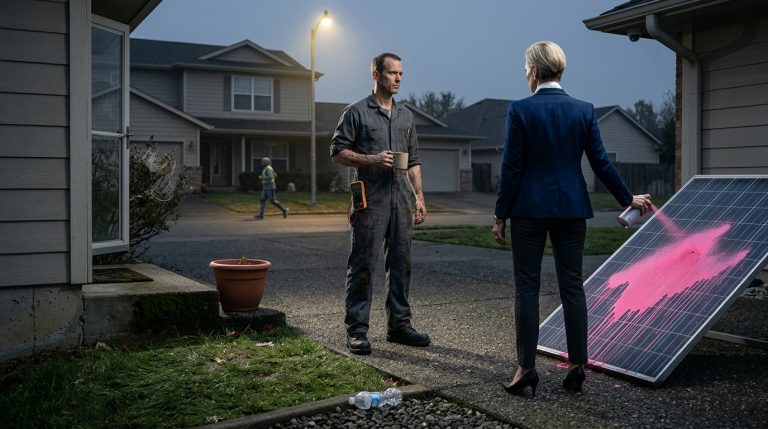
A Calculated Dismantling: How a Federal Judge and a Master Electrician Weaponized Law Against Petty Tyranny
CHAPTER 1: The Weight of Ink
The eviction notice crackled in my grip, the weight of the paper feeling heavier than it had any right to. 6:17 a.m. The silence of the morning was shattered only by the distant, rhythmic clicking of sprinklers—the heartbeat of Sunset Ridge. Brenda Kesler had not just slid a document under our door; she had declared a war she lacked the clearance to win.
I didn’t call out. I didn’t rush to the door. I simply stood in the entryway, the cool morning air biting at my bare feet, and watched. Brenda didn’t hurry. She moved with the predatory grace of someone who believed the law was an extension of her own will. She straightened her jacket, checked her reflection in the rearview mirror of her Lexus, and pulled away.
“Henry?” Sarah’s voice came from the kitchen, low and sharp. She didn’t need to see the paper. She could feel the shift in the air, the kind of static that precedes a storm.
I walked into the kitchen, placing the document on the granite island as if it were a bomb. “She’s finally done it, Sarah. She’s signed a court order. Or, at least, she thinks she has.”
Sarah stepped into the light. She didn’t look like the wife who spent her weekends gardening or trying fusion recipes. Her eyes scanned the document with a speed and cold precision that transformed the room. She didn’t read it; she dissected it. The case number, the formatting, the signature—the amateurish attempt at a federal seal.
“She used a template,” Sarah murmured, her tone devoid of emotion. “A poor one.”
“She’s threatening eviction, Sarah. 72 hours. She’s claiming you’ve personally ordered our removal.” I leaned against the counter, my pulse finally beginning to settle. “She has no idea who she’s hunting.”
Sarah reached out and tapped the forged signature. Her hand was steady, her expression unreadable—a mask of judicial neutrality that would have terrified any defendant standing before her bench. “She isn’t just hunting us, Henry. She’s documenting her own sentencing.”
I looked at her, really looked at her, and saw the gears of the federal machine beginning to turn. The anger that had fueled me for months—the urge to scream, to shove the truck into her driveway, to fight back with brute force—dissipated, replaced by the cold, surgical clarity of a man who realized he was no longer a victim. I was the bait, and the trap was perfectly set.
“What do we do?” I asked, though I already knew the answer.
Sarah turned to the laptop, her fingers hovering over the keys. “We do exactly what the law requires. We record. We document. And we give her enough rope to ensure that when she falls, she never gets back up.”
A new sound drifted from the street—the mail truck. My phone buzzed in my pocket: a text from Mrs. Lucy. She just left a notice at our door, too.
I walked to the front window, peering through the slats of the blinds. The neighborhood looked the same, but the reality had shifted. The trap wasn’t just for us anymore; it was for every family Brenda had targeted. I felt a surge of grim, quiet anticipation. She was going to try to evict the neighborhood, not realizing she had just handed the neighborhood the key to her prison cell.
CHAPTER 2: The Architecture of Evidence
“We don’t go to the police,” Sarah said. She was already at the kitchen table, the laptop screen casting a harsh, blue light across her face that made her look less like my wife and more like the judge who sent career criminals to state facilities. “Not yet. If we go to the local authorities, Brenda will simply claim it’s a neighborhood dispute. She’ll lawyer up, delete the digital footprint, and destroy the physical evidence.”
I leaned against the counter, watching her. Outside, the Arizona sun was beginning to bake the asphalt, turning the neighborhood into a shimmering, distorted landscape. “So we wait for her to escalate?”
“We encourage the escalation,” Sarah corrected, her voice clipped, professional. “She thinks she’s a genius because she bought a box of resume paper and downloaded a seal. She believes she’s playing a game of suburban power, but she’s actually playing a game of federal law. If she serves these documents to the other families, she isn’t just harassing neighbors. She’s committing multiple counts of mail fraud and impersonation of a federal officer. But she needs to believe she’s winning. She needs to feel like she’s finally silencing the ‘problematic elements’ of her kingdom.”
I felt the tension in my shoulders begin to knot. “The Lucy’s are terrified, Sarah. Brenda’s been monitoring their mail. If I tell them to keep these fake notices, I’m putting them in the crosshairs.”
Sarah stood up, walking over to the cabinet where I kept my electrical supplies. She didn’t look at me; she looked at the shelf where I kept the security camera hardware. “Then we don’t tell them to keep them. We tell them to treat it like a hazard. We get them to contact us the moment she arrives. We become their security, Henry. You have the skills. You can wire this entire street to record every interaction without the equipment even being visible.”
I looked at my hands—calloused, stained with the gray dust of a solar installation project. I had spent two decades making sure homes were safe, making sure wires were grounded so nothing caught fire. I knew exactly how to bridge a gap, how to turn a current into something useful. I could see it now: the cameras, the hidden recorders, the web of surveillance that would turn the entire subdivision into a high-definition witness box.
“She’s already planning the next step,” I said, a grim smile touching my lips. “I saw her looking at the clubhouse calendar. She’s going to try to convene an emergency board meeting. She wants to present these ‘court orders’ to the rest of the board.”
“Perfect,” Sarah said, and for a second, a glint of something dangerous flickered in her eyes. “If she presents them as legal facts to the board, she’s crossing the line from individual harassment to organizational fraud. That’s when the evidence becomes legally insurmountable.”
“I need to go to the clubhouse,” I said, my decision forming like hardened concrete. “I need to see if she’s left anything behind. If she’s using that printer, she’s keeping a log, a draft, something. Amateur criminals always keep a draft.”
“Be careful,” Sarah warned, her hand touching my arm. “She thinks she’s untouchable. A person who thinks they’re untouchable makes sloppy mistakes. Don’t let her see you looking.”
I left the house, the heat hitting me like a physical weight. My work boots crunched on the gravel, a sound that felt entirely too loud in the quiet morning. As I approached the clubhouse, the scent of parched desert grass and synthetic turf filled my nose. The building was locked, but the clubhouse manager, an elderly man named Arthur who’d been bullied by Brenda for months, was outside cleaning the windows. He looked up, his face pale.
“She was here at 5:00 a.m., Henry,” Arthur whispered, glancing toward his Lexus. “She looked like she hadn’t slept. She was printing things in the office. A whole stack of papers. She looked… manic.”
I nodded, keeping my expression neutral, checking the door handle. It was locked, but I knew the way the locks in these buildings worked—the master electrician’s curse, seeing the flaws in every system. I reached into my pocket, fingers brushing the small, multi-tool I always carried. “Did she leave the office open?”
“No,” Arthur said. “But she left the recycling bin outside the back door. She said the office trash was ‘unauthorized’.”
I moved toward the back, the smell of toner growing stronger as I neared the bin. My pulse quickened. There, beneath a discarded flyer for a local florist, lay the discarded drafts. Misspelled names, crossed-out legal jargon, and the chillingly recognizable template for the eviction notice. I pulled a piece out—it was a draft with handwritten notes on the side. Target: Rivera. Target: Lucy. Target: Patel.
I shoved the papers into my jacket. My hands were shaking, not from fear, but from the raw, kinetic energy of the hunt. I had the evidence of the forgery, and I knew exactly where she was headed next. I turned back toward the house, but stopped. Through the clubhouse window, I saw it: the mahogany cabinet where the board kept the HOA ledger. It was slightly ajar. Brenda had been so obsessed with her fake court orders that she’d forgotten to secure the real community funds.
I looked at the lock. It was a simple tumbler. A few seconds, a light touch, and I could confirm Mr. Patel’s suspicions about the missing funds. The risk was enormous—if she walked in now, I wouldn’t just be an annoyed neighbor, I’d be a trespasser. But the thought of her stealing from the families she was terrorizing made the choice easy.
I took a deep breath, the desert heat pressing against my back, and reached for the lock.
CHAPTER 3: The Ghost in the Ledger
The tumblers yielded with a sharp, sickening click that sounded like a gunshot in the silent, sun-drenched clubhouse. I froze, my heart hammering against my ribs, waiting for the sound of Arthur’s broom or the distant hum of Brenda’s Lexus. Silence reclaimed the room, heavy and stagnant, smelling of old coffee and industrial cleaning agents.
I pulled the cabinet open. The HOA ledger sat there, bound in cracked, imitation leather. Beside it lay a stack of invoices, bank statements, and the thick, ominous logbook that tracked every cent of the community’s maintenance fund. I didn’t care about the bylaws or the petty complaints; I went straight for the finances.
I flipped through the pages, my fingers tracing the columns of numbers. For the first two years of the neighborhood’s life, the bookkeeping was impeccable—linear, predictable, the work of a board that actually cared about asphalt and sprinkler repair. Then, five months ago, the handwriting changed. The ink turned from a disciplined, archival blue to a frantic, hurried black. The entries became vague. “Contractor Service – Misc” appeared with increasing frequency, accompanied by suspiciously round dollar amounts.
My stomach twisted. Mr. Patel had been right. It wasn’t just mismanagement; it was systematic stripping. But as I reached for the digital tablet the board used to cross-reference transactions, my hand stopped. The screen was black. I tapped the power button, but the battery was dead—drained as if it had been left on for weeks. I turned the device over, and the realization hit me like a physical blow: the charging port was smashed, the metal bent inward with deliberate, calculated violence.
She knew. Or someone did.
I pulled out my phone, snapping photos of every page of the logbook. My hands were steady now, driven by the cold, tactical necessity of the situation. I needed to know where the money was going. I traced the “Contractor Service” payments to an account registered to a shell company: Sunset Property Solutions. I didn’t recognize the name. It wasn’t local.
I heard the front door handle jiggle.
Panic, cold and sharp, flooded my veins. I didn’t have time to hide the ledger. I shoved it back into the cabinet, not bothering to relock the tumbler, and vaulted over the back desk just as the clubhouse door swung open.
Brenda.
She wasn’t alone. I heard the muffled, indignant voice of Harold Lucy, the treasurer who had been struggling to find his footing.
“I’m telling you, Brenda, the budget doesn’t add up,” Harold was saying. His voice was tremulous, the sound of a man trying to be brave in the face of a landslide.
“Harold, your inability to grasp modern asset management is precisely why I was elected,” Brenda’s voice purred, sharp and dismissive, like a knife sliding through silk. “We are maintaining standards. Standards cost money. If you don’t like the pace of the improvements, you are more than welcome to step down. I’m sure there are plenty of other residents who would love the opportunity to contribute to the community’s future.”
I stayed perfectly still, pressed into the narrow gap between the desk and the back wall. The smell of her perfume—that suffocating, floral scent of funeral lilies—flooded the small office. It was so close I could hear the rustle of her silk blouse.
“It’s not just the money,” Harold pushed on, though his resolve was clearly fracturing. “It’s the notices. The forgeries—”
“Careful, Harold,” Brenda interrupted, her voice dropping to a dangerous, low register. “Those aren’t forgeries. Those are formal notices of impending legal action. If you continue to spread such libelous accusations, I’ll be forced to include you in the next round of eviction filings. I have the judge’s full support. Do you really want to test the patience of the federal court?”
I held my breath until my lungs burned. She wasn’t just bluffing; she was escalating the lie, weaving it into the fabric of her tyranny until even the treasurer was afraid to speak. I shifted my weight, my boot scraping against the carpet, and a sharp, stinging pain flared in my side—I’d caught my jacket on a discarded staple gun. I froze again, praying she hadn’t heard the metallic click.
“I just… I want to see the bank statements,” Harold whispered.
“The statements are being audited by our legal consultant,” Brenda lied, the words flowing from her with the practiced ease of a professional gambler. “You’ll see them when the audit is complete. Now, leave me. I have official business to attend to.”
I heard the door close, and a long, agonizing minute passed before I dared to move. When I finally crawled out from behind the desk, the room felt different. The air was thinner, charged with the electricity of a trap about to snap. I had the photos of the ledger, I had the draft of the forged notice, and I had confirmation of the shell company.
I slipped out the back way, my mind racing. Sarah had been right—Brenda was digging a hole so deep that when she finally hit bottom, there would be no way back up. But as I walked back toward our house, I realized the missing logbook entries weren’t just an oversight. They were a bridge. Brenda wasn’t just embezzling; she was using the money to pay for the ‘legal consultants’ who were helping her draft the forgeries.
She was using the neighborhood’s own money to build the machine that would destroy them.
I reached our driveway, but stopped. My solar work truck was parked there, but its rear window was shattered. A single, jagged stone sat on the driver’s seat. Beside it, tucked into the door handle, was another notice.
It wasn’t a court order this time. It was a note, written in Brenda’s precise, arrogant hand.
Don’t go digging where you aren’t wanted, Mr. Rivera. The light eventually fades for everyone.
I stared at the broken glass, the sunlight reflecting off the shards like jagged teeth. She wasn’t just playing a game anymore. She was watching.
CHAPTER 4: The Calculus of Intimidation
The note was weighted with the same arrogance that dripped from everything Brenda touched. I held it between two fingers, the paper stock thick and expensive, mocking the shattered window of my truck. The desert air was warming rapidly, bringing the smell of dust and heat, but the cold sensation in my gut had nothing to do with the temperature. She was no longer just prowling the streets with a clipboard; she was watching our home.
“Henry?” Sarah appeared in the doorway, her eyes instantly locking onto the broken window. She didn’t gasp. She didn’t recoil. Her gaze traveled from the shattered glass to the note in my hand, and then to the security camera mounted on the soffit above the garage.
“She’s escalating,” I said, my voice tight. “She’s moving from administrative harassment to property damage. She’s trying to goad me into a confrontation.”
Sarah stepped down onto the driveway, her movements calculated, silent. She took the note from me, her eyes skimming the words. “She isn’t goading you into a confrontation, Henry. She’s attempting to establish a pattern of hostility. She wants you to be the aggressor so she can file a police report, get a restraining order, and use that as the justification for the eviction. She wants to paint you as the ‘disruptive element’ in her federal filings.”
I looked at the truck, the sunlight glinting off the shards of glass on the driver’s seat. The truck was my livelihood—my tools, my blueprints, my solar panels were all inside. It was a violation that felt intensely personal. “I’m not going to give her that satisfaction.”
“You won’t,” Sarah agreed, turning to look toward Brenda’s house. The white Lexus sat in the driveway, gleaming like a pristine, taunting weapon. “We go to the clubhouse tonight. She’s calling the board meeting, isn’t she?”
“She is.”
“Good. We’re going to give her exactly what she expects, but we’re going to do it on our terms.” Sarah pulled her phone from her pocket and opened the app that connected to our home surveillance. She spent a long moment studying the feed from the clubhouse exterior. “She thinks she’s using the federal court to intimidate us. Tonight, we show her the reality of that court.”
The rest of the day was a blur of tactical preparation. I didn’t repair the window. I left the truck exactly as it was, a visible scar to show the neighbors what “community standards” looked like under Brenda’s regime. I spent the afternoon at the Lucy’s, installing a hidden, high-definition camera in their living room, camouflaged behind a row of house plants. It was the kind of work I’d done for years—wiring, circuiting, hiding the technology until it was nothing more than an invisible eye.
By the time evening arrived, the neighborhood felt different. The usual sense of peace was replaced by an undercurrent of fear, but beneath that fear, I could feel something else—a hardening. The Patels, the Gonzalez family, the Lucys—they were tired of the intimidation.
When we walked to the clubhouse at 7:00 p.m., the air was thick with the scent of sage and impending change. Brenda was already there, standing at the head of the folding table, her expression a mask of practiced, cold authority. She looked polished, her makeup perfect, her white blazer radiating an aura of sterile control.
She saw me enter, her eyes flicking to my work boots—still coated in the dust of the day’s work—and then to my face. She smiled, a thin, tight expression that didn’t reach her eyes. “Mr. Rivera. I see you’ve had a minor incident today. Perhaps a reflection of your own aggressive tendencies?”
The room went silent. The neighbors, most of whom had been on the receiving end of Brenda’s “citations,” watched us with held breaths.
“My truck window was broken, Brenda,” I said, keeping my voice level, though my heart was a drumbeat in my ears. “And I found this.” I held up the note.
Brenda didn’t flinch. She simply tilted her head, the picture of faux concern. “I’m sure it’s just a misunderstanding, Henry. But let’s keep the focus on the business at hand. We have an agenda to cover. The enforcement of community standards is not a suggestion. It is a requirement.”
She gestured to the pile of manila folders on the table—the fake court orders. I walked toward the table, Sarah following a step behind, her presence a quiet, immovable weight.
“We’re here to discuss the board’s authority,” Sarah said, her voice cutting through the room with the precision of a scalpel. She didn’t sound like a neighbor. She sounded like an authority. “And specifically, the certification of your election, Brenda.”
Brenda’s smile faltered for the briefest of seconds. “The board is elected, Ms. Rivera. The bylaws—”
“The bylaws,” Sarah interrupted, “require county certification within thirty days. I’ve checked the public records. That certification is missing. Which means, legally speaking, the board is currently acting without the authority of the law.”
The room erupted. Mr. Patel stood up, his face flushed with triumph. “I’ve been looking into the finances, Brenda. Where is the maintenance fund? There are thousands of dollars unaccounted for, and you’ve been using our money to pay for these… these ‘consultations’?”
Brenda’s composure cracked, a fine web of fissures appearing in her polished exterior. “Those are administrative expenses! The community doesn’t understand the costs associated with—”
“The community understands theft, Brenda,” I said, stepping closer. The smell of her perfume was cloying, nauseating. I could see the sweat glistening on her forehead, the first signs of the panic she’d spent months inflicting on others. “We know about the shell company. We know about the forged orders. And we know you’ve been using a federal judge’s name to validate your greed.”
She looked at Sarah, then at me, her eyes darting around the room like a trapped animal. She was looking for an exit, looking for a supporter, looking for a way to maintain the delusion. But the room was full of people who had finally stopped looking at her with fear and started looking at her with clarity.
“You’re making a mistake,” Brenda hissed, her voice rising to a shrill, hysterical pitch. “I am this neighborhood’s president! I am the one protecting your investments! You are the disruptive element! You are the ones who don’t belong!”
“We belong exactly where we are,” I said, my voice steady, my gaze locked on hers. “And you? You’re done.”
The moment hung there, a fragile, explosive tension that threatened to shatter the room. Brenda looked at the forged documents on the table, her hands trembling as she reached for them, her fingers curling around the fake seal of the court. She was going to fight. She was going to scream. She was going to escalate the lie to the bitter, jagged end.
And that was exactly what we needed her to do.
CHAPTER 5: The Fractured Blueprint
The manila folders scattered across the sheet-draped folding table like a deck of dropped cards. Brenda’s hand slammed down onto the central ledger, her knuckles turning porcelain white against the imitation leather. The room was spinning with overlapping voices, a rising tide of localized heat and adrenaline that smelled faintly of cheap carpet cleaner and old dust. Mr. Patel moved forward, his spreadsheet gripped firmly in a trembling fist, his analytical calm entirely consumed by the raw geometry of the theft.
“The numbers don’t lie, Brenda,” Mr. Patel barked, his finger tracking a column of uncertified withdrawals. “Forty-eight hundred dollars vanished from the reserve pool in ninety days. It’s not an administrative cost. It’s routed straight to an entity called Sunset Property Solutions. I want the corporate registration documents now.”
Brenda did not panic. Her eyes narrowed into two dark, calculating slits as she looked past Patel, her focus anchoring directly onto me. The crimson on her lips pulled into a taut, rigid line of absolute resistance. “Mr. Patel, your interpretation of our operational liquidity is as uneducated as your presence in this administrative chamber. This meeting is formally adjourned under Section 4 of the community maintenance guidelines. Clear the room.”
“Section 4 doesn’t exist in the verified 1998 covenant,” I said, stepping between Patel and the table. My boots found a firm purchase on the linoleum floor, the weight of my body serving as a physical wall against her retreat. “And neither does your presidency. We checked the county clerk’s database at five o’clock today, Brenda. The signature box for the election certification is blank. You haven’t had the legal authority to write a single citation or move a single dollar since the day you took the keys to this office.”
A sharp, collective intake of breath echoed from the doorway where Mrs. Lucy stood with four other families. The psychological leverage was shifting, the invisible geometry of her control fracturing in real-time under the weight of documented facts.
Brenda’s hand drifted toward the corner of the table, her fingers brushing the cold, brushed-aluminum bracket of her legal folder. It was a calculated micro-movement—a predator checking its exit routes. “The county records are subject to a standard processing delay, Mr. Rivera. If you believe a administrative technicality shields your family from the federal eviction mandate signed by Judge Rivera, you are welcome to explain that to the United States marshals when they arrive on your property on Monday morning.”
She grabbed the ledger with a sudden, violent twist of her torso, turning toward the private office door behind the folding bench.
“Don’t touch those files,” I shouted, my hand launching forward to clamp down on the opposite corner of the leather binding. The friction of the old material scraped against my calloused palm, the raw mechanical resistance of her pull vibrating through my arm.
“Get your hands off board property, Henry!” she hissed, her voice dropping into a guttural, desperate register that carried none of her usual suburban polish. Her fingernails dug into the grain of the cover, ripping a small flap of the synthetic material away to reveal a pale gray cardboard core beneath. For a split second, our eyes locked in a silent chess match of physical and psychological momentum. I felt her strength fracture—she wasn’t fighting for an ideology; she was fighting to keep the ledger from being opened in front of ninety witnesses.
With a sudden, desperate jerk, she ripped the ledger free, but the violent motion caught the edge of her expensive leather folder. The aluminum bracket snapped open with a high-pitched metallic ping, and a single, crisp piece of paper slid across the table, spinning face-up under the harsh fluorescent lights.
It wasn’t an eviction notice. It was a certified bank draft from an offshore institution based in the Cayman Islands, stamped with a routing number that didn’t match any domestic clearinghouse. At the bottom of the ledger transfer line, printed in precise, typed characters, was a recurring payment authorization for fifty thousand dollars, completely separate from the petty maintenance funds we had been tracking.
My focus locked on the routing stamp. The trap we had built with Sarah was designed to catch a local embezzler who was forging documents to drive out minority families. But the paper in front of me pointed to something vastly larger—a systematic laundering operation using the HOA structure as a shell for an out-of-state corporate syndicate.
“What is this, Brenda?” I demanded, my fingers reaching for the bank draft.
Before my hand could secure the paper, Harold Lucy reached across the table, his face white with confusion, his clumsy fingers grabbing the document first. “Brenda… this isn’t our local branch pool. This is an external routing index. Who is funding Sunset Property Solutions?”
“Give me that!” Brenda screamed. She lunged across the folding table, her shoulder slamming into Harold’s chest with enough force to send the elderly treasurer stumbling backward into a row of metal folding chairs. The chaotic clatter of aluminum against linoleum ripped through the room as Harold went down, his head striking the edge of the mahogany cabinet with a dull, sickening thud.
“Harold!” Mrs. Lucy shrieked, running from the doorway as the crowd surged forward.
In the ensuing explosion of motion and human noise, Brenda didn’t check on the man she had just knocked down. She snatched the bank draft from Harold’s limp fingers, scooped the remaining folders into her arms, and bolted through the private office exit, the heavy steel door slamming shut behind her with a definitive, mechanical click that locked from the inside.
I ran to the door, throwing my weight against the handle, but the deadbolt was already thrown. Through the thin window pane, I heard the rapid crunch of her designer heels on the exterior gravel pathway, followed by the immediate, high-RPM roar of her Lexus engine tearing out of the parking lot.
I knelt beside Harold. His eyes were open but unfocused, a thin line of blood beginning to bloom along his hairline where it had met the cabinet corner. Mrs. Lucy was weeping, her hands trembling as she held a paper towel against the wound.
“He’s breathing,” Mr. Patel muttered, his hands checking Harold’s pulse with a frantic, uncoordinated rhythm. “But she took the transaction records, Henry. She took the entire audit trail.”
The absolute failure of the moment settled over me like iron dust. We had pushed too hard, too fast, expecting a small-time racist to surrender under the threat of local disclosure. We hadn’t calculated the sheer velocity of her desperation, nor had we anticipated the existence of the offshore account. The decoy secret—the four thousand dollars in missing neighborhood fees—had just been blown apart by a multi-thousand-dollar corporate paper trail that we didn’t understand, and the primary witness was now bleeding on the floor while the suspect was driving away with the weapon.
My phone vibrated in my pocket. I pulled it out, my fingers leaving a smear of gray dust on the glass screen. It was an alert from our home security array.
The camera tracking our front driveway showed the white Lexus pulling up to our house at forty miles an hour. Brenda didn’t get out. The passenger window rolled down, and a thick, dark cylinder was tossed onto our front lawn, landing directly beneath the main electrical panel where my solar business lines connected to the house grid.
The screen flickered once, twice, and then went entirely black as the central power feed to our property was cleanly severed from the exterior wall.
CHAPTER 6: The Blackout Gambit
The darkness inside the house was absolute, a heavy, suffocating blanket that pressed against my eyes. The silence that followed the sudden death of the power grid was even worse—the hum of the refrigerator, the faint ticking of the smart thermostat, the distant background noise of a subdivision at night—all gone. I stood in the middle of our living room, my breath coming in jagged, shallow rasps. The acrid tang of ozone drifted through the vents, a sharp, metallic warning that the primary circuit had been physically compromised.
“Henry?” Sarah’s voice came from the hallway, low and cautious. I heard the soft, steady click of her tactical flashlight as the beam cut through the gloom, a stark, white sliver that caught the dust motes dancing in the stagnant air.
“She’s done it,” I said, my voice sounding hollow in the vast, unlit space. “She didn’t just cut the power. She overloaded the main relay. She’s turned the house into a liability.”
I moved toward the kitchen, my movements measured, relying on muscle memory to navigate the familiar space. I found the emergency kit in the utility drawer—a heavy-duty flashlight and a compact, portable diagnostic tool. I needed to know if the damage was localized to the breaker or if she had managed to bridge the lines, potentially causing a fire inside the walls. If the insulation had melted, the house itself was a trap.
“She’s not just playing games with the HOA rules anymore,” Sarah whispered, her light playing over the walls as she approached. She was holding her phone, though the screen was dead—no signal. The Faraday-style shielding she used for her courthouse work had proven its worth tonight; Brenda hadn’t just cut the power, she had managed to jam the local cellular repeaters that served this block. “She’s committing tactical sabotage.”
“She has help,” I said, snapping the diagnostic tool onto the main line. The screen flickered with a faint, green backlight. “This wasn’t a homeowner’s move. This requires specialized tools—a high-amperage bypass bridge. Brenda Kesler doesn’t know the first thing about electrical load balancing. She had a professional do this.”
I felt a surge of cold, visceral rage. The realization that she was scaling her operation—moving from petty forgery to industrial-grade sabotage—meant the decoy secret we had been chasing, the embezzled maintenance funds, was nothing but a smokescreen. She was being bankrolled by something much larger, something that had the resources to silence her if she failed, and the reach to threaten a federal judge in her own home.
“We need to get out of here,” Sarah said, her voice dropping into her ‘judge’s tone’—the one that brooked no argument. “If she’s already escalated to physical sabotage, the house is no longer defensible. We need to reach the prosecutor, Martinez. She’s our only bridge to the federal authorities now that our comms are down.”
“If we leave, we abandon the evidence,” I countered, already reaching for my backup hard drive, the one containing the 4K footage of the clubhouse meeting and the ledger photos. “If she returns and torches the house, we lose everything. We lose the bank draft record. We lose the proof of the shell company.”
“If we stay, we’re sitting ducks in a blackout,” Sarah snapped, her light catching my face, reflecting the grim, resolute determination in her eyes. “She’s already escalated to destruction. The next step is a fire. We are not martyrs for a pile of digital files, Henry. We are witnesses.”
A sudden sound—the sharp, unmistakable crack of glass—echoed from the front of the house. Not the entryway this time, but the side bedroom window.
I doused our lights instantly, plunging the room back into total darkness. My heart hammered against my ribs, each beat a frantic, rhythmic warning. I moved toward the living room, my hand finding the heavy, iron fire poker I kept near the fireplace. It felt crude, an archaic weapon against whatever technology Brenda and her ‘consultant’ were using, but it was all I had.
“Stay behind me,” I whispered, the words barely audible.
I crouched behind the sofa, listening. The house groaned, the cooling structure settling in the night air, but beneath it, I heard the faint, rhythmic scraping of leather against the stucco exterior. Someone was climbing onto the porch. They weren’t hiding their presence anymore. They were moving with the arrogant, slow pace of someone who expected no resistance.
I reached for the diagnostic tool still hooked to the main line. If I could bridge the capacitor, I could create a localized short—a bright, blinding surge of light that would act as a flashbang in the pitch-black room. It was a risky move; it could blow the entire remaining system, but it would give us three seconds of tactical advantage.
“Henry, don’t,” Sarah warned, sensing my intent. She moved toward the back exit, her hand gripping the door handle. “If you surge the grid, she’ll know we’re armed. She’ll escalate to lethal force.”
“She’s already there,” I said, my hand closing over the wire. I felt the pulse of electricity still trapped in the residual charge.
The front door groaned under a heavy, calculated impact. The hinges screamed—a high, piercing sound of metal yielding to leverage. The silhouette of a man—tall, broad-shouldered, and entirely unfamiliar—stepped through the door, his form framed by the faint, ambient moonlight of the street. He wasn’t holding a citation or a legal notice. He was holding a thermal-cutting torch, the tip glowing with a low, cherry-red heat that cut through the darkness like an eye of fire.
Brenda wasn’t coming to serve papers. She was coming to burn the evidence, and she was bringing the professional muscle to make sure the job was finished.
I lunged forward just as the intruder raised the torch, the heat radiating off it hitting my face like a blast from a furnace. I swung the iron poker with everything I had, a desperate, swinging arc fueled by the wreckage of the last few months. The metal collided with the man’s forearm, the sickening sound of snapping bone echoing through the living room, but the man didn’t even grunt. He simply pivoted, his free hand swinging out to catch me in the throat with a practiced, brutal efficiency that sent me reeling back into the shadows.
I hit the wall, the air trapped in my lungs, my vision swimming. Sarah screamed, but the sound was cut short by the man’s heavy, deliberate stride toward the back of the house where our servers were hidden.
He didn’t care about the money. He didn’t care about the eviction orders. He was a cleaner, and we were the only loose ends left in the ledger.
CHAPTER 7: The Educational Arrest
The man didn’t move like a typical thug. He moved with a cold, terrifying economy, his torch sweeping across the living room with the deliberate care of a jeweler. He wasn’t looking for jewelry or cash; he was scanning for the server tower tucked beneath the mahogany desk. My shoulder throbbed with a dull, white-hot ache where his hand had clipped my throat, but the pain was a distant, secondary concern. Sarah had vanished into the shadows of the kitchen, and I knew—without needing to see her—that she had moved to the secondary defense position.
“You’re making a mistake,” I choked out, my voice raspy. I gripped the fire poker, my knuckles white, the metal slick with a mixture of sweat and the blood I’d drawn from his arm. “The data is already mirrored. You burn the house, it doesn’t matter. It’s already in the cloud.”
The man stopped. He turned his head slightly, the torch light casting long, demonic shadows against the ceiling. He wasn’t surprised by the data, nor was he afraid of the law. “The cloud is a pipe dream, Mr. Rivera. We don’t care about the files. We care about the signatures.”
The floorboards groaned under a sudden, heavy pressure from the kitchen. Sarah lunged from behind the pantry, not with a weapon, but with the heavy, pressurized fire extinguisher we kept for the workshop. She didn’t shout; she didn’t warn him. She triggered the valve with both hands, sending a dense, blinding plume of chemical powder directly into the man’s face.
The man roared, a raw, animalistic sound, and swung the torch wide. A jet of superheated blue flame hissed through the air, carving a jagged, charred line through the dining room table before he blindly backpedaled, his hands clawing at his stinging eyes.
“Henry, now!” Sarah screamed.
I didn’t wait. I charged, not at the man, but at the circuit breaker I’d spent all day preparing. I slammed the diagnostic probe into the bypass line and threw the master toggle with both hands. The house surged. A blinding, violet-white flash of electrical discharge exploded from the wall, the sound like a thunderclap trapped in a box. The arc jumped across the main relay, a beautiful, violent display of raw physics that shattered the remaining light bulbs and sent a shower of sparks cascading across the living room like molten gold.
The intruder went down, the surge hitting him through the conductive torch casing. He didn’t scream; he simply collapsed, his muscles locking in a rigid, involuntary spasm as the voltage tore through his nervous system.
I stood over him, my chest heaving, the smell of charred insulation and chemical foam stinging my nose. Sarah was already across the room, her phone out, a signal bar finally flickering to life on the screen.
“I’ve got Martinez,” she said, her voice shaking but resolute. “The grid surge tripped the silent alarm we linked to her office. She’s ten minutes out. We have him.”
I looked down at the man. He was breathing, but he was out of the fight. The house was a wreck—walls scorched, the air hazy with fire retardant and smoke. I stepped outside, my boots crunching on the broken glass of the front door, and looked toward the street.
Brenda was sitting in her Lexus at the end of the driveway, the engine idling. She wasn’t fleeing. She was watching, waiting to see if her cleaner emerged. When she saw me standing in the doorway, framed by the smoke pouring from our living room, she didn’t look scared. She looked disappointed.
I started toward the street, my legs heavy, my blood pumping with a cold, relentless fury. But before I could take more than three steps, the sound of sirens cut through the night—a discordant, beautiful chorus of emergency vehicles approaching from every direction.
Brenda’s car jerked into gear, her tires spinning against the gravel as she tried to peel away, but a patrol cruiser slammed into the rear bumper of her Lexus, the metal crunching with a finality that brought the car to a dead halt. The street flooded with blue and red light, turning the neighborhood into a strobe-lit stage.
As Agent Rodriguez and Attorney Martinez stepped out of the lead vehicle, their weapons drawn, I saw the exact moment the realization hit Brenda. She wasn’t just being arrested for HOA violations or embezzlement. She was being swarmed by federal task force agents who had spent the last eight hours building a felony case around the very ‘consultant’ she had sent to silence us.
I watched as they dragged her from the car, her pristine white blazer stained with road dust, her face a contorted mask of hatred. She didn’t look at the agents. She looked at me.
“You think you won?” she shrieked, her voice cracking as the handcuffs clicked into place. “You think a little documentation changes the system? You’re nothing, Rivera. You’re just a temporary occupant in a world you don’t understand!”
I didn’t answer. I just watched as they shoved her into the back of the cruiser. The ‘cleaner’ was brought out on a stretcher, unconscious, and shoved into an ambulance.
The neighborhood was full of people now. Neighbors were standing on their porches, watching the final act of the Brenda Kesler regime. I saw Mrs. Lucy, I saw Mr. Patel, and I saw the other families who had spent months living in the shadow of her tyranny.
Attorney Martinez walked over to me, her expression grim. “We have the bank draft, Henry. We have the connection to the offshore syndicate. Brenda didn’t act alone—she was a pawn, a local point of contact for an out-of-state laundering scheme. But the forgery… that’s all her. She forged a federal judge’s signature in her own neighborhood, and she’s going to spend the rest of her life wishing she hadn’t.”
I looked at Sarah. She was standing by the ambulance, her judicial robes replaced by a simple dark coat, but she carried herself with the same untouchable, terrifying authority. The street was quiet now, the sirens dying down to a low, rhythmic pulse. The war was over, but as I looked at the blackened, scorched wreckage of our home, I knew that the ‘peace’ we had fought for was just the start of a long, expensive reconstruction.
The decoy secret—the local embezzlement—was gone. The deeper, dark truth of the syndicate was only just beginning to surface, and we were the only ones left who knew the full scope of what had been hidden beneath the manicured lawns and the perfectly painted fences of Sunset Ridge.
CHAPTER 8: The Weight of the Gavel
The federal courtroom was a cathedral of silence, built from polished wood and cold, unforgiving marble. It felt a world away from the sun-baked dust and rattling sprinklers of Sunset Ridge. Here, the air tasted of floor wax and stale paperwork, and the only sound was the rhythmic, hollow ticking of the wall clock—a countdown that had finally run out for Brenda Kesler.
She sat at the defendant’s table, looking diminished. The white blazer was gone, replaced by the drab, ill-fitting jumpsuit of a federal inmate. She didn’t look at the gallery where the families she had targeted sat, a silent, unified row of witnesses. She didn’t look at the prosecutors, or the court staff. She stared intently at the tabletop, her hands folded in her lap—the hands that had once measured individual blades of grass and forged signatures of the federal judiciary.
Judge Morrison, the visiting jurist who had inherited the case after Sarah’s mandatory recusal, adjusted his spectacles. He looked through the thick stack of documents—the bank drafts, the forged eviction notices, the transcripts from the clubhouse meeting. He seemed to weigh the papers as if they were physical stones.
“The court finds that this was not merely a case of neighborhood dispute,” Morrison said, his voice echoing with a dry, judicial finality. “This was a calculated, multi-jurisdictional attack on the integrity of the federal system. Ms. Kesler, you leveraged the authority of this court to facilitate a criminal enterprise that extended far beyond the boundaries of your subdivision. You didn’t just break the rules; you attempted to rewrite the law to serve a private, discriminatory agenda.”
I felt Sarah’s hand slip into mine under the wooden bench. Her grip was tight, her palm cool, but her eyes were fixed on the proceedings with the unwavering focus of a woman who had spent her entire professional life defending the sanctity of the bench. She had seen this process from the other side, but now, seeing the final outcome, there was a profound, weary satisfaction in her expression.
“You have pled guilty to fourteen counts of federal felony fraud,” Morrison continued, the gavel sitting heavy and still beside him. “The restitution ordered covers not only the embezzlement of your neighbors’ funds but the massive costs of the federal investigation triggered by your attempts to impersonate an officer of this court. The court sentences you to thirty-two months in federal prison, to be followed by three years of supervised probation.”
Brenda finally looked up. For a split second, her eyes met mine across the center aisle. There was no apology in her gaze, no remorse—only a cold, hollow surprise, as if she were still struggling to understand how the system she had tried to manipulate had functioned as designed. She had believed she was the architect of her own reality, only to find that she was just another cog in a system that didn’t tolerate forgery.
As the bailiffs moved in to escort her away, the courtroom felt as though it were exhaling. The tension that had held us in a stranglehold for months—the late-night surveillance, the fear of the ‘cleaner’, the uncertainty of the legal trap—simply evaporated, leaving behind a profound, almost uncomfortable quiet.
We stepped out into the bright Arizona afternoon, the transition from the sterile, air-conditioned courtroom to the harsh, desert light feeling disorienting. Mrs. Lucy and Mr. Patel were waiting on the plaza steps. There were no cheers, no grand proclamations of victory. Just a quiet, shared acknowledgement. The neighborhood would need time to heal—the scars of the harassment wouldn’t vanish simply because a sentence had been read—but the shadow had been lifted.
Sarah stopped at the edge of the plaza, watching the city traffic flow past. The buildings stood tall against the blue sky, oblivious to the small, suburban war that had nearly brought them a federal crisis.
“Is it finished?” I asked, my voice still carrying the rasp from the night of the blackout.
Sarah looked at her hands, then back at the courthouse. “The trial is over, Henry. The syndicate is being tracked by the FBI’s financial crimes unit, and the paper trail is leading them toward the offshore accounts we uncovered. The systemic part is finished.”
“And us?”
“We rebuild,” she said, a small, genuine smile touching her lips. “We go back to being neighbors. We go back to being Sarah and Henry.”
We walked to the car, the crunch of gravel and the smell of desert sage waiting for us at home. The truck was repaired, the house had been patched, and the cameras had been uninstalled. We were turning the page on the most difficult chapter of our lives, not by erasing the memory, but by folding it into the foundation of what we were becoming. Brenda Kesler would serve her time, and the offshore syndicate would be dismantled, but the real victory was in the street.
Back in Sunset Ridge, the aroma of a dozen different cultures drifted from the open windows of the houses. The street hockey games had resumed, the laughter of children echoing off the stucco walls. We had fought to protect our home, but in the end, we had done something far more important: we had helped create a place that was actually worth protecting.
As I pulled into our driveway, I looked at the front door. The lock was new, the exterior wall was patched, and the solar panels on the roof caught the setting sun, glowing with the promise of a clean, renewed energy. The war was over. The truth was out. And for the first time in three years, the house felt entirely, beautifully our own.