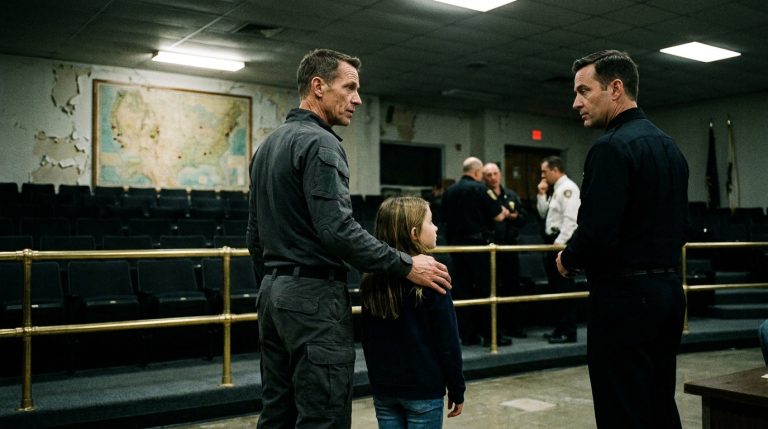
The Bones of the High Desert Do Not Move: A Novel of Rusted Sovereignty
CHAPTER 1: THE WEIGHT OF STOLEN SAGE
The air off the Cascades tasted like cold iron and dry juniper, the kind of sharpness that settled deep in the throat before a storm. Wyatt Holloway kept his boots planted on the gravel, his thumbs hooked loosely into the belt loops of his work pants. Fifty yards away, the smell of fresh-cut cedar drifted from the two-story wrap-around porch of the lodge. The structure sat square on the back five acres—ground his father had left fallow so the sage could rebuild its root systems. Now, the earth was turned up, raw and pale, choked by rolls of sod that had no business being green in this dirt.
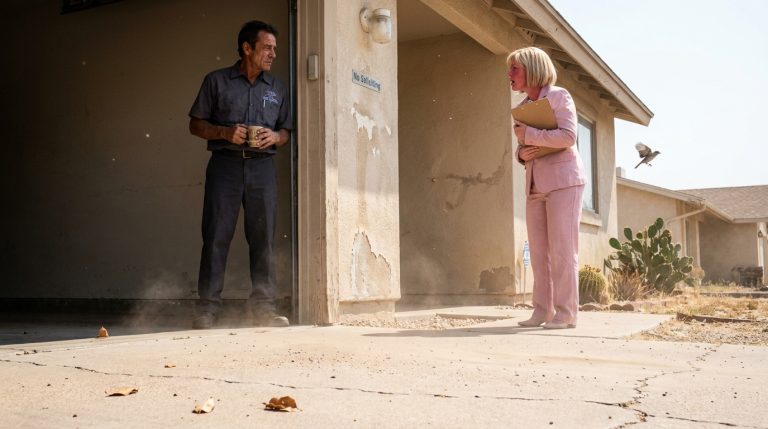
“Wyatt, you’re back early,” Brin Caldwell said. She didn’t look up from her tablet. Her turquoise blazer was crisp against the desaturated gray of the high desert, a gold president pin catching the slanting pink light.
“That’s my pasture, Brynn.” Wyatt’s voice was flat, dry as the washboard roads he’d spent three days driving from Wyoming. He didn’t look at her face; he looked at the ground beneath her heels, tracking the grade where his grandfather’s corral poles used to run.
“This is community land,” she replied, her tone carrying the smooth, polished edge of a woman who handled opposition with certified mail. “The boundary was corrected by a recorded plat last fall. Filed with the county, approved by the commission. I know change can feel personal, Wyatt. Please don’t make this difficult.”
Behind her, Garrett Caldwell stood with his hands tucked into his pockets, his balding head reflecting the pale sky. He didn’t speak. He didn’t need to. A man on the planning commission let his silence do the heavy lifting.
Calder Hayes, the builder whose name tape was stuck to a white pickup nearby, stepped between them, holding a clipped packet. His eyes were tired, the skin around them weathered by wind and flying sawdust. “Here’s the permit set, sir. Engineering stamp, boundary survey. Everything was vetted through the HOA secretary.”
Wyatt took the packet. The paper was heavy, clean, and smelled of fresh toner. He flipped to the survey sheet, his thumb immediately finding the lower right corner where the surveyor’s seal sat. Wyatt had set thirty thousand monuments in his career; his father had set more. He knew the pressure of a real embossing tool, the slight ink bleed from a healthy stamp, the exact alignment of the serif letters.
The seal on this sheet was flat. It was a digital drag-and-drop job, the ‘R’ in Oregon lifted from an entirely different font family. The corner monument coordinates listed at the margins didn’t even align with the geodetic reference for Section 24. It wasn’t just wrong; it was a cheap imitation wearing a suit.
“Calder,” Wyatt said, his voice dropping into the quiet rhythm he used when calculating a difficult run. “You pull these permits yourself from the county GIS, or did you rely on what she handed you?”
The builder blinked, his cordless drill hanging heavy against his thigh. “We rely on what the owner provides.”
Wyatt handed the packet back, his fingernail dragging across the smooth, un-embossed paper. “You’re a good builder, Calder. I’m not going to give you grief. But for the record, you’re standing on private deeds.”
Brin’s smile tightened, her nostrils flaring slightly as she tapped the screen of her tablet. “Mr. Holloway, I’m going to have to ask you to leave community property.”
From behind the stone columns of the porch, a nineteen-year-old kid in a navy polo with a private security patch stepped into the gravel. His boots were too clean. He looked at Brin, then at the bulk of Wyatt’s shoulders, his hands hovering uncertainly near his empty belt.
Wyatt didn’t move. He looked down at the kid’s brass badge, memorizing the scratched numbers on the rim. “Buddy,” Wyatt said softly, the silence between his words heavy as the stones in the creek. “Take a breath. You’re standing on the wrong side of a deed.”
The kid hesitated, his heels shifting backward into the loose rock. Wyatt turned his back on them without another word, walking toward his truck. He pulled his phone from his pocket, the screen cold against his palm, and clicked three clean frames: the vinyl banner stretched across his sage, the forged packet resting on the porch rail, and the silent, calculating look on Garrett Caldwell’s face.
As he reached the cab, the wind picked up, rattling the dry brush along the fence line. Wyatt looked down at his boots, where the fine red sand was already drifting over the tire tracks. The framework was set. He climbed into the truck, shifted into low gear, and watched the rearview mirror as the three figures on his land grew smaller, completely unaware of the weight that was about to come down on top of them.
CHAPTER 2: THE CHECKEDOUT MEMORY
The heavy oak door of the Deschutes County Courthouse didn’t swing so much as it dragged, its lower hinge groaning against a floor worn smooth by eighty years of mud-crusted work boots. Inside, the air was thick with the smell of floor wax, wet wool, and the faint, sweet rot of old ledger paper. It was a space defined by rusted iron filigree and green shaded desk lamps that cast long, jaundiced shadows across the high plaster ceilings. Wyatt Holloway didn’t look at the directory. He knew the turnings of these hallways the way a man knows the knots in his own pine fencing. His father had walked them before the drywall had replaced the lath and plaster, back when a county survey was logged with a dipped pen and a straightedge.
He reached the Records counter, his boots striking the gray linoleum with a heavy, deliberate rhythm. The counter itself was a massive slab of red oak, the edge where the public leaned split and splintered into microscopic gray teeth. Behind it sat a row of green steel filing cabinets, their drawers slightly out of alignment from decades of over-packing.
Mina, the clerk whose spectacles hung from a beaded lanyard that clicked against her plastic name tag, didn’t look up immediately. She was feeding yellowed index cards into an archaic mechanical sorter, the machine thumping like a distant engine in a dry well.
“Wyatt,” she said when the machine finally clicked to a halt. Her voice had the dry, raspy scrape of someone who had spent thirty years breathing the dust of land patents. “Heard you were up in Wyoming. Thought you’d stayed there.”
“The dirt’s too soft up north, Mina,” Wyatt said, leaning his forearms against the oak slab. The wood felt cold, leaching the heat right out of his skin. “I need the recorded plat correction for tax lot 1402. Township 14 South, Range 11 East. Section 24.”
Mina stopped her sorting. Her eyes drifted toward the frosted glass window that looked out on the planning director’s office across the courtyard. For a second, the only sound was the radiator in the corner, hissed out a wet, metallic breath that smelled of iron scale. “That section’s been busy lately, Wyatt. Your name was on the ledger twice last week.”
“Not by my hand,” he said.
She turned without another word, her orthopedic shoes squeaking against the linoleum as she disappeared into the narrow aisles of the vault. Wyatt waited, his fingers tracing a deep gouge in the oak counter where someone had once dropped a brass transit head. Through the window, the high desert sky was the color of zinc, heavy and flat, promising a hard freeze before nightfall.
When Mina returned five minutes later, her hands were empty. Her mouth was set in a thin, straight line that looked remarkably like a property boundary on a bad map. She held a small slip of gray paper—a checkout voucher—its corner torn and jagged where it had been ripped from the ledger binding.
“It’s not in the drawer, Wyatt,” she said softly, lowering her voice until it barely carried over the hum of the fluorescent fixtures. “The whole master file for Section 24 was pulled for administrative review on March 12th. It hasn’t come back down.”
Wyatt didn’t blink. He reached out and turned the gray slip toward himself. The paper was cheap, pulpy stuff that left a gray smudge on his thumb. On the line marked Authorized Person, a name was scrawled in thick, black felt-tip ink that had bled into the fibers: G. Caldwell. But it wasn’t the name that caught Wyatt’s eye. It was the serial number at the top of the voucher. A thin line had been scratched through the archival tracking code with something sharp—a pocketknife blade or a heavy staple—leaving a white furrow in the paper that obscured the original entry.
“Who checked the log before Garrett signed it, Mina?” Wyatt asked, his voice dropping into a register that made the clerk shift her weight.
“The computer says it was an internal routing request from the Planning Commission,” she said, her fingers nervously adjusting her spectacles. “Wyatt, I can’t give you the file if it’s not in the building. You know the rules. If the commission is working on a retroactive adjustment, the master record stays quarantined until the final sign-off.”
“A retroactive adjustment requires an absolute monument check,” Wyatt said, his thumb pressing down on the scratched paper until the bone went white. “You don’t quarantine a baseline plat from 1971 unless you’re trying to make sure nobody compares it to a fresh lie.”
He pulled his small leather notebook from his shirt pocket. The leather was scarred, stained with old linseed oil from his field kits. With a stub of a pencil, he copied the scratched-out tracking code exactly as it appeared, tracing the jagged marks where the metal had torn the paper. There was a letter hidden under the gouge—a small, cursive b that didn’t belong to the standard county indexing system. It was an environmental regulatory code, the kind used for state-protected salmonid streams.
“Don’t lose that voucher, Mina,” Wyatt said, closing the notebook with a sharp snap that sounded like a dry branch breaking.
“Wyatt,” she called out as he turned for the door, her voice small against the vast, empty rows of steel cabinets behind her. “Garrett’s got three weeks left on his commission seat before the rotation. Whatever he’s doing, it’s already built. People don’t look at old paper when there’s new cedar standing on the ground.”
“They do when the ground belongs to someone else,” Wyatt said.
He pushed the heavy oak door open, the friction of the iron latch vibrating through his palm. Outside, the wind had shifted, bringing the sharp, metallic tang of the juniper flats with it. He stood on the stone steps of the courthouse, looking across the street toward his truck. A late-model Lincoln Navigator with tinted glass was parked three stalls down, its engine idling with a low, expensive purr that rattled the loose gravel in the gutter. The windshield was a dark mirror, reflecting nothing but the gray zinc sky and the cold silhouette of the mountain behind him. Wyatt didn’t slow his pace. He walked straight to his Dodge, his boots kicking up the dry, alkaline dust of the lot, his mind already running the lines of the old cattle trail. They had the records under lock, but they didn’t have the iron pins in the dirt, and those were the only bones that mattered.
CHAPTER 3: THE BLACK STEEL KEYPAD
The transmission groaned as Wyatt shifted the Dodge down into second, the heavy steel bumper stopping exactly three inches from the fresh, powder-coated face of the gate. It hadn’t been there when he left for Wyoming. The steel was cold, thick-walled, and black as a charred log, spanning the exact width of the gravel easement spur that his father had cut into the county pavement back in the winter of 1962.
Wyatt stepped down from the cab. His work boots hit the loose stone with a sharp crunch, the sound deadened by the vast emptiness of the flats. He walked to the stainless-steel post planted at the edge of the trail. A small, blue-lit keypad hummed behind a plastic cowl, topped by a brushed-metal placard that read: Juniper Mesa Reserve, Private Drive, Authorized Vehicles Only.
He reached out, his calloused thumb rubbing the edge of the mounting bracket. The metal was raw underneath, the galvanized coating scraped away where a self-tapping screw had been forced in too fast. But it was the hinge assembly on the main gate structure that caught his eye—the weld wasn’t a standard field bead. It was a rhythmic, scalloped pattern, a specialty wire stitch that only two fabrication shops in Deschutes County used. One of them owed its commercial license extension to Garrett Caldwell’s seat on the planning commission.
Wyatt pressed the call button. The internal speaker spit out a burst of static, a dry, electric hiss that smelled faintly of ozone before a woman’s chipper, digital voice broke through.
“Welcome to Juniper Mesa Reserve. Please state the name of the resident you are visiting.”
“Wyatt Holloway,” he said, keeping his eyes on the fresh concrete at the base of the post. The mix was still curing, the edges gray and crumbly. “I live here.”
A momentary pause followed, the line filling with the rhythmic click of a keyboard on the other end. “I’m sorry, sir. This entry point is restricted to HOA residents only. I’ll need to verify your lot number or your access credential.”
“My address is on the easement deed recorded with the state,” Wyatt replied, his voice level, matching the unyielding weight of the iron under his hand. “The spur connects tax lot 1402 to the county road. Open the gate.”
“One moment.” The voice dropped its polished edge, replaced by the mechanical hum of an internal routing system. When she came back, the chipper tone was entirely gone. “Our current digital registry shows no resident named Holloway within the reserve boundaries. This drive is private property. If you do not have an access code, you will need to use the public turnaround and exit the area.”
The line clicked dead. The blue light on the keypad stayed on, a small, square eye staring back at him in the fading light.
Wyatt didn’t argue with the speaker. He didn’t punch the metal cowl. He walked back to his truck, the wind catching the collar of his canvas jacket and whipping the scent of sage across his face. This easement had been restated in three separate decades, signed in ink that had turned to dust long before Brin Caldwell ever bought a pair of yoga pants. It was the only legal passage for a heavy flatbed or a stock trailer; the back trail was nothing but high-desert washboard and volcanic rock.
He climbed into the cab, pulled the shift lever down into four-low, and backed the truck off the gravel pad. The tires slipped once on the steep shoulder, spitting dry volcanic cinder against the pristine black finish of the barrier before finding purchase in the brush.
To enter his own home now, he had to go the long way around—the trail his father had cleared for the yearling cattle back in 1973. Wyatt turned the steering wheel hard to the right, forcing the heavy front axle over the lip of the ditch and directly into the unmanaged sage. The brush scraped against the rocker panels with a sound like tearing fabric, the old iron leaves of the sagebrush giving up their pungent oil as the tires crushed them down into the dirt.
The truck bounced violently, the suspension bottoming out against the rubber bumpers as he hit the first dry wash. For half a mile, Wyatt kept his foot steady on the throttle, tracking the faint, parallel indentations in the earth where the old cattle trucks had compressed the subsoil fifty years ago. The high desert didn’t forget a track; the scars stayed in the hardpan for generations if the frost didn’t lift them.
Through the dust-streaked windshield, the silhouette of his house finally appeared against the western rim, its low roofline tucked beneath the shelter of three ancient, wind-twisted junipers. Jude was sitting on the porch steps, an algebra textbook propped against his knees, a yellow pencil balanced between his fingers. He looked up as the truck rumbled into the clearing, his small face tightening as he saw the gray dust thick on the fenders.
Wyatt cut the ignition. The engine died with a heavy, metallic click as the manifold cooled, the silence of the flats rushing back in to fill the space.
“Sheriff was here, Dad,” Jude said, staying on the porch as Wyatt swung his legs out of the cab.
Wyatt paused, his hand resting on the utility box in the bed. “Talk to me, bud.”
“He said someone from the reserve reported a trespasser on the new community property,” Jude said, his voice quiet, careful to keep the rhythm steady the way his father taught him. “They told dispatch it was a man matching your description. I told him you were still on the road from Lander.”
“What did he say to that?”
“He wrote it down in a little black book,” Jude said, pointing his pencil toward the gravel turnaround. “He asked if I was alone out here. He stayed on the porch, though. He didn’t try to look inside. His name tag said Whitman.”
Wyatt felt a cold knot tighten in his gut, a hard, physical weight that had nothing to do with the rough ride down the wash. Whitman. Linnea Whitman’s boy. A local kid who had watched his own mother’s pasture get swallowed by a corrected boundary map six years ago.
Wyatt walked up the steps, his boot heels striking the barn-red trim his wife had painted before the winter she got sick. He laid a heavy hand on Jude’s shoulder, feeling the slight tremor in the boy’s frame beneath the denim jacket. “You did right, Jude. Every word you gave him was the truth.”
He looked back down the old cattle trail, where the dust from his entry was still hanging in the cold, slanting light like a line of gray smoke. The gate down on the pavement wasn’t an administrative error, and it wasn’t a simple mistake by an HOA secretary. It was a physical blockade, designed to isolate the Holloway place until the retroactive vote on Saturday could finalize the theft. They were closing the box, tightening the screws before he could get his paper into the record. Wyatt turned back toward the house, his thumb finding the notebook in his pocket. The baseline pins were still out there in the dark, and tomorrow, he’d find out exactly whose hand had held the welding torch on that gate.
CHAPTER 4: THE COMPLAINT AT THE DOORSTEP
The wall-mounted black rotary telephone in the barn office didn’t ring so much as it vibrated the entire pine studding behind the drywall. It was a heavy, industrial bell, cast in an era when field mechanics needed to hear a line over the roar of a tractor engine. Wyatt didn’t take his thumb off the heavy brass handle of the filing cabinet until the third clapper strike had rattled the loose scale inside the bells.
He picked up the receiver, the black bakelite plastic cold and heavy against his jaw, smelling faintly of sixty years of stale tobacco smoke and cold copper wires. “Holloway.”
“Wyatt Holloway?” The voice on the other end was clipped, thin, and carried the echo of an open bullpen in a state office building down in Salem. “This is Brenda Vance, case compliance officer for the Oregon Board of Examiners for Engineering and Land Surveying.”
Wyatt reached into his breast pocket, his fingers finding the stub of the surveyor’s pencil. He didn’t sit down on the drafting stool. He kept his boots flat on the concrete floor, eyes fixed on the gray light filtering through the high barn window. “Go ahead, Brenda.”
“We’ve received a formal, expedited complaint regarding your professional land surveyor license, number 48211,” she said, the sound of stapled paper rustling through the receiver. “The filing alleges fraudulent boundary determinations and intentional manipulation of monument references on a 2019 ranch survey located in Crook County. The complainant has provided copies of a conflicting plat and is requesting an immediate emergency review and suspension of your field authority pending a full board hearing.”
Wyatt didn’t feel his pulse jump. He felt the cold, hard logic of the landscape narrow down to a single point. “Who signed the complaint?”
“The filing party is listed as the Board of Directors for the Juniper Mesa Reserve Homeowners Association, corporate signature by Brin Caldwell, President,” Vance read, her tone completely detached from the weight of what she was dropping onto the wire. “There’s a supporting administrative affidavit attached from the Deschutes County Planning Commission reviewer’s office. Docket number 882-b.”
Wyatt’s pencil tip hovered over the margin of his desk calendar. 882-b. The suffix matched the scratched-out letter on the courthouse checkout voucher. It wasn’t a standard land fraud file number; it was an internal environmental clearance bypass tracker. Garrett Caldwell hadn’t just taken the master file; he had generated a shadow docket to provide the legal leverage his wife needed to cut Wyatt’s legs out from under him before the weekend.
“Brenda,” Wyatt said, his voice dropping into the quiet, rhythmic cadence he used when measuring a line through dense timber. “That 2019 Crook County job was peer-reviewed by two independent PLS signatures before filing. One of them sits on your current board.”
“The board will review all submitted evidence during the scheduled cycle, Mr. Holloway,” she said, though the bureaucratic finality in her voice suggested the machinery was already turning. “But under emergency provisions cited in the affidavit, you are required to submit your original field books, geodetic logs, and instrument calibrations for that specific section within five business days. Until those are logged in Salem, any signature you place on an Oregon plat will be flagged as contested.”
“Understood.”
“A formal notification packet has been dispatched to your address. Good day, Mr. Holloway.”
The line went dead with a soft, mechanical click that sounded like a firing pin striking an empty chamber. Wyatt held the receiver for three seconds, listening to the vast, empty hum of the long-distance copper before dropping it back onto the black iron forks.
“Dad?”
Jude was standing in the doorway of the office, his shoulder leaning against the weathered pine frame. He was holding an old brass plumb bob—the heavy, teardrop-shaped piece of metal his grandfather had carried in his leather field vest for twenty-six years. The string was wrapped tight around the brass neck, the steel point dulled slightly from decades of striking volcanic hardpan.
Wyatt looked from the boy’s face down to the tool in his hand. The brass was dark, tarnished to a deep, greasy brown from the oil of his father’s palms. “They’re going after the paper, bud.”
“The lady on the phone?” Jude stepped into the room, his boots kicking up a small cloud of fine, gray barn dust that danced in the single shaft of sunlight from the roof pane. “Can they take your stamp?”
“They can try to clog the ink,” Wyatt said, walking over to the oak filing cabinet. He grabbed the brass handle of the drawer marked 1965 to 1975 and pulled. The slides groaned, the heavy steel tracks dry and coated in fifty years of grit, but the iron frame didn’t give an inch. “Your grandpa taught me that a lie is like a bad weld. It looks bright on the surface, but if you put enough weight on it, the steel tears right where the heat was wrong. Brin Caldwell just put her whole weight on the one piece of paper she can’t buy.”
He reached into the back of the drawer, his hand passing over dozens of faded manila tabs until he found the thick, blue-bound cotton ledger from the summer of 1971. The spine was wrapped in black oilcloth, the edges frayed and stiffened by age. When he laid it on the drafting table, the smell of linseed oil and iron-gall ink filled the small room, sharp and ancient.
“Look here,” Wyatt said, pointing to the first page of the field notes, written in his father’s bold, angular pencil hand. “Every corner pin has three reference trees and a geodetic tie. You don’t just measure from a fence post; you tie the dirt to the stars. Garrett Caldwell can move the screen on a county computer, but he can’t move the brass cap buried under four feet of sand out in that pasture. He doesn’t have the book.”
Jude reached out, his small finger tracing the embossed seal on the lower corner of the paper, his face catching the same stubborn line that Wyatt had seen in the mirror every morning since Cora died. “What do we do now?”
“We don’t tip them off,” Wyatt said, his hand closing over the boy’s shoulder, feeling the solid, unyielding frame beneath the denim. “We let them finish their speech. We let them spend every dollar they’ve got on that lodge. And then we use their own track to take it down.”
CHAPTER 5: THE CIRCLE OF WIDOWS
The screen door of Tilda Bookman’s kitchen didn’t latch so much as it dragged against a threshold worn thin by fifty years of winter mud. Inside, the oilcloth on the table was frayed down to the yellowed jute threads at the corners, smelling faintly of cold lard and kerosene. Tilda didn’t offer Wyatt tea. She sat with her small, gnarled knuckles pressed into the grain of the wood, her eyes fixed on the manila folder he had laid between them. The slanting high-desert light coming through the unwashed window pane was thick with floating lint, casting a dull, orange glare across the open documents.
“They told me the state had updated the coordinates,” Tilda said. Her voice had the dry, rattling scrape of cold gravel sliding down a chute. “They had a piece of paper with a silver seal on it, Wyatt. A man from the county planning office—not Garrett, but a younger fellow with a clip-on tie—showed me the screen on his machine. He said my husband’s 1974 run had an eight-foot error in the baseline.”
Wyatt didn’t lean back. He kept his forearms flat against the oilcloth, his thumbs tracing the rusted staples that held his father’s 1971 field notes together. “The baseline didn’t have an error, Tilda. The baseline is tied to the iron pin at the southwest corner of Section 24. It hasn’t moved since the cavalry survey in 1888.”
He pulled a secondary sheet from the folder—a certified copy of the deed restriction the HOA had used to force her sale in 2018. At the bottom, under the corporate letterhead of the Juniper Mesa Reserve, was a faded stamp from an escrow company that had gone into receivership three winters ago. The docket suffix was 882-b-1. It was the same shadow tracking sequence he’d pulled from Mina’s checkout log at the courthouse.
“Who handled the title insurance, Tilda?” Wyatt asked.
“A firm out of Bend,” she said, her fingers tightening until the skin over her knuckles went as pale as alkaline dust. “But the papers came through Garrett’s office. He told my nephew that if we went to court, the county would file a retroactive lien for the administrative correction fees dating back to 1990. Sixty-five hundred dollars a year, plus interest. I didn’t have the stomach for it, Wyatt. My husband was six months in the ground, and the well pump had just choked on sand.”
Wyatt turned his head toward the window. Out in the yard, an old John Deere tractor sat half-buried in the wild rye, its yellow paint oxidized to a dull, chalky mustard, its manifold choked with dry pine needles. This was how they did it. They didn’t come with torches or a crew of ironworkers in the daylight. They waited until the grease in the machinery went dry, until the checkbook was down to the double digits, and then they dropped a shadow docket onto an old woman’s kitchen table like a brick.
The gravel outside crunched under a light tire. A moment later, the screen door groaned again, and Linnea Whitman stepped into the kitchen. She wore a faded denim jacket that had belonged to her husband, the cuffs rolled back twice to show wrists that looked like dried willow branches. She didn’t look at Wyatt; she looked straight at the blue-bound ledger on the table.
“Cole told me you were digging, Wyatt,” Linnea said, her voice small but steady, carrying the thick, flat drawl of the old Crook County families. She reached into her pocket and dropped a square piece of gray card stock onto the table. It was a foreclosure notice from 2020, the ink faded to the color of wet soot. “They used the same number on mine. 882-b. They said my back acreage wasn’t coded for livestock use under the new county comprehensive plan. Garrett co-signed the variance that handed it to the reserve for a horse trail.”
Wyatt picked up the gray card. The texture was rough, the cheap pulp absorbing the dampness of the kitchen until it felt like old skin. He turned it over. In the lower corner, half-hidden by a coffee stain, was a three-digit suffix hand-written in red grease pencil: 024. The section number.
“They didn’t just steal the land to build a lodge,” Wyatt said, the words settling heavy in the small room. He looked at the three women now gathered around the table—Tilda, Linnea, and Tilda’s sister, who had remained silent by the stove. “The lodge is the front. They’re systematic about it. Every time Garrett finds a section with an old state correction plat and a single owner who can’t pay a retainment lawyer, he isolates the file in the vault and lets his wife file an encroachment notice based on a shadow docket.”
“Can you break it, Wyatt?” Tilda asked. Her small, water-clear eyes didn’t have hope in them; they had the cold, pragmatic curiosity of an old settler looking at an oncoming grass fire.
“The paper will break it,” Wyatt said, his hand closing over the folder until the cardboard corners bent against his palm. “But we don’t move until Saturday. If Hollis certifies the 1971 original in Salem tomorrow, Garrett’s shadow docket becomes a felony forgery the second he tries to vote on the retroactive adjustment at nine in the morning. We need your names on the affidavits by Friday night.”
“My boy’s on the shift Saturday, Wyatt,” Linnea said, her hand coming down on top of his, her skin dry and rough as wood rasps. “He’ll be there. But you make sure that paper is clean. If you miss a link in that chain, Garrett will have the sheriff’s department moving your own fences by Monday morning.”
Wyatt stood up, the oak legs of his chair scraping a sharp, white crescent into the grease-filmed linoleum. He tucked the folder under his arm, the cold weight of the documents pressing against his ribs like an iron bar. “The bones don’t move, Linnea. My dad set that cap in seventy-one, and he didn’t round his numbers.”
He walked out onto the porch, the screen door slapping twice behind him with a dry, wooden clatter. The high-desert air had dropped five degrees while he was inside, the smell of mountain pine giving way to the cold, dead scent of wet stone. He climbed into the Dodge, his boots heavy on the pedals, his mind already tracking the mileage down to the state line. He had the names, he had the pattern, but as he shifted into gear, his eyes caught the small cursive b he’d copied into his notebook. It wasn’t just an administrative tracking code—it was a river marker. The shadow docket wasn’t just covering a land-grab; it was hiding something under the water table, and he had exactly four days to pull it into the light before the concrete at the lodge went hard.
CHAPTER 6: THE UNYIELDING BLUEPRINT
The wire brush made a harsh, rhythmic rasping sound against the stone, throwing up tiny chips of dried green lichen and rust-colored grit that caught the beam of Wyatt’s headlamp. The cold had settled deep into the soil over the last twelve hours, turning the high-desert mud into solid crust that resisted the tip of his digging shovel. Wyatt was on his knees at the absolute eastern boundary point of Section 24, his wool gloves already worn through at the thumbs from clearing three feet of frozen shale.
“Hold the light steady, Jude,” Wyatt muttered, his breath plume breaking white against the dark backdrop of the juniper flats.
The beam shifted, trembling slightly before locking onto the center of the pit. Beneath the layer of scraped earth, a dull circular glint began to show—the solid brass cap set by Earl Holloway during the late-summer heat of 1971. The metal was dark, oxidized to a deep, greasy brown from decades under the silt, but the embossed lettering was sharp beneath the film of dirt.
Wyatt took a dry rag from his vest pocket and rubbed the face of the cap until the stamp emerged. PLS 914. COUNTY SURVEYOR. Beside him, Hollis Banner leaned his heavy frame against an old iron transit tripod, the metal legs clicking faintly against the frozen basalt rocks. Hollis didn’t look down into the hole immediately. He was watching the distant ridge line to the west, where the perimeter lights of the Juniper Mesa Reserve glowed like a string of cold, yellow beads along the dark horizon.
“It matches the field notes to the exact link, Wyatt,” Hollis said, his voice slow, carry the gravelly rasp of an old field hand who had spent forty winters checking lines in the timber. He pulled a massive, leather-bound state ledger from beneath his heavy canvas coat and laid it across the hood of the idling Dodge. The pages were stiff, thick cotton paper that rustled like dry corn husks in the night wind. “The geodetic tie your dad logged on August 11th gives no deviation. If the HOA’s plat pulls this corner twelve chains west, they didn’t just misread a monument—they had to invent a whole new benchmark out of thin air.”
“Look closer at the base, Hollis,” Wyatt said, pointing the tip of his pocketknife at the bedrock beneath the brass collar.
Beneath the main seal, partially obscured by an old layer of scaling iron slag, was a secondary mark—a clean, three-digit notch cut into the basalt with an old cold chisel. 024. It wasn’t an official state code. It was the same registration mark Wyatt had found on Linnea Whitman’s foreclosure notice and the courthouse voucher.
Hollis leaned down, his spectacles catching the glare of the headlamp as he traced the chisel mark with a thick fingernail. His jaw tightened, the skin around his weathered cheeks pulling taut. “That’s not Earl’s hand. That’s Sandy Bookman’s mark. He used that old chisel on the south section lines before he passed. Garrett Caldwell didn’t make this up last fall, Wyatt. This shadow file has been sitting in a dead man’s field trunk for over seven years.”
“They used Sandy’s old apprentice notes to build the reference,” Wyatt said, standing up, his joints popping with a dry, mechanical crack in the freezing air. “Garrett knew the state office never digitized the 1971 paper ledger. He figured if he kept the master file checked out under an administrative review code, nobody would ever come out here with a wire brush to look for the real brass.”
“The state surveyor signed the fresh certification two hours ago in Salem,” Hollis said, tapping the blue ink on the document pinned to the truck hood. The paper was crisp, white, and carried the heavy, embossed seal of the state capital, its edges unmarred by the dirt or the frost. “It’s logged, Wyatt. The baseline is legally locked. The planning commission can vote whatever they want at nine tomorrow morning, but the second Garrett signs that retroactive adjustment, he’s placing his name on a document that contradicts a certified state record.”
“He’ll sign it anyway,” Wyatt said, his hand closing over the cold iron frame of his truck’s utility box. “He’s got forty-seven lot owners who think they bought a view of the creek, and a construction loan that defaults if the lodge isn’t clear for title transfer by noon. He can’t stop the train.”
A distant sound cut through the wind—a low, rhythmic rumble that wasn’t the breeze or the mountain diesel. Wyatt looked toward the back pasture. From the direction of the Founders Lodge, the heavy headlights of two commercial flatbeds were moving slow across the fallow sage, their yellow amber clearance bars flashing against the dark trees. They were moving in more equipment. Even at midnight, the build was accelerating, the concrete trucks or the grading crews pushing to lay down the final access pads before the ribbon cutting at three.
“Dad,” Jude said, his voice dropping into that quiet, careful rhythm he used when the wind got too high. He was looking at the old cattle trail behind them.
A single set of headlights had turned off the county pavement, bumping over the washboard dirt at the edge of the Holloway fence line. The vehicle didn’t have an HOA marker or a commercial decal. It was a dark sheriff’s truck, its rooftop bar unlit, moving with the slow, cautious crawl of a driver who knew exactly where the rocks were buried.
Wyatt didn’t move his hand from the truck box. He watched the headlights approach, the dust from the trail rising behind the vehicle in a long, gray wall that blotted out the distant lights of the reserve. The trap was closing on both sides of the line, the legal machinery in Salem locked down, but the physical ground under their boots was still wide open, and the night was freezing fast.
CHAPTER 7: THE RIBBON AND THE EXCAVATOR
“Shut down the lamps, Wyatt,” the voice called out before the truck door even finished clicking against its latch.
Deputy Cole Whitman stepped into the narrow beam of the Dodge’s headlights, his green uniform coat dark with the freezing night mist that had begun to roll off the creek. He didn’t have his hand on his sidearm, but his thumb was hooked into the strap of his heavy utility vest, his fingers tapping a rhythmic, flat cadence against the nylon. The engine of his cruiser was idling behind him, a low, metallic cough that sounded like a shovel striking hardpan.
Wyatt didn’t drop the wire brush. He kept his boots locked on the rim of the pit, his eyes measuring the space between the deputy’s belt and the white emblem on the door of the patrol unit. “You’re off your section, Cole.”
“The dispatch line’s been ringing since eleven, Wyatt,” Whitman said, his boots grinding a handful of sharp lava rock into the frozen dirt as he closed the distance. “Brin Caldwell called the sheriff directly at his house. She said you’re running a crew out here under the dark to sabotage the utility lines before the morning presentation. She wants a trespass arrest before the sun clears the Ochocos.”
Hollis Banner stepped out from the shadow of the truck hood, his heavy hand tapping the white edge of the state certification document. “Tell the sheriff to read the baseline log, Cole. This is a state monument verification. Your department doesn’t have the jurisdiction to pull a licensed surveyor off an active pin.”
“The sheriff isn’t reading the book tonight, Hollis,” Whitman said, his voice dropping an octave until it was barely a whisper against the rattle of the wind through the sagebrush. He reached into his coat and pulled out a heavy, manila envelope wrapped in yellow plastic bands—the official county color for an emergency injunction. “Garrett walked into the evening session of the circuit court three hours ago. He didn’t wait for the morning commission vote. He got a signature on an emergency order to clear the easement spur of all non-HOA machinery by six-hundred hours.”
Wyatt took the envelope. The paper was cold, damp from the river air, and carried the specific three-digit docket suffix 882-b-2 stamped in purple ink across the seal. He didn’t open it. He looked up at the ridge, where the high headlights of the flatbeds had finally ground to a halt behind the lodge’s stone pillars. A yellow excavator was already sitting on its tracks, its long steel boom folded down like a grasshopper’s leg against the cedar siding.
“He’s running the clock,” Wyatt said, his fingers digging into the heavy stock of the envelope until the paper creaked. “He knows if the commission rubber-stamps the retroactive plat at nine, the injunction becomes permanent before my attorney can get a judge to look at the state seal on Monday morning.”
“There’s more,” Whitman said, his eyes shifting toward Jude, who was still holding the headlamp steady against the brass cap in the pit. “The flatbeds up there aren’t contracted by the HOA. They’re registered to a private holding firm out of Portland. The same firm that bought out the riparian rights on Hayes Road before Tilda sold her section. Garrett isn’t just trying to save his wife’s lodge, Wyatt. He’s already transferred the deed for the five acres under that foundation to a secondary corporate shell. If that vote goes through at nine, the property isn’t even in county jurisdiction anymore. It becomes an unmapped private easement.”
The realization hit like an iron bar across the shins. The lodge wasn’t the final reality. The entire building was a decoy, a three-hundred-thousand-dollar piece of cedar bait designed to draw Wyatt’s attention into a standard boundary dispute while the planning commission quietly severed the riparian zone from the county tax maps entirely. Once the land was locked behind a corporate veil, the state’s environmental protections wouldn’t have a legal target to serve.
“Hollis,” Wyatt said, his voice dropping into the flat, absolute tone he used when the measurements didn’t leave room for an error. “Get Marlena on the landline. Tell her we’re not waiting for Monday.”
“Wyatt, the judge signed the TRO but it’s sitting under seal in Bend,” Hollis said, his weathered face tightening under the gray brim of his hat. “The bailiff won’t move until the courthouse doors open.”
“The bailiff won’t have to,” Wyatt said. He turned to Whitman, handing the manila envelope back to the deputy without looking at it. “Cole, you logged my call at dusk as a civil property dispute on a recorded parcel. Is that log still live on the screen?”
“It’s live,” the deputy said.
“Then you tell dispatch you’re maintaining the perimeter to prevent a breach of the peace on a contested state baseline,” Wyatt said, his boots already moving toward the cab of the Dodge. “I’m going to go stand on my line.”
“Dad?” Jude called out from the edge of the pit, the headlamp beam sweeping across the open dirt as he stood up.
“Get in the truck, bud,” Wyatt said, his hand hitting the cold grease of the door latch. “Bring the book.”
The truck engine roared to life with a heavy, unrefined thud that vibrated through the steering column. Wyatt didn’t shift into four-low for the trail; he hit the main throttle hard, the heavy rear tires chewing through the frozen sage and throwing a cloud of red hardpan against the side of the patrol car as he forced the Dodge up the steep embankment toward the lodge. Behind him, the red and blue lights of Whitman’s cruiser finally cut through the mist, not following to stop him, but turning crosswise across the old cattle road, locking the entry point behind them from any vehicle coming down from the reserve. The high-start was over; the lines were drawn in the rock now, and the clock was ticking down to the first strike of the gavel.
CHAPTER 8: WHAT THE SOIL INHERITS
The morning sun cracked over the Ochocos like a split sheet of copper, casting long, razor-thin shadows across the fresh, frozen mud of the back pasture. The 3:00 PM ribbon-cutting crowd from yesterday was gone, replaced by the relentless, heavy rhythm of iron meeting cedar. The court-ordered writ of possession and demolition wasn’t just a piece of paper anymore; it was three hundred horse-power of diesel machinery tearing the Founders Lodge down to its raw components.
Wyatt Holloway stood thirty yards back, his boots anchored deep into the loose volcanic hardpan, his hand resting on Jude’s shoulder. The excavator’s bucket, edged with heavy, unyielding steel teeth, slammed through the second-story headers with a sound like a rifle shot. The cedar siding, once clean as a new penny, splintered and folded into a mass of gray wreckage.
Detective Ramsey Bell stood to Wyatt’s left, his black sport coat buttoned tight against the high-desert frost, his fingers hooked into his belt beside his gold shield. Nearby, Hollis Banner and Marlena Strand watched the demolition contractor track the footprint, matching the physical tearing of timber to the baseline coordinates on Earl Holloway’s 1971 plat.
Every dollar the HOA had poured into the foundation was being ripped out by the roots. The stone columns fell first, the river rock collapsing into coarse gray dust that filled the cold air with the smell of wet mortar and fractured quartz. By noon, the structure was gone, reduced to sorted piles of salvage timber and scrap framing that would end up expanding Tilda Bookman’s barn and funding local masonry apprenticeships.
Then the machine stopped.
The excavator’s bucket had dropped into the core of the foundation pour, right where the main utility conduits pierced the subsoil four feet beneath the slab. The operator reversed the tracks, the steel pads grinding against the basalt ledge with a piercing, metallic screech that made the entire clearing go silent.
The operator killed the engine. He climbed down from the cab, his heavy work boots slipping once on the grease-stained tracks, and pointed a gloved finger into the mud matrix beneath the cracked concrete footings. “Holloway! Bell! You better get down here. The teeth caught on something hard that isn’t volcanic rock.”
Wyatt was the first into the pit. His boots sank into the wet, red sand beneath the broken slab, the cold moisture leaching instantly through his leather uppers. He knelt next to the severed electrical main, his calloused hands brushing away the thick slurry of wet lime and aggregate.
Buried deep within the subgrade, protected by a layer of freshly poured concrete that had still been curing when he arrived from Wyoming, sat a black Pelican case. It was heavy, industrial-grade plastic, secured by four massive, unyielding latches that were coated in dried grease.
“Step back, Wyatt,” Bell said, sliding down the embankment with a short iron pry-bar in his hand. He wedged the tip beneath the primary latch, applying his full weight until the plastic hinge gave way with a sharp, pneumatic pop.
The lid swung open. The interior was dry, lined with grey foam that smelled of stale desiccant and chemical ink. Inside lay six separate folders, each bound in the same heavy, blue-cloth backing as the master records Garrett Caldwell had quarantined from the courthouse vault.
Wyatt reached out, his thumb catching the edge of the top folder. He didn’t look at the signatures; he looked at the maps. They were forged correction plats, executed with the same digital stamp manipulation, the same lift on the letters, the same shadow docket codes. Six different properties. Two sat on the neighboring Warm Springs Reservation; one belonged to an elderly couple in La Pine who had died believing the county had taken their acreage for unpaid taxes.
The lodge hadn’t just been a decoy for the riparian zone—it was the physical vault for the entire land-grab network. Garrett Caldwell had buried the evidence of a ten-year conspiracy directly under the concrete floor of the very building meant to legitimize it.
“Six families,” Bell said, his voice dropping into a hard, professional register as he logged the contents into his notebook. He looked at the serial engraving on the case rim, matching it to the administrative tracking numbers from the state board complaints. “Wyatt, you didn’t just save your pasture. You just pulled the floor out from under the whole planning commission.”
The legal fallout was kinetic. Within three weeks, the Oregon Department of Justice unsealed a seventeen-count indictment. Five members of the reserve’s HOA board, two sitting county commissioners, and the private surveyor who had co-signed the digital scans were processed through the Deschutes County jail. Garrett Caldwell pleaded guilty before the winter freeze; Brin lost the Lincoln, the lot on the hill, and her right to ever sit on a corporate board in the state.
By the following spring, the land had begun to remember itself.
Wyatt stood on the porch, his hand holding a cup of black coffee that had gone cold an hour ago. The five acres were completely clear now, deeded permanently into a conservation easement managed by the Deschutes Land Trust. Down along the creek bank, the high school FFA chapter—with Jude leading the chain crew—had planted rows of native willow cuttings into the red mud, stabilizing the bank where the construction runoff had threatened the salmonid beds.
An osprey dropped out of the sky, its wings catching the updraft off the canyon wall before settling into a high juniper snag two hundred yards from where the lodge’s porch had stood. The air smelled of cold gravel, damp earth, and clean sage, the metallic tang of the development completely blotted out by the wind.
Jude walked up the steps, his work boots caked in thick, gray clay, his hands stained dark from the willow bark. He sat down on the rail next to his father, taking a long pull from a carton of chocolate milk. “Hollis said the new public plat book is coming out next week, Dad. They’re putting Grandpa’s name on the front cover.”
Wyatt looked out over the flats, where the shadows of the mountains were beginning to stretch eastward across the undisturbed gray brush. The bones of the high desert were right where his father had left them, and they weren’t going to move again.
“He’d have liked that, bud,” Wyatt said, his voice quiet against the vast, clean silence of the land. “He’d have loved it.”