The Echo of the Frozen Forest: A Legacy of Sacrifice Beneath the Modern Parade Ground
CHAPTER 1: The Weight of Brass
Lieutenant Davies had been reaching for his radio, his knuckles white against the black plastic, when the air around him shifted. It wasn’t a change in the wind; it was a drop in the temperature, a sudden, sharp stillness that silenced the surrounding crowd of junior officers.
Arthur’s hand—knotted with veins and mapped by age—clamped onto the lieutenant’s wrist. It was a movement of terrifying economy. Davies, who had spent his morning obsessing over the exact millimeter of his tie, found his arm locked in a grip that felt less like flesh and more like weathered iron.
“I would ask you not to touch them,” Arthur said. His voice was a low-frequency hum, a sound that bypassed the ear and vibrated directly in the chest.
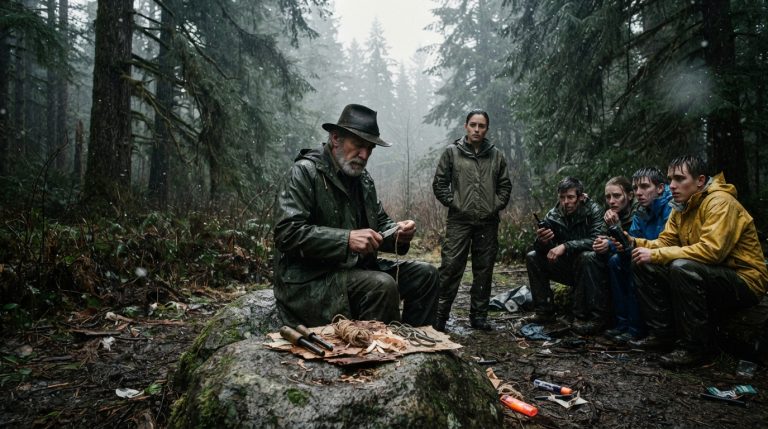
Davies tried to pull back, but the old man didn’t budge. For a fraction of a second, the pristine concrete of the parade ground beneath their feet seemed to liquefy, replaced by the crunch of frozen needles and the suffocating, wet dark of a forest that hadn’t seen the sun since the war began. Davies saw it in Arthur’s eyes—not senility, not confusion, but a sudden, piercing clarity that made the young officer feel incredibly small.
Then, just as quickly as the pressure had arrived, it vanished. Arthur released him.
Davies stumbled, his heel catching on the perfectly manicured grass. He felt the heat rising in his neck, a prickly, suffocating flush of public humiliation. Around him, the other officers were murmuring, their voices thin and reedy compared to the silence the old man had just carved out of the morning.
“I’m calling the MPs,” Davies stammered, his fingers fumbling for the radio clip on his belt. “You’re done here.”
But the crowd had already shifted. A low ripple of movement started from the edge of the deis, a separation of the ranks like water breaking around a stone. General Thompson was moving toward them, his stride deliberate and heavy. As he drew closer, the Lieutenant felt a surge of desperate hope. The General would see the uniform—the faded, olive-drab ghost—and he would excise this irregularity.
The General stopped three feet away. His gaze moved from the Lieutenant’s polished boots to the old man’s face. The harsh, commanding lines of Thompson’s jaw suddenly slackened. His breath caught, a stuttering, involuntary inhalation that sounded like a sob muffled by a lifetime of discipline.
“Arty?” The General’s voice was a ghost, a hollow echo of the man he had been before the medals and the star-studded shoulders.
Arthur gave a thin, tired smile. “It’s been a long time, Tommy.”
The silence that followed was heavy enough to break bone. Davies watched, paralyzed, as the Commander of the District—the man whose signature had been on his own promotion papers—forgot the world, his eyes locked on the old man as if searching for a bridge back to a life he’d long since burned.
The lieutenant’s radio crackled with a burst of static, a harsh, mechanical reminder of the world he thought he understood. He looked down at his own hand, still trembling, and realized with a sickening thud of clarity that he hadn’t just insulted a civilian; he had interrupted a conversation between two ghosts who had walked out of the fire, leaving something precious behind in the ashes.
CHAPTER 2: The Unspoken Debt
The static on Lieutenant Davies’s radio finally cut out with a sharp, electronic chirp, but the silence that rushed into the gap was far more deafening. Davies stood like a statue carved from pride and regret, his hand still hovering near his belt, his knuckles bloodless. Beside him, General Thompson hadn’t looked his way for nearly a minute. The General’s eyes were fixed on Arthur Vance, and in that gaze, the entire hierarchy of the base seemed to invert.
“Tommy,” Arthur said again, the name hanging in the humid afternoon air like a fragile ornament. He didn’t look triumphant. There was no sharpness in his posture, only the sagging weight of a man who had carried a secret across half a century and was finally allowed to set it down.
“I thought—” The General’s voice hitched, a rare crack in a foundation that had supported four stars for a decade. “The records, Arty. The unit was scrubbed. We were told—”
“You were told what you needed to hear to keep walking,” Arthur interrupted gently. He stepped forward, his boots making a soft, gritty sound on the pristine grass—a sound that seemed to mock the silent, terrified junior officers standing at the edge of the deis.
General Thompson didn’t back away. Instead, he signaled with a curt, almost desperate flick of his hand to the aide-de-camp standing ten feet away. “Clear the area. Everyone. Except the Corporal.”
The order was an anomaly. Officers did not clear a parade ground while a graduation ceremony was imminent, but the sheer gravity of Thompson’s demeanor acted like a physical shove. Within moments, the junior officers were retreating, their faces a frantic collage of confusion and fear. Davies was the last to go, his face pale, his eyes darting between the two men as if he were trying to memorize a map he’d never be allowed to read.
When the last of them had disappeared around the corner of the administration building, the General exhaled—a long, shuddering sound. He took a step toward Arthur and stopped, his posture shifting from the rigid geometry of a commander to the slouched, weary frame of a man who had long ago forgotten how to be anything else.
“I have spent forty years wondering,” Thompson said, his eyes scanning the faded olive-drab jacket. “I checked the manifests every year. There was nothing. Just empty files.”
“There’s a reason for that, Tommy,” Arthur replied. He shifted his weight, and for a moment, his hand moved to his chest, his fingers brushing the bronze star hidden beneath the fold of his jacket. “We weren’t ghosts by accident. We were ghosts because you had to survive. If the records stayed, the story stayed. And if the story stayed, you wouldn’t have made it to the rank you’re wearing now.”
Thompson’s face hardened, the professional mask flickering back into place before melting away again. “You did that? You buried your own history to protect my promotion?”
Arthur looked out toward the distant, empty bleachers. The afternoon sun was beginning to dip, casting long, fractured shadows across the lawn. “I didn’t bury it to protect your promotion. I buried it to protect the truth. The things we did in that forest… they didn’t belong in a history book. They belonged to the earth.”
Thompson stepped closer, his voice dropping to a harsh whisper. “And the payments? The anonymous accounts, the trust set up for your grandson? I thought that was the department. I thought it was a pension, buried deep.”
Arthur’s gaze snapped back to the General. A flicker of something—not anger, but a profound, weary disappointment—crossed his features. “You still think this is about money, Tommy? You were always the one with the ledger. I never touched a dime of that. I didn’t even know it existed.”
The General’s eyes widened, the color draining from his face. “If you didn’t know… then who—”
“Exactly,” Arthur said, the word cutting through the warm air like a blade. “Someone has been keeping those files active. Someone who knows exactly what happened in that forest, and someone who has been waiting for the right moment to use it.”
Arthur reached into the inner pocket of his worn jacket and pulled out a small, yellowed envelope. It was sealed with a plain, nondescript wax stamp. He held it out, his hand steady despite the tremors of age.
“I didn’t come here to see my grandson graduate, Tommy,” Arthur said, his voice barely audible over the rustle of the wind in the trees. “I came because I received this three days ago. It’s an invitation to a conversation I’ve been avoiding for forty-five years. And I think it’s time you saw who sent it.”
Thompson stared at the envelope as if it were a coiled viper. He reached out, his fingers grazing the rough paper, and the moment he touched it, the distant sound of a marching band began to drift across the field, the melody bright and discordant against the suffocating tension that had descended upon them.
The General didn’t take the envelope immediately. He looked at Arthur, his eyes searching for a sign of the man he had once known, but finding only a stranger with the same tired eyes. The air smelled of ozone and damp earth, the scent of a nightmare rising from the ground to reclaim them both.
CHAPTER 3: The Architecture of Memory
General Thompson did not move for a long time. The envelope in his hand seemed to pulse, its yellowed edges fraying against his thumb. He stood in the center of the parade ground, the space around them now eerily vacant, save for the distant, muted sounds of the graduation preparations. The General finally tucked the envelope into his breast pocket, his movements stiff, as if he were protecting a fragile bird.
“Not here,” Thompson muttered. His voice lacked the booming authority of his rank; it was the quiet, hollowed-out sound of a man who had suddenly lost his anchor. He motioned toward the administration building, a monolithic structure of glass and steel that rose above the manicured lawn like an intrusion. “My office. We need to walk.”
Arthur nodded, his gait slower, his joints stiff from the damp, but his posture remained that of a man who knew exactly where he was going. As they walked, Arthur kept his gaze fixed on the ground, noticing the way the shadows fell—sharper, colder, and less forgiving than he remembered. Every step felt like a negotiation with gravity.
They bypassed the main entrance, where a young sergeant stood guard, and followed Thompson through a side corridor that bypassed the checkpoints. The transition from the open air to the climate-controlled silence of the interior was jarring. The air here was stripped of scent—no pine, no damp earth, just the clinical dryness of recycled air and floor wax. It was a sterile, paper-thin reality that made Arthur’s skin crawl.
Inside the office, the contrast was even starker. The walls were adorned with digital displays and high-resolution maps, glowing with the frantic, data-driven pulse of a modern military machine. Thompson walked behind his desk, but he did not sit. He leaned against the heavy mahogany surface, his hands gripping the edge until the skin went white.
“The envelope,” Thompson said, not looking up. “You’re sure about the sender?”
Arthur reached out, his fingers tracing the edge of the mahogany desk. It was cool, smooth, and utterly devoid of the history he carried in his bones. “The stamp, Tommy. It’s the same mark we used to mark the crates in the valley. The ones we weren’t supposed to touch. The ones that disappeared the night you were injured.”
Thompson’s head snapped up. “That mark was burned with the unit. I saw the fire. I saw the records turn to ash.”
“You saw the fire you were told to see,” Arthur replied, his voice calm, steady, and terrifyingly precise. He looked around the office, his eyes landing on a small, framed photo of the General taken decades ago, standing in front of a nameless base in a nameless country. His eyes narrowed, not at the photo, but at the small, encrypted security terminal flickering in the corner of the desk.
He walked toward it, his movements slow and deliberate. As he drew closer, he noticed a faint, recurring flicker on the display—a rhythm of lights that didn’t match the standard security protocol of a base commander. It was a sequence, a code he hadn’t seen in nearly fifty years, yet he recognized the pattern instantly. It was a heartbeat. A transmission.
“You said you didn’t have access to the old records,” Arthur said, his hand hovering just inches from the console. “Yet you have a direct feed to the archives, tucked behind an encryption layer that shouldn’t exist outside of the Pentagon’s deepest vaults.”
Thompson moved to intercept him, his face a mask of sudden, frantic panic. “Arty, don’t. That terminal… it’s not what you think. I don’t control the feed. It’s been sending me data for years. Reports on your grandson, on your location, on everything you’ve touched since you left the service. I’ve been trying to trace it, to shut it down, but every time I get close, it redirects.”
Arthur stopped, his hand dropping to his side. He looked at Thompson, not with the pity he had felt on the parade ground, but with a sharp, calculating assessment. “You haven’t been shielding me, Tommy. You’ve been the conduit.”
The General paled, the weight of his own secrets crashing down on him. He reached into his pocket and pulled out the envelope, his fingers trembling as he tore it open. He withdrew a single sheet of paper, the ink still fresh and stark against the aged parchment.
Arthur watched him, his mind racing through the fragments of memory he had spent decades trying to suppress. He remembered the cold, the smell of cordite, and the specific, bone-deep fear of knowing they were being watched by their own. He looked at the console, then back to the General, and realized with a sickening clarity that the forest hadn’t been an accident. It was an extraction. And the General hadn’t just been a passenger; he had been the primary objective.
“It’s not an invitation,” Thompson whispered, his voice cracking as he scanned the lines of text. “It’s a recall order. And it’s dated for tomorrow.”
Arthur didn’t take the paper. He didn’t need to. He could feel the shadow of the past stretching out to claim them, a cold, unyielding weight that had been waiting for them to walk into the light. He looked out the window, past the manicured lawns and the rows of young cadets, and saw only the vast, dark expanse of a forest that never truly let anyone go.
CHAPTER 4: The Shadow of the File
Arthur’s gaze remained fixed on the terminal’s flickering sequence. The rhythm—a pulse of three short, two long—was a cadence from a different life. It was the signal used by scouts to indicate an extraction was compromised. Seeing it here, in the sterile heart of a command office, was like finding a bloodstain on a pristine white sheet.
“They’re watching us right now, aren’t they?” Arthur asked, his voice low.
Thompson didn’t answer. He was still staring at the recall order, his breathing ragged. The General’s hand, usually steady enough to hold a weapon through a hurricane, was now shaking violently enough that the paper rattled against his desk. He looked up, his eyes bloodshot, reflecting the harsh fluorescent glare of the office lights.
“It’s not just a recall, Arty. It’s an audit. The department isn’t just looking for records; they’re looking for accountability. My accountability.” Thompson grabbed a heavy, leather-bound folder from beneath his desk—a dossier Arthur hadn’t noticed before. “I’ve been building this for years. Every time they sent me an encrypted update, I pulled a file. I thought if I knew what they knew, I could stay ahead of them.”
He pushed the folder across the desk. It felt heavy, filled with decades of receipts, casualty reports, and personal correspondence that had been scrubbed from every official database on the planet.
Arthur opened it, his fingers brushing against photographs of men he had served with—men who were supposed to have died in that frozen forest. The sight of them was like a physical blow to his gut. He had carried the weight of their deaths for nearly half a century; to see them breathing in grainy surveillance photos taken only a decade ago was a violation of the only truth he had ever truly owned.
“They never died,” Arthur whispered, the words tasting like ash.
“They were repurposed,” Thompson corrected, his voice hardening into the brittle tone of a man trying to convince himself. “We were the best, Arty. They couldn’t let that talent go. They kept us on the books as KIA, but they kept the unit active. I didn’t know the extent of it—not until I saw the transaction logs for your grandson’s tuition. It wasn’t a trust fund. It was a severance payment for your silence.”
Arthur stood, the folder falling from his hand. The room seemed to tilt. The hum of the office fluorescent lights surged, sharpening into the high-pitched whine of artillery shells screaming overhead. He blinked, and for a heartbeat, the desk was a rotting log, the polished floor was mud, and the smell of floor wax was the overwhelming, cloying stench of pine needles and damp, scorched earth.
He leaned against the wall to steady himself, his hand finding the cool, smooth metal of a heating vent. The friction of the metal against his palm brought him back. He had to keep his feet. He had to be the anchor.
“You didn’t protect me, Tommy,” Arthur said, his voice regaining its granite weight. “You were the administrator of our disposal.”
Thompson didn’t try to deny it. He slumped into his chair, the four stars on his shoulders suddenly looking like lead weights dragging him toward the floor. “I was a captain, Arty. They told me if I signed the manifests, I’d get us out. I signed. I kept signing. Every time they needed a signature to make a man disappear, I was there. I bought this rank with the lives of our brothers.”
The confession hung in the air, a poisonous, undeniable reality. Arthur walked to the window. Below, the parade ground was being set up for the evening ceremony. He could see his grandson, James, walking in formation, his movements crisp and hopeful—the exact image of a future that Arthur had tried to buy with his own suffering.
“The terminal,” Arthur said, pointing toward the flickering console. “Who is on the other end?”
Thompson looked at the screen, his expression one of hollowed-out resignation. “I don’t know the name. They call themselves ‘The Custodian.’ And according to this,” he tapped the terminal, “they aren’t here to audit the past. They’re here to close the account. And that means everyone who knows the truth has to be off the books by dawn.”
A soft, electronic beep emanated from the terminal, followed by a new prompt: Connection Active. Identification Required.
Arthur walked toward the desk, his movements deliberate. He knew the protocol. He knew the sequence. But as his hand hovered over the keys, he felt the weight of the purple heart in his pocket—not as a decoration, but as a commitment. If he entered the code, he would be acknowledging the reality of the last forty years. If he didn’t, he would be choosing a different kind of fire.
He looked at the General, who was watching him with a desperate, pathetic hope. Arthur realized then that the decoy secret—the idea of a simple cover-up—was a child’s game compared to what this was. This wasn’t a cover-up; it was a cycle, and he had been the gear that kept it turning for the sake of a man he had once called brother.
He placed his fingers on the terminal. The metal of the keys was cold, unyielding. He didn’t look at the screen as he began to input the sequence. He wasn’t logging in to save himself. He was logging in to see who had been holding the leash for all these years.
“If we do this,” Arthur said, his voice a whisper, “there is no going back to the parade ground. No more quiet retirements. We end this, or it ends us.”
Thompson nodded, his face ghost-white. The screen flickered, the cursor pulsing like a heartbeat, waiting for the final input. Arthur took a breath, the air in the room suddenly feeling thin, and pressed the final key. The terminal screen illuminated, the light flooding the room with a cold, blue glare that erased the shadows of the office, leaving them exposed in the harsh, unflinching reality of their own history.
CHAPTER 5: The Confrontation of Truth
The screen didn’t display a name. It displayed a grid—a live satellite feed of the parade ground. Arthur watched, his pulse hammering against his ribs, as the rows of cadets began to dissipate, not in the orderly fashion of a graduation, but in the frantic, disorganized retreat of a base suddenly under threat.
“They know,” Thompson hissed. He was already moving, tearing the encrypted drive from the terminal’s port. “They saw the access. The lockdown isn’t for the ceremony. It’s for us.”
As if to punctuate his words, the office lights flickered and died. The hum of the climate control ceased, replaced by the heavy, oppressive silence of a building sealed off from the outside world. Then, the emergency strobes ignited—rhythmic, strobing pulses of crimson that turned the mahogany office into a flickering chamber of shadows.
“We need to get to the archives,” Thompson said, his voice stripped of all command, now just the frantic rasp of a man running out of time. “If we have the drive, we can verify the link. We can find out where the data is actually routing to.”
“And if we leave this room, we’re exposed,” Arthur countered, his eyes scanning the office for any sign of a breach. “They don’t need to break in, Tommy. They just need to wait for us to step into the corridor.”
Arthur’s hands moved with a reflex that hadn’t dulled with age. He reached down and unlocked the panel of the security terminal, revealing the complex, outdated wiring beneath. It was messy, a physical manifestation of a decades-old deception. He spotted a bypass relay—a physical link that, if severed, would force the system into a local-only loop. It was a gamble, but it was the only way to sever the connection to “The Custodian” before they were traced.
He grabbed a letter opener from the desk—cold, polished brass—and jammed it into the wiring. Sparks showered his hands, a stinging, sharp heat that smelled of ozone and melted plastic.
“Arty, wait!” Thompson shouted, but it was too late.
The terminal shrieked—a high, discordant sound that vibrated through the floorboards—and then the blue glow vanished. The crimson strobes dimmed, replaced by the dim, flickering amber of a secondary emergency system. The room grew colder, the sterile air being pumped in from the outside, carrying the smell of the damp earth and the coming rain.
“It’s local,” Arthur breathed, his hands shaking slightly from the electricity. “They can’t track us, but they know exactly where we were five seconds ago.”
Footsteps echoed in the corridor outside. They weren’t the crisp, rhythmic boots of the cadets; they were heavy, deliberate, and methodical. The sound of a keycard reader, then the harsh click of an electromagnetic lock disengaging.
Thompson pulled his sidearm—a standard-issue weapon that looked tiny, almost fragile, in his grip. “We have to go through the maintenance tunnels,” he whispered. “They’re not mapped in the digital grid. If we can reach the lower levels, we can get to the server farm.”
“Why the server farm?” Arthur asked, pushing himself away from the desk.
“Because that’s where the physical backup is kept,” Thompson said, his face a mask of desperate resolve. “The truth isn’t just in the code, Arty. It’s in the paper. The physical manifests from the valley. If we burn those, the cycle breaks. No more accounts, no more ghosts.”
Arthur looked at the General, seeing the man he had saved in the forest—the man who had lived in fear of the very thing he had helped create. Arthur reached out and placed a hand on the General’s shoulder. The fabric of the uniform felt thin, worn, and surprisingly vulnerable.
“We don’t burn them, Tommy,” Arthur said, his voice hard as tempered steel. “We show them. All of them.”
The office door groaned as the lock was forced from the outside. Arthur turned, his eyes fixed on the gap widening between the frame and the door. He didn’t feel the fear he had expected. Instead, he felt a strange, chilling clarity. For the first time in forty years, the weight he had been carrying—the burden of the lies, the silence, the manufactured history—was shifting.
He gripped the brass letter opener, not as a weapon, but as a reminder of the sharp, ugly edges of the reality he was about to face. The door swung open, and the flickering amber light caught the silhouette of someone standing in the corridor, a shadow framed against the harsh, white light of the hallway.
Arthur stepped into the center of the room, his back straight, his eyes unblinking. He was no longer the old man in the faded uniform. He was the ghost who had walked out of the fire, and he was ready to finish the walk.
CHAPTER 6: The Final Salute
The figure in the corridor wasn’t an assassin, nor a tactical team. It was the young Lieutenant, Davies, his face pale, his uniform disheveled, and his hand resting uncertainly on the hilt of his service weapon. Behind him, the corridor was empty. The base’s lockdown had cleared the halls, leaving Davies alone with the two men he had branded as enemies only hours before.
“The orders,” Davies said, his voice trembling. “They came through the local net. They said you were compromised, General. They said I was to secure the office and… isolate the threat.”
“Look at the screen, Lieutenant,” Arthur said, his voice cutting through the young man’s hesitation. He didn’t move toward the weapon. He simply pointed to the terminal, where the data packets were now cascading—a relentless, unedited scroll of names, dates, and locations.
Davies glanced at the screen, his eyes widening. He saw the unit’s name. He saw the General’s signature on a series of manifests that stretched back decades, each one a death warrant for a man who had been labeled “KIA” while still breathing. The horror on the young officer’s face was total; it was the look of a man watching the foundation of his entire world dissolve.
“It wasn’t a hero’s death,” Arthur said, stepping past the General to stand between Davies and the door. “It was an accounting error. We weren’t protecting the country, Lieutenant. We were protecting the ledger.”
General Thompson slumped against the desk, his gaze fixed on the floor. The “Core Truth”—the hidden reality of the survivor’s guilt—was laid bare in his posture. He hadn’t just been a cog; he had been the architect of the silence, keeping the unit alive in the shadows simply because he couldn’t bear to be the only one left to remember the fire. He had paid Arthur’s family not out of duty, but out of a desperate, pathetic need to buy a shred of absolution.
Davies’s weapon dropped to his side. The metallic clack against the floor sounded like a gavel.
“What do I do?” Davies whispered.
“You look,” Arthur said. “And then you walk away. If you report this, you’re part of the ledger. If you leave, you’re just a man who saw something he couldn’t understand.”
Arthur turned to Thompson. The General looked up, his eyes meeting Arthur’s. For a moment, the years of rank and protocol evaporated. There was only the medic and the captain, the man who had carried the burden and the man who had been crushed by it. Arthur reached into his own pocket and pulled out the tarnished bronze star. He placed it gently on the mahogany desk, right on top of the General’s meticulously kept, blood-stained manifest.
“You didn’t save my life in that forest, Tommy,” Arthur said, his voice quiet, devoid of malice. “I saved yours. And I’ve been saving it every single day since, waiting for you to realize that you were already dead the moment you chose the ledger over the men.”
Thompson reached out, his hand shaking, and touched the metal of the medal. He didn’t look at Arthur; he couldn’t. He looked at the manifest—the list of names he had signed away—and he slowly, deliberately, began to fold it. He folded it until the names were hidden, until there was nothing left but the weight of the paper.
Davies turned and walked out. He didn’t salute. He didn’t speak. He simply vanished into the shadows of the corridor, a man who had seen too much to ever serve the same way again.
The final phase of the resolution was a quiet, agonizing deconstruction. Arthur spent the next three hours helping the General feed the physical records into the office shredder. The sound was constant—a harsh, grinding mechanical bite that slowly turned forty-five years of secrets into sterile, gray confetti.
As the last folder vanished, Arthur walked to the window. The evening ceremony was over. The parade ground was empty, the stage being dismantled in the fading light. He reached into his pocket and pulled out his pocket watch—the one that had stopped in the forest, the hands frozen at the exact second they had been extracted.
He didn’t wind it. Instead, he placed it on the windowsill, a small, still object against the vast, darkening landscape.
Thompson joined him at the window. The General’s uniform was unbuttoned, his tie gone, his posture finally, truly, broken. He looked older than the world.
“What happens tomorrow?” Thompson asked, his voice a rasp.
“The sun comes up,” Arthur said. “And for the first time in forty-five years, the shadows don’t have our names on them.”
They stood in the silence for a long time. There was no catharsis, no dramatic ending, only the quiet, settling peace of an account finally balanced. Arthur walked to the door, his gait steady, his heart lighter than he had ever thought possible. He didn’t look back. He didn’t need to. He walked out of the administration building and into the cool, evening air, hearing the distant, faint sound of his grandson’s laughter drifting across the field. The journey was over. The forest was gone.