A Quiet Stand at Juniper Court: The Echo of Honor and the Healing of Willow Ridge
CHAPTER 1: THE NOTICE
The screen door latched with a familiar, metallic groan. Frank Delaney stood on his porch, the morning paper tucked under one arm, his fingers tightening instinctively around the ceramic handle of his mug. The coffee inside was black and cooling, but the heat of it mattered less than the weight it provided to his left hand.
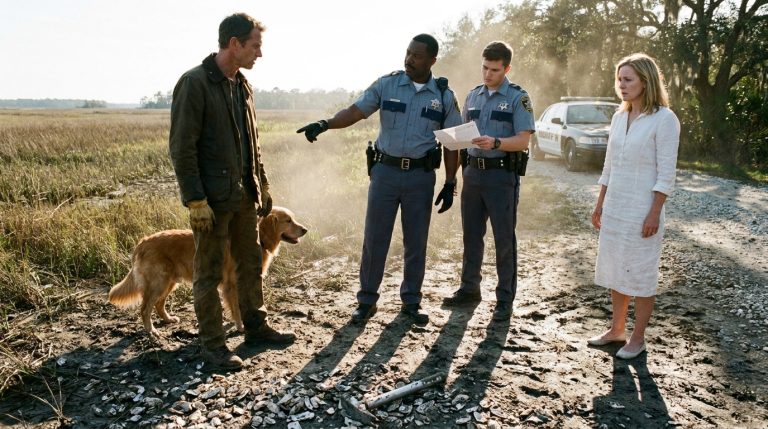
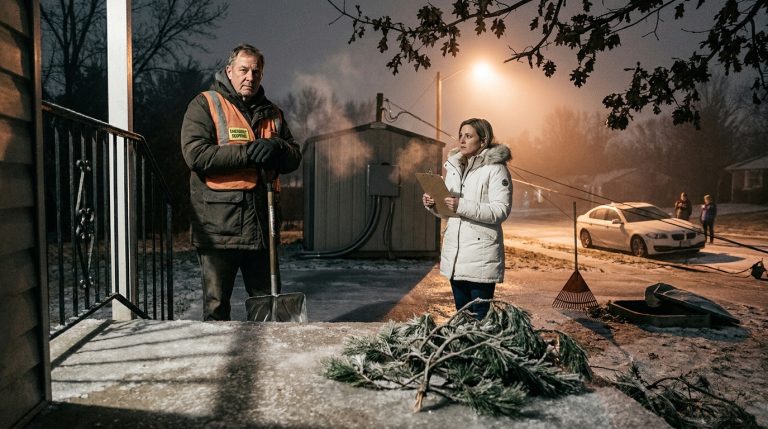
Diane Halverson didn’t look at the house; she looked at the clipboard. Her eyes were sharp, scanning the property line with the clinical efficiency of a realtor appraising a potential sale. When she finally looked up, her gaze didn’t soften. It skipped over the peeling paint on the porch railing and landed squarely on the flag—the 5×8 expanse of wool stripes that had been caught in the breeze for six long years.
“Mr. Delaney,” she said, her voice cutting through the quiet of Willow Ridge like a dull blade. “This is your final notice. That flag comes down in forty-eight hours, or we remove it ourselves.”
Frank didn’t look at her. He looked past her shoulder at the pole. The morning light was thin, washing out the colors of the yard, turning the grass into a muted, dusty green. He felt a familiar, involuntary tremor start in his right hand. He shoved his thumb deep into the pocket of his worn flannel shirt to steady it, the fabric thin and soft against his skin.
“It’s too large, too loud,” Diane continued, her pen hovering over the paper. “It violates the aesthetic standards we’ve laid out for the subdivision. Surely, you understand that a neighborhood needs a certain level of uniformity to maintain its value.”
Frank finally shifted his gaze to her. He didn’t see a villain; he saw a woman standing in a pair of expensive shoes, worried about a number on a page. He saw someone who didn’t know that the flag didn’t just hang in the wind; it held the air together.
“Ma’am,” Frank said, his voice as steady as he could manage. “I’ll need to make a phone call.”
Diane’s lips curled into a tight, thin-lipped smile—the look of a person who believes a concession is a surrender. She stepped off the porch, her heels clicking against the concrete as she retreated toward the white Lexus idling at the curb.
Frank watched her walk away, but his eyes weren’t really on her. They were on the pole. For a second, the reflection of the morning sun against the Lexus windshield flared, momentarily blinding him. He blinked, and for a fleeting, terrifying second, the reflection shifted. It wasn’t the white SUV parked in his driveway. It was the white-hot flash of a mortar round in a rice paddy, and the smell of wet earth and copper filled his nose, sharper than the scent of the morning pine.
He gripped the mug tighter, his knuckles white. The memory faded as quickly as it had arrived, but the tremor in his hand remained, now a dull, persistent ache. He turned back toward the house, but as he reached for the door handle, he noticed something that hadn’t been there before: the small, decorative stone border around his flower bed had been kicked out of alignment. A singular, jarring piece of displacement in an otherwise orderly row.
He knew then that the fight wasn’t going to be won on the porch. He went inside, the house feeling suddenly much larger and much colder than it had a moment ago. He walked straight to the mantel, his eyes fixing on the cedar box that held the weight of fifty-three years.
The house settled into a heavy, expectant silence, but for the first time in four years, the silence didn’t feel like peace. It felt like a countdown.
CHAPTER 2: THE WEIGHT OF THE CEDAR BOX
The kitchen was still, but the air felt thin, strained by the recent intrusion of Diane Halverson’s demands. Frank set his mug on the counter with a soft click. The sound, usually rhythmic and unremarkable, seemed to vibrate through the linoleum floor, a single point of discord in the quiet house. He stood for a moment, his hand still resting on the ceramic, waiting for the tremor in his fingers to subside. It didn’t. Instead, it migrated, a dull, rhythmic thrumming in his forearm that matched the beat of the Hamilton watch ticking on his wrist.
He walked to the hallway closet, the floorboards sighing under his weight—a sound he knew by heart, like the cadence of a familiar prayer. He opened the door. The smell of cedar and stale air greeted him, a sensory bridge that spanned the decades.
He didn’t reach for his winter coat or the spare linens. His eyes moved straight to the top shelf, where the cedar box sat nestled between a stack of moth-eaten wool blankets and a shoebox of old property tax receipts. He reached up, his fingers brushing the rough grain of the wood. The box felt heavier than it had a week ago, as if the urgency of the morning had compressed the contents, giving the old memories a new, denser mass.
He carried it to the dining room table, where the late afternoon light was beginning to stretch, casting long, bruised shadows across the wood. He set the box down and stood over it, hands hovering.
The flag inside was not the one he raised at 0600. That flag, the one with the wool-stitch stripes, was meant for the living—for the neighborhood, for the cul-de-sac, for the cycle of days. This one, curled in the dark of the box, was meant for the past.
He popped the latch. The scent of dust and something metallic—like oxidized copper—billowed out. It was a smell that shouldn’t have existed in a suburban living room in the middle of a Colorado spring, yet there it was, vivid and undeniable.
He touched the fabric. The blue field was fraying at the corners, the white stars yellowed like old parchment. His finger traced the bullet hole in the lower right corner, a jagged, imperfect circle that the restorationists at the Legion had tried to bind with invisible thread. He knew the history of that hole. He knew the trajectory of the round that had made it, and the precise, terrifying second the man holding the staff had crumpled to the ground.
He didn’t pull the flag out. He just kept his hand there, feeling the texture of the fabric, contrasting the fraying threads against his own scarred, calloused skin.
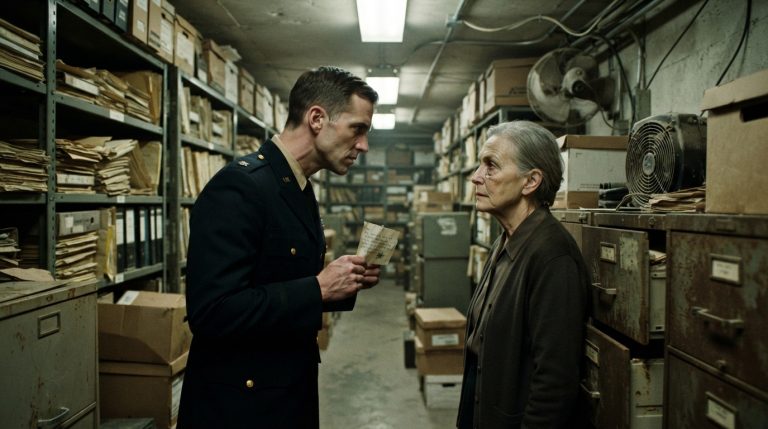
He remembered the rice paddy outside Khe San. He remembered the rain, a relentless, gray sheet that seemed to turn the world into a slurry of mud and shadow. James Talbot hadn’t cried out when the mortar landed; he had only looked up, his face pale, his eyes wide with a sudden, dawning comprehension. Frank had crawled toward him, the weight of his own gear pulling at his shoulders, the shrapnel in his thigh acting like a tether, keeping him rooted to the chaos.
He hadn’t been a hero that day. He had just been a boy who realized he couldn’t leave his friend behind. And yet, the citation that eventually arrived in the mail years later called it “conspicuous gallantry.”
Frank stared at the dog tags taped to the inside lid. They were dull, scuffed from years of rubbing against each other in the dark, but they were pristine in his mind. Talbot, James L. The name was more than a record of service; it was the anchor for everything Frank had done since. The reason he rose at 05:59. The reason he didn’t buy nylon flags. The reason he couldn’t just take the pole down, despite the HOA’s threats, despite the risk of a fine, despite the fact that the woman with the clipboard had no idea what she was asking him to dismantle.
To her, it was a aesthetic violation. To Frank, it was the only thing keeping the world from drifting away.
A shadow passed over the dining room window. Frank didn’t flinch, but he closed the lid, the soft clack of the wood settling into place like the closing of a tomb. He stood straight, his posture automatically correcting itself. He walked to the window and looked out.
The cul-de-sac was empty, but he could see the neighbor’s house, the one where the basketball hoop had been removed last month. The yard looked sterile, cleared of anything that might suggest a life lived, a game played, a moment enjoyed.
He realized then that Diane Halverson wasn’t just clearing his flag; she was clearing the neighborhood of its history, scrubbing it clean of the messiness of human experience. He looked down at his own hand. The tremor was gone. It had been replaced by a cold, sharp clarity.
He went to the microwave and picked up the white envelope. He opened it, not to read it, but to look at the signature. Diane Halverson. He sat back down at the table and opened his small black address book. He flipped past the names of veterans he hadn’t spoken to in years, past the list of plumbers and mechanics, until he reached the ‘W’s.
He looked at the number for Marcus Whitfield. He didn’t pick up the phone yet. He just sat there, watching the sun dip lower behind the foothills, realizing that if he made this call, he was finally acknowledging that he couldn’t carry the weight of this silence by himself anymore.
The house ticked. The shadows lengthened. Frank didn’t turn on the light. He sat in the fading day, listening to the house breathe, feeling the weight of the cedar box beneath his hand, and knowing that tomorrow, at 06:00, the sun would rise, and the flag would go up, and the quiet war of Juniper Court was only just beginning.
CHAPTER 3: THE CALL TO KHE SAN
The landline was an antique, a heavy, cream-colored device that sat on the kitchen counter like a relic from a different age. Frank stared at the dial, his finger hesitating over the circular holes. He had memorized the number long ago, a sequence he had traced in his mind a thousand times but had never once dared to fully commit to the air.
When he finally pressed the numbers, the clicks sounded disproportionately loud in the evening kitchen. He felt a sudden, sharp spike of apprehension. What would he say? How do you call a man after a decade of silence and ask him to stand against a woman in a Lexus? How do you explain that the flag, which he had raised every morning with such calculated precision, was no longer just a ritual—it was a fraying line connecting him to a boy who had died in the mud, a boy he had promised to remember?
The line began to ring. It wasn’t the crisp, digital chirp of a cell phone; it was a rhythmic, mechanical pulse that vibrated through the cord and into his palm.
One ring. Two rings.
Frank’s gaze drifted to the window. The sky had turned a bruised, deep purple, the kind of twilight that seemed to press against the glass. He felt the phantom vibration in his leg, the old shrapnel wound pulsing with the drop in temperature. It was a sensation he usually ignored, but tonight, it felt like a warning.
Three rings.
“Whitfield,” a voice answered.
It was gruff, efficient, and instantly recognizable. Colonel Marcus Whitfield. Even through the distorted quality of the line, Frank could hear the underlying cadence of the Marine Corps—the clipped vowels, the authoritative flatness. It was a voice that belonged to a different world, a world of firebases and wet red clay, far removed from the manicured lawns and HOA aesthetics of Willow Ridge.
Frank opened his mouth, but for a long moment, no sound came out. The static on the line hummed, a low-frequency hiss that sounded, for one terrifying second, like the background noise of a radio in a bunker, the muffled, chaotic roar of a distant engagement. He squeezed his eyes shut, forcing the imagery back. He wasn’t in Khe San. He was in a kitchen in Colorado.
“Marcus,” Frank said, his voice raspy. “It’s Frank Delaney.”
The silence on the other end was absolute. It wasn’t the polite pause of a conversational break; it was the sudden, bracing stillness of a man who had been jolted out of a long-standing routine. Frank could hear the colonel’s breathing—steady, controlled, the breath of a man who had mastered his own biology.
“Frank,” Marcus said finally. There was a shift in the tone, a subtle softening that betrayed the surprise. “I haven’t heard from you in… what has it been? Eleven years?”
“Something like that,” Frank replied. He leaned his shoulder against the wall, finding strength in the physical support. He felt like he was standing on the edge of a precipice, staring into the dark. “I wouldn’t call, Marcus. I know you’re supposed to be taking it easy. Linda told me you had the surgery.”
“Linda tells everyone everything,” the colonel muttered, though there was no malice in it. “And I am taking it easy. I’m sitting in my study looking at a budget for the Association. What’s wrong, Frank? You don’t call to catch up on my medical history.”
Frank took a deep breath. He looked toward the hallway closet, toward the cedar box behind the closed door. “I’ve got a situation here. The Homeowners Association. They sent me a notice. They want the flag down, Marcus. They want the pole gone.”
He explained it carefully, stripping away the emotion and leaving only the facts. He talked about Diane Halverson, the clipboard, the amendments, the “aesthetic standards.” He avoided mentioning James Talbot, but he felt the presence of the boy at the edge of his thoughts, a silent observer in the kitchen.
As he spoke, Frank watched the reflection of the kitchen light on the window. He saw himself, an old man in a flannel shirt, his hair cut in a style that hadn’t changed since 1968. He looked fragile. He looked like an artifact. But as the story spilled out, his voice gained a firmer edge, the rhythm of his words echoing the cadence of a man who had once stood his ground when the earth itself seemed to be folding inward.
“She put her hand on it,” Frank said, the memory of Diane’s palm against the wool still burning in his mind. “She treated it like a piece of lawn furniture. She told me it didn’t belong here.”
Marcus didn’t interrupt. He stayed silent, listening with the patience of a commander receiving a report from the front line. When Frank finally fell silent, there was a long, heavy pause. Frank could hear the scratch of a pen on paper, the sound of a man considering his next move.
“Forty-eight hours, you said?” Marcus asked.
“Yes.”
“And you’ve told them nothing? You haven’t agreed to move it?”
“I told her I’d make a call,” Frank said.
“Good.” The colonel’s voice sharpened, shedding the civilian tone. “Don’t take it down, Frank. Don’t touch the halyard. Don’t give them a single inch of ground. You show up at 06:00 tomorrow morning, and you raise that flag just like you always have. Do you understand me?”
“Yes, sir.”
“One more thing,” Marcus said, his voice dropping, carrying a weight that Frank hadn’t heard in half a century. “Why now? Why didn’t you call me two weeks ago?”
Frank looked at the empty chair across the table, the one where Marjorie used to sit, the chair that had become a monument to his own stubborn isolation. “I didn’t want to be a bother,” he whispered.
There was a catch in Marcus’s breathing, a fleeting moment where the mask of the iron-willed colonel slipped. “Frank,” he said, his voice rough. “You have never been a bother, not for one goddamn minute of my life. I’ll see you at 06:00 day after tomorrow.”
The line went dead, the silence returning to the kitchen with the weight of a physical presence. Frank held the receiver for a long time, the dial tone having long since cut off. He felt a strange sensation in his chest, a thawing of something that had been frozen since 1968. He wasn’t just a man in a cul-de-sac anymore. He was a Marine who had finally, after years of silence, signaled his squad.
He placed the receiver back on the cradle. The kitchen was dark now, save for the faint, silver glow of the moon reflecting off the neighbor’s roof. He didn’t feel the weight of the cedar box as much as he felt the gravity of the promise he had just made. He was no longer waiting for the end; he was preparing for the sunrise.
CHAPTER 4: THE DAWN ASSEMBLY
Frank stood at the end of his driveway. It was 05:59. The air was thin, carrying the sharp, metallic bite of a mountain morning. The sky over the foothills was the color of a bruised plum, slowly lightening to a pale, clinical grey.
His hand was on the halyard. The tremor in his right hand was present, a fluttering cadence that mirrored the wind, but he ignored it. He didn’t look at the houses. He didn’t look at the cream-colored Lexus parked two lots down, though he knew Diane Halverson was likely watching from her window, her coffee cooling on the counter, her mind already racing through the slide deck she intended to use as a shield.
He raised the flag. The wool cloth caught the wind, a sharp snap that echoed off the neighboring siding. It was the only sound in Willow Ridge. For a heartbeat, there was nothing else. Then, a low rumble began to build, a vibration that started in the soles of his boots and moved up through his chest.
It wasn’t the sound of a vehicle. It was the synchronized, heavy heartbeat of forty-seven engines.
He turned his head slowly. At the entrance to Juniper Court, the first headlight broke the darkness. It was a single, piercing eye of LED light, followed immediately by another. Then another. They moved with a slow, deliberate grace, a column of iron and steel navigating the suburban curves as if they were riding into a tactical zone.
Frank didn’t move. He felt the weight of the moment pressing against his lungs. He had expected maybe three, maybe four men. He hadn’t expected a tide.
Ernesto Ramirez—Doc—was at the front, his black Harley creeping forward with a calculated rhythm. Behind him, the others followed in pairs. They didn’t rev their engines; they rode with a silence that felt more imposing than noise. As they reached the center of the cul-de-sac, they didn’t scatter. They began a slow, synchronized movement, the bikes peeling off to block the exits, forming a wide, protective arc that effectively cordoned off the entire street.
Frank watched, his breath hitching, as the riders came to a stop. One by one, the kickstands hit the pavement with a rhythmic clack-clack-clack that sounded like a drum roll.
The colonel, Marcus Whitfield, was the last to dismount. He looked exactly as Frank remembered him from a decade ago: rigid, focused, his presence commanding the space around him with an invisible gravity. He didn’t look at the houses. He didn’t look at the news vans that had appeared at the edge of the subdivision, their antennas glinting in the rising light. He walked directly toward the end of the driveway, his boots silent on the concrete.
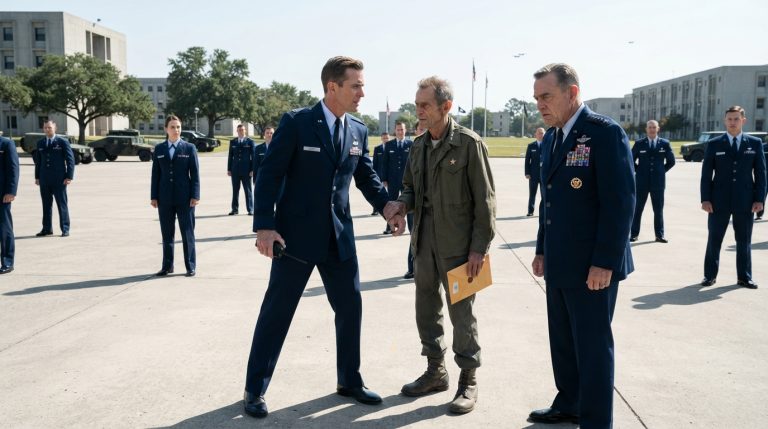
He reached Frank, stopped, and removed his cap. He didn’t speak. He simply stood at attention, his posture a testament to the fifty-three years that separated them from the rice paddies of Khe San. He raised a hand in a crisp, sharp salute.
Frank returned it. The flag snapped above them, the wind pulling at the halyard, but neither man moved.
“You took your damn time,” Marcus said, his voice quiet, barely audible over the wind.
“I apologize, sir.”
“Not a sir,” Marcus corrected, his gaze shifting to the flag on the pole. He didn’t look away. “I’m here to stand watch, Frank. That’s all.”
Then, the rhythm of the morning shifted. Marcus turned toward his men. He didn’t need to shout. He simply looked at them, and the forty-six veterans, who had spent the last hour in quiet focus, began to move. It was a display of efficiency that made the frantic, clipboard-driven pace of the HOA look like child’s play.
They didn’t just stand; they worked. Each man produced a folded flag from his saddlebag. They fanned out across the cul-de-sac, moving with a fluid, practiced motion. Within minutes, the lawns of Willow Ridge were transformed. It wasn’t a protest; it was a memorial. Forty-seven flags were planted in the grass, spaced with an exacting, cemetery-like precision.
Helen Margolis appeared on her porch. Frank saw her step out in her housecoat, her hands trembling as she clutched a small, folded triangle of fabric. A biker, a man with grey hair and a unit patch on his vest, stopped near her yard. He didn’t demand anything. He simply nodded, knelt, and helped her plant her flag beside his own.
The tension in the air was palpable—a thick, electric charge that kept the neighborhood suspended. Frank saw movement at Diane Halverson’s window. The curtain twitched, then fell back. He knew she was watching. He knew she was seeing the HOA’s “aesthetic standards” being rewritten by men who understood that true value wasn’t found in property taxes, but in the cost of the ground itself.
Doc Ramirez walked up the driveway. He stopped in front of Frank, his face etched with the wear of years, his eyes rimmed with a redness he made no effort to hide. He didn’t try to be strong. He simply reached out and gripped Frank’s arm.
“We’re here,” Doc said.
Frank nodded, his throat tight. He looked around the cul-de-sac. The flags were fluttering in unison, a forest of red, white, and blue that made the small, grey houses feel suddenly small, fragile, and temporary. He felt the phantom pressure of the cedar box in the closet, the weight of the secret he hadn’t yet shared. He knew that the confrontation with Diane was inevitable, that the true test was yet to come, but for this moment, the burden he had carried for half a century felt lighter, shared by the forty-six men who stood silent watch over his lawn.
The sun broke fully over the horizon, casting long, golden shadows across the pavement. The street was no longer a subdivision; it was a field of memory.
CHAPTER 5: THE UNRAVELING
The front door of the cream-colored corner house stood open, a dark rectangle against the sterile interior lighting of the foyer. Diane Halverson stood in the threshold. She was still wearing the cream-colored blazer she had planned to wear to the clubhouse, but it looked different now—rumpled at the cuffs, the fabric lacking the crisp, authoritative edge it had possessed only an hour ago.
She didn’t step out onto the porch. She stood behind the screen, her fingers white-knuckled as they gripped the frame. Behind her, in the entryway, the silhouette of a laptop bag rested on a side table, a stark reminder of the slide deck she would never present.
Marcus Whitfield walked toward her. He didn’t rush. He moved with the measured, steady pace of a man who had already won the ground he was walking on. Frank followed a few steps behind, his boots heavy on the pavement. Every step felt like he was closing a distance that had existed for fifty-three years. He felt the cold air pressing against his face, a sharp contrast to the heat radiating from his own chest.
When they reached the porch steps, Diane didn’t speak. She looked at Marcus, then her eyes flickered to Frank, and for a fleeting, uncomfortable second, she seemed to see him—not as a violation of property code, not as a symbol of ‘underperforming assets,’ but as a man. Her gaze dropped to the worn flannel shirt, then to his hands.
“Ma’am,” Marcus said, his voice level, stripped of all artifice. He held out the single piece of paper—a printout of the federal flag code, the ink sharp and clear. “I’m Colonel Marcus Whitfield. I served with Mr. Delaney in 1967 and 1968. I believe there’s been a misunderstanding regarding what constitutes ‘aesthetic standards’ in a neighborhood that includes men who have given everything to ensure you have the right to hold them.”
Diane’s breath hitched. She looked at the paper but didn’t reach for it. Her eyes were red, the edges of her makeup smudged. She looked younger than forty-two, and, suddenly, very small.
“I didn’t…” she began, her voice cracking. She swallowed hard, trying to regain the cadence of the realtor she was, but the words failed her. “I was only trying to… the values were slipping. Everyone said the neighborhood was underperforming.”
“Values aren’t measured in square footage,” Marcus said. He didn’t raise his voice; he didn’t need to. The silence of the forty-seven men behind them, standing vigil over the flags on the lawns, provided all the volume necessary. “You’ve spent your time here looking for flaws in fences and mailboxes, Diane. You should have been looking at who was living behind them.”
Frank watched her face. He noticed then—a detail that hadn’t been there when she stood on his porch days ago—the way her shoulders were slumped, a slight, involuntary tremor in her jaw. It reminded him of the way a new recruit looked when the reality of their situation finally settled in. She wasn’t a villain; she was a woman drowning in a pool of her own making, desperate to keep the water from rising.
“I have a meeting,” she whispered, looking toward the clubhouse, then back at the news vans that had started to pull into the cul-de-sac. The realization hit her, slow and agonizing: the cameras weren’t there to document her revitalization of the neighborhood. They were there to record its conscience.
“There is no meeting,” Frank said. His voice was quiet, but it cut through the hum of the morning. “The community has already spoken.”
Diane looked at him. Really looked at him. And in that moment, the barrier between them—the clipboard, the notice, the petty bureaucracy of Willow Ridge—shattered. She looked down at the paper Marcus held, then slowly, tentatively, she reached out and took it. Her hand brushed his, and for a second, the friction of the paper against her skin seemed to ground her.
She looked back at the lawns, at the rows of flags that had turned her pristine street into a site of profound, heavy significance.
“I’ll withdraw the notice,” she said, her voice barely audible. It was a surrender, not to the HOA, not to the rules, but to the reality of the history she had tried to erase. “I’ll resign.”
“That’s the right decision,” Marcus said. He stepped back, giving her space.
She turned away, retreating into the darkness of her hallway, and the door clicked shut. There was no grandeur in it, no finality—just the dull, empty sound of a door closing on a life that would never look the same again.
Frank stood on the porch, the wind pulling at his hair. He looked down at the lawn, where the flags were still standing, a silent, colorful sentry of men who had seen the world burn and yet had chosen to come home and plant flowers. He felt a profound, aching exhaustion, the kind that comes when you’ve been holding your breath for half a century.
The battle wasn’t over; there was still the work of the coming months, the inevitable questions, the slow process of returning to a life that had been fundamentally altered. But for now, as the morning sun hit the pole in his front yard, Frank felt the tremor in his hand finally, fully, come to rest. He reached up and touched the rope on the halyard, not to adjust it, but to confirm it was still there. It held.
CHAPTER 6: THE FINAL FOLD
The house was quiet, but it was a different kind of quiet now. The tension that had held the air rigid for two weeks had evaporated, leaving behind a stillness that felt almost heavy. Frank stood on his porch, his hands hanging loose at his sides. The cul-de-sac was emptying; the last of the motorcycles had already rumbled away, leaving only the smell of exhaust and the faint, lingering imprint of tires on the asphalt.
The forty-seven flags remained on the lawns, a silent, colorful parade that seemed to have reclaimed the neighborhood. Frank looked at the sign Emma had planted—a purple crayon scrawl of a flag—and felt a strange, detached calm. He turned and walked back inside, the floorboards no longer sighing under his feet, but settling comfortably under his weight.
He went directly to the mantel. The cedar box sat there, its dark wood catching the soft afternoon light. He didn’t hesitate. He took it down, the wood cool and solid in his hands, and carried it to the dining room table where he had sat and stared at the empty chair for four years.
This was the final piece of the equation.
He opened the lid. The flag, with its frayed edges and the nickel-sized hole, lay there, silent and expectant. He took it out, feeling the texture of the fabric—softer than modern wool, weighted with history. He laid it flat, smoothing it out with the flat of his palms.
He remembered the rice paddy. Not the fire, not the mortar, not the chaos—but the moment after. The moment he had picked this flag up from the mud, the moment he had realized that James Talbot was gone, and that he, Frank, was the only one left to carry the weight of that day. He hadn’t told anyone, not even Marjorie, because how could you explain that the flag wasn’t a symbol, but a physical extension of a man you hadn’t managed to save?
He touched the bullet hole. It wasn’t just damage; it was the focal point of his life. Everything he had done—the way he drove his truck, the way he raised his flag at 06:00, the way he lived his life in the silence of Juniper Court—had been an attempt to honor the space where that hole existed.
He began to fold.
Thirteen folds. Each one slow, deliberate, precise. He wasn’t folding it for the Legion, or for the neighborhood, or for the news crews. He was folding it for James.
With the final fold, the blue field with the stars was on the outside, a perfect, sharp-edged triangle. He held it for a moment, the weight of it anchoring him to the table. The truth of his life—his survivor’s guilt, the way he had lived in the shadow of 1968—finally felt like something he could hold, rather than something that held him.
He heard a soft sound at the door. He didn’t look up, but he knew who it was.
“Mr. Delaney?”
Diane stood in the entryway. She wasn’t holding a clipboard. She was holding a mug—the same Semper Fi mug he had given her on the porch. She looked different; the sharp, defensive edges of her posture had softened, and for the first time, she looked like a woman who was seeing the street she lived on for the first time.
“I just wanted to…” she started, then stopped, looking at the flag on the table. She didn’t ask what it was. She looked at the hole in the fabric, at the frayed edges, and she seemed to understand that some things didn’t need to be explained to be felt.
Frank stood up. He didn’t offer an apology, and she didn’t ask for one. He held the folded flag out toward her, not to give it to her, but to let her see the weight of the work he had been doing.
“I lost a man in 1968,” Frank said, his voice steady. “James Talbot. He was eighteen. This was his.”
Diane stepped closer, her eyes fixed on the triangle of blue and white. She didn’t speak, but she nodded, a slow, solemn acknowledgment of the space the flag occupied. She finally understood. The neighborhood wasn’t a real estate project; it was a collection of stories, some of them buried deep in the earth, some of them fraying at the edges, but all of them deserving of the space they occupied.
Frank placed the flag back into the cedar box and closed the lid. The sound was final, but it wasn’t harsh. It was a release.
“The board meeting is canceled,” Diane said softly. “I’m stepping down. I think… I think I’d like to see the flag raised tomorrow morning. If you don’t mind.”
“I don’t mind,” Frank said.
She turned and left, her footsteps quiet as she walked back out to her house on the corner. Frank stayed at the table. He looked at the empty chair, then at the box, and for the first time in his life, he didn’t see a monument to what he had lost. He saw a beginning.
He went to the kitchen and washed his mug. The house was no longer filled with the weight of the past; it was just a home, quiet and settled in the gathering dusk. Tomorrow, he would wake up at 05:59. He would go to the pole. He would raise the flag. And for the first time in fifty-three years, he wouldn’t be doing it because he had to. He would be doing it because he was finally, truly, home.