The Silent Echo of the Wraith: A Former Legend Faces the Consequences of a Broken Mask
CHAPTER 1: The Weight of Silence
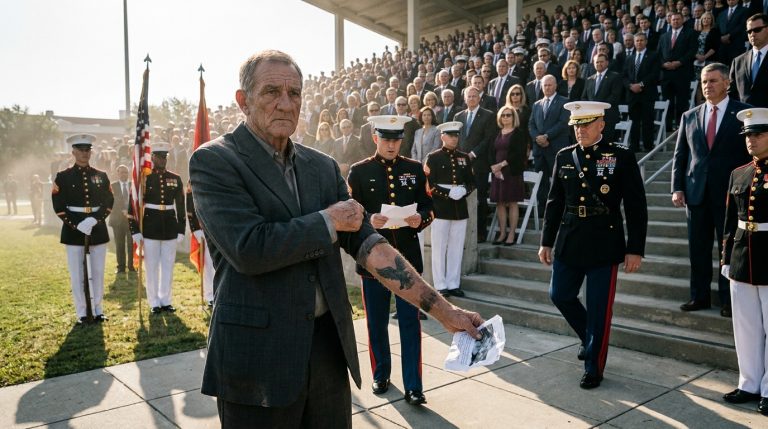
The transition from the grand oak-paneled hall to the mid-day sun felt like stepping into a furnace. Jack kept his stride measured, his hand resting lightly on Daniel’s shoulder. The boy—no, the officer—was beaming, a kaleidoscope of pride and relief.
“I still can’t believe he did that,” Daniel whispered, his voice vibrating with youthful awe. “A four-star, Dad. He just stood there and saluted you like you were the President.”
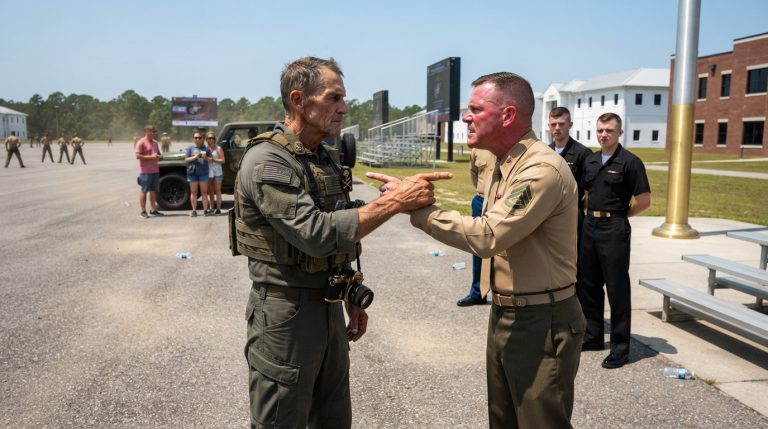
Jack didn’t turn his head. His focus was a locked aperture, scanning the perimeter of the parking lot. The polished asphalt shimmered under the July heat, but his skin crawled with the sensation of being under a microscope. He caught a glimpse of a reflective surface near a parked black sedan—not a window, but a lens.
“It was a formality, Daniel,” Jack said, his voice a low, gravelly hum. “Military politics is a theater. Don’t let it cloud your focus.”
“But they called you a legend. Everything Kent said—”
“Forget it,” Jack interrupted, his tone tightening just enough to command immediate silence.
He moved them toward his truck, a battered domestic pickup that stood in stark contrast to the line of luxury sedans surrounding it. As he fumbled for his keys, his peripheral vision picked up the movement of the three men from the reception hall. They hadn’t followed them out, but they had moved to a higher vantage point on the administrative terrace, their silhouettes sharp against the white stone.
Jack opened the driver’s side door. The scent of old vinyl and stale coffee hit him, a grounding, earthy reality that felt a thousand miles away from the ceremony. He didn’t climb in. Instead, he gripped the roof of the cab, his knuckles turning white as he felt the structural vibration of the truck.
He leaned in, ostensibly to check the ignition, but his eyes were darting across the parking lot, counting the exit points. Four. Three blocked, one clear.
“Dad? Are you okay?”
Jack straightened, the motion fluid and deceptive in its laziness. He looked at his son. For a heartbeat, the mask slipped. He didn’t see a graduate; he saw a target. The realization hit him with the force of a physical blow: by standing up for him, Kent hadn’t just honored him. He had stripped the armor of obscurity away.
“Daniel,” Jack said, his voice dropping into the register he used for briefing a team. “Take the keys. Drive to the main gate. Do not look back, do not stop for anyone, and do not—under any circumstances—mention my name to anyone on this base.”
Daniel’s face paled, the pride draining away to reveal a sudden, sharp fear. “What? Why? What’s happening?”
Jack reached into his jacket, his fingers brushing the cold, familiar shape of a key fob, but his mind was already calculating the distance to the terrace. The men were gone.
“The wind just changed, son,” Jack whispered, and he felt the familiar, cold weight of the ghost he had tried so hard to bury clawing its way back into the light.
CHAPTER 2: The Geometry of Distance
Daniel didn’t move. He stood by the driver-side door, the engine of the truck ticking as it cooled, a rhythmic, metallic heartbeat that punctuated the sudden void of noise. His hand hovered over the door handle, his knuckles pale. The graduation ceremony was still happening somewhere behind the brick walls, a muffled sound of applause and distant, formal music, but it felt like a broadcast from a different planet.
“Dad, what are you talking about?” Daniel asked, his voice cracking, shedding the polished veneer of the new second lieutenant. “You’re acting like—”
“I’m acting like a man who knows when the environment has become untenable,” Jack snapped, the words clipped and devoid of his usual warmth.
He didn’t look at his son. He kept his eyes locked on the exit of the parking lot, his internal compass already mapping the sightlines, the cover, and the inevitable avenues of approach. He felt the phantom weight of a rifle sling on his shoulder, a muscle memory that had been dormant for years, now screaming for attention. The V-2 variance in his mind—the sudden, sharp memory of a jagged ridge in the Hindu Kush—slotted into place, overlapping with the neat, paved rows of the base. The smell of cedar and old leather from his jacket was suddenly suffocating, replaced by the ghost of acrid, burning rubber and stone dust.
Jack reached out, his hand firm as it gripped Daniel’s arm, guiding him around the truck. He was moving with a fluid, predatory economy, pushing his son into the passenger seat before the boy could protest further. He didn’t care about the confusion in Daniel’s eyes; he cared only about the distance between them and the three men who had been watching from the terrace.
“Keys,” Jack demanded, his voice a low, gravelly rasp.
Daniel handed them over, his fingers trembling. Jack slid into the driver’s seat, the springs of the old bench seat groaning under the shift in weight. He didn’t turn the key immediately. He sat for a heartbeat, his head tilted slightly, listening to the ambient sounds of the base. The wind was whipping through the sparse trees at the edge of the lot, creating a low, whistling sound that hid the hum of a distant surveillance drone.
“Listen to me,” Jack said, turning to face his son. The intensity in his eyes was blinding, a hard, blue light that allowed no room for argument. “Everything you’ve been told about me, everything you think you know—some of it is true. But the part where I’m a simple man? The part where I’m just a carpenter who lives in the quiet? That’s the part that just died in that room.”
“I don’t understand,” Daniel whispered.
“You don’t need to understand. You need to drive. You go to the secondary rally point we discussed—the cabin by the lake. Do not take the highway. Use the service roads through the valley. Keep the radio off.”
“Dad, you’re coming with me, right?”
Jack looked at the rearview mirror. A dark sedan was turning into the parking lot, its movement too deliberate, its speed calculated to cut off the exit. It was a professional entry. A tactical positioning.
“I’ll be right behind you,” Jack lied, his voice as smooth and steady as granite.
He reached into the center console and pulled out a small, heavy piece of metal—a simple, custom-made lock-pick set, a relic of a life he thought he had successfully buried. He tucked it into the lining of his waistband, the sharp edge of the metal biting into his skin. It was a grounding sensation, a reminder of the binary nature of his existence: either he was the hunter, or he was the target.
As Daniel put the truck in gear, the engine roared to life, a rough, mechanical scream that broke the tension. Jack stepped out of the truck, the door slamming shut behind him. He wasn’t walking away from a conversation; he was stepping into a containment field. The sedan was fifty yards away now, slowing, its windows tinted deep enough to render the occupants invisible.
Jack turned his back on his son, his posture shifting, his shoulders dropping, his center of gravity lowering. He wasn’t a groundskeeper anymore. He was a geometry of violence, calculating the exact trajectory required to ensure that whatever was coming out of that car, it wouldn’t be following the truck.
He felt the cold, hard reality of his past settling back into his bones like a suit of armor he never truly took off. The ceremony in the hall, the applause, the pride—it was all dust. He watched the truck pull away, his son’s face a blurred shape in the side mirror, and then, he took a step forward, directly into the path of the oncoming vehicle.
CHAPTER 3: The Geometry of Interception
The black sedan slowed to a crawl twenty feet away, its front tires biting into the gravel with a sound like grinding teeth. It was a high-end vehicle, matte finish, the kind of car that didn’t belong in a parade ground lot unless it was carrying someone who valued absolute anonymity. Through the polarized windshield, Jack couldn’t see faces, only the distorted reflection of the sky and the sharp, rectangular shadows of the surrounding trees.
He didn’t move. He stood with his feet shoulder-width apart, weight evenly distributed, his hands empty and open at his sides. This wasn’t a challenge; it was a roadblock. He was betting on the fact that whoever was inside wasn’t looking for a public firefight. They were looking for confirmation.
The driver’s side window hummed downward. A sliver of air escaped the climate-controlled interior, smelling faintly of synthetic upholstery and stale ozone. The man behind the wheel wasn’t wearing a uniform. He wore a crisp, charcoal-gray suit that looked as uncomfortable as a straitjacket, his hair cut to a military standard but styled for a boardroom. His eyes, cold and assessing, swept over Jack with the clinical detachment of a butcher eyeing a carcass.
“You’re making a mistake, Callahan,” the man said. His voice was melodic, practiced, the kind of tone that could sell a lie or dictate a death sentence with equal ease.
Jack didn’t blink. He kept his gaze fixed on the man’s hands. The driver had left his right hand resting on the center console, fingers curled around a bulky, rectangular object—a burner phone, likely—but his left hand was hidden below the window line.
“I don’t make mistakes,” Jack replied, his voice a low, gravelly vibration that seemed to absorb the ambient noise of the base. “I make adjustments. And right now, the adjustment is that you turn around and leave.”
The man in the car smiled. It was a thin, joyless expression that didn’t reach his eyes. He leaned forward, the interior light of the car catching a small, silver pin on his lapel—a nondescript logo, but one that triggered a flicker of recognition in the deepest, most dormant part of Jack’s mind. It was a mark of the ‘cleanup’ crews, the bureaucrats of the shadow world whose job it was to ensure that the secrets left behind by men like him stayed buried.
“We aren’t here for a conversation,” the driver said. He shifted his grip on the phone, and Jack saw the subtle, rhythmic pulse of his thumb against the side of the device. “We’re here to verify a status. A simple ‘yes’ or ‘no’ will suffice. Are you, or are you not, the individual identified as Wraith?”
Jack felt the V-1 variance sharpen his focus. He noticed a slight dip in the rear suspension of the sedan. The car wasn’t just carrying a driver. There was weight in the back—a passenger, someone who was keeping their head low, someone who hadn’t spoken yet. The realization tightened the tension in his chest. This wasn’t just a verification team; it was an extraction unit.
“You’re wasting your time,” Jack said. He took a single, deliberate step toward the car, closing the distance to fifteen feet. The driver’s posture tightened; his hidden hand began to rise. “Go back to whoever sent you and tell them the ghost didn’t show up today.”
“The Bureau is very thorough, Master Chief,” the man replied, dropping the pleasantry. His voice grew harder, more transactional. “We know about the cabin. We know about the boy. If you think your anonymity is still a viable strategy, you are dangerously out of touch with the current intelligence climate.”
Jack felt the cold iron of his own resolve solidify. The mention of the cabin hit him like a physical impact, but his expression didn’t flicker. He wasn’t afraid. He was calculating the cost of the next three seconds. He saw the driver’s left shoulder tense—a classic ‘tell’ before a reach for a weapon.
“You’re in the wrong place,” Jack said, his voice dropping to a whisper.
He didn’t wait for the man to finish the movement. In a blur of motion that defied his age and the stillness he had projected moments before, Jack lunged. He didn’t go for the driver; he went for the door frame. His left hand slammed against the top of the door, pinning it shut, while his right hand found the base of the driver’s jaw, applying precise, agonizing pressure to a nerve cluster that forced the man’s head back against the headrest.
The car rocked on its suspension. The driver gasped, his hands flying up to peel Jack’s fingers away, but Jack was a pillar of unmovable force. He leaned into the window, his face inches from the man’s.
“Tell the passenger in the back that if I see this car again, or if I find so much as a shadow near my son, I won’t be using a handshake next time,” Jack hissed. He reached inside the open window with his left hand, snatched the phone from the console with a quick, snapping motion, and slammed it against the door frame, shattering the screen into a web of white cracks.
He stepped back, letting the door snap open. The driver was wheezing, his face a mask of shock and pain. Jack didn’t look at him again. He turned on his heel, his movements still economical, still perfect, and began the long walk toward the perimeter fence where he had hidden his own backup transport. The sedan sat idling, the engine sputtering, the man inside too stunned to even try to follow. Jack knew the game had changed. He wasn’t just defending a memory anymore; he was defending a future, and for the first time in thirty years, the mask was gone, and he didn’t care who saw the face beneath.
CHAPTER 4: The Iron Rain
The sky over the valley had been a bruised purple for miles, but as Jack navigated the winding service road, the heavens opened with a violent, rhythmic intensity. Rain didn’t just fall; it hammered against the roof of the truck, a deafening drumbeat that turned the dry, iron-rich earth into a treacherous slurry of slick red mud. Jack’s knuckles were white against the steering wheel, his eyes scanning the horizon not for landmarks, but for the telltale glint of headlights—or the absence of them—that would indicate he was being tracked.
The truck skidded, the rear tires hunting for purchase on the saturated clay. Jack corrected the slide with a subtle, instinctual twitch of his wrists, his body language relaxed despite the encroaching danger. He was already calculating the turn-ahead, a sharp, unbanked switchback that cut through a dense thicket of scrub oak. If he was being followed, the mud would be the great equalizer; it didn’t care about the quality of the vehicle, only the competence of the driver.
His phone, the one he had retrieved from the sedan, sat on the passenger seat, its screen a spiderweb of damage. It flickered occasionally, the backlight pulse a rhythmic, dying heartbeat. He needed to know who was at the other end of that connection, but he knew better than to turn it on before he was clear of the immediate vicinity. He reached down and shoved it into the glove box, the metallic ‘clack’ lost in the roar of the storm.
A sudden, sharp shudder ran through the chassis. A branch, heavy with rainwater, had been forced across the path by the gale, obstructing the narrow track. Jack slammed on the brakes, the truck coming to a controlled stop inches from the foliage. The engine idled with a rough, uneven cadence, sounding like a wounded animal in the silence that followed the sudden cessation of movement.
He didn’t exit the vehicle immediately. He sat in the dark cab, the rain blurring the world into a smear of gray and black, and listened.
The wind whistled through the gaps in the door seals, carrying the faint, metallic scent of wet iron. He reached under his seat and pulled out a small, canvas-wrapped bundle. Inside lay a set of tools—a multi-tool, a length of heavy-duty paracord, and a compact, high-intensity flashlight. He tucked the light into his pocket and popped the door.
Stepping out was like plunging into a river. The cold was instantaneous, biting through his jacket, but the sensory shock did exactly what he needed: it cleared the mental static. He walked toward the obstruction, his boots sinking into the muck with a heavy, sucking sound. He focused on the wood, the texture of the bark wet and slick under his touch, his movements surgical.
He didn’t notice the flash of light behind him at first.
It was a flicker, reflected in the wet mud at his feet—a brief, stuttering illumination that didn’t belong to the storm. Jack stopped, his body going rigid. The atmosphere shifted. The silence of the woods felt different now, heavy with the intent of someone else observing.
He didn’t turn around. He reached down as if to clear a small branch, his fingers finding the tension point of a vine, and used the leverage to spin, his body flowing into a low crouch as he swept his gaze across the rearward path.
Nothing but the driving rain and the swaying silhouettes of the oaks.
“Too slow,” he whispered to himself, the ghost of a wry, bitter smile touching his lips. He was letting the frustration of the past catch up to his perception. He was reacting, not leading.
He grabbed the thickest part of the obstructing branch and heaved, the wood snapping with a dull, wet sound. He shoved the debris aside, the movement exposing the road ahead. But as he turned back toward the truck, he saw the mud.
There were impressions in the slurry—heavy, treaded boot marks, distinct and fresh, leading away from the road and into the brush, perpendicular to his own path. Someone had been waiting, and they had just repositioned.
The realization sat in his gut like lead. They weren’t trailing him; they were herding him. The service road wasn’t just a route; it was a funnel. Jack felt the old, familiar weight of the hunt settle over him. He wasn’t the one in control anymore. He walked back to the truck, his pace steady, his mind already discarding the route he had planned. He needed to be in the brush, not in the vehicle. If the road was a funnel, he would stop being the target and become the ambush.
CHAPTER 5: The Glass Threshold
Jack moved through the scrub oak like smoke. Every step was a calculation of weight and placement, his boots finding purchase on rocks rather than soft earth, his body keeping low to minimize his silhouette against the gray-black backdrop of the storm. He could hear the sedan idling further down the track, a low, mechanical growl that sounded like a mechanical beast breathing in the dark.
He didn’t need to look. He knew the pattern. The men would wait for him to circle back to the vehicle, or they would assume he had fled on foot. They weren’t prepared for the man who didn’t run, but rather, the man who folded himself into the terrain and became part of the threat.
As he crawled toward the tree line, his hand brushed against something cold and hard pinned to the underside of a drainage culvert—a magnetic tracking beacon, the size of a coin. He froze. His breath hitched in his throat, and for a terrifying second, the roar of the rain faded into a soft, melodic hum—the sound of his wife humming in the kitchen, a phantom sensation of a hand resting on his back.
He blinked, the image shattering into the harsh, wet reality of the woods. The hallucination was a warning sign; his brain was overtaxing its reserves. He was tired. The tactical discipline he had maintained for thirty years was fraying at the edges.
He pried the beacon loose, his fingers numb. It was sophisticated—military-grade, signal-hopping, encrypted. It wasn’t the product of a simple field unit. It was the calling card of the organization he had served. They hadn’t just ‘pinged’ him in the reception hall; they had been tracking him for days, perhaps weeks, waiting for the perfect moment to force a verification.
The decoy secret—the idea that they just wanted to know if ‘Wraith’ was alive—was collapsing. This was a clean-up operation. They didn’t want a legend; they wanted a liability erased.
He pulled the beacon apart, his thumbs and forefingers working with mechanical precision to snap the internal circuitry. As the component fell into the mud, he heard the metallic click of a rifle safety being disengaged.
It came from ten o’clock, obscured by the density of the brush.
Jack dropped, his face pressing into the wet, iron-smelling earth. The air above him hissed as a suppressed round tore through the canopy, shredding leaves and snapping branches. He didn’t fire back. He rolled, his movement silent and violent, repositioning toward the source of the muzzle flash.
He saw them then: two silhouettes, moving in tandem with a practiced, aggressive rhythm. They were wearing standard-issue tactical gear, but their movements were erratic, desperate. They were hunting him, but they were doing it with the fear of men who knew exactly what the man in the brush was capable of.
Jack pulled his multi-tool, the small, serrated blade reflecting the faint, gray light of the storm. He didn’t want to kill them. Not yet. He needed them to lead him to the source—to the person in the back of that sedan who held the authority to issue this command.
He tracked them, matching their pace, his heart rate stabilized by years of conditioning. He let them get close, close enough to hear their labored breathing over the wind.
“Target is off the road,” one of them whispered, his voice jagged with adrenaline. “He’s gone to ground.”
“Keep your eyes on the heat signature,” the other replied, his hand gesturing to a thermal scanner. “If he’s here, he’s close.”
Jack waited for the moment they stopped to check the device, their backs to a hollowed-out stump. He moved.
He wasn’t a shadow; he was a physical collision. He stepped from behind the brush, catching the man with the scanner in a chokehold that paralyzed his vocal cords, and simultaneously swept the legs of the second man. The struggle was short, brutal, and silent. He didn’t use a weapon; he used their own momentum, their own armor, and their own weight against them.
Within seconds, they were both unconscious on the wet leaves. Jack stood over them, his chest heaving, the cold rain washing the mud from his face. He reached down, unhooked the scanner from the belt of the first operative, and checked the screen.
There was no heat signature of an enemy. But there was a persistent red blip, a mile to the west—the location of the sedan.
He looked at the unconscious men, then back toward the road. He had the decoy now. He had the proof that they were here to hunt him. But as he stood in the freezing dark, the truth that sat behind the hunt began to bleed through the cracks of his composure. They weren’t just here because he was ‘Wraith.’ They were here because of the date.
It was the anniversary of the operation that cost his wife her life. And if they were here for him, it meant the file—the one he had supposedly burned—had never been lost. It had been held, waiting for him to surface.
He turned his back on the men and began to run, not toward the road, but toward the dark horizon of the west. The game had shifted from survival to a final, desperate act of erasure.
CHAPTER 6: The Final Threshold
The rain had tapered to a thin, freezing mist that clung to the valley like a shroud. Jack moved with a predatory, ragged intensity, his lungs burning with the sharp, high-altitude air. He reached the edge of the clearing where the black sedan sat, its lights extinguished, its presence a dark smudge against the desolate landscape. He didn’t approach from the front. He circled wide, his boots finding purchase on the slick, iron-rich mud, his hand resting on the multi-tool in his pocket—his only equalizer.
He saw them before they saw him. Two figures stood by the sedan’s open trunk, their silhouettes illuminated by the dim dome light. One was the driver from the parking lot, his face bruised and swollen, his movements clumsy. The other was a woman. She stood with a rigid, unnatural stillness, a small tablet in her hand, her posture broadcasting a quiet, lethal authority.
Jack stepped into the light, his presence sudden and absolute.
The driver jumped, his hand darting to his belt, but the woman held up a hand. She didn’t look surprised. She looked tired. She closed the tablet, the screen vanishing into a sleek, matte black surface.
“I expected you four miles back, Master Chief,” she said, her voice carrying across the silence without strain. “But you chose the brush. It was predictable, yet efficient.”
Jack didn’t stop. He moved to within ten feet of them, his posture a testament to his tactical readiness, yet there was a deep, hollow exhaustion in his eyes. He wasn’t playing the game anymore. He looked at the trunk of the car. Inside, a file box sat—open, its contents exposed to the damp air. He saw the edge of a photograph, a familiar date scribbled in blue ink: Operation Serpent’s Tooth.
“The file,” Jack said, his voice barely a rasp. “It was never burned.”
The woman sighed, a small, sad sound. She stepped toward the trunk, her eyes meeting his with an unsettling lack of malice. “Secrets of that magnitude aren’t burned, Jack. They’re quarantined. The operation in the Kush wasn’t a failure because of a tactical error. It was a failure of intelligence. We knew the target was surrounded by civilians. We knew your wife was in that sector.”
The world tilted. The cold mist seemed to freeze in the air. Jack’s hands, usually steady as stone, trembled. The Layer 2 truth he had spent three decades outrunning, the ghost he had nurtured in his own grief, crashed into his reality.
“You let her stay,” Jack whispered. “You knew she was there, and you gave the order to drop the payload anyway.”
“It was the only way to decapitate the network,” she said, her voice remaining clinically detached. “You were the instrument, Master Chief. You were the only one who could have made that extraction succeed. We needed you to believe that her death was a casualty of war, not a strategic necessity. A man without a tether is the most effective weapon in the arsenal.”
The driver reached for his weapon again, but Jack didn’t look at him. He looked at the woman. The Poetic Justice he had sought for years—the vindication—wasn’t found in a violent outburst. It was found in the absolute, crushing clarity of her cold-blooded logic. She had turned his grief into a leash, and now, the leash was useless.
“The file,” Jack repeated, his voice devoid of emotion.
He didn’t wait for her permission. He stepped forward, his eyes locked on hers. She didn’t retreat. She simply handed him a small, silver flash drive that sat atop the documents.
“The evidence is all here,” she said quietly. “If you take it, you’ll burn the entire department down. You’ll destroy the agency that built you. But you’ll also ensure that your son spends the rest of his life as a target.”
Jack took the drive. The weight of it was negligible, but it felt like a mountain in his palm. He looked at the driver, then back at the woman. He realized that the Payoff wasn’t in their destruction—it was in his departure.
“I’m done,” Jack said.
He turned away from them, leaving the file box, leaving the sedan, and leaving the ghost of his past in the mud of the service road. He walked into the darkness of the woods, his gait slow and deliberate.
The Cool Down began in the silence of the trees. He walked for hours, the adrenaline fading, his heartbeat settling into a steady, quiet rhythm. He reached the cabin by the lake as the first, pale light of dawn began to bleed through the canopy. The cabin was a small, quiet place—a structure he had maintained with his own hands, a physical representation of the life he had built for Daniel.
He sat on the porch, the wood cool and damp beneath him. He pulled a small, rusted pocket knife from his pocket—the one he had carried since the beginning of his time as a carpenter—and began to scrape the mud from the heel of his boot, a quiet, rhythmic act of restoration. He felt a shift in the air, a lightness in his chest.
Daniel emerged from the doorway, his eyes weary, his face pale with concern. He didn’t ask questions. He simply stood beside his father, his hand resting on Jack’s shoulder. It was a gesture of deep, unvoiced connection, the symbolic closure of the wall that had stood between them for years.
Jack looked at his son, then out at the lake, the surface perfectly still, reflecting the morning sky. The Wraith was gone. The war was over. He had no medals, no rank, and no secrets left to keep. He just had the sunrise, and for the first time in his life, it was enough.