The Weight of Bedrock and the Fragile Mechanics of Suburban Arrogance
CHAPTER 1: THE INITIAL ENCROACHMENT
The air smelled of iron filings, wet clay, and the sharp, artificial sweetness of Linda Pemberton’s vanilla perfume. It was a combination that didn’t belong in the canyon, a violent distortion of the crisp mist that usually rolled off Willow Creek at six in the morning. Beneath my boots, the 127-year-old limestone block felt solid—unyielding as the mountain it had been cut from—but the gravel approach road was already groaning.
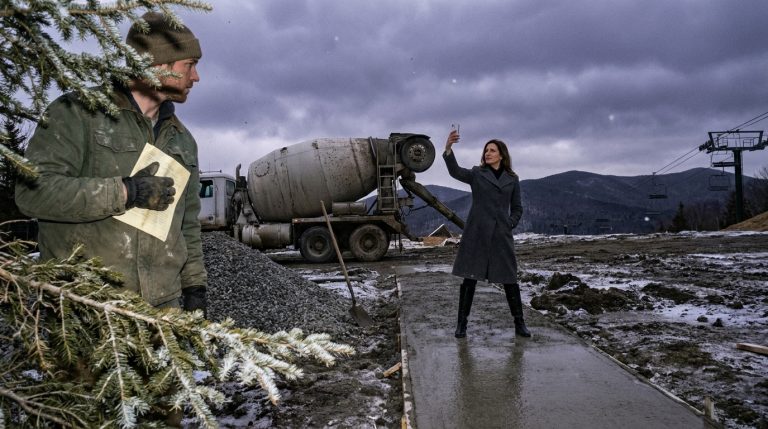
“Heads up, Blackwood,” Linda called out. Her voice was too loud for the valley, amplified by the rigid plastic of the brand-new yellow hard hat sitting high on her manicured hair. “Public safety doesn’t wait for your nostalgia. We have an infrastructure assessment to conduct, and your little footpath is the primary obstruction.”
Behind her, three commercial dump trucks sat in a rusted lineage, their air brakes hissing with a rhythmic, hostile patience. The lead truck was a Mack, its bed piled high with coarse river stone, its springs compressed until the iron leaves were nearly flat. Forty tons. I didn’t need a scale to know the math; thirty years of laying spans across the Continental Divide gives you an eye for density.
“The approach isn’t engineered for that axle weight, Linda,” I said, keeping my hands inside the pockets of my canvas work jacket to hide the cold sting of the limestone dust. “The bridge will hold. The earth beneath your feet won’t.”
She laughed, a short, dry sound that cut through the low rumble of the diesel engines. She lifted her clipboard, tapping a silver pen against a thick stack of cream-colored paper. “Section 12.4.7 of the community bylaws guarantees emergency vehicle access compliance. If a standard fire engine can’t cross, this structure is a certified hazard. These drivers are simply verifying the load limits.”
The driver of the lead Mack leaned his head out of the cab, his face weathered to the texture of old boot leather. He spat a dark stream of tobacco juice onto the fresh asphalt of the HOA’s beautified turnaround. “Lady,” he shouted over the engine drone, “the ground’s soft near the culvert. I can feel the left rear tires settling already.”
“Drive the vehicle, Mr. Vance,” Linda snapped, her real estate mask slipping just enough to show the hard, gray line of her jaw. “The structure is rated for traffic. If it fails, the liability is clear.”
I walked down the slight incline, my eyes fixed on the joint where the hand-hewn stone met the subdivision’s decorative paving. My grandfather had laid these foundations directly onto the granite shelf that choked the creek’s bend. He’d used lime mortar, a slow-curing mix that breathed with the seasons, absorbing the dampness without cracking. It was an elegant piece of engineering, designed to grow stronger as the weight of the years compressed the stones into a single, self-supporting arch.
But the road Linda’s association had built two years ago was a different matter. They’d cleared the native willows, dumped three feet of uncompacted fill dirt over the old marshy bottom, and skinned it with two inches of cheap binder course. It looked clean, it looked suburban, and right now, it was holding back three months of accumulated spring runoff like a sponge.
The Mack’s clutch engaged with a metallic clank that echoed off the limestone cottage behind me. The massive tires rotated once, twice, biting into the gravel before the front bumper cleared the transition line.
Then the ground gave way.
It wasn’t a sudden collapse; it was a slow, hydraulic displacement. A hair-line crack zipped through the neat black asphalt, widening into a finger’s breadth within seconds. The left front tire dipped, the heavy steel rim tilting three degrees to the port side as the saturated clay beneath the roadbed squeezed outward toward the creek bank like toothpaste from a tube.
“Hold it!” the driver yelled, throwing the transmission into reverse, but the weight was already committed. The truck didn’t move backward; it simply listed further into the mire, the massive aggregate bed leaning toward the rushing water of Willow Creek.
Linda didn’t drop her phone. She stepped closer, her designer heels sinking into the shifting silt of her own ruined road, her eyes wide as she recorded the tilting steel cab. “Look at this,” she muttered, her voice rising in a frantic pitch that was entirely unscripted. “The bridge approach is completely unstable. It’s pulling the road down.”
I walked over to the edge of the widening fracture, reaching down to pull a handful of the displaced earth from the tear in the asphalt. It was cold, slick with grey silt, and completely waterlogged. I let the mud drop back into the crack, wiping my palm against my jeans as I looked across the tilting hood of the truck directly into Linda’s eyes.
Nestled inside the fresh tear of the roadbed, half-buried in the wet clay, was a thick, black PVC conduit that hadn’t been there during the county inspection three days ago—and it wasn’t running toward my property.
CHAPTER 2: EXCAVATION OF THE LEDGER
“Don’t touch that, Blackwood,” Linda said, her voice dropping an octave into a hard, defensive rattle. The camera on her phone was down now, tilted toward the wet gravel as she stepped between me and the jagged lip of the fractured asphalt.
“Your road is bleeding plastic, Linda,” I said, gesturing to the thick sleeve of black PVC visible in the torn clay. The outer casing was scored by the shearing force of the aggregate truck’s descent, exposing thick, silver-shielded cabling nestled inside. It was buried less than twelve inches deep, insulated with nothing but cheap bedding sand. “This isn’t standard residential power. This looks like heavy-phase industrial transmission, and it’s heading directly toward the creek’s sub-surface bed.”
“It’s an HOA infrastructure upgrade,” she said, her chest rising and falling beneath her stiff safety vest. The perfume she wore was cloying, an artificial wall against the smell of ancient silt and raw diesel exhaust coming from the listing truck. “Approved by the board last autumn. It’s completely within our utility easement.”
“The board doesn’t have subsurface rights below the high-water mark,” I replied. The grit of the limestone dust on my hands ground against the plastic casing as I leaned over the edge to trace the angle of the pipe. It didn’t curve toward the neighborhood grid; it pointed straight like an arrow toward the deep, underwater pylons supporting the 1897 stone arch. “This canyon belongs to the county’s historic water basin. You can’t drill here without a federal hydrological clearance.”
“The truck needs a heavy wrecker, ma’am,” Vance broke in, slamming his cab door shut with a wet, heavy thud. He stood on the shifting embankment, his work boots sinking an inch into the gray clay with every step. “And I’m telling you right now, if that back axle shifts another two inches, the whole fuel tank is going to catch the edge of that stone wall and rupture. We need to clear the area.”
“Nobody is clearing anything until the surveyor logs the structural failure of this bridge,” Linda said, her face flushing a deep, blotchy crimson under the rim of her pristine yellow hat. She turned on her heel, her designer boots crunching viciously through the gravel as she marched toward the second dump truck in the line. “Vance, get your supervisor on the radio. Tell them we need Consolidated’s heavy recovery unit out here immediately.”
I didn’t stay to watch her argue. The friction in the air was thick, but the logic was simple: Linda wasn’t just arrogant; she was frantic. Real estate agents don’t bring forty-ton aggregate trucks to a historic site just to prove a point about mailbox heights or emergency access. They do it when a clock is ticking.
I crossed back over the stone arch, feeling the absolute vibration-free density of the limestone beneath my feet. The bridge wasn’t the problem; it was the anchor holding back a truth she needed gone. I walked past my cottage, taking the narrow, overgrown trail that wound down into the lower valley toward Eleanor Hendricks’s property.
The old mining office sat on the border where my three acres met her boundary—a low, rusted corrugated-iron shack that had survived the closing of the Millbrook shafts in the late fifties. The air inside smelled of dry rot, damp iron, and decades of dead pine needles. Eleanor was already there, sitting at a battered oak desk with a heavy brass desk lamp threw a yellow, institutional beam across three open ledger books.
“The Mack truck just dropped its left flank into the fill dirt,” I said, leaning against the door frame. My shoulder caught the rough orange flake of a rusted roof support. “Linda’s trying to call in Consolidated’s heavy crews to pull it out.”
“She’s running out of days, Arthur,” Eleanor said without looking up. Her fingers, spotted with age but steady as a draftsman’s hand, traced a column of figures in a faded blue logbook from 2024. “My late tech-bureaucrat of a husband didn’t just keep the minutes; he saved the municipal tax receipts for every parcel adjacent to Willow Creek. Look at the ledger for the third quarter.”
I walked over, the floorboards creaking under my weight with a dry, hollow snap. I leaned over her shoulder, my eyes following her pencil tip down the page.
The entries weren’t listed under the Willowbrook Heights Homeowners Association. They were registered to an entity called ‘Basin Hydrology Holdings LLC’—a shell company incorporated in Delaware with a registered agent address that matched the corporate headquarters of Consolidated Development Corporation. Every month for the last year and a half, the association had transferred exactly twelve thousand dollars out of the neighborhood’s reserve fund under the label “Sub-Surface Drainage Maintenance.”
“They aren’t maintaining anything, Eleanor,” I muttered, my mind running through the grade calculations of the creek bed. “The drainage for this entire sector runs north through the natural stone channels. There’s no municipal pipe down here.”
“There is now,” Eleanor said, pulling a folded sheet of vellum from the back pocket of the ledger. The paper was crisp, bearing the blue-line stamp of a land surveyor’s office, dated six months ago. It was a signed stop-work order from the state’s environmental protection division, but across the front, someone had stamped VACATED BY EXECUTIVE OVERSIGHT. “Linda didn’t just buy CDC stock, Arthur. She signed over the subsurface utility easement directly beneath your grandfather’s bridge pillars to Basin Holdings. They leased the dirt under your water right before you even moved back here.”
I took the vellum, the texture dry and chalky against my calloused fingertips. My eyes fixed on the engineering diagram at the bottom of the page. It showed a projected five-inch drill path passing straight through the ancient timber grillage that sat beneath the limestone bedrock foundation of my bridge.
The door to the shack groaned open, the rusted hinges screaming as the mountain wind pushed a spray of cold mist into the room. A silhouette stood against the grey morning light, holding a thick white envelope with the official seal of the County Sheriff’s office stamped in red ink across the adhesive seam.
“Mr. Blackwood?” a young voice called out, tight and unnatural against the roar of the diesel engines up the hill. “I have an emergency injunction here. You need to sign for it right now.”
CHAPTER 3: THE DECOY ORDER
The young courier didn’t step past the threshold. He stood with his collar turned up against the damp draft, his fingers twitching against the corners of the thick white envelope. The red ink of the emergency seal looked wet under the low morning light, catching the dull yellow glow of Eleanor’s desk lamp.
“Arthur Blackwood?” he asked again, his voice cracking slightly under the low hum of the idling diesels up the ridge. “I was told to find you here if you weren’t at the cottage. You need to initial the registry.”
I didn’t take the envelope. I reached out and took the clipboard from his hand instead, running my thumb along the metal hinge. The clip was rusted, leaving a orange smudge across my thumb. The signature line wasn’t standard county paperwork; the header read Ex Parte Emergency Restraint – Transverse Infrastructure Protection.
“Who filed the deposition?” I asked. My voice was low, flat, matching the steady friction of the water grinding over the stones outside.
“Linda Pemberton, acting as corporate representative for the Willowbrook Heights Infrastructure Committee and Basin Hydrology Holdings,” the kid recited, his eyes moving past my shoulder to the sprawling mess of old ledgers on Eleanor’s table. “They have an emergency structural variance. The court ordered an immediate freeze on all private interference within thirty feet of the creek centerline until the aggregate vehicle is recovered.”
Eleanor let out a sharp, rhythmic sound from the desk—a laugh that had no humor in it. “A freeze,” she muttered, her pencil snapping against the heavy oak wood. “She isn’t freezing the bridge, Arthur. She’s locking you out of the yard so the Consolidated crew can bring the drilling rigs past the property line under the guise of an emergency tow.”
I signed the line with a quick, hard stroke of the pen, leaving the ink to bleed into the cheap porous paper. I took the envelope, tearing the red seal apart with a clean pull. Inside, the documents didn’t detail a recovery plan. They contained a notarized copy of a subsurface lease agreement dated fourteen months prior, granting Basin Hydrology exclusive rights to “realign, reinforce, and stabilize the subterranean channels of Willow Creek Sector 4.”
“They’re using the stuck Mack as a legal anchor,” I said, turning the pages over to show Eleanor the engineering schematic attached to the back. “Look at the datum points. They aren’t trying to pull the truck back onto the road. They’ve designated the entire approach bank as an active construction zone. By noon, she’ll have a legal permit to drop a concrete pumper directly onto the old timber grillage to ‘stabilize the foundation’.”
The courier took his clipboard back, his boots crunching quickly through the dead pine needles as he backed away toward his sedan. He didn’t say another word; he knew the weight of what he’d just dropped into the room.
I walked to the small window of the shack, wiping a circle through the condensation and grease on the glass. Up the ridge, the silhouette of the lead aggregate truck had shifted again. The left rear axle was deep in the grey clay now, the iron leaf springs twisting under the unnatural torque of forty tons leaning at a twelve-degree angle. Linda was standing near the hood, her yellow hard hat gleaming through the rising mist as she pointed two men toward the old stone abutment. They weren’t carrying tow cables. They were carrying heavy pneumatic rotary drills.
“They’re going to pierce the bedrock before the county inspector can get back with the landmark injunction,” I said, my hand tightening against the rough wood of the window frame until a splinter bit into my palm. “She knows the landmark status doesn’t override an emergency public safety order if the ground is actively moving.”
“The ground is only moving because she filled the old marsh with uncompacted silt,” Eleanor said, rising from the desk with a stiff, deliberate movement. She picked up the old blue land survey from 1987, her fingers tapping the edge where the creek bed widened. “Look at the old mining discharge records, Arthur. This isn’t just about a shopping center. The volume of water they’re trying to divert through that five-inch PVC line matches the capacity of the old deep-level pump shafts from the lower mine. They aren’t draining the subdivision. They’re pulling something out from the deep rock.”
I looked down at the vellum schematic in my hand. The drill path didn’t just pass through my grandfather’s bridge pillars; it formed a loop, a closed circuit that dropped six hundred feet into the abandoned granite shafts before rising back to the surface. It was an industrial heat-exchange layout, or a high-pressure drainage loop.
The sound of air brakes hissed through the trees again, louder this time—a deep, rhythmic mechanical throb that vibrated through the floorboards of the shack. It wasn’t the sound of a standard recovery vehicle. It was the high-torque grunt of an industrial concrete pumper, its articulated steel boom rising over the treeline like a pale crane against the grey mountain sky.
“She’s skipped the heavy wrecker,” I said, my mind calculating the weight distribution of the concrete truck. Sixty tons minimum when loaded, with a concentrated footprint that would hit the saturated approach road exactly where the clay had already liquified. “She’s going to pour the slurry straight into the fracture to seal the PVC line before anyone can trace where it leads.”
I turned toward the door, the cold air hitting my face as I stepped back into the mist. My grandfather had built the bridge to stand against the highest water the canyon could give, but he’d built it on the assumption that the mountain itself would stay steady. If Linda dropped sixty tons of wet cement into the saturated silt above the bedrock, the hydraulic pressure would blow the lime mortar right out from between the limestone blocks.
“Arthur,” Eleanor called out from the dark interior of the shack, her voice steady but thin. “The state stop-work order was vacated by a signature from the Department of Natural Resources, not the court. Someone paid for that pen.”
“I don’t care who signed the paper,” I said, my boots digging into the wet gravel as I started up the steep trail toward the bridge. “The laws of soil mechanics don’t take bribes, and that pumper is about to set its outriggers on four feet of liquid mud.”
As I cleared the treeline, the massive white truck was already backing into position, its hydraulic stabilizers extending like insect legs toward the jagged tear in the asphalt. Linda stood right beneath the boom, her silver pen pointing toward the ancient stone arch.
CHAPTER 4: THE SATURATED CORE
The steel outriggers of the concrete pumper truck slid down with a deafening hydraulic screech, their heavy iron pads punching through the wild mint along the bank. The ground didn’t merely compress; it shuddered. From where I stood at the edge of the granite shelf, I could see the grey silt bubbling upward through the gaps in the crushed stone, a clear sign that the water table had completely breached the upper soil boundaries.
“Arthur, get back behind the barrier line!” Linda yelled over the rising hum of the pumper’s secondary engine. She was holding the emergency court order like a shield, her voice cutting through the thick smell of warm oil and wet clay. “This is an active reinforcement zone now. Any interference makes you legally liable for the loss of the transport vehicle.”
“You’re setting your stabilizer pads on four feet of liquefiable silt, Linda,” I said, my voice steady against the vibrating iron of the truck’s chassis. I pointed beneath the rear axle, where the outrigger plate was already tilting toward the creek bed. “The bedrock is ten feet down, but the fill dirt you dumped here has zero sheer strength. The moment that boom extends over the arch, the center of gravity shifts, and the hydraulic fluid won’t hold the pressure.”
The pumper operator, a burly guy with a grease-stained cap, hesitated with his hands resting on the remote control box strapped to his chest. He looked at the bubbling gray mud around his rear stabilizers, then back to the limestone bridge. “Ma’am, the gent has a point. This ground is soup. I can’t guarantee the vehicle’s level indicator stays in the green if I swing the boom full extension.”
“Pour the slurry,” Linda ordered, her face taut, the skin around her eyes turning a brittle, paper-thin white. “The structural variance covers the placement. If the road shifts, we fill the road. Just open the line.”
I didn’t argue further with her. Arrogance has its own momentum, and physics doesn’t negotiate with a court order. I dropped down the embankment, the rough weeds tearing at my canvas jacket as I crawled beneath the stone arch itself. The air here was colder, smelling of mineral deposits, old dampness, and something metallic—sharp, synthetic, and completely out of place.
Running my fingers along the bottom joint of the limestone foundation, I felt a high-frequency vibration that wasn’t coming from the truck engines above. It was inside the stone. I traced the seam down to the waterline, where the ancient timber grillage met the bedrock. A dark, oily film was seeping directly out of the stone joints, swirling into the clear water of Willow Creek.
It wasn’t diesel fuel. It was an industrial chemical compound, thick and pungent enough to sting the back of my throat. The black PVC line I’d seen earlier wasn’t a standard conduit for power or drainage; it was an active extraction conduit tapping into the deep, flooded shafts of the old mining complex beneath my property. The bridge foundation hadn’t been an obstacle to a retail development; it was being used as a structural anchor to secretly drill into a toxic storage pocket that had been sealed since 1954.
Above my head, a loud crack echoed through the canyon—the sound of overstressed structural steel.
The pumper truck’s articulated boom swung outward, its fifty-foot reach extending toward the center of the stone arch. The moment the weight shifted past the axis of the chassis, the left rear outrigger didn’t just sink; it punched cleanly through the asphalt skin, disappearing into the liquid clay up to the hydraulic cylinder.
“The line’s going down!” the operator screamed, hitting the emergency kill switch, but the kinetic force of sixty tons shifting on an unstable pivot was already locked into a consequence loop. The entire rear of the massive white vehicle tilted toward the creek bank, its tires spinning uselessly in the gray mud as the front wheels lifted off the ground.
“Arthur!” Eleanor’s voice came from the top of the trail, sharp and frantic.
I scrambled out from beneath the stone arch just as the first spray of pressurized slurry blew out from a ruptured hose coupling, coating the limestone cottages and the wild columbine in a thick, gray layer of quick-drying cement. The truck was listing at fifteen degrees now, its steel boom swinging wildly like a broken limb, the tip scraping a deep, white scar across the ancient stonework of my grandfather’s masterpiece.
I didn’t look at Linda. I ran toward the manual water diversion gate fifty feet upstream—the old iron sluice my grandfather used to regulate the creek overflow during the spring thaws. The wheel was rusted, the iron pitted with deep pits of oxidation that bit into the skin of my palms as I threw my weight against the gears.
If I couldn’t stop the truck from falling, I had to drop the water level before the hydraulic impact split the bedrock beneath the grillage. But the valve wouldn’t budge. The main pin was jammed tight by a wedge of fresh, unweathered limestone gravel that had been dumped into the channel from the road above. Someone had intentionally blocked the overflow.
The mechanical thunder from behind me reached a splitting crescendo as the main hydraulic line on the pumper truck blew, sending a geyser of red oil forty feet into the misty morning sky.
CHAPTER 5: THE FINAL SETTLEMENT
The air did not just carry sound; it carried the physical compression of over-pressurized steel giving way. The second outrigger on the concrete pumper snapped with a sharp, metallic percussion that felt like a localized atmospheric drop. I let go of the jammed sluice wheel, my palms raw and silvered with grey zinc flecks from the handles, and hit the gravel bed just as sixty tons of high-tensile industrial machinery crossed its terminal tipping point.
Time didn’t speed up; it elongated into the precise, mathematical intervals of a structural collapse. I watched the pale white hydraulic boom slice down through the damp canyon mist, its articulated joints groaning as the fluid inside reached thousands of pounds per square inch. The steel tip collided with the crown of my grandfather’s arch. 1897 hand-cut limestone met modern reinforced plate.
There was no explosion of stone. There was only a deep, vibrating hum that traveled down through the granite shelf into the soles of my boots. The lime mortar—yielding, patient, and packed under a century of compression—did exactly what it was engineered to do. It absorbed the kinetic shock wave, transmitting the downward force laterally into the bedrock abutments. The stone remained. The boom didn’t. The front section of the steel lattice buckled like wet cardboard, the internal high-pressure lines bursting to discharge a thick, grey torrent of heavy aggregate slurry directly down into the marshy roadbed below.
“Get out!” the operator screamed, dropping his remote control harness onto the tilting deck as he scrambled clear of the rising cab. The truck’s front tires were eight feet in the air now, pointing toward the grey mountain sky like the limbs of a dying mechanical beast.
Linda Pemberton didn’t run. She stood paralyzed on the fractured edge of her own association’s roadwork, her hands frozen around the leather trim of her clipboard. Her yellow hard hat had tumbled into the grey clay, exposing her hair to the spray of hydraulic oil and liquid cement that hung like an industrial fog across the creek bed. Beneath her feet, the two-inch binder course of asphalt was lifting in a single, massive sheet, riding the wave of displaced subsoil as sixty tons of truck settled into its final, permanent home in the muck.
The truck didn’t fall into the creek; it sank into the artificial swamp Linda’s contractors had laid down to hide the excavation. The rear axles disappeared entirely within twelve seconds, the heavy chrome rims grinding down through the cheap fill dirt until they hit the black PVC line we’d discovered an hour before.
The weight did what no county inspector could have accomplished. It crushed the thick industrial pipe, fracturing the silver-shielded transmission casing underneath.
A high-pressure geyser erupted from the tear—not water, but a viscous, dark-amber fluid that reeked of chemical oxidizers and deep-level mining leachate. The force of the rupture blew the grey clay clear, exposing the sheer scale of the diversion. It wasn’t an infrastructure upgrade for a housing development. The line was an illegal siphon tap, drawing highly toxic, unregulated industrial runoff out from the deep, flooded shafts of the closed Millbrook mines and using the natural gravel filtration of the creek bed under my property to dilute the evidence before it hit the municipal reservoir intake two miles downstream.
The commercial development wasn’t the goal; the development was the legal shield to acquire the land and bury the extraction loop under twenty feet of retail parking lot foundation.
Linda’s clipboard slipped from her fingers, landing flat in the amber sludge that was now bubbling around her designer boots. Her eyes were fixed on the black pipe, where the corporate stencil of the Consolidated Development Corporation was clearly visible beneath the grease. The moral logic of her eight-year presidency—the manicuring of lawns, the enforcing of uniform beige siding, the systematic clearing of elderly residents who couldn’t pay the arbitrary fines—shattered in the face of the gray silt and chemical runoff. It hadn’t been about community standards. It had been about keeping the property values high enough and the neighbors quiet enough to ensure the drill bits could turn without notice.
“Arthur,” she whispered, her voice stripped of its bureaucratic authority, sounding thin and dry against the hiss of escaping air from the truck’s broken brake lines. “The county engineers… they said the soil stability was verified. They signed the clearance.”
“The clearance was based on an empty road, Linda,” I said, my boots crunching through the aggregate slurry as I stepped onto the stone arch. The limestone beneath my feet didn’t move an eighth of an inch; it stood cold, heavy, and immovable against the mechanical wreckage leaning against its flank. “You brought sixty tons of pressure to a site held together by optimism and bribery. Physics doesn’t check the signature on a county permit.”
Eleanor Hendricks walked up the path from the old mining office, her face calm, her fingers holding her phone up to capture the definitive layout of the cracked line and the amber fluid filling the trench. Behind her, the distant wail of emergency sirens began to echo off the canyon walls—the county inspector had finally returned, and he hadn’t come alone.
I leaned against the parapet of my grandfather’s bridge, feeling the rough, cold texture of the stone through my torn gloves. The oil film on the water was already clearing as the pressure in the fractured pipe died down, the natural current of Willow Creek washing the residue away from the granite shelf. The bridge had taken the blow, held its ground, and forced the machine to destroy itself on its own overreach. Sometimes, the oldest engineering is still the smartest engineering, not because it fights the weight of the world, but because it knows exactly where to put it.