Salt-Caked Iron and Midnight Steel: The Weary Captains Who Forged the Deadliest Strike Force in the Channel
CHAPTER 1: IRON AND ASHES
The cold grease on the binnacle ring smeared against my thumb as the bulkhead shuddered. Down in the wardroom, the tea mugs were already sliding across the scarred oak table before the anchor watch even finished pouring.
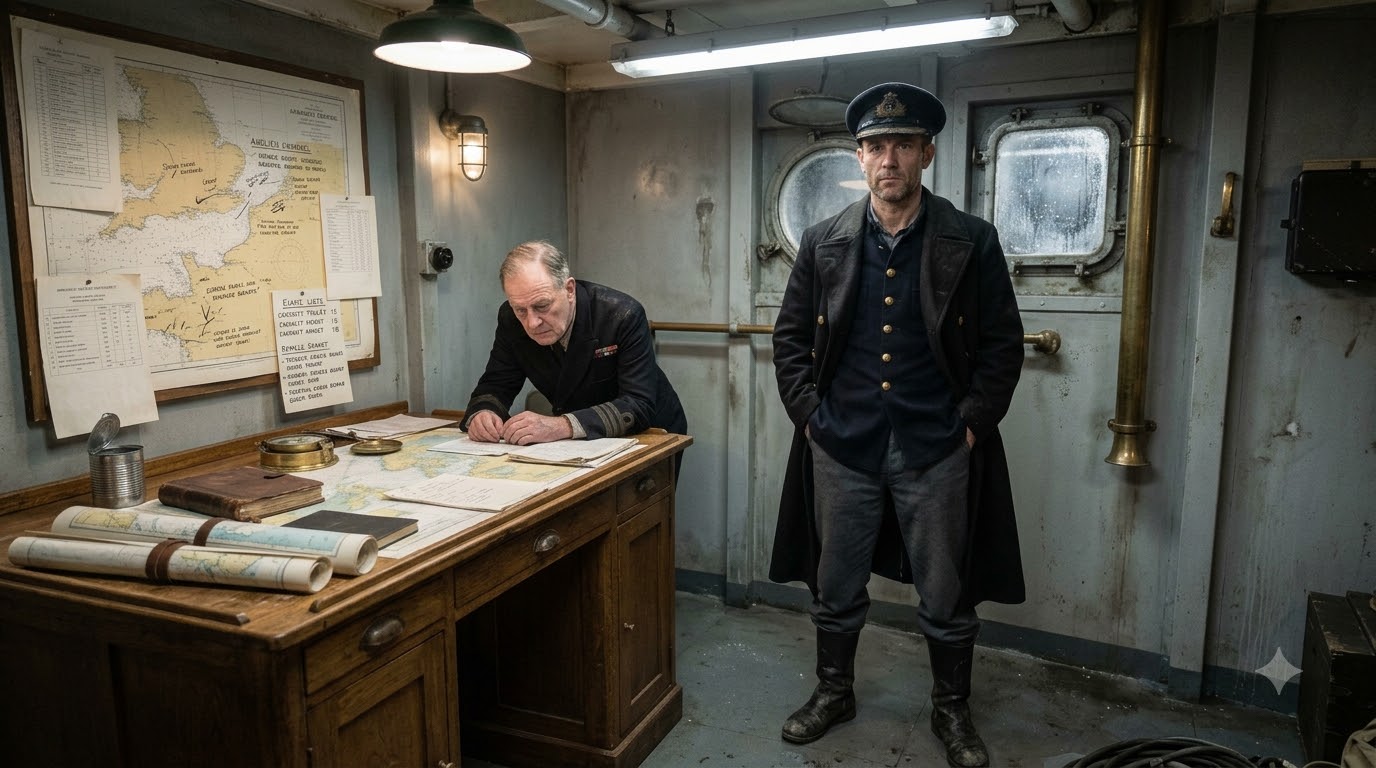
Admiral Leatham didn’t look up when the heavy oak door banged against the stop. He just stared at the greasy grease-pencil marks smeared across the Admiralty chart of the Channel.
“They called it a balanced force,” Leatham muttered, his voice raspy with cheap tobacco and two days without sleep. “A cruiser and six assorted tin cans. Look at the paper work, Commander. It looked magnificent in Whitehall.”
I dropped the fresh casualty tallies onto the corner of the desk. The paper was damp from the spray coming off the quarterdeck.
“Paper doesn’t float when a torpedo opens the boiler room,” I said, rubbing a hand over my stubbled jaw.
“No, it doesn’t,” Leatham said, finally lifting his head. His eyes were bloodshot, fixed on the empty coffee mug sitting beside the fuel manifests. “The Germans aren’t playing gentleman chess out there in the dark. They wait until the tide turns, they use the rocks as radar shadows, and they dump steel into our hulls while our ships are still trying to form a proper line.”
Outside, the wind whipped salt spray across the window glass with a flat, rhythmic rattle. There were no intelligence briefs coming down the line tonight. We were entirely blind, relying on whatever greasy scrap of coal dust and engine smoke we could sniff out ourselves.
Leatham tapped a scarred finger against the margin of the disaster report. “We are done asking permission for sensible formations. Get the repair gangs onto the Tribals. If the high-ups in London want to complain about protocol, they can come down here and explain it to the widows.”
CHAPTER 2: GATHERING THE Rusted Hounds
The dock at Plymouth smelled of wet coal, damp canvas, and the sharp, chemical tang of fresh welds.
The Tribal-class destroyers lined up along the quay looked less like crown warships and more like iron scavengers that had barely dragged themselves home from a graveyard.
Chief Engineer Miller wiped a black smudge across his forehead, leaving a greasy streak right above his left eyebrow.
“The Eskimo’s bow looks like she tried to bite a cliff,” Miller muttered, pointing a heavy wrench toward the scarred forward plates. “And don’t look at the Tartar’s rudder unless you want a migraine. The pins are worn down to the width of a sixpence.”
I jammed my hands deeper into the pockets of my canvas coat to keep the biting North Atlantic draft from freezing my knuckles.
“Patch her up with whatever scrap iron is lying behind the drydock,” I said. “We aren’t waiting for a pristine yard allocation from Whitehall.”
Miller spat a dark stream of tobacco juice onto the wet timber planking. “Whitehall thinks we’re running a parade ground out here. They don’t hear the way those turbine bearings howl when you push past twenty knots in the pitch black.”
A sharp, rhythmic tapping echoed from the hull of the Ashanti as a rating hammered a fresh patch over a shrapnel scar.
Every ship assigned to us was a floating collection of compromises, held together by stubborn pride and quick-drying red lead.
“Just make sure the boilers hold steam,” I said, turning away from the gray, churning water of the slipway. “The Germans aren’t waiting for our refit schedule to clear.”
CHAPTER 3: NIGHT WATER DRILLS
The telegraph clanged twice, sending a sharp mechanical shock straight up through the deck plates into my boots.
Chief Engineer Miller was down in the bowels of the ship right now, swearing at a stubborn condenser tube while freezing spray washed over the open bridge wings.
“Keep her steady on zero-four-zero,” I shouted over the screaming gale, wiping a film of greasy sea-salt off the binnacle glass.
The helmsman’s knuckles were white against the wooden spokes, his teeth clenched tight as another wall of black water smashed into the forward breakwater.
We didn’t have the luxury of clear skies or reliable shore beacons to tell us where the shoals ended and the deep channel began.
Every night maneuver was a calculated gamble against broken machinery, exhausted crews, and the bitter reality of operating completely blind in the dark.
“If the bearings hold another hour, we might actually make port without snapping a shaft,” the executive officer muttered, coughing into the raw collar of his wool coat.
“They’ll hold because they have to,” I said, squinting into the impenetrable blackness ahead where the French coastline loomed like a jagged wall of teeth.
CHAPTER 4: FIRST BLOOD IN THE DARK
The green sweep rotated slowly across the PPI scope, painting a jagged coastline and two tiny, moving targets hugging the shallow rocks.
“They’re laying mines in the approach channel,” the radar officer muttered, his fingers tightening around the edge of the rubber viewer hood.
“Hard a-starboard,” I said, leaning over the binnacle to watch the wake churn white against the black water.
The Ashanti surged forward, her turbines whining with a high-pitched metallic shriek that vibrated straight through the steel deck plates.
We didn’t have the luxury of shore radar stations or central command telling us what maneuvers to execute.
We had to read the dark water ourselves, calculating every yard between our hull and the jagged teeth of the French reef.
“Target bearing zero-one-two,” the gunnery officer reported, his breath frosting in the damp night air.
“Light them up,” I said, gripping the brass handrail as the first star shell roared skyward.
CHAPTER 5: BREAKING THE LINE
The old textbook maneuvers dictated a neat, single-file column through the dark, but neat columns only made a convenient target for waiting shore batteries.
“Shift to line of breast,” I shouted, wrenching the voicepipe closer to my mouth.
The ship shuddered violently as all four forward guns swung around in unison, locking their sights onto the fleeing shapes hugging the shallows.
We weren’t relying on distant headquarters or delayed intelligence tonight; every captain had to read the gun flashes and judge the distance by eye.
“Keep those forward mounts firing,” the gunnery officer yelled, wiping sweat and soot from his forehead despite the freezing air.
The entire port bow erupted in blinding orange fire as the full forward broadside tore into the night, rattling every rivet in the bulkhead.
We closed the gap relentlessly, ignoring the cold spray and the sickening roll of the deck as the enemy tried to slip back into the rocky maze.
CHAPTER 6: THE VENGEFUL FLAK
The sinking torpedo boat had her rudder torn away, but someone down in her blasted hull refused to quit swinging.
A twenty-millimeter autocannon raked across our forward superstructure, spitting hot steel against the armor plates with a harsh, rhythmic tearing sound.
“They’re firing blind from the water level,” the gunnery officer shouted, ducking behind the bridge windbreak as fragments of timber and paint chipped off the rail.
We didn’t have the luxury of standing back and waiting for them to surrender gracefully; they had chosen to double down right to the bottom.
“Give them the rest of the main battery,” I said, my jaw locked tight as the vibration shook the deck plates beneath my boots.
The heavy guns roared in unison, answering the petty defiance with an overwhelming wall of iron that flattened the remaining superstructure into silence.
The water boiled white around the wreckage as it slipped beneath the surface, leaving behind nothing but floating timber and a heavy, acrid reek of oil.
CHAPTER 7: THE TORPEDO TRAP
The dark water off the port beam suddenly fractured into a pale, frothing line of white wakes cutting straight through the swells.
“Torpedoes running deep and fast,” the first lieutenant shouted, his voice cracking against the wind as he hauled hard on the engine telegraphs.
We didn’t have the luxury of shore intelligence to warn us about hidden traps laid by the survivors of the previous night’s clash.
“Put the helm hard over,” I said, slamming my palms against the freezing brass binnacle ring as the ship shuddered under a violent turn.
The deck listed sharply to starboard, sending loose shell cases clattering across the steel plates while the icy spray washed completely over the bridge screen.
We swung directly toward the incoming tracks, presenting the narrowest possible profile to the invisible menace lurking beneath the surface.
A deafening detonation echoed across the dark channel moments later as one of the iron fish found its mark against a sister ship’s plates.
CHAPTER 8: NINETEEN HOURS ADRIFT
The engine housing rattled with a dry, metallic whine that threatened to shake the pistons right out of their mountings.
“Keep her head into the swells,” the motor mechanic shouted, wiping black grease across a stubbled cheek while oil pressure dropped toward zero.
We didn’t have the luxury of shore communications or a friendly escort to guide us through forty miles of hostile channel water.
“We stop for repairs, the coastal batteries find us before nightfall,” I said, gripping the wet wooden gunwale as spray slammed across the bow.
Every yard of open water was a grueling battle against fatigue, freezing spray, and the persistent hum of enemy patrol craft hunting the wreckage.
“Check the reserve fuel tins,” the mechanic muttered, coughing against the biting exhaust fumes.
“Just keep the shaft turning,” I answered, eyes locked on the gray horizon where the next wave rolled down.
CHAPTER 9: REWRITING THE PLAYBOOK
The old doctrine of sailing in a single, rigid line ahead had nearly cost us half our hulls in the previous engagements.
“Every time we charge in a straight column, the trailing ships are masked by smoke and dead reckoning,” Jones said, pressing a scarred thumb against the French coastal boundary.
We didn’t have the luxury of waiting for Whitehall to approve new rulebooks while enemy torpedo boats exploited our formation gaps.
“We shift to line of breast the second contact is made,” I said, tapping the edge of the chart with a heavy brass dividers tool.
The lamp above the table swung lazily with the roll of the ship, casting long, shifting shadows across the tired faces of the gathered officers.
Every captain in the flotilla knew the risk; opening the line wide meant trusting each vessel to manage its own radar and gun bearings independently.
“If the boys up front can’t see through the cordite smoke, the second division has to step straight into the gap,” Jones muttered, his eyes sharp and unyielding.
CHAPTER 10: THE SHERBOURG GAUNTLET
The glowing green sweep on the PPI scope didn’t just show single torpedo boats tonight; it painted the heavy silhouettes of Narvik-class destroyers cutting hard north.
“They’re sorting out from Sherbourg to clear the transport lanes,” the radar officer reported, his knuckles whitening against the rubber edge of the scope housing.
“Sound general quarters,” I said, dropping the navigational dividers onto the chart table with a sharp metallic clatter.
The claxon wailed through the damp steel passageways, sending boots pounding up the vertical ladders as every man scrambled to his station in the freezing dark.
We didn’t have shore-based intelligence to confirm their exact payload or speed; we only had the hard, brutal closure rate ticking down on our screens.
“Division split as planned,” Commander Jones signaled from the lead ship, his voice breaking through the static of the tactical radio link.
The night air outside turned instantly electric as the first flash of German gunfire flickered against the low-hanging clouds over the channel horizon.
CHAPTER 11: RAMMING SPEED CHAOS
Flames leaped from the forward signal housing like a jagged banner, bathing the smoke-choked deck in a harsh, flickering orange glare.
“They’re trying to clear our bridge with heavy caliber fire,” the executive officer shouted, spitting glass splinters from his lips as he slammed down on the emergency telegraph.
We didn’t have the luxury of calling for shore reinforcements or waiting for central intelligence to bail us out of the trap.
“Keep her bows locked straight on their wake,” I said, wiping a smear of hot grease and soot from my eyes as the deck heaved violently under our boots.
The enemy captain refused to yield, doubling down with frantic, desperate counter-measures that spat wild fire across the dark swells.
Every yard of closing water was an agonizing test of grit and endurance, forcing our scarred hulls right into the teeth of the burning wreckage.
“Hard a-starboard,” I roared against the screech of tearing iron, driving our bow directly into their line of retreat with unyielding resolve.
CHAPTER 12: THE DUSTY GRAY MORNING
The fires along the forward gun tubs had finally burned down to a dull, hissing smolder, leaving black streaks across the gray steel plates.
“The channel is clear,” the executive officer reported, his voice flat and raspy as he leaned against the scarred binnacle stand.
We didn’t need Whitehall to send down fancy commendations or paperwork to tell us what we had survived out here in the dark.
“Secure the main battery,” I said, wiping a thick layer of soot and dried salt off my wrist with a greasy rag.
The engine room telegraph hummed softly as the turbines settled down from flank speed into a steady, rhythmic idle that rattled the damp floorboards beneath our boots.
Every bulkhead on the ship bore the deep, jagged scars of close-quarters friction, reminding us of the heavy price paid to keep the transport lanes open.
I set the heavy brass tool down on the chart table, walked out onto the open bridge wing, and watched the cold morning spray wash quietly over the anchor chains.