The Steel Perimeter: One Grieving Engineer’s Calculated Dismantling of a Suburban Tyrant’s Criminal Empire
CHAPTER 1: THE TENSION OF CONCRETE
The Arizona sun hit the Desert Willow Drive pavement like a hammer against an anvil. It was 6:30 a.m., the hour when the desert usually breathed a sigh of relief before the heat turned predatory. But the silence didn’t last. The diesel roar of a white Escalade shattered the stillness, an aggressive, guttural sound that had become the soundtrack to my stolen retirement.
I stood in my garage, hands slick with the black, familiar grease of Elena’s ’67 Mustang carburetor. My hands were steady, even as my blood pressure spiked. I didn’t rush outside. I waited.
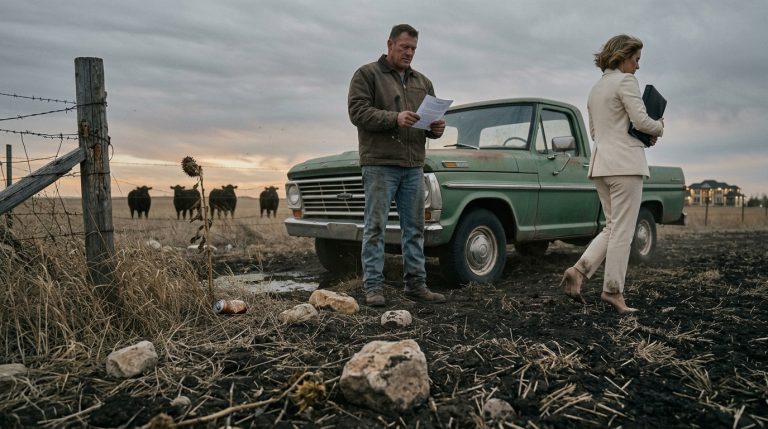
The driver’s side door slammed—a sharp, percussive sound that echoed off the dry desert rocks. Brenda Kilpatrick strutted toward the garage, her designer athleisure looking as out of place as her sense of entitlement. She held a manila folder like a weapon, her fake-blonde highlights catching the brutal morning light. She didn’t look at the Mustang; she looked at the driveway, her eyes tracing lines that only existed in her forged surveys.
“Marcus,” she called out, her voice a shrill probe. “You’re in violation again. My survey shows you’re encroaching three feet onto municipal land. The city doesn’t appreciate obstruction.”
I wiped a rag over my knuckles, feeling the familiar weight of my engineering calipers in my pocket. I stepped out of the garage, moving slowly, deliberately. The heat already radiated off the concrete, but the cold, clinical logic of my trade was the only thing keeping me upright.
“Brenda,” I said, my voice quiet, cutting through the hum of the morning. “I have the original 1987 site plans. I have the county deed. You’re holding a document from a home printer.”
She didn’t flinch. She leaned in, her perfume—a cloying, cheap floral—mixing with the dry, baked dust of the desert, choking me more than the heat. “The city records were updated, honey. Municipal law supersedes your little hobby plans. You have thirty days to surrender the land, or I’ll ensure the city forces a demolition.”
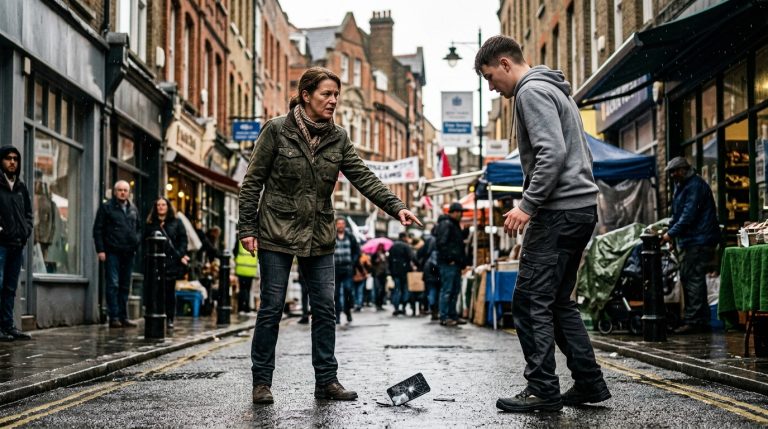
She turned, her heels clicking against the concrete like gunshots, and walked toward the curb. She pulled a bright orange sticker from her folder—a fake municipal violation notice—and slapped it across my garage door. It stuck there, a gaudy, synthetic insult against the aged wood.
She walked back to her Escalade, a smirk pulling at the corners of her mouth, and climbed in. As the engine rumbled, I looked down at the orange sticker. My heart wasn’t racing with fear; it was calculating. She thought she was dealing with a grieving widower, a man weakened by loss and retirement. She didn’t realize that for thirty years, I didn’t just build structures—I built systems designed to outlast tyrants.
As the Escalade peeled away, I caught a glimpse of her face in the side mirror. It was the face of someone who had never once considered the possibility that she might be wrong. And that, I realized, was going to be her final, fatal error.
CHAPTER 2: THE ARCHIVE OF LIES
“Property line disputes aren’t solved with orange stickers, Brenda. They’re solved with geometry.”
I didn’t wait for her to respond. I turned my back on her, the sticker’s adhesive tacky against the wood of the garage, and walked toward the house. My pulse was a steady, rhythmic thrum—the heartbeat of a man who spent three decades making sure bridges didn’t collapse under the weight of heavy traffic.
Behind me, the Escalade’s engine idled, a low, mechanical growl that vibrated through the soles of my boots. I heard her heels click once, twice, then stop. She was waiting for me to panic. She was waiting for me to argue, to plead, to ask for a “settlement” that involved me moving out. I walked into the kitchen, the cool air inside a jarring contrast to the desert furnace outside, and went straight to the kitchen table.
It looked like the briefing room of a construction project. I’d cleared off the mail, the bills, and the stray photos of Elena. In their place were rolls of architectural blueprints, yellowed survey maps from 1987, and my own high-precision drafting tools.
I sat down, pulled the latest violation notice off the garage door—I’d peeled it away just before coming in—and laid it out under the harsh, fluorescent glow of the overhead light.
I took out my jeweler’s loupe.
“Amateur,” I whispered to the empty house.
The font was close, but it wasn’t the standard municipal typeface used by Pima County. The kerning was slightly off, and the seal—a watermarked stamp that was supposed to represent the city’s legitimacy—was a pixelated blur under the magnification. It was a digital composite, printed on a high-end laser printer. Someone with too much arrogance and not enough technical oversight had drafted this.
I reached for the county survey, the real one, the one that had been filed and certified when the development was built. I spread it out, the paper crisp and familiar. I grabbed my ruler, the steel edge cold and grounding, and began to map the coordinates.
Three feet? If she was claiming three feet of my driveway was public property, she was asserting a claim that would effectively cut off the entrance to my garage entirely. It wasn’t just a nuisance. It was a physical impossibility based on the original site plan.
My engineering mind began to race, not with anger, but with the cold, hard logic of a diagnostic. If she was falsifying a survey, she wasn’t just bullying me. She was committing a crime. And if she was committing a crime to get this property, it meant there was a profit motive.
I stood up and walked to the wall where I’d pinned a map of Siguaro Springs. My neighbor, Mrs. Patterson, lived three doors down. She’d sold her house suddenly two years ago. The Martinez family, the young couple, had left in the middle of the night.
The pattern wasn’t just an annoyance; it was an infrastructure of theft.
I grabbed my keys. The sun was dipping lower, casting long, sharp shadows across the neighborhood—shadows that felt like bars. I needed to see Patricia at the county recorder’s office. She was the one constant in a landscape of shifting, fake boundaries.
As I walked out to my truck, I glanced back at the driveway. The spot where Elena’s Mustang sat, covered in its tarp, seemed smaller, squeezed by the encroaching pressure of Brenda’s ambition. I didn’t see a driveway anymore. I saw a line in the sand.
The drive into Tucson was a slow crawl through a desert landscape turned industrial. My mind didn’t wander. I kept replaying the interaction with Brenda. The way her sunglasses hadn’t just shielded her eyes; they had served as a barrier, reflecting my own world back at me, distorted. She hadn’t been looking at me. She had been looking at the property as a liquid asset, something to be drained, re-routed, and sold.
When I finally reached the county recorder’s office, the air smelled like old paper and the stale, bitter scent of government coffee. It was the scent of truth.
Patricia looked up from her computer, her silver hair pulled back in a severe bun. She recognized me before I even reached the counter. We’d worked together years ago on the permit filings for the local school expansion.
“Marcus,” she said, her voice dry but not unkind. “You look like you’ve been fighting a war.”
“I have,” I said, sliding the fake orange violation sticker across the counter. “I need to know if this is a municipal document. And then I need to know everything you have on the last five property sales on Desert Willow Drive.”
She picked up the sticker, squinting. She didn’t need a loupe. She just touched the paper and gave a small, sharp sniff of disdain.
“This? This is a joke, Marcus. The city doesn’t use adhesive stickers for property enforcement. They use certified mail, registered letters, and a mountain of legal briefs.” She flipped it over and looked at the back. “This is nothing.”
“Check the survey files for my house,” I insisted. “And look for the names Patterson, Martinez, Thompson, and Johnson.”
Patricia’s eyes darkened. She turned back to her terminal, her fingers flying across the keys with the practiced efficiency of a woman who had seen the worst of human nature buried in government files.
“You’re not the first to ask about those families, Marcus,” she said, her voice dropping to a whisper. She pulled a series of files, stacking them one by one. The thud of the paper on the counter sounded like a gavel. “You want to know what’s happening? It’s not a municipal dispute. It’s a systematic evacuation.”
She leaned in, her gaze meeting mine, and for a second, the office fell silent. The air felt heavy, charged with the weight of the secrets she was about to spill.
“Brenda Kilpatrick isn’t just an HOA president, Marcus,” she said. “She’s an architect of panic.”
CHAPTER 3: THE FORGED FRONT
“Mr. Weatherbe, you are out of order. This is a closed board session regarding municipal compliance, not a public hearing.”
Brenda sat at the head of the mahogany table, her designer blazer pristine, her posture radiating the rigid, false authority of a dictator. She looked at me not with anger, but with the weary impatience one might reserve for a troublesome stray dog. Beside her sat Janet, the retired teacher, who looked like she’d rather be anywhere else, and Phil, the bank manager, whose eyes were fixed intensely on his tablet.
I didn’t sit. I kept my hand on the back of the conference chair, feeling the cool, polished wood. I had the certified county survey in my hand, the document heavy, thick, and smelling of the official truth I’d extracted from Patricia’s archives.
“This meeting is about my property, Brenda,” I said, my voice steady, stripped of the emotional exhaustion that had been clawing at me for weeks. “And according to the county, my property doesn’t have a compliance issue. It has a forgery issue.”
The silence in the room wasn’t just quiet; it was pressurized. Brenda’s hand, resting on her clipboard, didn’t twitch, but the slight tightening around her jawline gave her away.
“I don’t know what fairy tales you’ve been collecting down at the recorder’s office,” Brenda said, her smile not reaching her eyes. “But we are operating under the authority granted by the city’s revised municipal zoning mandate. Phil, would you care to confirm?”
Phil looked up from his tablet. He looked tired. He looked like a man who spent his days reconciling ledgers that didn’t want to balance. “The board has received documentation regarding the encroachment,” he said, his voice flat. He didn’t look at me. He looked at the wall behind my shoulder. “If the city deems it a public thoroughfare, the board has the obligation to enforce it.”
“The city didn’t deem it anything,” I said, stepping forward. I placed the certified survey on the table. It landed with a sharp thwack. “This is the original 1987 survey. It’s signed, stamped, and verified. Brenda’s survey—the one she’s been using to bully neighbors into ‘panic sales’—is a forgery.”
I watched Janet. Her head snapped toward Brenda, her eyes narrowing as she scrutinized the documents on the table. She was a teacher; she knew the difference between a legitimate assignment and a plagiarized cheat sheet. She reached out, pulling my survey toward her, and began to compare it to the map Brenda had been waving around for the past twenty minutes.
“Brenda,” Janet said, her voice slow, precise. “Where exactly did you get this map? The font for the municipal seal here… it doesn’t match the standard ordinance template.”
Brenda didn’t miss a beat. She stood up, smoothing her blazer, her movements as controlled as a practiced actress. “The city provided it during the last community infrastructure update. If you’re going to question the board’s access to government records, Janet, I suggest you take it up with the city council. In the meantime, Marcus is trespassing.”
“I’m a homeowner,” I countered, my eyes locking onto hers. “And I’m a civil engineer. I spent thirty years looking at blueprints. I can spot an amateur design a mile away, and this? This isn’t a zoning issue. It’s a creative writing exercise.”
I looked over at Phil. “You work in banking, Phil. You handle loans, property equity, the reality of what a house is worth. How do you reconcile your signature on this?”
Phil finally looked at me. His gaze was sharp, transactional, and for a fleeting second, I saw a flicker of something—not guilt, but a profound, hollow fear. He looked back down at his tablet and tapped the screen twice. “I’m just reviewing the board’s financial disclosures, Marcus. I don’t set the property lines.”
“But you help set the prices,” I said, the realization hitting me like a physical blow. “That’s the game, isn’t it? Fabricate a problem, crash the property value, and have someone waiting in the wings to buy the wreckage.”
Brenda laughed—a sharp, brittle sound that echoed in the small room. “You’re delusional. You’re a grieving man who can’t handle losing his wife’s house, so you’re inventing a conspiracy to explain why you’re being forced to follow the rules.”
She was good. She was using the exact psychological profile she’d built for me: the broken widower, the man lost in the fog of his own grief. She was trying to frame my precision as paranoia.
I didn’t argue. I didn’t get angry. I looked at the three of them—Brenda, the conductor; Phil, the accountant; and Janet, the witness who was just starting to see the cracks in the curtain.
“I’m not the one losing my house,” I said, turning toward the door. “And by the time I’m done with the county, you won’t be the ones managing this neighborhood, either.”
I walked out of the boardroom, the cool air of the hallway hitting my face. Behind me, I heard the faint, muffled sound of Brenda’s voice rising, sharp and commanding, as she tried to pull the room back into the orbit of her lies. I didn’t turn back. I had the documents. I had the contradiction. And I had the beginning of a map that showed exactly where the bodies were buried—or rather, where the equity was stolen.
I stepped out into the bright, uncompromising afternoon sun. My car sat in the parking lot, and for the first time, the heat didn’t feel like a threat. It felt like a forge. And I was ready to start building.
CHAPTER 4: THE FRACTURED AXIS
The high-pressure hiss of a hydraulic line venting split the dawn wide open. Through the thin pane of the garage window, the world was composed of harsh, unyielding geometric shapes cut by the early light. A white flatbed truck, its sides stenciled with the fading green letters of Desert Vista Landscaping, sat idling across the mouth of my concrete driveway. The exhaust was a thick, blue smudge in the crisp morning air, smelling of unburnt fuel and heavy oil.
I laid the carburetor float bowl down on the steel workbench. The metal was cold against my skin. I didn’t reach for a weapon; I reached for my aluminum clipboard, the one containing the certified survey with the raised notary seal from Pima County.
When I stepped past the threshold of the garage, the gravel crunched under my boots with a sound like breaking bone. Brenda was already there. She was wearing tactical-style cargo pants and a hard hat that looked pristine, devoid of a single scratch or dust mote from an actual job site. She was brandishing her home-printed manila folder like a marshal delivering a writ of execution. Behind her stood three men in stained canvas work shirts, their eyes fixed on the ground, flat-head spades balanced on their shoulders like rifles.
“Right here, Carlos,” Brenda snapped, her voice cutting through the diesel rattle. She pointed the tip of a designer pen at the concrete seam exactly three feet inward from my eastern boundary line. “Score the concrete first. Then excavate for the permanent municipal boundary markers. We have thirty minutes before the full board reviews the compliance logs.”
Carlos, a thick-set man with skin the color of old leather and hands that looked like they had spent thirty years clearing caliche out of the desert soil, didn’t move. He looked at the driveway, then looked up at my ranch house. He was an independent contractor. I knew the type. He didn’t see public land; he saw a potential litigation trap.
“Brenda,” I said, my voice low enough that the workers had to tilt their heads to catch it over the rumble of the truck engine. “Your men touch that concrete with a saw, and your insurance company will be answering for criminal property damage before the blade cools down.”
Brenda turned on her heel, her sunglasses reflecting the sharp glare of the rising sun. “Marcus. I told you before, this is an official municipal enforcement action. The HOA is executing a city-approved boundary realignment. This isn’t a discussion.”
I ignored her. I walked straight up to Carlos, stepping into the space between his crew and the idling truck. I laid my aluminum clipboard on the hot hood of the flatbed. The metal surface vibrated under my palms.
“Take a look at the billing string, Carlos,” I said, pointing to the paper Brenda had pinned to her own board. “Every legitimate Pima County public works order has an active twelve-digit alphanumeric billing code at the top right. It’s what releases the municipal funds to your business account. Check hers.”
Carlos blinked, the dust in his eyelashes shifting as he leaned over the truck’s fender. He looked at Brenda’s document. His finger, thick and scarred at the knuckle, traced the header. There was no billing string. There was only a bold, typed title that looked official if you didn’t know how the city clearinghouses actually functioned.
“Ma’am,” Carlos said, his voice a deep, gravelly rumble that carried no warmth. “Where is the county purchase order number? My office needs the code to log the utility clearance before we break concrete.”
“It’s an emergency authorization,” Brenda said, her voice rising an octave, the smooth authority beginning to fray at the margins. “The code is being generated by the department clerk this morning. You have the signed board directive right there. That’s all the authorization your crew requires.”
I slid my certified survey across the hood, the sharp corner of the paper catching a glint of sunlight. “This is the original plat map from the 1987 archive, Carlos. Look at the benchmark monument at the northwest corner of the lot. See that brass pin indicator? I measured it with an optical level yesterday. The line is exactly four point two feet beyond where she’s telling you to cut. You aren’t on city land. You’re three feet inside my living room approach.”
Carlos looked at the map, then looked back at Brenda’s paper. The silence that followed was long, measured only by the steady, heavy thumping of the truck’s diesel cylinders. The two laborers behind him shifted their spades, the metal edges clinking against each other.
“We don’t cut without a county PO,” Carlos said cleanly. He reached down, unhooked his clipboard from the truck’s side rail, and turned toward his crew. “Load the tools back up. We’re done here.”
“Carlos!” Brenda shrieked, stepping forward, her hard hat slipping slightly over her brow. “You are under contract with this association! If you walk off this site, I will personally ensure your municipal vendor license is revoked by the end of the business day!”
Carlos didn’t even look back as he climbed into the cab. “Call the city, lady. Tell them we wouldn’t trespass without a valid code. See what they tell you.”
The passenger door slammed with a heavy, metallic thud. The truck shifted gears, the transmission grinding roughly as it backed out into the street, leaving a grey cloud of exhaust hanging between Brenda and me.
She stood there in her spotless cargo pants, her chest heaving, her knuckles white around her folder. The glare from her sunglasses didn’t hide the frantic, erratic movement of her jaw. She wasn’t just an annoyed neighborhood president anymore. She looked like an engineer watching the structural supports of a bridge snap one by one under a load they were never designed to carry.
She pulled her phone from her pocket with a jerky, uncoordinated motion, her acrylic nail clicking violently against the glass screen. “Yes,” she whispered fiercely into the receiver, turning away from me so I could only see the sharp profile of her tense shoulder. “This is Brenda. I need an immediate escalation at Desert Willow Drive. The homeowner is actively interfering with the infrastructure assessment. Send the field rep now.”
She hung up without waiting for an answer. She didn’t look at me as she walked back to her Escalade, her boots hitting the asphalt with an erratic, unstable rhythm. She climbed inside, locking the door with a loud, electronic click that sounded like a dry-firing pistol.
I stood on my concrete driveway, the sun now high enough to cast short, dark shadows beneath my feet. I looked at the spot where the truck had been idling. A small, dark pool of hydraulic fluid had dripped onto the road surface, its rainbow sheen reflecting the cold glare of the sky. The first crack had appeared in her perimeter, but as I looked at the frantic way she had handled her phone, I knew she wasn’t retreating. She was calling in the heavy armor.
CHAPTER 5: THE DUSTY GRAY
The Desert Rose Diner sat on the edge of the industrial park like a rusted gear caught in a machine that had stopped working years ago. The fluorescent lights hummed a low-frequency buzz that grated against my teeth, and the air smelled of stale grease and the metallic tang of impending rain. I pulled the collar of my jacket up, not for warmth, but for a sense of separation from the gloom outside.
I pushed through the door. The bell didn’t chime; it gave a dull, hollow clatter.
The booth in the back was shadowed. A man sat there, nursing a black coffee that had long since developed a skin on top. He didn’t look up as I approached. He was hunched, his shoulders hunched inward as if he were trying to occupy as little space as possible. This was Dale. The man who had haunted the perimeter of Brenda’s life like a ghost, a presence I had only heard about through the whispered grievances of the neighborhood.
I slid into the vinyl booth across from him. The seat groaned under my weight, the fabric sticky and cracked.
“You’re late,” he said. He didn’t raise his eyes. They were fixed on the oily surface of his cup, his fingers trembling ever so slightly—a mechanical tremor, the kind brought on by long-term, high-voltage stress.
“I’m here,” I replied, my voice hard. “You sent the text. You said you had something on Brenda.”
Dale finally looked up. His eyes were bloodshot, the whites webbed with broken capillaries. He looked like a man who hadn’t slept in a week, or perhaps a month. He reached into his coat pocket—a motion so stiff and unnatural it made my hand drop to the heavy wrench I’d kept in my back pocket—and pulled out a thick, weathered manila envelope. He didn’t slide it to me. He held it, his grip tight, the paper crinkling under the pressure of his knuckles.
“She’s not just a tyrant, Marcus. She’s a vortex,” Dale whispered. “She doesn’t want your house because of the landscaping. She doesn’t want it because of the property lines. She wants it because she’s leveraged every cent of our marriage—and the HOA’s reserve fund—against the high-stakes tables at the Desert Diamond.”
I froze. The engineering side of my brain tried to process the data, to map it onto the reality of the community I lived in. “The HOA fund? That’s audited, Dale. There’s a board. There’s oversight.”
Dale let out a laugh that sounded like dry leaves scraping against pavement. “Oversight? She is the oversight. She falsifies the balance sheets, masks the withdrawals as ‘infrastructure maintenance,’ and keeps Phil in her pocket with a promise of a future commission. It’s not an HOA, Marcus. It’s a bank robbery in slow motion.”
He finally slid the envelope across the table. I opened it, my fingers moving with the mechanical precision of someone inspecting a faulty bridge beam. The documents were damning: casino receipts, bank statements with unauthorized wire transfers, and a series of emails between Brenda and a name I hadn’t heard before: Monica Vasquez.
“Who is Monica?” I asked, my voice barely audible over the hum of the diner’s cooling unit.
“The shadow broker,” Dale said. “She provides the forged permits, the fake surveys, and the legal threats. Brenda identifies the target—someone vulnerable, usually a widow or a young family—and Monica helps her turn the screws until they crack. They’ve done it to four families in the last three years. Your driveway? That’s just the next line item on her ledger.”
My blood went cold. I had been fighting a nuisance, a neighbor with an ego problem. But this? This was organized extraction. This was an economic hit squad masquerading as civic duty.
“Why tell me now?” I looked at him, searching his face for a lie. “You’ve lived with her for years.”
Dale’s expression fractured. He looked down at the coffee again, his shoulders slumping. “Because she’s moving to phase three with you. She doesn’t just want to buy you out anymore. She’s hired people, Marcus. Professionals. She’s planning to make you feel like you aren’t safe in your own home. She’s going to break your windows, cut your power, make you beg to leave.”
He leaned forward, his voice a desperate hiss. “She’s already finalized the contract. They’re coming for your garage tomorrow.”
The diner seemed to tilt. The fluorescent light flickered violently, and for a moment, the entire world felt like it was shifting into a darker, more dangerous alignment. I was an engineer. I understood structures. I understood how to build, and I understood how things came apart. And I realized then that my current defense—my surveys, my logic, my attempts at municipal diplomacy—wasn’t just insufficient. It was naive.
“What’s the play, Dale?” I asked.
“There is no play,” he said, rising from the booth, his movements frantic and uncoordinated. “There’s only the exit. I’m filing for divorce tomorrow. I’m taking the digital copies of everything you just saw to the DA. You have to document everything. If you don’t catch them in the act, she’ll frame you for the damage. She’s already building the case that you’re the one who’s unstable, the one who’s armed and dangerous.”
He turned and walked toward the door, his silhouette appearing thin and fragile against the harsh glow of the diner’s front window. He paused, his hand on the handle, and looked back.
“Don’t trust the paperwork, Marcus. Brenda doesn’t write history. She manufactures it.”
He pushed out into the night, the bell clattering a final, hollow warning. I sat in the booth, the envelope heavy in my hands, the truth of Brenda’s ambition settling into my bones like lead. I had been looking for a boundary dispute. I had found a predator.
I stood up, the chair scraping sharply against the tile. My mind was already pivoting, calculating the structural integrity of my home’s defenses. If they were coming for the garage—for Elena’s Mustang, for the last piece of my life that still felt real—then diplomacy was over. I didn’t need a permit to defend my home. I needed a counter-measure.
I walked to the counter, tossed a few crumpled bills for the coffee, and stepped out into the night. The rain was finally starting, the drops hitting the dusty pavement in small, dark explosions of mud. I turned the collar of my jacket up against the wind.
Brenda was coming for the garage. And I had a few designs she hadn’t accounted for.
CHAPTER 6: THE STEEL PERIMETER
The excavator’s diesel roar turned the morning into a rhythmic, teeth-rattling struggle. Bob, a man whose face was a topographic map of forty years in the construction trade, signaled for the next load of high-strength concrete. The smell of wet earth and hardening cement was a sharp, grounding scent against the stale heat of the encroaching desert day.
“Four-foot footings, Marcus,” Bob shouted over the din of the motor. “If we hit the rebar cage right, this gate won’t move even if a semi-truck decides to kiss it at fifty miles an hour. You sure about this? Once this cures, it’s a permanent fixture.”
I stood on the edge of the trench, my boots caked in red dust. I wasn’t looking at the trench; I was looking down the long, narrow reach of my driveway, imagining the trajectory of a vehicle coming in fast, fueled by nothing but malice and entitlement. “Make it permanent, Bob. That’s the only way this ends.”
We were building a barrier—a professional-grade boom gate, the kind usually reserved for restricted logistics yards or high-security facilities. It wasn’t a fence; it was a kinetic statement.
My hands were raw from stripping wire and wrestling with the control housing, but the pain was distant. My mind was entirely focused on the integration of the proximity sensors. I had wired the logic so that it was automated for my Mustang, but the manual override—the “Justice Gate,” as I’d started calling it—would be under my control. It was designed to stop unauthorized access, but more than that, it was designed to force a confrontation on my terms, in my space.
As the concrete mixer groaned and tipped its heavy, gray load into the waiting maw of the earth, I caught sight of the Escalade prowling at the end of the cul-de-sac. It slowed, the tinted glass reflecting the blinding desert sky, then sat there. Watching.
Brenda was studying the construction. She wasn’t just observing; she was calculating the cost, the effort, and the audacity of the structure. I knew what she was thinking: This is an illegal obstruction. This is an encroachment. She was already composing the lie in her head, preparing to weaponize the building codes against a system she couldn’t out-engineer.
“Don’t mind her,” Bob said, wiping sweat from his forehead with a grit-covered forearm. “I’ve seen enough HOAs try to pull the ‘aesthetic violation’ card to know when they’re desperate. She’s just a person with a clipboard, Marcus. We’re building a wall.”
“She’s not just a person, Bob,” I said, my voice barely audible over the mechanical churn of the cement. “She’s a debt-collector for a ghost.”
I thought about the manila envelope still sitting on my workbench back in the garage. The receipts, the proof of her desperate, hollow existence, and the looming reality of the “professionals” she was hiring. The barrier was my first real move in a game she had been rigging for years. If she wanted to test the physical reality of her authority, I was going to provide her with a hard lesson in physics.
By the time the sun hit its zenith, the foundation was set. The steel post stood upright, anchored deep into the earth, a vertical line of cold, gray stability in a landscape that had become entirely too fluid. I watched the concrete settle, the surface smoothing out under Bob’s trowel.
“She’s calling someone,” Bob noted, nodding toward the end of the drive.
I looked up. Brenda was out of the car, pacing, her phone pressed to her ear. She was animated, her gestures jagged and sharp against the backdrop of the desert. She wasn’t calling a lawyer; she was calling an enforcement mechanism. The realization sat in my stomach like cold iron. The fraud was coming to a head.
I walked into the garage, closing the side door behind me. I didn’t turn on the lights. I stood in the semi-darkness, the air thick with the smell of motor oil and the faint, sweet perfume that still seemed to linger around the Mustang, a ghost of a memory that I was now protecting with high-tensile steel.
I picked up the manila envelope again. The evidence was all there. But it was useless if I couldn’t survive the next forty-eight hours.
The sound of a heavy engine—not a car, but a larger, utilitarian truck—roared into the street. It stopped right behind the Escalade. I didn’t need to look out the window to know what it was. Brenda had brought in her muscle.
I stepped to the window, the blinds pulled tight. The Escalade had pulled aside, and a white van with generic white-and-yellow signage was pulling up toward the boom gate. It wasn’t landscaping. It wasn’t maintenance. It was the demolition crew she’d promised Dale.
I reached out and clicked the main control for the gate’s activation. The relay in the wall hummed—a soft, metallic click—and the heavy yellow boom arm began to rotate downward, a silent, smooth motion that looked like the closing of a tomb lid.
The war wasn’t in the courts anymore. It was here, on the concrete, and the perimeter was now officially locked.
CHAPTER 7: THE KINETIC COLLISION
The sound was less like a collision and more like the world being torn in half. My teeth rattled in my skull as the steel boom gate—a monument of solid, reinforced rebar and high-grade hydraulic tension—met the blunt, over-engineered nose of the white Escalade.
The impact did not send the gate flying. It didn’t bend it. The gate was anchored into four feet of high-strength concrete. Instead, the Escalade absorbed the entirety of its own momentum. The hood crumpled like wet cardboard, the metal shrieking as it folded back toward the windshield. The headlights shattered in a spray of crystalline dust that shimmered in the dawn light.
Airbags deployed with a muffled, explosive thwump, filling the cabin with a fine, chemical-smelling powder. The engine stalled instantly, the radiator ruptured and hissing a white, scalding plume of steam that rose into the still morning air like a funeral pyre.
I didn’t move from the garage window. I was frozen, my hands still hovering over the control console. My heart was hammering a frantic, uneven rhythm against my ribs. I had built the barrier to stop a vehicle, yes, but I hadn’t truly believed she would be stupid enough to test it.
The silence that followed was total. It was broken only by the rhythmic, metallic ping-ping-ping of hot metal contracting in the morning cold.
I pushed off the wall and ran out of the garage. The driveway was littered with plastic shards, a headlight housing, and the viscous, oily smear of coolant spreading across the concrete like a dark, creeping stain.
Brenda was trapped. The driver’s door was jammed shut against the mangled fender. Through the spider-webbed windshield, I could see her. She wasn’t unconscious. She was gasping, her hands clawing at the steering wheel, her face smeared with the white dust of the airbags. She looked like a ghost trapped in a steel cage.
I approached the vehicle, my boots crunching over the headlight glass. I pulled my phone from my pocket and tapped the recording icon.
“Get out!” I shouted, the adrenaline spiking through my veins like electricity.
She looked up. Her designer sunglasses were missing, one lens gone, the other hanging by a single hinge. Her eyes were wide, vacant, and terrified. She tried to shove the door open, but the metal wouldn’t budge. She looked at me, and for the first time, I didn’t see the dictator. I saw the gambler. I saw the person who had spent months living on the razor’s edge of ruin.
“You… you killed me,” she whispered, her voice a fragile, broken thread. “You trapped me.”
“You did this to yourself,” I said, my voice cold, devoid of the empathy she had been betting on. I kept the phone steady, capturing the wreckage, the debris, and her frantic, failing struggle. “You tried to bulldoze a home, Brenda. This is what you get when you run into something that’s actually built to last.”
I heard sirens then—a distant, rising wail that seemed to vibrate through the very air. I had called them twenty minutes ago, the moment the van pulled into the street. I had calculated the response time, the proximity, and the necessity of witnesses.
“They’re coming,” I said, stepping back as she began to scream, a high, piercing sound that set the neighborhood dogs to barking.
“This is public land!” she shrieked, her hand slamming against the glass. “You built an illegal trap on public property! They’ll tear it down! They’ll put you in jail!”
She was still spinning the narrative. She was still trying to forge the reality she needed to survive.
Officer Rivera’s patrol car rounded the corner, its blue and red lights painting the driveway in flickering, strobe-light flashes. A Channel 9 news van followed close behind, its roof-mounted camera already swiveling toward the carnage.
I looked at the gate. It stood tall, solid, and completely unmoved. The paint was scratched where the hood had slammed into it, but it hadn’t shifted an inch. It was the only honest thing left on this street.
I walked to the curb as Rivera stepped out of his cruiser, his hand resting on his holster, his gaze scanning the ruin of the SUV and the imposing bulk of the boom gate.
“Mr. Weatherbe,” he said, his tone clipped, professional. “I’m going to need you to stand back. Is there anyone else in that vehicle?”
“Just her,” I said, my voice steady. I felt a strange, detached calm settling over me—the feeling of a long-term engineering project finally reaching its successful, planned conclusion. “And I have everything on file. The survey, the threats, the collision. Every single bit of it.”
Rivera glanced at the gate, his eyes lingering on the heavy steel pillar. He looked back at me, and for a second, he looked less like an officer of the law and more like a man who was impressed by the sheer physics of what he was seeing.
“You’ve been busy, Marcus.”
“I just wanted to protect my property, Officer,” I said.
As Rivera moved toward the Escalade, I saw Brenda trying to collect her things, trying to find her dignity amidst the shattered glass and the deployed airbags. She was finally, fundamentally, broken. The lie had hit the steel, and the steel hadn’t blinked.
The cameras were rolling. The lights were flashing. The truth, finally, had nowhere left to hide.
CHAPTER 8: THE WEIGHT OF THE TRUTH
The flashing lights of the police cruisers didn’t just illuminate the driveway; they dissected it. Every shard of the Escalade’s headlight, every drop of hydraulic fluid, stood out in high-contrast relief against the cracked concrete. The air felt thin, stripped of the pressure that had been mounting for months.
Officer Rivera walked toward me, his boots crunching rhythmically. Behind him, paramedics were stabilizing Brenda. She was subdued now, her earlier shrieking replaced by a dull, wide-eyed stare as they secured her to a stretcher. The fight hadn’t just left her; it had been forcibly evicted by the cold physics of the barrier.
“Mr. Weatherbe,” Rivera said, not looking at the wreck, but at me. “We’ve got the statement from the landscaping crew. They’ve corroborated your account of the attempted demolition. And we’ve found the forged documents in her Escalade.”
I didn’t answer immediately. I looked past him, to the boom gate. It stood silent now, its yellow paint chipped, its steel frame vibrating slightly in the desert wind. It had performed its function with terrifying efficiency. It had held the line.
“What happens now?” I asked. My voice sounded foreign to my own ears, hollowed out by the adrenaline and the sudden, jarring cessation of the threat.
“Now? We follow the paper trail,” Rivera replied. He motioned toward the police cruiser, where a laptop was already open, the screen glowing with data. “Her husband is at the station. He’s started talking, Marcus. And once he started, the whole thing unspooled. It wasn’t just you. It was everyone on this street. The gambling debts, the fake municipal ‘fees’, the coordinated panic sales—he has the digital ledger for all of it. It’s enough to put her away for a very, very long time.”
I looked toward the house. The garage door was still open, the soft tarp over Elena’s Mustang still rustling in the breeze. I felt a sudden, sharp ache—not of loss, but of realization. I had built the barrier to protect a memory, but in doing so, I had inadvertently exposed the rot that had been festering beneath the surface of the entire community.
Sarah Martinez, the reporter, moved into the perimeter of the light, her microphone held like a baton. “Marcus? Can you tell us what’s going through your mind right now? People are calling this the ‘Justice Gate’ already.”
I looked at the camera. I looked at the neighbors who had begun to emerge from their homes, their faces lit by the strobing red and blue lights. Mrs. Vanessa stood at the edge of the driveway, her arms crossed, a look of profound, quiet vindication on her face.
“I didn’t want a war,” I said, my voice finding its weight again, steady and clear. “I just wanted to live in the home I built. If there’s a lesson here, it’s that you don’t have to be a victim of a system you don’t understand. You just have to be willing to look closely at the blueprint.”
I walked back into the garage. The darkness inside was cool and still. I reached out and touched the fender of the Mustang, the paint smooth and cold. I had spent months feeling like I was losing my grip on the only thing that kept me connected to Elena—the belief that home was a sanctuary, a place where the world’s chaos couldn’t reach. Brenda had tried to take that. She had tried to prove that everything, even grief, could be monetized.
But she had been wrong.
I looked at the control console for the gate. With a steady hand, I reached over and engaged the lock. It was finished. The barrier had done its work, and the truth had been brought into the light of the emergency flares.
The sound of the neighborhood was changing. The shouting was over, replaced by the low, murmuring conversations of people finally realizing they weren’t alone. They were talking to each other, comparing stories, realizing that the ‘municipal violations’ they had been bullied with were just strings on a puppet.
I turned the light off in the garage. As I walked into the house, the silence felt different. It wasn’t the silence of a man hiding from a tyrant; it was the silence of a man who had finally finished a project that had been eating at him for years.
The debt Brenda had accumulated, the stolen equity, the shattered lives—it was all going to be tallied, accounted for, and prosecuted. The law was slow, but it was relentless, and now it had the one thing it had been missing: proof.
I went to the kitchen and made a pot of coffee. The ritual was old, familiar, and grounding. As the water dripped through the filter, I looked out the window at the driveway. The wrecker was backing in, the chains clanking against the lift. Brenda’s Escalade was being hoisted away, a broken, hollowed-out carcass of a life built on sand.
It was over. The structure had held. The truth had been revealed, and the weight of it—the years of theft, the cold, calculated manipulation—was finally shifting off my shoulders.
I sat at the table and drank my coffee, watching the dawn turn the Arizona sky from a deep, bruised purple to a clear, piercing blue. I didn’t think about the courts or the prison time or the restitution. I thought about the Mustang. I thought about the next part I needed to order for the carburetor, and the way the desert air would smell once the roses finally started to bloom again.
I had built a barrier, but in the end, I had discovered that the only thing that could truly protect a home was the refusal to let someone else draw the lines for you.