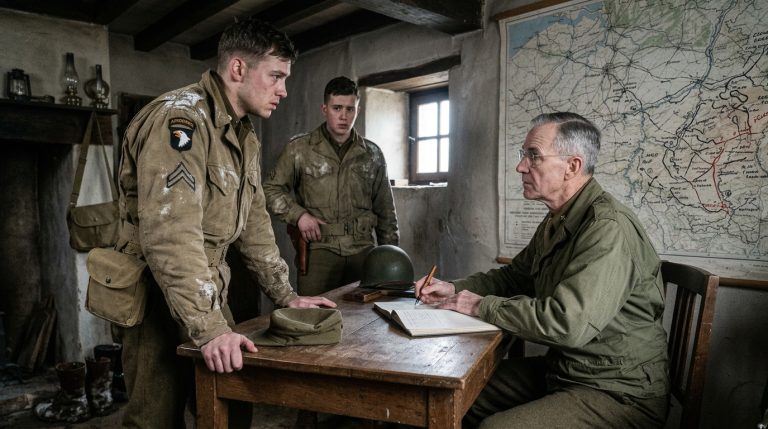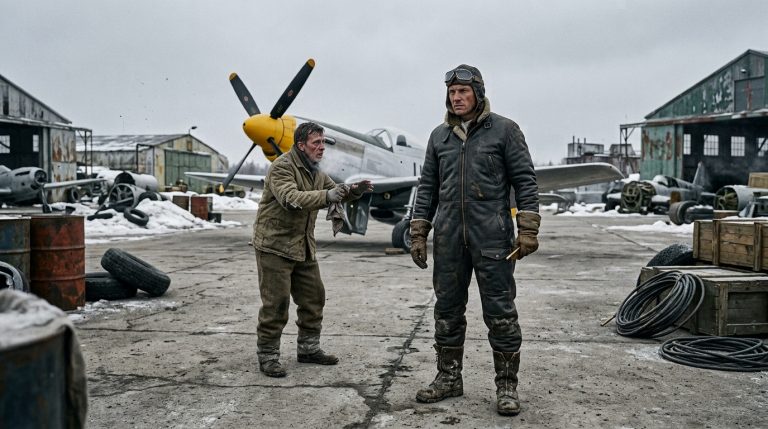
The Iron Perimeter: How One Downed American Pilot Turned a Hostile Airfield Into His Exit Strategy
CHAPTER 1: THE FROZEN DROP
The altimeter unwound in a sickening blur before the canopy blew off.
I didn’t think about the manuals or the statistics floating around back at base. My left boot slammed into the frozen Czechoslovakian sod with a jolt that shot straight up my spine, twisting my ankle until white hot needles fired through the joint.
I dropped flat into the bracken, dragging the silk canopy down with me.
My fingers were already stiff, useless blocks of ice inside leather gloves. I hauled wet leaves over the white nylon until it blended into the gray floor of the woods.
There was no radio. There were no flares.
The holster on my hip bumped against my thigh, entirely empty of iron—stripped clean by the violent ejection sequence, leaving me with nothing except the clothes on my back and the raw throb of my ankle.
The forest was dead quiet except for the distant pop of a diesel engine two miles west.
The German search parties would fan out toward the hills and the rivers by dawn, looking for a scared kid running south.
I pulled my flight jacket tight against the damp chill, spat the taste of copper out of my mouth, and turned my face toward the north.
CHAPTER 2: NORTHWARD DEFIANCE
The forest canopy blocked out the pale wash of the moon, turning the frozen undergrowth into a chaotic maze of black shadows and jagged roots.
My left ankle screamed every time I shifted my weight onto the heel, forcing me to drag the boot through the frozen moss rather than step clean.
A sharp, metallic tang filled my throat, the biological cost of burning four thousand calories a day on empty air.
There were no tracks to follow here, only the instinct to move counter to what any rational soldier would do.
The main roads two miles south were choked with canvas-covered trucks and boots crunching gravel toward the hills, hunting for a downed pilot who had vanished into thin air.
Instead of hiding in a ditch to wait out the frost, I kept my shoulders hunched, pushing deeper into the dense pine thicket that crested the ridge line.
Through a break in the dark branches, a low-slung cluster of corrugated steel hangars materialized against the gray horizon.
A pale amber glow leaked from the corner of a maintenance shed, casting long, sharp angles across open tarmac.
The distant clatter of a wrench hitting concrete echoed through the damp air, carrying a clean, crisp warning across the frozen perimeter.
I dropped flat into a clump of dead fern, my chest heaving as I pressed my palms hard against the frozen dirt to steady the tremble in my arms.
CHAPTER 3: THE BUTCHER BIRD
The gravel crunching under a distant mechanic’s boot sounded like breaking glass in the damp predawn stillness.
I kept my weight off my injured left heel, sliding my palms across the wet grass as I closed the gap toward the eastern revetment.
The camouflage netting draped over the structure smelled heavily of treated canvas and stale machine oil.
Inside the shadow of the revetment, a single German Focke-Fulf sat dark and silent, its massive radial nose cowl looming like a iron wall against the gray dirt.
Two technicians in heavy wool coats stepped away from the port wing, their voices muffled by the low rumble of a distant fuel pump.
— Just check the oil pressure again before morning stand-down— one muttered, tossing a greasy rag onto a wooden crate.
They walked back toward the main mess hall, leaving the fighter completely unguarded under the pale stars.
I crouched behind the starboard tire, my breath pluming white in the freezing air while my fingers curled into a tight, scarred fist.
The machine was fully fueled, its 1,700-horsepower engine primed for the morning sweep, completely unaware that a stranded American pilot was squatting right beneath its wing.
CHAPTER 4: COCKPIT IN THE DARK
The open ground stretched eighty yards without a single shadow to hide behind, the cold air burning raw inside my lungs.
My left boot dragged through the frozen ruts, but adrenaline locked down the pain as I slammed hard against the metal wing root.
I hauled myself over the armored rim, dropping straight down into the narrow confines of the German cockpit.
Every single dial, switch, and placard stared back at me in thick, incomprehensible Gothic script under the dim emergency glow.
My knees wedged tight against the lower instrument panel while my gloved hand felt blindly along the right console for the starter handle.
A mechanical whine began to build beneath the floorboards, spinning up like an iron turbine caught in a gear.
The sound filled the enclosed space with a rising, high-pitched shriek that cut sharply through the sleeping perimeter.
I let the inertia spool for twenty agonizing seconds before yanking the handle home with a sharp, heavy jerk.
The massive radial engine coughed twice, spat dark exhaust against the windshield, and caught with a roar that shook the entire revetment.
CHAPTER 5: IRON AWAKENING
The 1,700-horsepower radial engine screamed in protest, slamming me back against the armored headrest as the heavy fighter surged across the frosty concrete.
Shouts erupted from the dark shadows near the main briefing shack as silhouette figures spilled into the open, waving frantic arms against the blinding glare of the engine exhaust.
I didn’t look back to see who was running.
The hangar corners blurred into solid gray walls as the tail came up violently, begging for air.
At ninety miles an hour, I hauled back on the stick with both arms, tearing the landing gear away from the ground just as the corrugated roof tiles flashed inches beneath the belly.
The airfield dropped away instantly into the gray mist, leaving behind a swarm of angry confusion and shouting guards who realized too late what had just rolled out from under their noses.
I banked hard toward the western horizon, keeping the nose glued to the frosty treetops to stay entirely invisible to the radar stations dotted across the hills.
CHAPTER 6: FRIENDLY FIRE RUN
Tracers ripped across the gray morning sky in angry red streaks as our own base anti-aircraft crews lit up the horizon.
I hauled back on the stick, banking violently over the perimeter fence of Orconte while the hydraulic handle jammed hard against the floorboards.
The landing gear refused to drop, leaving me with a heavy machine and zero options left on the dial.
I cut the throttle, lined up square with the wet grass beside the main runway, and let the belly hit the dirt at ninety miles an hour.
Mud and gravel sprayed in a thick rooster tail against the steel plating as the aircraft ground to a violent halt.
Military police swarmed the smoking fuselage within seconds, boots hitting the wing while rifles leveled straight at my face.
— Get out of that cockpit right now— an officer roared, his voice shaking with pure disbelief.
I slid the canopy back, wiped the cold grease from my forehead, and stood up in the torn flight suit.
— I am Captain Carr of this goddamn squadron, and you can tell your gunners to stop shooting at my tail— I muttered, stepping down onto the muddy grass as Colonel Bickell’s staff car skidded to a halt in the muck.
The colonel stared at the German crosses painted on the wings, then up at the mud-spattered pilot who had just flown back through his own lines in a stolen bird.
— Carr— Bickell said, shaking his head slowly— where in the hell have you been?
The engine ticking cool in the damp morning air was the only answer needed.