The Quiet General Who Built the Anvil to Crush Hitler’s Last Great Gamble
CHAPTER 1: THE SHATTERED QUIET
The vibration came through the floorboards before the sound hit the glass.
Troy Middleton didn’t jump. He sat behind the scarred oak desk in the requisitioned Belgian farmhouse, the steel tip of his wooden fountain pen hovering a quarter-inch above a supply ledger. Outside, the night was black, frozen, and dead silent—until the horizon north of Bastogne lit up in a dull, flickering orange that rattled the oil lamp in its iron bracket.
A runner slammed through the heavy oak door without knocking, snow caked to his wool overcoat, breathing frost into the warm room.
“Sir, the wire to the 106th just went dead. Artie shells hit the junction at St. Vith. Third time tonight.”
Middleton didn’t look up from his page. He lowered the pen, systematically blotting a bead of black ink on the edge of the blotter paper before setting the cap down with a quiet click.
“The landlines aren’t coming back, Corporal,” Middleton said, his voice flat and dry as cured timber. “The Germans don’t spend that much high explosive on telephone poles unless they intend to walk where the wires used to hang.”
A second soldier hurried into the hallway, his face tight with the specific panic of a man holding bad news. “HQ at Clervaux says they hear heavy armor moving west along the river trail. They’re asking if they should pull the command post back across the Our River.”
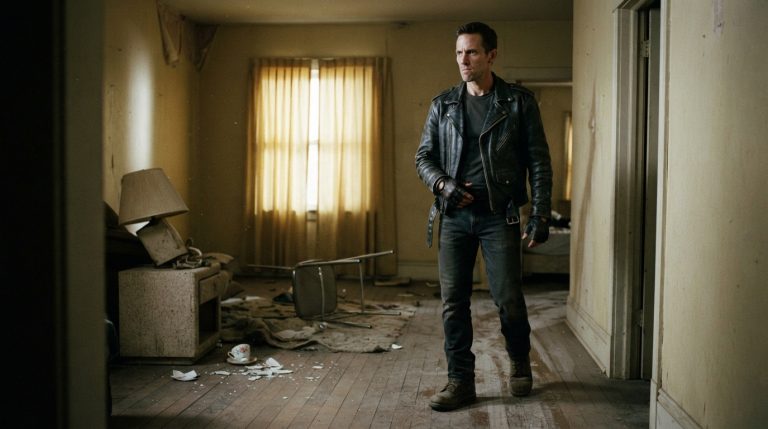
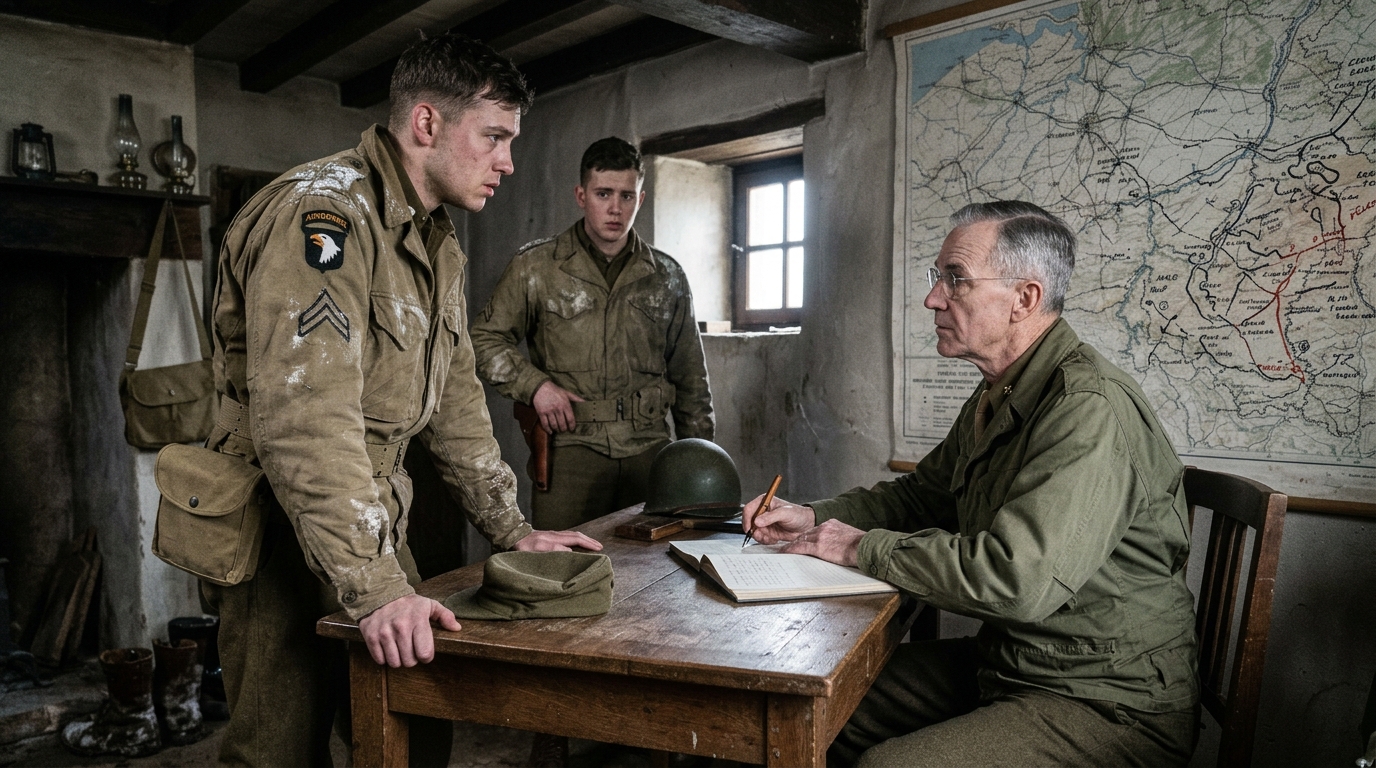
Middleton stood up slowly, the joints in his knees popping in the damp cold of the unheated room. He was fifty-five years old, his hair thin and gray, looking far more like the university administrator he had been three years ago than a man commanding eighty miles of frontline. He walked over to the wall map pinned to the timber frame.
The Ardennes was supposed to be a graveyard for quiet divisions—a place where green farm boys learned how to sleep in foxholes and worn-out regiments patched their frostbite. But looking at the grease-pencil marks showing six major road junctions converging on a single, unremarkable market town, Middleton saw the truth instantly.
They weren’t trying to raid a post. They were trying to race for the Meuse River before anyone noticed the door was wide open.
“Tell Clervaux no,” Middleton said, turning his back on the map.
The young staff officer blinked, his hand frozen on his sidearm holster. “Sir? The 28th is taking heavy tank fire. If they stay on the ridge, they’re going to get cut off by morning.”
“If they fall back, the Germans get the paved road to Bastogne by noon,” Middleton replied softly. He picked up his wooden pen, feeling the worn grain under his thumb. “And if they get the paved road, they don’t have to fight the mud. We hold the shoulders. Nobody pulls back an inch.”
CHAPTER 2: THE LOGIC OF THE MAP
The noise from the north wasn’t artillery anymore; it was the heavy, rhythmic thud of diesel engines idling in the snow three miles out.
Middleton didn’t look back at the young lieutenant waiting by the doorway. He pressed the tip of his thumb into the soft wood of his pen, feeling the small splinter near the cap—a sharp little reminder that kept his mind locked right where it belonged.
“Get me the road map for the Ardennes sector,” Middleton said, his voice dropping into the quiet cadence he used when faculty meetings at LSU threatened to turn into shouting matches. “The one with the bridge weight limits.”
A second-lieutenant scrambled over, spilling a stack of blue-penciled topographical sheets onto the oak table. “Sir, if we don’t send the runners to order a general withdrawal toward the Meuse, the 106th is going to be wiped off that ridge by breakfast. The Germans are bypassed them on both sides.”
“They’re supposed to bypass them,” Middleton said softly. He didn’t raise his eyes from the paper. “A division that stays in its hole takes two regiments to bypass and three to watch. That’s five regiments the enemy can’t use to take the paved roads.”
He traced a finger down the narrow blue line of the Our River, dragging it west until it hit the dark, webbed junction of seven red lines.
Bastogne.
It wasn’t a fortress. It was a sleepy Belgian town full of stone houses, cattle pens, and seven narrow strips of asphalt cutting through a sea of frozen mud and dense spruce forest. Off the roads, an armored car would sink to its axles in thirty minutes. On the roads, a single stalled half-track could block a division for half a day.
A motorcycle messenger slammed into the room, his leather goggle strap snapped and hanging over one ear. He dropped a canvas dispatch pouch onto the desk, his breathing ragged and wet.
“From Colonel Hurley at the southern shoulder, sir,” the messenger panted, wiping grease from his lip with a frozen sleeve. “German column spotted heading west on Route 4. They aren’t flying German colors.”
Middleton unbuckled the pouch and pulled out a single sheet of water-stained grid paper. “What are they driving?”
“American two-and-a-half-ton trucks, sir. Dozens of them. Filled with gas cans. They took our fuel depot at Bullingen before the guards could burn the valves.”
Middleton set his pen down beside the dispatch. A small anomaly, the kind a panicked staff officer might overlook while screaming for retreat—enemy tanks using captured Allied gasoline because their own supply lines were already stretched to the snapping point.
If they were burning captured fuel on day one, they were running on a stopwatch. Every hour they spent fighting for a crossroad was an hour their engines ran dry in the snow.
“They aren’t trying to clean up our infantry,” Middleton said, looking up at his chief of staff, whose knuckles were white where he gripped the edge of the table. “They’re running for the river. They need Bastogne, and they need it before the frost thaws.”
“Sir, we have no wire contact with the 101st,” the chief of staff insisted, his voice edge-strained and tight. “If we send them into the town without comms, they’ll be an island in a sea of panzers. You’re throwing a reserve unit into a trap.”
“It’s only a trap if they try to leave,” Middleton said quietly. He picked up his pen, uncapped it, and wrote three words on a fresh courier order. “Send the runner. Tell them to sit on those seven roads and lock the gate.”
CHAPTER 3: COMMITTING THE FROZEN
“He’s not going to make it through the tree line,” the chief of staff murmured, his eyes tracking the courier through the frosted window pane. “The Germans have mortar teams registered on every crossroad between here and the town.”
Middleton didn’t argue. He picked up his wooden fountain pen, screwing the cap down until the threads bound tight.
“Then we send a runner on foot behind him,” Middleton said, his voice flat, steady, and devoid of the dramatic weight the officers around him kept trying to project. “And another twenty minutes after that. The order gets there.”
He walked over to the supply map spread across the lower bench. The lines were gone. No copper wires, no switchboards, no voices crackling through headphones to give him the comfort of a real-time update. He was operating in the dark, calculating movement by the speed a man could walk through three feet of mud and frozen snow.
A field officer from the 101st Airborne stepped forward, his canvas jump jacket dark with melted frost at the shoulders. “General, if my boys march into Bastogne without landline contact to your headquarters, we’re cut off the moment the main column closes the ring. We won’t have heavy artillery support, and we won’t have a clear supply corridor.”
“You won’t have a corridor at all,” Middleton said plainly.
The officer stiffened, his jaw tightening as he stared at the older man. “You’re telling us to go into a pocket.”
“I’m telling you to hold a junction,” Middleton corrected him. He pointed a dry, ink-stained finger at the center of the map. “If you fall back, the German armor takes the paved road west. If you stay, they have to stop, unload their infantry, and spend three days trying to dig you out of stone cellars. That buys three days for the armor down south to turn around.”
“And if the armor down south doesn’t turn around?”
Middleton met the man’s eyes without blinking, his expression as unreadable as a ledger page. “Then you stay in the cellars.”
The room went completely quiet, save for the dull, distant thud of heavy shellfire shaking the plaster ceiling. It was a cold equation, the kind of brutal arithmetic that sounded terrible spoken out loud in a warm room, but Middleton knew the alternative was worse.
If he tried to save the division by pulling them back, they would get caught on the open roads by panzers moving thirty miles an hour, chopped to pieces while trying to negotiate narrow bridges in the dark. Staying put was miserable, dangerous, and isolated—but it was the only move on the board that didn’t end in immediate ruin.
“Get your men moving,” Middleton told the airborne officer. “Don’t bother setting up a wire team. Just dig in before the armor arrives.”
CHAPTER 4: THE VERSAILLES FRICTION
The air inside the hotel ballroom tasted like stale tobacco and damp wool. Maps covered three folding tables pushed together, surrounded by red-faced staff officers arguing over blue grease-pencil lines that didn’t match the actual dirt outside.
General George Patton paced the edge of the carpet, his pearl-handled revolver bumping against his hip with every impatient stride. “We pull back to the Marne, regroup the Third Army, and strike when the weather clears. Standing in a mud hole in Belgium while they bypass your flanks is suicide.”
Field Marshal Montgomery leaned over the map board, tapping a wooden pointer against the northern sector. “A tactical withdrawal is the only sensible operation. Shorten the line, consolidate the corps, and let them overextend.”
Eisenhower didn’t look at Montgomery. He looked across the table at Middleton, who was standing quietly near the back, holding an unlit wooden fountain pen between his index and middle fingers.
“Troy,” Eisenhower said, his voice cutting through the noise. “Your lines are broken in three places. The phones are dead. You have no direct wire link to Bastogne. Can you hold it?”
“Yes,” Middleton said.
Patton stopped mid-stride, turning his head. “They’ve surrounded the town, Troy. You’ve got one airborne division down there eating cold rations, taking tank fire from three sides, and you don’t even have a telephone wire to ask them how long they can survive.”
“They don’t need a telephone to know what their job is,” Middleton replied, his voice level and entirely unhurried. “They have seven roads under their boots. As long as they stay on those roads, the German armor stays stuck in the spruce woods.”
“And if they get overrun?” Montgomery pressed, his pointer resting on the red circle around Bastogne. “You lose an entire division for a market town.”
“They won’t get overrun if you stop talking about retreat and start turning armor north,” Middleton said. He set the wooden pen onto the corner of the map, right over the blue line representing the Meuse River. “The Germans aren’t attacking our army. They’re trying to reach that water before their gas tanks run empty. They’re running captured American trucks because they don’t have their own fuel.”
Eisenhower leaned closer to the map, staring at the small gap where Middleton’s pen lay. “They’re on a clock.”
“They’re on a tight clock,” Middleton said. “Every hour my boys sit in those stone cellars in Bastogne is an hour the enemy burns engine oil doing nothing. You don’t pull back. You hook Patton’s army ninety degrees north and slam them into the side of that bulge while the door is jammed shut.”
Patton stared at Middleton for three long seconds. The impatience in his face shifted, settling into something hard and calculated. “How long can your boys hold that door?”
Middleton picked up his pen and slipped it into his jacket pocket. “Until you get there.”
CHAPTER 5: THE COLLAPSE OF THE SPEAR
A dispatch runner dropped his bike against the wheel of the trailer, his heavy woolen trousers caked solid with frozen mud up to his knees. He didn’t offer a salute. He simply reached into his damp jacket and slapped a dispatch slip onto the wooden steps.
Middleton stepped down, picking up the folded paper. The pencil ink was smeared by rain, but the message was clear enough.
The German fifth panzer army had hit the eastern perimeter of Bastogne three times since midnight. They had used two full infantry regiments, supported by heavy armor, trying to punch a three-hundred-yard hole through the stone farmhouses near the railway line. The 101st Airborne hadn’t yielded an inch.
“They’re burning their reserves,” Middleton said softly, walking back inside to the map table. He pulled his wooden fountain pen from his breast pocket, tapping the blunt end against the narrow red corridor on the map. “They can’t bypass the town because the secondary trails are bottomless slop. They can’t take the town because our boys are sitting in the cellars with anti-tank guns.”
His chief of staff leaned over the table, rubbing red-rimmed eyes. “The German command sent a courier under a white flag two hours ago, sir. Demanded immediate surrender. Said they have the town completely encircled.”
Middleton didn’t pause. “What did McAuliffe tell them?”
“One word, sir. ‘Nuts.'”
A rare, faint crease appeared at the corner of Middleton’s eye before vanishing back into his weathered face. “That about covers it.”
Outside, the steady, rhythmic thud of heavy artillery began to shift pitch. It was no longer coming from the east; the deep boom of American 155mm guns was breaking out from the south, cutting across the frozen forest trails.
Patton’s lead armored division was slamming into the German flank at Arlon, shoving hard against a enemy force that had spent its fuel, its ammunition, and its momentum trying to break a door that Middleton had locked seven days ago.
The German vanguard was caught in the open—trapped on narrow, icy roads between an immovable stone perimeter to the north and a wall of fresh steel driving up from the south. The grand offensive wasn’t a spearhead anymore. It was a stalled column running dry in the Belgian snow.
Middleton uncapped his pen, drew a heavy, decisive black line across the red arrow pointing toward the Meuse, and set the cap back down with a firm click.
CHAPTER 6: THE QUIET AFTERMATH
The wooden desk in the administration building at Louisiana State University smelled of pine oil and wax, identical to the one he had left three years ago in Belgium.
Middleton dipped his fountain pen into the black ink jar, filling the internal bladder with a quiet suction click. Outside the office window, rain tapped against the glass, steady and soft, carrying none of the concussive thrum that used to shake the plaster ceilings of his forward posts.
A faculty member leaned against the doorframe, holding a stack of course schedules for the spring term. “General, a reporter from the city paper called again. They want a piece on how you held the shoulder before Patton got north. Said you haven’t given them a single quote.”
“Tell them I don’t have one,” Middleton said, setting the pen down carefully across his blotter paper.
“They’re calling it the defining moment of the western front, Troy,” the colleague pressed, stepping into the office. “Patton’s writing his memoirs. Montgomery’s holding press conferences in London. The whole world is talking about how that line held.”
Middleton leaned back, his thumbs resting against the edge of his oak desk. The mystery was never complicated, and he had no desire to sell it as a miracle.
Hitler hadn’t been stopped by grand speeches or heroic theatricals. The entire German counter-offensive—that desperate, final drive for the Meuse—had been built on a fragile assumption: that American soldiers would panic when the phone wires went dead and the roads got crowded.
When the lines snapped in the opening hour, the Germans expected retreat. Instead, Middleton had looked at the map, realized the enemy was running on stolen gas and a ticking clock, and gave the only common-sense order available without waiting for high command to wake up. He held the junction at Bastogne, choked their fuel supply, and forced three panzer divisions to waste their strength against stone cellars until the trap snapped shut behind them.
Layer 1 was the fear that his corps was being wiped out in the dark. Layer 2 was the truth—that by locking his divisions in place without comms, he had turned Hitler’s ultimate gamble into an airtight choke-point that broke the back of the German army.
“Let them write about Patton,” Middleton said softly, picking up the top schedule from the faculty stack. “Patton likes the ink.”
He pulled the ledger toward him, smoothed down the corner of a student petition, and began reading.