Rusted Bolts And Raw Steel: How One Exhausted Veteran Forged the Deadliest Weapon of the Pacific War Against All Odds
CHAPTER 1: THE RUSTED NOSE
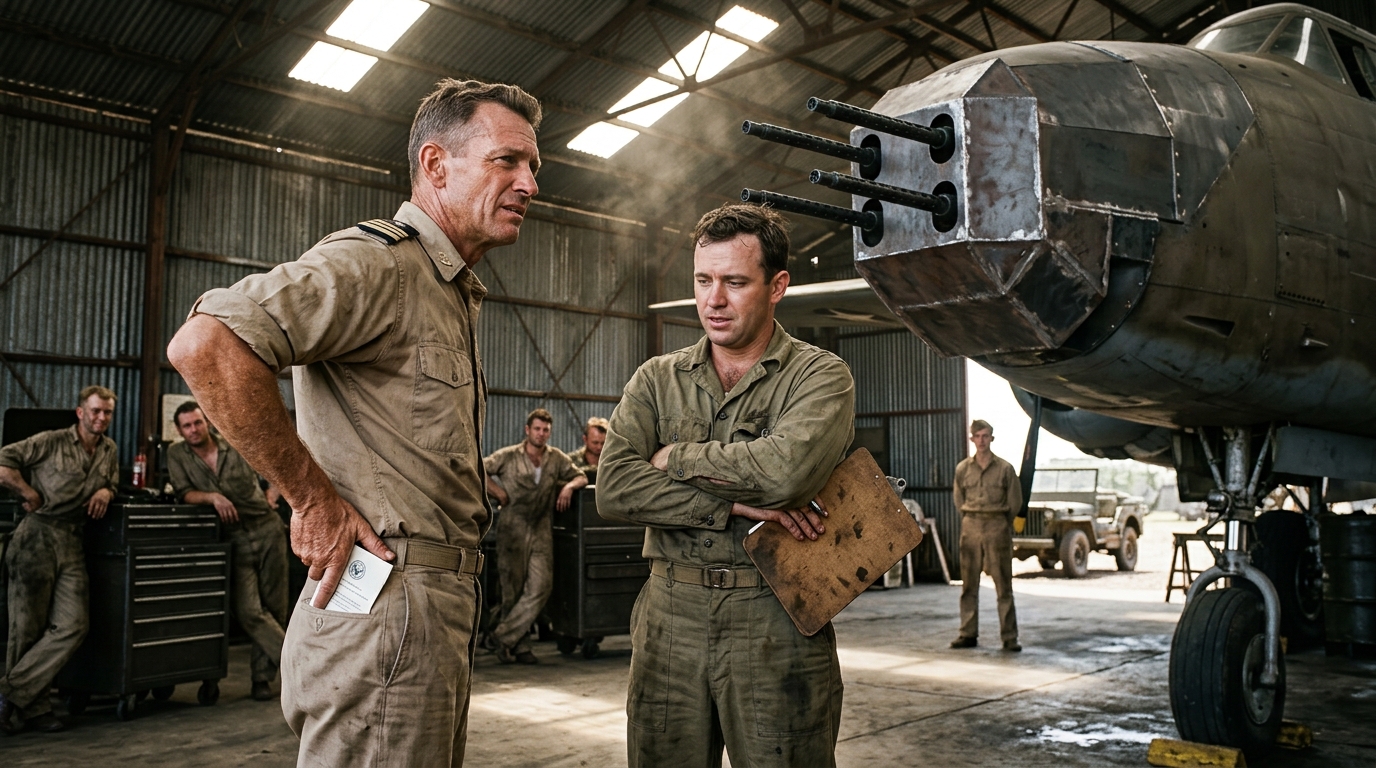
The hangar at Eagle Farm smelled of stale aviation fuel, scorched welding flux, and the heavy, metallic tang of sweat.
Paul Gun straightened his back with a slow, deliberate wince, pressing the heel of his palm against his lower spine.
At forty-three, twenty-one years in the Navy had taught him that pain was just background noise, but the damp Brisbane heat made every joint ache like a poorly set bolt.
Under the aluminum wing of the Douglas A-20 Havoc, the work light cast long, jittery shadows across the concrete floor.
Mechanics were busy slicing into the aircraft’s nose compartment where the glass-enclosed bombardier station used to sit.
They were dropping the useless optics and making room for heavy steel framing.
In July alone, the third attack group had lost eleven bombers trying to drop high-altitude payloads on moving ships.
The math was simple and brutal: high-altitude bomb loads missed every time, and low-altitude runs brought deck gunners straight through the thin skin.
Gun reached into his breast pocket, pulled out a grease-stained notebook, and flipped the curled pages with a calloused thumb.
His wife and four children were locked behind the barbed wire of Santo Tomas in Manila, living on meager rations while the clock ticked down.
Every failed mission over the Owen Stanley Mountains meant another week they stayed trapped.
“The brackets are cut, Captain,” Sergeant Miller said, wiping his oily forehand with a rag. “Four guns. Two hundred pounds of lead and brass. But the frame’s shaking loose when we test the mount.”
“Then double the weld thickness on the load-bearing spar,” Gun said, his voice flat and gravelly. “Use scrap steel from the wing tanks if you have to. We don’t wait for factory shipments.”
The sergeant stared at him, hesitant. “The center of gravity is going to shift hard forward, sir. If the pilot pulls up too fast on takeoff, she’s going to snap right into the tarmac.”
Gun looked past the mechanic, out toward the sun-bleached airstrip where another patrol was limping home on two engines.
“Then we tell the pilots not to pull up too fast,” Gun muttered, picking up a heavy crescent wrench. “Get the torches lit. We’ve got six days before General Kenny comes back to inspect.”
CHAPTER 2: THE WEIGHT OF STEEL
Paul Gun sucked in a sharp breath through his teeth, wiping the smear of blood onto his trouser leg without pausing his work.
The heavy grease on the wrench handle offered no quarter, slick with sweat and the residue of aviation fuel that hung like a fog under the corrugated iron roof.
“She’s sitting heavy on the nose, Captain,” Sergeant Miller muttered, stepping out from the shadows with a clipboard clutched in grease-stained fingers. “We moved the radio gear three feet aft, but the balance point is still hovering right over the pilot’s seat.”
Gun didn’t look up from the four-gun steel frame bolted into the stripped bombardier station.
He reached for a scarred brass shim, wedging it firmly beneath the forward mount to absorb the bone-jarring vibration of the 50-caliber receivers.
“The air doesn’t care about blueprints, Miller,” Gun said, his voice a low gravel rasp that cut through the whine of a distant lathe. “Get the tail trim adjusted five degrees down and check the cable tension on the elevators.”
Outside the hangar, the tropic dawn was bleeding a sickly orange over the damp tarmac of Eagle Farm.
The first test flight was scheduled for the morning watch, and every mechanic in the depot knew the stakes.
If the nose dropped too fast on takeoff, the modified Douglas A-20 would dig its reinforced nose straight into the dirt and snap the fuselage in two.
Gun picked up his flashlight, casting a narrow beam along the interior ribs of the fuselage.
Something caught the edge of the light near the rear bulkhead—a scrap of paper wedged behind a spare oxygen tank that shouldn’t have been there.
It was an unaddressed teletype stub, gray and crumpled, bearing a faint red stamp that didn’t match any supply code issued in Brisbane.
He pulled it free, turning it over in his rough fingers, but the ink had smeared into an unreadable smudge of damp pulp.
“Captain,” Miller called out, pointing toward the runway lights flickering through the haze. “The test crew is walking out. You want to abort?”
Gun slid the ruined slip of paper into his pocket, his jaw tightening until the muscle ticked against his cheek.
“Tell the pilot she flies today,” Gun said, grabbing his heavy canvas jacket. “And make sure the ballast is locked down tight.”
CHAPTER 3: THE PAPER WALL
Paul Gun stepped out into the blinding midday glare, squinting as a courier jeep crunched to a halt near the fuel drums.
A young corporal jumped down, holding a thick manila folder stamped with the austere seal of the matériel command in Dayton.
“Special delivery from right field, sir,” the corporal said, wiping dust from his goggles. “Came through headquarters an hour ago.”
Gun snatched the envelope without a word, his thumb tearing the heavy paper seam with a sharp rip.
Inside lay a formal engineering memorandum detailing three days of rigorous desk study regarding his modified A-20 nose configurations.
The verdict was laid out in clean, unbending typewritten paragraphs: the changes were structurally impractical, the center of gravity was mathematically flawed, and the fuselage skin would inevitably peel under the muzzle blast of quad fifty-cals.
The concluding paragraph demanded the immediate grounding of every modified aircraft across the theater pending formal review.
Sergeant Miller walked up behind him, glancing at the official seal with a low whistle.
“Well, Captain, that’s coming straight from the top engineers,” Miller muttered, crossing his arms over his chest. “They say the frame will buckle under sustained recoil.”
Gun didn’t blink, his eyes scanning the neat rows of institutional logic that completely ignored the smoking hulls at the bottom of the Coral Sea.
“They built those calculations in an Ohio office where the only thing shaking the desk is a typewriter,” Gun said, his voice dropping an octave as he folded the memo in half and tucked it into his back pocket.
He looked back toward the line of bombers idling on the tarmac, their newly bolted noses glistening with fresh primer.
“Tell the ground crews to double the rivet count on those blast tubes,” Gun ordered, his jaw tightening into a hard line. “We aren’t grounding anything until the enemy stops moving across the water.”
CHAPTER 4: THE BISMARCK TRIAL
Paul Gun stood at the edge of the coral strip, squinting through the rising salt spray and exhaust smoke as Captain Ed Lner led the formation down the runway.
The modified B-25 Mitchells sat heavy on their landing gear, their blunt noses bristling with fourteen forward-firing barrels that caught the flat equatorial sun.
“They’re rolling, Captain,” Sergeant Miller shouted over the screaming roar of radial engines pushing full throttle. “If the weight distribution fails in this crosswind, those noses are going to dip right into the mud.”
Gun didn’t answer, his hand clamped tightly around the strap of his binoculars as the lead aircraft lifted off with a shuddering groan.
The flight path pointed northwest toward the Bismarck Sea, where an enemy convoy of eight transports and eight destroyers was steaming hard for New Guinea.
High-altitude bombers had tried and failed to stop them three days prior, dropping tons of steel into scattered clouds while the enemy ships pushed unbothered through the monsoon chop.
Theory from the distant desks in Ohio had failed when it met the reality of the open ocean.
Now, twelve converted gunships were flying low at masthead height, carrying a wall of lead designed to strip anti-aircraft decks clean before the bombs even touched the water.
“They won’t be using standard bomb runs today,” Gun muttered, watching the last silver tail disappear into the low maritime haze.
The radio truck behind them crackled with static, spitting out coded fragments from the reconnaissance aircraft shadowing the enemy fleet seventy miles out.
A drop of sweat rolled down Gun’s temple, stinging his eye as he waited for the first wave report to crackle across the speaker.
The line of fire was moving fast, and there was no paper memo in the world that could stop what was coming over the water.
CHAPTER 5: THE FACTORY FLOOR
Paul Gun looked out across one hundred and forty acres of floor space where twenty thousand workers moved between towering rows of aluminum fuselage ribs.
An assembly superintendent stepped up, holding a set of formal production blueprints covered in neat red margin corrections.
“We checked your measurements, Colonel,” the superintendent said, tapping a pencil against the margin notes from the Ohio engineering board. “The stress calculations still don’t balance out. If we mount fourteen heavy barrels in these cheek packs and the solid nose, the vibration will peel the skin right off the frames.”
Gun stared past him, his eyes tracking a completed B-25 rolling slowly down the chain toward the massive hangar doors.
“I didn’t ask for your stress calculations,” Gun said, his voice flat and unyielding. “I flew the plane through live antiaircraft fire while your engineers were sitting at oak desks arguing about margins.”
He reached into his pocket and pulled out the crumpled teletype stub with the faded red stamp, placing it squarely on top of the superintendent’s blueprints.
The superintendent frowned, picking up the scrap of paper to examine the unauthorized markings before looking back up with a sudden, cautious tightening around his eyes.
“Where did you pull this from?” the superintendent asked, his tone dropping from managerial defiance to quiet suspicion.
“From the wreckage of a system that tried to legislate a war it never had to fight,” Gun answered, snatching the paper back and tucking it securely out of sight. “Now get those blast tubes welded into the production line before the Pacific runs out of bombers.”
CHAPTER 6: THE LONG ROAD HOME
Paul Gun dragged his bandaged left leg across the wooden floorboards of the makeshift ward, ignoring the sharp, tearing pain where a shrapnel fragment had severed tissue weeks prior.
The medical officer stood in his path, holding a clipboard with an official discharge recommendation that offered months of quiet convalescence back in the States.
“Colonel, your leg hasn’t healed,” the doctor said, pointing toward the stained gauze wrapping around Gun’s calf. “By all rights, you should be boarding a transport home right now.”
Gun didn’t slow his pace, leaning his weight heavily onto a varnished wooden cane with every stride.
“Home is right through those doors, Doctor,” Gun said, his voice raspy and unyielding as he pushed past the threshold into the interior hallway of Santo Tomas.
The corridor smelled of damp cotton, antiseptic, and the faint, sweet scent of lingering starvation.
He stopped outside Room 14, where rows of narrow cots lined the cracked plaster walls under flickering overhead bulbs.
On a thin mattress near the barred window lay Paulie, her frame withered down to eighty-nine pounds after three agonizing years behind enemy lines.
For a long moment, she stared up at him blankly through sunken eyes, her gaze drifting over his completely gray hair and deeply weathered face without a flicker of recognition.
She thought he was just another weary army surgeon making rounds.
“Paulie,” Gun said softly, dropping his cane against the cot frame and sinking slowly onto the edge of the mattress.
Her breath hitched, her frail fingers trembling as they reached out to touch the worn silver band on his finger before sliding up to trace the familiar lines of his jaw.
“You took your time getting here,” she whispered, a fragile, broken smile finally cutting through the exhaustion.
Gun pressed his forehead against hers, the heavy weight of the past three years lifting off his shoulders in the quiet hum of the hospital room.
Outside, across the ruined streets of Manila, the sound of Allied transport engines thrummed steadily against the morning sky, carrying forward a legacy forged entirely from grit, common sense, and unbroken resolve.