The Painted Runways of Kent: How a Quiet Logistics Officer Outsmarted the Luftwaffe With Plywood and Smoke
CHAPTER 1: The Weight of Paperwork
The tea in the chipped stoneware mug had long since gone cold, forming a thin, gray skin across the surface. John Turner did not drink it. He simply used the warmth of the ceramic to thaw fingers stiffened by hours spent unrolling damp architectural diagrams under the dim flicker of a rationed bulb.
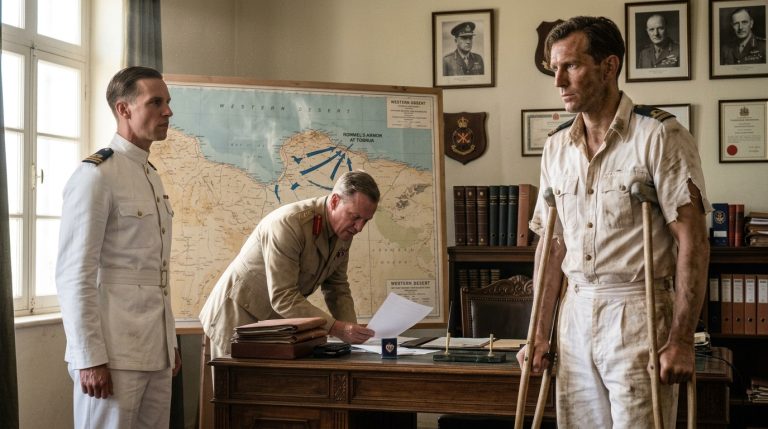
Across the mahogany desk, Group Captain Douglas Evill tapped a blunt pencil against a margin note. The sound was a steady, rhythmic irritation that matched the distant, low throb of anti-aircraft batteries miles away on the coast.
“The numbers do not justify the timber, Turner,” Evill said, not looking up. “Eighty-four tons of structural steel requested for dummy hangars alone. Fighter Command is burying pilots by morning and patching craters before noon. We cannot spare nails for ghosts.”
Turner kept his expression flat, his thumb tracing the deep notch worn into the edge of his wooden scale rule. The office smelled of wet wool, stale tobacco, and the permanent damp of London in the autumn of 1940.
“The Luftwaffe isn’t looking at our steel, sir,” Turner said, his voice level, stripped of any theatrical pleading. “They’re reading the ground. If a field looks abandoned, they pass over it. If it shows the scars of use, they drop their payload.”
“And your canvas shapes will bleed convincingly enough to satisfy a Heinkel observer at twelve thousand feet?” Evill tossed the memorandum onto the stack, the paper sliding across the green blotter with a dry hiss. “The Air Ministry reviewed three proposals last year. All rejected. The German photographic reconnaissance units in Brussels map every shadow inconsistency down to the inch.”
Turner did not argue the point. He knew the reconnaissance reports as well as any man in the directorate. He had spent fifteen years studying drainage patterns and fuel delivery logistics while other officers chased flight hours.
He stood up, his joints popping quietly in the damp air, and reached for his trench coat hanging from the iron hook by the door.
“They check photographs in daylight, Group Captain,” Turner murmured, sliding his arms into the heavy fabric. “But they navigate by beam guidance in the dark. And in the dark, a well-lit runway looks identical whether it’s made of reinforced concrete or painted plywood.”
Evill didn’t answer, turning his attention back to the casualty manifest from Biggin Hill. Turner pulled the heavy door shut behind him, leaving the warmth of the argument to the cold, black London night.
CHAPTER 2: Blueprint in the Mud
The sodden pasture near Swindon looked less like a military defense and more like a ruined sheepfold abandoned to the elements.
Water pooled in the ruts left by a delivery dray, reflecting the gray, featureless sky of late October.
John Turner stepped off the edge of the macadam road, his leather soles sinking an inch into the greasy clay.
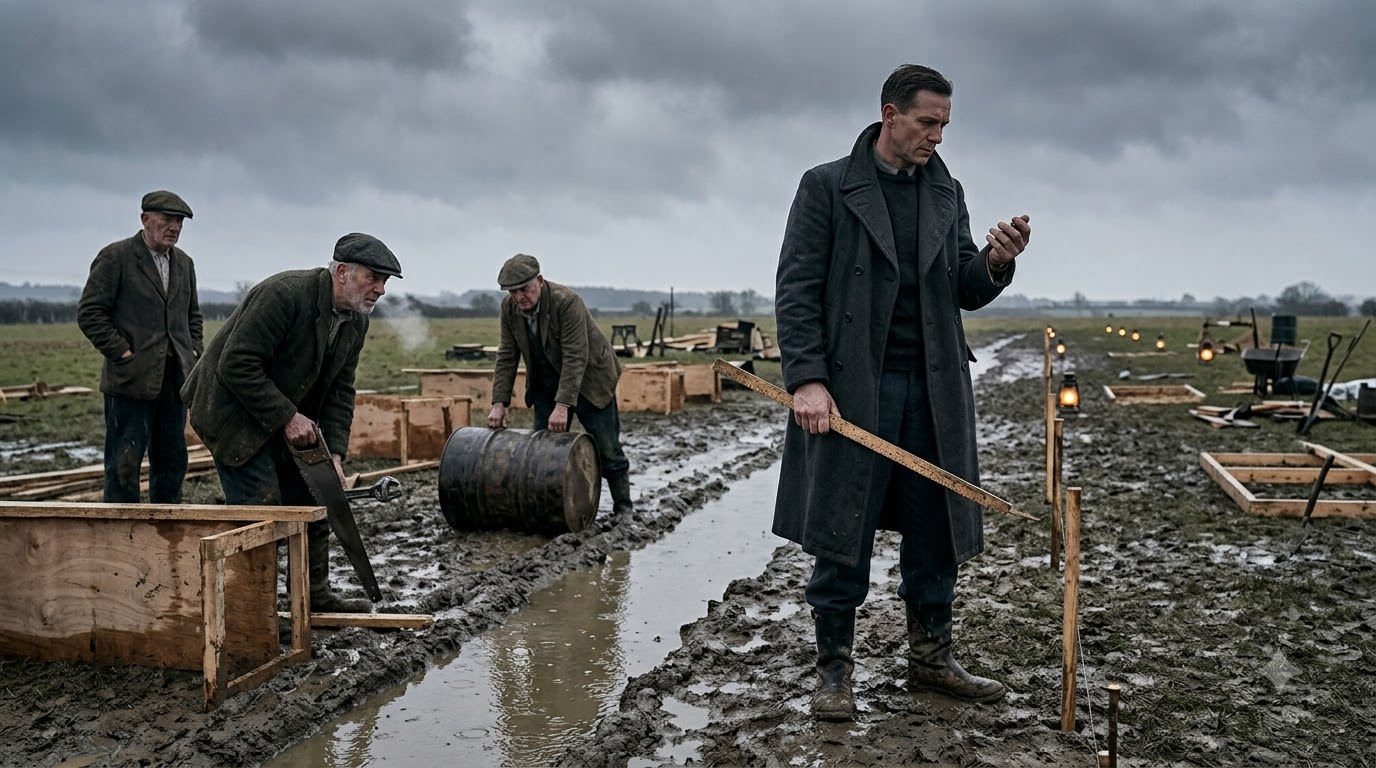
A crew of three elderly civilian laborers stood by a stack of damp plywood sheets, their breath pluming white in the chill dawn air.
There were no military guards, no brass-hatted observers from 11 Group, and certainly no telegraph wire connecting this forgotten strip of Wiltshire grass to the Air Ministry.
That was the price of the deleted high-command link; if this site failed, there was no rescue party to call.
“The lumber arrived wet from the wharf, Mr. Turner,” said old Miller, wiping a gray mustache with the back of a calloused hand. “If we nail these frames together now, the damp will warp the panels before the glue sets.”
Turner did not answer immediately.
He pulled a heavy, notched wooden measuring scale from his trench coat pocket and ran a thumb along its scarred edge.
He looked across the broad, empty expanse of the field, visualizing the exact angle from which a Heinkel bomber would approach under a ten-thousand-foot cloud deck.
“We don’t need them straight, Miller,” Turner said, his voice flat against the wind. “We just need the silhouette to catch the moonlight from twelve thousand yards.”
He dropped to one knee in the wet grass, ignoring the moisture soaking through his trousers, and pointed a gloved finger at the alignment stakes.
A sharp, unpainted wooden spar protruded awkwardly from the framework of a simulated dispersal revetment, sticking out like a raw splinter against the dark turf.
It was an oversight—a sloppy piece of carpentry that a meticulous ground observer would spot through binoculars in a heartbeat.
Turner stared at the offending timber, his jaw tightening as the raw friction of the work ground into his bones.
“Cut that spar flush,” Turner ordered, tapping the wood with the corner of his scale rule. “And drag the oil drum through the mud here to leave a deep track. If the tracks don’t look like an engine mechanic hauled a dead weight across this hardstand, the whole damn field is just firewood.”
Miller nodded slowly, picking up a rusty crosscut saw that bit into the damp pine with a harsh, whining rasp.
The sound carried across the empty acreage, blending with the distant, steady rumble of a British freight train crawling northward through the valley.
Turner stood up, wiping mud from his knee, and watched the sawdust mix instantly with the black earth.
CHAPTER 3: The Midnight Gamble
The generator stuttered in the wet grass, its heavy iron flywheel spitting a blue spark of carbon into the dark before catching a steady, rhythmic thump.
John Turner wiped greasy fingers down the front of his woolen trousers, his eyes fixed on the sequence timer wired to the kerosene landing lamps.
Old Miller stood nearby, holding a heavy wrench, his jaw working a silent rhythm as he stared up at the low, churning canopy of clouds.
“The wind is shifting from the east, Mr. Turner,” Miller muttered, his breath pluming gray in the damp air. “If the Knickebein beam guides them off course tonight, they won’t even see the approach lights until they’re right on top of our canvas.”
“They’ll see what they’re trained to look for,” Turner answered, his voice stripped of any warmth.
He reached into his pocket and turned over the heavy, notched wooden measuring scale, feeling the cold grain under his thumb to anchor his focus against the exhaustion.
Distant and low, the unmistakable drone of twin-engine Heinkel bombers vibrated through the wet sod, rolling across the valley like heavy iron cartwheels over gravel.
Turner did not look up at the sky; he watched the small amber indicator bulb on the control box, waiting for the precise voltage drop that meant the timing circuit was engaging.
“Cut the auxiliary line,” Turner ordered, pointing a gloved finger at the junction box. “If the red boundary marker stays on two seconds too long, any German navigator with a stopwatch will smell a rat.”
Miller swung the wrench with a dull, heavy clang that severed the wire, plunging the outer perimeter into total darkness while leaving the central runway lights burning in a precise, welcoming geometry.
The engine noise overhead sharpened, the deep rhythmic throb turning into a harsh, metallic beating that shook the damp grass beneath their boots.
Turner did not move an inch, his eyes locked on the artificial flare pots flickering across the dummy hardstands.
CHAPTER 4: Decoy and Deception
A low, tearing whistle split the night air, followed instantly by a thunderous concussive shockwave that drove the breath from Turner’s lungs.
High-explosive ordnance slammed into the empty pasture fifty yards from the dummy hardstands, sending a geyser of black earth and shattered plywood into the sky.
Old Miller stumbled against the generator box, his hands flying up to shield his face as glowing embers rained down on the canvas wings.
“They took the bait, Mr. Turner!” Miller shouted over the screaming roar of descending metal. “They’re dropping right on the false line!”
Turner did not flinch, his eyes locked on the burning oil drums illuminating the simulated runway markers through the drifting smoke.
He reached into his coat and gripped his notched wooden measuring rule, feeling the hard edges steady his nerves against the violence of the explosions.
A second wave of detonations tore across the western perimeter, blasting deep craters into the fallow field where no real aircraft had ever sat.
Through the acrid stench of cordite and burning pine, Turner spotted something out of place near the third decoy revetment—a dark, unburned shape half-buried in the fresh debris.
It wasn’t a bomb fragment or a piece of plywood.
It was an unexploded German incendiary canister, its delayed fuse ticking quietly in the mud just feet away from the main fuel store simulation.
Turner stepped forward through the smoke, his boots crunching on splintered laths as he moved to intercept the hazard before the creeping fire reached it.
CHAPTER 5: Scaling the Grid
The damp chill of the trench cut through Turner’s heavy wool coat as he heaved the heavy casing away from the dry timber framework.
Old Miller stood back, wiping soot from his forehead with a stained sleeve, his breathing ragged in the darkness.
“That’s the third site this month, Mr. Turner,” Miller said, his voice carrying a harsh edge of strain. “If the Air Ministry keeps cutting our transport fuel allocations, we won’t be able to haul enough kerosene to light the eastern grid by next week.”
“They won’t cut anything if the diversion numbers hold,” Turner replied, sliding his thumb along the scarred edge of his wooden scale rule.
He remembered the endless desks in Whitehall, the tidy piles of rejection memos, and the cold skepticism of men who sat safely behind mahogany while others buried the dead.
The memory vanished as a distant flare lit up the horizon toward Essex, signaling another Luftwaffe stream veering off target toward a grid of phantom runways.
“We replicate the pattern in Hampshire tomorrow,” Turner said, rising stiffly from the mud. “Double the canvas frames, and make sure the oil drum tracks look deep enough to fool a photographic run at dawn.”
Miller let out a short, humorless breath, hefting his shovel over his shoulder as the distant rumble of anti-aircraft fire faded into the damp morning fog.
CHAPTER 6: The Silent Ledger
The post-war archives in Whitehall smelled of dry paper and cold tea, far removed from the wet clay and cordite of the dispersal fields.
John Turner sat at a scarred oak table, turning the heavy pages of captured enemy operational records translated from the Luftwaffe’s high command files.
Group Captain Evill stood by the frosted window, holding a slender docket that detailed the final diversion statistics compiled across eighty-four separate false installations.
“They went to their graves believing every single one of these dummy strips was an active fighter station,” Evill said, his voice stripped of its former skepticism. “The German post-war assessments list one hundred and sixty successful raids on targets that were made entirely of painted canvas and pine laths.”
Turner did not look up from the ledger.
He ran a tired finger down the column of figures, tracing the exact tally of bombs absorbed by empty fields instead of crowded hangars.
“They weren’t fooled because our work was perfect,” Turner said quietly, closing the heavy leather cover with a dull thud that kicked up a faint cloud of dust motes in the shaft of afternoon light. “They were fooled because they saw what their training told them they had to see.”
He reached into his coat pocket, pulled out the notched wooden scale rule, and laid it flat across the center of the oak table.
The room was silent, save for the faint hum of London traffic outside on the street, entirely free of the tension of sirens and falling iron.