The Sand and the Brass: How a Rebellious Misfit Forged the World’s Deadliest Desert Unit
CHAPTER 1: THE CAIRO WALL
The crutch dug into my left armpit, every step sending a jolt straight up my healing spine. Dust hung thick in the humid Cairo heat, smelling of stale sweat, diesel exhaust, and cheap tobacco. I didn’t have a pass, I didn’t have an appointment, and according to the memo sitting in the adjutant’s office, I was supposed to be resting in a hospital bed recovering from a broken back.
Instead, I was staring at the reinforced gates of Middle East Headquarters.
Two sentries in immaculate tropical whites stepped into my path, their Lee-Enfield rifles crossed in a clean, rigid X.
“Off-limits, Captain,” the corporal said, not even looking me in the eye. “No entry without a stamped clearance from the Duty Officer.”
“My business is with Major General Ritchie,” I said, leaning my weight onto the uninjured right leg. I pulled the brass sun compass from my tunic pocket, my thumb running over the deep scratch across its glass face. “And he doesn’t like to be kept waiting.”
“Clearance, sir. Rules are rules.”
I didn’t argue. Arguing with a man following orders is a waste of breath, and breath was something my lungs were short on today. I took two slow steps backward, nodding as if accepting the refusal, then dragged myself along the perimeter fence until the guard post dropped out of my direct line of sight.
A section of the heavy wire mesh had rusted through near a dry drainage ditch, propped up by a wooden stake.
I didn’t hesitate. I dropped my shoulder, shoved the crutches through the gap first, and squeezed my six-foot-five frame through the jagged opening. The metal scraped hard against my webbing, tearing the sleeve of my tropical jacket, but the pain was just noise.
Ten seconds later, I was inside the main courtyard.
The corridors of GHQ smelled of polished teak and damp paperwork—the scent of men who fought a war with ink instead of lead. Staff officers in crisp uniforms darted between offices, carrying leather-bound folders like sacred relics. None of them looked twice at an oversized lieutenant on crutches moving with a deliberate, aggressive posture.
I found the door marked Deputy Chief of Staff.
I didn’t knock. If you knock, you give them time to check a ledger, find your name, and remember that you’re supposed to be under medical observation for malingering.
I turned the brass handle and shoved the door open.
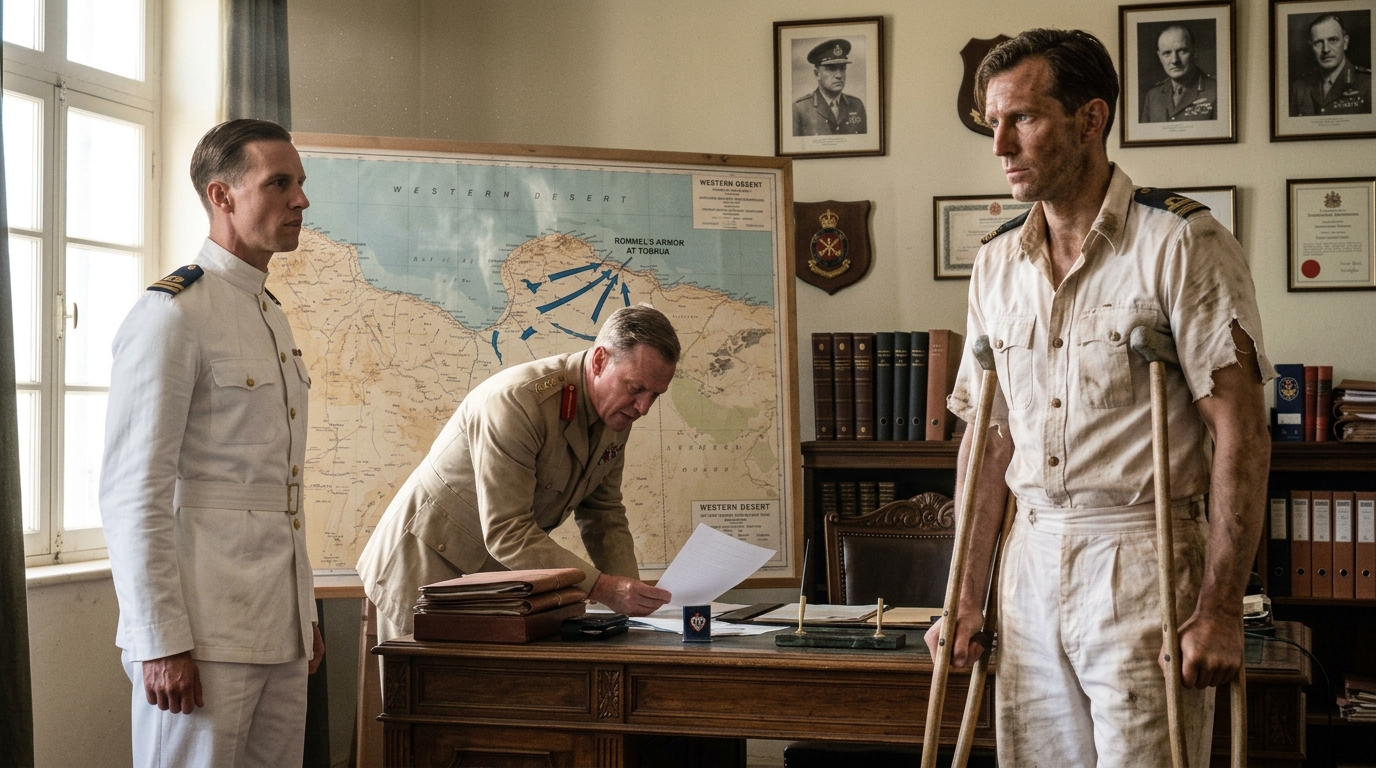
Major General Neil Ritchie didn’t look up immediately. He was bent over a massive map of the Western Desert, a blue pencil balanced between two fingers. Sitting across from him was a slick staff major whose collar was so stiff it looked like it was holding his head off his shoulders.
“What is the meaning of this?” the major snapped, dropping his pen as I let the door swing shut behind me. “Who let you in here?”
“General,” I said, ignoring the major entirely. I tossed my memo straight onto the center of the desert map, right over the blue arrows marking Rommel’s armor at Tobruk. “That document will save you fifty thousand men and two hundred supply trucks.”
Ritchie froze. He looked at the paper, then up at my face, taking in the dusty uniform, the crutches, and the sheer audacity standing in front of his desk.
“Stirling,” Ritchie said softly, his voice dry as parchment. “You’re supposed to be in a ward.”
“The ward is quiet, sir. The desert isn’t.” I tapped the brass compass against the edge of his desk—a single, sharp metallic click that cut through the silence of the room. “Read the memo. Or throw me in the stockade. Either way, read it first.”
CHAPTER 2: THE KABRIT SCRAP
“A small team,” Ritchie muttered, turning the pages of my memorandum with one thumb. “No heavy armor. No artillery support. Just a handful of men sneaking through hundreds of miles of open sand.”
“Four or five men per target,” I said, keeping my right foot planted firm while my crutch held the rest of my weight. “We don’t need artillery to blow up a parked plane, General. We just need to get close enough to touch it.”
The staff major stepped forward, his boots clicking on the parquet floor like a typewriter key. “It’s completely against standard operational doctrine, sir. Layforce was disbanded for a reason. Irregular units are an administrative nightmare and a waste of frontline material.”
“Layforce failed because you dropped two hundred men on a beach with loud boats and expected the Italians not to notice,” I snapped, letting my gaze drift to the red-inked logistics ledger resting open on the corner of the desk. Near the bottom, a heavy crimson line crossed out three supply manifests marked for Kabrit—an abandoned staging post on the edge of the Great Bitter Lake. “You’re already writing off the Kabrit depot. Give it to me.”
Ritchie looked up, his jaw set hard. “You get six officers and sixty men, Stirling. L Detachment, Special Air Service Brigade. But don’t expect Cairo to roll out the red carpet. You’ll supply yourselves.”
Twelve hours later, the Nile Delta was behind us, and the bitter stink of stagnant salt water and desert heat hit my throat.
Kabrit was nothing more than a stretch of cracked earth, three rusted corrugated iron shacks, and a sun-baked parade ground littered with empty oil drums. The sixty men I’d gathered from the remains of the commandos stood in the dust, their kit bags piled on the dry dirt. They were tough, sun-scorched misfits with eyes that had already seen too much bad leadership, led by Jock Lewes and a towering Irish rugger player named Paddy Mayne.
“Where are the tents, sir?” Mayne asked, his massive shoulders stretching the seams of his faded khaki shirt as he kicked a rusted tin can across the sand. “Or are we sleeping under the stars to build character?”
“Cairo staff officers don’t like irregulars, Paddy,” I said, tapping my thumb against the scratch on my sun compass. “They didn’t authorize a single bed, blanket, or mess kit for this unit. They’re hoping we freeze through the desert night and walk back to Cairo with our tails between our legs.”
Lewes stepped forward, adjusting his spectacles, his eyes scanning the barren horizon with cold calculation. “The New Zealand regiment is camped four miles west at the railhead. I saw three supply marquees, a dozen wall-tents, and an officer’s mess crate being unloaded off the train at dusk.”
“They have tents,” Mayne grunted, a dark, dangerous smile breaking across his broad face. “And we have empty hands. That sounds like a distribution error.”
“We don’t use weapons, and nobody gets hurt,” I said, leaning hard on my crutch as the desert wind whipped up a fine spray of grit. “We take what we need to survive, and we leave them a receipt if they’re lucky. Move out at midnight.”
The New Zealand camp was lit by a few flickering kerosene lanterns, the sentries marching their beats with the lazy rhythm of men who thought they were a hundred miles from the nearest enemy.
We moved in like shadows across the dunes. Lewes had trained the men well—not a single canteen rattled, not a boot scuffed against a rock. While Mayne led a four-man team to loosen the guy-ropes of the main quartermaster marquee, I stood by the edge of the supply park, keeping my eyes fixed on the duty officer’s hut.
A sudden muffled crash echoed from the far side of the encampment, followed by the deep, rich chord of a piano string vibrating through the night air.
I froze, my thumb digging into the rim of the compass. Mayne and three guys were dragging a full-sized grand piano out of the back of a wooden transport crate, their boots slipping in the soft sand as they lifted the three-hundred-pound instrument.
“Paddy,” I hissed, shuffling forward as fast as my bad back allowed. “What in God’s name are you doing?”
“A mess hall needs music, David,” Mayne whispered back, his face glistening with sweat under the moonlight as he lifted his corner of the heavy oak frame. “It builds morale.”
A flashlight beam cut through the dark from fifty yards away, sweeping across the open sand toward the quartermaster’s tent. “Who’s over there? Identify yourselves!”
“Run,” I ordered quietly.
We didn’t run like soldiers retreating; we ran like thieves in the night, dragging eight luxury tents, thirty woolen blankets, three crates of tinned beef, and one upright piano through two miles of open desert under a canopy of stars.
By dawn, the sun rose over Kabrit to reveal a fully equipped military camp sitting on the salt flats. The tents were pitched in neat, military rows, smoke was rising from a field kitchen stove we hadn’t owned twelve hours ago, and Paddy Mayne was sitting on a wooden crate in the center of the camp, playing a ragtime tune on a stolen piano.
Jock Lewes walked up beside me, handing me a tin mug of boiling black tea. “HQ is going to be furious when the New Zealanders file their theft report.”
“Let them file it,” I said, taking a scalding sip and staring out over the empty expanse of sand that stretched all the way to Libya. “They gave us a name on paper. We took the rest. Now we start teaching these men how to turn this sand into a weapon.”
CHAPTER 3: THE BROKEN CHUTE
“Operation Squatter,” Lewes said, pointing a thumb toward the Gazala landing strips marked in red ink. “HQ wants five targets hit simultaneously. They want us in position by midnight to support Crusader’s opening armor push.”
Paddy Mayne leaned over the drum, his knuckles raw and black with engine grease. “The wind is already gusting thirty knots out on the flats, David. If we go up in those lumbering Bristol Bombays in a gale, half the lads will get scattered across thirty miles of empty ridge before they hit the deck.”
“If we cancel, Cairo disbands us by Monday morning,” I said, tapping the edge of my brass compass against the rim of the oil drum. “The pencil-pushers at staff HQ are practically begging for a weather delay so they can brand us cowards and reassign the men to labor battalions.”
Mayne let out a short, dry laugh, his jaw flexing. “Then we don’t give the bastards the satisfaction.”
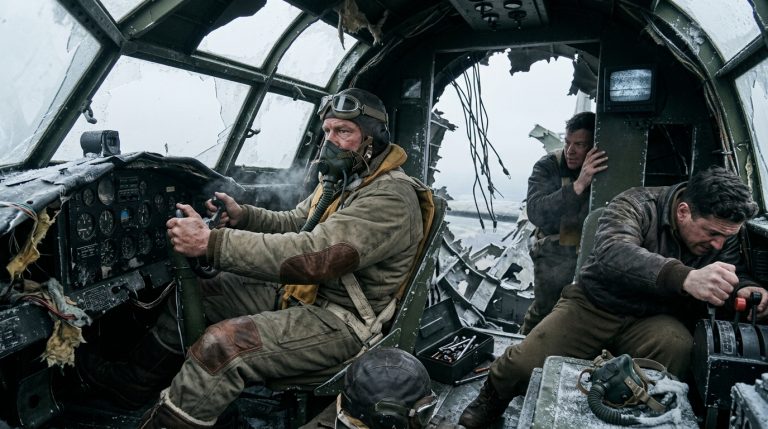
Twelve hours later, the twin engines of the Bristol Bombay roared with a bone-rattling vibration, filling the dark cabin with the stench of unburnt aviation fuel and cold exhaust. Sand whipped through the floorboard gaps, biting at our faces like needle points as the plane pitched violently in the rising storm.
Fifty men sat packed on the narrow metal benches, static lines clipped to the overhead cable, faces pale under the dim yellow interior light.
The green jump light flickered on near the door frame, but the aircraft lurched violently to the left as a gale-force crosswind slammed into the fuselage.
“Out! Out! Out!” Lewes shouted over the deafening roar of the airframe screaming against the storm.
I hit the open door frame first, the night air tearing at my uniform like a pair of iron hands. The desert below was a pitch-black abyss, completely swallowed by a blinding, howling sandstorm that erased the horizon.
The drop was a disaster before my boots even touched the ground.
The wind grabbed my canopy, dragging me sideways through the freezing air and slamming me hard into a rocky gully. The impact rattled my teeth and sent a burning spike of pain straight up my healing spine, knocking every cubic inch of oxygen out of my lungs.
I cut the harness webbing with my trench knife, fighting for air through the sand filling my nose and mouth.
For three hours, I stumbled through the screaming darkness, using the sun compass by tactile feel to stay on a southward bearing toward our emergency meeting point. There were no burning enemy bombers on the Gazala strips that night, no detonations, no victorious charges.
The sandstorm had devoured everything.
By dawn, the wind died down to a dull whistle, revealing a wasteland of flat stone and shifting dunes under a pale, bruised sky. I reached the rocky mound where the rendezvous was set, finding only Mayne and nineteen other men huddled behind a low stone wall.
“Where are the others?” I asked, my throat feeling like it was lined with coarse sandpaper.
“Lost in the drifts or taken by the Italian patrols,” Mayne said quietly, his large hands carefully picking grains of silt out of a jammed revolver cylinder. “McGonigal’s dead on impact. Bonington’s transport got shot down before they even hit the door.”
Lewes walked over, his face coated in white dust, holding a single canvas bag recovered from the drop zone. Inside, the Lewis demolition bombs were soaked through with rainwater, their fuses turned to useless gray pulp by the sudden storm.
“Thirty-four men gone,” Lewes said, his voice flat, devoid of emotion. “Zero enemy planes touched. The staff officers at GHQ are going to have a celebration when this report hits their desks.”
“Let them celebrate,” I said, wiping a mixture of sweat and red dust from my brow as I leaned heavily on my crutch. “They think this proves irregular warfare doesn’t work.”
“It proves jump drops in the desert are suicide, David,” Mayne growled, kicking a stone across the ridge. “You can’t control the wind.”
“Then we stop jumping,” I said, staring south toward the vast, trackless sand sea where no plane could ever track us. “We don’t need parachutes to cross the desert. We just need wheels that don’t sink.”
CHAPTER 4: THE CHEVROLET LIFELINE
Lieutenant David Lloyd Owen hopped down from the running board of the lead truck, his canvas cap tilted back, eyes squinting through the heat shimmer at the twenty survivors huddled against the rock.
“You lot look like you’ve been dragged through a gravel pit,” Lloyd Owen said, unhooking a brass water canteen from his belt and handing it over. “GHQ told us to look out for drop debris. Didn’t realize the debris was still breathing.”
“The wind took the chutes,” I said, taking a short pull from the canteen to wet my cracked tongue before handing it straight to Paddy Mayne. “The operation’s dead, David. But the idea isn’t.”
I tapped the brass sun compass against the steel bed of the nearest Chevrolet. The heavy 1.5-ton truck sat low on its springs, modified with sand channels strapped to the sides and extra fuel drums welded along the wooden rails.
“You drove four hundred miles across open dune fields to pick us up,” I said, looking Lloyd Owen in the eye. “If your trucks can cross the sand sea to rescue us, they can cross it to drop us off.”
Lloyd Owen rested his hand on his hip, letting out a slow breath. “The LRDG isn’t a taxi service, Stirling. We do road watch and deep reconnaissance for Middle East HQ. My commanders aren’t going to let us risk heavy transport on an airfield assault.”
“GHQ wants L Detachment dead and buried,” Paddy Mayne rumbled, stepping up beside me, his tall frame casting a long shadow over the driver’s cab. “They’re processing the disbandment papers in Cairo right now. If we go back empty-handed, they stick us in a garrison unit.”
“We don’t need your trucks to fight,” Jock Lewes added, pulling a small, black-wrapped package from his tunic—a improvised Lewis bomb made of Nobel 808, thermite, and motor oil. “We just need a lift to the perimeter fence. We do the work on foot, you pick us up five miles out.”
Lloyd Owen looked at the small demolition charge, then at the hard, unyielding faces of the twenty men standing around the trucks. He rubbed the back of his sun-burned neck with a dust-caked palm.
“One run,” Lloyd Owen said softly. “Tamimi airfield. If it works, I talk to my commander. If it goes sideways, we leave you behind.”
Three nights later, the low, black silhouettes of Junkers 52 transports sat lined up along the tarmac at Tamimi, illuminated only by the faint glow of an open barracks door.
We slipped off the back of the Chevrolets two miles out, moving through the perimeter wire like ghosts. No chutes, no roaring aircraft engines in the night sky to warn the sentries—just twenty men on foot with four Lewis bombs each.
Paddy Mayne moved ahead into the darkness, his trench knife held reverse-grip, slipping past an Italian sentry before the man even turned his head.
Ten minutes later, a dull thump echoed across the tarmac, followed instantly by a blinding orange fireball as aviation fuel ignited inside a bomber’s wing tank. Another explosion followed three seconds later, then another, ripples of white-hot thermite melting through metal fuselages.
By the time the alarm sirens began to wail across Tamimi, twenty-four Axis aircraft were burning to the ground.
We reached the extraction point five miles south in under an hour. Lloyd Owen was waiting beside the idling Chevrolets, his jaw slack as he watched the thick black plumes of smoke rising against the midnight sky.
“Twenty-four,” Mayne said, climbing into the bed of the truck and resting his back against a spare tire. “Zero casualties.”
I pulled myself onto the running board, resting my heavy crutch against the gear stick. “Now tell Cairo we’re ready to order our own wheels.”
CHAPTER 5: THE TOLEDO IRON
Inside lay a olive-drab hood, two unmounted wheels, and a stamped steel grille bearing the name Willys.
Paddy Mayne stepped up, wiping grease off his palms with a rag, staring down into the crate with a skeptical frown. “It looks like a tin toy, David. It doesn’t even have doors.”
“It has four-wheel drive, Paddy,” I said, dropping the crowbar onto the concrete floor of the Cairo docks. “And it weighs half as much as an LRDG truck. If we strip the dead weight off it, it won’t sink into the soft dunes.”
“It won’t hold enough fuel to get us fifty miles past the line either,” Jock Lewes noted, tapping his finger against the tiny fifteen-gallon tank under the driver’s seat. “Not as it sits.”
“Then we make it fit,” I said.
For seventy-two hours, the workshop behind the Kabrit shacks smelled of hot welding torches, grinding steel, and spilt oil.
We unbolted the windshields and threw them behind the tents. We torched off the canvas tops, the metal doors, and every inch of decorative sheet metal. Every pound we cut meant another gallon of fuel or another drum of ammunition we could carry into the deep sand.
Lewes rigged condenser cans onto the radiators, piping the steam through copper tubes to recycle precious cooling water in the heat. We welded heavy angle-iron racks across the rear fenders and hood, packing each frame tight with twelve five-gallon steel jerrycans.
“What about the teeth?” Mayne asked, leaning against the bare steel frame of the lead vehicle.
I hauled a wooden crate onto the workbench and kicked the slats open, revealing four twin-mounted Vickers gas-operated machine guns—surplus stock pulled straight from stripped RAF bombers.
“Nine hundred rounds a minute per barrel,” I said, running my hand along the cold steel receiver. “We mount two on the passenger side and a twin post in the back.”
Mayne’s face broke into that grim, predatory grin. “Four guns per wagon. That’s nearly four thousand rounds of tracer and incendiary a minute.”
“We don’t plant charges on foot anymore, lads,” I said, tapping the brass sun compass against the steel dash of the modified Jeep. “We drive straight down the flight line with everything firing.”
As we tightened the last bolts on the fifteen Jeeps, a quartermaster major from GHQ rolled up in a pristine staff car, his polished boots stepping carefully around the oil slicks on the dirt. He held a clipboard tight against his ribs, his eyes wide with horror as he looked at our hacked-up vehicles.
“What have you done to these transport assets, Stirling?” the major demanded, his voice thin and shrill. “These are official Lend-Lease utility vehicles! You’ve destroyed army property! I am filing an immediate report to the Ordnance Department!”
I didn’t even bother getting down from the driver’s seat. I pulled a redacted, red-inked movement schedule from my pocket—the one I’d pulled from the discarded supply box in Cairo—and tossed it into his lap.
“Look at the serial numbers, Major,” I said softly, my voice cold as ice. “GHQ wrote these vehicles off as lost in transit three days ago. You can’t destroy what doesn’t exist on your ledger.”
The major looked down at the official stamp, his mouth opening and closing like a landed carp, but no sound came out.
“Now get out of my light,” I said, turning the key. The modified engine roared to life with a deep, throaty rumble, blowing a cloud of blue exhaust straight across his polished boots. “We have a air strip to catch.”
CHAPTER 6: THE SIDI HANEISH STORM
“Luftwaffe transport coming in,” Sadler whispered over the low idle of eighteen Jeep engines. “Ground crew lit the whole strip for him.”
“Nine vehicles in the left column, nine on the right,” I said, my voice barely audible above the desert wind as I pulled a green Very flare pistol from the holster on the dash. “Paddy takes the left line. Keep thirty yards between buggies and don’t stop driving until the strip is clear.”
Paddy Mayne didn’t speak. He just racked the bolt on his twin Vickers mount with a sharp, heavy metallic clack, the sound carrying across the dark sand.
I squeezed the trigger on the Very pistol.
The green flare arched high into the night sky, casting an eerie emerald glare over the airfield. Eighteen engines roared simultaneously as sixty men slammed their boots to the floorboards.
We hit the edge of the runway at forty miles an hour in a wide V-formation.
Tracer rounds instantly tore through the dark, four thousand rounds a minute streaming from seventy-two Vickers barrels in a blinding torrent of orange and red lead. Junkers 52s, Stuka dive bombers, and Messerschmitt fighters lined up along the tarmac erupted into towering fireballs one after another as incendiary bullets punched straight into their fuel tanks.
Ground crews scattered in utter panic, throwing themselves into drainage ditches as the twin columns of Jeeps swept down the flight line like a mechanical thunderstorm.
For fifteen relentless minutes, we hammered the strip from end to end, turning forty prime enemy aircraft into molten aluminum and black smoke.
When the last column cleared the northern perimeter wire, the airfield behind us was a single, massive inferno visible for thirty miles across the desert. Zero infantry support, zero artillery, and not a single parachute dropped from the sky. Just sixty men and eighteen modified American utility wagons that GHQ had dismissed as useless scrap.
Three days later, the dust of the raid had barely settled when the courier plane from Cairo landed at our forward strip in southern Tunisia.
A staff major—not the one from the docks, but a senior liaison from General Auchinleck’s personal cabinet—marched into our command tent with a thick leather pouch under his arm.
He didn’t look at Paddy Mayne, who was sitting on a wooden crate cleaning a machine gun receiver, nor at Jock Lewes’s notes pinned to the map table. He pulled out an official parchment document bearing the red wax seal of the War Office.
“Special Air Service Brigade is granted full regimental status, effective immediately,” the major read, his tone stiff and completely drained of its former bureaucratic condescension. “L Detachment is designated 1st SAS. Authorization is granted for full expansion to three operational squadrons, with priority requisitioning authority for all vehicular, fuel, and armament assets across Middle East Command.”
He set the document on the center of the table, right next to my scratched brass sun compass.
“The Commander-in-Chief also extends his personal commendation,” the major added, stiffening his spine. “GHQ acknowledges that your tactical doctrine has diverted an entire enemy division from the frontline to guard rear-area airfields.”
“Tell GHQ they can keep their commendation,” I said quietly, tapping my thumb against the brass rim of the compass. “Just tell them to keep sending the fuel.”
The major stood silent for a second, realized there was no polite military response to give, gave a brief nod, and turned on his heel to exit the tent.
I picked up the sun compass, slipped it into my tunic pocket, and stepped out into the bright afternoon sun.
In the center of the camp, Paddy Mayne was sitting on a dry oil drum near the stolen piano, picking out a slow tune while three mechanics tightened the wheel lugs on a newly arrived Willys Jeep. The desert wind blew clean and cold off the sand, carrying away the lingering stink of scorching metal and spilled gasoline.
There were no headquarters memos left to fight, no staff officers blocking the gate, and no pencil-pushers writing us off on a ledger.
I leaned back against the hood of the lead Jeep, pulled out a rag, and began wiping the fine layer of red sand off the steering wheel.