Wooden Wings in the Dark Sky: The Reluctant Night Hunter Who Outsmarted the Luftwaffe
CHAPTER 1: COLD IRON AND WOOD
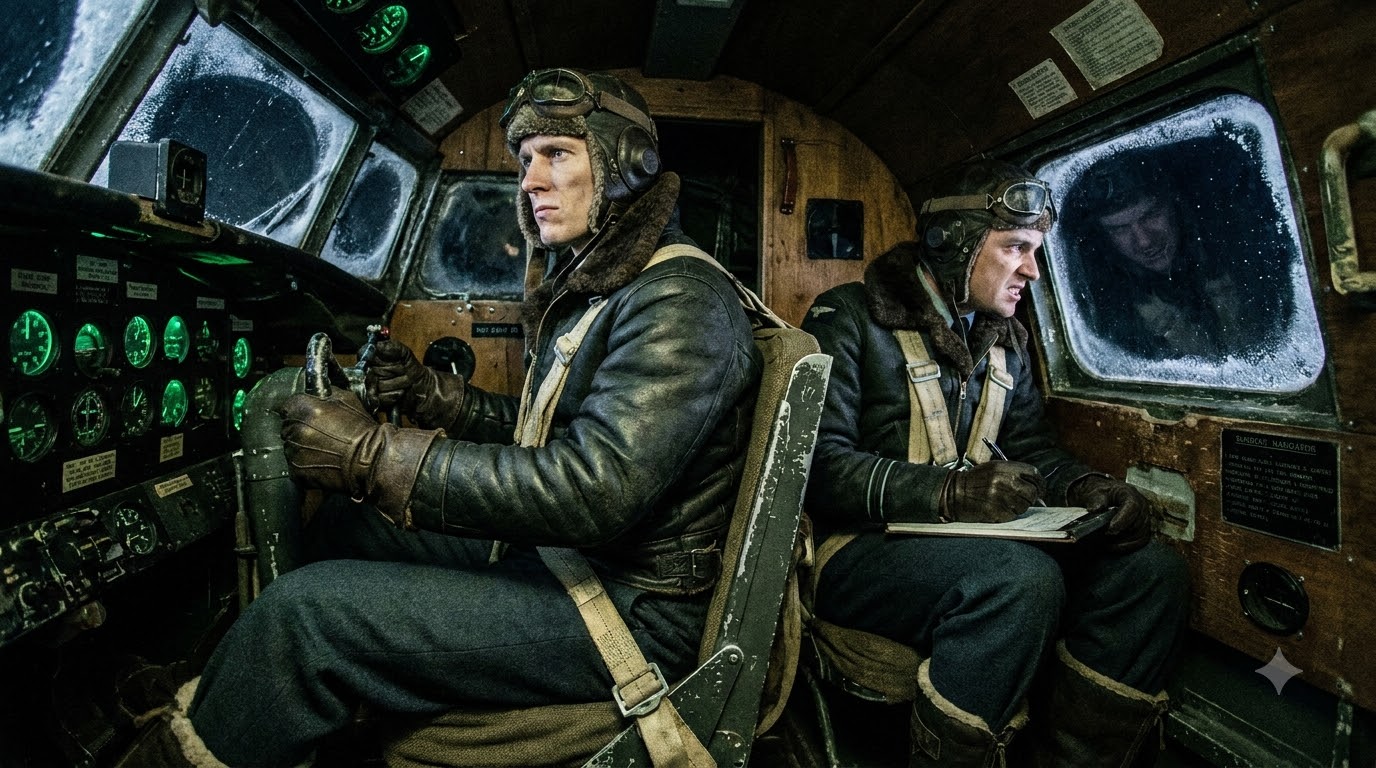
The leather of my flight harness was stiff with old sweat and sub-zero frost.
Beside me in the cramped cockpit, Bill didn’t look at his instruments; his gloved hands moved by muscle memory across the blank panel where the radar scope used to live.
We had no electronic crutches tonight.
The airframe vibrated with a deep, rhythmic shudder as we climbed through eighteen hundred feet over the English coast, banking hard to duck beneath the sweep of coastal radar.
The cockpit heater was broken again, leaking a thin stream of lukewarm air that smelled faintly of stale oil and damp wool.
I pulled my scarf tighter around my neck, staring out into the absolute blackness of the North Sea.
Every dial on the dash glowed a faint, sickly green, casting sharp shadows across Bill’s jawline as he tracked our heading with a grease pencil on his knee-board.
CHAPTER 2: CROSSING THE BLACK RHINE
The cockpit was dead silent except for the low, rhythmic thrum of the two Merlin engines beneath the wooden cowling.
We crossed the Belgian border at fifteen thousand feet, slipping through a thin shelf of high-altitude cirrus that left a greasy film on the windscreen.
Bill leaned forward over his knee-board, his eyes scanning the empty scope where our electronic eyes used to live.
“Nothing on the band,” he whispered, his voice flat against the roar. “We are flying blind tonight.”
I didn’t answer.
My knuckles were white around the control column, the cold iron biting through the worn leather of my gloves.
Below us, the landscape was swallowed by a heavy, bruised darkness, broken only by the occasional pinprick of a blackout violation in a darkened rail yard near Liège.
A low, unmapped hum vibrated through the airframe, too steady to be engine resonance, rattling the fuel gauges on the instrument panel.
Bill tilted his head, listening for a fraction of a second before marking a small X with his grease pencil.
“Ground station,” he muttered. “They are sweeping wide tonight.”
We held our altitude, refusing to adjust our heading despite the creeping temptation to drop lower beneath the cloud deck.
The air grew bitterly cold, frosting the edges of the side glass and forcing me to blink constantly against the sting of my own breath.
Then, a faint flash of silver cut through the gray shadows off our starboard wing.
A Junkers 88 drifted across the upper boundary of the cloud layer, its twin tails silhouetted against the pale starlight for barely a heartbeat.
It was hunting the bomber streams ahead of us, entirely unaware that the prey had turned hunter.
I eased the throttles forward, feeling the wooden airframe surge responsively into the freezing wind.
CHAPTER 3: THE SILENT FORMATION
The air felt heavy, choked with the exhaust of a dozen unseen engines orbiting the airfield below.
We slipped straight into the circular holding pattern, squeezing our wooden frame between two German night fighters without a single word passing between us.
Bill stared out his side window, his jaw clenched tight as a Messerschmitt drifted eighteen hundred feet ahead, its twin tail booms dark against the starry void.
“We are inside their orbit,” he murmured, his breath frosting the side glass.
“Keep your eyes on the spacing,” I whispered back, my grip on the control column slick with sweat despite the cabin’s freezing chill.
For ninety long seconds, we flew their formation, mimicking their exact bank angle and speed while they hunted bombers that hadn’t yet arrived.
The absurdity of it pulled a cold, grim irony tight across my chest—sitting wingtip-to-wingtip with men who would kill us instantly if they knew we were there.
A sudden flash of memory from my instructor days flickered behind my eyes, reminding me how fragile this thin wooden skin really was.
I nudged the throttles forward by a fraction of an inch, closing the gap on the lead aircraft as the orbital circuit turned toward the dark valley below.
CHAPTER 4: THE ENGINE RULE
The port engine of the Messerschmitt filled our front windscreen, a massive iron block glowing with a faint, dull heat against the frost.
Bill didn’t look up from his knee-board; his shoulders tensed as the cockpit filled with the sharp, acrid smell of hot cordite.
“Three seconds,” he muttered, his voice flat and steady. “Keep it on the tin.”
I squeezed the trigger, letting the weapon kick back violently through the wooden airframe with a bone-rattling roar.
Tracer rounds ripped across the dark void, tearing directly into the enemy’s engine housing rather than the glazed cockpit glass.
Orange flames erupted instantly from the wing root, bathing the German pilot’s profile in a harsh, flickering light before he banked hard into the abyss.
We pulled up sharply to dodge the falling debris, the slipstream rocking our thin wings with a brutal, groaning heave.
“That is one,” Bill whispered, his pencil marking a sharp line across the paper.
CHAPTER 5: THE HEADON MERGE
The oncoming Junker surged out of the blackness, its twin engines roaring like a freight train on a iron track.
Bill did not look up from his screen, his finger tracing a sharp arc across the cold metal of his clipboard.
“Closing fast—four hundred knots,” he shouted over the howling slipstream.
I locked my eyes on the shimmering arcs of lead rushing straight toward our wooden windscreen.
There was nowhere to dive, nowhere to hide in the frozen open air above the Rhine.
We held our line, refusing to break under the sheer arrogance of the opposing approach.
At three hundred yards, the enemy gunner opened up, stitching a line of hot metal across our outer wingtip.
I mashed the triggers down to the floorboards, feeding every remaining ounce of ammunition into a desperate, head-on wall of lead.
The enemy canopy shattered into a thousand glittering shards under our sustained fire, rolling upward in a thick cloud of oily black smoke.
We scraped past the burning wreckage by inches, the hot wash of their exhaust slamming our tail feathers into a violent shudder.
CHAPTER 6: THE LONG RETURN HOME
The wooden airframe settled onto the wet tarmac with a harsh, groaning bump that rattled every rivet in the fuselage.
Bill pulled his knees back against the instrument panel, exhaling a long, shuddering breath that cleared a circle of frost from his side glass.
“We are down,” he said quietly, his voice devoid of triumph, carrying only the flat weight of survival.
I cut the Merlin engines, letting the twin propellers spin slowly to a halt in the damp Norfolk dawn.
Ground crew figures materialized out of the gray mist, their faces drawn and tired as they approached the battered wingtip.
There were no cheers, no grand speeches about glory—just the silent, grueling mechanics of checking fuel levels and tallying empty ammunition bays.
We had stopped the machines in the dark above Germany, but the heavy toll of that survival settled deep into our bones like winter frost.
I climbed down from the cockpit onto the muddy ground, my legs stiff and trembling under the sudden absence of G-force.
The war would go on tomorrow, but tonight the sky belonged only to the silence.