The Secret Shell That Outsmarted Physics and Saved Thousands in the Frozen Winter of the Ardennes
CHAPTER 1: THE IMPOSSIBLE STANDARD
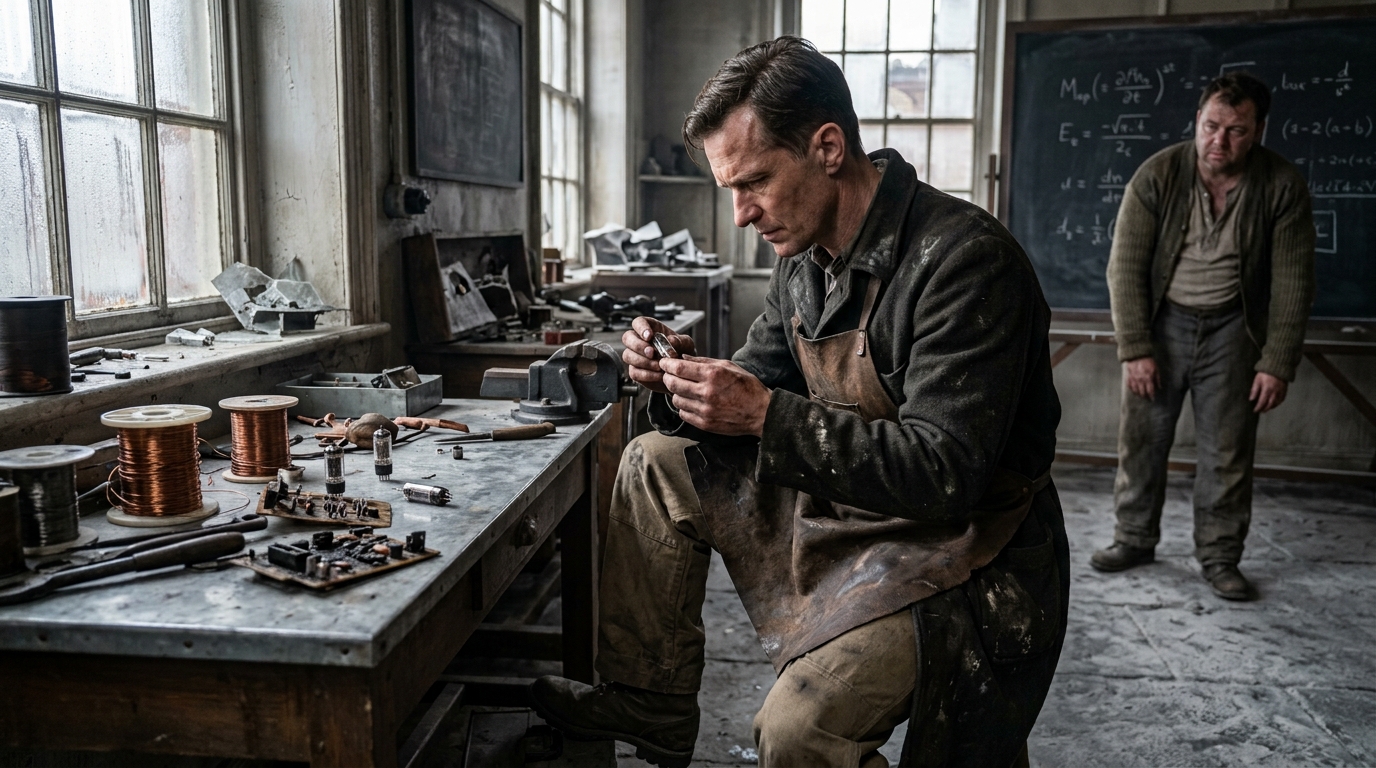
The brass soldering iron hissed against the resin flux, sending a sharp, chemical sting straight up the nostrils.
William Butement did not blink.
He stared down at the tangled nest of copper wire and miniature glass tubes clamped to the wooden workbench, his thumb calloused and blackened from weeks of touching hot leads.
Across the damp London laboratory, another prototype battery hit the stone floor with a dull, ceramic clatter.
It shattered into gray dust, joining a dozen others swept into the corner by the broom.
“The physics simply will not permit it,” Edward Shire muttered, wiping grease from his forehead with the back of a thick woolen sleeve.
His breath plumed white in the unheated room, mixing with the acrid smoke of burning solder.
“Twenty thousand times gravity inside a rifled barrel will turn these filaments into powdered glass before the round clears the muzzle.”
Butement did not look up from the bench.
He picked up a tiny vacuum tube no larger than a peanut shell, rolling its fragile cylinder between his thumb and forefinger.
The math on the chalkboard behind them was stark and unforgiving.
Every test firing had ended the same way: a deafening roar in the proving grounds, followed by the silent recovery of a completely pulverized circuit board.
The British engineers had reached the edge of what human industry could manufacture under the falling bombs.
They had proved the radio frequency concept worked on paper, but the brutal mechanical reality of high-velocity artillery kept smashing their best work to pieces.
Shire dropped his tools onto the wood with a heavy thud, his shoulders slumping under the weight of exhaustion and endless failure.
“We are chasing a ghost,” Shire said, his voice dropping to a gravelly rasp. “The Germans are right. You cannot put a radio set inside a cannon shell.”
Butement set the tiny tube down on the scarred wood with deliberate slowness.
He reached for a fresh roll of copper wire, his fingers stiff from the bitter draft seeping through the cracked windowpane.
“Then we stop trying to build it like a radio,” Butement said quietly, his eyes fixed on the broken glass in the corner. “And start building it like an anvil.”
CHAPTER 2: THE SILVER SPRING GARAGE
Merle Tuve did not look down at the fallen tool.
His eyes were locked on the makeshift shock-testing rig bolted to the battered workbench.
A single glass vacuum tube sat inside a heavy steel casing, wired to an oscilloscope that hummed with a low, steady frequency.
“The housing is holding the rotational torque,” Richard Roberts said, his voice tight as he adjusted a dial on the flickering screen. “Twenty-five thousand revolutions per minute. But the filament inside is a different story.”
Tuve picked up a magnifying glass, squinting under the harsh glare of an overhead work light.
A microscopic hairline fracture spiderwebbed across the base of the tiny glass envelope.
It looked like nothing more than a scratch, but it meant total failure the moment a cannon charge ignited.
“We are not packing it tight enough,” Tuve said, his thumb rubbing a smudge of grease on his apron. “The wax we used to equalize pressure is shifting under the initial acceleration spike.”
Across the drafty room, a technician dumped a box of discarded radio parts onto a metal table, the scrap clattering loudly against the zinc surface.
There were no factory-fresh precision plates arriving from polished assembly lines today; the team had to scavenge whatever workable wire and glass they could salvage from obsolete commercial sets.
Roberts leaned over the rig, wiping condensation from his spectacles.
“If we cannot stop that internal vibration, every single shell we send to the field will turn into an expensive paperweight before it clears the barrel,” Roberts muttered.
Tuve reached out and gripped the edge of the wooden bench, feeling the vibration of the city outside rattling through the floorboards.
“Then we change the medium,” Tuve said, his voice dropping to a low, flat register. “Melt down the paraffin and mix it with fine quartz dust. Make it pack solid.”
CHAPTER 3: THE BATTERY BREAKTHROUGH
The hot wax hit the zinc-plated cavity with a sharp hiss.
James Van Allen leaned forward, his elbows planted on the edge of the workbench.
He watched the liquid pool around the base of the tiny, heavily reinforced vacuum tube they had spent the last seventy-two hours building.
The heat radiating off the metal mold made the air in the cramped garage shimmer.
“The wax will hold the glass during launch,” Van Allen said, his voice flat with fatigue. “That solves the acceleration.”
He reached out and tapped a dry cell battery sitting on the bench.
“But it doesn’t solve this. By the time these shells get loaded onto a transport, sit in the humid hold of a Liberty ship for a month, and finally reach a forward ammunition dump in the Pacific, these dry cells will be completely dead.”
Tuve set the crucible down heavily.
The iron clanged against the wood, a dull sound that seemed to swallow the ambient noise of the lab.
He didn’t argue. They both knew the numbers. An eighty percent failure rate in tropical storage meant the weapon was functionally useless to the Navy.
“A battery requires a chemical reaction,” Tuve said, wiping a line of sweat from his temple with a dirty rag. “And a reaction degrades over time. There is no negotiating with chemistry.”
Van Allen picked up the dry cell, feeling its heavy, useless weight.
He turned it over, examining the sealed casing.
“Then we stop letting it react,” Van Allen said. “We build a battery that isn’t a battery until the exact second it needs to be.”
Tuve raised an eyebrow, his jaw tight.
“You want to store the electrolyte separately.”
“Inside a glass ampule,” Van Allen replied, pulling a scrap piece of paper toward him and sketching rapidly with a grease pencil. “Right in the center of the fuse. Inert zinc and lead plates surrounding it. Totally dry. Infinite shelf life.”
He stabbed the pencil onto the center of his crude drawing.
“The shell fires. Twenty thousand Gs of acceleration instantly shatters the glass. The shell is spinning at thirty thousand RPMs.”
Van Allen dragged the pencil outward in sharp, radiating lines.
“Centrifugal force drives the liquid acid outward, through the plates. The battery builds a charge in less than a second while the shell is already in the air.”
Tuve stared at the rough schematic.
The silence in the garage grew thick, broken only by the cooling crackle of the hardening wax in the mold.
It was a brilliantly ugly solution, relying entirely on the violent physics of the cannon to assemble the battery mid-flight.
“We need glass ampules,” Tuve said finally, his voice low.
“And we don’t have a supplier.” Van Allen tossed the pencil onto the table.
Tuve didn’t blink. He reached into his apron pocket and pulled out a heavy brass pocket watch, checking the time.
“Then find an obsolete medical supply catalog,” Tuve ordered. “Find someone who makes iodine vials and tell them we need fifty thousand empty ones by Tuesday.”
CHAPTER 4: THE FORBIDDEN STOCKPILE
Master Sergeant Harrison wiped wet clay from his boot against the edge of the loading dock, staring down at the heavy black lettering stenciled across the pine boards.
POSIT.
The word meant nothing to the stevedores hauling crates through the freezing drizzle, but the armed guards standing twenty paces back with their carbines unslung made it clear this cargo carried a heavy penalty.
“Another twelve pallets of them came in off the last railcar,” Dennis said, his quiet voice cutting through the hiss of the rain as he stepped up beside Harrison with a clipboard pressed against his ribs.
“And they aren’t going anywhere.”
Harrison spat a glob of gray tobacco juice into the puddles, his eyes narrowing at the iron seals locking the lids down.
For four months, these crates had piled up in every depot from Marseille to the Belgian border, taking up valuable floor space while infantry units five miles up the road rationed high-explosive rounds like bread during a famine.
The brass in Paris had made the rule absolute: not one single box opened, not one round chambered.
A single dud discovered in a muddy wheat field by a German patrolman, and the entire multi-million-dollar radio secret would leak straight to Berlin.
“They’re sitting on gold and calling it scrap,” Harrison muttered, his fingers rapping a steady, impatient rhythm against the cold wood of the nearest crate.
“Orders are explicit, Sergeant,” Dennis replied, adjusting his canvas collar against the wind. “A single stray round falling into enemy hands means an immediate court-martial. Command says we keep them locked.”
Harrison reached out, his bare knuckle scraping against the rough grain of the stencil.
He didn’t care about Paris, and he didn’t care about the high-level briefings he was never invited to attend.
He cared about the casualty lists coming back from the tree lines every evening, written in grease pencil on oilcloth boards.
“They’re treating a war like a safety inspection,” Harrison said, his jaw tightening as a distant rumble of artillery rolled over the frosted hills.
“Let’s see how long that rule holds when the line breaks.”
CHAPTER 5: THE CHRISTMAS MASSACRE
Master Sergeant Harrison wiped freezing mist from his binoculars, his knuckles raw against the rubber eyecups as gray silhouettes moved across the distant ice of the Sauer River.
The German infantrymen walked with an unearned swagger, shoulder-to-shoulder on the wooden bridge, entirely convinced that the low-hanging winter cloud cover rendered them completely invisible to American forward observers.
“They think they have God’s own blanket over them,” Dennis muttered from the trench floor, his breath freezing into gray crystals on the wool of his scarf.
“Let them keep thinking it,” Harrison said, his thumb flicking the safety catch of his radio box.
He didn’t wait for permission from division headquarters; the emergency override orders from General Patton were already burning a hole in his pocket.
Harrison signaled down the line, his voice hard as iron.
“Load the posit rounds. Fire for effect.”
Ten howitzers roared in unison, a concussive shockwave that kicked up a wall of frozen mud and dead leaves.
There was no whistle of an incoming arc, no warning shriek to let the enemy dive for cover.
Thirty feet above the frozen bridge, the radio frequency nose cones sensed the mass of the wooden structure and triggered instantly.
The sky erupted in a deafening sheet of white-hot steel and pulverized wood, raining jagged fragments straight down into the crowded ranks below.
Men on the span were cut down in their tracks before they could comprehend that the air itself had turned lethal.
Those who leaped into the black, icy current found no sanctuary from the descending shrapnel.
Dennis stared through the drifting cordite smoke as the screaming stopped, leaving only the dark water and scattered debris along the shoreline.
“They didn’t even have time to drop,” Dennis whispered, his face pale under the soot.
Harrison lowered his binoculars, his jaw set in a grim, unchanging line as he watched the enemy line shatter under the weight of a secret they never saw coming.
“That’s because the earth doesn’t protect you anymore,” Harrison said, tossing his damp cigarette into the freezing mud.
“Get the second battery ready. They aren’t done crossing yet.”
CHAPTER 6: THE SILENT AFTERMATH
Master Sergeant Harrison let go of the sighting crank, his shoulder muscles aching with a deep, heavy stiffness that no amount of rest could shake.
The valley below was utterly still.
The wooden bridge over the Sauer River stood scarred and splintered, its timbers jagged where the high-burst shrapnel had stripped away the handrails and left the crossing empty of life.
Dennis walked up behind him, carrying a crate of empty shell casings, his boots crunching softly against the frozen winter grass.
“The reports from the front lines are coming in through the wire,” Dennis said, setting the heavy brass tubes down with a dull metallic clatter.
“They say the enemy units in the forest have stopped moving out of their bunkers entirely.”
Harrison looked down at his own hands, blackened with powder residue and grease that had worked its way deep into the skin lines.
He didn’t smile, and there was no sense of celebration in the freezing air, only the heavy, sober realization of a massive turning point.
The ancient contract between the foot soldier and the earth—the promise that digging a deep trench or hiding under a canopy of trees could save a man’s life—was broken forever.
“They spent years telling themselves that electronics could never survive the shock of a cannon,” Harrison said, his voice dropping to a dry, raspy whisper.
“And they were wrong because a few stubborn men in a Maryland garage refused to quit tinkering with scrap glass and wax.”
Dennis leaned against the cold steel of the howitzer shield, looking out toward the distant tree line where the Ardennes forest began to fade into gray mist.
“Does anyone back home even know what did this?”
“Not yet,” Harrison replied, reaching down to pick up a single, unbroken copper driving band left over from the morning’s barrage.
“The secret stayed locked up tight until the guns forced the issue.”
Harrison tossed the scrap piece of metal back into the supply box, turning his back on the valley as the first pale light of winter afternoon broke across the frozen ridge.
The war would go on, but the sky had changed, and the rules of the earth would never be the same again.