The Salt and the Flame: How a Forgotten Classified Weapon Saved a Generation of Marines on Peleliu
CHAPTER 1: The Coral Trap
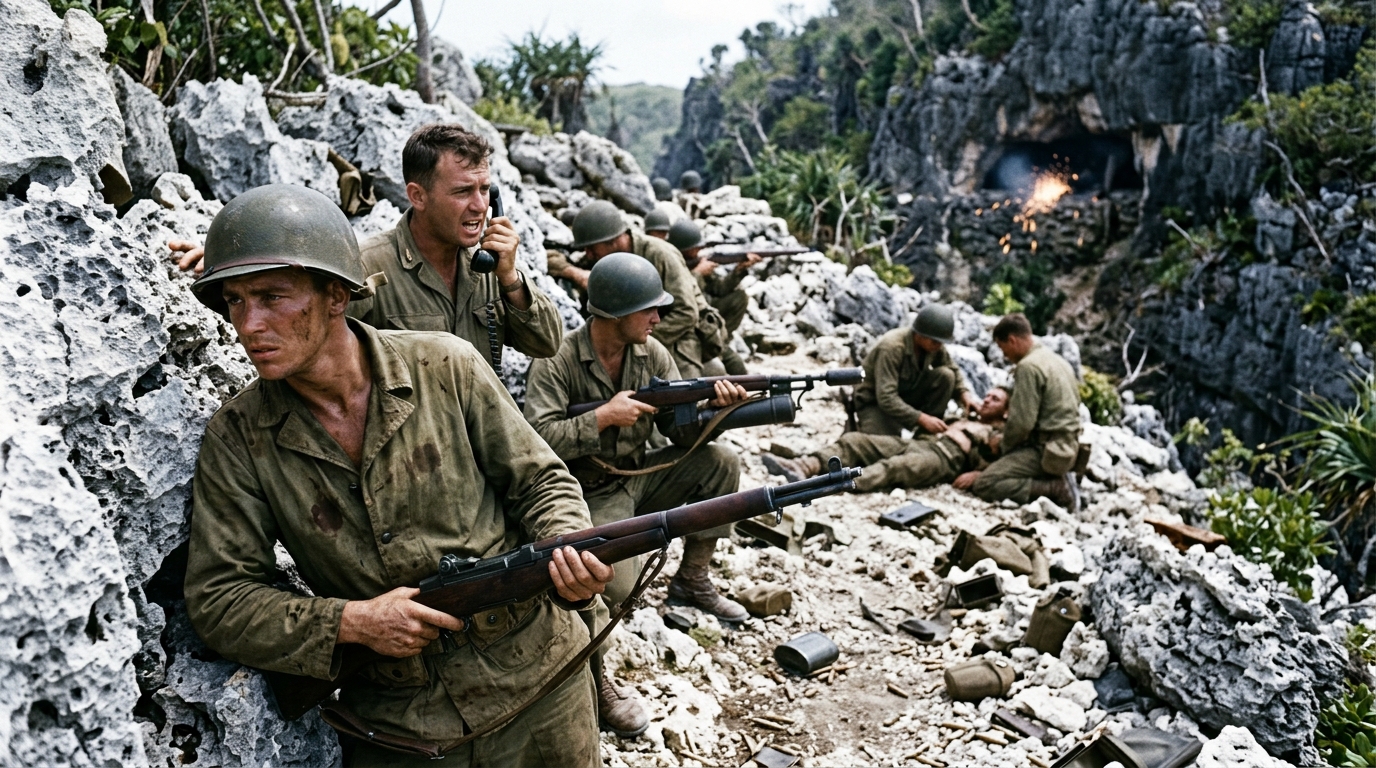
The M1 Garand felt useless against the limestone.
Thomas Whitmore pressed his shoulder hard into the jagged outcropping, his fingers slipping on the sweaty steel of his stock.
Seventy-five yards upslope, a Japanese Type 92 machine gun chattered in steady three-round bursts.
The bullets didn’t penetrate the cave fortification; they sparked bright yellow against the rock and whined off into the humid air.
Twelve feet to his left, Sergeant Miller leaked blood into the crushed coral.
Each breath came with a wet, heavy rattle that cut through the noise of the ridge.
Lieutenant Crawford screamed into the radio handset for the third time, demanding flamethrower support that was hours away.
The infantry line was pinned tight against an exposed field.
To advance meant getting cut down; to stay meant waiting for an artillery barrage that might never connect.
Whitmore wiped salt sweat from his eyes with a grime-stained sleeve.
His boots sat soaked in stagnant water pooled inside the fold of the trench.
There was no room for heroics in the dirt, only the heavy, grinding math of survival against an unseen enemy hiding deep inside the dark throat of the ridge.
CHAPTER 2: The Unseen Spark
The air across the coral ridge grew tight and sharp as Hutcherson dropped to one knee beside Whitmore’s outcropping.
He didn’t yell over the machine gun fire.
He simply adjusted the canvas strap cutting into his shoulder and checked the small aluminum canister strapped against his lower back.
Whitmore stared at the bulbous steel tube welded beneath the rifle barrel, its dark opening reflecting the harsh island sun.
“Keep your heads down,” Hutcherson muttered, his voice flat and steady with the dry drawl of rural Georgia.
He didn’t wait for permission or radio clearance from the rear command post.
His thumb flipped a small lever near the receiver, shifting the gas valve with a distinct, metallic click.
Seventy-five yards upslope, the Type 92 gunner paused for a fraction of a second, entirely unaware of the compact fuel line now primed inches below the rifle’s standard stock.
Hutcherson raised the weapon, sighted down the scarred receiver, and pulled the trigger.
A compressed air cartridge hissed sharply against the bolt, forcing the thickened fuel stream out through the narrow nozzle in a tight, focused arc.
The piezoelectric igniter at the tip caught instantly, turning the spray into a roaring tongue of white-hot fire that bridged the open coral field in less than a second.
The flame didn’t disperse into a harmless cloud; it struck the limestone cave opening with brutal, sticky persistence.
Inside the fortification, the air vanished instantly, replaced by a wall of thermal pressure that turned the enemy bunker into a sealed oven.
The machine gun chatter cut off mid-burst, replaced by the muffled pop of ammunition cooking off under extreme heat.
Whitmore pressed his hands against the trembling rock, feeling the sudden, violent shift in the ridge’s tactical gravity.
CHAPTER 3: The Ridge Cleared
Whitmore kept his boots planted firmly in the damp mud as he followed Crawford past the smoking limestone opening.
The heavy stench of scorched earth and burnt metal clung to their uniforms like a second skin.
There was no time to celebrate the silence left behind by the neutralized bunker.
Further up the jagged ridge, another enemy position began spitting intermittent rifle fire down the slope.
Crawford dropped low behind a jagged outcropping, his hand slapping against the radio handset with visible frustration.
“We don’t have hours to wait for heavy gear,” Crawford muttered, his eyes darting across the uneven terrain.
Hutcherson didn’t hesitate; he shifted the canvas strap of his modified M1 Garand and checked the fuel canister on his lower back.
He didn’t look like a hero out of a Hollywood picture; he looked like an exhausted working man dealing with an impossible chore.
“I’ve got enough pressure for two more bursts,” Hutcherson said, his voice flat and steady against the mountain wind.
Whitmore checked his own rifle bolt, ensuring the standard chamber was clear while keeping his eyes locked on the upper bunker’s firing slit.
They moved together, utilizing every fold of the broken coral to close the distance without relying on outside support.
When they reached effective range, Hutcherson flipped the receiver valve with a sharp metallic snap.
The compressed air hissed into the nozzle, turning a routine infantry advance into a calculated exercise in raw survival.
CHAPTER 4: The Silent Return
Decades washed over the Michigan snow like a slow, unyielding tide.
Thomas Whitmore kept his service medals tucked deep inside a grease-stained shoe box in the back of his closet, alongside a faded photograph of men who never grew old.
He never spoke a public word about the weapon that saved his platoon on Peleliu, honoring a strict government classification stamp that lasted thirty-eight years.
Across the country in Georgia, James Hutcherson taught generations of high school students how to shape sheet metal, hanging a single quiet picture of his fire team on the workshop wall.
When young hands asked about the war, Hutcherson offered only a flat, steady smile—just some boys he served with.
The experimental gear they carried had been cut apart with torches and thrown into scrap heaps by December 1945, leaving no physical traces behind except three preserved museum pieces.
Yet that raw, practical ingenuity remained locked in their bones, a quiet reminder of what ordinary men could endure when left with no other choice.
Whitmore closed his closet door against the winter chill, his weathered hands steady and entirely at peace with the ghosts of the past.