The Iron Foundation: Where the Blood of the Soil Shatters the Glass Kingdom
CHAPTER 1: THE CEDAR BLADE
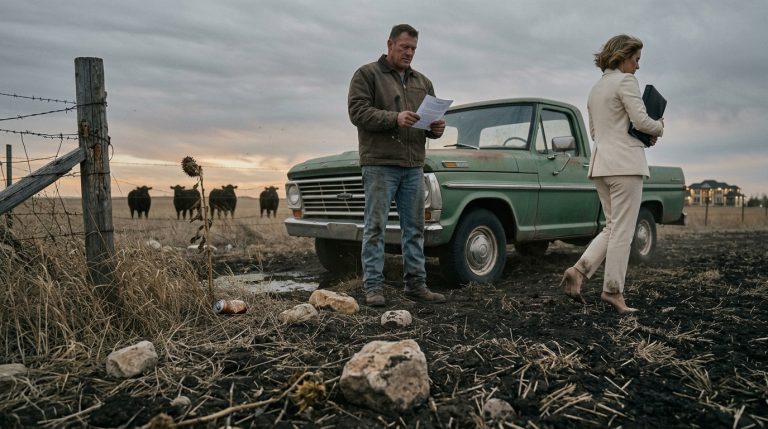
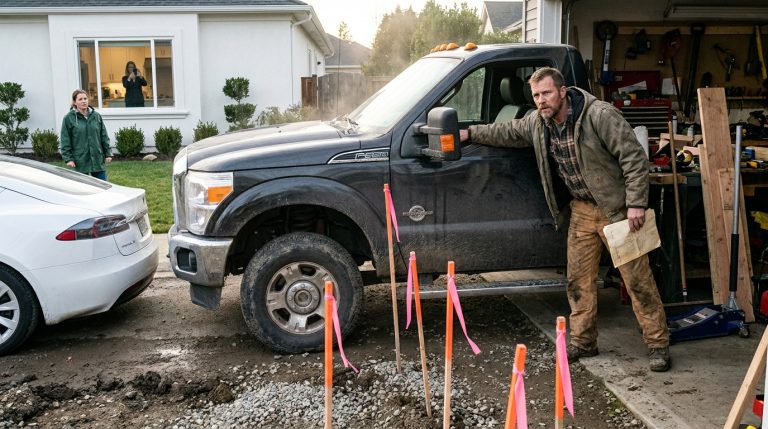
The air smelled of fresh-cut cedar and the sharp, oily exhaust of my old Ford idling near the ditch. It was barely seven in the morning, but the heat was already rising off the asphalt of Willowbrook Estates, casting a shimmering haze over thirty-five identical, half-million-dollar houses. I didn’t look up immediately. I kept my weight pressed against the post-hole digger, forcing the iron blades through the rocky crust of the Washington soil. Another inch of dirt yielded, dry and gray.
“Ma’am,” I said, my voice flat, level, the kind of quiet you use around a horse that’s looking for a reason to bolt. “This land isn’t in your HOA.”
“Everything from the highway to the ridge line is within our jurisdiction,” she snapped. Her fingernails, manicured to a jagged, pearl-white point, clicked against the screen of her phone. She stood on the neat, green margin of her perfect lawn, her white BMW X5 parked behind her like a sterile fortress on wheels. She radiated the precise, synthetic scent of honeysuckle perfume mixed with stress sweat. “You need an application. Review fees. Board approval. You can’t just put up a six-foot barricade because you don’t like the view.”
“I like the view fine,” I murmured, pulling the digger free and dropping a heavy, rough-sawn cedar post into the earth. It went down with a solid, hollow thud. “I just like boundaries better.”
She lost it. Her jaw set into a hard, plastic line, and within thirty seconds, her fingers were punching emergency digits into her screen. She didn’t drop her gaze. She stared at my muddy boots, the sawdust swirling in the morning breeze, as if my simple presence was a stain on her property value. I didn’t argue. I didn’t leave. Sometimes you have to let a person dig their own hole just to see how deep they’re willing to make it.
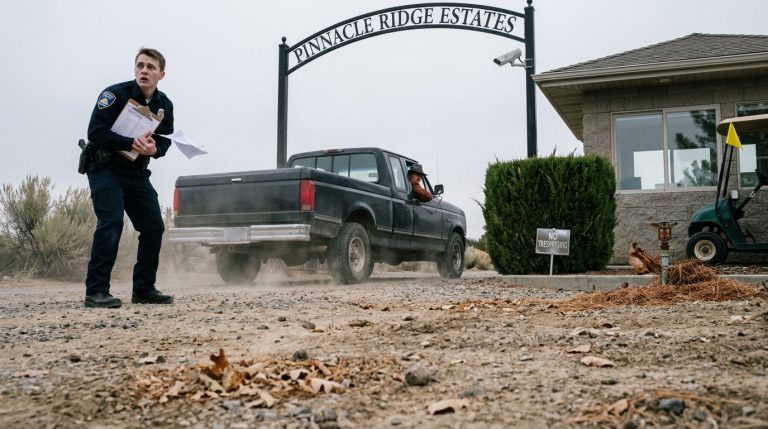
Ten minutes later, the gravel split under the weight of tires. Red and blue lights cut through the low-hanging pine branches, splashing across the front of my grandfather’s cabin. The cabin Gramps built with his own two hands out of timber he milled on this very spot back in 1962.
The deputy stepped out, his utility belt clicking as he approached the property line. Bethany was already moving, her designer sunglasses slipping slightly down her nose as she pointed a manicured finger at my chest. “Officer, thank God. He’s trespassing, building illegal structures, and ignoring formal community citations.”
I didn’t say a word to her. I walked over to the cab of my truck, my work gloves leaving a dull smudge on the steering wheel as I reached into the glove box. When I stepped back out, I wasn’t carrying a weapon. I was holding a single sheet of yellowed, heavy-bond paper—a 1962 statutory warranty deed, signed by a county clerk who’d been in the ground since the Vietnam War.
I handed it directly to the deputy.
His eyes scanned the ink, then drifted down to the small, rusted iron pin buried three inches deep in the dirt right beneath Bethany’s left heel. Her smirk didn’t just fade; it crashed. Her face paled under her expensive makeup, her mouth parting as the deputy took out his county map template and laid it over the yellowed page.
“Mrs. Walsh,” the deputy said, looking up with a cold, professional indifference that made her entire posture shrink. “According to these coordinates, his line doesn’t end here. It goes back twenty feet into what you call your common area playground.”
I leaned back against my truck fender, watching a sharp, icy draft cut through the hot morning air. I didn’t smile. But as I reached into my pocket for a piece of grandfather’s cedar chalk, I noticed something else—the iron survey pin at the western corner wasn’t just old. It had been fresh-cut with a hacksaw, recently, and the top half was entirely missing.
CHAPTER 2: THE INTERROGATION OF TIMBER
My thumb scraped against the chalk in my pocket, the white dust embedding itself in the deep, calloused lines of my palm. I kept my eyes fixed on the base of the dirt where the iron survey pin should have split the earth clean. The metal wasn’t weathered with forty years of rain; it was bright, silver, and jagged at the crown where a saw blade had chewed through the iron. Someone had worked fast, probably under the cover of the midnight fog that rolled off the Sound, trying to rewrite the geography of this ridge with twelve inches of steel teeth.
Bethany didn’t notice the pin. She was staring at the deputy’s county-issued ledger, her throat moving as she swallowed down whatever frantic argument was rising in her chest. The white leather straps of her luxury watch cut into her wrist as she clamped her arms tight against her ribs.
“That’s a mapping error,” she said. Her voice had dropped its rhythmic, polished cadence, thinning out into something reedy and sharp. “The Pinnacle plats were approved by the county commission six years ago. Every square inch of the common space was cleared by title attorneys. You’re reading an obsolete document, officer.”
The deputy didn’t look up from his brass scale. “Deeds don’t expire because someone builds a playground on top of them, ma’am.” He adjusted his flat-brimmed hat against the glare of the morning sun, his boots grinding a stray chunk of my fresh-cut cedar into the gravel. “But I’m a road deputy, not a recorder. I’m calling the structural division.”
Before his hand could even reach the microphone clipped to his shoulder, the low, rhythmic rattle of a heavy diesel engine drifted up the slope from the county road. A white Ford F-250 with the green county emblem stenciled on the door panel rounded the corner of Willowbrook Drive, its tires crunching heavily over the pristine asphalt before braking hard at the edge of my gravel turnaround. The door groaned on its hinges as Carl Novak swung his boots out into the dust.
Carl was seventy if he was a day, his face lined like a piece of old boot leather, his khaki uniform permanent-pressed into stiff, parallel ridges that looked like they could cut glass. He carried a heavy leather map case under his arm, the brass corners tarnished to a dull greenish-black. He’d worked these lines with Gramps back when the county was mostly logging roads and blackberry thickets, back when a man’s word was recorded with iron stakes rather than digital registries.
“Morning, Dutch,” Carl said, his voice a low, gravelly rasp that sounded like river stones turning in a current. He didn’t look at Bethany, and he didn’t look at the deputy. His eyes went straight to the post-hole digger leaning against the half-set cedar timber. “Smells like good wood. Old crop?”
“Gramps kept it dry-stacked in the lean-to since ninety-eight,” I said, leaning my arm against the hot metal of my truck’s hood. “Tight grain.”
“The best kind,” Carl murmured. He unclasped the leather strap of his case, the dry hide popping in the quiet. He laid the map out directly over the truck bed, ignoring the fine layer of sawdust that immediately settled across the blue-line prints.
Bethany click-clicked three steps closer, her designer trainers stopping exactly an inch short of the mud line. “Mr. Novak, I assume you’re here to issue the stop-work order. This individual is violating the structural setback requirements for the entire eastern quadrant of the subdivision.”
Carl adjusted a pair of thick, wire-rimmed spectacles, his finger tracing a faint, hand-inked line from 1962. “Mrs. Walsh, the only thing violating a setback here is that fancy stone entrance gate your board put up three winters ago. According to the original dedication, that gate sits four feet inside the Morrison mineral access corridor.”
The silence that followed was heavy, broken only by the dry ticking of my idling engine. Bethany’s fingers twitched against her phone. “The corridor was vacated when Pinnacle bought the surface rights. Our corporate counsel verified the release.”
“Pinnacle bought what the county let them buy,” Carl said, his voice entirely devoid of heat. He reached into his shirt pocket, pulled out a small steel magnifying loupe, and bent over the map. “But they never satisfied the 1962 county planning condition. See this little stamp here? The one with the red ink that’s faded to pink? That’s an automatic reversion clause. If the developer failed to register the subsurface clearance within ninety days of platting, the surface easement remains subject to immediate extraction access. And looking at the county index from six years ago… Pinnacle never filed the paperwork. They went into bankruptcy with the debt still on the books.”
I watched Bethany’s face. The strategic calculation behind her eyes was shifting into something resembling primitive survival instinct. She wasn’t looking at me like an annoying neighbor anymore; she was looking at the yellowed documents like they were the walls of a cellar closing in.
“That’s a technicality,” she whispered, her manicured hand dropping to her side. “We have title insurance. Consolidated Title signed off on every lot.”
“Then I suggest you call them,” I said, my voice cutting through the humid morning air like a cold blade. “Because every shovel of dirt Pinnacle turned out here was a structural trespass. And your corporate counsel didn’t just miss the line—they hid it.”
Carl stood up straight, his spine popping with a dry, wooden sound. He looked down at the freshly sawed iron pin in the dirt, his eyes narrowing as he took in the bright, silver score marks of the hacksaw. He didn’t say anything about it out loud, but he looked up at me, a sharp, unspoken understanding passing between us in the glare.
“Deputy,” Carl said, closing his map case with a sharp snap of the brass buckle. “Write the report however you like. But as far as the county planning office is concerned, Mr. Morrison can build this fence forty feet high if he wants to. He owns the rock under the houses they’re sleeping in.”
The deputy nodded once, his pen scratching against his notepad with a dry, rhythmic hiss. Bethany didn’t move. She stood on her manicured grass, her shadow stretching long and thin across the boundary line, her jaw locked so tight the muscle in her cheek was trembling. She didn’t offer a counter-move. She didn’t monologue. She just turned on her heel, her shoes crunching hard on the hot asphalt as she retreated toward her white fortress, her fingers already flying across the glass of her phone with a desperate, frantic speed.
I looked down at the severed iron pin, then back at the next cedar post waiting in the bed of my truck. The gray dust was settling back into the holes, but the air remained sharp with the smell of iron and fresh-milled wood. The chess pieces were on the board, and Bethany had just realized she was playing without her king.
CHAPTER 3: THE VAULT OF MOTHBALLS
The dust from Carl’s truck took a full three minutes to clear the driveway, drifting over my new cedar fence line like a gray shroud. I watched the tail-lights vanish past the rows of identical, pristine garages. The air had turned heavy, holding onto the stagnant heat of late morning, but inside the shade of the porch, the silence felt as solid as a block of granite. My fingers were still coated in white cedar chalk. Instead of picking up the post-hole digger to finish the run, I unbuckled my work gloves, dropped them into the bed of the Ford, and walked toward the cabin door.
Every floorboard under my boots gave its familiar, low groan as I crossed the threshold. The interior smelled exactly as it had when I was ten years old—a thick, dark mixture of boiled linseed oil, stale coffee grounds, and the heavy dampness of Douglas fir that had spent sixty winters settled on its foundations. In the back bedroom, tucked behind a stack of weathered surveyor transits and green canvas tarps, sat my grandfather’s steel filing cabinet. It was a four-drawer Army surplus monster from the late fifties, painted an industrial olive drab that had oxidized into a rough, chalky texture.
I dragged my heavy steel toolbox across the floorboards, the metal casters screaming against the grain. I knew where the key was supposed to be—Gramps used to keep it in an old tobacco tin on top of the gun safe—but that tin had been empty since the day we put him in the ground. Carl’s warning about what lay beneath the subdivision surface was a physical weight pushing against my shoulder blades. I didn’t have time to look for a phantom key.
I reached into the toolbox, pulled out a pair of twenty-four-inch drop-forged bolt cutters, and wedged the hardened steel jaws against the padlocked latch on the bottom drawer. I leaned my weight into the handles. The steel gave a sharp, metallic screech before the shackle snapped with a sound like a pistol shot, the broken piece clattering against the floor.
But when I reached down to clear the broken lock, my fingers caught on something grease-slicked and cold. I knelt lower. The latch mechanism hadn’t just jammed with age; someone had forced a broken piece of a modern carbon-steel drill bit deep into the keyway, packing it with heavy graphite grease to keep the tumblers from dropping. The grease was fresh, black, and completely free of the fine wood dust that coated every other surface in the room. Someone had been inside this cabin before me, trying to ensure these drawers stayed sealed forever.
My jaw tightened. I took a heavy flathead screwdriver, jammed it into the gap between the frame and the drawer face, and pried back with a slow, calculated application of leverage. The steel groaned, the ancient rivets holding the internal locking bar popping one by one until the drawer gave way, sliding outward with a heavy, metallic rattle.
The smell hit me instantly—the suffocating, chemical sting of mothballs mixed with the sweet, rot-like scent of water-damaged manila folders.
Inside lay dozens of neatly alphabetized records, all written in Gramps’s spidery, precise engineering script. My fingers moved through the tabs: County Road Petitions 1964, Timber Cruises 1971, Tax Assessment Injunctions 1985. I pulled out a thick, legal-sized folder marked Pinnacle Development Corp – Correspondence & Disclosures (2018-2019).
I carried the file to the kitchen table, where the midday sun cut through the multipane window, highlighting the fine layer of airborne sawdust. I opened the folder. The top document was a certified letter from my grandfather to the chief legal counsel of Pinnacle, dated three months before his stroke.
My eyes scanned the lines. He hadn’t just complained about their survey lines. He had sent them a formal, notarized title objection detailing the unpurchased subsurface rights, specifically warning them that their proposed construction plan for Willowbrook Estates would violate the 1962 automatic reversion clause. Taped to the back of that letter was a return receipt signed by Bethany Kensington Walsh herself, back when she was still operating as the developer’s primary acquisition agent.
Beneath that layer lay the true payload: a copy of Pinnacle’s confidential title insurance disclosure statement from Consolidated Title. In the margin, next to the section detailing the property’s clean title, someone had stamped a tiny, internal corporate note: Risk accepted per executive override. Proceed to construction loan closing.
They knew. Bethany had known before the first bulldozer ever tore through the roots of the old-growth oaks. They had deliberately falsified their corporate disclosures to secure their multi-million dollar construction financing, banking on the fact that an eighty-eight-year-old surveyor living in a log cabin wouldn’t have the resources to challenge a bank’s legal department.
The sound of a lawnmower started up three blocks over, its distant, tinny hum emphasizing the isolation of my kitchen. I reached out, my thumb brushing the rough edge of the manila folder. I could feel the cold precision of the trap they had built—and the exact point where their structure was about to fracture. I didn’t rush to the phone. I didn’t call the sheriff. I just sat there in the silence, listening to the clock on the wall tick, slowly tracing the ink on the page until I knew every name on the disclosure list.
CHAPTER 4: THE BLUECOLLAR ALLIANCE
The manila folder closed with a dry, hollow flap that sounded louder than it should have in the quiet kitchen. I stood up, the chair legs scraping hard across the old linoleum, and walked to the back door. The sun was leaning toward the west now, casting long, fractured shadows through the Douglas firs. I took a slow swallow of my coffee—it had gone stone cold, leaving a bitter, metallic film on my tongue. Bethany Walsh wasn’t just defending a boundary; she was protecting a house of cards built on corporate fraud. But to dismantle it without crushing the people caught in the middle, I needed to know exactly how far her nightly patrols were pushing across my markers.
I stepped off the porch and made my way down the tree line, my heavy work boots sinking into the soft needles. Hidden in the hollowed-out trunks of three old oaks were the small, matte-black boxes of my game cameras. I pulled the SD cards from each one, the plastic clicking smoothly into my pocket.
Ten minutes later, I crossed the gravel turnaround, heading toward the small gap in the cedar posts that led into Jim Patel’s backyard. The air smelled of wet earth and rich fertilizer. Jim was kneeling by his rows of heirloom beefsteaks, his hands dark with soil, but his shoulders were hunched with a tight, unnatural tension.
“Dutch,” Jim said, standing up and wiping his palms on his canvas trousers. His face looked gray under his ballcap. “I saw Carl’s truck earlier. Did she… did she pull the construction permits?”
“Carl confirmed the lines are exactly where Gramps set them, Jim,” I said, leaning against his fence post. I took a pair of small, black trail-cam photos from my pocket and laid them on the wooden top rail between us. “But that’s not why she’s panicking. Look at the time-stamps.”
Jim leaned in, his eyes narrowing as he studied the glossy paper. The images were crisp, illuminated by the infra-red flash of the night vision lens. There was Bethany, her white BMW idling on the shoulder at two in the morning, while a man in dark overalls used a long-handled pry bar to pull up the iron survey stake at my western corner.
“That’s her cousin’s contractor,” Jim whispered, his jaw tightening. “She told the board you were moving the stakes into the common area to steal the playground lot. She’s trying to build a case to get a county injunction against you.”
“Let her try,” I said, my voice low and level. “She’s digging her own grave with every step she takes onto this dirt. But I need you to keep your head down, Jim. Don’t pay the daily fines she’s sending you. Don’t answer her calls. Just document every notice she drops on your porch.”
“She’s threatening a lien on the house, Dutch,” Jim said, his voice dropping into a rough, anxious rasp. “My wife isn’t sleeping. Every time a car slows down on the road, she thinks it’s the process server.”
“A lien requires a valid legal entity behind it,” I said, my fingers tracing the sharp, cold edge of the SD cards in my pocket. “And by the time we’re done with the emergency board meeting next week, Willowbrook Estates isn’t going to have an HOA left to enforce them. I’ve already sent copies of these files to Frank Delro. He’s drafting the quiet title action tonight.”
Jim looked down at his tomato plants, his calloused thumbs rubbing against each other. “The Johnsons are with us. She tried to fine them five hundred dollars yesterday for their chicken coop, claimed the noise was driving down property values. Mrs. Johnson told her to get off her porch, but they’re scared too, Dutch. We’re working people. We can’t afford twenty-thousand-dollar retention lawyers.”
“You won’t have to,” I said. “Gramps paid for the defense sixty years ago. Every lot they built sits on top of an unvacated development easement. Pinnacle sold these people the surface, but they didn’t buy the structural rights underneath. If Bethany pushes this to a courtroom, the bank is going to foreclose on the whole development before she can even file her motion.”
A sudden, sharp breeze rattled through the leaves of the old oak above us, dropping a handful of dry twigs into the dirt. From three blocks over, the unmistakable, rhythmic click-click-click of heavy heels on the hot pavement began to echo through the cul-de-sac. Bethany was starting her evening inspection early, her shadow already stretching long and thin past the edge of Jim’s driveway.
I didn’t move away from the fence. I stood there in the fading light, my face turned toward the sound, letting the cold calculation of the trap settle into my mind. She was moving exactly according to her own psychological logic—arrogant, relentless, and completely blind to the iron foundation beneath her feet. I turned back to Jim, nodded once, and slipped the trail-cam photos back into my vest pocket. The line was held, but the real escalation was about to begin.
CHAPTER 5: THE POISONED STREAM
The rhythmic click-click-click of Bethany’s heels faded down the pavement, but the silence that took its place was instantly shattered by the sharp, metallic vibration against my ribs. I pulled my phone from my vest pocket. The screen bled an aggressive white light into the deepening dusk. It wasn’t a message from Frank Delro, and it wasn’t a county update. It was a long-distance call routing through an Oregon area code.
I pressed the receiver to my ear, my boots pivoting on the dry grass as I stepped away from Jim Patel’s fence line, my body instinctively turning back toward the dark, protective canopy of my grandfather’s trees.
“Dutch?”
The voice was thin, breathless, and laced with a ragged tremor that instantly tightened the muscles across my chest. It was Melody. My daughter rarely called this late on a work night, especially not from the nonprofit office in Portland where she handled graphic design.
“I’m here, Mel,” I said, my voice dropping into that low, flat register meant to anchor her. “What’s happened?”
“Someone… a woman named Walsh called my executive director about an hour ago,” she said, her breath catching over the static of the line. “She didn’t just complain, Dad. She told them that the environmental land trust project we’re working on is being funded by an active criminal investigation. She said you were under indictment for land fraud and structural extortion in Washington. She told them that my presence on the design team was a liability to their non-profit tax status.”
A cold, heavy drop of sweat rolled down the back of my neck. My hand clamped around the casing of the phone so hard the plastic groaned. The image of Gramps flashed through my mind—the day the logging corporate suits tried to cut his access road in seventy-four, how he’d stood on the porch with nothing but his survey log and a quiet, terrifying certainty. He’d told me then that when a beast knows its territory is shrinking, it stops fighting for the perimeter and goes straight for the throat.
“Did your director buy it?” I asked, my eyes tracking the faint, pale glow of the streetlamps flickering to life in the Willowbrook cul-de-sac.
“No, but they had to log it with HR,” Melody whispered, the sound of her crying hitting me with the physical force of an impact. “They’re auditing my background check now, Dad. I can’t lose this job. You know how hard it was to get this placement. Who is this woman? Why is she doing this to us?”
“She’s a cornered animal, Mel,” I said, my teeth grinding against the words until they tasted like iron. “And she just crossed the only line that mattered. I want you to log out of your work terminal, go home, and lock your door. Don’t answer any unfamiliar numbers. Let HR do their audit. My attorney will have a certified copy of my clean record and a cease-and-desist on your director’s desk before they open tomorrow morning.”
“Dad, please—”
“Go home, Melody. Trust me.”
I cut the call. The screen went dark, reflecting the hard, flat geometry of my jaw in the glass. The air felt charged with ozone, the sky above the ridge bruised with the purple tint of an approaching summer storm.
I didn’t walk back to the cabin. I strode down the gravel drive, my fingers typing a short, transaction-clear directive to Frank Delro: File the civil harassment. Include intentional infliction of emotional distress. Target her personal real estate license. No terms.
Before I could even slip the phone back into my pocket, a secondary chime alerted me to a community notification. I opened the local Willowbrook Facebook group—the one Bethany managed under the title Protecting Our Property Values.
The top post was less than ten minutes old. It featured a heavily cropped photograph of my grandfather’s cabin, the contrast adjusted to make the weathered cedar look like rotting timber. Beneath it was a block of text detailing a “Safety Warning for Neighborhood Families,” claiming that a “documented sovereign squatter” with “unstable, aggressive tendencies” was actively constructing unpermitted blockades to interfere with children’s play areas. It hinted at anonymous reports of illicit activity conducted behind the fence line, advising residents to lock their doors and report any sight of my Ford truck to the sheriff.
The strategy was transparent, calculated, and vicious. She couldn’t beat the 1962 deed in a county surveyor’s ledger, so she was poisoning the stream, turning twenty-three families into a weaponized wall of paranoia to force me into a settlement.
I looked up from the screen. Across the asphalt road, behind the pristine white colonial shutters of the house nearest my gate, a curtain twitched. A pale face flickered behind the glass before disappearing into the interior shadows. The seeds of her panic were already taking root. They were looking at my trees, my truck, and my grandfather’s home as an infection.
I stood dead still in the middle of my driveway, the gravel sharp beneath my soles. Bethany Walsh thought she was playing an optimization game with neighborhood sentiment. She thought she could pressure my family from three hundred miles away without ever having to look at the iron under her feet. But as the first distant rumble of thunder rolled over the Washington paradise, I knew her calculation was completely dead. She wanted a war of attrition. I was going to give her a structural collapse.
CHAPTER 6: THE MIDNIGHT BRIBE
The first heavy drops of the summer storm hit the corrugated tin roof of the porch with a hollow, metallic ring. I sat in the darkness of the wooden rocker, the phone unlit in my shirt pocket, my hand resting flat across the cold, oiled receiver of the old field radio on the side table. The digital smear campaign had run its course through the evening, but the real movement wasn’t happening online anymore. The headlights of a vehicle cleared the lower bend of the gravel road, their beams cutting long, yellow slashes through the weeping pine branches. It wasn’t a cruiser. The engine was too quiet—the smooth, high-end hum of a German luxury V8.
The white BMW X5 pulled up to the very edge of the turnaround, its high beams catching the rough grain of my newly dropped cedar posts before dying out. The door click-snapped shut.
A flashlight beam danced across the mud, tracking the line of a pair of high-end athletic trainers as they made their way toward my steps. Bethany wasn’t wearing her designer sunglasses tonight. In the flash of the distant lightning, her face looked hollow, the skin tight over her cheekbones, her lips pressed into a bloodless line. She carried a large, heavy nylon duffel bag by its canvas straps, her fingers dug into the fabric so hard her knuckles showed white.
She stopped at the bottom step, the smell of her honeysuckle perfume cutting through the damp, rich scent of the cedar and the oncoming rain. She didn’t see me in the deep shadow of the porch until I shifted my weight, the old fir board beneath my rocker giving a single, dry groan.
She tensed, her hand dropping the flashlight beam straight down onto her own shoes. “Dutch,” she said. Her voice lacked the sharp, micro-managed authority from the morning. It was thin, rapid, and pitched flat against the low rumble of the thunder over the ridge. “We need to close this out. Tonight.”
“You’re trespassing, ma’am,” I said, my voice coming out slow, balanced against the rhythm of the rain. “The civil injunction is already logged with Frank’s office. You shouldn’t be on this side of the markers.”
“Frank Delro doesn’t have a mortgage to protect,” she snapped, stepping up onto the first tread. The wood creaked under her weight. She set the nylon duffel onto the rough-sawn porch table between us with a heavy, soft thud. The zipper was already pulled back an inch, revealing the tightly packed, band-wrapped edges of hundreds of crisp, green bills. “There is fifty thousand dollars in that bag. It’s cash. It was pulled from three separate liquid accounts before the bank closed at five.”
I didn’t reach for the bag. I didn’t even lean forward to look at the paper. My thumb quietly found the side button of the phone inside my vest pocket, pressing it twice through the canvas until the short, silent vibration confirmed the voice memo was drawing the room’s sound into the flash memory.
“The families pulled their resources for a peaceful resolution,” she continued, her words tumbling out faster now, driven by the frantic internal calculation of a real estate shark who could feel the water draining from her pool. “You take the compensation for the inconvenience. You sign the surface easement variance Frank has on his desk, and you move your fence line back five feet past the playground common area. Everyone keeps their investments. The subdivision stays whole.”
“The families didn’t buy this cash, Bethany,” I said, my eyes tracking a leak in the porch gutter as the water began to stream down the corner post. “The families are too busy locking their doors because you told them a dangerous squatter was targeting their children. This money came out of your personal escrow.”
Her left eye twitched, a tiny, involuntary spasm against the glare of another distant flash of lightning. “It doesn’t matter where the capital originates, Dutch. It’s a settlement. A clean out. You’re an old man living in a timber shack; fifty thousand is more than this entire acreage is worth in back taxes. If you push this to the county board, the title companies will freeze every sale in Willowbrook for the next five years. Nobody wins that kind of war.”
“I’m not at war,” I said, my voice dropping an octave, becoming as steady as the foundation timbers beneath our feet. “I’m just reading the deed. And according to the recording rules under Washington law, an attempted bribe to alter a filed county survey map doesn’t clear a title flaw. It just adds a felony obstruction charge to the civil litigation pile.”
She leaned over the table, her manicured fingers slamming flat onto the nylon fabric of the bag. The sweet, chemical sting of her perfume filled the space between us, suffocating in the humid air. “You think you’re untouchable because your grandfather kept some yellowed paper in a box? Pinnacle is gone, Dutch. There’s no corporation left to sue. If the title insurance company takes a loss on this development, they will tie you up in administrative appeals until you die in this chair. Take the money and clear the line.”
“No,” I said, looking up into her dark eyes, letting the absolute flat certainty of the word settle into the damp air between us. “Leave the porch, Mrs. Walsh. And take your duffel with you.”
She stood dead still for three long seconds, the rain now coming down in sheets behind her, splashing off her white BMW and turning the gravel driveway into a slick, gray soup. She didn’t take the bag. She turned on her heel, her trainers skidding slightly on the wet top step as she descended into the downpour.
“You’ll regret that,” she whispered through the dark, her voice carrying over the roar of the water as she reached her car door.
The engine roared to life, the high beams hitting the cabin windows like a pair of white searchlights before the tires tore out of the gravel, throwing a heavy spray of mud and wet cedar shavings against my new fence posts. I didn’t move from the rocker. I reached down, picked up the broken padlock latch from the side table, and turned it over in my calloused hand, listening to the rain wash the tire tracks clean. She had left the cash on the table—and she had just handed me the final link in her own chain.
CHAPTER 7: THE PUBLIC EXECUTION
The rain had stopped by Thursday afternoon, leaving the air thick with a cold, low-hanging mist that clung to the structural glass of the Willowbrook Community Center. I sat in the cab of my Ford, my hands resting on the steering wheel, watching the parking lot fill. Jessica Cove’s Channel 7 van was parked three bays over, its high-gain mast already rising into the desaturated evening sky like an iron needle. Beside me on the bench seat sat the heavy cardboard box containing sixty years of county planning records and, tucked beneath them, the voice recording from the midnight bribe.
I turned the ignition off. The low rumble of the diesel died away, replaced by the distant, rhythmic slam of car doors across the asphalt. I grabbed the box, the rough cardboard edge digging into the callouses of my fingers, and stepped out into the damp chill.
The double doors of the community center groaned on their commercial hinges as I entered. The room smelled of industrial floor wax and the anxious, collective heat of forty residents packed into rows of metal folding chairs. Up at the front, behind a plastic folding table, stood Bethany Kensington Walsh. She didn’t look like a woman who had left a duffel bag of illicit cash on a timber porch a week ago. She wore a tailored gray blazer, her hair pinned back with mechanical precision, though her fingers tapped a frantic, irregular rhythm against the rim of her water glass.
I didn’t make a scene. I walked down the side aisle, my heavy work boots thudding against the thin industrial carpet, and took a seat in the back corner. I placed the box flat on the floorboards between my feet.
Jim Patel shifted in his seat three rows ahead, turning just enough to catch my eye. I gave him a single, barely perceptible nod. He looked back toward the front, his shoulders squaring under his canvas jacket.
Bethany adjusted the microphone on the table, the high-frequency feedback piercing the murmurs of the crowd until the room fell dead silent. “Thank you for coming to this emergency session,” she began, her voice amplified into something cold and metallic by the ceiling speakers. “We are here tonight to resolve the ongoing structural and criminal disruptions threatening the safety and fiscal integrity of Willowbrook Estates. Formal actions have been prepared to authorize immediate county intervention regarding the eastern perimeter encroachments.”
“Mrs. Walsh,” a clear, sharp voice cut through the room before she could complete her next sentence. Jessica Cove stood up from the media bench along the left wall, her cameraman immediately pivoting the heavy lens toward the front table. “Before you vote on authorizations, Channel 7 has verified a series of title disclosure irregularities filed during Pinnacle’s construction phase. Our records show you personally signed for corporate objections regarding unpurchased development rights on this very lot in 2019.”
Bethany’s hand froze on her water glass. The color didn’t leave her face all at once; it drained out from the margins of her jaw line, leaving her makeup looking like a dry, plaster mask. “This is an internal neighborhood governance meeting, Miss Cove. External press is not recognized for floor comments.”
“They don’t need to be recognized,” Frank Delro said, stepping through the rear entrance doors with a leather briefcase gripped in his left hand. Beside him stood Sarah Blackwood and a county sheriff’s supervisor whose badge caught the sharp glare of the fluorescent tubes overhead. Frank didn’t stop until he reached the margin of the plastic table. He reached into his coat, pulled out a thick sheath of legal documents bound by blue backing paper, and dropped them flat onto the table right in front of Bethany’s microphone.
The sound of the papers hitting the plastic was a dull, heavy slap that seemed to echo through the ballasts.
“Mrs. Walsh, you’re being served with an immediate quiet title injunction, a civil defamation action, and an active citation for third-degree harassment with intent to cause emotional distress,” Frank announced, his voice carrying the flat, transactional weight of a hammer hitting an anvil. “Furthermore, the state planning commission has initiated a forensic audit of Pinnacle’s construction loan disclosures from 2018—disclosures which bear your personal validation stamp.”
The room erupted into a sharp, chaotic murmur. Residents stood up in their rows, their mortgage papers and HOA notices clutched in their hands like small shields.
“What does that mean for our titles?” Jim Patel called out, his voice rising above the din. “Are our properties clear or not?”
I stood up from the back corner, leaving the box at my feet, and walked down the center aisle until I was standing level with Frank. Every eye in the room turned toward my flannel shirt, my sawdust-dusted vest, and the yellowed 1962 deed I pulled from my pocket.
“It means your homes are built on land Pinnacle never fully bought,” I said to the room, my voice level, clear, and unhurried. “Bethany knew it six years ago. She hid the automatic reversion clause from the title insurance inspectors to guarantee the construction financing cleared. She didn’t want a fence built because she knew the second a county surveyor came out to check my posts, the whole paper empire would fall into the mud.”
Bethany lunged forward against the table, her perfectly manicured nails scraping against the plastic as she glared down at me. Her mouth opened, her breathing rapid and shallow, her eyes darting toward the side exit where her security crew was already step-backing into the shadow of the corridor. The gray mask had broken completely, and beneath it lay the raw, frantic desperation of a dictator who had just realized the floor beneath her throne was entirely hollow.
CHAPTER 8: THE DUST SETTLES
The plastic table legs groaned against the industrial carpet as Bethany Walsh lunged. Her breath came in short, ragged gasps that hissed through the microphone, the high-frequency ring vibrating through the ceiling ballasts. She reached out, her perfectly polished fingernails clawing at the thick backing paper of Frank Delro’s motion as if she could shred the county records by hand.
“This is an administrative ambush!” she shrieked, her gaze darting toward the double exit doors where her private security guards were already melting into the corridor shadows. She swiveled toward the county deputy supervisor, her shoulder blazer bunching unnaturally as her posture fractured. “Arrest him! He’s using fraudulent documentation to threaten the fiscal stability of this entire district!”
The sheriff’s deputy supervisor didn’t flinch. He stepped forward, his heavy leather duty belt creaking with tactical precision as his hand came down flat over her wrist, pinning her fingers against the document. “Mrs. Walsh, step back from the table. We’ve already verified the 1962 county index records. The automatic reversion clause means you are currently operating enforcement activities on land you do not own.”
“Get your hands off me!” she screamed, her body twisting with a raw, visceral violence as she swung her free arm. Her manicured hand caught the deputy across the cheek, sending his wire-rimmed glasses skittering across the plastic table.
The response was instantaneous. The metallic, rhythmic click-click of double-locking Smith & Wesson handcuffs sliced through the chaotic shouts of the room. The deputy twisted her arm behind her back with unyielding, mechanical leverage, snapping the steel cuffs around her wrists before she could launch a secondary move.
“Bethany Kensington Walsh, you’re under arrest for assault on a peace officer, criminal harassment, and suspected financial obstruction,” the deputy stated, his voice a flat drone that completely flattened her frantic protests.
They led her down the center aisle, her trainers skidding uselessly against the industrial carpet. She didn’t look like a neighborhood dictator anymore; her gray blazer was pulled half off her shoulder, her face pale and streaked with sweat as the television camera tracked her all the way to the heavy double doors.
The hum of the room died down into a deep, stunned quiet as the rear doors banged shut, leaving only the sharp glare of the fluorescent tubes and the anxious breathing of twenty-three families staring down at the front table.
Frank Delro stepped up to the microphone, his thumb sliding the voice recording device out of his pocket and plugging it directly into the audio jack of the media bench. The sound of Bethany’s voice from the midnight encounter filled the room—clear, transaction-sharp, offering fifty thousand dollars in cash to bury the title flaw.
Jim Patel stood up from his row, his face completely pale as the recording cut out. “Dutch… what happens to our mortgages now? If Pinnacle didn’t buy the subsurface rights, do we lose the houses?”
I walked up to the podium, my boots heavy against the floorboards, and laid my palms flat against the wooden grain. “Nobody is losing their home, Jim,” I said, looking out at the faces of the neighbors who had spent months hiding from arbitrary fines. “Pinnacle cut corners to save fifty thousand in development fees, but my family isn’t looking to displace working people. Tomorrow morning, Sarah Blackwood is filing the paperwork to establish the Grandfather Dutch Morrison Conservation Land Trust.”
The room remained perfectly still as Sarah stepped up to present the layout. “Instead of your three-hundred-and-fifty-dollar monthly fees going into an enforcement fund,” she explained, her voice cool and structured, “the trust will grandfather your existing surface lots for a flat fee of one hundred and seventy-five dollars. That capital goes directly toward preserving the thirty-five acres of old-growth forest along the ridge line. The arbitrary aesthetic guidelines are dissolved. Your vegetable gardens, your vehicle storage, your yards—they belong to you under common sense, not a corporate committee.”
A slow, deep breath seemed to pass through the crowded room, the heavy weight of financial terror lifting from their shoulders like a breaking fog. Jim Patel sat back down, his thumbs rubbing against his knuckles as his eyes watered with a quiet, unyielding relief.
Three months later, the early morning sun cut through the pine branches of the ridge line, casting long, clean blocks of light across my gravel turnaround. The air smelled of damp earth, rich pine shavings, and black coffee. The white BMW X5 was gone from the cul-de-sac, replaced by the quiet, rhythmic sounds of kids laughing three blocks down near the newly dedicated conservation trail.
I sat on the edge of the porch, a wood plane in my calloused hands, slowly running the iron blade down the length of the final cedar privacy post. The steel bit shaved off a long, curling ribbon of timber, revealing the clean, tight grain beneath.
The gravel rattled as a small truck pulled up. My daughter Melody stepped out of the cab, her canvas work bag slung over her shoulder, a roll of architectural blueprints tucked under her arm. She didn’t look like the panicked girl who had called me from Portland three months ago; her face was bright, her boots solid on the mud as she walked up the steps.
“The state planning commission just cleared the final trust registry, Dad,” she said, leaning against the porch railing as she unrolled the layout for the new environmental education center inside the old clubhouse. “The baseline survey is locked. Every acre of the old-growth forest is officially off the development grid.”
“Good,” I murmured, setting the plane down on the workbench and running my bare thumb along the smooth, sharp edge of the cedar post. The surface was perfect—unbroken, resilient, and grounded deep into the rock that Gramps had secured sixty-four years ago.
I stood up, wiping the fine wood dust from my canvas trousers, and looked out past the boundary markers toward the green margin of the valley. The iron survey pins were buried deep, their coordinates locked in the county ledger where no corporate saw blade could ever reach them again. The line was held, the legacy was intact, and for the first time in three generations, the soil was entirely at peace.