Rusted Steel and Red Fire: How One Exhausted Sergeant Rewrote the Rules of Survival in the Pacific Jungle
CHAPTER 1: THE MOCKED METAL
The gasoline smelled stale in the heat. Sergeant William Miller wiped a smear of black grease across his forehead and stared up at the empty gray sky.
Fifty yards away, a group of infantrymen walked past the halftrack without breaking their stride. One of them pointed a canteen at the open turret and laughed.
“Hey, bird watcher,” the soldier shouted over the hum of generator noise. “See any sparrows coming in from Tokyo today?”
The men around him chuckled, keeping their heads down as they trudged toward the mess tents. Miller didn’t look up. He kept his hands wrapped around a oily rag, rubbing at a stubborn carbon stain on the edge of the Maxson mount.
The M16 multiple gun motor carriage sat dead center in the clearing like an oversized metal toy. Its four Browning M2 machine guns pointed blankly toward the clouds, useless and ignored.
The logistics officers back at headquarters called it an asset. The men in the mud called it a target magnet. Thin armor, open top, and zero action for six straight months.
Miller tossed the dirty rag onto the deck plates. His shoulders ached from twenty-four hours of damp air and cold rations.
The sun dropped behind the canopy, dragging heavy shadows across the perimeter. There would be no mail call tonight, and no relief coming from the rear.
The forest at the edge of the wire stopped whispering. The cicadas went dead silent all at once, leaving only the sound of distant wind through the high ferns.
Miller reached down, picked up a heavy brass shell casing from the floor, and rolled it slowly between his calloused fingers. The metal was cold now, but it wouldn’t stay that way for long.
CHAPTER 2: WHISPERS IN THE DARK
The silence didn’t fade; it shattered. Hundreds of voices rose from the black foliage in a ragged, overlapping roar that shook the damp air.
Sergeant Miller dropped the brass casing into the ammo rack. His boots gripped the slick metal floor of the halftrack as he vaulted up into the open turret.
“They’re moving,” the loader shouted from the lower deck, his voice cracking against the rising noise. “Sarge, look at the tree line!”
Miller didn’t waste breath answering. He gripped the twin steel handles of the Maxson mount and threw his weight against the traverse mechanism.
The gear teeth groaned, dry and ungreased, grinding through a quarter-turn before catching on the forward stops. He could see them now—dark, frantic shapes rushing through the high ferns with fixed bayonets flashing in the starlight.
The men in the forward foxholes opened fire with their carbines, short red stabs of light punctuating the blackness. But the flashes were swallowed instantly by the sheer volume of the charging wave.
Miller slammed his thumb onto the elevation lock, forcing the four Browning barrels down from the empty sky toward the churning dirt.
“Keep your heads down below the plate,” Miller shouted down the intercom, his voice flat and hard. “This is going to get loud.”
CHAPTER 3: BREAKING THE MANUAL
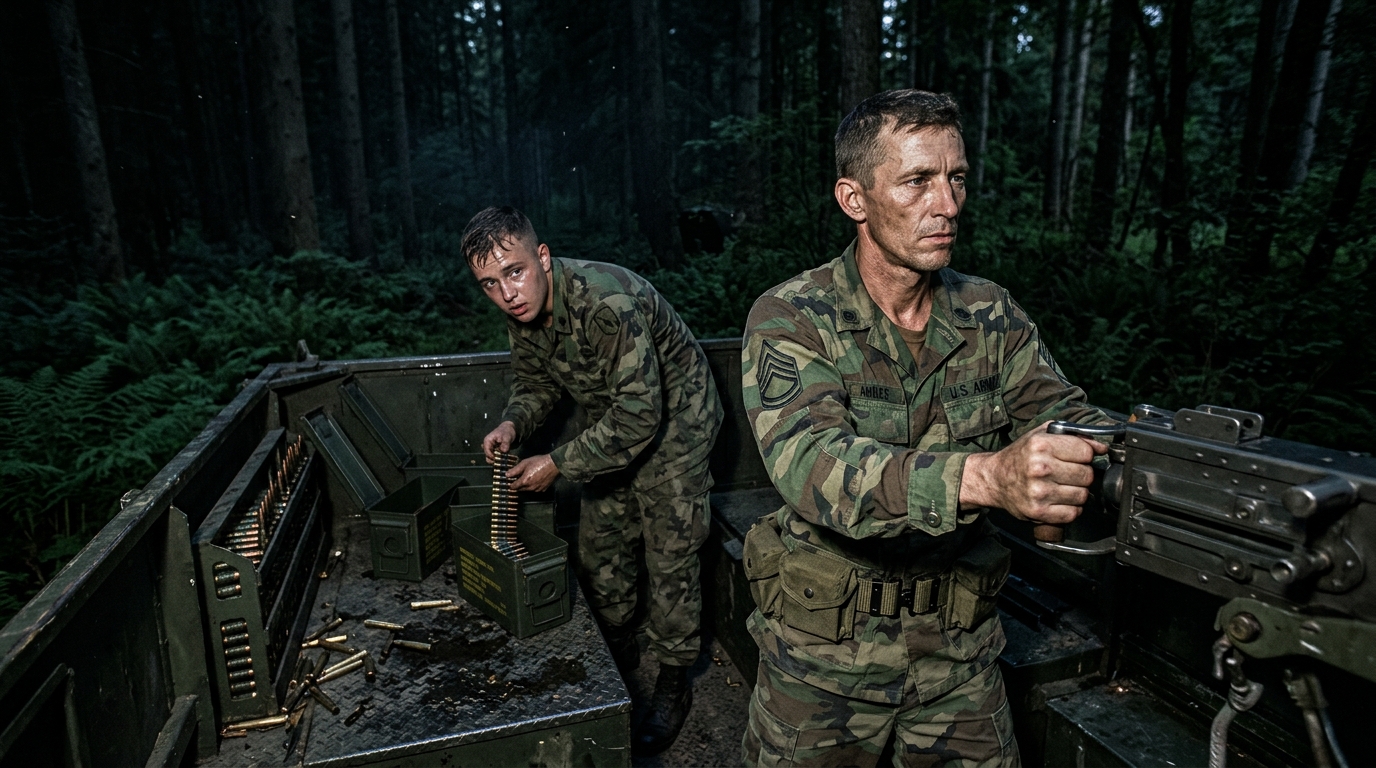
The ammunition boxes sat open at his feet, smelling of machine oil and cold zinc. Without pre-scavenged belts ready, Miller had to strip standard cans by hand, interlocking ball rounds and bright tracers link by link under the stuttering starlight.
“Sarge, ordinance command said a one-to-one mix warps the chambers,” the loader shouted, wiping sweat from his forehead as he shoved a fresh link into the receiver.
“Command isn’t sitting in this turret,” Miller muttered, yanking the canvas strap tight.
Every second spent hand-feeding the non-standard ratio made the metal beneath his boots vibrate with the advancing rush outside. The rules were written in safe rooms miles away, but survival was measured in inches of steel and raw velocity.
Miller slammed the feed cover down with a sharp metal clang that echoed off the turret shield. He didn’t wait for permission or logic from the rear; he pulled the charging handles back until the springs groaned under the tension.
The dark figures at the edge of the clearing loomed larger, their frantic shouts cutting sharply through the humid night air.
CHAPTER 4: THE RED WALL
The night tore open. Four Browning barrels erupted simultaneously, throwing a dense, continuous beam of burning red light straight into the advancing human wave.
The heat radiated outward instantly, blistering the green paint on the turret shield.
“Keep your heads down!” Miller shouted over the mechanical thunder, his knuckles whitening against the hot steel.
The concentrated fire swept across the tree line like an iron scythe. Tracers blurred into a solid bar of crimson energy, sawing through ancient trunks and dense undergrowth with terrifying speed.
The barrels glowed dull orange in the dark, absorbing the brutal thermal stress of the unapproved mix. Miller didn’t let up. Stopping meant the wave would reach the perimeter, and survival demanded pushing the machinery past every legal limit.
CHAPTER 5: THE MORNING SILENCE
The sun cut through the smoke like a thin gray blade, dragging long shadows across the torn earth.
Miller released his grip on the twin triggers, letting his arms drop to his sides with a heavy, shivering jolt. His muscles burned from the sustained recoil, and the acrid smell of burnt propellant hung thick in the stagnant air.
Around him, the perimeter was dead quiet, save for the crackle of smoldering brush and the dull ping of metal contracting in the cooling dawn.
“Sarge,” the loader whispered, his voice trembling as he peered over the edge of the lower hatch. “Look out there.”
The dense jungle that had hidden the charge an hour ago was gone, replaced by a wide, jagged scar of splintered wood and churned mud. Nothing moved across the newly carved lane.
Miller reached down, picked up a warped brass casing from the floor plates, and turned it slowly in his raw palms. The danger had passed, but the cost of holding the line was written directly into the warped steel of every barrel in front of him.
CHAPTER 6: THE NEW STANDARD
The heavy brass casing clinked against the iron floor plate as Miller dropped it into the scrap bin.
Footsteps crunched through the broken twigs behind him, stopping just short of the halftrack’s rear step. Miller didn’t turn around; he kept his eyes fixed on the charred barrels cooling in the morning air.
“High command wants an accounting of the damaged mounts,” the supply officer muttered, his voice lacking its usual administrative bite.
“Tell them the mounts stopped a regiment,” Miller said, wiping a greasy rag across his knuckles.
The officer stared at the flattened corridor of shattered timber stretching out into the brush, then back at the scorched steel of the turret. No one mentioned court-martial. No one asked about the ordinance ratios.
The ridiculous nickname used by the rear echelons was gone for good, replaced by a hard-earned title that everyone in the camp now respected.
Miller tossed the rag onto the deck, picked up an oil can, and began the slow, quiet work of cleaning the weapons that had saved them all.