The Measured Strike: How a Montana Farrier Dismantled a Corporate Empire with a Single Legal Document
CHAPTER 1: The First Cairn
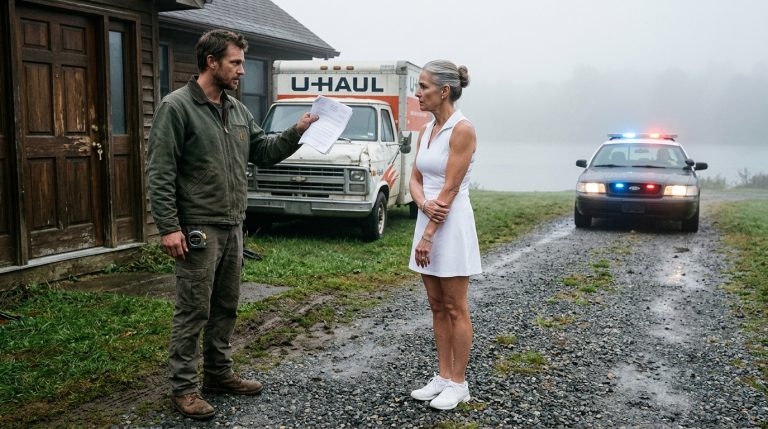
The air at 5:53 a.m. didn’t just feel cold; it carried the sharp, biting edge of a blade—the kind that cuts through the silence of a Montana valley before the sun manages to peek over the Absarokas. I didn’t reach for the ignition key; I reached for the phone. My thumb hovered over the camera icon, my pulse steadying into that practiced, rhythmic beat I’d maintained for fourteen months.
I didn’t care about the dozer’s weight or the tremor of the ground. I cared about the angle.
I parked the truck hard against the north entrance, the tires biting into the gravel with a crunch that sounded like bone. I left the dashcam rolling, its red light blinking like a small, accusatory eye in the dawn. Stepping out, I didn’t see a contractor. I saw a liability.
The operator was a kid, maybe twenty-two, his ball cap pulled low, his shoulders hunched as if trying to shrink away from the machine he was steering. He killed the engine when he saw me, the silence returning with a suddenness that felt pressurized.
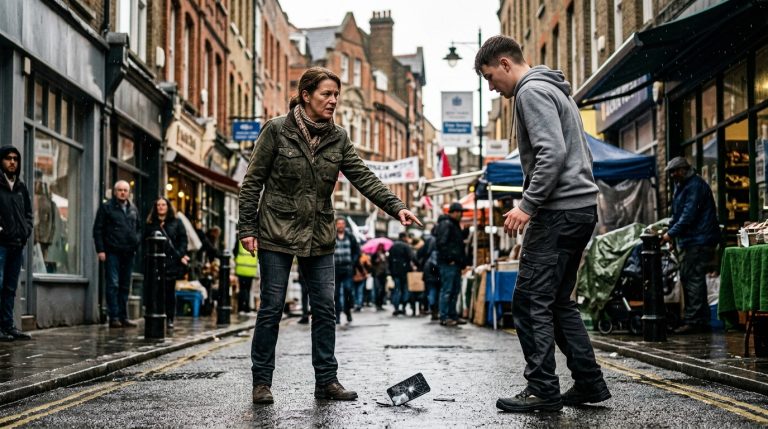
Diane Pedegrue didn’t shrink. She marched toward me, her heels sinking into the mud with every step, her Yeti mug clutched like a weapon. She wore a Pendleton blazer that cost more than a month of my labor, and her expression was a perfected mask of bored annoyance.
“You’re trespassing, Mr. Holloway,” she said, her voice clipped, professional, and entirely hollow.
I didn’t look at her. I looked at the pile of yellow wood shavings lying beneath the cat-tracks. That was the 1923 bench. My grandmother’s name had been etched into the backrest, a testament to a marriage that had survived drought, frost, and the sheer unforgiving nature of this range. Now, it was debris.
“Look down, Diane,” I said, the words falling out flat.
She didn’t look down. She looked at the clipboard, her fingers drumming against the plastic. “I have a work order. We are clearing brush for the HOA. This is community maintenance.”
I raised the phone, framing her face against the backdrop of the churned-up earth. I didn’t need to yell; I needed to be precise.
“That brush is a registered historic easement. That pile of kindling was a state-monitored landmark. And that sediment hitting the creek? That’s a federal violation of the Clean Water Act, Section 404.” I paused, letting the silence expand between us, watching the flick of her eyes as she processed the terminology. “You didn’t hire a contractor. You hired a witness.”
Her smile didn’t waver, but the light behind her eyes shifted. It was the look of a predator who had just realized the trap she was walking into was built of thicker steel than she’d ever encountered. She tried to say something, but the wind shifted, bringing the metallic scent of a rasp and the cold taste of ice-melt from the creek, and I knew—even then—that the floor was already falling out from under her.
CHAPTER 2: The Logic of Evidence
Diane Pedegrue didn’t look at me, and she certainly didn’t look at the ruin of the bench. Her gaze was locked on the horizon, toward the subdivision, as if hoping a line of Escalades would crest the rise and rescue her from the sudden gravity of the situation.
“You’re a surveyor, Mr. Holloway,” she said, her voice dropping into a register that wasn’t quite a whisper, but had all the brittle quality of dry ice. “You know how easily boundaries can be contested. You know how quickly a simple filing error can be corrected in a closed-session meeting.”
I didn’t answer immediately. I reached into the bed of my truck and pulled out a heavy canvas roll—my surveyor’s kit. I didn’t need to be loud. The sound of the rasp against the tailgate was sharp, rhythmic, and intentional. Scritch. Scritch. Scritch. It was the sound of iron meeting iron, a sound that usually meant a horse was going to walk soundly for another month, but today, it was the sound of sharpening an argument.
“Filing errors don’t usually involve D6 Caterpillars, Diane,” I said, finally turning to face her. The wind caught the scent of the churned limestone—sharp, chalky, and suffocating. “And they don’t usually result in the destruction of federal markers. You’re talking about resolutions. I’m talking about Section 404 of the Clean Water Act. You’re trying to build a narrative. I’m building a case file.”
She finally looked at me, and for the first time, I saw the hesitation in the way she held her hands. She was calculating. Not in the way I was—counting chain lengths and verifying deed coordinates—but in the way someone calculates the price of an exit strategy.
“What do you want, Wyatt?” she asked, abandoning the corporate veneer. “You think you can stop the development? You think a scrap of parchment from 1907 is going to stand up against three million dollars of infrastructure?”
“I don’t need the parchment to stand up,” I said, setting the rasp down with a heavy thud that vibrated through the metal tailgate. “The record already exists. It’s sitting in a fireproof box in my closet, along with the drone footage of every single cairn you just turned into gravel. You aren’t playing a game of land use anymore. You’re playing a game of criminal liability.”
I watched her face as I said it. She looked past me, toward the kid, Trevor, who was still sitting on my tailgate, his head hung low, his hands clasped tight enough to turn his knuckles white. The air between us wasn’t just cold; it was ionized, charged with the sudden, undeniable realization that her entire professional life was balanced on a very narrow ledge.
She opened her mouth to retort, but stopped when the sound of a distant engine—the low, steady rumble of a truck—broke through the morning quiet. It wasn’t the harsh, rattling roar of the bulldozer. It was the rhythmic, reliable purr of a law enforcement vehicle.
“That’s the deputy,” I said, not taking my eyes off her. “And for the record, Diane, I don’t want anything. I’m just here to make sure that when the state arrives, they see exactly what you’ve left behind. You’ve been ‘strategizing’ land for four years. I’ve been watching the trail. Do you have any idea how much money has gone into that ‘maintenance fund’ since you arrived?”
She stiffened. The question was a scalpel, and I had just twisted it.
“That’s an internal HOA matter,” she snapped, though her voice wavered.
“It’s a matter of public record,” I countered. “I’ve seen the wires, Diane. Every single one of them. Pedegrue Land Strategies doesn’t look like a landscaping firm from where I’m standing. It looks like a siphon.”
She didn’t deny it. She just pulled her phone from her blazer pocket, her fingers trembling, and looked down at the screen. She didn’t have service, or perhaps she just didn’t have anyone left to call. The deputy’s cruiser rounded the bend, the light bar strobing a rhythmic, pulsing blue against the backdrop of the rugged Montana morning.
“You think you’ve won,” she whispered, her eyes dark, almost hollow.
“I don’t play to win,” I said, moving to meet the deputy as he pulled up, his tires crunching on the gravel. “I play to preserve. And right now, you’ve given me everything I need to ensure this trail stays exactly where it’s been for over a hundred years.”
I didn’t look back at her. I knew the look she had—that predatory, frantic, cornered look. I’d seen it in horses before they bolted, and I’d seen it in developers before they crumbled. She was looking for a way out, but there was nowhere left to run. The trail was etched into the stone, and the paper trail was beginning to match the earth.
CHAPTER 3: The Witness in the Cab
Trevor didn’t look like a criminal. He looked like a kid who had been sold a version of the truth that was starting to flake away like cheap paint. He sat on the tailgate of my truck, his boots scuffing the dry Montana dust, his shoulders pulled inward as if he were trying to occupy as little space as possible. He had his hands jammed into his pockets, but when he caught me watching, he pulled them out—fingers stained with hydraulic grease and trembling.
“You’re not in trouble yet, Trevor,” I said, pitching my voice low, steady, and devoid of the righteous fury I reserved for Diane. “But that changes the second the sergeant gets here if you don’t tell me exactly what you were told.”
He looked toward the dozer. The yellow Caterpillar sat like a beached whale on the churned-up earth, its blade still biting into the side of the cut he’d made. The sun was gaining height, turning the frost on the sage into a dull, grey sludge.
“She said it was routine,” Trevor muttered, his voice cracking. He didn’t look at me; he looked at the ground, at the twisted remnants of a cairn marker that had stood for nearly a century. “She said the HOA president had all the paperwork. She gave me the work order. It had the Aspen Bluffs letterhead. It looked official, Mr. Holloway. I swear.”
I watched his hands. The way his left index finger tapped a frantic, irregular rhythm against his thigh told me he was holding something back. Not because he was guilty, but because he was terrified.
“Who else was there, Trevor? Who gave you the order?”
He looked up then, his eyes wide and bloodshot. “Roger. Her husband. He met me at the feed store parking lot at ten last night. He paid me in cash. Counted it out right there on the hood of his sedan. He told me to start at five-thirty, before anyone was up, and to push everything—cairns, benches, markers—into the creek bed. He said the state lands commission had already cleared it.”
My stomach tightened, not with surprise, but with the cold, hard validation of a theory turning into fact. Roger Pedegrue wasn’t just a facilitator; he was the architect of the deletion. He knew exactly what he was destroying, and he knew exactly how to make it look like a tragic miscommunication by a naive contractor.
“Did he give you anything else? Any map? Any supplemental instructions?”
Trevor hesitated, his hand diving back into his pocket. He pulled out a crumpled piece of paper—not a work order, but a hand-drawn sketch of the trail corridor. It was crude, drawn with a thick black marker on the back of a grocery receipt, but it had red ‘X’ marks over every single historical feature I had spent the last two years documenting.
“He told me to make sure the bench was pulverized,” Trevor whispered, his voice barely audible over the wind whistling through the valley. “He said it was the most important thing to get rid of. He called it an ‘eyesore’ that was causing a title conflict.”
I took the paper. It was cold to the touch, and the ink was already starting to smudge from his sweat. This wasn’t just destruction; it was a surgical removal of a specific legal history. I looked toward the deputy, who was still busy documenting the scene at the north entrance, his clipboard held like a shield against the mounting pressure.
“Trevor, you need to tell the deputy exactly what you told me,” I said, my voice hardening. “Roger Pedegrue isn’t going to stand by you. He’s already planning how to paint this as your mistake. You’re the one holding the controls, and you’re the one they’ve already decided to sacrifice.”
Trevor looked at the dozer, then back at me. He seemed to shrink further into his oversized work jacket, his face pale against the harsh morning light. He realized it then—the truth of the predator-prey dynamic. He had been a tool, and tools were discarded the moment they stopped being useful or started becoming a liability.
“What happens to me?” he asked, his voice small.
“That depends on the truth,” I said, turning to look at the trail, at the scarred earth and the shattered stones. “If you give them the truth, you’re a witness. If you try to protect them, you’re an accomplice to federal crimes. And believe me, son, you do not want to be an accomplice to what Roger Pedegrue is doing.”
I walked him toward the deputy. The morning was warming up, but the shadows in the draw felt deep, permanent, and heavy with the weight of what was coming. I knew, with the cold, clinical certainty of a surveyor, that we were just at the beginning of the undoing. The Pedegrues were about to discover that in Montana, you don’t just bulldoze a trail; you bulldoze the memory of everyone who walked it, and that was a debt that would be collected with interest.
I stepped back, letting Trevor approach the lawman. My phone buzzed in my pocket—a text from Hannah Lindstrom. Keep them there. I have the subpoenas for the bank records. It’s all there, Wyatt. Every cent.
I looked at the dozer, then at the sky. The work wasn’t finished. It was only just beginning to pay out.
CHAPTER 4: The False Resolution
The air inside the Aspen Bluffs clubhouse was thick, recycled, and carried the faint, cloying scent of pine-scented cleaner and expensive, stale scotch. It was a vanity project, a monument to the illusion of order, with a fireplace large enough to roast a goat and a conference table of polished dark wood that reflected the faces of the four people seated around it. They looked small against the grandeur of the room—huddled, anxious, and visibly fraying at the edges.
Roger Pedegrue sat at the head of the table, his navy windbreaker a sharp contrast to the luxury surrounding us. He was orchestrating the lie, his voice a low, urgent drone that filled the silence. “It’s a simple administrative adjustment, Dixon. We’re just codifying what was already implied. The trail is redundant. It’s an liability. If we pass the resolution now, backdated to 2022, we’re protected. It indemnifies every one of us.”
I watched them from the edge of the doorway, concealed by the shadow of the foyer. The tension was surgical. Dixon Penberthy, the real estate agent, looked like he hadn’t slept in a week. His hand hovered over the pen, his gaze darting toward the heavy mahogany doors every few seconds.
“Indemnifies us from what, Roger?” Yvonne Beaumont’s voice was sharp, a sliver of glass in the room. She was sitting with her hands folded on the table, her posture rigid. She wasn’t playing the role of the submissive board member anymore. “You’re asking us to commit perjury. You’re asking us to rewrite a history that the state has already filed records for.”
“I’m asking you to protect the value of our investments,” Roger snapped, his restraint finally cracking. “Diane’s… misunderstanding with the contractor is an inconvenience, nothing more. But if we don’t present a unified front, the state is going to start digging into everything. Do you want them looking at the maintenance fund? Do you want them questioning where the capital improvements went?”
He said it without thinking, a slip of the tongue that vibrated through the room like a hammer strike. He thought he was rallying them with fear, but he was actually handing them the motive.
Curtis Stillman, the retired civics teacher, stood up slowly. His chair scraped against the hardwood with a screech that set my teeth on edge. “You’re talking about the trail maintenance fund, Roger? The one that was supposed to clear the brush? The one that paid for absolutely nothing for four years?”
Roger stared at him, his face flushing a mottled, angry red. “That’s irrelevant.”
“It’s not irrelevant,” Holland Whitcomb muttered, his voice gravelly. “I’ve been tracking the invoices. Or, rather, the lack of them. There isn’t a single receipt for equipment rental. There isn’t a single cent paid to a ground crew. Where is the money, Roger?”
The room plunged into a suffocating silence. The Decoy Secret—the backdated resolution—was failing before it even hit the table. But the deeper, uglier truth—the empty bank account—was rising to the surface, and it was a reality that none of them were prepared to face.
Dixon reached for the pen, his eyes glazed over with a frantic, desperate need for the payment Roger had promised. “I’ll sign,” he croaked, his voice cracking. “Just get this over with. We need to pass the resolution.”
As he leaned forward, the front door of the clubhouse swung open with a violence that made the chandelier rattle in its housing. Hannah Lindstrom stepped inside, followed by two troopers who filled the threshold like pillars of iron. The atmosphere shifted instantly; the air in the room seemed to vanish, replaced by the weight of inevitable consequence.
“Gentlemen, please,” Hannah’s voice cut through the room, smooth, calm, and absolutely final. “Put your hands flat on the table where I can see them.”
Roger tried to stand, a reflexive, arrogant gesture of defense, but the lead trooper stepped in, his hand resting on the holster at his hip. Roger froze, his face collapsing as the reality of the situation finally settled over him like a burial shroud. Dixon dropped the pen, the ink blooming into a black, permanent stain on the table, a Rorschach test of his own ruin.
I watched from the shadows as the handcuffs were produced—the dull, metallic click-clack that signifies the end of a long, calculated game. The board members were being processed, their protestations dying in their throats as Hannah laid the warrants on the table.
But then, I saw it. Amidst the chaos of the arrests, Roger’s eyes darted toward his phone on the table. He didn’t care about the backdated resolution anymore. He was trying to delete something. A digital breadcrumb. A final piece of evidence of the wire fraud that hadn’t even been touched by the state’s investigation yet.
The decoy secret was gone—the resolution would never pass. But the true architecture of his crime, the digital trail of the money, was still flickering on that screen. I took a step forward, my boots loud on the polished floor, the weight of the last fourteen months pressing down on my chest. I wasn’t just here to witness the fall. I was here to ensure the truth didn’t disappear into a deleted folder.
“Don’t let him touch it,” I said, my voice echoing in the sudden, unnatural silence of the room.
Hannah looked at me, her eyes tracking the movement of Roger’s hand as he lunged for the device. The room turned into a blur of motion, the sound of the chairs tipping over, the heavy thud of bodies against the table—a collision of desperation and iron-clad law.
CHAPTER 5: The Federal Arrival
The silence that followed the scuffle was heavy, pressing against my eardrums like deep-water pressure. Roger Pedegrue was on the floor, his face pressed against the polished dark wood of the conference table, the trooper’s knee pinning his shoulder. He wasn’t struggling anymore. He was shivering, a low, rhythmic vibration that suggested the complete collapse of his internal architecture.
Hannah Lindstrom didn’t look at him. She walked straight to the table, her gaze fixed on the phone that had slid across the surface during the struggle. She picked it up with a gloved hand, holding it like a live wire.
“Keep him secured,” she said, her voice devoid of any triumph. It was just business—the grim, grinding business of state law intersecting with federal jurisdiction.
I leaned against the wall, my heart still hammering a frantic beat against my ribs. I had been planning for this, drafting the affidavits and logging the drone flights for fourteen months, but seeing it manifest in the sterile, air-conditioned quiet of a clubhouse lounge felt different. It felt like the final gear in a clockwork mechanism finally snapping into place.
The door opened again, and this time, it was the BLM ranger I had spoken to on the trail. He stepped inside, his uniform sharp, his face the color of granite. Behind him followed a man in a plain charcoal suit—a federal agent from the Department of the Interior.
“Mr. Holloway,” the agent said, nodding at me as if we were colleagues. “You have a record of the Section 106 claim? The one from 2018?”
I pulled the manila folder from my jacket—the war shelf, condensed into a single, portable unit. “Every page, every correspondence, and the GPS coordinates of every sign and cairn.”
He took it without a word, his focus shifting to the scene on the floor. Roger looked up then, his eyes tracking the movement of the federal agent with a dazed, uncomprehending stare. He wasn’t a land strategist anymore. He was just a man who had realized, too late, that he’d been playing a game with the wrong opponent.
“The warrants are signed, Hannah,” the agent said, turning to the District Attorney. “The federal complaint is active. We’re taking the lead on the environmental and cultural resource violations.”
Hannah nodded, stepping back to let the federal team take over. “He’s yours. But the wire fraud charges remain under state jurisdiction. We’ll coordinate on the sentencing.”
I walked out onto the porch, needing the air. The smell of pine-scented cleaner was still clinging to my clothes, and I hated it. It felt like a mask for the rot. Outside, the parking lot had transformed into a staging ground for the legal finality I had spent months courting. The flashing lights of the cruisers cut through the afternoon, a jagged, pulsing rhythm of red and blue that danced against the pristine siding of the subdivision homes.
I looked up the valley, toward the trail. I could imagine it—the scars in the earth, the juniper splinters, the silence of the cairns. It felt like a crime scene, yes, but more than that, it felt like a violation of a trust that had started in 1907.
My daughter’s Bronco pulled into the lot, its engine groaning in the thin air. She stepped out, her camera already around her neck. She didn’t say anything. She just stood there, looking at the line of agency vehicles—the unmarked Tahoe, the BLM trucks, the federal sedan.
“Did you do this, Dad?” she asked, her voice quiet, almost lost in the rustle of the wind through the sage.
I looked at the clubhouse, at the men in suits and uniforms, and then back at her. “No, Riley. They did this. I just made sure they were here to see the result.”
“It’s a lot of cars,” she observed, her hand gripping the camera strap.
“It’s a lot of law,” I corrected. “And a lot of history that’s finally got some teeth.”
As we watched, Roger Pedegrue was walked out of the clubhouse in cuffs. He didn’t look at us. He didn’t look at the homes he’d strategized or the subdivision he’d tried to insulate from the past. He looked straight ahead, his head bowed, his walk uneven. He was a man who had been hollowed out by his own ambition.
But as the door of the federal transport closed, I felt a sudden, sharp prickle of unease. It wasn’t over. Not really. The warrants were executed, yes, and the board was in custody, but as I looked at the folder in the federal agent’s hand, I realized something. Roger hadn’t been fighting for the development. He had been fighting for time. And if I was right, the money he had been siphoning hadn’t just gone into his pocket. It had been moving through a network of LLCs that stretched far beyond this county, far beyond this state.
I looked at the federal agent, who was already on his satellite phone, his expression tightening into a grim, focused mask. This wasn’t just a land dispute anymore. It was the beginning of an investigation that I had only just peeled the first layer of. The truth was buried deeper than the limestone of the trail, and the machinery required to dig it out was just starting to arrive.
CHAPTER 6: The Weight of the Plaque
The workshop smelled of iron, cedar, and the dry, lingering dust of a Montana autumn. My hands, calloused and mapped by years of farriery, were steady as I held the brass plaque. It had been bent nearly in half—a jagged, ugly scar inflicted by the teeth of a bulldozer—but I had spent the last three days slowly, agonizingly, working the metal back into alignment.
It was a slow, quiet labor. The loud part of the war was over; the sirens, the federal jackets, the flash of news cameras—that had all receded, leaving behind a silence that felt heavier than the noise. I hammered the brass, my movements precise, feeling the metal yield under the force of the mallet. The plaque was cool against my fingertips, the patina darkened by age and the indignity of being trampled into the dirt.
My daughter, Riley, stood by the workbench, her camera resting on its strap against her chest. She wasn’t filming. She was just watching, her eyes tracing the line of the metal where the bend had been.
“Is it going to hold?” she asked.
“Brass is stubborn, just like us,” I said, giving one final, gentle tap to the edge. “It remembers the shape it was forced into, but you can persuade it back to where it belongs if you have the patience.”
The bench was finished—a sturdy, juniper-wood seat that looked like it had grown out of the high overlook, not been built by human hands. I had set the plaque into the center, the brass catching the low, amber light that slanted through the workshop window. It wasn’t perfect; there were hairline fractures in the metal where the force of the treads had been greatest. But it was whole.
We drove to the overlook in the Bronco just as the sun began to bleed into the peaks of the Absarokas. The air was thin and bitingly cold, carrying the faint, metallic taste of the creek and the sharp, resinous scent of crushed sage. The site was quiet. The churned-up earth had been leveled by the Forest Service, and already, the native grasses were beginning to push through the scars.
I set the bench into the ground, packing the earth tight with my heels until it sat as immovable as the limestone foundation my great-grandfather had carved in 1907. I laid the plaque in place, the brass gleaming like a golden eye in the dimming light.
“It looks like it was never gone,” Riley said. She stepped up, running her hand along the wood.
“It was gone,” I corrected her, “but it’s back. And it’s staying.”
I looked at the valley below, the subdivision appearing as a neat, sanitized grid in the distance, oblivious to the history that framed its borders. The Pedegrues were gone—processed into the federal system, their names stripped of their local power, their bank accounts gutted by the court-ordered restitution. The HOA had dissolved, and the new board was, for the first time, actually looking at the records.
But as I stood there, with the weight of the work settling into my shoulders, I felt the finality of it. This was the truth that the loud part of the fight had obscured: that justice wasn’t just about the verdict. It was about the endurance of the land itself. The legal battles would continue—there would be appeals, sentencing, the slow grinding of the federal machine—but the trail was open, and the markers were set.
I reached into my pocket and pulled out a small, heavy stone—the original cairn marker Riley had helped me pull from the creek. I placed it at the base of the bench, a final, silent sentinel guarding the path.
“What do we do now, Dad?” Riley asked, looking at the trail winding off into the darkening trees.
“We keep walking,” I said, putting a hand on her shoulder. “We look after the next mile. Then the next.”
I left the overlook as the stars began to pin themselves to the sky, cold and distant and bright. Behind us, the brass plaque caught the fading light, a small, stubborn piece of history that had survived the bulldozer, the greed, and the attempt to erase the past. I didn’t look back at the subdivision. I looked ahead, where the trail continued, winding through the sage and the stone, quiet and enduring and ours.
The work was done. The silence had returned, and for once, it felt exactly like it was supposed to—the quiet, steady rhythm of a land that refused to be forgotten.