The General Who Rebuilt the Map: The Silent Heroism of Utah Beach
CHAPTER 1: THE SAND AND THE WIRE
The diesel exhaust from the Higgins boat burned my nostrils, mixing with the sharp, bitter stench of salt mist and burnt cordite.
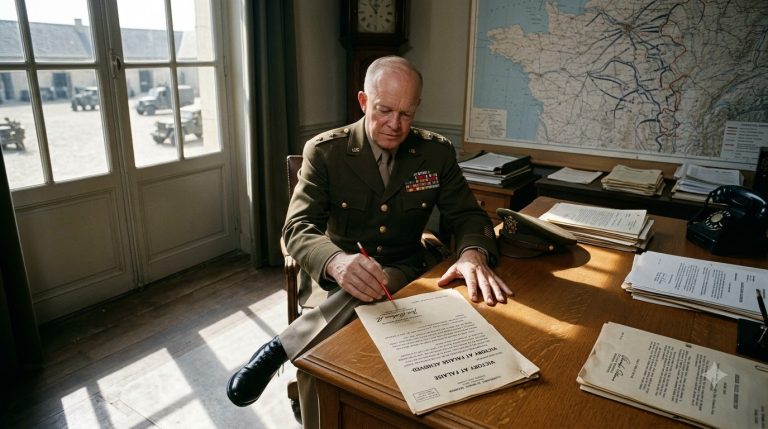
My left knee buckled the second my boots hit the wet gravel, the cold sea driving through my wool trousers like a handful of dull needles. I leaned heavy on the hickory cane, feeling the wood groan under my weight while my thumb pressed hard into the brass casing of the pocket watch in my coat pocket. My heart hit a jagged, uneven double-thump against my ribs—that familiar, dangerous stutter—but I kept my chin up and faced the grey wall of the sea-wall.
“General, this isn’t Red Beach,” Colonel Van Fleet grunted, wiping sea-spray off his wire-rimmed spectacles with a dripping sleeve. “Look at those dunes. The bunker placements… there’s no pillbox on the left spur. We’re at least two thousand yards off.”
“Two thousand yards south,” I corrected, my voice raspy from the morning air. “Sector Victor.”
A young lieutenant sprinted up, his helmet lopsided and his eyes wide with the frantic energy of a man waiting for an artillery shell to split him in two. “Sir! The radios are soaked—the salt water fried the signal tubes in the surf. We can’t reach the command ship to signal the error! We don’t have HQ authorization to pivot!”
I didn’t answer him right away. I pulled the brass watch from my pocket, feeling the cold metal settle against my palm, and snapped the lid open with a quiet click. The second hand ticked with steady, unbothered precision, completely indifferent to the giant invasion fleet grinding against the coast behind us.
Around us, three hundred soldiers were crouched low in the wet foam, staring at the wrong ridge, holding maps that described a completely different piece of France. The silence on this stretch of beach was heavy, almost unnatural compared to the thunderous roar echoing off the cliffs five miles north at Omaha.
Van Fleet stepped closer, his jaw tight. “If we move north along the exposed sand to hit our original objectives, we’ll be caught in the open by whatever’s sitting behind those dunes. If we stay here and wait for HQ to sort the naval drift, we’re sitting ducks.”
I looked down at the sand near my boot. Halfway buried in the wet grit lay a thick black insulation cable, freshly cut. I reached down with the tip of my cane and turned the heavy rubber over, noticing the perfectly smooth edge where the wire had parted.
“General?” Van Fleet pressed, his voice dropping an octave. “What are your orders?”
I closed the pocket watch with a dull snap and slipped it back into my breast pocket, letting my hand rest over the irregular, heavy thudding in my chest.
“We’ll start the war from right here.”
CHAPTER 2: THE SILENT KILLBOX
“Sir?” Van Fleet’s voice cut through the wet hiss of the surf. He took a half-step forward, his boots crunching in the fine gravel. “If we aren’t calling this in, we need to push north along the shoreline now. Sector Victor wasn’t on the assault schedule. We are out of position.”
I kept my eyes on the sea-wall ahead. “If we move two thousand yards up an open beach, Colonel, we spend thirty minutes walking inside a machine-gun funnel. Look at the terrain, not your paper.”
He paused, pulling off his spectacles to wipe away the salt grime again, his eyes squinting against the dull grey daylight. “The map indicates concrete emplacements on the bluffs above Red Beach.”
“And the map was drawn by men sitting in warm rooms in London,” I said, lifting the cane and taking two measured steps toward the embankment. The damp wool of my trousers heavy around my shins. “Nature handed us a mistake. I intend to keep it.”
We breached the gravel shelf where the high tide broke, scrambling over a low mound of tangled driftwood and torn wire. The air here was strangely quiet—no heavy machine-gun chatter, no mortars tearing up the wet sand, just the distant rumble of naval artillery hammering the bluffs three miles to our right.
Lieutenant Miller dragged himself over the crest behind us, clutching his useless signal receiver like a dead weight. “General, if command doesn’t know we landed here, the follow-up waves are going to pile right into our stern. We have to establish the net.”
“We don’t have a net, Lieutenant,” I replied, my voice flat as I paused to catch my breath, feeling the cold air bite into my lungs while my thumb traced the smooth edge of the watch in my pocket. “So stop worrying about what you don’t have and look at what’s in front of you.”
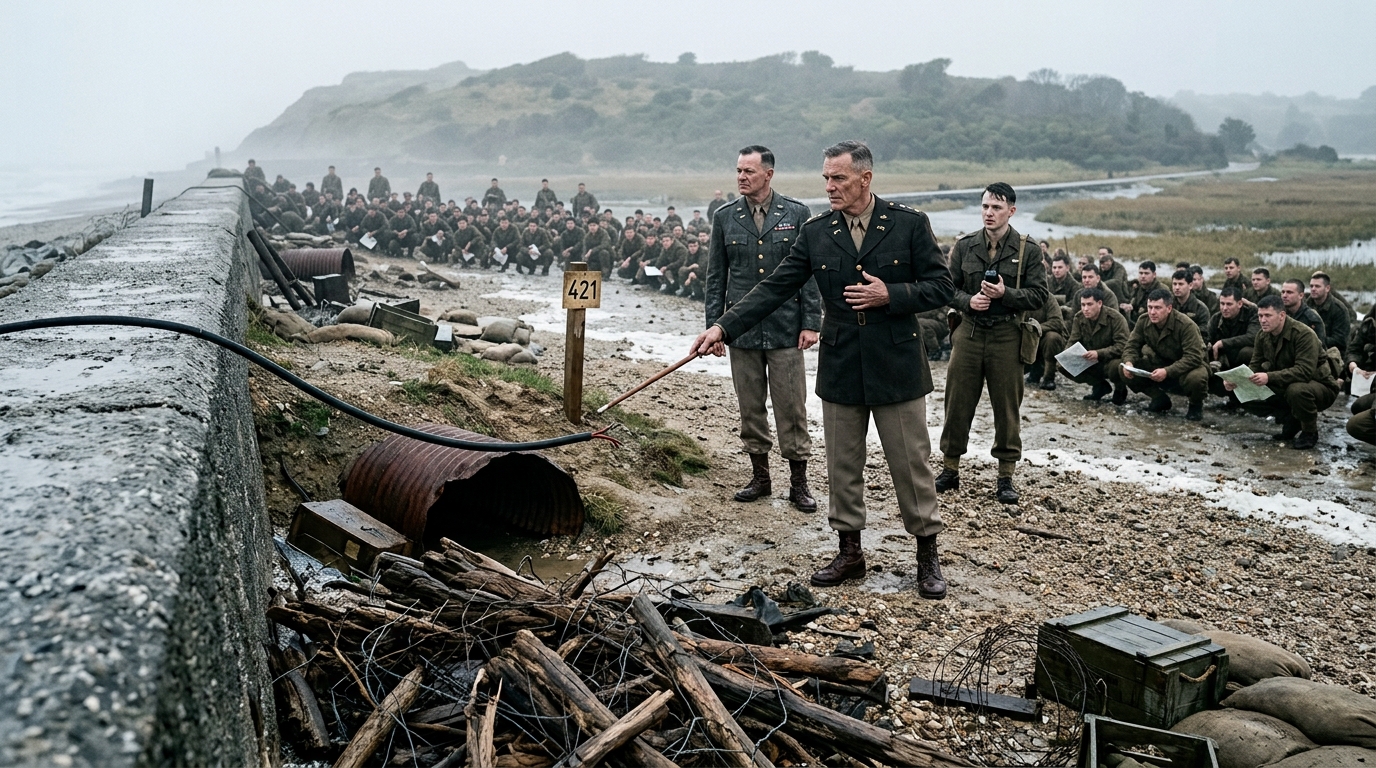
I pointed the cane toward a wooden marker post stuck firmly into the dirt near a breached section of the sea-wall. Painted across the pine board in fresh white lettering were three German numbers: 421.
Van Fleet leaned down, his brow furrowed as his fingers brushed the raw wood. “A range marker. They pre-sighted this gap.”
“They didn’t just pre-sight it,” I said, scanning the empty, quiet marshland extending behind the embankment. “They left this gap open on purpose. It’s an artillery kill-box. They wanted us to land off-target, push through this exact breach, and crowd into the low ground.”
Miller turned pale, his grip tightening on his wet leather strap. “They’re waiting for us to group up.”
“Then we don’t group up,” I said, stepping past the marker post into the mud of the causeway. “And we don’t wait.”
I looked down at the soft dirt near the edge of the drainage ditch. Running straight along the embankment was a second length of black wire—identical to the sliced rubber cord on the beach—snaking up toward the high ridge in the distance.
CHAPTER 3: THE BROKEN LINE
Van Fleet flinched as the spray of wet sand rained down on our backs, but he didn’t run. “That came from the ridge. They know someone’s at the breached sea-wall.”
“They know someone is down here,” I said, leaning down to catch the black cable between the rubber ferrule of my cane and the heel of my boot. “But they aren’t adjusting. That burst landed eighty yards wide of the marker post.”
Miller scrambled up the lip of the drainage ditch, wiping mud from his chin. “General, they’ve got four hundred yards of open marsh zeroed out. If we move the infantry through this sector without air support or radio clearance to counter that battery—”
“Look at the cable, Miller,” I interrupted, resting my weight on the hickory handle to keep my knees from shaking. “Follow it with your eyes.”
The heavy rubber cord ran fifteen feet along the embankment before dangling uselessly over a rusted iron culvert. The copper core inside wasn’t frayed or blown apart by a shell fragment. It was a clean, sharp shear—severed right at the factory crimp.
Van Fleet crouched down, his fingers hovering over the dead wire without touching it. “That wasn’t hit by naval bombardment. That was cut by hand before we even hit the water.”
“Their forward observer on the beach lost his line to the heights ten minutes ago,” I said, pulling my brass watch out with my left hand and snapping the casing open. “The battery up on that ridge is firing off old grid coordinates. They can’t see where their rounds are falling, and they have no way of knowing we’ve already crossed the ditch.”
Miller blinked, looking back toward the crest where two hundred men were crouched in the sea-grass, waiting for an order to retreat. “They’re blind?”
“They’re completely blind,” I said, clicking the watch shut with a flat thump and sliding it deep into my pocket. “They think we’re still stuck in the surf, trying to regroup on the wrong maps.”
Van Fleet looked up at the ridge, a grim, hard realization settling over his face. “If we press up the causeway now, we bypass their entire defensive sweep while they waste their shells on empty sand.”
“We don’t just bypass it,” I said, turning my shoulder toward the rising ground ahead and digging the tip of my cane deep into the sod. “We take the road before they realize nobody’s dying in their trap.”
CHAPTER 4: THE FIRST ROAD TO CHERBOURG
We crested the embankment without a single shot fired at our line.
The heavy concrete bunkers on the ridge were silent, their gun barrels aimed squarely at the empty surf two miles north. Down below us, the wet sand of Sector Victor was already alive with columns of men, trucks, and equipment moving steadily off the beaches and pouring down the open road toward the interior.
Miller wiped sweat from his forehead with the back of his hand, staring out at the clear, unobstructed pavement ahead. “No counter-attack. They don’t even know we’ve taken the causeway.”
“They will in ten minutes,” Van Fleet grunted, his boots heavy on the dry gravel of the main road. He stopped beside me and looked down at my hand. “General, your hand is shaking.”
I pulled the brass watch from my coat pocket and snapped it open. My pulse was still uneven, a dull, nagging flutter against my ribs, but the second hand kept moving forward, steady as ever.
“Let it shake, Colonel,” I said, slipping the watch back into my pocket. “As long as the men keep walking, my heart can do whatever it pleases.”
By noon, the Fourth Division had pushed three miles inland, linking up with the airborne troops holding the hedgerows and securing the western flank of the entire allied invasion. Fewer than two hundred men were lost—a fraction of the slaughter the planners had written into their notebooks.
Van Fleet looked back down the long grey ribbon of road leading all the way to Cherbourg. “We did it without calling back once. No new orders. No authorization.”
“The plan broke,” I said, leaning my weight onto the hickory cane and watching the lead squad disappear over the next rise. “We didn’t.”
I sat down on a overturned wooden crate by the side of the ditch, unbuttoned my wet coat, and took a slow, deep breath of the damp French air. The noise of the beach was fading behind us, replaced by the quiet, steady rhythm of boots marching on dry stone.