The Red Coral Road: How an Unyielding Everyman Shattered an Unbeatable Fortress
CHAPTER 1: THE WOODEN PLANK
The diesel exhaust from LVT-47 hits my lungs before the salt spray does.
Down in the well deck, eighteen men sit shoulder-to-shoulder, their helmets clinking against the steel hull with every violent chop of the Pacific. Up on the bridge of the flagship, the admirals called this a three-day turkey shoot. They said two hours of naval bombardment would flatten the concrete.
They lied.
I roll a single, sea-corroded mounting screw between my thumb and forefinger. It’s the only part of my Springfield M1903 sniper rifle that matters right now, stripped straight off the top receiver because the salt air rusted the optical mounts back in the transport bay. The six-power scope is wrapped in wax canvas at the bottom of my pack, completely useless. The state rifle championship trophy I won back in Arkansas doesn’t mean a damn thing out here. There are no six-hundred-yard targets today.
“Lieutenant,” Sergeant Williams barks over the roar of the tracks. He points a grease-stained finger toward the bow ramp. “Reef’s running dry! The Higgins boats behind us are catching bottom!”
I pocket the rusty screw, grab two four-pound canvas satchel charges of TNT, and hook four MK2 fragmentation grenades directly into the webbing across my chest. My fingers are stiff with salt and grease, but the cold iron of the grenade pins feels solid. Real.
“Forget the scopes!” I yell down the line, my voice cutting through the thrum of the engine. “If it’s got a firing slit, you don’t shoot it! You feed it iron and powder!”
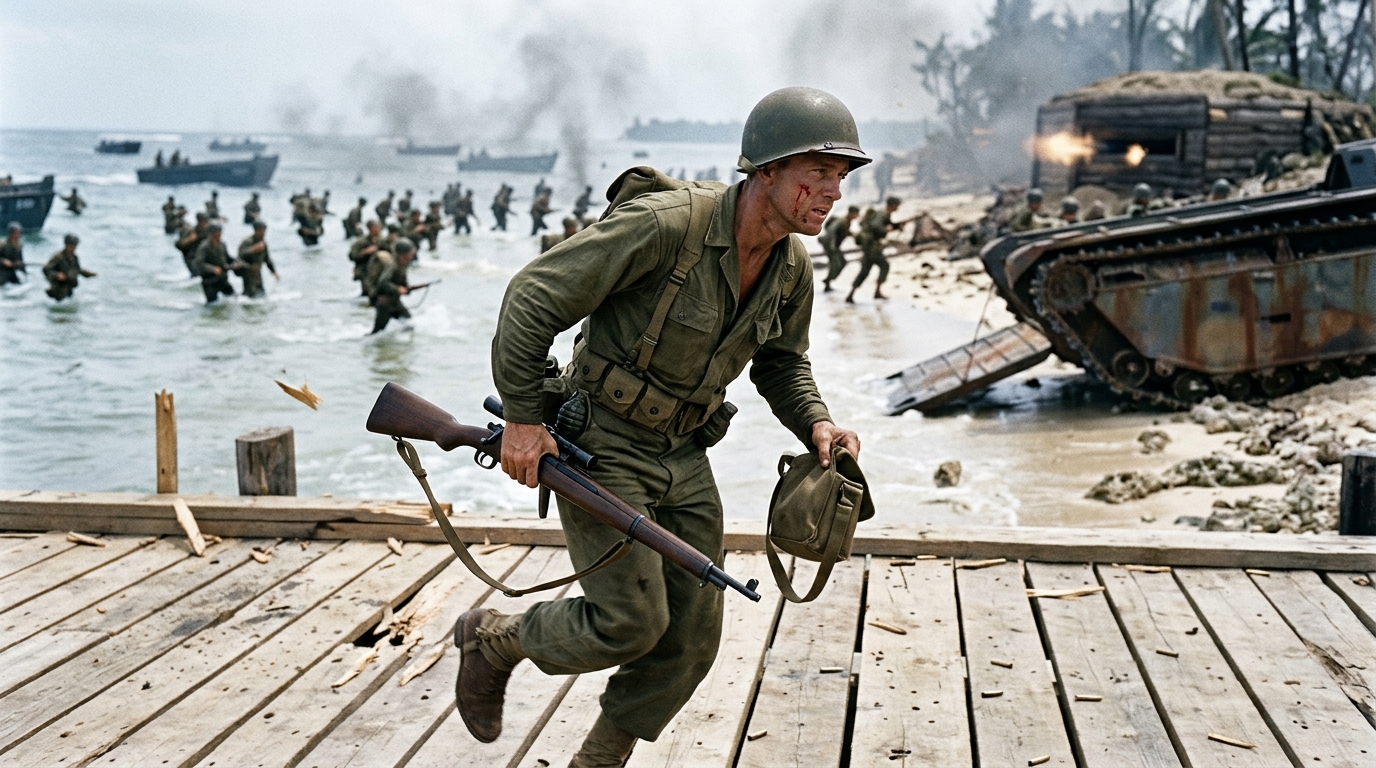
The tracks grind against wood. The amphibious tractor surges forward, mounting the edge of the five-hundred-yard supply pier that sticks out into the bay like a broken bone. Bullet strikes begin immediately—pock-marking the oak planks, sending razor-sharp splinters screaming through the air like shrapnel.
The ramp drops with a heavy steel clang.
I don’t look back to see if the battalion commander is watching from his post. I leap off the ramp, my boots slamming hard onto the sun-bleached timber of the pier.
Directly ahead, fifty yards down the wooden span, a low coconut-log bunker sits embedded in the coral base. The muzzle flash of a heavy machine gun blinks rhythmically through a six-inch slot, sweeping the water where hundreds of Marines are wading chest-deep through the red tide.
There’s no long-range cover. No scope. Just four hundred yards of open planking and a bag of high explosives.
I pull the pin on the first grenade with my teeth, hold the spoon down for two agonizing seconds, and start sprinting straight toward the flash.
CHAPTER 2: IRON AND CORAL
The heavy machine gun inside the bunker cycles with a rhythmic, pounding roar that shakes the planks beneath my boots.
I drop flat. A burst of seven-point-seven millimeter rounds rips through the air three inches above my helmet, tearing a spray of salty oak splinters directly into my cheek. I don’t bleed much—the salt in the air dries the cuts before they can drip.
Behind me, Sergeant Williams hits the deck, his elbow striking the timber with a dull thud. “They’ve got the whole length of the pier pre-ranged, Lieutenant! We can’t crawl through this!”
“We aren’t crawling!” I pull a second MK2 grenade from my canvas webbing, my calloused fingers catching on the cold steel ring.
My scoped Springfield is slung uselessly across my back, the wax-coated canvas bag shielding it from the salt water, but it might as well be a piece of driftwood. There’s no sitting back at four hundred yards today. No pristine crosshairs. Just thirty yards of exposed wood, a bleeding cheek, and an enemy commander who thinks two feet of reinforced coconut logs make him invincible.
I roll onto my left side, using the slight lip of the pier’s outer framing timber for an inch of cover. Down in my coat pocket, the corroded scope screw digs sharp into my hip—a stupid, metal reminder that precision is dead out here.
“Williams!” I yell, keeping my forehead pressed to the damp planking. “Keep their eyes on the slit! Give me three seconds!”
Williams doesn’t ask questions. He unslings his iron-sighted M1903, levers a round into the chamber with a harsh metallic snap, and fires directly at the dark opening. The bullet strikes the edge of the firing slot, kicking up a puff of concrete dust that momentarily obscures the Japanese gunner’s vision.
That’s the window.
I spring up from the timber, my knees burning as I drive my weight forward. The three-pound satchel charge in my left hand feels like a anvil, swinging with my stride. Twenty yards. Fifteen.
The machine gun barrel swings toward me, its dark snout protruding from the slit like a cornered beast. I don’t look for a target. I don’t wait for a clean shot.
I yank the pin on the grenade in my right hand, release the safety lever, and let the spoon fly with a sharp, hollow clack.
One.
I keep running, feeling the heat of the muzzle flash scorch the hair on my forearms.
Two.
I shove the grenade straight through the six-inch firing slit, driving my hand inside just deep enough to feel the cold edge of the steel frame before ripping my arm back.
I throw my body sideways over the edge of the pier, falling six feet into the shallow, coral-choked water below just as the charge detonates inside the concrete vault. The muffled, heavy concussive wave slaps across the ocean surface, showering my back with wet coral dust and silence.
CHAPTER 3: THE DRAINAGE DITCH
I press my back against the slimy piling, breathing hard through my nose to keep from swallowing salt water.
Blood spreads fast in sea water—a dark, blossoming cloud near my ribs—but there’s no sharp bone sticking out, and the fingers on my left hand still curl when I force them to. Good enough to work a fuse. Good enough to pull a pin.
“Hawkins!” Williams leans over the edge of the pier, his knuckles white as he grips the splintered oak timber. “You’re hit!”
“Keep your head down!” I bark back, my voice gravelly from the cordite fumes drifting off the water. “Check the platoon behind us!”
Williams glances back along the four-hundred-yard span, his mouth setting into a hard line. “Half the landing craft are hung up on the outer reef! Water’s too shallow! The boys are wading in chest-deep under direct fire—they’re pinned behind the seawall!”
That’s the trap. The brass promised a high tide to float the heavy armor right over the coral, but the water level isn’t rising. There are no tanks coming. No heavy artillery landing on this beach. Every square inch of ground has to be cleared by hand.
I reach up, grab a rusted iron ring on the piling, and haul myself out of the swell, my boots sloshing as I gain the beachhead.
Ahead lies forty yards of flat, open coral sand leading to the low coconut-log seawall. Between us and the interior lies a narrow, knee-deep drainage ditch clogged with broken palm fronds and hot shell casings.
I drop into the trench on my stomach, my elbows taking the brunt of the sharp coral floor. Pain shoots up my left arm like a hot needle, but I keep moving forward, dragging my weight inch by inch.
Thirty feet inland, the rear iron door of the third bunker stands exposed, its heavy hinges unpainted and pitted with rust. The defenders inside are shouting coordinates through the front slit, completely oblivious to the ditch running right past their blind spot.
They built this defensive network believing nobody could survive the open beach to reach their back door.
I reach into my satchel, fingers brushing past the useless scope screw in my pocket, and pull out a short cylinder of TNT with a friction fuse. My fingers are shaking, wet with salt and warm blood, but I pull the wire ignition tab with my teeth.
The fuse sputters, spitting a sharp spark against my thumb.
I don’t pause. I don’t calculate margins. I rise up from the ditch just high enough to plant the explosive flush against the iron door hinge, step back, and throw my shoulder hard into the trench bank as the world turns inside out.
CHAPTER 4: THE BLIND SPOT
Fifty yards inland, sitting on a elevated mound of dead coral, stands the main bunker.
It isn’t just a log pillbox; it’s a three-room reinforced concrete fortress with three-foot-thick walls, housing the defense coordination center. This is where the local commander sits behind his impenetrable walls, convinced his five hundred defensive works can hold against any force for a hundred years.
I pull myself out of the trench, my left arm hanging stiffly at my side. The shrapnel in my shoulder grinds against muscle with every step, but the right arm still works.
Williams creeps up alongside me, his face blackened by soot. “Hawkins, look at the tide line! The water’s dropping, not rising! The naval brass miscalculated the moon cycle! No Higgins boats are getting over that reef today!”
I touch the rusted scope screw in my pocket—a worthless scrap from a battle plan that fell apart the second our boots hit the salt water. “Then we don’t wait for boats. We clear the gate ourselves.”
A sudden burst of heavy machine gun fire snaps through the fronds above, clipping leaves that flutter down like green rain. A hidden Japanese sniper up in a palm tree eighty yards out has us pinned against a fallen log.
My scoped rifle stays strapped to my pack, totally useless for counter-sniper fire. There’s no picking him off through a glass lens.
I don’t waste time trying to spot him. I pull my penultimate MK2 grenade, pull the pin, and hurl it toward the base of the thickest palm tree in his sector. The explosion tears through the underbrush, kicking up dirt and shattering the sniper’s angle, forcing him to slide down the trunk to cover his ears.
That brief silence is all the space I need.
I charge the distance, low to the dirt, lunging straight for the eastern side entrance of the command fortress. The steel-reinforced door is cracked open an inch to vent cordite smoke.
I don’t ask for surrender. I don’t give a speech.
I jam my last Bangalore torpedo directly into the narrow gap of the door hinge, pull the friction igniter, and throw my weight back into a shallow shell crater as the heavy iron slab buckles inward with a roaring flash.
CHAPTER 5: THE COUNTERSURGE
The enemy command post behind me is nothing but a mountain of cracked concrete and smoking steel, but the defenders aren’t surrendering.
They emerge from the palm groves in a desperate, surging wave, bayonets fixed, driving straight toward the gap in our seawall to push us back into the sea before the tide turns.
Williams slides into the crater next to me, his hands frantically stripping an ammunition clip into his bandolier. “They’re trying to roll up the beachhead, Hawkins! We’ve got no automatic weapons left on this line!”
I unstrap the Springfield M1903 from my pack. The wax canvas bag falls away, revealing the bare receiver. The glass scope is gone, leaving only the rugged, notched iron sights standing up from the steel barrel.
No five-hundred-yard precision marksmanship today. No windage adjustments or elevation dials. Just eighty yards of open coral sand and an advancing line that refuses to stop.
I roll onto my belly, bringing the rifle butt firm into the notch of my right shoulder. Pain flares in my left arm, but I lock my elbow against the dirt to keep the barrel steady.
My thumb twitches against the corroded mounting screw resting in my coat pocket. The admirals thought arrogance and fortified concrete could dictate this war, but wars are won by the men who hold the line when the plan falls apart.
I line up the front post on the lead helmet seventy yards out.
Crack.
The bolt handle goes up, back, forward, down. A hot brass casing ejects with a metallic ring, tumbling onto the coral sand at my elbow.
Crack.
The iron sight stays rock steady. Another target drops into the brush.
“Keep feeding me clips, Williams!” I shout, my voice raspy from smoke and salt.
He slams a five-round stripper clip into the top guide, his thumb driving the brass rounds down into the magazine well with a single fluid shove.
Five shots. Five spent shells flying over my shoulder. The advancing line falters fifty yards out, pinning themselves behind a burnt log as their momentum breaks against iron sights and plain common sense.
They thought we were helpless without our armor on the reef. They thought a sniper without a scope was just a man with a wooden stick.
They were wrong.
CHAPTER 6: THE DUSTY GRAY
The Seventy-Five millimeter field gun inside that final bunker is sweeping the runway approach, keeping our transport planes from touching down.
There are no more artillery strikes coming. No high-tech scope to pick off the crew from safety. Just fifteen yards of open dirt and the last block of TNT sitting in my canvas pouch.
Williams crawls up to my flank, his face smeared with grease and coral dust. “Hawkins, you’ve taken enough iron for one day. Give me the charge.”
“Not a chance,” I say, my thumb sliding over the corroded scope screw in my pocket—a quiet reminder that every inch of this island had to be bought with blood and plain work, not brass promises. “You cover the communication trench.”
I leave the Springfield in the dirt, pull the last fuse-cap from my pouch, and crawl straight through the shattered fronds toward the bunker’s side wall. The heat radiating off the concrete hits my face before the smoke clears.
I don’t look for an opening to shoot. I don’t wait for permission. I jam the explosives directly between the steel door frame and the wall, pull the friction tab with my right hand, and roll hard into the drainage ditch.
The blast rips through the concrete structure with a dull, subterranean thud that settles deep into the coral bedrock.
When the dust drifts out over the lagoon, the field gun sits silent, its steel barrel warped and cold. Down the coast, the Marines break through the seawall in force, taking the runway step by step.
I drag my back up against the scorched trunk of a coconut palm, unlace my canteen with my right hand, and take a long, quiet sip of lukewarm water. The salt on my lips tastes like sweat and tide, but the air over Beach Red 3 is finally still.
The brass promised three thousand tons of iron would turn this fortress to dust in three days, but in the end, it was just a few dozen tired men with grenades and iron sights holding the line.
I reach into my pocket, take out the little corroded mounting screw, and drop it into the coral dust at my feet.