Walking Through The Iron Rain: How One General Refused To Let A Doomed Invasion Die
CHAPTER 1: SALT AND SILENCE
The salt spray caked the lenses of the binoculars until the shoreline looked like a smudge of charcoal on dirty water.
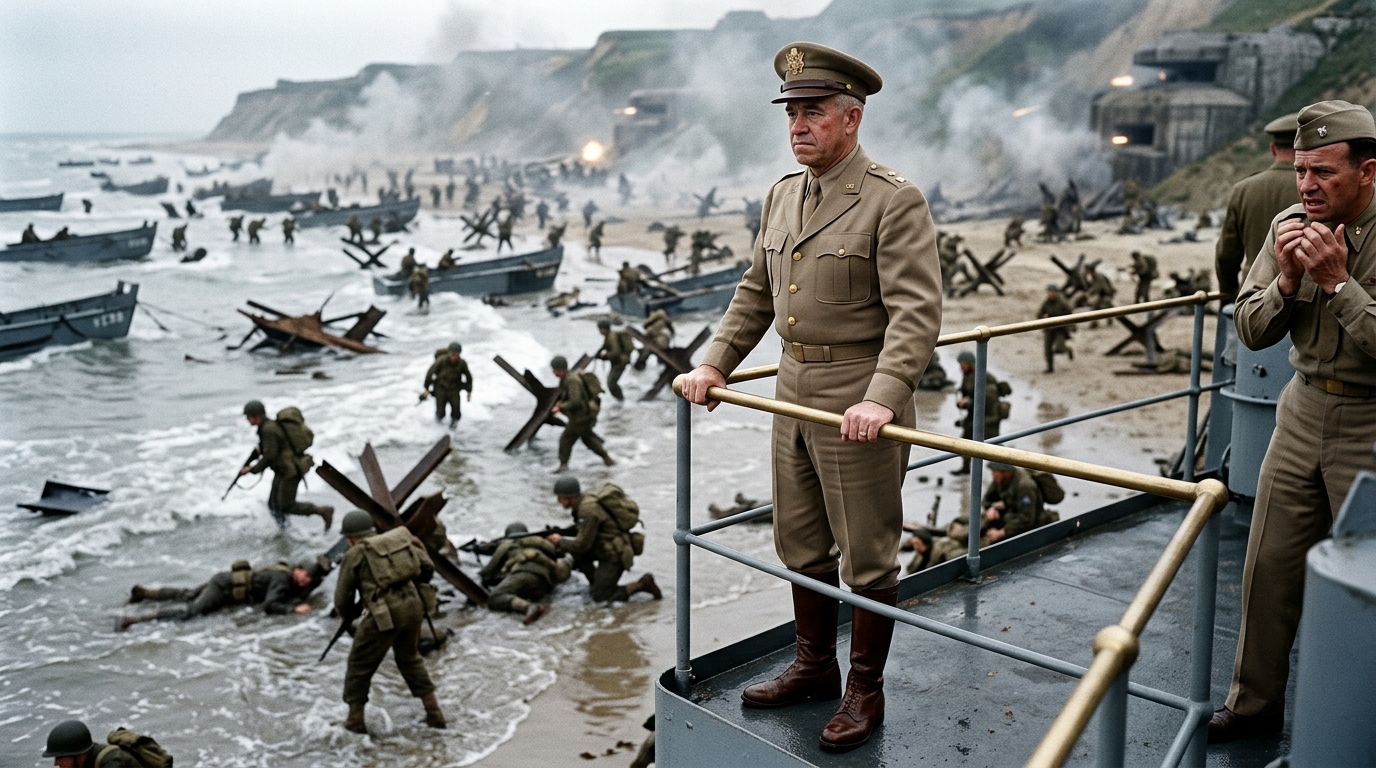
Lieutenant General Omar Bradley gripped the brass rail of the USS Augusta, his knuckles whitening against the cold iron.
A mile ahead, Omaha Beach was burning.
Landing craft twisted in the grey surf like broken toys while dark figures vanished beneath the white foam.
The naval guns had fallen silent too soon, leaving the concrete bunkers untouched and hungry.
Bradley lowered the glasses and felt the bitter weight of a plan turning to ash.
There were no bomb craters on the sand for cover.
There was only an open slope swept clean by continuous machine gun fire.
Every calculation made in the war rooms of London had underestimated the German 352nd Division.
The air tasted of burnt cordite and wet wool.
Down in the water, the men of the first wave were learning that doctrine could not stop a bullet.
A staff officer muttered something about pulling back the survivors.
Bradley did not answer at once, watching another landing craft erupt in a fan of splintered wood and fire.
The sea was choked with gear and blood.
Somewhere out in that churning chaos, a fifty-one-year-old general with a bad heart was stepping onto the sand to see if stubbornness could beat steel.
CHAPTER 2: IRON ON THE WATER
The landing craft pitched violently in the five-foot swells of the English Channel.
Sergeants and privates crowded the bow, their wool uniforms soaked through with freezing brine and sweat.
The expected bomb craters on the sand were entirely absent from the grey shoreline ahead.
Instead, the German 352nd Division waited behind untouched concrete emplacements with fixed fields of fire.
A machine gun burst chewed through the forward ramp before the first boot could hit the metal.
The young men from Iowa and Texas stepped out into water over their heads, weighed down by sixty pounds of gear.
Some sank instantly into the churned mud without a sound.
Others struggled toward the shallows only to find a flat, open killing zone swept by unyielding crossfire.
There was no cover behind them except the rising tide and burning wreckage.
The official timeline placed these troops a mile inland by now.
Instead, they held ten yards of wet sand, pinned behind steel hedgehogs that offered no protection against plunging fire.
Up on the cruiser deck miles out, the high command stared through smeared binoculars at a disaster unfolding in real-time.
Down on the water, the men had to throw away their heavy packs just to keep their heads above the surface.
A private beside the seawall stared down at his wrist, watching a salt-crusted watch tick uselessly against skin turned blue by the cold.
There were no more plans left to follow.
CHAPTER 3: PINNED AGAINST THE WALL
The coarse sand scraped against raw skin as the men flattened themselves lower into the shallows.
A sergeant from Virginia spat out a mouthful of brine and grit, his eyes locked on the smoking concrete ridge above them.
Every path forward was swept clean by interlocking machine gun fire that turned the beach grass into confetti.
The timeline dictated they should be a mile inland, but the only movement on the sand was the rising tide closing in behind their boots.
A young private trembled beside a rusted ammunition crate, his fingers locked onto a strap he had no strength left to pull.
There were no reinforcements coming over the horizon, and the heavy artillery silence felt heavier than any explosion.
They were trapped between a rising ocean and an enemy who held every high card.
A low voice cut through the whistling wind, reminding the small cluster of survivors that staying put meant waiting for a bullet.
Movement was the only option left, even if the slope looked impossible.
CHAPTER 4: WALKING THE KILLING GROUND
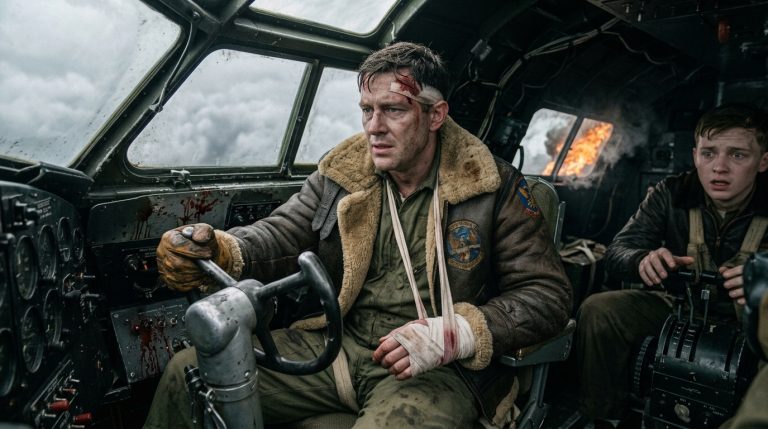
General Cota stepped fully upright into the line of fire, his bad knee throbbing with every stride across the open shingle.
Around him, elite rangers and exhausted infantrymen hugged the ground, paralyzed by the steady chatter of enemy machine guns up on the bluffs.
A young private shrank behind a disabled landing obstacle, eyes wide with terror as lead kicked up wet plumes of sand inches from his face.
Cota didn’t shout or look for cover; he walked straight up to the huddled group and tapped a boot against the steel edge.
—Get off the sand and move up that bluff, — Cota demanded, his voice cutting cleanly through the whistle of incoming ordnance.
The ranger sergeant looked up from the dirt, his face caked in grey salt and sweat, shaking his head against the sheer impossibility of the climb.
—We are pinned down, General, we cannot cross that wire without support, —
—Then use what is in your hands and make your own path, — Cota replied, leaning his weight onto the scarred wooden cane while pointing toward the tangled wire ahead.
There was no magical artillery barrage coming to save them, and no staff officer was going to hand them an easy victory.
Survival required standing up when every instinct screamed to stay down.
CHAPTER 5: BREAKING THE CONCRETE LOCK
The explosive charge seated itself against the tangled barrier with a dull, grating thud that cut through the whistle of incoming fire.
A young engineer wiped wet sand from his forehead, his breathing shallow and ragged as he fumbled with the firing wire.
Up on the bluffs, the German machine gunners adjusted their sights down onto the narrow gap where the men had gathered.
There was no clean engineering solution left to try, only a raw gamble against an entrenched obstacle.
—Clear the line, — a sergeant muttered, shoving the remaining men back into the hollow of the shingle.
The detonation tore a jagged hole through the thick coils of wire, sending up a geyser of gray smoke and shredded metal.
The first soldier through the gap staggered two steps before dropping silently into the churned mud.
The men behind him froze for a fraction of a second, staring at the sudden wall of risk ahead.
No one wanted to step into that open gap, but staying put meant waiting for the tide to finish what the bunkers started.
CHAPTER 6: THE FRAGILE FOOTHOLD
The gray steel of the bow shuddered as the destroyer closed within eight hundred yards of the shallow surf, risking grounding to save the line.
A gunnery officer wiped soot from his brow, his fingers locking onto the firing lever while the coastline erupted in a wall of smoke.
The shore batteries on the bluffs returned fire, kicking up columns of white spray that soaked the vessel’s hull.
There was no clean protocol left to follow, only the raw demand to blast the concrete nests before the tide finished the work.
—Keep those guns firing until the barrels warp, — a voice shouted over the screech of incoming metal and the roar of the deck engines.
The ship shuddered again, belching fire and smoke directly into the fortified ridge that had held the whole landing at bay.
On the sand below, the surviving infantry watched the bunkers crack open under the weight of point-blank steel.
The stubbornness of men who refused to die on the wire finally met the firepower that turned a slaughterhouse into a narrow door.
By nightfall, the beach was no longer a graveyard of broken timber, but a fragile, bleeding foothold purchased at a bitter price.
The survivors sat in the dark salt air, checking gear that would never look clean again, knowing the hard way that boundaries are held only by those who refuse to step back.