The Detroit Factory Worker Who Built Scrap Metal Grenades to Shatter Unbreakable Normandy Concrete Bunkers
CHAPTER 1: THE HEDGEROW DEAD END
The morning mist clung to the damp brush like a cheap wool blanket. Corporal Jack Sullivan didn’t look at the sky or think about the grand sweep of the invasion. He looked at the seam where the concrete met the earthen berm sixty yards ahead, noting the hairline crack in the gray aggregate.
Another platoon had tried the open stretch before dawn. The machine guns inside the bunker hadn’t even needed to sweep back and forth; they had simply held a fixed, brutal line across the tall grass. Thirty-four men in three days, and the thick reinforced walls hadn’t so much as chipped.
Beside him, a young private was chewing frantically on a dry ration biscuit, his jaw working in jerky, uneven rhythms. Jack reached into his pocket and rolled a heavy, square-cut roofing nail between his thumb and forefinger, feeling the sharp bite of the steel against his callus.
“Standard ordinance isn’t doing a damn thing,” the private muttered, staring out at the smoking ruins of a tank destroyer. “Command wants another infantry push before noon.”
Jack didn’t answer right away. He kept his binoculars pressed to his eyes, tracking the faint, lazy curl of blue-gray exhaust smoke drifting out from the very back of the enemy fortification.
The books back at Fort Benning said a frontal assault required heavy artillery support or specialized flamethrower teams. But the artillery was miles behind, bogged down in the choked country lanes, and the flamethrower crews were already gone.
Jack lowered the binoculars and spat a bitter taste of dust from his mouth. The textbook solutions were dead on arrival, which meant he had to stop looking at what the enemy was holding and start looking at how they were breathing.
CHAPTER 2: TOLERANCES UNDER FIRE
Jack held the small cylinder up to the flickering lantern light, measuring the interior diameter with the calloused tip of his thumb. Standard issue was engineered in clean factories miles away from the mud, but this was built out of necessity.
He dumped a small pile of coarse black powder onto a scrap of oiled canvas, watching the dark grains roll like dry sand. Beside the powder sat a row of forty heavy roofing nails, each one cold, sharp, and uniform.
The lieutenant’s words from yesterday still echoed outside the canvas flap, warning about regulations and safety margins. Jack ignored the noise, focusing entirely on the clearance tolerances inside a six-inch metal tube.
“If the gap is too loose, the shifting charge dampens the shock wave,” Jack muttered to himself, pressing the nails tightly around the central core. “It needs a tight, calculated fit or the blast just vents outward.”
A sudden gust of wind rattled the tent poles, carrying the distant, hollow thump of artillery from the crossroads three miles north. Jack didn’t look up from his work. He trimmed the modified pyrotechnic fuse with a pair of wire cutters, keeping the burn time precisely calibrated for ten slow, deliberate seconds.
He reached for a piece of friction wire, his fingers moving with the steady, practiced rhythm of a man who spent ten hours a day inspecting fuel tank welds at Ford. This wasn’t about heroics; it was about math, pressure, and making sure the container held until it reached the target.
CHAPTER 3: THE COMMANDER REJECTION
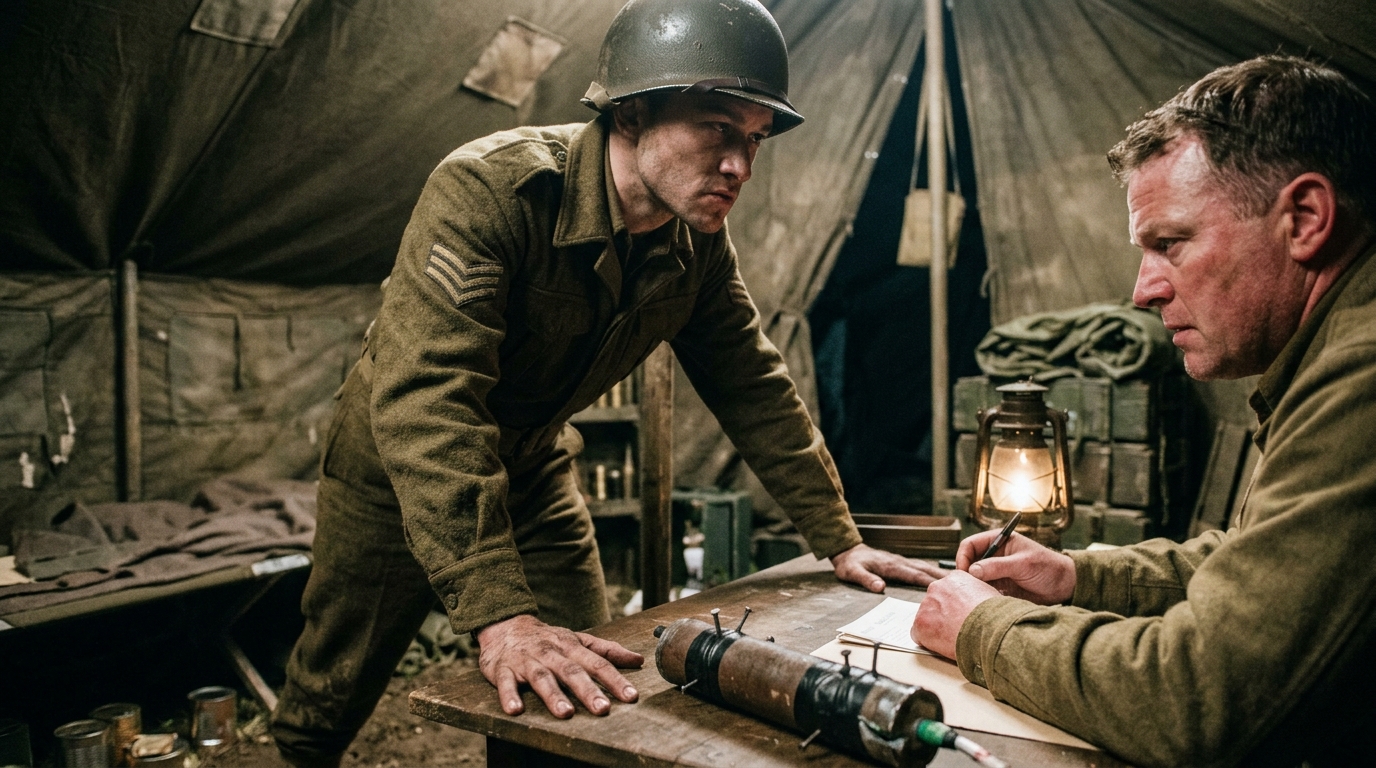
Captain Miller didn’t look at the tin when Jack placed it on the folding field desk. He kept his eyes fixed on a clipboard tracking the morning’s casualty reports from the third platoon.
— Regulations are clear, Corporal, — Miller said, his pen tapping a sharp, uniform rhythm against the wood. — You are a quality inspector from Detroit, not an ordnance officer. If this makeshift device detonates in your hand, my report will look like sheer negligence.
Jack wiped a smudge of black powder from his thumb onto his wool trousers, feeling the coarse fabric resist the friction.
— Standard fragmentation grenades are bouncing straight off that concrete wall at the crossroads, sir, — Jack replied, his voice flat and level. — Thirty-four men are dead because the books say front assaults are the only option.
The captain stopped tapping his pen, his jaw tightening into a hard, defensive line.
— I cannot authorize frontline use of unauthorized scrap metal explosives, Sullivan. It violates every protocol we have down from headquarters.
— Protocol isn’t stopping the machine gun nest seventy yards up the lane, — Jack said, leaning his weight forward against the edge of the table. — Give me permission for one test run on one abandoned bunker tomorrow morning. If it fails, I drop the whole thing.
Miller stared at the small metal cylinder, his face flushing with the stubborn resistance of a man cornered by his own rulebook.
— One bunker, Sullivan, — the captain snapped, waving a hand to dismiss him without looking up. — And if you blow yourself to pieces, don’t expect a sympathetic word in the casualty telegram.
CHAPTER 4: ONE DESPERATE GAMBLE
The machine gun fire cracked overhead, chipping splinters of bark from the hawthorn bushes just inches above his helmet. Jack kept his head low, feeling the cold mud smear across his nose as he wormed his way toward the blind side of the concrete target.
Up ahead, the massive slab of reinforced gray structure sat silent, its heavy firing slits turned outward toward the abandoned road where previous frontal attacks had stalled.
— You’re crawling right into a crossfire, Sullivan, — a sergeant hissed from the secondary trench back behind the line, his voice tight with raw tension. — That tin’s going to blow your arm off before you reach the dirt.
Jack ignored the warning, his eyes locked entirely on the lower corner at the rear of the structure where the six-inch exhaust opening cut through the concrete.
The air smelled intensely of burnt gunpowder and wet sod, thick enough to make the back of his throat burn with every shallow breath he took. He reached the base of the concrete wall, pressing his shoulder flat against the cold, rough aggregate to stay completely out of the machine gun’s lateral field of view.
His fingers trembled slightly as he pulled the igniter wire on the modified ration tin, counting the rhythmic beats in his head.
— One, two, three—
Jack shoved the cylindrical container hard through the narrow rear opening, listening to it clatter against the iron floor inside before he scrambled backward into the mud.
CHAPTER 5: THE SILENT COLLAPSE
The dull, localized thud rolled outward through the grass, lacking the sharp crack of an external detonation. Jack stayed down, pressing his face into the damp soil as thin gray smoke puffed lazily from the rear vent.
Inside the concrete housing, the contained overpressure did its silent work without wasting a single ounce of force against the thick exterior walls.
A squad mate peered over the edge of the trench thirty yards back, his eyes wide with disbelief as the heavy machine gun atop the enemy post fell instantly dead.
— There’s no return fire, Sullivan, — the soldier shouted across the clearing, his knuckles white around his rifle stock. — The slit stopped smoking. Go look.
Jack pushed himself up on trembling arms, brushing loose dirt from his knees before creeping forward to inspect the result.
He didn’t celebrate; he simply checked his tolerances, noting how the trapped blast had successfully bypassed the armored facade by exploiting the single unprotected engineering oversight.
The heavy steel door at the side creaked open a fraction under a boot-kick, revealing absolute silence inside the concrete chamber.
CHAPTER 6: STANDARDIZED SILENCE
The heavy stamping press at the Ford Rouge Plant dropped with a steady, deafening thud that vibrated straight through the concrete floor into Jack’s boots. Decades had passed since the hedgerows of Normandy, but the tolerance checks remained identical.
A younger inspector handed over a rejected fuel tank housing, pointing a grease-stained finger at a hairline flaw near the weld seam.
— This one’s off by a millimeter, Jack, — the kid said over the roar of the factory line. — Scrap it?
Jack took the metal piece, his thumb running across the cold surface with the same careful precision he had used to measure black powder under enemy fire.
— Scrap it, — Jack replied quietly, tossing the imperfect housing into the bin. — If the tolerances aren’t right, the whole system breaks under pressure.
He walked back to his station, his thoughts anchored entirely to the present moment, completely stripped of any lingering tension from the war. The medals remained buried in a drawer at home, and the 47 bunkers were just history tucked away in dusty after-action reports.
He picked up a clean inspection gauge, adjusted his glasses, and went back to work.