The Iron Ledger of the Western Desert: How a Single Captured Engine Humbled an Empire
CHAPTER 1: THE DESERT DISCOVERY
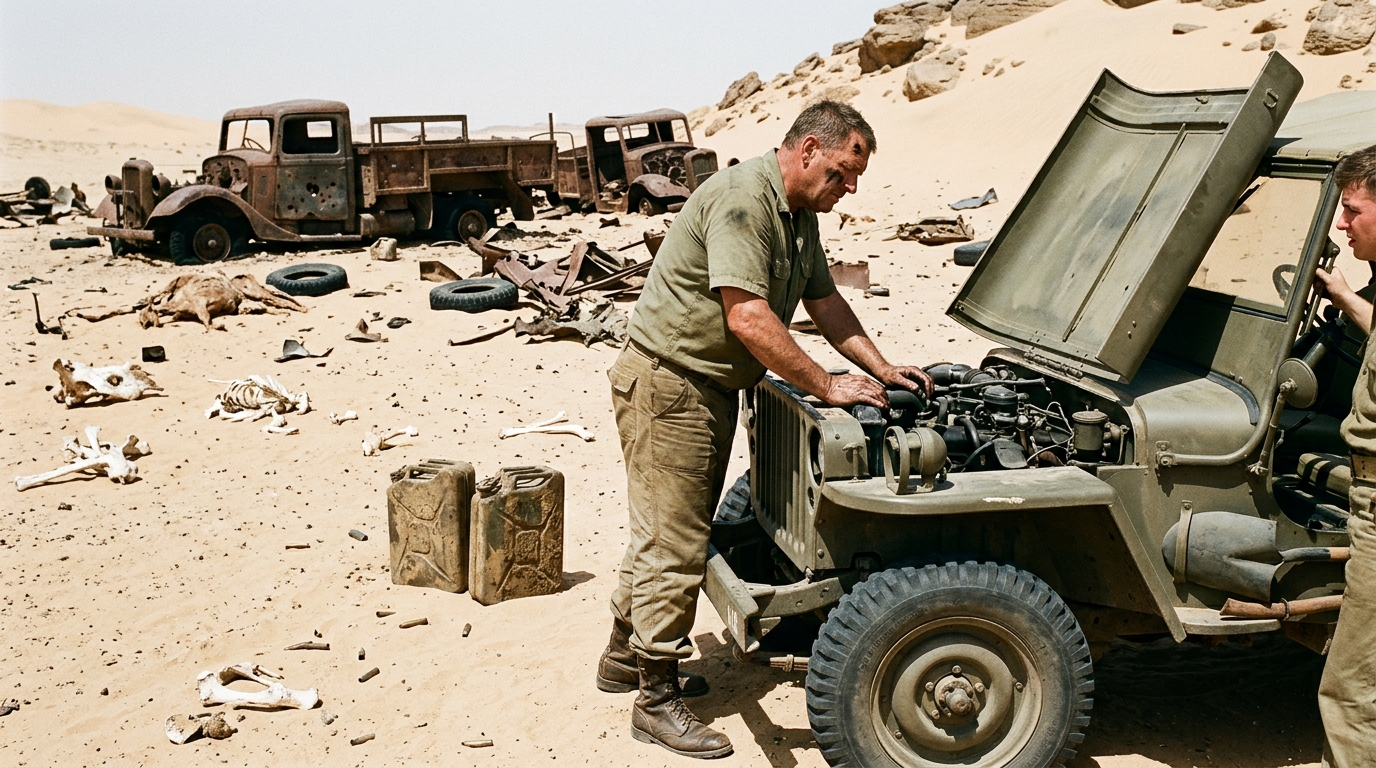
The sand was hot enough to bite through the soles of heavy leather boots.
Senior Mechanic Hans Bauer wiped grease from his forehead with the back of a scarred wrist, leaving a smear of dark carbon across his skin.
Before him sat the captured American machine, abandoned beside the skeletal remains of a British supply column with its radiator hissing its last dying breath.
The vehicle’s hood was already unlatched, propped open against the blinding desert sun.
“Get our best mechanic,” the commanding officer had ordered back at the forward outpost, his voice tight with the strain of a receding front line. “I want to know if we can use this thing.”
Hans reached into his pocket, his fingers brushing the cold, familiar steel of an oil-stained pocket wrench.
He turned the tool over in his palm, feeling its weight as he stared down at the engine block.
German doctrine demanded absolute perfection, tight tolerances, and specialized machinery maintained only by factory-trained specialists.
Yet this machine sat here in the dust, seemingly untouched by the sophisticated maintenance schedules the Reich’s manuals required.
A younger corporal shifted uneasily beside him, kicking a stray shell casing into the dirt.
“Do we burn it, sir?” the corporal muttered, eyeing the horizon for enemy aircraft. “Standard orders say leave nothing for them to salvage.”
Hans didn’t answer immediately.
He stepped closer to the fender, the dry heat radiating off the stamped metal body panels.
He leaned down, bringing his eyes level with the grille, looking for the intricate flaws that propaganda promised were hidden beneath every allied design.
Instead, he found only a simple placard bolted to the dash bearing a single, quiet name: Willys MB.
He reached out, his fingertips grazing the latch of the hood, and pulled it wide to see what lay hidden in the dark.
CHAPTER 2: BENEATH THE HOOD
Hans let out a slow, deliberate breath, the dry desert air scraping against the back of his throat.
He didn’t reach for the specialized metric wrenches that filled his unit’s tool chests back at the base.
Instead, he gripped a standard adjustable spanner, noting how easily the jaws locked onto a hexagonal bolt head that bore no complex factory hallmarks.
The corporal leaned in closer, his boots crunching on the grit, watching the older mechanic’s hands move with reluctant fascination.
“Is it German steel?” the corporal asked, his voice dropping low to avoid carrying across the wind-scoured dunes.
“No,” Hans murmured, his eyes tracking the vibrant, clean layout of the wiring harness. “Look at the insulation. Color-coded, neatly bundled, and routed clear of major heat points without a single braided copper shield.”
It flew in the face of everything the Reich’s engineering academies taught about redundancy and shielding.
Every wire in a German Kübelwagen was wrapped in heavy casing, secured by bespoke brackets, and tied to fragile electrical sub-assemblies that required a specialist with a magnifying glass to service.
Here, a farm boy or a factory hand could trace a broken circuit in seconds using nothing more than natural light and basic logic.
Hans loosened a secondary housing bracket, the bolt spinning free with a clean, unbinding hiss of dried sand.
As the cover lifted away, a tiny detail caught the edge of his vision—a single, unnumbered bolt securing the fuel pump bracket that matched the thread pitch of the steering column mounts.
He paused, his thumb rubbing against the smooth steel of the fastener.
It was an impossible design choice by European standards, where every part had its own unique part number, its own strict tolerance, and its own dedicated manufacturing die.
The Americans had built this machine not as a delicate piece of clockwork, but as a collection of interchangeable components that could be swapped across entire fleets without a second thought.
“They aren’t building for a parade, corporal,” Hans said quietly, setting the unnumbered bolt down on the fender with a dull metallic clink.
“They’re building an army that can fix itself in the mud.”
CHAPTER 3: THE SOFT SAND TRIAL
Hans slid behind the narrow steering wheel, his weight settling heavily onto the cracked canvas seat.
The corporal slammed the passenger-side door shut, the latch catching with a hollow, tinny rattle that lacked the heavy resonance of German armor.
“Let’s see if this American toy actually moves,” the corporal muttered, gripping the grab handle above the dash as Hans pulled the single transfer case lever back into position.
The Go-Devil engine coughed once, caught its breath, and settled into a steady, utilitarian hum that vibrated straight through the floorboards.
Hans pressed his boot down on the accelerator, steering the machine directly toward the soft, shifting dunes where their standard Kübelwagen units routinely dug their own graves.
The rear-wheel-drive German vehicles would have bogged down instantly in this loose powder, their light frames spinning helplessly until the axles dragged in the sand.
This machine did something entirely different.
All four wheels bit into the slope simultaneously, the suspension flexing with crude leaf springs that absorbed the punishing terrain without a whimper.
“Look at the wheels,” Hans shouted over the steady roar of the engine.
The machine didn’t slow down; it simply crawled over the crest at a walking pace, its low-range gearing locking every ounce of power into the ground.
They crested the ridge and dropped smoothly into the basin beyond, leaving deep, uniform treads stretching back toward the horizon.
The corporal exhaled sharply, letting go of the grab handle with a visible shudder of surprise.
“It didn’t even slip,” the younger man said, staring back at the empty desert behind them.
Hans cut the ignition, letting the engine die with a soft tick of cooling metal as he looked out across the endless expanse of sand.
CHAPTER 4: THE SUPPLY DISPARITY
Hans dragged a grease-caked rag across his palms, staring down at the intelligence reports spread haphazardly over an upturned ammunition crate.
The numbers scrawled across the onionskin paper didn’t look like tactical assessments; they looked like accounting ledgers from another planet.
A supply officer—a man who had spent years calculating fuel rations down to the final drop—stood nearby, his posture stiff with disbelief.
“They aren’t just building replacements,” the supply officer muttered, tapping a blunt finger against a column of production statistics intercepted from Allied wiretaps.
“Willow Run alone is turning out a heavy bomber every single hour.”
Hans didn’t look up from the manifest.
He picked up a small, standardized spark plug pulled from the Jeep’s block, turning it over in his calloused fingers.
“It is not just the aircraft,” Hans said, his voice flat and weary.
“Look at the vehicle output ratios. For every single light utility vehicle we manage to cobble together in our factories, they are shipping thousands across the Atlantic in iron hulls that outpace our torpedoes.”
The supply officer let out a sharp, humorless laugh, rubbing the bridge of his nose where fatigue had etched deep grooves.
“Our high command talks of superior metallurgy, of tolerances measured in microns,” the officer hissed, gesturing toward the silent expanse of the desert.
“And yet, here we are, stranded with broken axles and empty fuel drums, while their farm boys throw away functional machines simply because a tire went flat.”
Hans set the spark plug down on the wood crate, the small piece of metal rolling an inch before coming to rest against an unmapped deployment grid.
The silence between them felt heavier than any artillery barrage.
CHAPTER 5: THE CAPTURED MOTORPOOL
Hans wiped grease from his knuckles, staring down at the immaculate assembly of American trucks lined up outside the motorpool barracks in Texas.
Two full years of prison camp labor had stripped away every illusion of German industrial superiority.
An American motorpool sergeant, barely old enough to shave, walked past carrying a standard-issue replacement axle that fit three different vehicles without a single modification.
“You’re staring at the parts bin again, Hans,” the sergeant said, tossing a fresh wrench onto the workbench with a sharp clatter.
Hans did not flinch.
He picked up a standard hex nut, his calloused fingers tracing the uniform threads that could be matched in Detroit or Dallas with equal ease.
“We built for a museum,” Hans said, his voice low and raspy from the dry camp winds.
“You built for the road.”
The sergeant leaned against the fender of a freshly serviced command car, crossing his arms over his canvas jacket.
“We just realized that if a farm boy can’t fix it with a basic wrench in ten minutes, the design is already broken,” the sergeant replied bluntly, offering no sympathy and no malice, only the cold, unyielding reality of mass production.
Hans looked back down at the unnumbered steel bolt resting in his palm, recognizing at last that no amount of engineering pride could ever outlast an infinite supply chain.
CHAPTER 6: THE RUSTED TRUTH
Hans stood inside the quiet shell of a reconstructed motorpool near the Rhine, his fingers tracing the edge of a fresh assembly layout sheet.
The war was years behind them, swallowed by the gray ash of history and the relentless march of reconstruction.
A younger apprentice, a fresh-faced German lad who had never smelled desert dust or heard the screaming whine of a remote air-cooled engine, walked up with a puzzled frown.
“Master Bauer,” the boy asked, holding up a simplified transmission casing.
“Why do we build them like this now? Why not the intricate designs our grand academies taught before the conflict?”
Hans looked down at the tool in his own hand—the same oil-stained pocket wrench he had carried across continents.
He didn’t speak of glory or national honor.
Instead, he thought of the desert, of the captured machine that had taught him more in thirty minutes than decades of academic pride.
“We stopped building for perfection,” Hans said softly, setting the wrench down on the clean wooden workbench with a dull, steady thud.
“We built for reality.”
The apprentice nodded slowly, turning the standardized part over in his hands as the morning light broke clear across the rebuilding street.