The Architect of Silence: Turning a Suburban Nightmare into a Masterclass of Calculated Cold Retribution
CHAPTER 1: THE METRONOME
The concrete felt solid beneath my feet, a deceptive foundation for a life that had spent eighteen months fracturing along lines I hadn’t seen coming. My divorce had cost me everything—my savings, my proximity to Emma, and finally, my sense of belonging. This modest colonial in Willowbrook Estates was supposed to be the fix. It was a project, a place to rebuild, a space where I could paint a bedroom sunshine yellow and pretend that structural integrity was a quality that still existed in my world.
Then, the clicking started.
It began at 7:00 a.m. sharp. A rhythmic, piercing staccato that sliced through the morning air like a judge’s gavel hitting a bench. I knew the sound before I saw the woman. Cordelia Whitmore. Mid-fifties, blonde hair lacquered into a shape that defied wind and gravity, and a leather portfolio that looked like it contained the blueprints to my ruin.
She didn’t just walk; she inspected. She moved across my property with the predatory focus of a bomb squad technician, scanning the roofline, the flower beds, and finally, the driveway.
“You must be the new resident,” she announced, not looking at me as I stood on the porch, my coffee cold in my hand. Her voice was thin, sharp, and possessed that specific, hollow resonance of someone who spoke only in edicts. “Cordelia Whitmore. Neighborhood Standards Coordinator.”
I didn’t answer immediately. I took a slow breath, forcing my hands to unclench. My engineering brain was already running a diagnostic, breaking down her tone, her stance, the way she gripped that portfolio. She wasn’t here to welcome a neighbor. She was here to assess a liability.
“Nice to meet you, Cordelia,” I said, keeping my voice neutral. I didn’t mention the divorce. I didn’t mention the 60-hour work weeks I was logging just to keep my child support payments current.
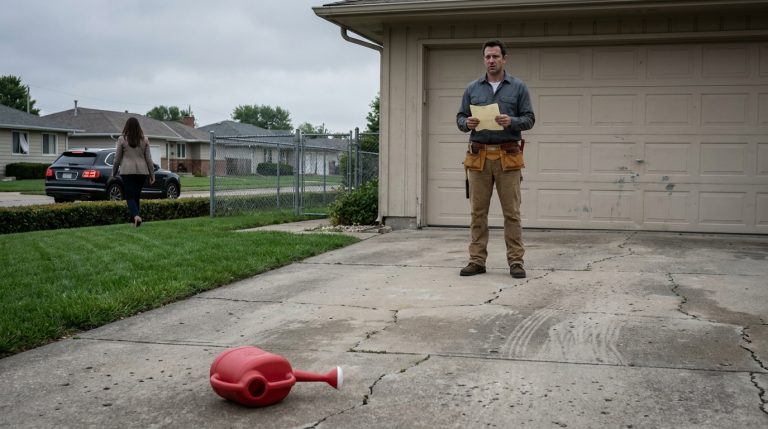
She didn’t care. She was already crouching, her heels digging into the asphalt, pointing at a line in the concrete so thin it was almost invisible. “This,” she said, tapping the spot. “This eyesore is destroying the neighborhood’s property values. Section 12.4. You have thirty days to fix it, or the fines begin.”
I walked down the steps and stood over her, looking at the fracture. It was six inches long, a hairline shift caused by the oak tree’s roots, not neglect. It was harmless. It was human.
“It’s a crack in the driveway, Cordelia. It’s barely a scratch.”
She stood up, and for the first time, she looked at me. Her eyes were hard, colorless, and utterly devoid of empathy. “In this community, Jake, there is no such thing as ‘barely.’ There is only compliance, and there is consequence.”
She turned and clicked away, her stride measured and perfect. I watched her go, the sound of her heels echoing off the houses like gunfire. She disappeared into her white Lexus, but she left something behind—the distinct, cold pressure of a conflict I hadn’t chosen, but one I now realized I was perfectly equipped to finish.
I looked down at the crack again, but this time, I didn’t see a flaw in the concrete. I saw an opening. I pulled out my phone and checked the last photo of Emma’s room, the one I’d been planning to paint yellow, and then I looked at Cordelia’s departing car. I realized she had made one critical mistake: she had assumed that because I was new, I was broken.
She didn’t know I was an engineer. And she certainly didn’t know that I had spent the last year learning exactly how to handle structural failure.
I turned back to the house, the silence of the driveway suddenly heavy, charged with the static of a war that had just officially begun. I needed to see the covenant. All of it.
CHAPTER 2: THE ANATOMY OF A SUBURBAN SIEGE
The ink on the covenant was barely dry, but the intrusion was already underway. I was in the kitchen, the sunlight struggling to pierce the grime on the windows, holding a lukewarm cup of coffee when the silence of the house was shattered by the familiar, precise click of designer heels.
It was 7:00 a.m. on a Tuesday. I hadn’t even finished my first scan of the 1987 bylaws.
I moved to the front window, keeping the curtain pulled back just enough to see through the glass. Cordelia was there, crouched beside my walkway like a forensic investigator at a crime scene. She had a ruler, a clipboard, and a smartphone. She wasn’t just checking the crack; she was photographing it from three different angles, the flash of her phone glinting off the concrete with rhythmic, calculated pulses.
My coffee sat untouched on the counter. The sensation of being hunted in my own home was a physical weight, settling into the marrow of my bones. She didn’t live on this street. She had no stake in this property other than the one she had manufactured for herself. Yet, here she was, measuring the height of my grass with a plastic tool as if she were grading a lawn in a gated community.
I didn’t wait. I opened the front door, the heavy wood groaning in protest.
“Cordelia,” I said, my voice steady, though my heart was hammering a warning against my ribs.
She didn’t flinch. She stood up slowly, tucking the ruler into the pocket of a tailored blazer that looked entirely too expensive for a Tuesday morning in a suburb. She didn’t look at me; she looked at the foundation of my home, her eyes scanning the siding for some new, invisible flaw.
“The crack is still there, Jake,” she said, her voice devoid of inflection. “And now, I’ve noted a discrepancy in your refuse container placement. Section 15.2 states bins must be removed from street visibility within four hours of collection. They were out for six.”
“I was at work, Cordelia. I have a life outside of this sidewalk.”
She finally turned to me, offering that smile—the one that suggested she was already composing my obituary. “Then perhaps you should reconsider your professional commitments. The neighborhood is not a place for ‘life.’ It is a place for adherence. We are protecting the integrity of Willowbrook Estates.”
She adjusted the clipboard, her movements precise, robotic. I noticed the way she moved toward her white Lexus, her heels clicking against the driveway with a deliberate, metronomic cadence that seemed designed specifically to erode my sanity.
“Wait,” I called out.
She paused, hand on the driver’s side door.
“Who authorized the Standards Coordinator position?”
For a heartbeat, the mask slipped. Her pupils tightened, and a sharp, brittle edge of panic flickered in the depths of her eyes before she buried it under a layer of performative disdain. She didn’t answer. She simply looked through me, her silence a weapon, and slipped into the Lexus. The engine purred to life—a quiet, expensive sound that felt like a mockery of my own struggling truck in the driveway.
She pulled away, leaving me standing in the center of my own property, feeling the familiar, grinding pressure of a problem I couldn’t solve with a torque wrench.
I went back inside and sat down at the table, the 1987 document spread out before me like a map of a forgotten civilization. I started at Section 1. I skipped the boilerplate and went straight for the definitions of enforcement.
The silence of the house returned, but it felt different now. It was thin, brittle. I had realized something while watching her: Cordelia wasn’t just petty. Her obsession with the trash bins, the grass, the hairline fracture—it was too granular. It was the behavior of someone who was trying to control a variable they were terrified would spin out of their reach.
She wasn’t managing a neighborhood; she was maintaining a barricade. And if I wanted to win, I didn’t need to apologize for the crack. I needed to find out exactly what she was trying to keep on the other side of it.
I flipped to the back of the binder. Under the section labeled ‘Architectural Enhancements,’ I saw it. A clause regarding voluntary decorative improvements, requiring nothing more than written notification. It was a loophole, ancient and dusty, but it was enough to wedge a crowbar into the foundation of her little dictatorship.
I looked at the clock. 7:15 a.m.
I had been in the house for less than a month, and the war was already escalating. My phone buzzed on the table—a notification from my bank. Another deduction for my daughter’s schooling. My knuckles went white as I gripped the edge of the table. Cordelia wanted to talk about community standards?
I’d show her standards. I’d show her exactly what happened when you poked an engineer who had nothing left to lose. I reached for my laptop, the screen light casting a harsh, blue glow across my face as I began to search for the legal definition of ‘unauthorized enforcement.’
The hunt had begun.
CHAPTER 3: THE VULNERABILITY GAP
The Saturday morning air smelled of damp earth and fresh-cut grass—a suburban cliché that usually calmed me, but today, it felt like the scent of a trap closing. Emma was in the driveway, her small hands wrapped around the cool, metallic wrench I’d been teaching her to use. She was ten, with a sharp, inquisitive mind that didn’t just want to know how a car worked; she wanted to know why.
“Is the bolt supposed to be this tight, Dad?” she asked, her brow furrowed in concentration, a smear of grease highlighting her cheekbone.
“That’s just the friction of the seal,” I told her, my voice softening. “You have to be patient with it. Apply steady pressure. Don’t force it, or you’ll strip the threads.”
It was a lesson for more than just the tire. I watched her, feeling the familiar, aching pride that defined our weekends. These few hours were the only thing keeping me anchored.
Then, the sound arrived. The clicking. It was faster today, more urgent, vibrating against the pavement like a warning signal.
Cordelia turned the corner of the drive with the focused intensity of a predator who had finally cornered its prey. Her clipboard was tucked under her arm, and her face was set in that mask of clinical distaste I had come to loathe. She didn’t look at me; she looked at Emma.
“Jake,” she said, cutting through our focus like a razor. “Section 8.2 of the community standards clearly prohibits the use of mechanical tools on driveways before 9:00 a.m. on weekends. The noise pollution is statistically significant.”
I looked at my watch. It was 8:47 a.m.
“We’re teaching, Cordelia,” I said, stepping between her and my daughter. My body tightened, every muscle preparing for the impact of a conflict I knew she intended to escalate. “We’re being quiet. It’s a learning moment.”
“Education does not supersede ordinance,” she replied, her gaze flicking past me to look at Emma, who had frozen, the wrench still gripped in her hand. Cordelia’s expression was icy, a mix of pity and annoyance. “Perhaps your daughter could engage in quieter, more age-appropriate activities. These kinds of… crude displays are precisely why the property values on this cul-de-sac have stagnated.”
Emma’s shoulders slumped. The light that had been in her eyes when she finally cracked the lug nut loosened, replaced by a sudden, hurt confusion. “I was just helping, Dad.”
“You were doing a great job, Em,” I said, my voice low, vibrating with a controlled, dangerous heat. I turned back to Cordelia. “You need to step off my property. Now.”
“I am documenting a violation,” Cordelia stated, her pen hovering over a fresh sheet of paper. She began to scribble, the sound of the ballpoint scratching against the paper like a serrated knife. “This is your second warning regarding noise. If you persist in this… chaotic environment, I will be forced to escalate this to the Board of Directors. There are provisions for removing residents who consistently undermine the community aesthetic.”
She was bluffing. I knew it, and deep down, she knew it, too. But the threat wasn’t about the law anymore. She was weaponizing my insecurity, attacking the very foundation of my relationship with my daughter. She wanted me to lose my temper. She wanted a scene. She wanted to document a ‘volatile resident.’
“The Board is in Florida, Cordelia,” I said, my voice dropping into a register I hadn’t used since the divorce proceedings. “And Margaret Kim works the night shift. So, exactly which board are you reporting to?”
She didn’t miss a beat. She didn’t even look up from her clipboard. “My authority is established by the covenant. If you have a problem with the process, you are welcome to file a formal appeal. I’ll be sure to document your resistance in the summary.”
She clicked away, but not before casting one last, lingering look at Emma’s greasy hands—a look of profound, elitist disgust.
“Dad?” Emma asked, her voice small. “Is she going to make us move?”
I knelt down, putting my hands on her shoulders. The concrete felt cold through my jeans, the texture unforgiving. “No, Emma. She’s not. But she’s trying to see if we’ll get scared and walk away on our own.”
“Why would she care about a wrench?”
“She doesn’t,” I said, looking across the street at her house—the manicured hedges, the pristine white siding, the way the whole structure seemed to lean forward, watching us. “She cares about control. She thinks if she can make our driveway look like everyone else’s, she’s safe.”
After I dropped Emma off later that afternoon, I didn’t go inside to rest. I went to the garage and locked the door. I pulled out the industrial-grade photooluminescent epoxy I had ordered. It sat in a heavy, unmarked box, a potential, waiting for a catalyst.
I opened the technical specifications. The data was dry, clinical, and perfect.
I wasn’t going to fight her with words. I wasn’t going to file appeals to a board that didn’t exist. I was going to use physics. I looked at the floor, littered with the remnants of my life—the tools, the half-finished projects, the scattered notes.
Cordelia wanted order. She wanted a sterile, silent neighborhood where every lawn was the same height and every crack was invisible. She was trying to build a fortress of normalcy out of fear.
I looked at the epoxy, then at the map of the neighborhood I’d pinned to the wall. I’d circled three other houses—Mrs. Patterson’s, Ashley’s, and Bob’s. I’d seen the way they looked when Cordelia walked by, the way their heads bowed, the way they hurried inside. They weren’t just neighbors; they were casualties.
I turned the light off and let the room plunge into darkness, save for the faint, steady pulse of my laptop screen. I wasn’t just planning a repair anymore. I was planning a disruption.
I began to draft the formal ‘Notification of Architectural Enhancement.’ I wrote it with the cold, detached precision of an engineer, citing every ordinance, every section of the covenant, and every municipal code that supported my rights. I didn’t make a request. I made a declaration.
As I typed, I could hear the distant, faint sound of heels on the pavement outside. She was still out there, patrolling. Searching for another crack. Another violation.
Let her look, I thought, my fingers flying across the keys. She’s going to find exactly what I want her to see.
CHAPTER 4: THE ARCHITECTURE OF FRAUD
The numbers on the spreadsheet didn’t line up. I stared at the screen until the text began to blur, the blue light of the monitor reflecting in the empty coffee mug beside me. I had spent the last three hours cross-referencing the “violation notices” Cordelia had taped to the doors of five different houses on this street—including my own—with the official records from the city planning office and our neighborhood’s supposed bank account.
The results were damning.
There was no account. At least, not one belonging to the Willowbrook Estates Homeowners Association. The payments Cordelia had been demanding—the $50 for the crack, the $75 for the chalk, the $300 for a garden hose—were all being funneled into a private entity.
“Personal enrichment,” I whispered to the empty room. The silence of the house felt colder now, stripped of the comfort I’d tried so hard to build.
I toggled to the next tab, my heart rate steadying into a rhythm of pure, cold resolve. I had contacted Sarah Tatum, a friend from my engineering firm who specialized in corporate litigation. I hadn’t told her everything, just enough to get her to pull the public records for the business registration of “Willowbrook Standards Enforcement.”
It didn’t exist.
Instead, I found a string of shell companies registered to Cordelia’s name, all linked to the same personal cell phone number she used to harass us. She wasn’t an agent of the community; she was an independent contractor of extortion.
The house felt like it was shifting around me. The walls, which I’d once thought were a sanctuary, now seemed like part of a massive, meticulously documented crime scene. Every morning, she had been photographing my house, my life, my daughter’s bike, not because she was a perfectionist, but because she was building a dossier to justify the next ‘fine.’ It was a subscription model for misery.
I stood up, walking to the window. The street was quiet, the houses bathed in the fading orange light of a late afternoon sun. It all looked so perfect, so manicured, so peaceful. But now, I saw the seams. I saw the rot beneath the concrete.
I picked up the phone. Sarah had sent over a summary of the financial trail she’d managed to uncover in the last twenty-four hours. The figures were staggering. Over the last two years, she had extracted nearly twelve thousand dollars from our neighbors. Mrs. Patterson, who lived on a fixed pension, had paid for the ‘bird feeder violation’ twice. Bob, the guy next door who spent his weekends fixing up his garage, had paid for a ‘visual blight’ citation that had essentially funded Cordelia’s designer wardrobe.
I felt a surge of nausea, followed immediately by that sharp, crystalline clarity that comes right before you make a move.
She thought we were easy targets. She thought we were tired, beaten down by life, too exhausted from our own struggles to question a woman with a clipboard and a fake seal. She viewed us as maintenance issues—problems to be filed, audited, and liquidated to keep her own equity afloat.
I heard the familiar, distant click-click-click of her heels on the asphalt outside.
I didn’t turn on the light. I stepped back from the window and watched her through the gap in the blinds. She was in the driveway again, looking at my house. She wasn’t inspecting today; she was waiting. I knew that look. It was the look of a collector waiting for a payment.
She stood there for a long time, the shadow of my colonial stretching out to touch her feet. She looked small, almost frail, standing in the center of the road, but the arrogance of her stance remained. She was the queen of a domain made of air and printed paper.
I went to my desk and opened the drawer. I pulled out the folder containing my notifications, my permits, and the research I’d done on the architectural enhancement clause. I added the printouts of the financial fraud to the top.
I wasn’t going to go out there and yell. I wasn’t going to give her the scene she wanted. I was going to finish the application for the luminescent compound, and I was going to file the copies with the city inspectors and the local councilman—not to ask for permission, but to establish a legal paper trail that would hold up in a court of law.
When she tried to issue the next fine, when she tried to escalate the ‘structural damage’ to the driveway, I wouldn’t be playing the role of the beleaguered neighbor anymore. I’d be the one handing her a subpoena.
My phone buzzed again. It was a text from Maria, across the street. She’s at my door again, Jake. She says the color of my door is ‘unauthorized.’ I’m scared to open it.
I looked at the message, then back at the spreadsheet on my laptop. The number of victims was growing. The cycle was accelerating.
I typed a reply: Don’t open it. Tell her you’ve already contacted the city about the architectural enhancements and that you’ll be recording everything from now on. Don’t pay her anything. Just wait.
I sat back, the house settling into the quiet of the night. I had the bait, I had the trap, and I had the proof. All I needed now was the final piece of the puzzle—a way to force her to act in public, to force her to reveal that manufactured authority for what it was: a bluff.
I looked at the box of photooluminescent epoxy on my workbench. It was time to start the installation. If she wanted to obsess over my driveway, I would give her something she’d never be able to look away from.
She wanted a neighborhood that looked perfect, no matter the cost to the people living inside it. I was going to give her a light so bright she wouldn’t be able to hide in the shadows of her own lies anymore.
The war had entered its final, tactical phase. I could hear the wind rustling the oak trees outside, the branches scraping against the siding like phantom fingernails. I didn’t care. For the first time in eighteen months, I wasn’t just surviving. I was building. And by the time I was finished, there wouldn’t be a single piece of concrete left in this subdivision that didn’t scream the truth.
CHAPTER 5: THE FORGED FRONT
The morning air was thick with the scent of ozone and impending rain, a sharp contrast to the suffocating sweetness of the honeysuckle that seemed to choke the street. I was in the garage, the final assembly of my tactical document folder spread across the workbench, when the sharp, rapid-fire clack-clack-clack of Cordelia’s heels announced her arrival. It wasn’t the rhythmic pacing of a neighborhood inspector anymore; it was the frantic, uneven cadence of a woman losing her grip.
I stepped out onto the driveway. The sky was an bruised, heavy grey. Cordelia stood by the edge of my lawn, her hair slightly disheveled—a rare, startling departure from her usual polished armor. She held a document in her hand that shimmered with an official-looking municipal seal.
“Emergency Compliance Order,” she announced, her voice cracking slightly, though she maintained the posture of someone delivering a terminal verdict. “Failure to remediate the structural integrity of your walkway, Jake. It’s an immediate liability. The city has authorized a lien against this property if you don’t submit to a full replacement by Friday.”
I walked toward her, my pace slow and deliberate. I didn’t look at her face; I looked at the paper. The ‘seal’ was a distorted, pixelated image printed on a low-end inkjet, the font a jarring, informal Comic Sans that screamed of hasty desperation.
“This is a forgery, Cordelia,” I said, my voice quiet, cutting through the silence of the neighborhood like a whetstone.
She didn’t flinch, but her hands shook, the paper vibrating in the cool, damp air. “This is an official notice of intent. I wouldn’t test the patience of the municipal board, especially given your history of… non-compliant behavior.”
“I spoke to the city clerk an hour ago,” I lied—a tactical necessity to gauge her reaction. “They don’t know who you are. They certainly didn’t authorize a lien on this property.”
She took a step back, her heels digging into the soft earth of the lawn, ruining the perfectly manicured edge she had spent months protecting. For a moment, she looked less like a coordinator and more like a terrified child holding onto a lie because it was the only thing standing between her and a reality she couldn’t face.
“You’re an outsider,” she hissed, the mask of the neighborhood hero slipping to reveal a raw, jagged edge of panic. “You think you can just come here, with your broken house and your weekend visits, and redefine the standard? This neighborhood has a soul, Jake. A standard. I built this place. I kept it safe while people like you let everything slide into ruin.”
She wasn’t just talking about a crack in the driveway. The way her eyes darted toward the street, toward the other houses, toward the pristine, empty path behind her, revealed the truth. She wasn’t just extorting us for cash. She was performing a ritual of preservation. Every citation, every fine, every aggressive measure was a way of holding back the tide of whatever she feared—the decay, the loss of value, the inevitable shift in the neighborhood’s hierarchy that she could no longer control.
“You didn’t build this, Cordelia,” I said, moving closer until I could smell the sharp, metallic tang of her expensive perfume. “You’ve been cannibalizing it. You’re not protecting value; you’re selling fear. And the market has crashed.”
She raised the forged notice like a shield. “I have the authority. I have the records. I will see to it that you’re evicted. I’ll make sure no one in this subdivision ever speaks to you again.”
“They already are,” I said. “And they’re not talking about your standards. They’re talking about where the money went.”
She faltered, her gaze dropping to the folder I held in my hand. Her breath hitched, a jagged, shallow sound that broke the rhythm of the storm brewing overhead. She knew. She knew the fraud was exposed, and she knew that the fragile architecture of her authority was about to be dismantled, piece by piece.
“You’re making a mistake,” she whispered, her voice losing its edge, fading into the ambient noise of the street. “If you do this, there’s no coming back. Everything you’ve worked for here… it’ll be gone.”
“It was already gone, Cordelia,” I replied. “You just haven’t realized it yet.”
I turned my back on her and started walking toward my front door. I didn’t look back when she called out my name—a desperate, pleading sound that was soon swallowed by the first heavy drops of rain hitting the pavement. I didn’t need to see her face. I knew exactly what she was seeing: the reflection of a life built on sand, the tide coming in, and the absolute certainty that, for the first time in two years, she had no counter-move left to make.
As I closed the door, the lock clicking into place, I heard the sound of her heels—a frantic, uneven scramble as she retreated, the rhythm of her authority shattered. I leaned my head against the wood, listening to the rain begin to pour, the sound masking the sound of her car door slamming shut.
I had the proof. I had the witness. And I had the momentum. But as I turned to the kitchen, the reality of the cost hit me. I had just declared a war that would leave scars on every person living on this street, including my daughter. I had forced the issue, and now there was no turning back—no matter what the truth actually cost.
CHAPTER 6: THE ILLUMINATED VINDICATION
The final layer of the photooluminescent epoxy felt cool and viscous under the notched trowel. I was on my knees in the driveway, the smell of curing resin thick in the humid air. Every movement had to be calculated, every stroke of the compound against the concrete fracture an act of precision. If I missed, if the surface wasn’t perfectly level, the light would refract incorrectly, creating a jagged, uneven glow that would look like a mistake rather than a declaration.
My knees ached, a dull throb that pulsed in time with the distant, muffled sound of a neighbor’s lawnmower. Across the street, the white Lexus was parked, but the house remained dark. Cordelia hadn’t been seen since our confrontation in the rain. It was the silence that worried me—it was too heavy, too deliberate. She wasn’t gone; she was observing.
“Dad?”
Emma stood on the porch, her small shadow stretching long across the driveway. She was holding a tray of drinks, her eyes wide as she looked at the silver-blue line I had etched into the concrete. “It looks like a river of stars.”
“That’s exactly what it is, kiddo,” I said, standing up and wiping my hands on a rag. I looked down at the work. To the naked eye, it looked like a simple grey-white filler, a professional-grade patch that blended seamlessly with the aged concrete. But the ultraviolet index was rising as the sun began to dip toward the horizon. By the time twilight hit, this driveway would be a lighthouse.
“Is the lady coming back?”
I didn’t answer immediately. I walked to the edge of the property, looking at the caution tape—my own, not hers—that I’d set up to keep the curious at bay. “She’s not going to be able to stay away, Emma. Not tonight.”
The hours bled into each other. Mrs. Patterson showed up with a batch of cookies, her hands trembling as she set them on the folding table I’d moved out earlier. Bob followed, his garage door clanking shut with a finality that suggested he was done playing by Cordelia’s rules. Soon, the driveway was filling with neighbors—the ‘formerly terrorized,’ as I’d come to think of them. They moved with a hesitant, cautious energy, glancing toward the white house across the street as if expecting a sudden, violent eruption of authority.
The tension was a physical force, tightening the air between us.
Then, the sun dropped below the treeline.
The transition was subtle at first. As the ambient light bled out of the sky, the crack in the driveway began to change. It didn’t flicker; it hummed with a soft, electric blue luminescence that grew steadily stronger, drinking in the fading daylight and converting it into a cold, brilliant glow. It started at the foundation of the house and snaked out toward the street, a jagged, pulsing vein of light that carved through the darkness.
The crowd went silent. The sight was impossible, a piece of industrial technology ripped from a high-end aviation hangar and dropped into the middle of a mundane suburban nightmare.
“Holy hell,” Bob whispered, his voice cracking.
The blue glow was intense, casting sharp, elongated shadows against the surrounding houses. It was bright enough to illuminate the entire street, revealing the unkempt state of the common areas Cordelia had spent years trying to suppress. But more than that, it revealed the truth of the driveway. The hairline fracture, once the source of our collective anxiety, was now the most beautiful thing in the neighborhood.
And then, the sound began.
The click-click-click of heels.
It was coming from the sidewalk, fast and erratic. Cordelia emerged from the shadows of the oak trees, her face pale, her eyes darting between the glowing path and the group of neighbors standing in my driveway. She looked like a ghost, or perhaps someone who had just realized that the ground beneath her had literally changed.
“This is prohibited,” she shrieked, her voice high and brittle. She pointed a shaking finger at the light. “You don’t have a permit for this! This is a chemical hazard! I have the records, I have the—”
She stopped. She looked at the crowd. There were forty of them—forty people she had fined, bullied, and belittled over the last two years. Mrs. Patterson stood at the front, her back straight, a half-eaten cookie still in her hand. Bob stood behind her, his arms crossed.
Cordelia’s eyes searched for a weakness, a hesitation, a single person who would turn away from her, but she found only a wall of cold, silent steel.
“We don’t need a permit to be free of your threats, Cordelia,” Bob said, his voice deep and resonant.
She turned back to me, her face twisting into a mask of pure, unadulterated hatred. She reached into her bag, not for a clipboard this time, but for her phone. “I’m calling the police. I’m calling the city. I will have this entire street condemned for this.”
“Go ahead,” I said, stepping into the blue light. “The city inspector was here this morning. He signed off on it. And the police? They’ve been waiting for a reason to talk to you about the escrow account, Cordelia. You’re not the one who’s going to be calling them.”
Her face drained of color. The phone slipped from her fingers and hit the glowing concrete with a soft thud.
For a heartbeat, the atmosphere was absolute—the perfect pressure of a system about to fail. She looked at the light, then at the neighbors, and finally at me. She seemed to collapse inward, the rigidity of her posture vanishing as the weight of her own deception finally crushed her.
She wasn’t a standards coordinator. She was a woman who had played a game she couldn’t win, using tools that were never hers to wield.
She opened her mouth to speak, but no sound came out. She just turned and ran, her heels clicking a frantic, desperate rhythm as she disappeared into the darkness of her own driveway.
I looked at the light. It was burning brighter than ever, a beacon that made the darkness look like a temporary inconvenience. But as I turned to look at the neighbors, I saw that the triumph in their eyes was marred by something else—a lingering fear, a sense of loss.
We had broken her, but we were still standing in the wreckage of what she’d created. And as I looked up at the darkened windows of the houses around us, I realized that the fight wasn’t over. We had exposed the fraud, but we hadn’t yet addressed the deeper, darker reality of why we had allowed her to control us in the first place.
I walked to the edge of the glow and looked out into the night. The street was quiet, but it was the silence of a house held in place by a foundation that was slowly, inevitably shifting.
CHAPTER 7: THE WEIGHT OF THE BLUE LIGHT
The blue glow from the driveway was so intense it stained the skin of the neighbors standing around it, giving them a sickly, ethereal pallor. I was trying to explain the legal classification of the epoxy to Officer Reynolds when the first cruiser pulled up, its lights washing out the steady, pulsing luminescence of my work.
“Mr. Williams, the department has received reports of a hazardous material containment breach,” Reynolds said, his tone professional but tight. He was looking at the glowing cracks with genuine concern, as if expecting the concrete to start dissolving into acid. “Ms. Whitmore claims you’ve exposed the neighborhood to toxic chemicals without proper abatement protocols.”
“It’s photoluminescent epoxy, Officer,” I said, my voice sounding flat and alien under the harsh red-and-blue strobe of his cruiser. “It’s inert. It’s safety-rated. She’s weaponizing local emergency services.”
“Regardless, there’s a complaint on file,” Reynolds said, moving past me to the edge of the driveway. He looked at the neighbors, who had gone dead silent. The party atmosphere had evaporated, replaced by a suffocating, heavy dread. “I’m going to have to file a report. And I’m going to have to advise you to vacate the premises until we can get a hazmat team to verify the compound.”
“Vacate? It’s a crack repair, not a chemical spill!” Bob stepped forward, his face flushed with indignation. “She’s been extorting us for two years, and you’re listening to her?”
“I’m following procedure,” Reynolds snapped, his hand instinctively going to his utility belt.
I watched him, and then I looked at the dark windows of Cordelia’s house across the street. She wasn’t just losing; she was burning the house down with us inside it. By framing this as a ‘hazmat’ incident, she was turning the local bureaucracy against me, effectively freezing my ‘architectural enhancement’ as a crime scene.
But the real blow came when I checked my phone. Sarah had texted me: The escrow accounts for the neighborhood are empty, Jake. She moved the funds to an offshore digital trust three hours ago. She’s prepping to skip. The fraud case is airtight, but if she clears the jurisdiction, the restitution will take years.
My stomach dropped. I had focused so hard on the physical, technical victory—the glowing sidewalk, the architectural loophole—that I had left the financial escape route wide open. I had beaten her in the court of neighborhood opinion, but I was losing the war of logistics.
“You don’t understand,” I said, catching Reynolds by the arm. He pulled away, his expression hardening. “She’s not protecting the neighborhood. She’s fleeing it. Look at the financial records I sent to the district attorney.”
“I don’t have time for your spreadsheets, Mr. Williams,” Reynolds said, turning his back to me to radio in for backup.
The situation spiraled. The other cruiser arrived, then an ambulance—a full-scale emergency response fueled by a single, desperate woman’s lies. The neighbors were being pushed back by the police tape, their voices rising in protest, the neighborhood fracturing into a chaotic, loud, and ugly scene that was the antithesis of the ‘tranquility’ Cordelia claimed to serve.
I looked down at the glowing crack. It pulsed steadily, indifferent to the chaos. It was beautiful, but it was useless. It couldn’t stop the police. It couldn’t stop her from taking the money.
I turned and walked toward my front door, ignoring Reynolds’ order to stay put. I needed to get inside. I needed to reach Sarah. If I could get a freeze order on those accounts, I could stop her at the airport.
But as I reached for the handle, I saw it—the light in Cordelia’s house flickered on. She wasn’t fleeing. She was standing in her living room, perfectly composed, watching the scene unfold on her driveway with a look of terrifying, detached satisfaction. She had wanted this—the noise, the emergency lights, the public intervention. She wanted the chaos to be the last thing people remembered about my house.
The reality hit me with the force of a physical blow: I had won the battle of the sidewalk, but I had played exactly into the role she’d designed for me: the ‘unstable’ neighbor who brought disaster to the street.
The door opened before I could touch it. Emma stood there, her eyes wide, reflecting the pulsing blue light of the driveway. She wasn’t crying, but her face was set in a way that made me realize, with a sudden, sharp pang of guilt, that she was seeing the whole thing for what it was.
“Dad,” she said, her voice small but steady. “She’s not afraid of the light.”
I looked at her, then back at the glowing path. She was right. The light didn’t scare her because it didn’t change the foundation of the world she lived in. It only made the cracks more visible.
I stepped inside, the sound of the siren outside rising to a deafening, piercing wail. I had one chapter left to fix this, and if I didn’t find a way to shift the paradigm, Cordelia would walk away with everything, leaving us with nothing but a pretty, glowing monument to our own failure.
CHAPTER 8: THE COLLAPSE OF THE WHITE LEXUS
The rain had intensified, turning the driveway into a slick, black mirror that reflected the blue luminescence of the crack and the harsh, strobing chaos of the police lights. I stood on the porch, my lungs burning, the cold dampness of the night soaking through my shirt. Inside the house, the silence was heavy, but outside, the world was screaming.
Officer Reynolds was back at the street edge, his radio crackling with instructions that I couldn’t decipher. Across the way, Cordelia had finally emerged from her home. She wasn’t running. She was walking toward her white Lexus, her heels clicking against the concrete with a frantic, uneven rhythm that sounded like a mechanical failure.
I didn’t wait for permission. I walked down the steps and into the rain.
“It’s over, Cordelia!” I shouted, my voice barely audible over the wind.
She stopped. She turned, and in the harsh glare of the police lights, I saw her—really saw her—for the first time. The lacquered hair was ruined, matted against her forehead. Her face wasn’t the mask of a suburban dictator anymore; it was the face of a woman who had spent twenty years staring into an abyss of her own making. She looked hollow, aged by a decade of constant, grinding vigilance.
She wasn’t just a fraud. She was a scavenger. She was terrified of the very neighborhood she claimed to represent, convinced that if she didn’t enforce a rigid, sterile perfection, the entire world would slide into the kind of chaos that had claimed her own sense of security long ago. She wasn’t protecting value; she was trying to buy time against an inevitable decay she couldn’t fix.
“You don’t understand!” she shrieked, her voice cracking. “If I didn’t do it, no one would! You think this place is safe? You think you’re safe? Look at the properties around us, Jake! Look at the rot!”
“It’s just wood and concrete, Cordelia,” I said, stopping ten feet from her. “It was never going to save you.”
Reynolds and another officer were moving in now, their flashlights cutting through the rain. Cordelia saw them, but she didn’t run. She looked down at the glowing crack in my driveway—the source of her obsession—and a strange, haunting smile touched her lips.
“It glows,” she whispered, her voice almost tender. “I told them it was a hazard. I told them it was dangerous.”
“It’s just light,” I told her.
“No,” she said, finally meeting my eyes. “It’s a marker. You’ve marked us all now.”
The officers reached her. They didn’t ask questions. They took her arms, the metal of the cuffs glinting as they were ratcheted shut. She didn’t struggle. She went limp, a sudden, startling surrender that seemed to drain the last of the electricity from the air. As they led her to the cruiser, she didn’t look at the neighbors. She didn’t look at the police. She looked at the house—my house—as if memorizing the lines of the roof, the cracks in the foundation, the things she had spent two years obsessing over.
I stood there for a long time after they pulled away, the blue light of the driveway pulsing softly against the dark. The neighbors started to drift away, their voices low, their expressions guarded. They had their vindication, but the neighborhood felt different now—stripped of its pretense, exposed to the raw, uncomfortable truth of what had happened here.
I walked back to the house. Emma was waiting in the doorway.
“Is she gone?” she asked.
“Yeah, Em. She’s gone.”
“Are we the bad guys now, Dad?”
I looked at the light in the concrete. I thought about the files in my office, the bank accounts, the hollow look in Cordelia’s eyes as she was driven away. We had exposed the rot, but we had used a mirror to do it. We had made our own stand, and in the process, we had changed the atmosphere of the entire street.
“No,” I said, pulling her into the warmth of the entryway. “We just learned that sometimes, to fix a crack, you have to be willing to let the light in, even if it hurts your eyes.”
I looked out one last time. The blue line in the driveway continued to pulse, a constant, steady heart-beat in the dark. It would fade by morning, and the concrete would just be concrete again. But the neighborhood had shifted. The power dynamic that had held us all in a state of nervous compliance had been shattered.
I locked the door, the heavy bolt sliding home with a final, satisfying thud. The house was quiet. The war was over, but the work—the real work of rebuilding the foundation of our lives—was just beginning. I turned off the hallway light, and for the first time in eighteen months, the house felt like it belonged to me again.