The Architect of Silence: How a Century-Old Deed Dismantled a Suburban Empire of Deceit
CHAPTER 1: THE WEIGHT OF THE WOOD
The porch swing creaked, a rhythmic, metallic protest against the silence of the morning. I kept my grip tight on the handle of the hand-sanding block, the rough grit biting into my callouses. It was a grounding sensation—the friction of labor against the encroaching chaos of the law.
Seventy-two hours.
The sheriff’s voice still echoed in my ears, heavy with the bureaucratic indifference of a man who’d already signed the order. He hadn’t even looked me in the eye when he handed over the notice. He just pointed at the turret, at the sage-green trim I’d spent three months researching, and called it an aesthetic violation.
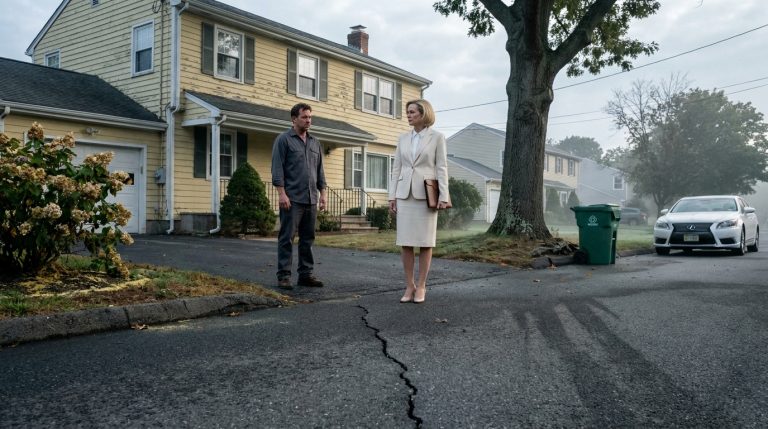
The white Mercedes blocked my driveway, its pristine paint a jarring contrast to the dust of my restoration. Constance climbed out. She didn’t look like a neighbor; she looked like an auditor sent to liquidate a failing asset. Every movement was calculated, from the way she adjusted her silk scarf to the artificial, tightening curve of her smile.
“You’re making a mess of the aesthetic, Ryan,” she said, her voice smooth, devoid of any genuine human inflection. “The committee doesn’t look kindly on prolonged construction. It’s an eyesore, and it’s dragging the neighborhood down.”
I didn’t stop sanding. I focused on the grain of the century-old pine, the way the wood held onto the memory of my great-grandfather’s hands. “The permits are valid, Constance. The work is compliant. You’re not here about aesthetics; you’re here because you want the house.”
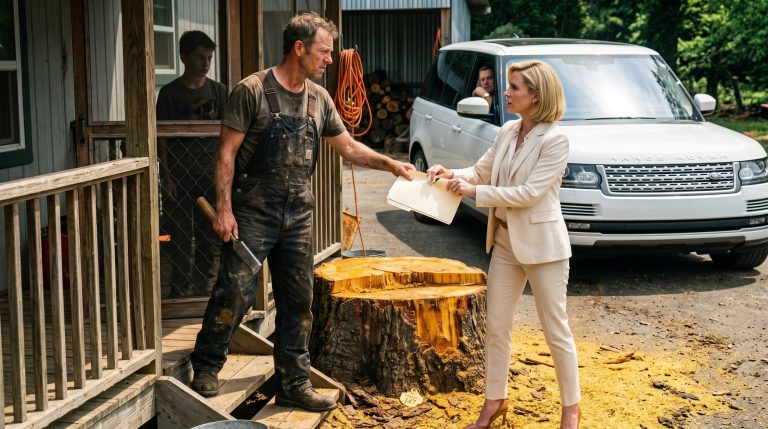
Her smile didn’t waver, but the light in her eyes flickered—a brief, sharp glint of predatory realization. She hadn’t expected me to call it out so bluntly. She took a step onto the porch, her designer heels clicking sharply on the restored floorboards. She pulled a thick, leather-bound packet from her bag and laid it on the railing.
“The rules protect us from people who don’t understand the cost of property,” she whispered, her voice dropping to a conspiratorial frequency. “You’re in over your head. I’m just trying to save you from the inevitable decline.”
She turned and left, the silence returning to the yard the moment her car door slammed. I looked down at the packet. Seventy-three pages of covenants, restrictions, and threats, all designed to bury me in paper until the house collapsed under the weight of the fines. But as I flipped through the pages, a single slip of paper fell out—a duplicate printout of a violation notice, but the timestamp on the bottom caught the light. It read 2:00 p.m. Tuesday.
My brow furrowed. I looked at the security camera mounted on the eaves, the red light blinking rhythmically. I knew exactly where I was at 2:00 p.m. on Tuesday. I was three miles away at the lumber yard, my receipts timestamped in my pocket.
If she had a photo of my house being ‘out of compliance’ at that exact moment, she wasn’t just enforcing rules. She was creating a reality that didn’t exist.
I walked to the attic stairs, my pulse hammering against my ribs. The house felt different now—less like a restoration project and more like a besieged fortress. I needed to see what the old man had left in the safe. If there was a lie this deep, there had to be a truth buried somewhere even deeper.
CHAPTER 2: THE PAPER TRAIL OF GHOSTS
The attic was a graveyard of ambition. My great-grandfather, Ezekiel, had been a railroad man—a breed of human that valued permanence above all else. He didn’t just build; he documented. I knelt on the rough-hewn floorboards, my flashlight beam cutting through the stagnant air. It smelled of pulverized cedar, dead insects, and the metallic tang of an era that had forgotten how to rush.
I shoved aside a rusted steamer trunk to reveal the safe. It was a heavy, iron-bound box that looked like it had been salvaged from a shipwreck. I didn’t need a combination. Ezekiel had kept the key tied to the interior handle of the trunk, a secret meant for someone who actually cared to look.
The click of the lock was loud, a sharp, singular retort in the stifling silence. Inside weren’t gold bars or cash. There were maps. Rolls of blueprints tied with brittle twine, and a single, thick manila envelope labeled in ink that had faded to the color of dried blood: Property Easements – Permanent.
I pulled the documents out, my fingers trembling slightly. The air in the attic seemed to thin. I laid the primary document on the floor, the flashlight casting long, dancing shadows across the parchment. It was a 1924 railroad corridor agreement. My pulse quickened as I read the archaic, precise legalese. The easement granted the Sterling family perpetual maintenance access to the strip of land running diagonally behind the property line—a corridor that, according to the original survey map, bisected what was now Constance’s backyard.
The realization didn’t hit me like a revelation; it hit me like a physical blow to the sternum.
I checked the timestamp on the violation notice again. Constance had provided photos of my porch with perfectly defined shadows—hard, biting lines cast by direct midday sunlight. I pulled my phone from my pocket and navigated to the National Weather Service archive. Tuesday, 2:00 p.m. Overcast. Light rain. Zero direct sunlight.
I stared at the photos in the HOA packet. The shadows in Constance’s ‘evidence’ were impossible. They were the result of high-intensity, portable artificial lighting—the kind used by commercial photographers or, more pointedly, by someone trying to manufacture a narrative.
I wasn’t just being harassed; I was being framed by someone who didn’t understand that I was an architect of my own structures. I knew how to read a room, how to calculate load-bearing limits, and how to spot a crack in a foundation before it brought the house down.
I climbed down from the attic, my boots heavy on the ladder. The house felt colder, the air thicker. I walked to the kitchen and laid the survey map next to the HOA’s packet of violations. The two realities sat side-by-side: one, a legal, ironclad claim to the land she thought she owned; the other, a collection of fabricated lies designed to bleed me dry.
My phone buzzed against the hardwood table. A text from an unknown number.
You’re making a mistake, Ryan. Don’t fight the committee. We can make this go away for a price.
I didn’t reply. I just stared at the screen, the blue light reflecting in the dark glass. They thought I was a desperate divorcee with a midlife crisis. They thought I was a carpenter who couldn’t read the law. They didn’t realize that in my great-grandfather’s safe, I hadn’t just found a deed. I had found the dynamite.
The silence of the house was no longer oppressive. It was waiting. I needed to see how deep the rot went. If she was staging photos for a simple aesthetic violation, what was she hiding behind the other violations in the neighborhood? I looked at the list of my neighbors—the widow in the blue house, the young couple with the swing set.
I was no longer sanding spindles. I was building a cage.
CHAPTER 3: THE ART OF THE STAGED DECEPTION
The morning air was thick with the scent of damp earth and the impending threat of a storm. I stood in the shadow of my wraparound porch, the digital recorder in my pocket humming with the weight of potential. I wasn’t just observing the neighborhood anymore; I was mapping its fault lines.
Constance’s Mercedes rolled into view, cutting through the morning mist with the clinical precision of a scalpel. She didn’t park in the driveway this time. She stayed on the street, her eyes scanning the house as if she were tallying the cost of every board. She had a camera around her neck—a professional-grade telephoto lens that caught the light like a predator’s eye.
I didn’t wait for her to initiate. I walked down the steps, my boots crunching on the gravel with a sound like breaking teeth. I carried my own camera, the one I’d used to document the restoration process from day one.
“Early start, Constance?” I asked, my voice flat, devoid of the deference she clearly expected.
She adjusted the lens, her smile not reaching her eyes. “Maintenance, Ryan. Documentation is key to keeping the neighborhood values intact. I’m sure you understand.”
“I do,” I said, stepping closer. I could see the fine lines around her mouth, the rigid tension in her jaw. She was vibrating with a controlled, artificial energy. “It’s interesting, actually. I was looking at the violation photos you submitted to the city. The lighting was spectacular. Almost professional.”
She paused, her thumb tracing the shutter button. “We have high standards.”
“Physics is a stubborn thing, though,” I continued, closing the distance until I was well within her personal space. The scent of her perfume—sharp, citrus-heavy, and clinical—filled the air. “Tuesday at 2:00 p.m. was a washout. Rain, clouds, absolute grey. Yet your photos show shadows that could only come from a high-noon sun in mid-July. You didn’t just document a violation, Constance. You staged a play.”
The change was microscopic, but I felt it. The air between us ionized. She didn’t blink, but her grip on the camera tightened, her knuckles turning the color of bleached bone.
“Accusations require evidence, Ryan,” she said, her voice dropping into a low, dangerous register. “And you have a history of instability. People don’t listen to a man fighting his own shadow.”
“Maybe not,” I replied, pulling my phone out and showing her the screen. It was a still frame from my security footage, dated 11:23 p.m. The beat-up sedan, the tripod, the professional lighting rig being hauled toward my property line. “But they do listen to timestamps. And they definitely listen to the hum of a power generator at midnight.”
She looked at the screen, her composure fraying at the edges. She didn’t try to deny it. She just pulled her camera up to her face, effectively using the lens as a barrier, a cold, glass wall between us.
“You think you’ve uncovered a scheme, but you’ve only annoyed a power structure that doesn’t care about your little history project,” she whispered.
She turned and retreated to her Mercedes, the movement fluid and calculated. As the engine purred to life, she stopped, her window lowering just enough to let a sliver of her cold voice through.
“The violation notice is just the beginning. I suggest you start packing, because by the time the county sheriff is finished, you won’t even have a foundation to stand on.”
She drove away, leaving me standing in the center of the driveway. I felt the surge of adrenaline, the cold, sharp focus that came with knowing exactly what I was up against. She thought she was the hunter, but she’d just confirmed that she was the one with the most to lose. I pulled out my own camera and snapped a shot of the back of her car, the license plate clear, the reflection in the rear window a distorted, hungry shadow.
I wasn’t just fighting for my house. I was fighting for the truth, and for the first time, I had a weapon that could cut through her porcelain veneer. I turned back to the mansion, the wood grain looking deeper, more solid than ever. It was time to start digging through the rest of the railroad records. If she was this sloppy with a simple violation, the financial rot underneath would be cavernous.
I went inside, my mind racing. I needed to find the link between her staging the photos and the actual property acquisitions. There was a logic to it, a cruel, predatory efficiency that I hadn’t yet fully mapped. The war wasn’t in the courtroom; it was in the metadata, in the shadows, and in the silence of the records she thought no one would ever bother to check.
CHAPTER 4: THE FRACTURE IN THE FOUNDATION
The community center smelled of stale coffee and the cloying, perfumed sweat of a hundred nervous residents. I stood at the back, my jacket heavy with the weight of the manila folder containing the 1924 railroad easement survey. My hands were steady—a calm forged in the fire of three years of construction and a lifetime of learning that a building is only as strong as its foundation.
Constance was at the head of the table, flanked by two board members who looked like they were participating in their own funeral rites. She gripped the gavel with white-knuckled intensity, her gaze sweeping the room with the practiced arrogance of a sovereign.
“We are here,” she began, her voice a sharp, rhythmic cadence that betrayed the mounting desperation beneath her polished exterior, “to address the unacceptable disruption of our community aesthetic. Mr. Sterling’s continued refusal to adhere to the HOA’s architectural mandates—”
I didn’t wait for her to finish. I started walking toward the front. The room went silent, the heavy air pressing against my skin. Every step was a tactical calculation. I could see the newcomers in the audience, the ones who had bought into the beige dream, looking at me with undisguised hostility. I saw the older residents, the ones who remembered the railroad money era, watching with cautious hope.
“The aesthetic isn’t the problem, Constance,” I said, my voice echoing against the bare walls. I reached the table and placed the survey map down. I didn’t slide it; I dropped it, the sound of heavy paper hitting the polished wood like a gavel strike.
She looked down at the map, then back at me. Her mask didn’t slip—it tightened. “This is a private meeting, Ryan. You have no standing here.”
“I have the standing of a property owner,” I replied, leaning into her space. I felt the sharp edges of the room—the cold light, the rigid angles of the furniture, the silence that was now waiting for me to pull the pin. “And I have the 1924 railroad easement that says the land your infinity pool sits on doesn’t belong to the HOA. It belongs to the corridor. It’s public-access maintenance land, perpetual and non-negotiable.”
A murmur rippled through the room. Constance’s face lost its suburban tan, turning the color of wet lime plaster. She reached for the gavel, but her hand trembled. “That is an archaic document, irrelevant to modern zoning. You are trying to sabotage this community.”
“I’m trying to preserve it,” I countered, looking directly at the board members, watching the realization dawn on them. They weren’t just board members; they were accomplices who had signed off on the violation notices, and they were beginning to smell the rot of legal liability. “But you wouldn’t know anything about preservation. You’re not here to manage the neighborhood. You’re here to harvest it.”
I pulled the photographs of the staged lighting from the folder and fanned them out next to the survey map. The contrast was undeniable: the impossible shadows in her photos versus the raw, overcast data from the National Weather Service.
“You manufactured the violations to force out owners you deemed ‘sub-par’,” I said, my voice rising just enough to carry to the back of the room. “You used the HOA as a weapon, and you used your own investment LLC as the scavenger. That isn’t governance. It’s organized crime.”
Constance stood up, her chair screeching against the linoleum. “Security! Get this man out of here!”
But no one moved. The room was paralyzed, the weight of the truth hanging in the air like ozone. Then, a voice from the back—Mrs. Patterson, the widow whose bird bath had been targeted—spoke up. “He’s right. She took my garden. She told me the bird bath was a violation, and a week later, she had a ‘buyer’ knocking on my door.”
The explosion was immediate. Voices clashed, shouting over one another, the sound of order dissolving into the frantic chaos of realization. Constance looked around, her eyes wide, searching for a defense that wasn’t there. She looked at her phone, her thumb hovering over the screen, but the person who usually handled her dirty work—the lawyer Jameson—wasn’t answering.
I watched her world fracture. She tried to maintain the facade, to scream over the noise, but she was a predator who had been forced out into the light. She was exposed, and the predatory edge of the room had turned toward her.
I felt a surge of cold, sharp triumph, but it was hollow. I knew this wasn’t the end. This was just the demolition of the decoy. The true reality—the sheer scale of the fraud and the network of shell companies that fed it—was still hidden in the deep file cabinets of her office. And I knew, with the instinct of a man who had spent his life repairing broken things, that a desperate creature like Constance wouldn’t go down without burning the house to the ground to hide her tracks.
The meeting erupted into a shouting match, but my focus remained on Constance. She was no longer looking at the residents. She was looking at the exit, her mind clearly already calculating the fastest way to scrub the hard drives and liquidate the assets. The war had just moved from the porch to the board room, and the cost was only beginning to mount.
CHAPTER 5: THE THREAT BENEATH THE SKIN
The rain was lashing against the windshield of my truck, turning the world into a smear of grey asphalt and neon glare. My phone buzzed again. Unknown number. I didn’t answer it; I let it drop into the passenger seat, the screen glowing in the dark like a radioactive warning.
I had Randy, the city inspector, on the line three minutes ago. His voice had been shaking—not the nervousness of a man caught in a lie, but the genuine, primal terror of a man who’d just realized his life was no longer his own.
She found out, Ryan, he had whispered, the sound of wind whipping against his microphone. She knew I was recording her. She’s got files. Pictures of my house, my kid’s school, the route I take home. She said if I show up in court, I’m a ghost.
I gripped the steering wheel, my knuckles aching. I had planned for a legal blitzkrieg, for a courtroom confrontation where the truth would be the gavel. I hadn’t planned for her to be willing to go nuclear. She wasn’t just defending her property value; she was protecting a criminal enterprise that clearly had reach far beyond the neighborhood HOA board.
I pulled into the parking lot of the county courthouse. It was nearly midnight, but the building loomed ahead, a monolithic tomb of stone and bad intentions. I had the recordings of her threats, I had the survey reports, and I had the proof of the staged photography. It was enough to bury any sane human being. But Constance wasn’t playing by the rules of society—she was playing by the rules of a mobster.
I checked my pocket. The digital recorder was there, a cold, plastic weight. I walked toward the side entrance, my boots splashing through deep, oil-slicked puddles. The rain felt like needles, sharp and persistent, washing away the sense of order I’d tried to maintain over the last few weeks.
Suddenly, a set of headlights swept across the parking lot. They didn’t slow down; they accelerated, cutting the dark in a white, blinding arc. My instincts, honed by years of reading building layouts and assessing structural threats, kicked in instantly. I dove behind the thick, concrete pillar of the entrance overhang just as the sedan surged over the curb, crushing the metal bike rack where I’d been standing a second before.
The car didn’t stop. It circled, the tires screaming against the wet asphalt. I pulled my own phone and hit the speed dial for Sarah, my attorney. It rang once, twice—a jagged, rhythmic sound that felt like a countdown.
“Ryan?” Sarah’s voice was crisp, even at this hour. “What’s happening?”
“She’s burning the bridge, Sarah. She knows about the witness intimidation. She’s not stopping at the court anymore.”
“Get out of there. If she’s escalating to this, the evidence you have is even more dangerous than we thought. There’s something else—something beneath the surface.”
“I don’t have time for theory,” I snapped, as the car swung around again, its high beams searching the shadows like the eyes of a deep-sea creature. “I’m going to lose the evidence.”
“Then don’t lead her to it,” Sarah hissed. “If she’s trying to stop you, it means the fraud goes higher. Much higher.”
The car cut its engine. The sudden silence was worse than the sound of the tires. I huddled in the dark, the concrete pillar vibrating as someone stepped out. The click of a heel on wet pavement was unmistakable. Constance. She wasn’t hiding; she was hunting.
I realized then that I had been wrong about the scale of this. The HOA violations were just a smoke screen—a small, petty game used to identify the easy marks. The real work, the real profit, was happening somewhere else, shielded by this neighborhood’s quiet, affluent exterior. My decoy secret—the photos—was a distraction. She wanted the documents. She wanted to reclaim the land.
I looked at the manila folder in my hand. It was soggy, the edges fraying, but the easement survey was still intact. I had to decide: stay and fight, exposing myself to a threat I couldn’t quantify, or retreat and find the real ghost in the machine.
I chose the shadows. I slipped around the back of the building, my heart slamming against my ribs like a trapped bird. The rain-slicked walls offered no traction, only the cold, unyielding resistance of the architecture. I was a man who knew how to build, how to create, how to restore. Tonight, I was learning the hardest lesson of all: how to dismantle the architecture of a predator.
As I reached the alleyway, I saw the flicker of a flashlight dancing over the bricks. She was close. She wasn’t looking for a lawsuit anymore. She was looking for a conclusion. I gripped the recorder in my pocket, the cold plastic biting into my palm, and stepped into the absolute dark. The game had changed, and I was no longer the architect of the board room. I was the target in the field.
CHAPTER 6: THE FINAL FOUNDATION
The morning air felt sharp enough to cut, smelling of diesel exhaust and the damp, metallic musk of upturned soil. I stood at the edge of the railroad easement, my boots planted firmly on the line where Constance Whitmore’s “paradise” ended and my family’s history began.
The excavator sat like a caged beast, its hydraulics hissing as I throttled the engine. Across the grass, Constance stood by her infinity pool. The water was crystalline, mocking in its stillness. She wasn’t screaming anymore. The screaming had stopped somewhere around the time the police scanners started lighting up with the news of the FBI raid on her shell company offices downtown. She looked smaller now—her white silk jacket stained with mud, her hair coming undone in the humidity. She looked like exactly what she was: a scavenger caught in the trap she’d built for everyone else.
I didn’t speak. I didn’t need to. I gripped the control levers, feeling the vibration of the machine travel up through my arms, a familiar, grounding sensation. I had spent three years restoring the wood, the plaster, and the spirit of this house. Today, I was restoring the boundaries.
I maneuvered the bucket. It moved with the slow, deliberate grace of a reaper. I dropped the teeth onto the edge of her Italian stone deck. The sound of the first crack was definitive—a sharp, jagged report that silenced the morning birds. The stone, imported from across an ocean to satisfy a vanity she hadn’t earned, shattered into useless gray rubble.
Constance finally moved, but it was a stumbling, uncoordinated step. “You’re destroying it,” she whispered. Her voice was thin, devoid of its syrupy authority. “That deck—the pool, the garage—it’s worth more than your entire life.”
“It’s worth nothing,” I said, my voice steady, carrying over the idling engine. “Because it was never yours. You didn’t build this neighborhood, Constance. You mined it. You treated people’s homes like raw material and their lives like overhead. You were never an architect of community. You were just a parasite that finally ran out of host.”
I pulled the lever, the hydraulic arm swinging, and the bucket ripped through the filtration system of the infinity pool. The water, clear and blue, poured out over the lawn, turning the manicured turf into a dark, sodden mess. It was messy, violent, and entirely necessary.
As the structure collapsed, I caught a glimpse of the foundation beneath the stone. It was crumbling—hastily poured concrete, riddled with air pockets, the kind of cheap, fast-tracking work that only someone who didn’t plan on staying would ever sign off on. She hadn’t even built it to last. She’d built it to flip.
Suddenly, a pair of blue-and-white cruisers surged into the driveway, their lights flashing in rhythmic, hypnotic pulses. Deputy Morrison stepped out, his hand on his belt, followed by two men in dark windbreakers—the kind of neutral, non-descript gear that signaled the end of a long, expensive game. They didn’t look at me. They walked straight to Constance.
She didn’t run. She stood there as they read the rights she had spent years subverting. I watched them lead her away, her designer slippers dragging in the mud, her back bowed under the sudden, crushing gravity of her own reality.
I killed the engine. The silence that rushed back into the neighborhood was absolute, punctuated only by the distant, rhythmic ticking of the cooling excavator. I walked over to the edge of the easement, where the grass had been scarred by the heavy steel tracks. I reached into my pocket and pulled out the old brass plumb bob—the one Ezekiel had used a century ago to ensure his walls stayed true. I dropped it into the soil, the point sinking deep into the earth.
The mansion stood behind me, its sage-green paint catching the rising sun, the windows clear, the structure sound. It wasn’t just a house anymore. It was a statement. The neighborhood would change, the trail would be paved, and the stories of the people she’d destroyed would be the ones that endured. I picked up the plumb bob, feeling the weight of the metal in my hand.
The truth was, I hadn’t won a war. I’d simply cleared the debris so the next generation could actually build something worth living in. I looked toward the porch, where my daughter was standing, holding a cup of coffee. She looked at the rubble, then at the house, and finally at me. For the first time in a long time, the weight in my chest wasn’t a burden. It was a foundation.