The Steel Ghost of the Solomons: One Damaged Carrier, a Burning Horizon, and the Last Stand of the Gray Ghost
CHAPTER 1: IRON IN THE LUNGS
The brass handle of the telegraph bit hard into my palm, cold and slick with stale sweat.
Up on the bridge, the air tasted of burnt fuel and low-hanging salt spray.
There was no time for speeches or grand reassurances.
The report from the scout plane crackled through the static with ruthless clarity: the enemy fleet was steaming southeast at highway speed.
Captain Hardison didn’t blink.
His knuckles were white as he leaned against the binnacle, eyes locked on the darkening horizon where the rain squalls promised a brief, fragile shelter.
Around us, the flight deck was a chaotic roar of warming engines and shouting deck crews waving off the first wave of Dauntlesses.
Down in the bowels of the ship, the rhythmic thrum of the turbines vibrated straight up through the deck plates into the soles of my boots.
It wasn’t the steady heartbeat of a healthy machine.
It was the labored, uneven strain of a hull patched together with scrap metal and stubborn pride after the eastern Solomons.
A fresh recruit stumbled past, carrying a heavy ammunition crate with a desperate, wide-eyed urgency that he tried hard to mask behind a tight jaw.
“Keep those hoists moving!” a voice barked down the hatchway, cutting sharply through the din of the wind.
Every man on this floating city knew what was waiting for us beyond the edge of the radar screen.
The Imperial fleet wasn’t turning back this time, and neither were we.
I wiped a smear of black grease from my forehead, tightened my grip on the cold brass, and watched the grey swells rise to meet the bow.
CHAPTER 2: BLIND MANS BLUFF
The glowing green sweeps on the main screen flatlined into a dead, stationary line.
Beside me, the radar technician hammered a heavy fist against the steel housing.
Nothing moved.
Up in the sky above us, the low drone of incoming engines tore through the low-hanging cloud cover before our eyes could even adjust to the gray haze.
“We’ve lost the sweep!” the tech shouted over the rising wail of the ship’s general quarters klaxon.
Captain Hardison didn’t waste breath demanding miracles from dead circuits.
He gripped the bridge rail, his face set in hard, weathered lines as he scanned the choppy gray horizon with binoculars alone.
We were fighting blind, relying entirely on the naked eyes of spotters scanning the rain squalls for the glint of enemy wings.
A violent shudder rolled up through the keel as the ship heeled hard to port, evading an unseen threat in the troughs.
The heavy grease on my palms smeared against the chart table as I tracked our estimated position manually with a parallel ruler.
Down in the bowels of the hull, that strange metallic clanking—rhythmic and sharp—rang out again beneath the turbine roar, ignored by everyone too busy dodging death.
Then the lookout’s voice cracked over the squawk box, sharp as a rifle shot.
“Dive bombers breaking out of the cloud deck off the starboard bow!”
CHAPTER 3: THE HANGAR INFERNO
The concussive shockwave from the gun mounts slammed against my chest, rattling teeth and shaking loose flakes of dried white paint from overhead conduits.
Up on the flight deck, the frantic chatter of boots gave way to the screech of tortured steel as a heavy bomb punched straight through the forward elevator well.
A wall of thick, choking black smoke billowed up from the hangar deck below, carrying the distinct, sickening odor of burning aviation fuel and scorched copper.
“Damage control to the forward compartments!” a voice screamed over the squawk box before cutting out into a burst of static.
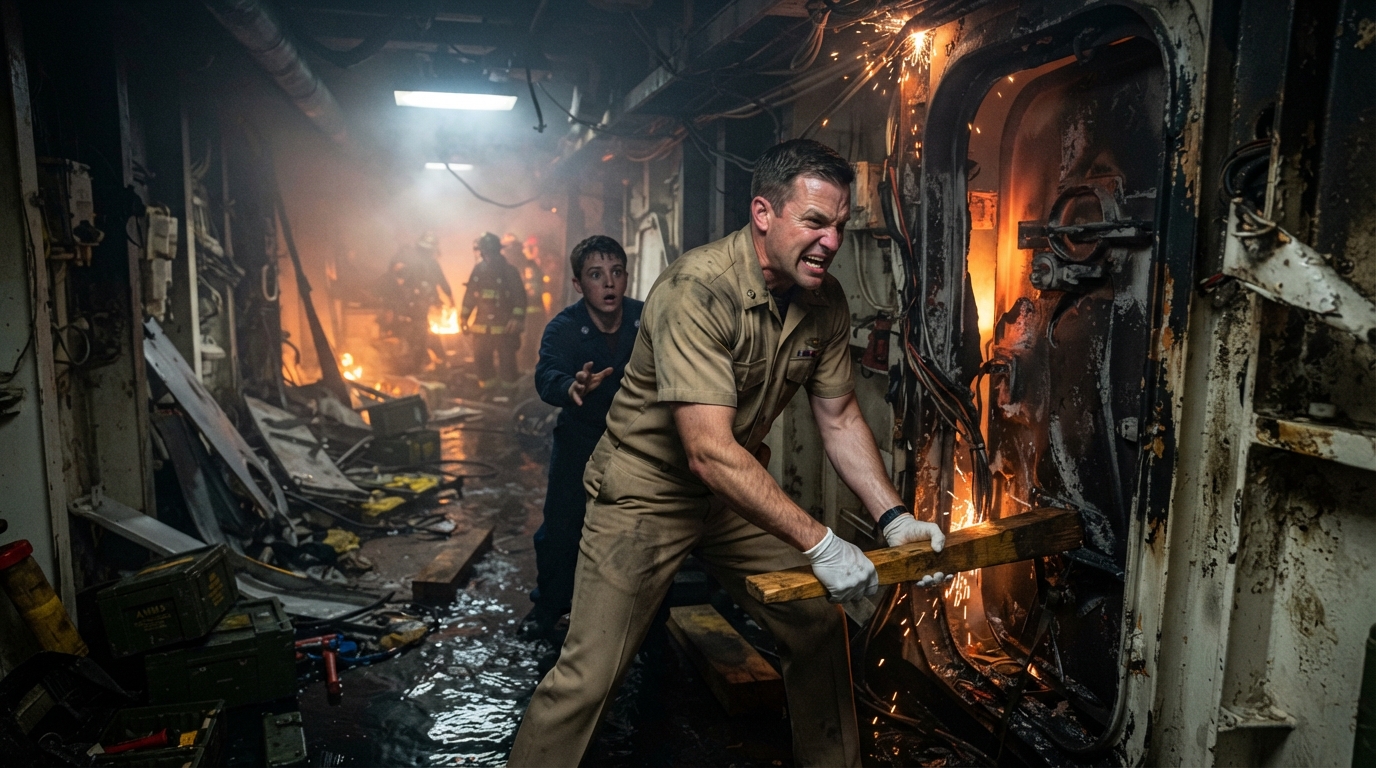
I scrambled down the ladder toward the lower deck, my hands burning as they gripped the scorching rungs.
The ship shuddered violently under another near-miss, throwing me hard against the bulkhead.
Down in the shadows, men were trapped behind warped steel doors while the fire hissed hungrily against the bulkheads.
There was no electronic telemetry to tell us where the flooding was worst; we had to feel our way through the dark by the heat radiating through the walls.
“Grab that wedge!” I yelled over the din to a young crewman frozen in the haze.
We threw our weight against the jammed hatch, muscles screaming against the resistance of the deformed metal frame.
Inside the compartment, the water was already rising past our boots, icy cold where it mixed with the firefighting foam.
We had to pry the hatch open inch by agonizing inch, fighting the crushing pressure differential with brute force and raw muscle.
Through the narrow gap, frantic hands reached out from the gloom, dragging the injured up toward whatever safety remained.
CHAPTER 4: THE TORPEDO GAUNTLET
The warning bells clanged a frantic, ragged rhythm through the smoke-choked companionways.
Outside the armored hatch, the sea was alive with churning white wakes converging on our flanks in a textbook pincer formation.
Captain Hardison didn’t hesitate, throwing the ship’s massive weight into a desperate, grinding turn that groaned against every stressed bulkhead from bow to stern.
“Starboard engine, full reverse!” I shouted over the screech of twisting metal.
The deck heaved beneath our boots, threatening to sweep anyone without a solid grip right off their feet.
There were no electronic computers to calculate intercept vectors or lead angles; we were steering entirely by the raw sight of foaming torpedo tracks cutting through the gray water.
A heavy shudder ran through the keel as a nearby explosion threw a wall of spray across the bridge windows.
“Hold the rudder steady!” Hardison barked, his face caked in sweat and black grease.
We watched the closest white streak slice past our stern by barely a dozen yards, missing the plates by pure stubborn geometry.
Another wake closed fast from the port beam, leaving us nowhere to turn except straight into the teeth of the oncoming fire.
CHAPTER 5: THE RADAR MAST CLIMB
The wind whipped stinging salt spray straight across my face, blinding me for a crucial heartbeat as I reached for the next rung.
Down below, the carrier’s hull pitched violently into another trough, turning the vertical climb into a swaying tightrope over a churning gray abyss.
There were no automated calibration tools or digital diagnostic screens to save us; fixing the twisted antenna required raw, bare hands against frozen iron.
“Hold that bracket steady!” I shouted down to Lieutenant Brad Williams, who was wedged into the structural framework below me with a heavy wrench.
Williams gripped the crossbeam, his knuckles bleeding where a flying shrapnel fragment had clipped his glove earlier.
The air smelled intensely of hot ozone and bitter cordite as another wave of enemy fighters buzzed low across the horizon, their engine roars vibrating straight through the metal rungs into my bones.
I hauled myself up against the ferocious gale, wrapping a length of canvas webbing around my waist to improvise a safety harness that dug brutally into my ribs.
“The connection box is completely sheared off!” I yelled over the screaming wind, my fingers stiff and numb against the cold bolts.
“Solder the primary bypass directly to the terminal wire—we don’t have time for anything else!” Williams shouted back, his voice cracking from exhaustion and salt inhalation.
I pulled the heavy soldering iron from my belt, praying the makeshift battery pack would hold long enough to spark life back into the dead screens below.
CHAPTER 6: THE CRIPPLED HARBOR
The green sweep on the radar screen flickered, caught, and then held steady in a clean, unbroken rotation.
Down on the bridge, the frantic clamor of general quarters finally wound down into a heavy, exhausted silence.
There were no cheering crowds or brass bands waiting for us as we limped back toward the harbor with a buckled flight deck and waterlogged compartments.
We had no high-tech wizardry left to shield us; just welded steel plates, raw grit, and the stubborn refusal to sink.
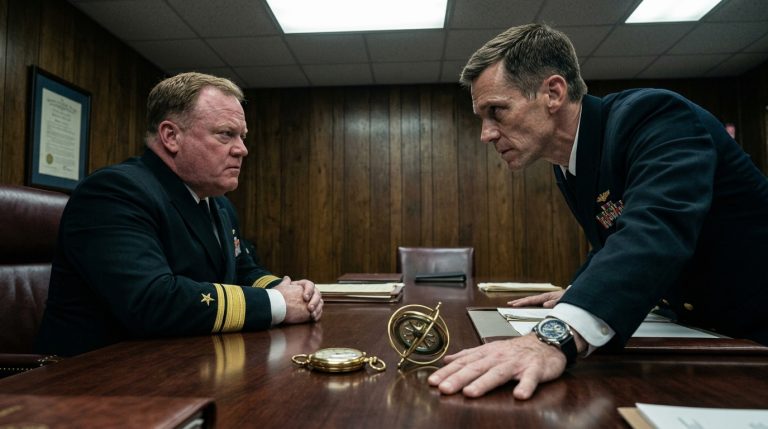
Captain Hardison leaned his weight against the chart table, wiping a layer of black engine soot from his cheek with the back of a raw, blistered hand.
“Secure the anti-aircraft batteries,” he muttered, his voice rasped and hollowed out by hours of screaming over the din.
We had paid an ungodly price for every single frame of our survival, losing good men and tearing our hull to ribbons in the gray swells of the Solomons.
Yet as the battered carrier settled into her berth beside the repair ship, the deck remained stubbornly level beneath our boots.
We weren’t invincible, and we certainly weren’t untouched, but we were still afloat—the last gray shield standing between the horizon and absolute ruin.