The Dusty Gray Range Where Common Sense Outmatched Million-Dollar Electronics in the Wyoming Wind
CHAPTER 1: THE UNPREPARED SERGENT
The desert air tasted of chalk and iron as the sun climbed higher over the hardpan. General Harold Stemens stood with his coffee, watching his adjutant arrange clipboards along the scoring table below. Eleven evaluations he had overseen, and every single one had relied on the comforting hum of digital ballistic computers and laser rangefinders.
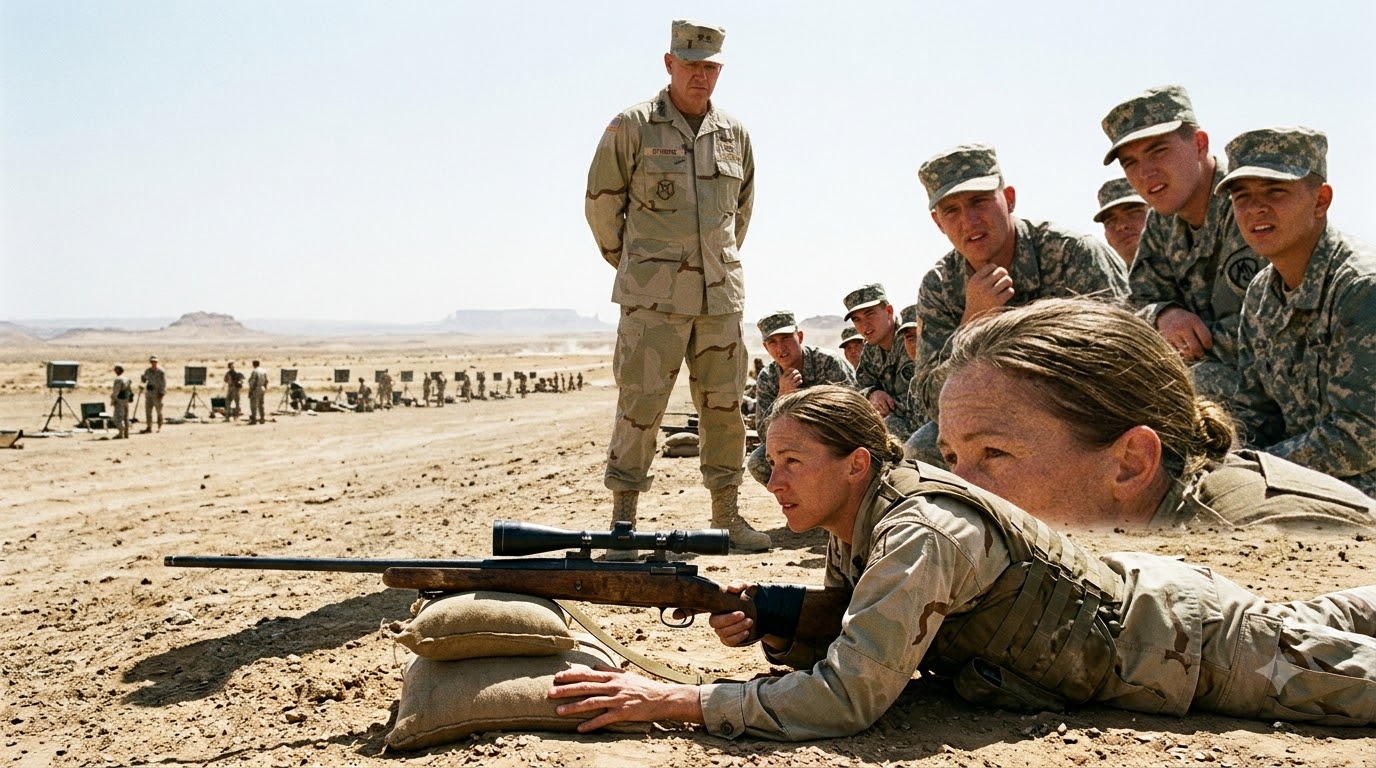
When Staff Sergeant Norah Callaway stepped onto the range at 0612, she carried nothing of the sort. Her weapon was an old Remington 700 with white athletic tape wrapped around the stock, its walnut worn pale at the grip. No wind meter clipped to her vest. No laptop case over her shoulder.
Stemens crossed the range in his deliberate, commanding stride, stopping three feet from her with his hands clasped behind his back.
“Sergeant Callaway,” Stemens said, his voice flat. “Where is your equipment?”
“This is my equipment, sir,” Callaway replied without looking up, her fingers adjusting the sling with two quiet motions.
Stemens looked from her plain canvas bag to the rows of competitors behind her standing beside hard-shell cases bristling with electronics. The primary qualification target sat out at 3,000 meters—1.86 miles of open desert where the atmosphere could tear a projectile off course in four seconds of flight time.
“You intend to engage that target with no ballistic computer, no digital wind sensor, and no advanced scope,” Stemens said, his tone carrying the weight of three decades of institutional science. “You are proposing to hit a steel plate using instinct.”
Callaway paused, her eyes fixed on the distant horizon where the heat shimmer danced across the ground. “Observation, sir. Give me 60 seconds at the firing position before I shoot. That’s all I’m asking for.”
Along the fence line, three cadets exchanged sharp glances, a low ripple of muffled skepticism passing through the group. Stemens felt it in the dry air. He could have ordered her back, enforced the standard protocol, and dismissed the display as a waste of range time. But something in the stillness of her posture kept his boots planted in the dust.
“Fine,” Stemens said, his jaw tightening. “Sixty seconds.”
CHAPTER 2: FIRST ROUND SILENCE
Callaway lay down behind the taped Remington without haste. Her left hand rested flat on the sandbag without gripping anything while her right hand held the stock lightly at the wrist. The 60-second window began to tick away across the valley floor.
She did not look through the scope immediately. She looked at the valley. The heat shimmer danced in a thick, rolling wave across the ground glass near the 800-meter mark.
General Stemens stood with his arms crossed behind his back, his jaw set tight against the rising heat. Beside him, Captain Whitfield stared at his watch with a quiet intensity that betrayed his nervous doubt.
“Forty-five seconds remaining,” the range safety officer called out over the dry wind.
Callaway ignored the voice entirely. Her eyes moved in a slow pattern across the terrain, tracking the drift of a tiny dust devil forming and dissolving near the twelve-hundred-meter ridge. She watched the brittle scrub grass bending to the south where the crosswind cut across her line of fire.
“Thirty seconds,” the safety officer’s voice echoed across the hardpan.
Callaway settled her cheek against the worn walnut stock. Then she raised her head fractionally, catching a sudden microscopic shift in the heat distortion band near the ravine. The wind column had changed angle. Without a single digital sensor or computerized readout, she registered the adjustment in her bones.
“Ten seconds.”
She settled back into the stock, her breathing slowing to four breaths per minute without conscious effort. Five seconds. Three seconds. She squeezed the trigger.
The Remington’s report crossed the valley in a flat, hard wave that the cadets felt in their chests before they heard it with their ears. Then came four long seconds of dead silence across the range.
“Impact, center plate, first round,” Corporal Fisk called out clearly from the spotting scope position.
CHAPTER 3: THE SMALLER TARGET
General Stemens stepped closer to the edge of the firing line, his hand tapping lightly against his thigh. He looked from the smoking barrel of the Remington to the distant steel plate shimmering through the heat haze.
“Same distance,” Stemens instructed Captain Whitfield, whose pencil hovered nervously over the scoring pad. “Replace with the qualification target for advanced certification.”
The target crew replaced the standard plate with a sixty-centimeter square—roughly half the surface area of the first. Most competing shooters during the morning evaluations had ignored it entirely, deeming a first-round hit at that scale an impossible gamble without full digital telemetry.
“Forty-five seconds this time, Sergeant,” Stemens said, his voice carrying a dry challenge. “Same conditions apply. First round impact only.”
Callaway nodded once, her expression unchanging as she settled back into the dust behind the stock. The valley’s thermal patterns were shifting rapidly now, creating erratic crosswinds that mocked fixed instrumentation.
She did not reach for any device. Her eyes tracked the dry scrub grass and the shifting heat distortion lines across the lower slope.
“Twenty seconds,” the safety officer’s voice cut through the dry air.
Callaway adjusted her windage dial by two precise clicks left, her breath steady and controlled. She squeezed the trigger just as a minor thermal gust peaked and died.
The sharp crack echoed back across the valley, followed by four agonizing seconds of absolute stillness.
CHAPTER 4: THE LEDGER REVEALED
The tactical report lay across the steel desk in the briefing trailer, its crisp paper pages contrasting sharply with the dry grit tracked in from the range. Captain Whitfield slid the manila folder across the surface toward General Stemens without a word.
“I pulled her family records from the civilian circuit archives,” Whitfield said, his fingers drumming a sharp, nervous tattoo against his belt. “It goes back over a decade before she ever set foot on an active base.”
Stemens adjusted his glasses, scanning the columns of national long-range civilian qualification results. Raymond Callaway—her father—had placed in the top national tiers year after year using nothing more than a fixed-power scope and a hand-scribbled dope card.
“He taught her to treat the wind as a living system instead of a data entry,” Stemens muttered, tracing a scarred finger down the margin notes of a 2005 championship ledger.
“She didn’t beat our technology with luck, sir,” Whitfield replied, his voice dropping an octave as the realization settled over the trailer. “She beat it because her instruments never had batteries to die in the middle of a shift.”
Stemens closed the folder with a dull thud that rattled the empty coffee mugs.
CHAPTER 5: THE INSTITUTIONAL PIVOT
General Stemens stepped out of the trailer into the glaring desert sun, his boots crunching against the hardpan gravel. Fourteen trainees stood assembled in the briefing area, the earlier smirks entirely gone from their faces.
“I made an assumption this morning,” Stemens announced, his voice carrying clearly across the silent compound without the aid of a loudspeaker. “I assumed that the absence of equipment indicated the absence of preparation.”
He paced slowly down the front row, his gaze sweeping over the young cadets who now watched with grim, undivided attention.
“We train soldiers to rely on machinery,” Stemens continued, stopping just short of the rear rank where Norah Callaway stood at attention. “She trained herself to understand the environment before looking at a tool.”
Captain Whitfield stood near the edge of the assembly, holding the scoring ledgers against his chest like a shield.
“I am requesting that Sergeant Callaway design an environmental reading module for this program,” Stemens said, turning to face her directly. “Not to replace our technology, but to precede it.”
Norah held his gaze for a long, quiet heartbeat, the desert wind rustling the brim of her faded olive drab ball cap.
“I’ll need to think about it, sir,” she said plainly.
CHAPTER 6: RETURN TO THE SOUTH FIELD
The drive back to Elk Hollow took four hours through flat, open country where the horizon stretched out without interruption.
Norah parked the truck by the equipment barn and stepped out into the familiar dry heat of the Wyoming valley.
Raymond Callaway was out in the south field, finishing the last stretch of fence post repair before the evening shadows lengthened across the alfalfa.
He didn’t drop his tools when he heard the truck engine cut out; he finished driving the final staple into the cedar post with two steady hammer strikes.
“They asked for a module,” Norah said, walking up to the fence line where the young alfalfa stalks bent evenly in the northern breeze.
“I figured they might,” Raymond replied, wiping his calloused hands on a rag tucked into his belt pocket. “What did you tell them?”
“I told them I needed to think about it first.”
Raymond looked out over the field, watching the way the wind moved the grass beneath the surface tops. “A method isn’t something you hand over on a spreadsheet. You give them the work, or you keep it to yourself.”
Norah adjusted the brim of her faded olive drab ball cap, feeling the familiar weight of the Remington resting in its canvas case in the truck bed.
She turned back toward the house, her boots finding the well-worn rhythm of the earth beneath her feet.
“I’m going to write it down,” Norah said quietly. “Starting with the grass.”