The Cold Weight of Iron and Silence in a House Built on Borrowed Pride
CHAPTER 1: THE COLD DINING TABLE
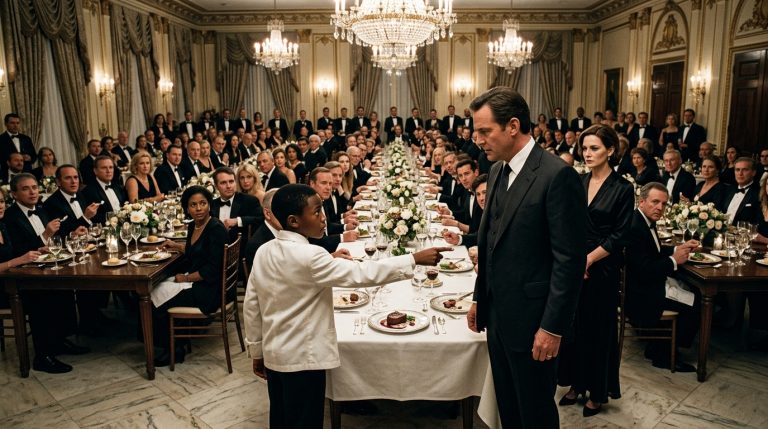
The spoon hit the glass with a sharp, metallic ping that cut right through the smell of roasted turkey and cinnamon.
Lauren stood up at the head of the long oak table, her five-month bump pressed tight against the fabric of her cream-colored sweater. Her posture was flawless, her smile calm and practiced. Beside her, Daniel stared fixedly at his gravy boat, his fingers drumming a nervous, silent beat on the linen napkin.
“Before we pass the dessert,” Lauren said, her voice smooth as polished varnish, “Daniel and I have an update. With the baby coming, structure is everything. Starting tonight, I’m taking over management of all family accounts.”
My thumb slid into the pocket of my dark wool sweater, my nail catching on the worn steel jaw of my pocket brass caliper. I clicked the slide twice, feeling the tiny micro-measurements lock into place under my skin. I didn’t speak. I didn’t reach for my glass.
“Evelyn,” Lauren continued, her eyes locking onto mine with the gentle, patronizing weight of a caretaker addressing an invalid. “We had your primary card canceled this morning. It’s really for the best. At sixty-nine, you shouldn’t have the stress of tracking monthly statements.”
Across the table, my sister-in-law let out a quiet sigh of relief and whispered, “Honestly, that’s so responsible. Older folks get taken advantage of so easily nowadays.”
Daniel still wouldn’t look up. His neck was red, the skin flushed right above his starched collar, but he kept his eyes glued to his plate like a boy waiting out a storm.
“If you need pocket money for groceries or prescriptions,” Lauren added, her hand resting delicately over her stomach, “you just ask Daniel. We’ll set up an allowance.”
I clicked the caliper once more in my pocket, the tiny metal stop hitting the end of the scale with a dull thud. My thumb measured the gap—three millimeters of clearance, tight tolerances, no room for error.
Beside the sideboard, tucked deep in the wicker wastebasket, the corner of a heavy manila envelope stuck out among the discarded gift wrap. A red rubber stamp caught the light from the chandelier: NOTICE OF RECOVERY ACTION – FINAL MANDATE.
I stood up slowly, the wood of my chair scraping against the floorboards with a dry, heavy groan. My knees stiffened, but my spine stayed straight. I looked past Lauren’s glowing smile and set my gaze directly on my son.
“Daniel,” I said, my voice barely above a whisper, carrying cleanly across the quieted room. “You really don’t know what you’ve signed, do you?”
Lauren’s smile tightened, the edges of her lips twitching just enough to show the fine strain around her jaw. “Evelyn, please don’t make a scene. We’re doing this because we love you.”
I didn’t argue. I didn’t raise my voice. I simply reached across the table, picked up my dessert fork, and laid it flat next to my plate, perfectly parallel to the edge of the dark wood.
“I’m going home now, Daniel,” I said, stepping back from the table. “Make sure you check your mail.”
CHAPTER 2: MECHANICS OF AUTHORITY
My boots crunching on the frozen slush of Daniel’s driveway felt like gravel grinding inside a dry bearing.
The damp Michigan air bit straight through the wool of my sweater as I pulled my collar tight, my left hand anchored deep in my coat pocket around the brass caliper. The metal was cold against my palm. I didn’t drive back to my quiet little house on the west side. Instead, I sat in my old sedan at the curb until the living room lights at Daniel’s house finally killed out, one by one.
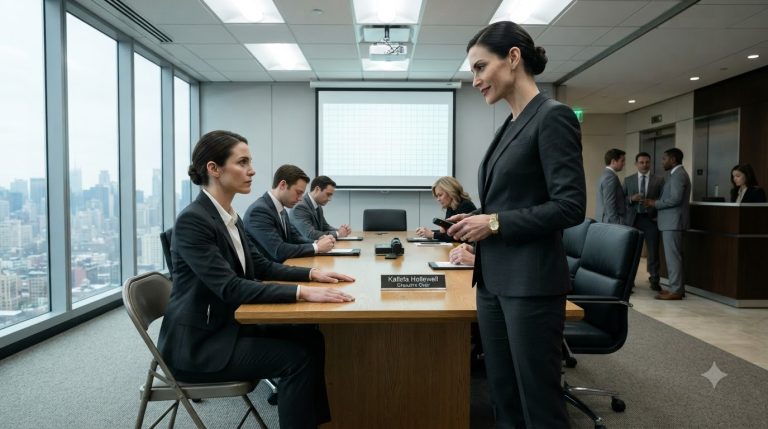
At 8:00 AM sharp, I pushed open the heavy glass door of the First Community Branch on Michigan Avenue.
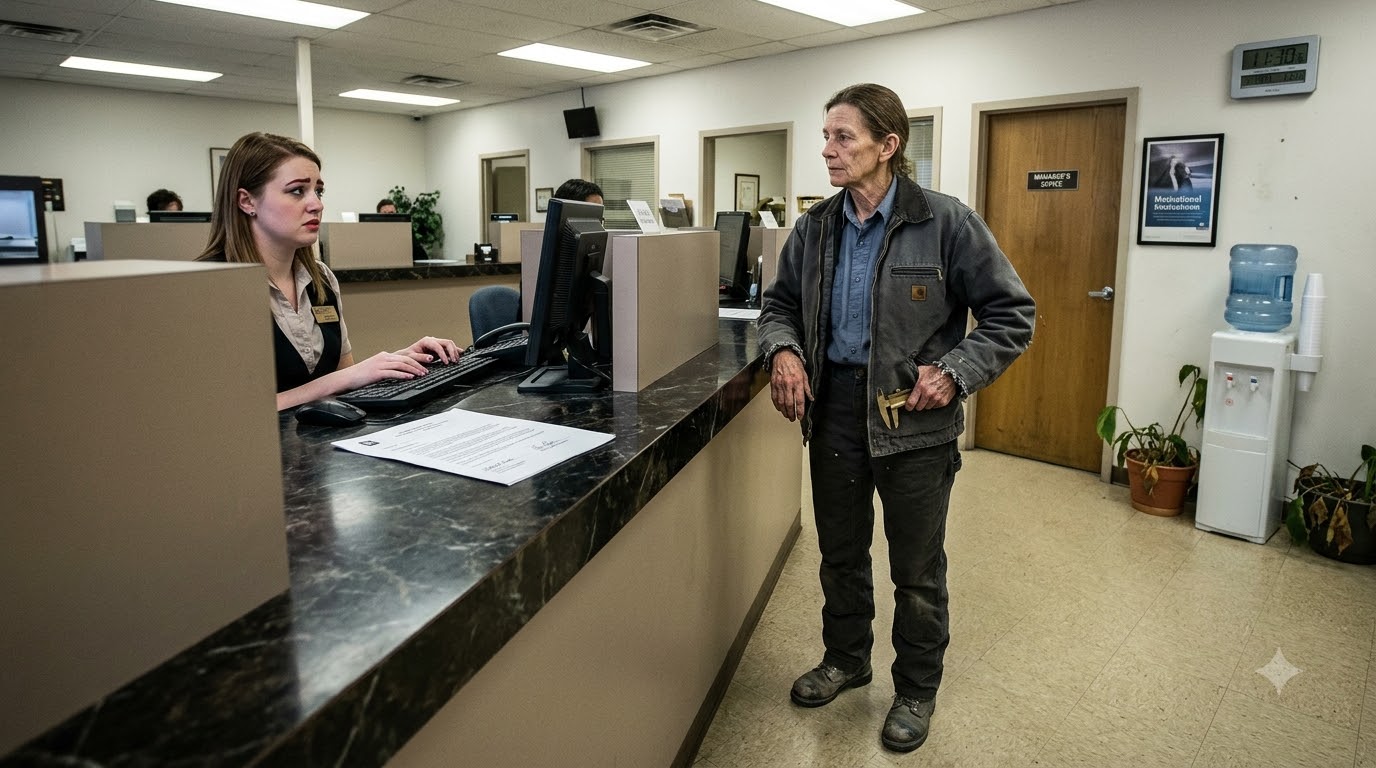
The smell of cheap carpet cleaner and recycled heater air hit me instantly. Behind the marble counter, a young clerk named Sarah looked up, her painted eyebrows pulling together in a quick flash of recognition before her customer-service smile snapped into place.
“Mrs. Brooks,” she said, her voice dropping into that careful, muted register people use for the grieving or the confused. “I didn’t expect to see you back so soon after yesterday.”
I walked up to the high counter, my shoes making no sound on the runner. “I need the signed authorization copy for the primary credit line cancellation, Sarah. The physical paper.”
Sarah shifted her weight, her manicured fingers hovering over her keyboard like she was afraid touching it might set off an alarm. “Mrs. Brooks, as I mentioned on the phone, your son brought in the signed safety protocol forms. Everything was processed under the family management proxy.”
“I didn’t ask who processed it,” I said, my voice steady, flat, and entirely devoid of anger. “I asked to see the sheet of paper with my signature on it.”
“It’s digital now—”
“Print it.”
She hesitated, her tongue pressing against the inside of her cheek before she clicked her mouse twice. A mechanical tray behind her groaned, spitting out a single black-and-white page with a wet, warm smell of toner. She slid it across the marble top toward me.
I didn’t reach for my reading glasses. I didn’t need them.
My name was signed at the bottom in dark blue ink—Evelyn M. Brooks. The loop on the E was too wide, the crossbar on the t slanting upward at a thirty-degree angle. It was a neat imitation, the kind someone makes when they trace over a light box or copy a signature off a Christmas card. But the pressure was all wrong. A person who spent forty years holding heavy wrenches doesn’t write with a light, feathered drag at the tail end of their own surname.
Beside my name was a secondary signature: Daniel Brooks, designated agent. Attached to the back was a notarized medical waiver form stating I was suffering from cognitive decline and unable to oversee daily liquid assets.
“Who notarized this?” I asked, looking up.
Sarah swallowed, her eyes darting toward the branch manager’s closed office door at the back of the lobby. “It came in pre-stamped, Mrs. Brooks. From a private notary service over in Royal Oak.”
Royal Oak. That was where Lauren’s sister operated an independent title company.
I took the paper, folded it precisely in half, and then folded it in half again until it was a hard square no bigger than a playing card. I tucked it into my coat pocket right beside the brass caliper.
“Is there anything else I can help you with?” Sarah asked, her voice tight, defensive. “Because Daniel said this was to protect you from fraudulent online vendors…”
“Tell your branch manager that if this account is accessed again before noon tomorrow,” I said softly, leaning over the counter just far enough for her to see the grease stains deeply embedded in the lines of my knuckles, “I won’t be calling a lawyer. I’ll be sitting right here on this floor with a box of original work orders from 1988 and every press reporter on the Eastside.”
She blinked, her lips parting, but no sound came out.
I turned and walked out the door before she could answer, the cold wind hitting my face like a wet towel. Lauren hadn’t just persuaded Daniel to take my credit card. She had built a legal cage around me, using his signature as the latch, because her time was running out.
I got back into my sedan, turned the key, and listened to the starter whine three times before the engine caught. The brass caliper in my pocket clicked as my thumb worked the wheel.
Lauren was drowning, and she was using my life raft to weigh down my son.
CHAPTER 3: THE LEVER AND THE PIVOT
The overhead garage door rumbled upward on rusted tracks, exposing Daniel as he carried a plastic recycling bin toward the driveway.
I killed the engine and pushed the car door open. The slush gave way beneath my boots with a heavy squelch. Daniel froze mid-step, his knuckles white against the blue rim of the bin, his breath puffing into the freezing morning air in ragged clouds.
“Mom,” he said, looking back toward the kitchen door inside the garage before stepping out onto the concrete. “What are you doing here? Lauren’s sleeping. She hasn’t been resting well.”
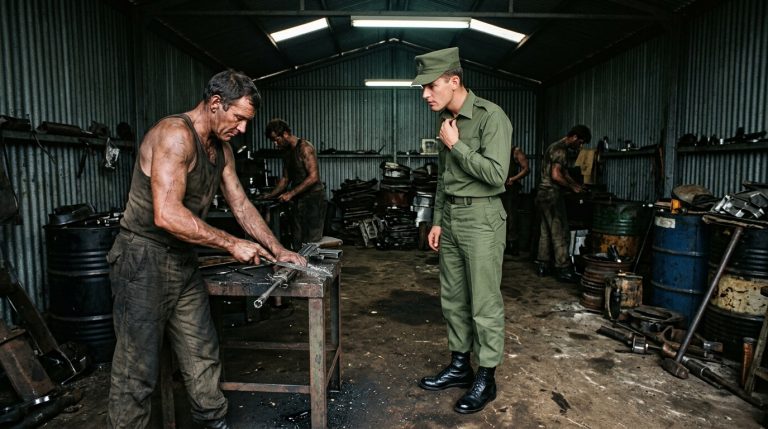
I didn’t answer right away. I walked past him, straight into the shadow of his garage, where the smell of motor oil and sawdust always reminded me of his father’s old workshop. On his workbench sat a small bench vise I had given him five years ago, its steel threads dry and ungreased.
I pulled the folded square of paper from my coat pocket and laid it flat on the workbench, right next to a pile of unpaid utility notices.
“Look at the signature, Daniel,” I said softly.
He set the recycling bin down hard. The plastic rattled. “Mom, we talked about this. Lauren just wants a unified system for the baby. We need clear boundaries.”
“I didn’t ask for a speech about boundaries,” I said, tapping my nail against the printed ink. “I asked you to look at the loop on the letter E.”
Daniel took a reluctant step closer, his shoulders hunched against the draft. He leaned over the bench, his jaw shifting as his eyes tracked across the page. The color didn’t leave his face all at once; it drained slowly, starting at his cheekbones and leaving his nose bright red against the gray light.
“That’s…” He cleared his throat, rubbing the back of his neck. “That’s just a digital signature rendering. Sometimes the bank software distorts the strokes when you sign on an iPad.”
“That was notarized in Royal Oak,” I said, my thumb slipping into my pocket to adjust the knurled screw on my brass caliper. “At your sister-in-law’s agency. On a Tuesday afternoon while I was replacing the belts on a commercial press in Dearborn.”
He closed his eyes. A muscle in his temple twitched violently. “She said you agreed over the phone. She said you were just being stubborn about giving up the physical card.”
“I never spoke to her that Tuesday,” I said. “And neither did you, apparently.”
“Mom, she’s stressed—”
“She’s scared,” I interrupted, stepping into his line of sight so he couldn’t look away. “And when people are scared, they look for something soft to break. She thinks I’m soft because I don’t raise my voice and I wear thirty-year-old sweaters.”
Daniel stared at the paper, his breathing turning shallow. “She wouldn’t forge something. She’s trying to manage our debt. We have costs coming up with the baby, and—”
“Check the wastebasket by your sideboard, Daniel,” I said, my voice cutting through his excuses like a sharp chisel through pine. “The mail that didn’t make it to this workbench. The ones stamped in red.”
He flinched. He knew exactly which envelope I meant. He didn’t defend her this time. The silence in the garage grew thick, heavy with the cold reality of a man realizing his home was built on shifting sand.
“I fixed machines for thirty years, Daniel,” I said quiet, firm, immovable. “When a gear slips, you don’t grease the teeth to hide the noise. You replace the gear. Or the whole unit breaks.”
I reached out, took the folded paper off the bench, and slid it back into my pocket alongside the brass tool.
“She’s hosting that community block committee dinner here tomorrow night,” I said, turning toward the driveway. “Be home early.”
CHAPTER 4: THE PRESSURE CHECK
Standing in Daniel’s dining room amid six local homeowners, holding a lukewarm cup of punch while Lauren holds court near the fireplace.
Her laugh rang out clear and practiced over the murmur of neighborly chatter. “Oh, we just feel it’s so vital to streamline things early,” she was telling Mrs. Higgins from down the block, gesturing with a glass of sparkling water. “With an elderly parent, you have to take charge before small oversights turn into real financial instability.”
I took a slow sip of punch, my left thumb resting against the knurled screw of the brass caliper inside my pocket. Daniel stood near the hallway arch, leaning against the doorframe with his hands shoved deep into his pockets, staring at the floorboards like he was waiting for the house to sink.
Lauren caught my eye across the room and smiled, a thin, tight expression meant to project patient tolerance. “Evelyn, why don’t you sit in the arm chair by the window? All this standing must be hard on your hips.”
“My hips are fine, Lauren,” I said, my voice carrying over the low hum of conversation. I walked toward the sideboard, where three porcelain serving trays were arranged in neat, symmetrical lines. “I was just looking at your organization system.”
Lauren’s chin lifted slightly, her eyes narrowing. “Everything is handled, Evelyn. You really don’t need to concern yourself with the household details tonight.”
“Of course,” I said. I reached into my coat pocket and pulled out two pieces of paper—not a stack of legal briefs, not a lawyer’s letter, just two single sheets folded down the middle. “I was just comparing your signature on the bank proxy to the certified notice that came in yesterday’s trash.”
The room went quiet. Mrs. Higgins paused mid-bite on a cucumber sandwich.
Lauren’s hand dropped to her belly, her smile freezing into an ugly, rigid line. “Evelyn, this isn’t the time or place for your confusion—”
“It’s a demand notice from a commercial recovery agency in Southfield,” I continued, unfolding the second sheet with a crisp, dry snap. “A thirty-day final mandate on a fifty-four thousand dollar personal guarantee. Attached directly to the deed of this house.”
Daniel straightened up instantly, his head snapping toward his wife. “What?”
“She’s lying!” Lauren’s voice cracked, rising an octave as she stepped forward, her expensive shoes clicking sharply against the hardwood. “She’s confused! She’s ninety years old and she doesn’t know what she’s reading—”
“I’m sixty-nine,” I said, setting the certified lien notice flat on the dining table, right next to the tray of baked brie. “And I spent forty years reading technical schematics for industrial presses. I know how to read a parcel identification number, Lauren. This is Daniel’s house. And in twenty-eight days, the county sheriff puts a lock on that front door.”
Neighbors began shifting silently toward the entry hallway, their eyes darting between the paper on the table and Lauren’s flushed, trembling face.
“Daniel, get her out of here!” Lauren shouted, her mask completely shattering as she spun toward my son. “She’s ruining everything! Tell them she’s losing her mind!”
Daniel didn’t move toward me. He walked slowly to the table, picked up the paper with a trembling hand, and read the red-stamped mandate line.
“Lauren,” Daniel whispered, his voice cracking down the middle. “What is this?”
“I did it for us!” she shrieked, backing against the mantelpiece as the neighbors began filing quietly out the front door, avoiding eye contact. “I did it so we could keep up! You think people respect a man who lives like a mechanic’s son? We needed capital!”
She didn’t surrender. She didn’t cry tears of remorse. She glared at me with pure, unfiltered hatred, her chest heaving as the last neighbor pulled the front door shut behind them.
“You think you won?” Lauren spat, her nails digging into the mahogany mantle. “You’re an old woman with a dead husband’s toolbox. You can’t stop this lien. The bank owns him, and I own the proxy!”
I stepped up to the table and picked up my brass caliper, resting it lightly between my fingers. “The proxy was signed on a forged waiver, Lauren. And the bank opens in eight hours.”
CHAPTER 5: IRON ON THE TABLE
Standing inside the bank manager’s office at 9:00 AM, the cold rain hitting the window pane, watching Daniel hand over the original garage documents while Lauren stands in the doorway.
Her wet coat clung to her shoulders, her mascara slightly smeared at the corner of one eye, but her posture was still stiff with desperate, cornered pride.
“Daniel,” Lauren called out, her voice echoing off the glass walls of the quiet office. “If you sign that affidavit, you’re ruining our credit before the baby even arrives. You’re choosing her over your own child!”
Daniel didn’t pause. He pressed the blue ink pen against the bank form, signing his full legal name under the line revoking all third-party proxy authority. The scratching sound of the pen was the only noise in the room.
The bank manager, a gray-haired man named Mr. Vance, reviewed the forged notary form, comparing it to Daniel’s fresh affidavit. “This document was generated fraudulently, Mrs. Brooks,” Mr. Vance said, looking squarely at Lauren. “We are freezing the proxy instantly. Mrs. Evelyn Brooks’s personal accounts remain entirely under her sole control.”
Lauren took a sudden step into the office, her hands gripping the strap of her leather purse so tight her knuckles turned white. “She can’t pay that debt! You think she’s going to save you, Daniel? She fixes sewing machines for chump change in grease-stained garages! She doesn’t have fifty-four thousand dollars!”
I sat back in the leather chair, pulling my hand from my coat pocket. I laid my brass caliper flat on the oak desk between us.
“I don’t need a fortune to fix this, Lauren,” I said softly, my voice calm against her rising hysteria. “I’m co-signing a standard low-interest consolidation loan directly with Daniel through this branch. Based on thirty years of my own clean credit and my own steady repair trade.”
Lauren blinked, her mouth opening, then shutting as the reality hit her. There was no grand reveal of millions, no expensive city lawyers stepping out of the shadows. Just plain, grinding, everyday credit built over decades of honest labor—enough to absorb the debt, remove the lien, and pull my son back from the ledge.
“You’re going to make him pay you back?” Lauren whispered, her voice dropping into raw, ugly disbelief. “You’re going to hold that over his head?”
“No,” Daniel said, standing up from the desk and turning to face her. “I’m going to work two shifts a week at the machine shop with Mom until every cent is cleared. And you and I are going to sit down with a mediator tonight.”
Lauren backed out of the doorway, her heels clicking a fast, frantic rhythm against the bank tile until the glass entrance doors swept open and swallowed her into the rain.
Daniel looked down at me, his shoulders dropping two inches as if a heavy engine block had finally been lifted off his chest. He didn’t ask for forgiveness. He just reached down and picked up the paper coffee cup I had brought him from the lobby.
An hour later, the rain had slowed to a quiet mist over the driveway.
I sat at my kitchen table on the west side of town. The silence in my house was solid, warm, and entirely mine. On the wooden tabletop sat my small toolbox, open to reveal rows of socket wrenches, feeler gauges, and metal files.
I picked up the brass caliper, wiped a tiny smudge of grease off its scale with a clean rag, and slid it back into its velvet-lined groove in the wooden box.
I closed the latch. The iron lock clicked shut with a clear, heavy snap.