The Frozen Grave: A Betrayed Wife’s Silent Reckoning for Dignity and Justice
CHAPTER 1: THE SHATTERED MIRROR
The grocery cart wheel wobbled with a steady, rhythmic squeak against the linoleum. I kept my eyes fixed on the rows of black beans, holding a single tin in my palm just to feel its cold, heavy weight. Six months of waking up to a silent mattress made a person look for any anchor that felt real.
Then a throat cleared three feet behind me.
It was a soft, dry cough followed by a muttered complaint about six dollars for a jar of pasta sauce. The exact rasp I had listened to across the kitchen table for forty-one years. My fingers went numb. The tin of beans slipped, crashing against the bottom shelf before thudding onto my shoe.
I turned slowly, my heel grinding against the dirty white tile.
He was standing near the salad dressings, holding a wire basket. Broad shoulders slightly hunched with age. The silver hair sticking up at the crown like it always did when he forgot to comb it after a nap. Across his right eyebrow, the pale white scar from the ladder fall on his thirtieth birthday stood out clearly under the harsh fluorescent lights.
“Thomas,” I said. The word came out like a rasping breath, barely loud enough to cut through the hum of the freezer units.
He didn’t jump. He just turned his head, his face entirely blank, eyes blinking once behind his thin wire frames.
“Thomas, it’s me,” I stepped forward, reaching out a trembling hand toward his jacket sleeve. “Eleanor.”
He pulled back, taking a short, polite step away from my fingers. “I’m sorry, ma’am. I think you’ve got me confused with someone else.”
The voice was identical—deep, rough around the edges, with the slight drawl he brought from the valley. It hit my ears like a physical punch to the chest.
“Don’t do this,” my voice cracked, a hot wave of panic surging up my throat. “It’s Eleanor. Your wife.”
“My name is Daniel,” he said, speaking slowly, the way a person talks to a stray dog on a porch. “Daniel Brooks. I’m sorry you’re having a hard day, but you have the wrong man.”
My hand flew to my cardigan pocket, pulling out my phone with fingers so stiff they barely worked. I brought up the picture from last July—us sitting on the wooden porch, his heavy arm draped over my shoulders while he held a half-eaten burger. I thrust the screen between our faces.
“Look at it, Thomas! Look at the scar over your eye! Look at your pinky!”
His eyes dropped to the screen for a fraction of a second. His jaw tightened—a tiny, familiar muscle twitch right below his ear that only happened when he was cornered. Then he raised his left hand to wave the phone away. The pinky finger was crooked at a thirty-degree angle from the time he broke it fixing his mother’s roof in 1978.
“I’ve never seen that photo before,” he said flatly, his thumb pressing hard against the side of his trousers. “You need to sit down, ma’am. Get some water.”
He turned his cart and walked toward the registers, his stride even, pressing the heels of his shoes down with the flat-footed gait I knew better than my own face.
An employee in a red apron stepped up beside me, asking if I needed help. I didn’t answer. My eyes stayed locked on his back as he paid the cashier in cash—folding the bills neatly down the middle with his thumb, pressing the paper flat before handing it over.
I followed him out into the parking lot, staying twenty paces behind, ducking behind a blue pickup truck as he loaded his groceries into the back of an old, dented white sedan.
He put the heavy flour bag in first, then the canned goods, and placed the carton of eggs carefully right on top.
I memorized the plate digits—7-K-M-4-2—repeating them under my breath like a prayer until I reached my own car. I didn’t cry. I didn’t shake. I just turned the key, waited three seconds for the engine to catch, and pulled out into the street, keeping three car lengths of gray asphalt between my bumper and his.
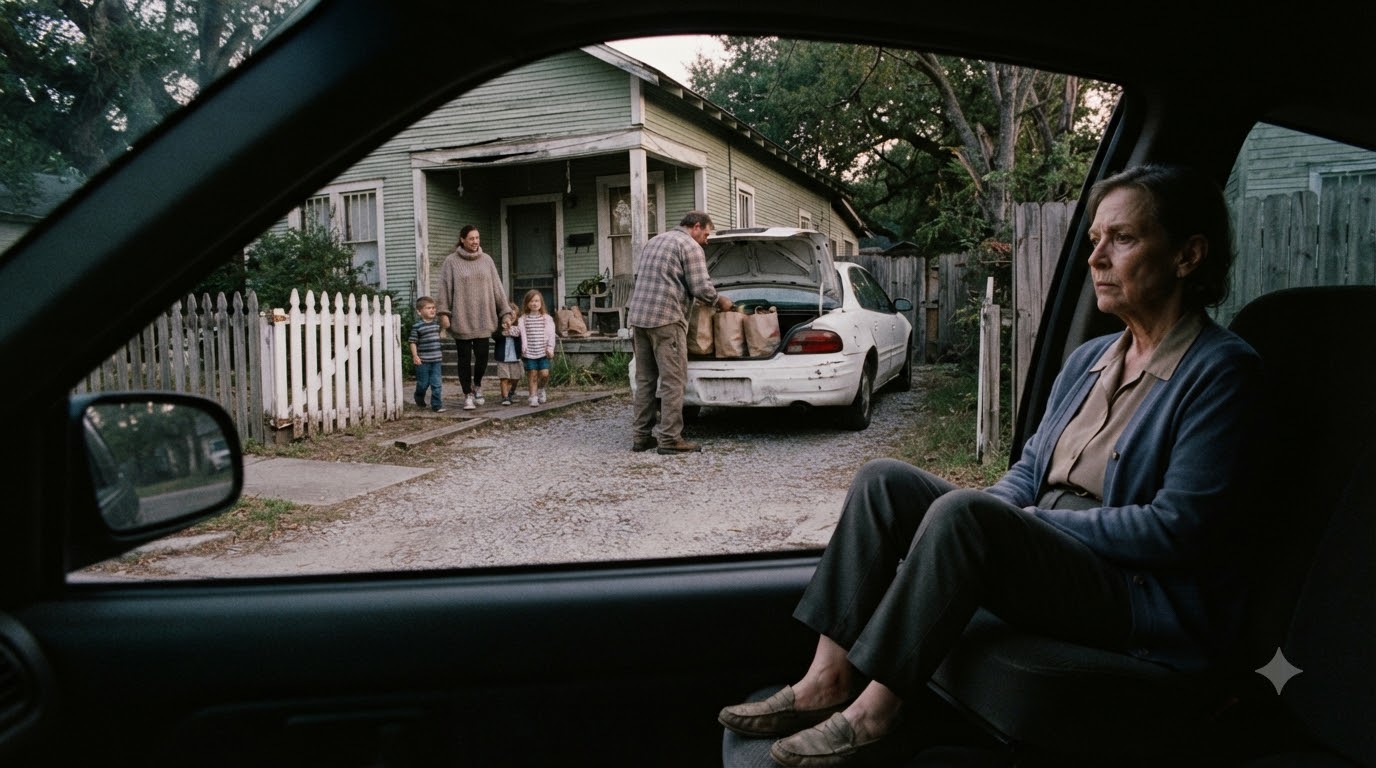
He drove past the main highway, turning down an old residential street lined with overgrown oak trees and sagging wooden fences. He pulled into the gravel driveway of a small, pale-green house with a white picket gate.
I parked half a block down, keeping the engine idling silently.
The front door of the green house opened before he even turned off his ignition. A woman in her mid-fifties stepped out onto the porch, wearing a oversized knit sweater. She smiled as he walked up the steps, leaning in to kiss his cheek before taking one of the paper bags from his arms.
Then two young children—a boy and a girl—ran out from the hallway, throwing their arms around his knees.
“Grandpa!” the little girl’s voice carried clearly through my cracked car window. “Did you get the pop-tarts?”
Thomas let out a short, lopsided laugh—the deep rumble that used to echo through our hallway every Sunday morning—and crouched down to scoop the boy up with his free arm. The woman put her hand gently on the small of his back, guiding them all inside.
The wooden front door clicked shut.
I sat alone in the heat of my car, my hands gripped so tightly around the steering wheel that the faux-leather cover pinched my palms until they were numb.
If Thomas was breathing inside that house, holding children who weren’t mine… then who was lying six feet under the marble headstone I had washed every single month?
CHAPTER 2: THE CRACKING FOUNDATION
I didn’t turn off the ignition. The air conditioning blew cold across my face, but my skin felt slick with a sudden, clammy heat.
My thumb hovered over the phone screen. I tapped Lucas’s name, holding the device to my ear while watching the quiet street. It rang four times before his voice cut through the speaker, thick with sleep and irritation.
“Mom? Do you know what time it is?”
“Come over,” I said. My voice was stripped of everything—no tears, no tremor, just cold, flat iron. “Right now.”
“Mom, it’s after four in the morning. Did you take your night medicine?”
“I took a photo, Lucas.” I stared straight ahead through the windshield at the white picket fence. “I’m sitting half a block from his house. I know where he lives. I know what he calls himself.”
Silence hung on the line. Sharp, shallow breathing hissed through the receiver.
“Stay there,” he whispered, his tone abruptly dropping the tired-son routine. “Don’t get out of the car. I’m coming to the house.”
I drove home on autopilot, my mind detached from my hands on the wheel. By the time I sat down at the kitchen table, the sky was turning a dirty, bruised purple. I spread the printed photos from my phone across the formica table—Thomas carrying the groceries, Thomas laughing with the kids, the license plate, the house number.
I pulled his old silver pillbox from my pocket—the tarnished casing he used to carry his heart medication in—and began clicking the latch open and shut. Snap. Snap. Snap.
The front door unlocked without a knock. Lucas walked in, his jacket unzipped, his hair messy, but his eyes were wide, darting instantly to the kitchen table.
He didn’t look like a grieving son. He looked like a man who had just checked his rear-view mirror and spotted flashing lights.
“Mom,” he started, reaching for the photos.
I slammed my hand down flat over the center picture, stopping his fingers an inch from the paper. “Look at him, Lucas. Look at his eyebrow. Look at his left hand.”
Lucas swallowed, his throat moving in a hard, jerky spasm. He dropped into the opposite chair, pulling at his collar as if the room had suddenly lost air.
“He looks like Dad,” Lucas muttered, looking at the salt shaker instead of my eyes. “People have lookalikes, Mom. Strangers look identical all the time.”
“He has the scar from the extension ladder in ’92,” I said softly, the pillbox latch snapping shut between my fingers. Snap. “He has the broken pinky. He folded the cash with his thumb before he put it in his pocket. Do strangers share our family memories, Lucas?”
“Mom, we buried him!” Lucas barked, his voice cracking on the last word. His hand twitched on the table, a nervous habit he picked up from his father whenever he lied about his report cards. “You stood there! I stood there! It was a closed casket because the state troopers said—”
“—They said the body was crushed beyond recognition,” I finished for him. “They said it was better not to look. And you agreed immediately. You pushed the mortuary paperwork through before the week was even out.”
Lucas closed his eyes. A bead of sweat trickled down his temple, tracking through the stubble along his jawline.
“Where did the money go, Lucas?” I asked, leaning across the table until I could smell the stale coffee on his breath. “The marina supply accounts. The business savings. You took over the books two days after the funeral.”
“He was drowning, Mom!” Lucas burst out, his hands slamming down onto the formica so hard the salt shaker rattled. He didn’t look at me; he glared at the floorboards between his shoes. “He had two lives! For twenty years! You think he was traveling to regional boat shows every month? He was living in that pale-green house half the time!”
The air left my lungs in a quiet, dry hitch. Twenty years. Half my married life was a staged performance.
“He came to me before the accident,” Lucas continued, his words tumbling out fast and messy, defensive and raw. “He wanted out. But a divorce would have wiped him out. It would have wiped us out! The business, this house, half his pension—gone. He said it was cleaner this way. He found a guy—some sick, homeless veteran with no kin—and paid off a debt for him. They swapped the IDs before the crash burned the truck.”
“And you helped him,” I said. It wasn’t a question.
“I protected the assets!” Lucas yelled, his chest heaving under his flannel shirt. “If he got caught, the state would seize everything for fraud! I took control of the accounts so you’d be taken care of! I was going to give you an allowance, keep the house paid off—”
“An allowance?” I stood up, the chair scraping sharply against the linoleum. I looked down at my son—the boy I raised, the man who had let me stand in the freezing rain in front of a stone slab and weep for a ghost. “You let me mourn a stranger so you could keep the business cash circulating without a judge watching.”
“It was his idea!” Lucas scrambled to his feet, holding his hands up like he was trying to stop a runaway train. “He begged me, Mom! He said you’d survive a death better than knowing he chose another family twenty years ago!”
I picked up the tarnished silver pillbox and slid it into my pocket.
“Get out,” I said.
“Mom, listen to me—”
“Get out of my house, Lucas.”
He hesitated, his mouth open, searching my face for the hysterical woman who used to cry on his shoulder every Sunday after the funeral. He didn’t find her. He backed toward the door, his boots dragging on the rug, before turning and stepping out into the cold morning air.
I didn’t lock the door behind him. I walked straight to Thomas’s old workbench in the garage, pulled out his dusty tackle box, and flipped the rusty metal latches.
Underneath the plastic fishing lures lay a heavy, duplicate brass key stamped with a code: WH-3. The marina supply warehouse on 4th Street. The one Lucas swore we sold off to pay the funeral expenses six months ago.
I squeezed the brass key until the jagged teeth cut deep ridges into my thumb.
CHAPTER 3: THE COLD INVENTORY
The heavy corrugated door of Unit 3 groaned against its tracks, resisting until I shoved my weight against the rusted handle. Cold, damp air smelled of diesel exhaust and stagnant water rolled out of the dark.
I didn’t turn on the overhead lights. The flickering yellow sodium streetlamp outside threw long, distorted shadows across the stacked wooden pallets and metal shelving units lining the back wall.
The lock on the inner office door was stiff. I inserted key WH-3, grinding it through years of ungreased tumbler pins until the brass caught and the bolt slid back with a dull thunk.
Inside, the desk was cleared of everything except a metal filing cabinet and an old desktop computer covered in a thick layer of grey dust. No investigator was going to hand me a neat manila folder with color-coded tabs. If I wanted the paper trail, I had to drag it out of the iron drawers myself.
I pulled out the silver pillbox from my cardigan pocket, clicking the latch once to ground myself before setting it beside the filing cabinet lock. Snap.
The top drawer jammed halfway out. I yanked it hard, the metal screeching loudly in the quiet space.
Inside were tax returns, marine equipment invoices, and bank statements—hundreds of pages tied together with deteriorating rubber bands. I pulled out a stack from two years ago, flipping through the pages under the blue glare of my small flashlight.
The numbers didn’t lie, but the names did.
Every three months, ten thousand dollars was wired from the marina supply operating account into a shell entity listed as DB Logistics. DB—Daniel Brooks. The signature on the authorization slips wasn’t Thomas’s broad, fluid loop. It was a neat, cramped script with a heavy underline.
I knew that handwriting. I taught him how to hold a pen when he was six years old.
Lucas hadn’t just protected his father’s asset transfers after the crash; he had been signing off on the siphoning long before the accident ever happened. The double life was funded straight out of our joint family account, authorized by my son’s right hand.
A floorboard creaked in the outer bay.
My flashlight beam snapped off instantly. I stood frozen against the side of the filing cabinet, my hand closing tight around the cold brass edges of the silver pillbox.
Hevy, unhurried footsteps dragged across the gravel floor of the main warehouse. A flash of light swept across the frosted glass panel of the office door.
“I saw the lock was turned, Mom,” Lucas’s voice echoed through the hollow space, flat and stripped of all panic. “I knew you kept that duplicate key in the tackle box. You never threw anything away.”
The office door pushed open. Lucas stood in the doorway, his silhouette framed by the sodium light outside. He wasn’t wearing his coat anymore. He looked tired, his arms hanging limp at his sides, but his face had gone hard—the quiet, stubborn set of his chin he always put on when he refused to apologize.
“You shouldn’t be digging around in here,” he said softly, taking one slow step into the room. “These are business records. You don’t know how to read commercial tax ledgers.”
“I know your signature, Lucas,” I said, my thumb resting flat over the pillbox latch. I held up the top invoice sheet under his gaze. “I know you were signing Daniel Brooks’s deposit slips fifteen months before your father supposedly died in that truck.”
Lucas didn’t flinch. He looked at the paper in my hand, then up at my face.
“Dad was going to sell his half of the marina to an outside investor,” Lucas said, his tone dry and matter-of-fact. “He was going to take the cash and disappear to Florida with her. If I didn’t help him set up the DB accounts, he would have liquidated the entire supply yard. You would have been left with a mortgaged house and zero income.”
“So you helped him steal it instead,” I said. “And took a cut for yourself.”
“I saved the company!” Lucas stepped closer, his boots crunching on the dusty floorboards. “I kept fifty-one percent of the equity in my name! If he stayed ‘dead’, the state locked his personal tax liabilities, and the insurance payout cleared the business line of credit! I made sure you kept the house, didn’t I? I made sure the power stayed on!”
He reached out, his fingers catching the corner of the bank ledger sheets I was holding.
“Give me the folder, Mom,” he said, his voice dropping into a tight, quiet demand. “You’re going to ruin everything over a dead man’s mess. You can’t handle what happens if the bank looks at these signatures.”
I didn’t pull back. I held the folder firm between us, feeling the paper tension pull tight against our fingers.
“I handled forty-one years of a lie, Lucas,” I said, looking him dead in the eye. “I can handle a bank manager.”
I jerked the folder back sharply, stepping around him toward the door before he could close his hand. He didn’t chase me. He just turned around slowly, watching me walk out into the cold warehouse bay, his breathing heavy in the dark.
“He won’t protect you when they come for the taxes, Mom!” Lucas called out after me, his voice bouncing off the metal walls. “He doesn’t care about you! He has a new family!”
“I’m not looking for his protection,” I said, hitting the side door handle with the palm of my hand. “I’m looking for mine.”
CHAPTER 4: THE STRATEGIC TRAP
I waited forty-eight hours before making the call.
When Lucas picked up on the second ring, I kept my voice slow and soft, letting a heavy raspy sigh drag across the microphone.
“I’m tired, Lucas,” I said, setting Thomas’s silver pillbox down on the kitchen counter with a light clink. “I can’t keep fighting you over dusty papers in an empty warehouse. I just want to understand how it all fell apart.”
A long beat of silence stretched across the line before his posture visibly thawed over the receiver.
“I just want what’s best for the family, Mom,” he said, his tone instantly shifting back to the protective, reasonable son. “Let’s get lunch. The diner on Oak Street. Just us.”
The diner vinyl booth creaked under my weight as I sat with my handbag rested flat on the bench beside me. Inside the side pocket, the red recording light of my phone glowed silently through a slit in the leather.
Lucas sat across from me, smoothing his paper napkin flat with his thumbs. He looked relieved—the easy, arrogant confidence of a man who believed his mother had finally broken under the weight of her grief and accepted her place.
“I brought the estate papers from last month,” he said, tapping a slim folder on the formica table. “If you sign the liability waiver for the warehouse equipment, the bank can clear your monthly stipend by Friday.”
“An allowance from my own husband’s business,” I said, picking up the tarnished pillbox from my coat pocket and turning it over in my palm. Snap. “Tell me how it started, Lucas. Before the crash. Before the funeral.”
He leaned in, lowering his voice, entirely comfortable in the vinyl booth.
“Dad was sloppy, Mom,” Lucas muttered, shaking his head with a faint, condescending smile. “He was funneling cash out of the marine supply register in paper envelopes to pay for that green house. The IRS would have flagged the discrepancy within two tax quarters. So I stepped in.”
“You set up DB Logistics,” I said, keeping my eyes fixed on his fingers.
“I routed the wire transfers properly,” he corrected, tapping his chest with his index finger. “I took a fifteen percent management fee for balancing the double ledgers. When he came to me with the fake death idea after finding that sick veteran, I told him I wouldn’t cover for him unless he transferred eighty percent of the primary business holdings to my name first.”
“You blackmailed your own father,” I said softly, the pillbox latch clicking shut. Snap.
“I secured the family assets!” Lucas snapped back in a harsh whisper, leaning over the table until his eyes narrowed. “If he wanted to go live with Claudia and play grandfather to her daughter’s kids, he had to pay for the exit! I forged his liquidation signatures six weeks before the truck went into the river! I made sure every dime stayed right here in my accounts where it belongs!”
“And me?” I asked. “The closed casket? Watching them lower an empty box into the dirt?”
“You would have ruined the valuation in a messy divorce,” Lucas said flatly, pulling his hands back and taking a sip of his black coffee. “You got the house. You got peace of mind for six months. You should be thanking me for handling the dirty work.”
I reached into my handbag, pulled out the phone, and tapped the red button on the screen to stop the recording. I laid the device flat on the formica right beside his coffee cup.
The audio track timer read twenty-four minutes and twelve seconds.
Lucas froze, his coffee cup hovering an inch above the saucer. The color drained from his face so fast his jaw looked like chalk under the diner lights.
“What is that?” he whispered, his eyes darting from the phone screen up to my face.
“That’s every signature, every wire transfer, and every forged document in your own voice,” I said, sliding the phone into my coat pocket and standing up from the booth. “You kept the assets, Lucas. But you forgot that I built that business with your father thirty years before you learned how to write your name.”
He scrambled to stand up, his knee slamming into the underside of the table, knocking the coffee cup sideways across the formica. “Mom! You can’t use that! I’m your son!”
“You were,” I said, looking down at the brown liquid pooling across his estate papers. “Now you’re just a co-conspirator.”
CHAPTER 5: THE UNRAVELING LIE
I didn’t park half a block away this time. I pulled my sedan right into the short gravel driveway, the front bumper stopping two feet from the white picket gate.
The windchimes on the porch rattled softly in the afternoon breeze. I gripped the thick envelope containing copies of the warehouse ledgers, bank transfers, and the audio recording thumb-drive, feeling the heavy paper edges strain against my fingers.
I didn’t knock. I walked around the side gate, the gravel crunching under my shoes, right into the small backyard.
Thomas was standing near the back fence, holding a pair of rusty garden shears, trimming a row of overgrown hydrangeas. He wore a faded plaid shirt with the sleeves rolled up to his elbows. The same white eyebrow scar caught the pale sunlight as he turned around at the sound of my footsteps.
“I told you at the store, ma’am,” he said, his voice instantly hardening into that polite, detached wall. “You need to leave before I call the police.”
“Lucas sang, Thomas,” I said, stepping onto the edge of the grass. “He sang for twenty-four minutes into my phone while he drank his coffee.”
The shears in his right hand dropped an inch. His jaw tightened—that same familiar muscle twitching below his earlobe.
I pulled out the tarnished silver pillbox and flicked the latch open with my thumb. Snap.
“Twenty years of DB Logistics,” I said flatly. “Lucas took fifteen percent to hide your paper trail. He forged your liquidation signatures six weeks before you bought a dying man’s name to drop in that truck.”
“You don’t know what you’re talking about,” Thomas rasped, his eyes darting toward the back kitchen window. “My name is Daniel Brooks. I’ve lived here for—”
“—Claudia!” I called out, raising my voice just enough to cut across the quiet yard.
The back screen door slapped open. The dark-haired woman in the oversized sweater stepped onto the wooden deck, her brow furrowed as she looked between the two of us.
“Daniel?” she asked, her voice cautious, her hand resting on the wooden railing. “Who is this woman? Why is she screaming?”
“She’s confused, honey,” Thomas said quickly, taking two fast steps toward the porch, holding his hands out to push her back inside. “Go back inside with the kids. I’m handling it.”
“He was married to me for forty-one years, Claudia,” I said, tossing the thick envelope flat onto the outdoor glass table between them. “His real name is Thomas Vance. The man you call Daniel Brooks is a ghost created out of forged corporate tax returns and stolen marital assets.”
Claudia stopped dead on the second step. Her eyes shifted from my face to Thomas’s back.
“Daniel?” she whispered, the warmth completely draining from her tone. “What is she talking about?”
“She’s lying!” Thomas shouted, his face flushing a mottled, angry red—the same explosive rage he used to throw whenever the boat engine wouldn’t turn over. “She’s an unstable widow looking for a payout! Look at her!”
“Open the folder, Claudia,” I said, keeping my thumb resting flat over the silver pillbox. “Check the wire transfers from DB Logistics into the mortgage account for this house. Check the dates. They start in 2004.”
Claudia slowly walked down the wooden steps. Thomas reached out to grab her forearm, but she slapped his hand away with a sharp, wet smack that echoed off the fence. She pulled the paper stack from the envelope, her eyes scanning down the top bank statement.
Her lips parted. She took a step back from him, her heels sinking into the soft lawn.
“You told me your wife died of cancer twenty years ago,” she said, her voice shaking violently. “You told me you had no family left.”
“Claudia, listen to me—” Thomas lunged forward, his hands trembling as he reached for her shoulders.
“Don’t touch me!” she screamed, shoving him back with both hands. “Who are you?! Who has been living in my house?!”
The sirens started then—a distant, rising wail cutting through the quiet neighborhood streets, turning onto 4th Avenue, coming fast. Lucas had realized what the recording meant the second I walked out of that diner. He had called the county prosecutor’s fraud unit himself to try and cut a deal before the tape reached the precinct desk.
Thomas turned toward the driveway, his feet scrambling against the grass as he looked for an escape, but his eyes hit my car blocking the gravel path.
He fell back against the glass patio table, his hands shaking so hard he couldn’t keep his grip on the frame.
“Eleanor,” he gasped, his voice cracking into a desperate, pathetic whine as he looked at me. “Please… for forty-one years… you can’t do this to me…”
“You died six months ago, Thomas,” I said, stepping back toward my car as two white-and-black cruisers pulled up to the curb behind my bumper, their red lights flashing against the pale-green siding. “I’m just making sure the paperwork stays honest.”
CHAPTER 6: THE QUIET REBUILDING
The radio on the lead officer’s shoulder crackled into the humid afternoon air, spitting out static and a series of numbers that formally invalidated the name Daniel Brooks.
Thomas didn’t look at me as they clicked the cuffs around his wrists. He kept his head down, his silver hair messy in the wind, his eyes glued to the gravel driveway as they guided him into the back seat.
Claudia stood on her wooden porch, her arms wrapped tight around herself, watching the white sedan get towed away while her children peered out from behind the living room curtains. She didn’t say goodbye to him. She didn’t wave.
I didn’t watch the cruisers turn the corner either. I got into my sedan, placed the tarnished silver pillbox on the passenger seat, and drove back to my house.
Three weeks later, the phone call came from the county detention center at 5:20 in the morning. A calm, procedural voice told me Thomas had suffered a massive cardiac arrest in his cell while awaiting his formal fraud hearing.
“You are listed as next of kin, Mrs. Vance,” the deputy said. “Do you wish to claim the remains for a service?”
“Cremate him,” I said, my voice steady, not a single tear falling onto my kitchen counter. “Scatter the ashes offshore. No service.”
The legal proceedings against Lucas moved with the slow, crushing weight of iron gears. The audio recording from the diner, combined with the duplicate wire ledgers I pulled from Unit 3, left his defense lawyer with nothing to bargain with. He accepted a plea deal for financial fraud and forgery—three years in state custody.
We spoke once through the glass panel at the county facility before they transferred him. He looked thin, his posture stripped of the easy arrogance he used to wear at my dinner table.
“I thought I was keeping the family afloat, Mom,” he whispered, his knuckles resting flat against the metal ledge beneath the partition.
“You were floating yourself, Lucas,” I said softly, my thumb touching the cool glass. “Love doesn’t require a lie, and it certainly doesn’t come with a management fee.”
The court dissolved the shell accounts. The primary business holdings, the marina equipment line, and the joint accounts were restructured under my sole legal name. Everything that had been systematically siphoned over twenty years returned to where it belonged.
Now, the morning light pours across my kitchen table through wide-open blinds.
I don’t keep the old photo albums out anymore. I don’t look at the marble headstone at the cemetery—a slab of granite covering a stranger’s empty memory. My dignity wasn’t given back to me by a court order or an officer’s badge; I took it back the moment I stopped begging a lie to be true.
I pick up my mug of hot black coffee with both hands, feeling the steady heat press into my palms, and take a long, quiet sip in a house that finally belongs to me.