The Legacy She Stole, The Sister Who Fought Back, And The Truth That Saved Her Daughter
CHAPTER 1: THE ATTIC DISCOVERY
The light coming through the lone attic window was dull and thick with the dust of thirty years.
I wiped a layer of gray grime off a cardboard box, the coarse paper scratching against my palm, while the sharp smell of decaying paper filled my throat. Across the narrow aisle, my sister Kalista smoothed the front of her tailored blazer, her sleeve cuffs rolled up with surgical precision. She held a clipboard in one hand and a black felt pen in the other, clicking the cap on and off with a steady, rhythmic snap that hit my ear like a ticking clock.
“We need to clear the east corner before the haulers arrive at four,” Kalista said, her voice dropping into that crisp, management-deck tone she used whenever she wanted to direct traffic. She didn’t look at me. Her pen hovered over a inventory grid, checking off boxes with swift, aggressive strokes.
In the corner, sitting on a low-backed velvet chair, our mother Eleanor kept her hands folded over her handbag. She hadn’t moved her legs in an hour. Her eyes remained fixed on a bare patch of floorboards, her lips set in a tight, pale line.
“Your father always kept his keys in the desk,” Eleanor said quietly. Her voice was flat, devoid of color. “He never let me touch the top drawer.”
Kalista didn’t pause her clicking. “Well, he isn’t here to hold the keys anymore, Mother. Hand me that red binder on the second shelf, Taran.”
I reached for the binder. My fingertips brushed a heavy, spine-damaged hardback wedged between two thick accounting ledgers. The gold lettering on the leather spine caught the weak sunlight: Building Trust in Family.
A faint, bitter memory stirred in my chest, but I pulled the book free anyway.
As the cover fell open, a folded sheet of yellowed paper slipped from between the pages and drifted down, landing softly on the toe of my work boot.
I rolled the silver-plated pen my father had given me when we incorporated the company between my knuckles—feeling its cool, solid weight—before bending down to pick up the paper.
The ink was faded, but the blocky, precise handwriting was unmistakable. It was my father’s script, complete with the sharp, exaggerated flourish he used only when writing personal notes to us as children.
My intention is that both of my daughters be treated equally, the note read. Not just in assets, but in control. Taran has as much stake in this company’s future as Kalista. That is my wish.
My pulse stuttered. I stared at the paper until the letters blurred together.
Two weeks ago, in the lawyer’s carpeted conference room, Kalista had read the formal will aloud while Eleanor wept silently into a tissue. That document had named Kalista sole executor, handing her sweeping, unchecked authority over every account, every asset, and every strategic vote for Hollowell and Company. I had sat there numb from grief, nodding along like a quiet ghost, trusting every syllable that came out of my sister’s mouth.
The signature on the legal paper from two weeks ago had been clean, straight, and sterile. It had lacked the flourish staring up at me right now from this dust-covered sheet.
“Taran,” Kalista’s voice cut through the stillness, sharper this time. “The binder.”
I folded the yellowed paper along its original creases, slipping it into the inner pocket of my jacket, right against my ribs. I picked up the red binder and handed it over.
Kalista took it without a word, her eyes sweeping over my face for a fraction of a second before she turned back to her clipboard. “Don’t get distracted. We have four more crates to catalog before dinner.”
I didn’t answer. I reached back into my pocket, my fingers brushing the crisp edge of the letter while my thumb clicked the silver pen twice in the dark silence of the attic.
CHAPTER 2: THE SIPHONED FUND
The floorboards creaked under my boots as I backed away from the attic door. Neither Kalista nor Eleanor turned around.
By midnight, the house was dead silent. Jolie was sleeping over at a classmate’s house for a biology project, leaving the kitchen empty and cold. I sat at the wooden table in the same faded sweatshirt I had slept in the night before, a mug of black coffee cooling beside my elbow. The silver-plated pen lay flat against the laminate, pointed straight at the laptop screen like an accusing finger.
I opened the lockbox my father had given me five years ago. Inside lay the thick envelope labeled in his hand: In case they turn on each other.
Between the folded business ledgers sat a scanned power of attorney, dated eleven months back. My signature sat at the bottom.
I remembered that day with brutal clarity. Jolie had strep throat, the company payroll server had crashed, and I had gone eighteen hours without food. Kalista had walked into my office carrying a single sheet of paper, looking composed, efficient, and mildly put out by my exhaustion.
It’s just standard, she had said, laying the page over my mess of receipts. In case you’re ever too overwhelmed to respond, it lets me help. This protects both of us.
I hadn’t read it. I had just signed it.
My fingers flew across the keyboard, opening the bank’s portal for Jolie’s college fund—the account I had opened when she was six years old, putting away two hundred dollars a month from my own salary.
The dashboard loaded. The primary balance read: $112.07.
My breath hitched in my chest. I scrolled back through four months of digital statements. $50,000 transferred on the third. $80,000 cleared on the fifteenth. $100,000 drained in a single wire transfer, all coded neatly as Company Asset Reallocation.
Two hundred and thirty thousand dollars. Gone. Every cent drained using the electronic signature tied to that power of attorney.
A soft chime signaled an incoming email. I opened my inbox to find an automated alert from an assistant I didn’t recognize: Mandatory Board Realignment Session. Flagged Urgent by Acting Executive Chair Kalista Hollowell.
I stared at the screen, my reflection ghosted against the black margins of the bank statement. My sister hadn’t just taken the money to build a safety net; she had used my distracted trust to weaponize my own name against my child’s future.
I didn’t scream. I didn’t reach for the phone to demand an explanation she would only twist into an emotional breakdown. Instead, I reached out, picked up my father’s silver pen, and slowly unscrewed the cap until the metal threads locked tight.
CHAPTER 3: THE BOARDROOM EXECUTION
The double glass doors of the executive suite opened with a soft hiss of compressed air.
I stepped into the top-floor lobby at eight forty-five, my heels quiet against the polished marble floor. The reception desk had been re-finished in dark walnut, wiping away the brass trim I had chosen when we signed the lease nine years ago. The young receptionist gave me a brief, practiced nod before handing me a crisp sheet of paper.
“Agenda for the realignment session,” she said, her voice smooth and devoid of familiarity. “You’ll want to review section three.”
I took the page without speaking. The elevator bank behind me chimed as three investors in gray suits stepped out, chatting in low, relaxed tones.
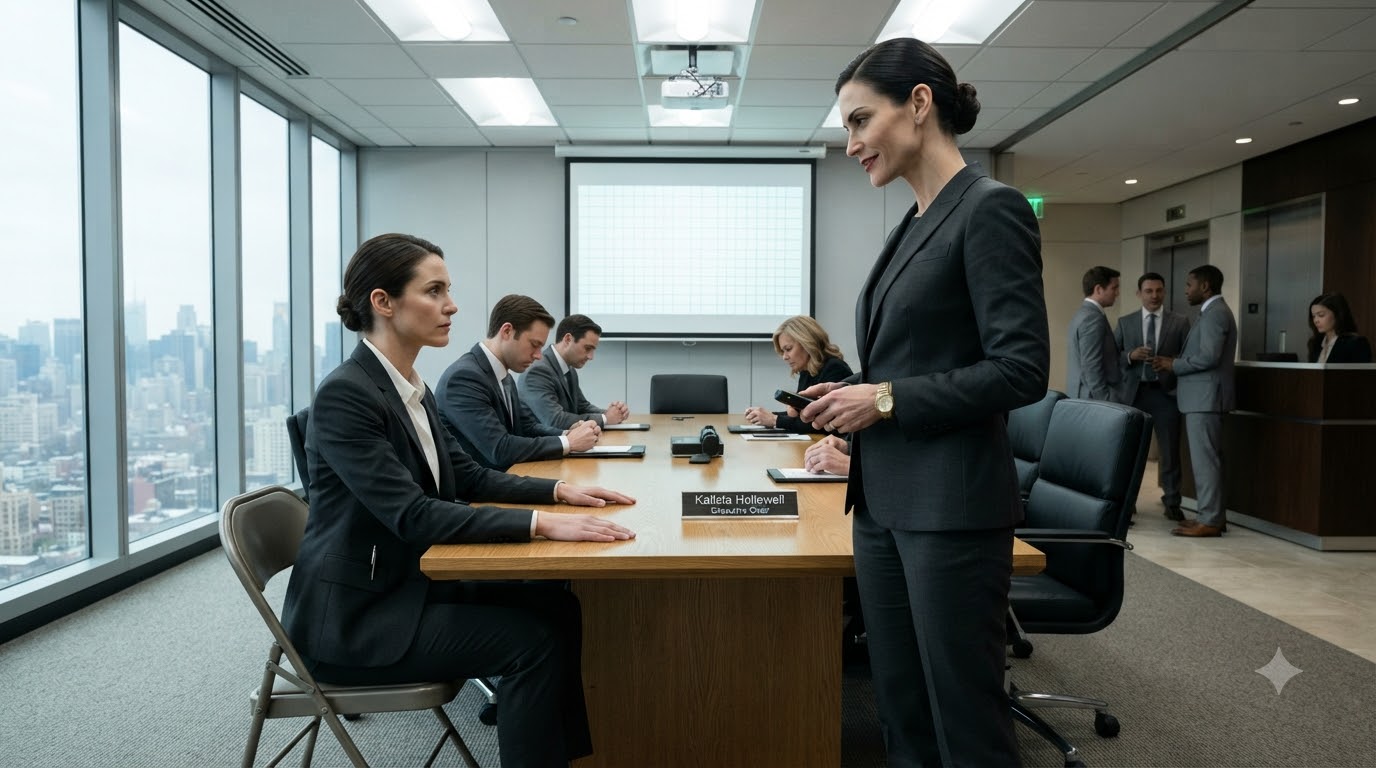
Inside the boardroom, the air smelled faintly of lemon polish and stale coffee. Eight leather chairs surrounded the long oak table. At the head of the room, standing beside a projected slide deck, Kalista adjusted her gold wristwatch. She wore a tailored charcoal suit, her hair pinned back in a tight knot.
I walked toward my usual seat at the right side of the head chair. A silver-engraved nameplate sat in front of it: Kalista Hollowell, Executive Chair.
My old seat on the far left had been removed entirely. In its place stood a folding metal chair pushed against the credential cabinet.
“We have a tight schedule,” Kalista said, clicking her presentation remote without looking in my direction. “Please take your assigned seat so we can establish a quorum.”
I pulled out the metal chair, the legs scraping loudly against the hardwood border of the rug. I sat down, resting my palms flat against the table. My thumb brushed the silver pen in my pocket, feeling the cold, familiar metal.
Across the table, Marcy Weller—a board member who had sat through every quarterly review with me since year four—kept her eyes fixed on her tablet screen. Her knuckles were white against the plastic casing.
Kalista tapped her remote. The projector hummed, casting a bright white grid onto the wall behind her.
“To ensure long-term stability and streamline our operational overhead,” Kalista began, her tone steady and clinical, “the executive committee proposes an immediate restructuring of corporate governance.”
She didn’t mention the ten years I had spent building our client list from three regional accounts to forty-two. She didn’t mention the seventy-hour work weeks during the supply chain crisis, or the personal guarantees I had signed to clear payroll when our first warehouse burned.
“Under the revised charter,” Kalista continued, “the role of Chief Operating Officer is permanently consolidated into the Chair’s office. Effective immediately.”
A quiet rustle went around the table as two junior directors nodded in unison.
“Is there any discussion?” Kalista asked, her gaze sweeping over the room, intentionally skimming half an inch above my forehead.
I didn’t raise my voice. I didn’t slam my hand on the table. “The founding charter requires a thirty-day notice for any structural vote involving equity partners.”
Kalista smiled, a thin, tight curve of her lips that didn’t reach her eyes. “Section four was amended during the January proxy review, Taran. Under the power of attorney on file, your voting proxy was recorded in favor of the expedited schedule.”
Marcy shifted in her seat, her fingers twitching against her tablet, but she said nothing.
“All in favor,” Kalista said smoothly.
Six hands went up around the oak table.
“Motion carried,” Kalista said, clicking her pen against her tablet screen. “Thank you, everyone. Human Resources will coordinate access transitions by noon.”
I sat perfectly still as the chairs pushed back and the board members filed out into the hallway. Kalista gathered her notes, slipping them into a leather folder without a single glance toward my side of the table.
When the room emptied, I pulled out my phone and swiped to my system credentials. The corporate dashboard flickered once, then refreshed to a solid red screen: Access Suspended by Administrator.
I stood up, slid the silver pen into my coat pocket, and walked out to the elevator bank without looking back.
CHAPTER 4: THE DEVASTATING REJECTION
Jolie pulled the passenger door open and dropped onto the leather seat without making eye contact. Her backpack hit the floorboard with a heavy, muffled thud. She didn’t unbutton her denim jacket or reach for her phone.
“Jolie?” I asked, lowering my mobile to the center console.
She tossed an official cream-colored envelope onto the dashboard. The top left corner bore the bold red seal of Stanford University’s financial aid office.
“They flagged the file,” Jolie said. Her voice was flat, shorn of any teenage dramatic edge. “The aid officer called me into the guidance room before third period. They said the verification audit showed a massive asset liquidation three months ago.”
I reached out, my fingers trembling slightly as I unfolded the paper.
…inconsistencies in declared household assets… non-matching tax schedules… status suspended pending legal review…
“They think I lied on the FAFSA,” Jolie whispered, staring straight out the windshield at the school buses loading across the street. “They asked if my family was trying to hide offshore accounts.”
“You didn’t lie,” I said, the words coming out low and sharp. “I built that account. I put every dollar in.”
“Then where did it go, Mom?” She turned her head, her eyes wide and rimmed with red, though no tears fell. “Because the school says the money was transferred out by an authorized company officer. They think we played a shell game.”
I couldn’t answer. I couldn’t tell her that her aunt had used my exhausted signature on a piece of paper to buy corporate leverage while her grandmother sat in the next room stirring cold tea.
When we pulled into the driveway twenty minutes later, a silver sedan was idling near my mailbox. A man in a plain gray suit stepped out as soon as my tires stopped rolling. He walked up to my window, held out a thick manila packet, and set it against the glass.
“Taran Hollowell?” he asked politely.
“Yes.”
“Notice of civil filing from the superior court. Have a good afternoon.”
He turned on his heel and walked back to his car.
I picked up the packet. The header read: Hollowell & Co. v. Taran Hollowell — Complaint for Intentional Interference, Financial Misconduct, and Defamation.
Kalista wasn’t just taking my title or my daughter’s tuition. She was filing a preemptive lawsuit to lock my personal accounts, frame my inquiries as corporate harassment, and gag me before I could present a single ledger to a judge.
I walked into the house, set the lawsuit beside Stanford’s rejection letter on the kitchen island, and pulled the silver pen from my pocket. I unscrewed the cap, laid the point against a blank legal pad, and dialed Rachel’s office line.
“Rachel,” I said as soon as the line connected. “She sued first. Run the forensic trail on the reserve accounts right now.”
CHAPTER 5: THE TRAP AND FORENSIC COUNTERSTRIKE
“Three separate wire transfers,” Rachel said through the speakerphone, her keyboard clicking rapidly in the background. “The money didn’t go to corporate operations, Taran. It went into a newly created reserve sub-account registered under an out-of-state holding shell.”
I unscrewed the top of the silver pen, setting the metal cap onto the oak island surface. “Whose device ID authorized the final transfer?”
“That’s the trap Kalista set,” Rachel said, her voice dropping into a tense hum. “The IP address traces back to your old office terminal on the fourth floor. She used your logged-in credentials from the night before you were locked out. On paper, it looks like you wired the funds to yourself.”
My knuckles tightened against the pen’s barrel. She had manufactured a digital paper trail to make her civil lawsuit look like a legitimate corporate defense.
“Check the timestamp on the terminal sign-in,” I said. “Compare it against the building keycard access logs from that evening.”
A short pause stretched across the line. The heavy tick of the wall clock in my kitchen filled the silence.
“Got it,” Rachel said suddenly. “Your keycard swiped out at 6:12 PM. The terminal sign-in occurred at 7:45 PM—using Kalista’s master override keycard at the lobby turnstile. She logged onto your machine forty minutes after you left the building.”
“Print the raw server logs,” I told her. “Every timestamp, every IP bridge, every swipe record. Include the scanned original letter from my father’s attic book.”
“What about the civil court filing?” Rachel asked. “Her attorneys are pushing for an expedited emergency injunction tomorrow morning to freeze your personal accounts.”
“We serve the cross-complaint at the injunction hearing,” I said, screwing the silver cap back onto the pen until the brass threads locked. “Hand-delivered to her counsel in front of the magistrate.”
I drove straight to the downtown legal center, the thick folder of forensic exhibits resting on the passenger seat. There would be no viral videos, no social media exposure, and no begging for family reconciliation.
I walked up the granite steps of the courthouse, holding the manila envelope firmly under my arm. Inside sat the full, unvarnished mathematical proof of her fraud, verified by server timestamps and backed by our father’s true handwriting.
As I reached the glass doors of the department, my phone buzzed with a text from Eleanor: Please drop this, Taran. Your sister is doing what she has to for the family.
I looked at the message for three seconds, swiped it off my screen without replying, and pushed open the courtroom doors.
CHAPTER 6: THE EXHAUSTING COLLAPSE AND AFTERMATH
Kalista stopped three feet in front of me, her leather briefcase hanging at her side. She smoothed the lapels of her dark navy blazer, her lips tightening into a practiced, superior line.
“You’re wasting the court’s time, Taran,” she said, her voice echoing off the tile walls. “And you’re making this infinitely harder on Mother.”
I didn’t answer. I reached into my coat pocket, pulled out our father’s silver pen, and laid it flat across the top of my file folder.
When the bailiff called our case, we walked into the bench area. Kalista’s lead counsel stood immediately, sliding a glossy binder across the mahogany bar toward the judge.
“Your Honor,” he announced smoothly, “we move for an immediate emergency freeze on the defendant’s liquid assets based on evidence of internal corporate embezzlement.”
My attorney stepped forward and placed our single manila folder on the bench.
“We cross-file for summary dismissal, Your Honor,” she said calmly, “and submit certified forensic server logs, cardkey access records, and the original, un-amended estate directive signed by the late founder.”
The judge pulled off his reading glasses and opened our file. The room fell into a heavy, suffocating silence, punctuated only by the crisp rustle of paper as he flipped past the IP address comparisons and the keycard timestamp logs.
Kalista’s attorney leaned over her shoulder, his eyes scanning the server log page. A bead of sweat broke near his hairline. He tapped her arm, whispering frantically in her ear.
Kalista jerked her arm away, her face flushing a deep, mottled red. “That terminal was unlocked! She left her profile open—”
“Ma’am,” the judge cut in, his voice cracking like a whip through the quiet room. “The keycard logs show your personal access badge swiping into the building forty minutes after the defendant departed. The IP address matches your master override terminal.”
“This is a family business!” Kalista snapped, her composure shattering into raw, unvarnished rage. She slammed both palms onto the counsel table, her voice rising to a shrill pitch. “I kept that company afloat while she was distracted with her child! Everything I did was to preserve the estate!”
“Your Honor,” my attorney added quietly, “we have also filed notice with the state licensing board regarding unauthorized power-of-attorney transfers involving two hundred and thirty thousand dollars of minor educational funds.”
Kalista turned her head toward me, her knuckles white against the dark wood of the table. “You destroyed this, Taran! You destroyed what Dad built over a handful of receipts!”
“Dad left two daughters,” I said, my voice steady, plain, and entirely devoid of heat. “You just couldn’t bear to share the table.”
The judge brought his gavel down with a sharp, heavy thud. “Injunction denied. Preliminary findings referred to the district auditor. Court is adjourned.”
Kalista stood frozen at her table as her attorneys rapidly packed their files, deliberately avoiding her eyes. She reached for her briefcase, her hand trembling so hard the metal clasp rattled against the leather.
I picked up my folder, slid my father’s silver pen into my coat pocket, and walked out of the courtroom into the morning air.
Two hours later, I sat at my kitchen table with a mug of black coffee. The house was completely quiet.
My phone buzzed on the placemat. A single text from Eleanor appeared on the screen: Kalista stepped down from the board this morning. The audit is starting. I hope you got what you wanted.
I stared at the message for five seconds. I didn’t feel a surge of triumph, nor did I feel the cold bite of regret. I simply swiped the notification away, tapped her contact name, and deleted the thread.
The front door clicked open. Jolie walked in, dropping her jacket onto the hall rack. She held a fresh piece of paper from Stanford’s portal, her face relaxed and bright in the soft daylight streaming through the kitchen window.
“The hold was lifted,” Jolie said, setting the printout on the table beside my coffee mug. “Financial aid verified the original account records.”
I picked up my father’s silver pen, set it neatly inside the mahogany lockbox on the counter, and turned the key in the brass lock until it clicked shut.
“Put your boots on,” I told her, reaching for my car keys. “Let me buy you lunch.”