The Paper Fortress: How One Homeowner Dismantled a Corrupt Neighborhood Empire Through Cold, Methodical Documentation
CHAPTER 1: The Weight of Paper
The mint green cardigan didn’t move with the urgency of a thief. It moved with the entitlement of a homeowner checking her own property. I watched from the kitchen window, the glass cool against my forehead, while she walked the short distance from my cluster mailbox bank back to her own porch.
Fourth time this week. Five days, four thefts.
It wasn’t just the missing envelopes. It was the $150 fines, the steady drip of administrative penalties for parking my work van in my own driveway, and the slow, grinding erosion of my business. For a decade, I’d built Callahan Electrical on a foundation of reliability. Now, my clients were calling to ask why contracts weren’t arriving, why I was missing deadlines, why I was suddenly unprofessional.
The stillness of the street was her armor. Sycamore Creek Estates didn’t deal in open conflict. We dealt in sprinkler systems, mature oaks, and the muted sound of garage doors—a neighborhood of decent, quiet people who assumed their leaders were decent, too.
I turned away from the window and walked to the kitchen table. My hands felt heavy, but steady. I didn’t reach for my phone to fire off a text or a rant on the neighborhood Facebook page. Instead, I reached for the Manila folder. It was starting to get thick—the edges slightly frayed, the contents held together by the gravity of documented fact.
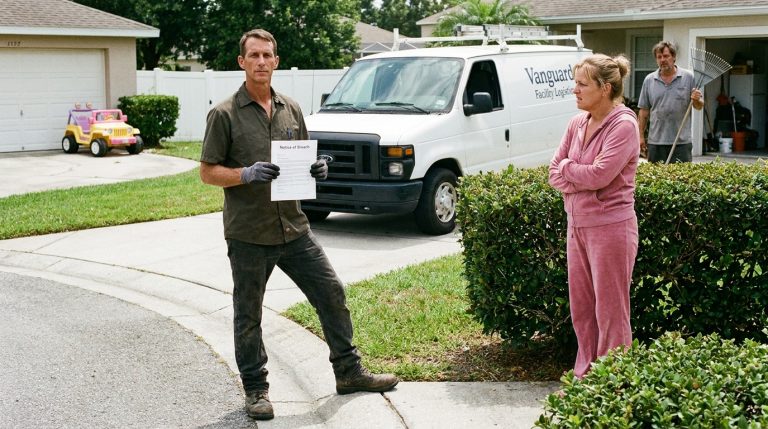
I opened it. Inside were photographs of her at the mailbox, time-stamped and clear. There were copies of the violation notices for my van, next to the original CC&R documents I’d highlighted in neon yellow. I had the spec sheet for my Ford Transit, proving it was under the weight limit, and measurements of my decals, proving they didn’t meet the definition of commercial advertising.
I wasn’t a victim anymore. I was a researcher.
The air in the kitchen felt stagnant, smelling of burnt coffee and the metallic edge of a storm building far to the west. I looked at the most recent piece of evidence: a certified letter from a contractor that had arrived with the seal mangled, the adhesive fresh and tacky, as if someone had tried to glue the secret back inside.
“She’s getting sloppy,” I whispered to the empty room.
Seven years of unchecked power does that. It makes you believe the rules are just suggestions you write for other people. Constance Birchfield Holt thought she was untouchable because she knew the bylaws better than anyone. She didn’t realize that in an electrical system, the biggest danger isn’t the current you see; it’s the short circuit hidden behind the drywall.
My phone vibrated. A text from a client: Brod, if the contract isn’t here by tomorrow, I’m going elsewhere.
I didn’t panic. I didn’t apologize. I set the phone face down and pulled out a fresh sheet of paper. I began to write a timeline, a precise record of every piece of mail she’d taken, every fine she’d levied, and every lie she’d told on official HOA letterhead.
The door chime rang. It was soft, polite. I walked to the front door and looked out the peephole. It was Wendell, standing there with his usual, calm expression and a tin of something that smelled like pecans and brown sugar. I opened the door, but before I could speak, I saw a scrap of white paper tucked into the frame of my mailbox.
I stepped outside. My pulse didn’t jump. I didn’t feel the adrenaline I’d expected. I pulled the note from the mailbox. No envelope. No signature. Just six words in careful, printed block lettering:
You should be more careful.
I turned back to Wendell, but my eyes stayed on the note. I didn’t crumple it. I didn’t burn it. I tucked it into the Manila folder, a new piece of evidence, a new thread to pull.
“Everything alright, Brod?” Wendell asked, holding out the tin.
“Everything is exactly where it needs to be, Wendell,” I said, my voice as level as a carpenter’s line. “She just made her first move.”
The note in my pocket felt like a circuit breaker, the one that tells you exactly where the fire is starting. I looked down the street at Constance’s white Cadillac, parked six inches over the property line, and I realized that for the first time in months, I wasn’t just surviving my neighbor. I was beginning the process of taking her apart.
CHAPTER 2: The Paper Trail
“Brod, you’re looking for trouble where there isn’t any. It’s just mail.”
Wendell’s voice was too loud for the small, claustrophobic kitchen. He sat at my table, turning a pecan cookie over in his calloused, retired-postal-worker fingers. He wasn’t wrong, not by his own logic. To anyone else, a missing letter was a misdelivery. To a man who had spent thirty years watching the gears of the postal service turn, it was just friction in the machine.
But Wendell didn’t know what I had in the folder. He didn’t know that the mint-green cardigan wasn’t just a neighbor—it was an auditor who had turned predator.
“It’s not just mail, Wendell,” I said, my voice quiet, cutting through the hum of the refrigerator. “It’s leverage. If she can control the mailbox, she can control the information. If she controls the information, she controls the board.”
I pulled the Manila folder into the center of the table. The paper inside was crisp, hard, and unforgiving. I pushed a printout across to him. It was a digital log, rows of dates and times correlating with the security footage of Constance at the cluster bank.
“She’s intercepted three certified letters this month,” I said, ticking them off with a pen. “One from my insurance, one from a legal firm, and one from a supply house. None of them made it to my porch.”
Wendell stopped chewing. He picked up the log, his eyes narrowing as he scanned the entries. He didn’t look like a man enjoying a cookie anymore. He looked like he was back in a sorting facility, hunting for an anomaly in a stream of thousands.
“This is federal, Brod,” he said, his voice dropping an octave. “You don’t play with this.”
“I’m not playing.”
I went to my laptop and pulled up the postalinspectors.uspis.gov portal. The screen was a harsh, unforgiving white against the gloom of the late afternoon. I didn’t want to storm her house. I didn’t want to throw a punch. I wanted her to feel the weight of a system that didn’t care about neighborhood politics or HOA bylaws. I wanted her to face a wall that was thicker than her own ego.
“I’m filing the complaint,” I said. “And I’m going to need you to confirm the standard procedure for handling misdirected certified mail on this route.”
“I can’t talk on the record,” Wendell cautioned, though he didn’t pull his hand away from the folder. “Not yet.”
“You don’t have to,” I said. “Just tell me if it’s possible for a carrier to miss forty consecutive pieces of mail without it being a systematic error.”
He looked at me for a long time. The smell of the pecan cookies suddenly felt cloying, oppressive. “No,” he said, finally. “It’s not possible. It’s intentional.”
I hit submit on the form. The confirmation number blinked on the screen—a string of digits that felt like a lock clicking into place.
After Wendell left, I sat in the dark for an hour. The house was quiet, but the air felt heavy, charged with the grit of what was coming. I stood up and walked to the window. Constance’s Cadillac was still there, the white paint catching the dying light. It looked like a monolith, a monument to seven years of unearned authority.
I pulled the Manila folder closer. I needed more. The mail theft was the hook, but it was too small, too petty. I knew her pattern now. She didn’t move in tantrums; she moved in procedure. She wouldn’t stop with the mail. She would escalate, and when she did, I would be waiting.
I opened my laptop again, not for the USPIS, but for the Ohio Revised Code. I started reading. Section 5312.10. Right to inspect and copy association records. It was dry, dusty, legalese that tasted like old iron and grit. But it was my terrain. I was an electrician; I knew how to trace a fault. I didn’t need to rip the walls out. I just needed to find the one loose connection that would bring the whole system down.
I traced my finger down the statute. My eyes caught on the clause about the board’s duty of transparency. If the board was hiding documents, they were in breach. And if they were in breach, they were liable.
I leaned back, the chair groaning under the weight. The room felt colder. I hadn’t even begun to dig, and already the foundations of Sycamore Creek felt brittle. I reached for a highlighter, the bright neon yellow a stark contrast to the gray, rusted truth of the paper in front of me.
Tomorrow, I would start the formal request. Tomorrow, the folder would get heavier.
CHAPTER 3: The Architecture of Lies
The certified letter arrived on a Tuesday, delivered by a substitute carrier who didn’t know the route’s rhythms. It was thick, heavy with the weight of forty-seven pages of HOA boilerplate, and damp from a sudden, sharp Ohio rain. I signed for it, the pen skidding across the plastic pad, and carried it into the kitchen like it was a live explosive.
My kitchen table was already covered in the preliminary layout: the timeline of mail theft, the photographs, the highlighted statutes. I laid the new documents down and felt the familiar, grounding friction of paper against wood.
Daphne’s legal advice had been clear: Always demand. Never ask.
I sat down and began to read. For four hours, the world outside my window ceased to exist. Sycamore Creek continued on as if nothing were wrong; a neighbor’s kid biked past, his tires spraying grit onto the pavement, while a dog barked somewhere in the distance. Inside, I was tracing a different kind of circuit.
I was looking for the logic in the chaos.
I started with the minutes from the emergency board meeting, the one where Constance had pushed through her new mail access rules. The ink was standard, the font uniform, but the math was a disaster.
“Eleven to zero,” I whispered, tapping the page.
According to the governing documents I had sourced, there were fourteen eligible board members. I cross-referenced the attendance logs. Three names were missing. They hadn’t been notified, and their votes weren’t even acknowledged as abstentions—they were just scrubbed from existence.
It wasn’t a clerical error. It was a surgical removal.
I poured a cup of coffee, the steam curling into the stale air. My hands were steady, but my mind was clicking into a higher gear, the gears of a man who spent his life analyzing faults until he could feel them in his fingertips. Constance had built a fence around our community, and she had used these documents to keep the wolves out. But looking at the falsified minutes, I realized the wolves were already inside. They were sitting at the head of the table.
I flipped to the back of the folder and found the conflict-of-interest disclosures. They were dated, signed, and bureaucratic. Except, when I laid them next to the attendance records for the landscaping contract vote, the dates drifted. Two board members had signed disclosure forms for a contract that hadn’t even been proposed yet on the date they signed.
I picked up my phone and dialed my attorney.
“Brod,” she answered, her voice tight. “I assume you found something.”
“I found everything,” I said. “The minutes from the emergency meeting are a fabrication. Three members were deliberately excluded. And the conflict-of-interest forms? They’re backdated. Someone forged the signatures or at least coerced the dates.”
“Are you certain?”
“I’m an electrician, counselor. I know when a wire is cross-connected.”
“Keep those documents separate,” she said, her tone hardening. “If she finds out you have the original, she’ll try to purge the record. Do you have a secondary location for the copies?”
“They’re already scanned. Off-site.”
“Good. Don’t confront her, Brod. Not yet. She’s like a trapped animal; she’ll start lashing out. If you go to her now, she’ll just bury the evidence deeper.”
I hung up and looked out the window. The rain had stopped, but the sky was still a bruised, desaturated gray. Constance’s white Cadillac was visible down the street, parked in that familiar, aggressive angle across the property line.
I didn’t feel rage. I felt a cold, clear clarity. I reached for my accordion folder—the one that was growing thick enough to require both hands to carry—and placed the falsified minutes on top.
Then, the doorbell rang.
It wasn’t a polite chime this time. It was sharp, rhythmic, the sound of someone who expected a response. I walked to the door, peering through the glass. It was Constance. She wasn’t wearing the mint-green cardigan. She was in a charcoal blazer, her posture stiff, her face a mask of practiced, professional concern.
I didn’t open the door. I just watched her, the lock still engaged.
“Mr. Callahan?” she said, her voice muffled by the glass, perfectly modulated as if she were addressing a board member during a disciplinary hearing. “I believe there’s been a misunderstanding regarding the recent HOA notices. I’d like to resolve this before it becomes… problematic.”
I leaned against the doorframe. I didn’t say a word. I just looked at her, noting the way her eyes darted to the camera, the way her hand tightened on her purse. She wasn’t here to talk. She was here to see if I had the documents.
I felt the Manila folder under my arm, the sharp, hard edges of the falsified minutes pressing against my ribs.
“Mr. Callahan?” she tried again, her tone sharpening, shedding the fake empathy for a razor-thin edge of authority. “This is an official inquiry.”
I didn’t speak. I didn’t even blink. I just stood in the silence of my hallway, the quietest room in the neighborhood, and let her realize that the power had shifted. She was standing on the porch of a man who was no longer looking for a neighbor, but an opening.
She stood there for another minute, the silence stretching until it was taut enough to snap. Then, she turned, her heels clicking against the concrete, and walked back to the Cadillac.
I went back to the kitchen and picked up my pen. I didn’t just have a case. I had a ledger. And I was going to make sure she was the one who paid the bill.
CHAPTER 4: The Beige Obstacle
Tuesday morning started with the smell of diesel. Teresa’s mail truck was idling two houses down, a low, rhythmic thrum that usually meant everything was exactly where it was supposed to be. I walked to my mailbox, the air crisp and dry, smelling of late-July heat and the dust of a neighborhood that prided itself on perfection.
I stopped dead.
Between my mailbox bank and the sidewalk sat a new structure. It was bolted to a post, painted a shade of beige so aggressively dull it practically screamed for attention. A hand-lettered, cheerful little sign was screwed into the front: Sycamore Creek Package Management Station. A combination lock hung from the door like a challenge.
I stood there for a moment, the morning sun glinting off the metal lock. It was an intrusion—a physical manifestation of Constance’s obsession with control. She hadn’t just been stealing mail; she was now actively re-routing the neighborhood’s physical life into her own private sorting facility.
I didn’t touch the box. I didn’t need to. I pulled out my phone and took a photograph—a high-resolution shot from three different angles, making sure to capture the proximity to the official USPS cluster boxes.
A shadow fell over the pavement. I didn’t have to turn around to know who it was.
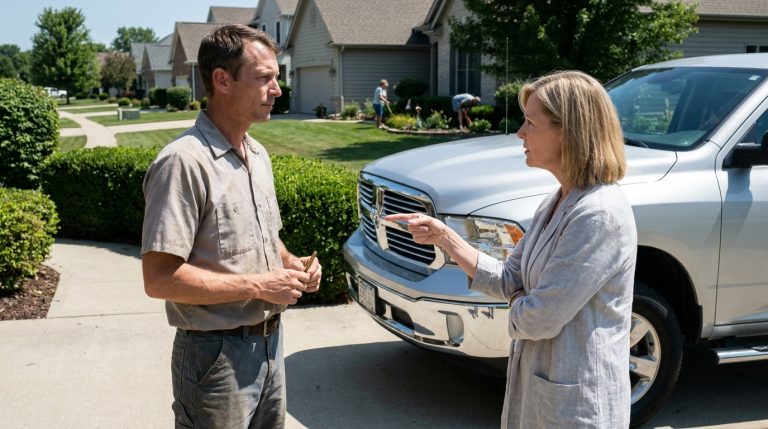
“Efficient, isn’t it?” Constance said. Her voice was smooth, devoid of any edge. She was dressed for a casual Tuesday, but her posture was as rigid as the post she’d just installed. “We’ve had so many issues with porch piracy. The board felt it was time to take a proactive stance on community security.”
I turned, keeping my expression neutral, the kind of blank mask I’d learned from years of commercial troubleshooting. “The board, Constance? Or you?”
“The board represents the community, Brod,” she said, her eyes never leaving mine. “I’m just the one who executes the vision.”
“It’s a structure on a public easement,” I said, my voice steady. “Did you clear this with the postmaster?”
She smiled, a thin, tight line that didn’t reach her eyes. “This is a private community initiative. We don’t need a postmaster’s permission to improve our own property values.”
“You’re interfering with delivery infrastructure,” I replied, feeling the familiar pull of a circuit breaker in my chest—that moment of calm before the arc. “You’re creating a restricted zone around a federal delivery point. Do you have a permit?”
“I have a board motion,” she countered. The condescension was thick, a layer of grease on a perfectly good engine. “Maybe if you spent more time worrying about your own compliance issues—that van, for instance—you wouldn’t be so concerned with the board’s efforts to keep us safe.”
She turned and walked away, her gait unhurried, the embodiment of a woman who had never been told no by a man in a position of authority.
I waited until she was out of sight, then I reached for the phone. I didn’t call a lawyer. I called the local Postmaster. I didn’t ask for permission; I asked for a definition. I cited the specific postal regulations regarding delivery infrastructure.
The silence on the other end of the line was the most beautiful thing I’d heard in weeks. The postmaster didn’t just know the regulation; he sounded actively irritated that someone had dared to mess with his jurisdiction.
“An unauthorized box?” the postmaster asked, his voice sharp. “Adjacent to a cluster unit? That’s a direct violation of Publication 52. If we haven’t signed off on the site plan, it shouldn’t exist.”
“It exists,” I said. “And it’s causing a disruption to the mail flow.”
“Send me the photos,” he ordered. “I’m sending a carrier supervisor out there by noon. If it’s not authorized, I’ll have it pulled myself.”
I hung up, feeling the adrenaline of the fight—a cold, precise, electric current. I didn’t just remove a box; I had used her own weapon against her. Constance had built this station to monitor the neighborhood, to control the flow of goods, but she hadn’t realized that by putting it on the easement, she had stepped onto federal ground.
I went back inside and opened my folder. I wrote down the time of the conversation, the name of the postmaster, and the promise of the inspection.
But as I looked at the folder, the weight of it hit me. I had forced the removal, yes. But I could see the way this was going. She wasn’t stopping. She was just recalibrating. The parcel station was a decoy—an obvious, clumsy attempt at control that she knew I would fight.
What was she hiding while I was busy fighting over a beige box?
I looked back at the board meeting minutes, the ones with the missing votes. If the parcel station was the distraction, the real operation was deeper, buried in the figures I hadn’t even begun to audit. I felt a sudden, sharp coldness in my stomach. I was winning the minor battles, but I was still looking at the surface, never the current.
I needed to see the bank statements. If I could get my hands on the reserve fund records, I could stop reacting to her moves and start anticipating them.
The phone rang. It was Wendell.
“Brod,” he whispered, his voice frantic. “She knows you’re pulling records. She just called a special emergency meeting for tomorrow night. She’s locking the agenda.”
I looked at the folder on my table. The battle over the beige box had just escalated into an emergency session. The trap was set. But for once, I wasn’t just walking into it. I was bringing the wire cutters.
CHAPTER 5: The Ledger of Ghosts
The kitchen was cold. Not the kind of cold that comes from a drafty window, but the kind that settles in your marrow when you realize you’ve been looking at the wrong map for your entire journey.
I sat at my table, the accordion folder open before me. It was heavier than it had been two days ago, filled with the financial records I’d finally forced Pinnacle Association Services to cough up after a week of threats. A single, low-wattage bulb hung over the table, casting long, jittery shadows across the rows of figures.
I had been chasing mail. I had been chasing parcel stations and zoning violations. I had been fighting a war of petty skirmishes, convinced that the victory would come from a well-placed citation or a stern letter from the postmaster.
I was wrong.
I ran my finger down the expenditure column for the last twenty-six months. My eyes moved with the mechanical precision of a clockwork motor. Eight hundred dollars. Fourteen hundred. Four thousand, four hundred. Twenty-six transactions, all flowing from the HOA reserve fund—our money, the money for the pool, the playground, the safety of the neighborhood—into a single, unremarkable black hole: BCH Property Maintenance LLC.
I had spent the last hour cross-referencing that name against every vendor list, every contractor database, and every public record I could access.
There was nothing. No license, no phone number, no website, no physical address. Just a UPS store box number.
I leaned back, the chair leg scraping against the floor, a sharp, abrasive sound that seemed to ring through the house. I had expected to find evidence of her arrogance—a receipt for a car part, perhaps, or a personal expense she’d tried to bury. I hadn’t expected to find a ghost.
BCH. Birchfield. Holt.
The realization hit me not like a wave, but like a physical blow to the lungs. It wasn’t just spite. It wasn’t just power. It was an industry. For seven years, she hadn’t just been running an HOA; she had been running a siphon, draining the lifeblood of this neighborhood into a shell company that existed only on paper.
I grabbed my coffee, but it was cold, a bitter, dreg-filled sludge. I didn’t care. I opened my laptop and pulled up the Ohio Secretary of State Business Registry. There it was, in the cold, digital typeface of the state’s database: Registered Agent, Constance B. Holt.
The math didn’t just fail; it detonated. Forty-three thousand, five hundred dollars.
I sat there for four minutes without moving. The house was silent, but in my head, I could hear the sound of the neighborhood outside. The yip of a terrier, the hum of a lawnmower, the normal, rhythmic pulse of 140 families who were, at this very moment, going about their lives, trusting that their investment was safe.
I picked up the phone to call my attorney, but my thumb hovered over the screen. I looked at the folder. I had spent weeks building this, thinking I was exposing a tyrant. I was actually exposing a scavenger.
When I finally reached her, my voice sounded like grinding stone.
“I have the financial records,” I said. “The reserve fund is gutted.”
“What are you looking at, Brod?”
“BCH Property Maintenance. Twenty-six payments. Forty-three thousand dollars. No work, no contracts, no receipts. And it’s her company.”
The silence on the other end was heavy, professional, and terrifying.
“Brod,” she said, her voice dropping, losing all its formal edge. “You need to stop everything. You are no longer dealing with an HOA dispute. This is white-collar crime. This is embezzlement on a scale that will bring the Attorney General down on this neighborhood like a hammer.”
“She’s been doing it for seven years,” I said. “She’s not just petty, she’s a predator.”
“Exactly. And if she realizes you’ve found the ledger, she won’t just try to intimidate you. She will liquidate every asset she has and run. You have to preserve the evidence. Do not let them know you’ve realized it’s a shell company.”
I hung up, looking at the spreadsheet. It was so simple. So clean. A perfect, symmetrical architecture of deceit.
I stood up and went to the window. It was late now, the streetlights humming as they flickered to life. Constance’s house was dark, save for a single light in the study—a sharp, yellow square of illumination against the night. She was in there, probably reviewing the agenda for tomorrow’s emergency meeting, oblivious to the fact that I wasn’t just looking at the mail anymore.
I wasn’t looking at the parcel station.
I was looking at her exit strategy.
And for the first time, I felt the terrifying, electric thrill of being the one who held the kill switch. I didn’t need to shout. I didn’t need to post on Facebook. I just needed to show up to that meeting with the ledger, and watch her realize that the beige walls she’d built around her empire were about to be torn down, piece by piece, under the weight of her own greed.
I closed the folder, the snap of the metal fastener echoing in the empty room like a gunshot.
CHAPTER 6: The Gavel and the Ghost
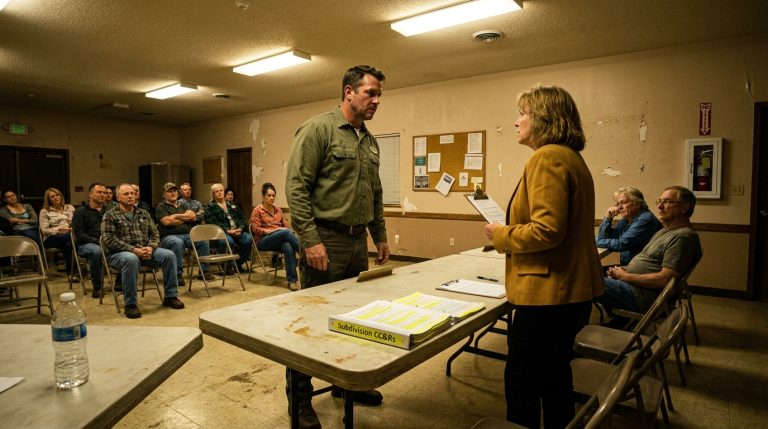
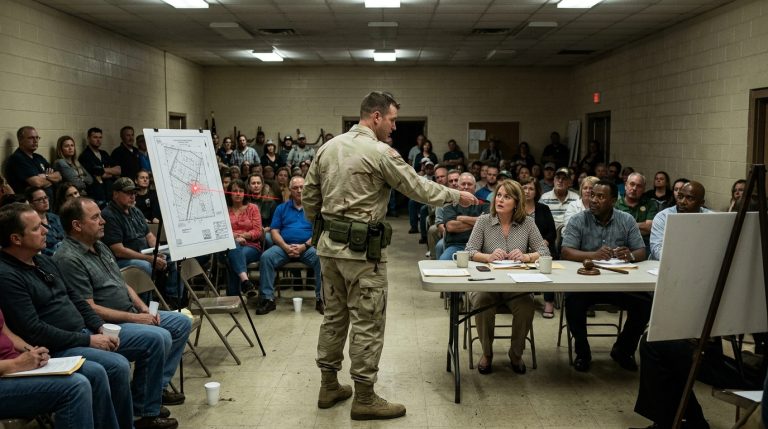
The Sycamore Creek clubhouse smelled of industrial-grade floor cleaner and stale coffee, a scent that had defined seven years of Constance’s reign. Tonight, however, the air was different. It was thin, brittle, and thick with the hum of seventy-four people who had finally stopped looking at their own feet.
I stood by the side door, my accordion folder tucked under my arm like a shield. I didn’t need to look for Constance; she was already at the front, a white-clad anchor in the middle of a room that was slowly drifting away from her.
She opened the meeting with her usual, practiced cadence—smooth, unhurried, the voice of a woman who had spent thirty years writing disciplinary memos. She tried to pivot the agenda to a ‘governance review,’ a procedural dodge that had worked a dozen times before. But the air in the room was too heavy for a pivot.
Daphne stood up, the chair scraping against the linoleum like a warning. She didn’t shout. She didn’t need to. She read the statute, her voice precise, the dry articulation of law cutting through Constance’s carefully constructed silence.
I watched Constance’s face. For seven years, that face had been a fortress. But as Daphne read the section of the Ohio Revised Code, I saw the first hairline fracture. A slight twitch in the jaw. A tightening of the eyes. She was running the calculations—re-routing, re-framing, searching for the loophole that wasn’t there.
Then, I clicked the trackpad.
The clubhouse’s wall-mounted screen flared to life, casting a harsh, blue-white light over the room. Slide one. The BCH Property Maintenance ledger.
The sound of seventy-four people inhaling at the exact same moment is something I’ll never forget. It wasn’t a roar. It was a vacuum.
“That’s my money,” a woman whispered. The voice carried in the silence, brittle and sharp.
Constance stood up. She started her rebuttal, the ‘school administrator’ voice, the one that had ended arguments for seven consecutive years. She said the documents were ‘misleading.’ She said there was a ‘reasonable explanation.’ She used the word appropriate like a weapon, as if she could simply define the truth into existence.
I didn’t let her finish. I walked to the front of the room, my boots heavy on the industrial carpet. I didn’t look at her. I looked at the room, at my neighbors, at Mrs. Ketterer sitting in her folding chair with the patience of an old soldier.
I placed the folder on the table. I opened it to the Secretary of State registration.
“The explanation is right here,” I said. My voice was low, devoid of the theatrical anger she was trying to bait out of me. “Registered agent, Constance B. Holt. A shell company with your initials, Constance. Forty-three thousand dollars of reserve funds gone.”
She froze. The fortress didn’t just crack; it disintegrated. She looked at the room, searching for the allies who had spent years nodding at her, but they were gone. They were just people now—angry, betrayed, and wide awake.
Two figures moved at the back of the room—the USPIS investigators, their presence as quiet and inevitable as a rising tide. They didn’t make a scene. They didn’t need to. Their mere existence in that room was the final, devastating evidence that the game had moved from the HOA board to the federal record.
Constance slumped back into her chair. The white Cadillac in the parking lot was suddenly just a car, the beige parcel station just a pile of scrap, and the seven-year reign of Sycamore Creek’s silent dictator was nothing more than a series of numbers on a spreadsheet that finally didn’t balance.
She didn’t speak again. She didn’t have to. The room had already moved on. A motion was made to strip her of her status, and for the first time in the history of the neighborhood, the vote was overwhelming, visceral, and final.
I slipped out the side door into the October night. The Ohio air was cold, the kind of cold that leaves the taste of woodsmoke and dry leaves on your tongue. I leaned against the beige siding of the building and listened. Through the thin walls, I could hear the sound of the neighborhood finally, truly, paying attention.
I had my folders. I had my documents. And I had my neighborhood back.
As I walked toward my van, I looked back at the clubhouse. The lights were still on, but the shadow that had hung over Sycamore Creek for seven years was gone, dissolved by the sheer, stubborn weight of documented truth.
Some things you don’t get back. The contract I lost, the time spent fighting for a mailbox, the innocence of a neighborhood that believed it was safe. But looking at the cold, dark street, I realized that we had gained something else. We had learned that petty power is a ghost, and the only way to banish a ghost is to turn on the lights.
I started the engine. It was quiet, steady, and ready to move forward.