The Bureaucratic Campaign of Oakwood Preserve: A Logistics Officer’s Strategic Counter-Insurgency
CHAPTER 1: SECTION 12 PARAGRAPH C
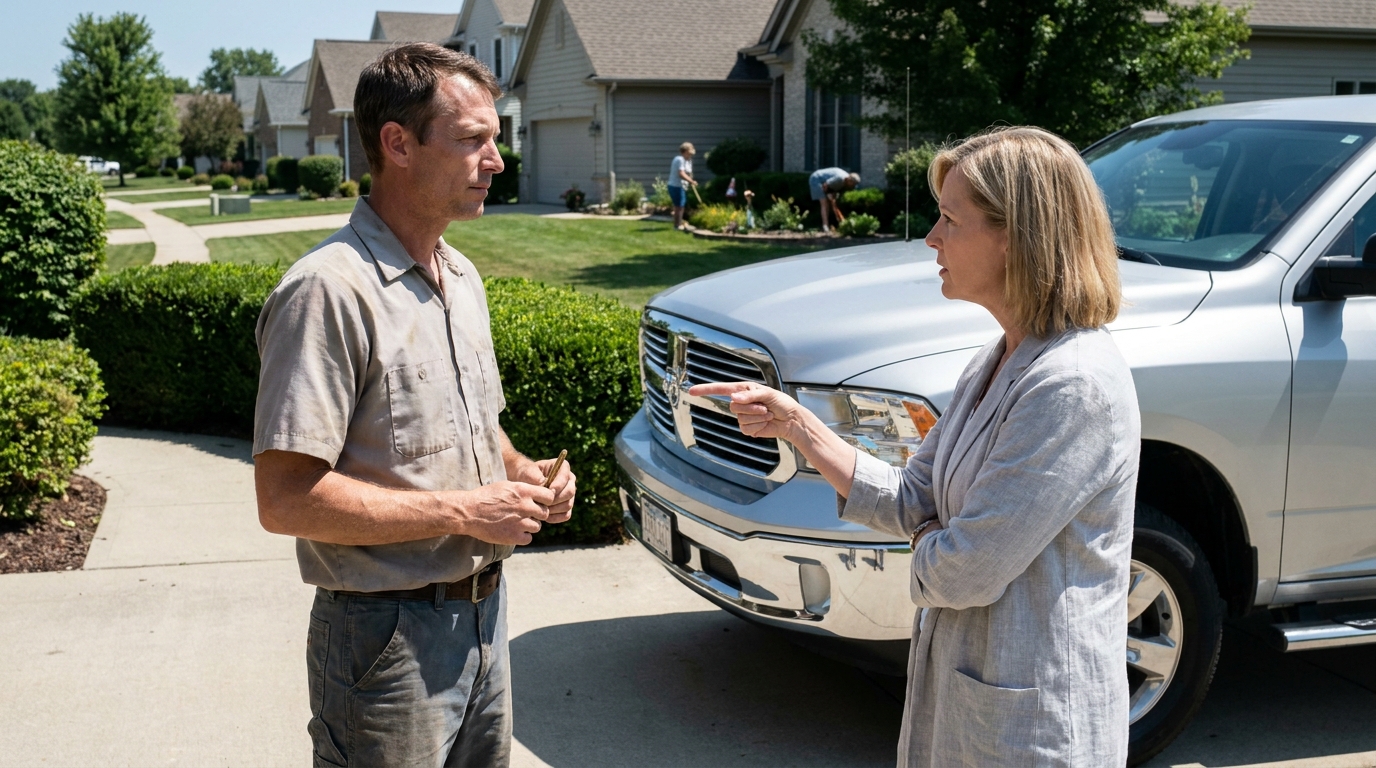
“That monstrosity,” she said, her voice dry like sour milk, “is a commercial vehicle.”
Karen didn’t look at me. Her small, dark eyes stayed pinned to the twenty-four-foot polished steel rig parked in my driveway. A jewel-encrusted index finger pointed at the chrome bumper.
“Section 12, paragraph C,” she continued, her tone flat, absolute. “Oakwood Preserve covenants. You have twenty-four hours to remove it from the premises, Mr. Jensen. Or it gets towed. At your expense.”
I didn’t move. My thumb clicked the heavy brass Parker pen in my right pocket. Once. Twice. The metallic snap grounded the cold heat rising behind my ribs.
“It’s registered as a personal vehicle, Karen,” I said. My voice was steady. Army logistics teaches you one thing early: never give a hungry officer an angle. “No permanent exterior signage. No active commercial operations on site.”
“Five hundred dollar fine for the initial infraction,” she said, cutting me off before the sentence hit the pavement. “One hundred dollars a day for every morning it remains on asphalt. The notice is in the mail. Have a pleasant afternoon.”
She turned on her heel, her white linen trousers snapping against her ankles as she walked toward her SUV. She didn’t look back. She didn’t need to. In her head, the maneuver was already complete.
I stood alone in the heat. The smell of sun-baked asphalt and fresh-cut grass hung heavy in the air. On the side of the truck, right near the side mirror, a faint square of faded paint caught the sunlight—a residue mark from a magnetic plate that wasn’t even there.
I pulled my hand from my pocket and looked at the brass pen. The barrel was hot from the sun.
Sarah was standing by the screen door when I walked inside. She didn’t ask. She had heard every word through the open double-hung window.
“She’s building a paper trail, Mark,” Sarah said softly. She set her mug on the kitchen island with a quiet clink. “She’s not looking for compliance. She’s setting up a lien.”
“She’s operating off an outdated map,” I replied.
I opened my leather notebook on the counter, uncapped the Parker pen, and drew a clean line down the center of the first page.
Enemy Objective: Property Removal / Financial Exhaustion.
Friendly Objective: Asset Retention / Position Security.
My eight-year-old daughter, Lily, peeked around the corner of the hallway, her small fingers holding the doorframe. “Daddy? Is the mean lady taking the truck?”
I looked at Lily, then at Sarah. The silence in the kitchen was heavy, weighed down by twenty years of military moves, deployment orders, and the promise of a quiet home base that had lasted exactly six months.
I didn’t answer my daughter with words. I capped the pen. The click sounded like a rifle bolt snapping home.
“No,” I said. “She isn’t.”
CHAPTER 2: PREDAWN MANEUVERS
The metal cap clicked onto the Parker pen, the sharp sound echoing in the quiet kitchen. Lily’s small hand slipped from the doorframe, her slippers scuffing against the oak floor as Sarah guided her back toward the bedrooms.
“Get some sleep, sweet pea,” Sarah murmured softly.
I stayed at the island, looking down at the notebook. Two columns. Straight ink. Asset Retention meant removing the target from the primary engagement zone. Karen’s threat of a tow truck in twenty-four hours wasn’t a bluff; it was an operational timeline. If the rig stayed on the driveway past sunrise, she’d have a commercial flatbed hooked to the front axle before the morning paper hit the grass.
I pulled my phone from my pocket and dialed a number I hadn’t called in fourteen months.
Tom answered on the fourth ring. No greeting, just the low raspy drag of a heavy smoker taking a breath. “Jensen.”
“I need a cold bay, Tom. Secure, covered, zero foot traffic.”
“The old depot off Route 9,” Tom said, his voice flat, reliable as a torque wrench. “Bay four is empty. Keypad code is your old unit designator. How long?”
“As long as it takes to clear the field.”
“Bring it in before five,” Tom said, and the line went dead.
I looked up as Sarah re-entered the kitchen. She picked up her cold tea, her eyes tracking my hands as I closed the leather notebook.
“Tom’s depot,” I said. “Before daylight.”
“And the fines?” Sarah asked. Her thumb rubbed a raw, red blister on the side of her index finger—a nervous tic she’d had since my second tour in Fallujah. “She’s logging five hundred tonight. One hundred every twenty-four hours after.”
“Let her write the paper,” I said. “A fine is an administrative claim. To collect, she needs a ruling or a lien. To get a lien, she needs a compliant paper trail that survives a legal audit.”
I walked to the front window and pulled the blind back an inch. The street was dark. Oakwood Preserve slept under a blanket of manicured silence and six-figure mortgages. Three doors down, a porch light glinted off the rear window of a white SUV parked in Karen’s driveway.
“She thinks I’m going to negotiate,” I said, letting the blind drop back into place. “She expects me to panic, sell the rig at a loss, or file an appeal through her own committee.”
“What are we doing instead?” Sarah asked.
“Information warfare,” I said. “We starve her of the asset, then we flood her office with statutory discovery.”
At 0415, the sky was a bruised, heavy purple. The morning air carried a damp chill that smelled of fertilizer and wet pine needles. I stepped out the side door without turning on the porch light, my work boots silent on the dew-soaked grass.
The rig sat gleaming under the faint yellow wash of the streetlamp. Twenty-four feet of custom stainless steel, built to military culinary standards. Every weld was smooth; every burner line was reinforced high-pressure copper. I reached up and checked the side panels. The magnetic plates were stored in the lower storage locker, leaving the exterior completely bare—just raw, unbranded metal.
I unlocked the driver’s cab, the door opening with a heavy pneumatic hiss. The vinyl seat was cold through my jeans. I turned the key. The six-cylinder diesel engine turned over once, twice, then roared to life with a deep, rhythmic vibration that shook the steering column.
I didn’t let it idle. I dropped the transmission into gear, released the air brake, and rolled the heavy truck down the driveway, the tires crunching softly over the concrete apron before hitting the smooth asphalt of Maple Drive.
Through the side mirror, I saw a second-story curtain twitch at Karen’s house. A silhouette appeared behind the glass, pale and rigid.
I didn’t accelerate until I hit the main boulevard, leaving Oakwood Preserve behind in the dark.
Tom’s storage depot was a sprawling, concrete-walled facility hidden behind a row of overgrown poplars six miles down Route 9. I pulled the rig up to the rusted chain-link gate, punched 101-BRAVO into the weathered keypad, and watched the iron gate slide open with a metallic groan.
Bay four was deep, dark, and smelled of motor oil and concrete dust. I backed the truck inside, killed the diesel engine, and pulled the kill switch on the main battery. The silence that followed was heavy, absolute.
As I stepped out and pulled the corrugated steel bay door down, latching it with a heavy brass padlock, my phone buzzed in my pocket.
An email notification.
Sender: Oakwood Preserve HOA Administration.
Subject: NOTICE OF FORMAL VIOLATION & ESCALATION – ACCOUNT 804.
I opened the attachment. It was a formal notice of non-compliance, signed in thick black ink by Karen Peterson. But at the bottom of the PDF, in the small, standardized footer used by the management software, a line of automated routing code caught my eye:
RECORD ORIGIN: VANGUARD RESERVE FUND SYSTEM / SUB-ACCT 804
I stared at the screen. Vanguard wasn’t the operational bank listed on our monthly dues statements. Our dues went to a local credit union.
I saved the PDF to a secure drive, tapped Sarah’s contact, and sent a short text.
Vehicle secure. Pull the state corporation registry. Look up Vanguard Reserve Fund and cross-reference with Account 804.
I walked out to the main gate on foot, the gravel crunching under my boots, the Parker pen heavy in my pocket. The sun was just breaking over the horizon, casting long, sharp shadows across the road.
The battle wasn’t on my driveway anymore. It was in the books.
CHAPTER 3: THE DISCOVERY MATRIX
The brass padlock clanked shut against the corrugated steel door of Bay Four, the heavy sound settling into the quiet morning air. I slid my phone back into my pocket, the screen still warm from the text I’d sent Sarah regarding the Account 804 routing line.
By two o’clock that afternoon, the sun sat high and sharp over the Oakwood Preserve clubhouse. The air inside the main hall was thick with the smell of chlorine from the adjacent pool and old floor wax.
Five cardboard banker boxes sat stacked on a folding table in the corner. Behind them sat Karen. She wore a pale gray cardigan, her arms folded tight over her chest. Her eyes followed me as I pulled out a metal chair and sat down across from the paper stack.
“Four hours,” Karen said. She didn’t check her watch. She didn’t need to. “The board approved four hours of administrative inspection time. No copies may leave the room.”
“I brought my own camera,” I said. My voice didn’t rise. I unclipped the Parker pen from my shirt collar and laid it flat on the formica table next to my phone.
I pulled the lid off Box One. A cloud of dry paper dust drifted into the light.
Box One was full of meeting minutes going back thirty-six months. I flipped through the heavy stapled packets, my thumb snapping the corner of every page. No formal board vote had ever redefined commercial vehicles. No motion had been introduced regarding my truck. Karen had drafted the citation letter entirely on her own authority.
“Find what you’re looking for, Mr. Jensen?” she asked. The edge in her voice was thin, sharp.
I didn’t answer. I reached for Box Two.
Financial disclosures. General ledger sheets, vendor disbursements, monthly bank reconciliations. I lined up my phone over the pages, taking systematic photos. Snap. Snap. Snap.
Midway through the twenty-four-month ledger, a recurring line item appeared under account line 410: Property Maintenance & Perimeter Care.
The payee was listed as Evergreen Solutions LLC.
Every single check issued to Evergreen Solutions over the last two years was signed by Karen Peterson and countersigned by Gary Thompson, the architectural committee co-chair. The monthly disbursements were four thousand eight hundred dollars. The previous contractor had billed two thousand seven hundred.
I turned the page and froze. Attached to the back of a quarterly invoice was a small, white routing slip. Printed in faint gray dot-matrix ink near the bottom margin was a familiar line:
SUB-ACCOUNT 804 // WIRE TRANSFER AUTHORIZED TO VANGUARD RESERVE FUND
I looked across the table. Karen was staring at her phone, her thumb flicking rapidly across the glass. Her jaw was tight, the muscles in her neck pulled taut like piano wire.
“GaryThompson lives on Willow Court,” I said softly, keeping my eyes on the invoice.
Karen’s thumb stopped moving on her screen. “What?”
“Gary,” I repeated. “He owns Evergreen Solutions. The company address on this vendor registry is 114 Willow Court.”
“The board selects contractors based on quality of service,” she said, her voice dropping an octave, dead of any inflection. “It’s entirely within our fiduciary mandate.”
“A forty percent rate hike without a public bidding process isn’t a mandate,” I said. “It’s a kickback scheme.”
I snapped a picture of the invoice, the routing slip, and the signature line.
I reached for Box Five. The violation files.
Inside were folders for dozens of residents. Eleanor Gable’s folder was nearly an inch thick—twelve separate citations for concrete garden gnomes, total fines totaling seven hundred and fifty dollars. The Miller family had four notices for a portable basketball hoop left out past six in the evening.
Then I pulled a blue folder from the back of the box.
Patri, David. 408 Maple Drive.
I opened it. A series of escalation letters from two years prior. The violation: parking a commercial cargo van in the driveway. The van belonged to Patri’s custom cabinetry business. The notices escalated from fifty dollars to two thousand dollars in less than ninety days, culminating in a formal notice of lien filed by the board.
A handwritten note in Karen’s sharp, angular script was paperclipped to the final legal filing: Owner defaulted. Property liquidated under market value. Account cleared through Vanguard.
David Patri hadn’t just moved. He’d been systematically squeezed out until he had to forfeit equity to clear a bogus lien.
I looked down at my Parker pen sitting on the table. The brass barrel reflected the overhead fluorescent lights in a dull, golden streak.
“Time’s up,” Karen said. She stood up, smoothing the front of her cardigan with both hands. “Four hours.”
I didn’t argue. I closed the lid on Box Five, picked up my phone, and clipped the brass pen back into my collar pocket.
“Thank you for your cooperation, Karen,” I said, standing up. “This was very informative.”
“You’re fighting a losing war, Mr. Jensen,” she said. She leaned across the table, her voice dropping to a harsh whisper. “You have no leverage here. This community belongs to the board.”
“No,” I said, looking her dead in the eye. “It belongs to the deed holders. And we’re about to audit the books.”
I walked out of the clubhouse into the bright afternoon glare. My phone buzzed in my hand as soon as I crossed the threshold.
It was Sarah.
“Mark,” she said, her voice tense. “I ran that company name you texted me earlier. Vanguard Reserve Fund isn’t a bank. It’s a privately registered holding company incorporated in Delaware three years ago.”
I stopped on the sidewalk, looking back at the sterile beige building behind me.
“Who’s the registered agent?” I asked.
“An attorney in Wilmington,” Sarah said. “But the parent entity listing has one primary officer named.”
She paused, the sound of paper rustling over the line.
“Karen Peterson.”
CHAPTER 4: THE TROJAN AGREEMENT
“Karen Peterson,” Sarah repeated over the line, the background hum of her home office printer whirring softly. “She incorporated Vanguard Reserve Fund ninety days before she took over as HOA board president.”
I stood on the concrete walkway outside the clubhouse, the sun dipping behind the pine ridge. The wind picked up, rattling the dry palm fronds near the entrance. I held the phone with my left hand while my right hand went into my pocket, fingers closing over the cold brass barrel of the Parker pen.
“Account 804 isn’t an internal ledger line,” I said, my thumb clicking the pen cap twice. “It’s an automated sweep account. Every dollar collected in fines or routed through inflated vendor contracts gets funnelled directly into Vanguard.”
“And because it’s registered as a private entity out of state, none of it shows up on the local credit union balance sheets,” Sarah said. “Mark, she’s not just enforcing rules. She’s running a systemic drainage valve on community equity.”
“We need a binding mechanism,” I said. “Something that forces her to acknowledge the asset on site before she realizes she’s signing her own audit.”
“How?”
“The annual block party,” I said. “She posted the vendor solicitation flyer yesterday. She’s looking for a main course caterer.”
I hung up, walked to my sedan parked at the far end of the clubhouse lot, and drove straight to the kitchen table.
By nineteen-hundred hours, the dining room table was covered in crisp twenty-pound bond paper. Sarah sat with her laptop open, drafting the legal shell. I sat across from her, my leather notebook open, mapping out the operational logistics.
“We can’t use ‘The Smoking Gun,'” Sarah said, her fingers tapping a steady rhythm on the keys. “The second she sees your name or the rig’s description on a bid, she’ll reject the proposal out of hand.”
“Then we deploy a shell,” I said. “Patriot Provisions LLC.”
Sarah looked up from the screen. “We need a registered point of contact. If she runs a background search on the business name, it has to lead to a clean address.”
I pulled my phone out and dialed David Petri.
The line rang three times before David answered. His voice was tired, the flat monotone of a man who had lost his home equity two years ago and still carried the weight in his jaw.
“Jensen,” he said.
“David. I have the paper file from your property,” I said directly. “Account 804. Vanguard Reserve Fund.”
Silence held the line for five seconds. I heard the faint click of a lighter on his end, followed by a slow exhale.
“She used Vanguard to execute the lien,” David said. It wasn’t a question.
“I need a straw officer for a bidding proposal,” I told him. “Patriot Provisions. You sign the catering submission as managing director. You take the intake call. I handle the food, the rig, and the execution.”
“What’s the endgame?” David asked softly.
“We lock her into an uncancelable commercial catering contract that explicitly mandates the presence of heavy mobile equipment on site,” I said. “She signs it thinking she’s getting cheap barbecue for her neighborhood photo-op. The moment she signs, she legally waives Section 12, Paragraph C for the duration of the event.”
“And when she sees you pull up in the rig?”
“Then she either lets me serve, or she breaches the contract on live video in front of two hundred residents while Marcus serves her with the audit.”
David let out a dry, rasping laugh that turned into a quiet cough. “Send me the signature block, Mark. I’m in.”
By twenty-two-hundred hours, the proposal packet was complete.
It was a masterclass in corporate presentation: a clean navy-blue cover sheet, a itemized menu featuring slow-smoked brisket and pork shoulder, and a price point fifteen percent below any commercial caterer in the county. Embedded deep in Section 4, Clause B of the attached service agreement was the key hook:
“Client agrees that Vendor shall retain absolute operational discretion regarding on-site equipment, including but not limited to mobile thermal holding units, commercial preparation trailers, and dedicated transport vehicles necessary to execute service delivery.”
Below that, Section 9: “Cancellation within seven days of the scheduled event incurs a mandatory liquid damage fee equal to one hundred percent of the contracted rate, payable immediately to Patriot Provisions LLC.”
I drove to the main HOA drop-box at the clubhouse under the cover of night, slipped the sealed manila envelope through the brass slot, and watched it disappear into the locked bin.
The trap was laid.
Thirty-six hours passed in absolute silence.
On Thursday afternoon, I was at Tom’s depot, greasing the wheel bearings on the rig’s rear axle. Grease covered my forearms, black and thick. My phone buzzed on the workbench beside a grease gun.
I wiped my hands on an shop rag and picked it up. A forwarded audio file from David Petri.
I tapped play.
Karen’s voice came through the small phone speaker, high, sweet, and dripping with patronizing warmth.
“Mr. Petri, good afternoon! This is Karen Peterson, president of the Oakwood Preserve Homeowners Association. The board has reviewed your proposal for the annual block party, and we are absolutely delighted by your pricing. I’ve signed the service agreement and attached the countersigned PDF to this email. We look forward to seeing Patriot Provisions on site Saturday at noon!”
I paused the recording.
I pulled the Parker pen from my shirt pocket, uncapped it, and marked a clean red checkmark next to Section 4, Clause B in my notebook.
The contract was signed. The legal waiver was locked.
My phone screen flickered with a second notification—a calendar alert for Saturday, 1130 hours. Below it, a text from Marcus: Summons and forensic audit petition printed on heavy bond. I’ll be in the cul-de-sac at 1145 in a suit.
I looked back at the twenty-four-foot stainless steel rig resting in the dark bay. The chrome surface reflected the single overhead bulb in a sharp, blinding line.
She thought she was buying cheap barbecue. She had just signed the warrant for her own financial autopsy.
CHAPTER 5: OPERATION BLOCKBUSTER
The diesel exhaust puffed gray against the depot wall as I turned the ignition key. The rumble vibrated straight up through the aluminum floorboards and into the heels of my boots.
I looked at the magnetic panel affixed to the side door: Patriot Provisions Catering LLC. It covered the raw stainless steel where Karen’s fine notices had tried to anchor her authority.
At 1140 hours, the tires crunched onto the asphalt of Oakwood Preserve.
The main cul-de-sac was decorated in plastic bunting. Red, white, and blue streamers fluttered from streetlamp posts. In the center of the asphalt loop stood Karen Peterson, wearing a white pleated skirt and holding a clip-board like a field commander reviewing a staging area. Gary Thompson stood three feet behind her, his arms crossed over a grease-stained polo shirt.
I didn’t slow down until the front bumper was ten feet from the folding registration table.
I pulled the air brake. The sharp, pneumatic hiss cut through the hum of the crowd.
Karen’s smile froze. Her eyes traveled from the chrome front grille, up the towering windshield, and down the long twenty-four-foot stainless body. The color drained from her face so fast her skin looked like dry plaster.
“You,” she whispered. The clip-board in her hand trembled, the metal latch clicking against the plastic board. “What is this?”
I opened the cab door, stepped down onto the warm pavement, and adjusted the brass Parker pen in my front pocket.
“Service delivery,” I said calmly. “Patriot Provisions.”
“This is a violation,” she shrieked, her voice spiking into a high, ragged register that brought twenty conversation clusters in the cul-de-sac to a abrupt halt. “Section 12! Paragraph C! You were ordered off the premises! Gary, call towing!”
Gary reached into his back pocket for his phone, but before his fingers could clear his belt, Marcus stepped out from behind a parked sedan. He wore a dark charcoal wool suit, holding a leather accordion file under his arm.
“Don’t make that call, Mr. Thompson,” Marcus said. His tone was smooth, deadpan, like a judge reading a bail setting.
“Who the hell are you?” Gary barked.
“Marcus Thorne. Legal counsel for Patriot Provisions LLC.” Marcus unzipped the accordion file, pulled out a four-page document, and held it three inches from Karen’s eyes. “Executed service agreement signed forty-eight hours ago by Board President Karen Peterson. Section 4, Clause B explicitly authorizes all heavy thermal equipment and dedicated transport vehicles on site.”
Karen snatched the paper. Her eyes darted across the signature line at the bottom. Her own handwriting—bold, sweeping, blue ballpoint ink.
“This is fraud!” she screamed, her thumb tearing the corner of the contract sheet. “You used a dummy corporation! You lied!”
“An LLC is a distinct legal person under state code,” Marcus said. “You accepted the bid. You cashed the retainer check drawn on Patriot Provisions’ account. If you breach this contract right now, liquid damages of four thousand dollars trigger instantly, assessed directly against board liability insurance.”
A ring of neighbors had already formed. Eleanor Gable stood near the curb, holding a manila folder tight against her cardigan. Behind her stood the Millers, their two young kids watching silently.
“Look at page three, Karen,” I said softly.
She flipped the page, her breath coming in ragged, shallow gasps.
Printed right below the fee schedule was a full, unredacted ledger excerpt:
EVERGREEN SOLUTIONS LLC // MONTHLY DISBURSEMENT $4,800
ROUTING CODE: SUB-ACCOUNT 804 -> VANGUARD RESERVE FUND
“That’s… that’s internal administrative documentation,” she stammered, her gaze darting wildly toward Gary.
“That’s a paper trail of wire fraud,” Marcus corrected. He reached into his briefcase and pulled out a thick stack of blue-bound legal packets. He handed the top one directly to Eleanor Gable. “Petition for forensic audit and emergency freeze of all Vanguard Reserve Fund accounts. Filed in Chancery Court at nine this morning.”
Eleanor opened her packet. Her eyes scanned the numbers, then looked up at Karen. “Seven hundred dollars for my husband’s gnomes,” Eleanor said, her voice shaking with a cold, quiet anger that carried across the quiet cul-de-sac. “And you were sweeping it into a private Delaware shell.”
“She fined us twice for a basketball hoop while paying her landscaper double market rate!” Mr. Miller shouted from the crowd.
“Where is our reserve money, Karen?” another voice yelled from three rows back. “Where’s the pool resurfacing fund?”
Karen looked around the circle. The crowd wasn’t afraid of her enforcement letters anymore. The paper armor was gone. The threat of a fifty-dollar citation carries zero weight when two hundred people are looking at a court petition for grand larceny.
She pulled her phone from her pocket with trembling fingers. “I’m calling the police. Trespassing. Disturbance of the peace.”
“Please do,” Marcus said smoothly, taking a step back to give her space. “Officer Vance is already on his way. I called dispatch twenty minutes ago to provide them with a copy of the Chancery Court freeze order.”
Karen’s thumb hovered over the glass screen. She didn’t press the button. She couldn’t.
Gary Thompson backed away two steps, his eyes glued to the pavement, before turning on his heel and walking quickly down Willow Court, leaving Karen standing alone beside her folding table.
I walked to the side of the truck, unlatched the heavy stainless steel service window, and swung it open. The rich, heavy aroma of hickory-smoked brisket rolled out into the humid afternoon air.
“Service is open,” I announced to the cul-de-sac. “No charge.”
Nobody looked at Karen as she turned and walked back toward her house, her heels clicking a fast, frantic rhythm on the asphalt before her front door slammed shut.
CHAPTER 6: RECLAIMED SOIL
The heavy stainless service latch clicked into place, the window locked wide open as the line of neighbors stretched thirty yards down the cul-de-sac.
Karen’s front door stayed shut. Behind her double-pane bay windows, the white slatted blinds twitched once, then fell still.
“Two pulled pork plates, Mark,” David Petri said, stepping up to the window with a clean tray. His fingers were steady now, the nervous tremor that had marked his speech three days ago completely gone. “And Eleanor wants extra sauce.”
I carved the brisket with rhythmic precision, the heavy knife sliding through the dark bark and pink smoke ring. “Give her two sides of cornbread, David. On the house.”
Marcus stood near the rear bumper of the rig, his charcoal jacket unbuttoned, reviewing the signed receipt affidavits with Officer Vance. Vance stamped his seal on the official incident dispatch log, handed Marcus a copy, and tipped his cap toward the truck before walking back to his cruiser.
By nineteen-hundred hours, the sun had dropped below the treeline, leaving a deep indigo sky over Oakwood Preserve. The plastic party bunting hung still in the evening breeze. Every pan in the rig was scraped clean down to the stainless steel.
Three weeks later, the forensic audit report landed on the kitchen island.
It was bound in heavy blue paper, two hundred pages thick. Sarah sat next to me with her red ink pen, tracing the flow of capital through the sub-ledgers.
“Account 804 was just the primary intake,” Sarah said, tapping the summary page. “Every fine levied against Eleanor, the Millers, and David Patri was systematically transferred from the local credit union directly into the Vanguard Reserve Fund. Over three years, Karen swept a hundred and forty-two thousand dollars out of community equity.”
“And the Evergreen Solutions contract?” I asked.
“Gary Thompson was taking a thirty percent cash kickback on every monthly maintenance disbursement,” she said, sliding a second document across the table—a copy of the formal state prosecutor’s indictment. “Grand larceny, wire fraud, and falsification of corporate records. The Chancery Court judge froze Vanguard’s accounts yesterday. Full restitution is being issued to every homeowner on the ledger.”
I picked up my brass Parker pen from the notebook, uncapped it, and drew a single, thick black line through the last entry on my operational outline: Account 804 — Fully Liquidated & Returned.
The front door opened, and Lily ran inside, her sneakers squeaking on the hardwood. “Daddy! Mrs. Gable is outside! She brought a new gnome!”
I stood up, slid the pen into my pocket, and walked out onto the front porch.
The late afternoon light lay warm and golden across Maple Drive. The air tasted clean, stripped of the low-pressure dread that used to hang over the street.
Down the sidewalk, Eleanor Gable stood near her mailbox, carefully placing a small resin gnome wearing a miniature yellow hard hat into her flowerbed. Beside her, Mr. Miller was helping his son bolt a permanent steel basketball hoop into the concrete footing of their driveway.
My rig sat parked in my driveway, polished to a mirror shine under the sun. No citations hung from the windshield. No certified letters sat in the mailbox. It wasn’t a violation anymore; it was an anchor.
I pulled the Parker pen from my pocket, turned the heavy brass barrel in my palm, and set it down on the porch railing. The metal was cool to the touch.
David Petri pulled up in a clean blue pickup truck, rolling his window down as he idling near the curb. “Board meeting’s at seven, Mark. Susan’s taking the chair. We’re striking Section 12 from the bylaws entirely.”
“I’ll be there,” I said. “I’ll bring the coffee.”
He nodded, tapped his horn once, and pulled down the street.
I looked out over the quiet lawns, the open garage doors, and the kids riding bikes across the clean asphalt. The battlefield was clear. The papers were signed. The soil belonged to the people who lived on it.