Blood in the Clay: The Battle for the Thorn Legacy and the Fall of Serenity Meadows
CHAPTER 1: BOUNDARY INTRUSION
The tires of the electric golf cart had crushed three rows of fledgling Cabernet Sauvignon rootstock.
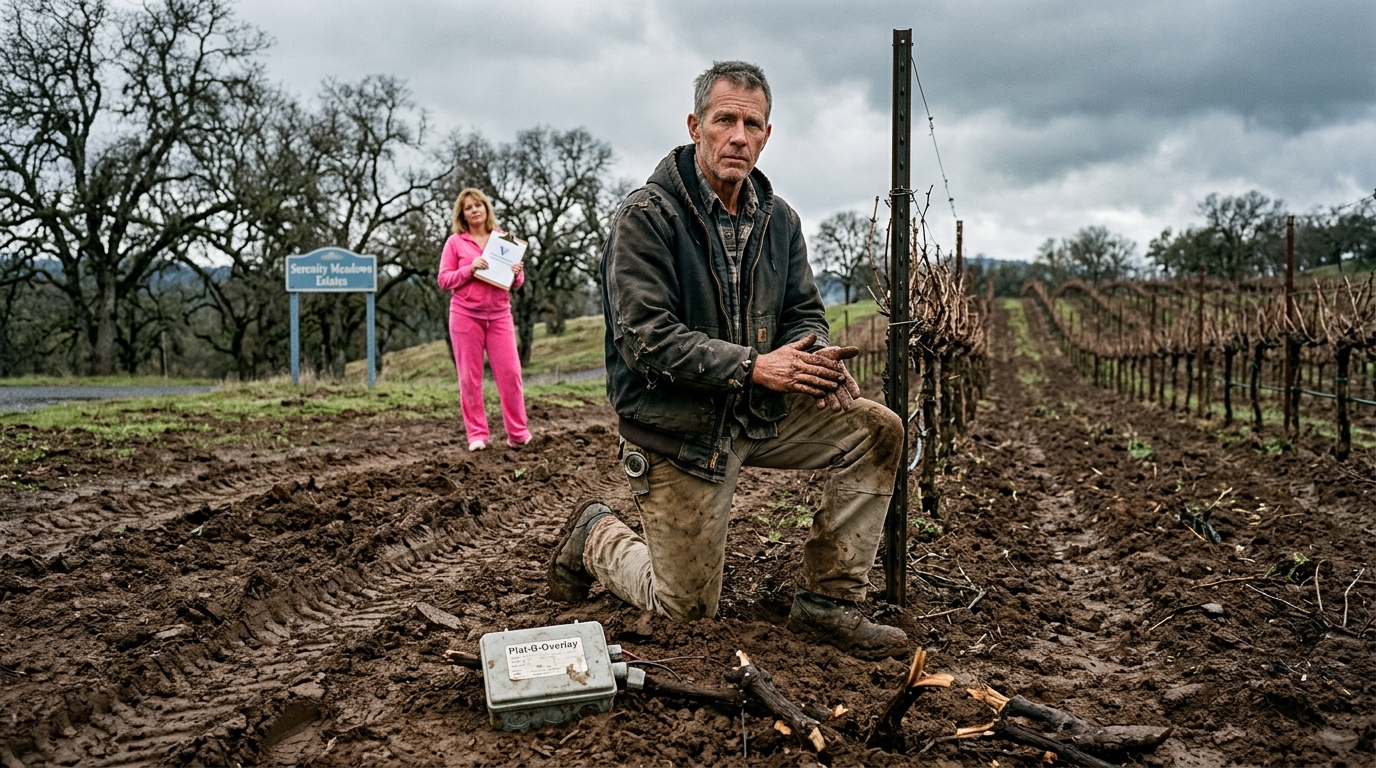
I didn’t speak. I knelt in the damp morning soil of Parcel-73, letting the black mud coat my knuckles as I traced the deep, double-wheeled impression in the dew. Ten inches wide. Turf-tread pattern. Heavy load on the passenger side.
A faint metallic click echoed off the gnarled oak line behind me as my thumb snapped the brass latch of my vintage Army Corps transit compass. I didn’t open the sight glass. I just rolled the cold, scarred metal against my palm, anchoring the rage before it could hit my chest.
“Mr. Thorne! I know you hear me!”
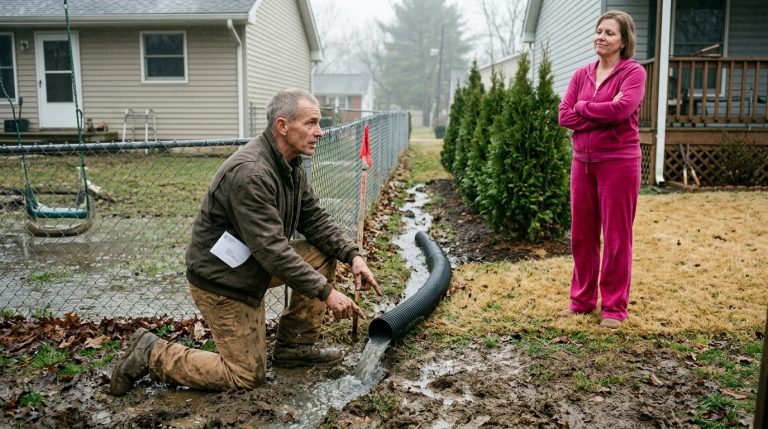
The voice came from thirty yards up the gentle slope, thick with artificial sweetness and sharp with bureaucratic entitlement. Karen Miller stood beside a freshly driven steel angle-iron post. The pink fabric of her tracksuit rustled as she adjusted a plastic clipboard against her hip.
I stood up slowly, wiping my muddy hands down the thighs of my faded canvas work pants. I didn’t rush. Thirty years in uniform teaches you that when an enemy advances past their supply line, you let them settle into the open before you measure the distance.
“Your little grape farm is now officially part of Serenity Meadows, Major,” she called out, holding a crisp sheet of paper between her index and middle fingers like a summons. “That’ll be five thousand dollars for the annexation fee. Plus two hundred a month in dues. Effective immediately.”
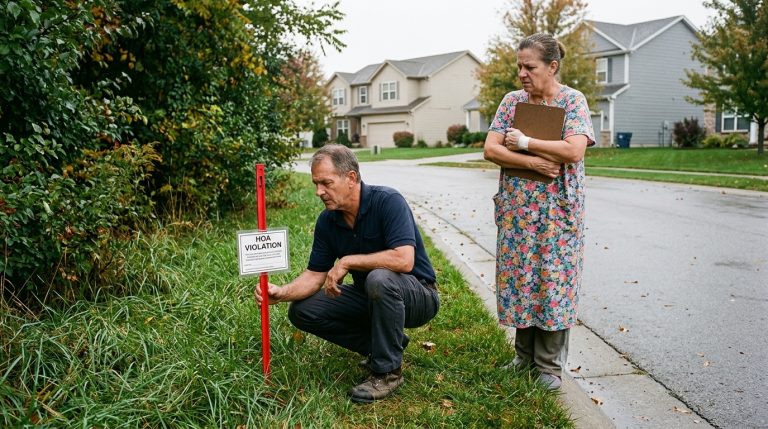
I walked up the row. My work boots sank two inches into the soft earth with every step. The sign she had hammered into my property border was painted sterile blue: Serenity Meadows Estates — A Better Way of Living.
Beside the sign, sitting right over my grandfather’s rusted iron survey pin, was a small, white plastic junction box that hadn’t been there yesterday. A fresh coat of gray sealant dripped down its side, still wet.
“You’re standing on private agricultural land, Mrs. Miller,” I said. My voice was low, flat, stripped of emphasis.
“Not anymore.” She thrust the paper toward my chest. “Revised community charter. Section 4, Paragraph B. Adjacent undeveloped parcels are subject to automatic master-plan incorporation upon board resolution.”
I took the paper. I didn’t read the text; I read the seal at the bottom. It wasn’t a county clerk’s stamp. It was an ink-jet print of a logo that said The Vanguard Escrow Services.
My thumb flicked the brass dial of the transit compass inside my pocket. Click. Click.
“You brought a golf cart past a clearly marked agricultural boundary,” I said, eyeing the fresh grease leaking from the cart’s front axle onto my cover crop. “You destroyed forty dollars worth of rootstock.”
“Consider it a down payment on your compliance,” she sneered, her chin tilting up. “You have thirty days before we file the lien.”
I didn’t answer. I reached down, wrapped my right hand around the cold steel post of her sign, and pulled upward using my legs. The wet earth gave way with a wet, sucking sound.
Karen gasped, taking a sharp step backward into the crushed grass. “What do you think you’re doing? That’s HOA property!”
I carried the sign to her cart, laid it flat across the passenger seat, and rested my hand on the steering wheel, leaning in until she had to tilt her head back to meet my eyes.
“Take your garbage off my hill,” I said softly. “If this cart crosses the oak line again without my written consent, I won’t hand the sign back.”
She open-mouthed for a second, a flicker of genuine alarm piercing through her smug composure as she looked at my face, then at the thick mud caked over my knuckles. Without another word, she stomped her sneaker onto the accelerator. The electric motor whined violently as the cart lurched backward, spinning its tires through my grass before speeding off toward the beige roofs of the subdivision.
I watched her go until the pink tracksuit vanished beyond the tree line.
Then I walked back to the freshly pulled hole. I knelt, shoved my hand into the dark mud, and pulled out the small white junction box she’d left behind near the survey pin. It wasn’t connected to any wires. It was just an empty plastic shell marked with a red felt-tip label: Plat-B-Overlay.
My thumb closed hard on the compass.
The war had started. And she had no idea what kind of foundation she was trying to dig into.
CHAPTER 2: RECONNAISSANCE IN THE DIRT
The plastic casing of the junction box felt too light in my hand. It was cheap, high-impact PVC, the kind you buy in bulk at a hardware chain for six dollars a unit. No wire leads inside. No ground spike. Just an empty shell glued to a half-inch strip of aluminum and stamped with red ink: Plat-B-Overlay.
I scraped a chunk of wet earth off its back with my thumbnail. The plastic underneath was clean, free of UV yellowing. It hadn’t been buried; it had been dropped there less than an hour ago to give the illusion of an established boundary marker.
My thumb flicked the brass rim of the transit compass in my pocket. Click.
My father had fought the county over an easement on the southern boundary back in ’84. Three years of letters, three years of tax receipts proving he’d maintained the culvert, all because a surveyor’s assistant misread a benchmark by four yards. He hadn’t raised his voice once. He just kept filing receipts until the county engineer gave up and signed the variance. “The dirt doesn’t lie, Jack,” he’d told me while we cleared brush out of the ditch. “People write on paper. Dirt stays where it fell.”
I shoved the plastic box into my canvas jacket pocket and turned toward the farmhouse.
The boots felt heavy, laden with three pounds of wet clay that peeled away in thick slices as I crossed the gravel driveway. Sarah was on the porch, holding a tin mug of coffee. She didn’t ask what the noise was. She looked at the red smear on my pants, then down at my hands.
“She put up a sign,” I said, stopping at the bottom step.
“I saw the pink cart from the kitchen,” Sarah said. Her voice was flat, settled into that steady cadence she took on whenever a storm blew in off the ridge. “She left a paper?”
I pulled the single sheet out of my pocket, smoothed the creases against my knee, and handed it up to her.
She read it once, her eyes scanning the boilerplate text at the top, then paused at the bottom margin. Her thumb brushed the printed emblem. “The Vanguard Escrow. That’s not a county seal.”
“It’s a private title holder,” I said, wiping my boots against the iron scraper bolted to the bottom step. “She’s not trying to annex us through the Board of Supervisors. She’s trying to establish a paper cloud. Build a record that looks real enough to scare a lender or force a compromise.”
“Can she file it?”
“She can hand it to anyone stupid enough to take it,” I said. “I’m going into the clerk’s office.”
I didn’t change my shirt. I washed the mud off my hands at the outdoor spigot, the water running cold and brown over the scarred skin of my knuckles, then dried them on a grease rag from the tractor shed.
The drive into town took twenty minutes down Route 6, past the neat, repetitive rows of Serenity Meadows. From the road, the subdivision looked like a scale model built from beige stucco and dyed green turf. Every house had the same dark gray asphalt shingles, the same brass lantern by the garage, the same young maple tree staked in the center of a two-hundred-square-foot front lawn.
I turned off at the brick courthouse in the center of the county seat. The building had stood since 1904, its red brick darkened by a century of coal smoke and rain.
Marge sat behind the high oak counter in the land records room, an old desk fan humming at her elbow, pushing warm air across stacks of manila folders. She looked up over the rims of her reading glasses as my boots creaked on the floorboards.
“Major,” she said, her voice like smooth river stones. “You look like you’ve been pulling posts.”
“Morning, Marge,” I said, laying my hands flat on the scarred oak ledge. “I need the official plat map for Parcel-73. The 1922 survey and the last tax boundary update.”
She didn’t ask why. She stood up, her knee joint giving a faint pop, and walked into the narrow aisle between the floor-to-ceiling metal shelving units. I heard the heavy clatter of a binder being pulled from a steel rack.
When she came back, she laid a heavy leather-bound volume on the counter and flipped the thick, yellowed pages with a practiced flick of her wrist.
“Parcel-73,” she said, tapping her finger against a hand-drawn map with black ink borders. “One hundred acres, more or less. Bounded on the north by the old Henderson line, east by the county road, west by the ridge line. Last recorded transfer was ninety-eight, when your father passed.”
I leaned over the counter. The paper was heavy, cotton-rag stock, smelling of cedar and old dust. The lines were sharp, ruled with India ink that hadn’t faded in a hundred years.
“Has anything been attached to this record in the last sixty days?” I asked. “Any easement petitions, variance requests, or boundary modifications from the Serenity Meadows PUD?”
Marge pulled her glasses down to the tip of her nose and peered at the ledger margin. Her finger traced the handwritten entry column.
“Nothing,” she said. “The PUD boundary is fixed under Charter 88-B. It stops thirty feet west of the county drainage ditch. Your property isn’t even in the same tax district.”
“Check the private registry overlay,” I said softly. “Search under The Vanguard Escrow.”
Marge paused, her hand hovering over the page. She looked up at me, her eyes narrowing slightly. “Vanguard? They’re a commercial clearing house out of Richmond. They don’t file deeds here. They handle private mortgage assignments.”
She walked over to her computer terminal, her fingers tapping out a quick sequence on the mechanical keyboard. The monitor cast a dull green glow across her face as she scrolled through the screen.
“Well,” she said, her voice dropping an octave. “That’s odd.”
“What is?”
“There’s a memorandum of agreement flagged under your parcel number,” she said, staring at the screen. “Filed three days ago. It doesn’t claim ownership. It claims an encumbrance based on a revised master site plan submitted by Serenity Meadows Homeowners Association.”
I reached into my pocket and set the empty plastic junction box on the oak counter right next to her keyboard. The red text—Plat-B-Overlay—faced her.
Marge looked at the box, then at me.
“Who signed the memorandum?” I asked.
“Karen Miller,” Marge read off the screen. “As President of the Board. And it’s notarized by a firm called Vanguard Legal.”
I didn’t answer right away. I took the transit compass out of my pocket, set it on the counter, and clicked the latch open. The mirror inside reflected the high, arched window behind me and the gray clouds gathering over the square.
“They haven’t changed the dirt, Marge,” I said, my thumb resting on the cold brass casing. “They’re trying to build a paper fence around the dirt.”
“Jack,” Marge said softly, leaning closer. “If they file a notice of default based on that encumbrance, it goes straight to the credit reporting agencies. You won’t be able to buy seed, you won’t be able to sell wine, and you won’t be able to borrow a dime against the land until it’s cleared.”
“How long does a clearing petition take?”
“Eighteen months,” she said. “If the court moves fast.”
I picked up the compass, snapped the cover shut with a sharp, metallic clack, and dropped it back into my pocket alongside the empty plastic box.
“Eighteen months is too long,” I said. “I have six thousand vines that need spray before the humidity hits next week.”
I turned toward the door, my boots striking the old oak floorboards with a steady, unhurried rhythm.
“Jack,” Marge called after me.
I stopped at the threshold, my hand on the heavy brass door handle.
“Karen Miller didn’t write that legal memorandum,” she said, her eyes fixed on the green terminal screen. “The language is corporate clearinghouse. Standard asset-lock format. Somebody gave her the template.”
“I know,” I said. “She’s just the one holding the shovel.”
I pulled the door open and stepped out onto the courthouse steps. The air smelled of wet asphalt and rain. Down the street, parked in front of the local bank, was a white pickup truck with a magnetic door sign that read Vanguard Property Services.
I stood on the top step, my hands deep in my canvas pockets, watching a man in a gray polo shirt step out of the truck with a thick binder under his arm.
The paper war was moving faster than her golf cart.
CHAPTER 3: THE ESCALATION TRAP
The first drop of rain hit the back of my hand, cold and fat. It dissolved a smear of red clay left near my thumbnail, turning it into a thin streak that ran down to my wrist like dilute rust.
Across the asphalt of the courthouse square, the driver in the gray polo shirt paused with his boots on the running board of the white pickup. The door stayed half-open, the magnetic sign—Vanguard Property Services—glinting under the overcast sky. He didn’t climb in. He looked up at the courthouse steps, his hand resting flat against the thick vinyl binder tucked under his arm.
Our eyes held for three seconds through the gray drizzle.
He didn’t nod. He didn’t look away either. He backed off the step, slid into the driver’s seat, and pulled the truck door shut with a heavy, double-latch thud. The engine turned over—a smooth, quiet diesel hum—and the truck pulled away from the curb, its tires whistling over the damp pavement toward the Route 6 intersection.
My thumb clicked the brass compass ring twice inside my coat. Click. Click.
“Jack!”
Frank stood by his station wagon at the base of the stairs, an oiled canvas hat pulled low over his forehead. Water was already trickling off the brim, landing on his coat collar. He carried a manila envelope stuffed so full the brass clasp was bent open.
“I saw her golf cart parked by the clubhouse on my way in,” Frank said, his boots grinding against the wet gravel as he met me at the bottom step. “She’s got a notary sitting in the lobby. They’re handing out printouts to anyone coming in for the mail.”
I took the envelope he held out. The rain hit the paper immediately, raising dark, translucent spots across the face of the folder. Inside was a stack of certified notices, each bearing the same registered header: Notice of Pending Encumbrance and Fine Schedule — Parcel-73.
I pulled the top sheet out just far enough to read the bold line below my name.
Total Outstanding Liability: $10,400.00.
Itemized Breakdown: Unapproved Barn Color ($500), Non-Conforming Perimeter Fencing ($500), Unauthorized Commercial Operation ($1,000), Unsafe Machinery Storage ($1,000), Lawn Standard Deficit ($2,000), Annexation Assessment ($5,000), Back Dues ($400).
“She’s demanding ten grand?” Frank spat onto the wet asphalt. “She’s lost her mind, Jack. That’s more than the entire annual maintenance budget for our whole street.”
“She doesn’t want ten grand,” I said, sliding the sheet back into the damp envelope to keep the ink from running. “If I pay ten grand, she gets cash and an admission of jurisdiction. If I don’t pay, the paper says she has a liquidated debt secured by a property lien.”
“She can’t file a lien without a court judgment,” Frank insisted, his jaw tight. “I checked the HOA covenants when I bought my place six years ago. Section 12 says lines require a ninety-day board review and a certified civil filing.”
“She isn’t using Section 12,” I told him, looking down Route 6 where the white Vanguard truck’s taillights vanished into the gray rain. “She’s using the private memorandum Marge found upstairs. She’s bypassing the county clerk entirely by filing directly with a commercial credit registry.”
Frank’s hand went to his hat brim, his fingers twitching against the wet canvas. “What does that do?”
“It freezes the farm,” I said. “I can’t draw on my equipment line of credit. I can’t buy fuel in bulk on thirty-day terms. If the bank sees an active title encumbrance over five thousand dollars, they auto-suspend the agricultural operating account until it’s cleared.”
I turned toward my truck parked across the square. The rain was coming down harder now, hammering against the hood of the old F-250 in a steady, drumming rhythm.
“Where are you going?” Frank asked, stepping alongside me.
“Home,” I said. “To draft the response.”
“You need a lawyer, Jack. A real one, from the city.”
“A city lawyer takes two weeks to file an entry of appearance,” I said, opening my truck door. The smell of old leather and damp floor mats hit me. “I have seven days before Vanguard reports the lien status to my bank. I don’t need a court appearance. I need a paper trail that makes holding that file toxic.”
I sat in the cab, set the thick envelope on the passenger seat next to the empty plastic junction box, and pulled the door shut.
The rain streamed down the windshield, distorting the red brick face of the courthouse into wavy, bleeding streaks. I reached into my pocket, pulled out my notebook, and wrote down the license plate of the white Vanguard truck from memory.
Beneath it, I wrote three lines:
County Plat 1922 — Clean.
HOA Memorandum — Fraudulent Instrument (Class 6 Felony).
Vanguard Escrow — Primary Beneficiary.
My phone vibrated against the console. The screen showed an unregistered local number.
I tapped the speaker button and set the phone on the dash without bringing it to my ear. “Thorne.”
“Mr. Thorne,” a man’s voice came through the speaker, crisp, flat, and lacking any local inflection. The background was completely silent—no wind, no rain, no office hum. “This is Arthur Vance with Vanguard Legal Services. I’m calling as a courtesy regarding the outstanding assessment on Parcel-73.”
“You’re calling on an open cellular line regarding an unverified civil claim,” I said, my voice dropping into the quiet cadence I used when running perimeter checks. “You’re speaking to the property owner. State your physical business address.”
A brief pause on the line. Half a second. Long enough for a man reading a script to find his place.
“We have received the certified documentation from the Serenity Meadows Board of Directors,” Vance said, ignoring the question. “Our client has requested an expedited title review. Under Commonwealth code, an unaddressed encumbrance exceeding ten thousand dollars triggers an automatic notice to primary mortgage holders within ten business days.”
“Your client submitted a forged map,” I said. “The original plat is recorded in Book 14, Page 202 of the county land records. My property is unincorporated.”
“Our filing is based on the revised site plan provided by the board,” Vance replied smoothly. “If you believe there is a boundary discrepancy, the proper recourse is to submit a deposit of three thousand dollars to Vanguard Escrow to cover the costs of an independent re-survey.”
I looked at the plastic junction box sitting on my seat. The red ink label—Plat-B-Overlay—was smudged where my muddy thumb had scraped it earlier.
“I don’t pay deposits to private clearinghouses,” I said. “And if your field agent sets foot on my land again to drop plastic markers, I’ll take the truck.”
“Mr. Thorne—”
I cut the call.
I didn’t turn the key in the ignition right away. I sat in the cab, listening to the rain beat against the steel roof, watching the water pool in the gutters along the courthouse square.
They weren’t trying to win a lawsuit. They were trying to force a three-thousand-dollar survey fee and a ten-thousand-dollar escrow deposit to buy time while they locked the title. If I paid, I recognized their standing. If I didn’t pay, they froze my credit line before the grapes even set on the vine.
I reached out, picked up the thick envelope Frank had given me, and turned it over. On the back flap, stamped in tiny blue ink, was a return address: Vanguard Escrow Services, Suite 400, Richmond, VA.
Beneath it was a file code: VES-73-B-L2.
My thumb pressed against the cold brass ring of the compass inside my coat. The trap was set, and Karen Miller was just the bait hanging from the hook.
I turned the key. The diesel engine roared to life, shaking the cab, and I backed out into the rain.
CHAPTER 4: ASYMMETRIC WARFARE
The vibration of the idle diesel engine hummed through my boot soles as I stared at the file code stamped on the damp paper. VES-73-B-L2.
I didn’t head straight back to the farmhouse. I swung the truck around the courthouse square, the tires splashing through standing water, and pulled into the gravel lot behind the VFW hall. The building was an old cinder-block structure with peeling green paint and an American flag snapping in the mountain wind above the porch.
George Bailey was sitting at a corner table inside, a chipped ceramic mug of dark coffee in his left hand and a legal pad covered in neat, penciled script under his right. His grey wool jacket smelled faintly of old pipe tobacco and damp dog.
“You look like a man who just had a boundary stake pulled out from under him, Jack,” George said, not looking up from his notes as my boots squeaked across the linoleum.
I sat down in the steel folding chair opposite him and laid the envelope flat on the Formica tabletop. Beside it, I set the plastic junction box and the page of notes I’d taken from Marge’s terminal.
“Vanguard Escrow filed a private encumbrance memorandum three days ago,” I said. “They used a site map Karen Miller signed under an HOA board resolution.”
George set his mug down with a soft, ceramic click. His thumb, thick and scarred across the knuckle from forty years of turning legal pages and hauling fishing lines, traced the edge of the blue file code on the envelope.
“The Vanguard Escrow,” he murmured. “They aren’t local.”
“Richmond,” I said. “Suite 400. The legal counsel who called my cell called himself Vance.”
George pulled his glasses down his nose and leaned in close to the paper. His eyes moved back and forth across the file code, then down to the handwritten entry I’d made from Marge’s ledger.
“This isn’t an HOA fight, Jack,” George said quietly. His voice lost its easy, country-lawyer drawl, hardening into the flat tone of an old Marine officer reading an overlay. “Karen Miller doesn’t know what a private clearinghouse encumbrance is. She couldn’t spell ‘equitable lien’ if you gave her three guesses.”
“She thinks she’s expanding her subdivision,” I said. “She thinks she’s taking forty acres of my slope for a community green space.”
“She thinks what they told her to think,” George replied. He flipped two pages back on his legal pad, revealing a list of six names written in red ink. “Mrs. Gable over on Cedar Lane. The young Navy couple down on Miller’s Creek. Frank’s brother-in-law. Every one of them got hit with a selective fine schedule right before Vanguard Escrow bought out their third-party mortgage notes.”
I looked at the list. “They’re forcing defaults.”
“They’re manufacturing paper clouds,” George corrected, tapping his pencil against the table. “They find an unincorporated parcel next to a high-density PUD. They get a useful idiot on the HOA board to sign a ‘master site revision’—Plat-B-Overlay. Then Vanguard files an encumbrance under an escrow hold. It doesn’t show up in a standard title search until the owner tries to draw on a credit line or transfer the deed.”
My thumb hit the brass latch of the compass inside my coat pocket. Click.
The mid-point of the board was exposed. The annexation wasn’t a local vanity project. Karen hadn’t just overstepped her authority; she’d been handed a pre-packaged forgery template designed to trigger a bank lock on Parcel-73. The decoy secret—that Karen was trying to steal land for her neighborhood pride—was completely hollow. She was just the straw buyer laying paper footprints for a corporate clearinghouse that wanted the entire seventy-acre southern ridge.
“If I file a quiet-title suit,” I said, “how long does Vanguard have to answer?”
“Thirty days,” George said. “And in those thirty days, your bank sees an active, unbonded cloud over ten thousand dollars. They freeze your operating account. You can’t pay the crew to spray the lower ten rows. The crop rots on the cane.”
“So we don’t file a quiet-title suit,” I said.
George looked up over his glasses, a slow, predatory grin spreading across his weathered face. “Now you’re thinking like a demolition engineer. What do you have in mind?”
“Slander of title is a civil tort,” I said, laying my hands flat on the table. “Filing a false instrument with a court or public registry is a Class 6 felony in Virginia. Section 18.2-168.”
George stopped tapping his pencil. “She filed the memorandum with the county clerk as an official annex record.”
“Under oath,” I added. “And Vance used that filing to issue a formal demand for escrow funds over an interstate wire.”
George pulled a fresh yellow pad out of his leather briefcase. He didn’t write slow now; his pencil moved in rapid, aggressive strokes across the lined paper.
“We build two files,” George said, his eyes bright behind his lenses. “File One goes to the Commonwealth’s Attorney for fraud and filing a forged public document. File Two goes to the State Bar Committee on Legal Ethics for Vance and his firm. We don’t ask for a hearing. We deliver the evidence packet directly to the Sheriff with a request for a civil standby at their next open meeting.”
“When is the meeting?” I asked.
“Tomorrow night,” George said. “Seven o’clock at the Serenity Meadows clubhouse. She put out a flyer calling it a ‘Community Expansion Celebration’.”
I stood up from the table. The floorboards creaked under my boots. I picked up the plastic junction box and shoved it into my coat pocket next to the compass.
“I’ll bring the maps,” I said.
“Bring the original 1922 plat, Jack,” George said, not looking up from his writing. “The cotton-rag one with the India ink. People like Karen Miller think paper is just something you print off a computer. It’s time we showed her what real paper looks like.”
I walked out to the truck. The rain had slowed to a fine, cold mist that hung in the valleys between the dark ridges of the Blue Ridge. I started the engine, set my hands on the wheel, and looked down at my phone resting on the dash.
There were two missed calls from my bank manager.
The freeze was already moving. But for the first time since Karen Miller drove her golf cart onto my dirt, I wasn’t defending a border. I was plotting the breach.
CHAPTER 5: THE PUBLIC INSURRECTION
The two missed calls from my bank manager sat on the truck’s screen like an unanswered marker. I didn’t return them.
The tires of the F-250 crunched over the crushed limestone driveway of the Serenity Meadows clubhouse at six-fifty-two. Rain still dripped from the eaves of the beige stucco building, pooling under a temporary banner strung between two aluminum light poles: Serenity Meadows Estates — Special Annexation & Expansion Hearing.
I killed the ignition. The diesel engine shuddered once and went silent, leaving only the steady tick of cooling exhaust steel.
Beside me, George Bailey lifted a flat black leather portfolio onto his knees. Inside lay two documents: the 1922 county cotton-rag plat map with its unfaded India-ink boundary, and the formal criminal referral drafted under Virginia Code Section 18.2-168 for filing a forged instrument.
“She’s got thirty people inside,” George said softly, adjusting the brass bridge of his glasses. “I saw Frank’s wagon near the utility shed. He brought Mrs. Gable.”
“The deputy is in the rear lot?” I asked.
“Sheriff’s cruiser is parked by the dumpster,” George confirmed. “Civil standby requested by counsel of record. He won’t move until I signal.”
I opened the truck door. The damp mountain air hit my face, cold and smelling of wet cedar and asphalt. I reached into my canvas jacket pocket, my thumb brushing the brass ring of the transit compass one last time before wrapping around the hollow plastic junction box marked Plat-B-Overlay.
We walked up the concrete steps together. My work boots left faint smears of dried red clay across the spotless welcome mat.
Inside, the clubhouse smelled of floor wax, cheap sheet cake, and stale coffee. Folding chairs were set up in six neat rows facing a raised oak podium. At the front, sitting behind a long folding table skirted in blue plastic, sat Karen Miller.
She wore a bright pink blazer, its brass buttons catching the overhead fluorescent glow. To her left sat Arthur Vance—the man from the white pickup—his hands folded neatly over a slim leather binder. On her right sat two terrified HOA board members, both staring down at their thumbs.
“…and this expansion secures our perimeter for the next twenty years,” Karen’s voice boomed through a small portable PA speaker. She was holding a laser pointer, aiming a red dot at a projected map on the wall. “By incorporating Parcel-73 into our master site plan under the revised escrow charter, we ensure that agricultural nuisance operations—”
“You’re pointing your red dot at private property, Mrs. Miller.”
My voice wasn’t raised. It didn’t need to be. The room went dead silent. Thirty heads turned at once—neighbors from the subdivision, Frank sitting in the second row, Mrs. Gable holding a worn leather purse in her lap.
Karen’s laser hand twitched. The red dot jittered off the wall and hit the floorboards.
“Mr. Thorne,” she said, her voice instantly dropping into that practiced, patronizing register. “This is an executive board session for Serenity Meadows residents. Non-members are not permitted to address the floor.”
“I’m not addressing the floor,” I said, walking down the center aisle. My boots struck the linoleum with a steady, unhurried cadence. “I’m addressing the notary sitting next to you.”
Arthur Vance didn’t flinch. He leaned back in his chair, unbuttoned his suit jacket, and rested his forearm on his leather binder. “Mr. Thorne, if you have a dispute regarding the clearinghouse hold, Vanguard Escrow provided you with the proper administrative appeals channel.”
“Vanguard Escrow isn’t a clearinghouse,” George Bailey’s voice boomed from three steps behind me. He unzipped his portfolio with a sharp, raspy slide of brass teeth. “Vanguard Escrow is a unregistered shell entity operating out of a mailing address on Broad Street in Richmond.”
A murmur rippled through the row of folding chairs. Frank stood up, his canvas coat rustling. “What’s he talking about, Karen?”
“Sit down, Frank!” Karen snapped, her face flushing a blotchy, furious red. “This man is under a lawful lien assessment for ten thousand dollars in unpaid municipal compliance dues! The board voted—”
“The board didn’t vote on anything,” I said.
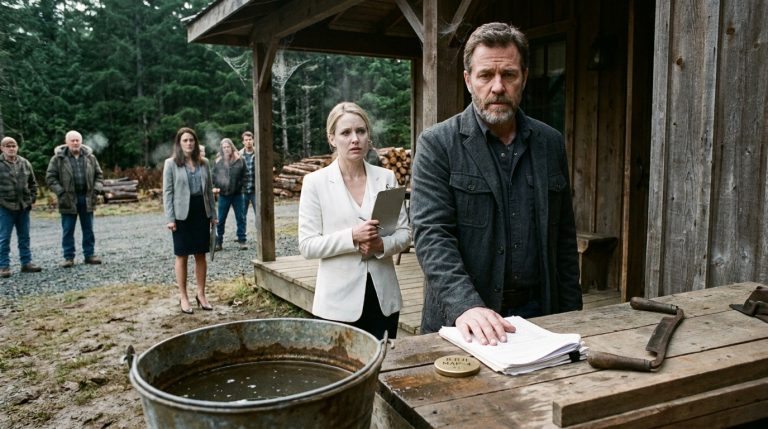
I reached the front table, pulled the empty plastic junction box out of my coat, and set it down with a heavy thud directly in front of Karen’s clipboard. The red marker text—Plat-B-Overlay—faced the front row.
“You dropped this next to my survey pin yesterday morning,” I said. “It isn’t connected to a line. It isn’t recorded with the county engineer. You buried empty PVC pipe to fake an encumbrance marker for a bank survey.”
Vance’s eyes narrowed slightly. He didn’t look at Karen. He looked at the folder in George’s hands. “A master site revision submitted by an authorized board holds prima facie validity under Section 4—”
“Section 4 doesn’t apply to a 1922 agricultural land grant,” George interrupted, stepping up to the table. He laid the heavy, yellowed cotton-rag map flat across Karen’s printed agenda papers. “This is the original plat recorded in Book 14, Page 202. It bears the seal of the Commonwealth of Virginia. There is no PUD overlay. There is no Vanguard easement.”
George turned a page in his portfolio and laid down a second sheet—a white copy stamped with a red intake number from the Commonwealth’s Attorney.
“And this,” George said, his voice ringing through the room, “is an official criminal referral for Slander of Title and the filing of a forged public document under Virginia Code Section 18.2-168. It names Karen Miller as the signator, and Vanguard Legal as the co-conspirator.”
Karen stood up so fast her metal chair scraped violently against the floorboards. “This is absurd! I signed what the legal team gave me! We are protecting community equity!”
“You signed a fraudulent encumbrance to trigger a debt default on sixty acres of prime slope,” Frank called out from the second row, stepping into the aisle. “You did it to Mrs. Gable last spring! You told her her reverse mortgage was invalid because of her garden fence!”
Mrs. Gable stood up next, her hands trembling as she pulled a yellowed receipt from her purse. “Ten thousand dollars,” she whispered, her voice carrying across the quiet room. “You made me write a check to Vanguard Escrow to keep my house from going to auction.”
Vance stood up smoothly, closing his leather binder. He didn’t look at Karen, and he didn’t look at Mrs. Gable. His face remained entirely smooth, devoid of anger or surprise. He was a man cutting his losses on a bad line of credit.
“This meeting is adjourned,” Vance said quietly, reaching for his briefcase.
“It isn’t adjourned,” I said, leaning over the table until my face was six inches from his. “The deputy in the hallway has a copy of the intake receipt. Nobody leaves until the Sheriff takes the log.”
Behind us, the double doors of the clubhouse swung open. The deputy stepped through the threshold, his leather duty belt creaking in the silence, his eyes fixed squarely on the front table.
Karen looked from the deputy to Vance, then down at the cotton-rag map spread across her plastic tablecloth. The color drained from her face, leaving her blotchy and small under her pink blazer.
The paper fortress hadn’t just cracked. The foundation had collapsed under its own weight.
CHAPTER 6: RUSTED PEACE
Arthur Vance didn’t pull his hand away from his leather briefcase, but his fingers went motionless.
The deputy’s heavy duty boots creaked twice on the freshly waxed floorboards, coming to a halt directly behind Vance’s shoulder. “Mr. Vance, ma’am,” the deputy said, his voice flat and unhurried. “We’re going to need everyone sitting behind that table to step out into the hallway. The Commonwealth’s Attorney wants a statement on the filing log before anyone drives out of the lot.”
Karen Miller’s mouth opened, but no sound came out. The bright pink fabric of her blazer seemed to deflate as she sank back into her folding chair, her hands trembling so hard her knuckles clicked against the metal armrests.
The room didn’t erupt into cheers. Thirty neighbors just watched in heavy, cold silence as Vance slowly closed his briefcase, stood up without a word, and walked toward the double doors under the deputy’s shadow. Behind them, George Bailey calmly gathered the yellowed 1922 cotton-rag plat map from the tablecloth, rolling it with precise, deliberate care before securing it inside his portfolio.
The paper fortress was gone. The fake encumbrances under Plat-B-Overlay, the predatory default notices issued by The Vanguard Escrow, the fictitious annexation charter—all of it dissolved the moment official state authority met the physical truth of the original land grant.
It took three weeks for the formal clearing notices to arrive in the mail. Three weeks of quiet work while the Commonwealth’s Attorney unraveled the paper trail that Vance and his corporate clearinghouse had spun through Karen’s committee.
The bank’s hold on my operating account was released on a Tuesday morning. The letter from the credit bureau was brief, formal, and signed by an assistant registrar: Record updated. Encumbrance under file code VES-73-B-L2 removed from Parcel-73. Title clear.
I didn’t celebrate with champagne or speeches.
Four months later, as the first autumn frost settled over the Blue Ridge, the lower ten rows of Cabernet Sauvignon stood thick and dark against the slope. The leaves had turned a deep, fiery amber, rustling softly in the cool mountain wind that rolled down off the ridge.
I stood on the porch of the farmhouse, holding a cup of black coffee in my left hand. In my right, my thumb rested on the cold brass latch of my Army Corps transit compass. Click. Click.
Beside the porch steps lay the blue steel sign Karen had hammered into my soil on that first damp morning. The blue paint was already flaking near the mounting holes, showing patches of dull, gray zinc underneath.
Frank walked up the gravel driveway, his hands shoved deep into his canvas coat pockets. He stopped at the bottom step, looking at the sign lying in the weeds.
“The board approved the final charter revisions last night,” Frank said, leaning his boot against the bottom riser. “No more selective fines. No more private escrow agreements. Mrs. Gable got her ten thousand dollars back from the court-ordered settlement fund yesterday afternoon.”
“She keeping her garden gnomes?” I asked, taking a sip of coffee.
Frank let out a short, rough laugh. “She bought three more. Put them right on her front walkway facing the main entrance.”
He looked out over the rows of vines, where the morning sun was burning the frost off the wooden trellises, turning the damp earth into a dark, rich brown. “What are you going to do with her sign, Jack?”
“Recycle it,” I said.
After Frank left, I carried the sign down to the workshop behind the barn. I didn’t throw it in the scrap bin. I took a heavy iron cross-member from an old disc harrow, bolted the blue steel plate to the top, and draped a worn flannel work shirt over the frame. I topped it with a frayed straw hat I’d used during the summer planting.
I carried the scarecrow up the slope, past the oak tree line, and set it squarely on the boundary line where my grandfather’s iron survey pin rested deep in the clay.
I hammered the post four inches into the earth using the flat side of a sledgehammer until the metal rang solid against the stone below.
The blue letters—Serenity Meadows Estates—were half-hidden beneath the flapping sleeve of the old flannel shirt. It stood there in the quiet field, a silent sentinel watching over forty acres of fledgling vines and a hundred years of undisturbed dirt.
I set the sledgehammer against the fence post, pulled the transit compass from my pocket, and opened the mirror glass.
The reflection showed the clear, unbroken line of the ridge, the dark green canopy of the oaks, and the steady, unmoving needle pointing due north across my land.
I snapped the brass cover shut with a sharp, clean clack.
The dirt was quiet. The boundary was locked. And the hill was mine.