The Hydraulic Blueprint: How an Engineer Turned Suburban Bureaucracy into a Ground-Eroding Trap
CHAPTER 1: THE SATURATED LINE
The yellow slide was four inches underwater.
Mark Evans stood at the edge of the rubberized tile pad, his boots sinking two inches into the fresh mud. A thin skim of oily yellow foam drifted across the surface, moving against the natural half-percent grade he had laid out twenty years ago. Water did not move uphill. Not unless a secondary head of pressure forced it.
He reached into his jacket pocket, his knuckles brushing the hard, knurled edge of a brass soil-sample auger. He rolled the metal cylinder once, twice, listening to the faint click of the thread against the casing.
“That’s an act of God, Mr. Evans.”
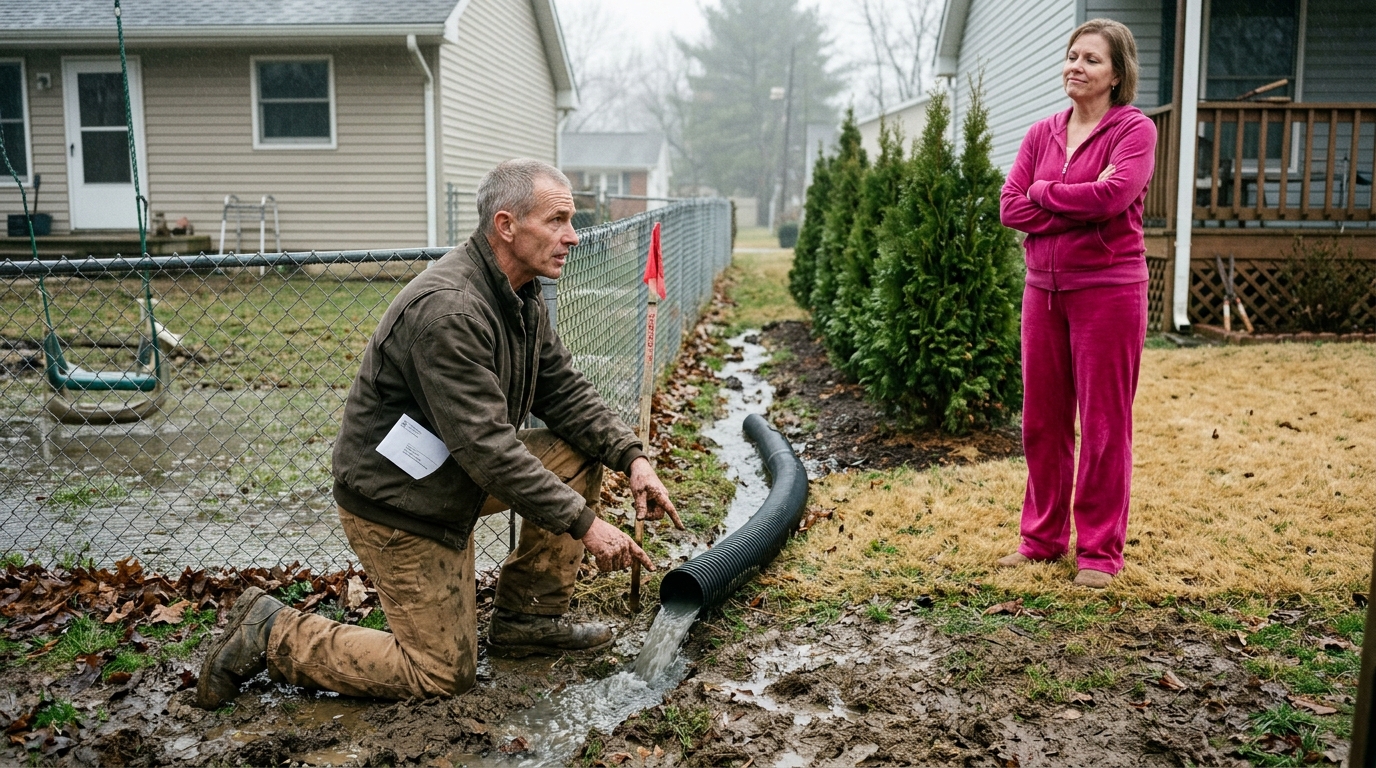
Karen’s voice came from fifteen feet up the rise, sharp enough to cut through the drizzle. She stood on the edge of her dry, pristine bluegrass lawn, arms folded tightly across the chest of a fuchsia velour tracksuit.
“Perhaps you should have built on higher ground,” she added. “The HOA is not responsible for your poor life choices.”
Mark didn’t look up immediately. He knelt on one knee, ignoring the cold soak through his jeans, and pressed his thumb into the soft rubber edge of the walker ramp he had poured three weeks prior. The concrete footer beneath the rubber was soft. The soil beneath the footer was washing away.
Sarah’s therapeutic walker sat five feet back on the back porch, its small aluminum wheels dry, but useless.
“This isn’t rain,” Mark said. His voice was level, stripped of pitch.
“It rained for three hours last night, Mark.”
“Three hours yields 0.8 inches of accumulation in this basin,” he replied, rising slowly. “That produces six hundred gallons of sheet runoff across a four-thousand-square-foot lot. This volume requires two thousand gallons. Minimum.”
Karen’s chin twitched upward. “I don’t care about your math. You built an unapproved park in your yard. The standing water is a maintenance violation. Article 7, Section 5.”
Mark stepped over the submerged border log and walked up the slope toward the property line. He didn’t look at her face. He looked at the row of newly planted Arborvitae shrubs lining her side of the fence—the dirt around their root balls still dark, freshly turned, and unmulched.
“You expanded your rear patio last Tuesday,” Mark said.
“What I do on my property—”
“Four hundred square feet of non-permeable stone,” he interrupted, stopping six inches short of the property line. He pointed down between two of the fresh evergreens.
Half-buried under loose dirt sat a four-inch black corrugated drain pipe. A steady, gurgling stream of grey water surged from its mouth, carving a deep, raw trench directly under his cedar fence pickets and into the soft turf around Sarah’s swing set.
Beside the pipe, half-submerged in the wash, lay a discarded plastic survey flag marked Parcel 9B – Sub-surface.
Mark stared at the flag. That parcel identifier wasn’t part of the residential lot survey.
He reached down, scooped up a thumbful of the slurry coming out of the pipe, and rubbed it between his index finger and thumb. Grit. Silt. Coarse grey limestone dust from a freshly cut foundation wall.
“That pipe is an illegal point-source diversion,” Mark said, his voice dropping into the quiet, flat rhythm he used when calculating structural loads. “You’re dumping your roof and patio head directly onto my footers.”
Karen’s arms tightened. Her thumbs dug into the soft velour of her sleeves, her fingernails pressing white against the fabric while her lips curled into a thin, tight smile.
“Prove it,” she said. “Fill out a form. The Architectural Review Committee meets in three months.”
She turned on her heel, her sneakers squeaking against the damp stone of her walkway as she walked away.
Mark didn’t follow. He stood in the rain, rolling the brass auger bit between his fingers until the metal clicked against his signet ring.
He didn’t need three months. He needed his drafting table, his old field boots, and the 1998 master drainage schematics sitting in his garage.
CHAPTER 2: THE BLUEPRINT AUDIT
The four brass corner weights held down the crisp linen-backed paper of the 1998 survey map, but the paper still wanted to roll.
Mark didn’t fight the paper. He laid his palm flat on the corner over Lot 42, feeling the faint, raised ink lines representing the drainage easements. His thumbs were still rimmed with grey silt from Karen’s runoff. As the mud dried under his nails, it shrank, tightening his skin with a constant, tiny pull.
Beside the blueprint, the glass jar held three inches of the slurry he’d scooped from the mouth of her pipe. The limestone dust was settling, separating into two clear layers: pale clay on top, heavy river grit on the bottom.
He pulled a pair of stainless steel dial calipers from his wooden toolbox and set the jaws against the blueprint’s scale bar. One inch to fifty feet.
“Lot 42,” Mark muttered. His voice was too low to vibrate in his chest, existing only as dry air across his throat. “Designed grade: 1.5% falling north-northwest toward the curb inlet.”
He moved the caliper jaw to the rear lot line—the shared boundary with his own Lot 43. According to his own calculations signed off twenty-eight years ago, Karen’s backyard was engineered as a zero-discharge basin. Any surface water that didn’t sink into the topsoil was meant to hit a underground French drain wrapped in geotextile fabric, percolation-tested for four inches of rain an hour.
He reached for a handheld magnifying loupe, resting its heavy zinc body over the boundary line.
Under the glass, the micro-fine topographic lines told a clear story. But there was a discrepancy. A thin, faint line drawn in red drafting ink—added after the master set was stamped by the county planning board—cut straight across the border. Adjacent to it, faded almost to ghost-grey, were the hand-lettered coordinates for Marshland Parcel 9B.
Mark’s thumb clicked the brass auger against his signet ring.
The red line didn’t follow the natural elevation contours. It ignored them. Someone had manually approved an off-book easement override before the final concrete poured in ’98. It bypassed the primary curb inlet on the street entirely and aimed the subsurface flow straight into the low pocket where he had built Sarah’s playground.
He reached for his field notebook, flipped past twenty years of bridge inspection logs, and opened a fresh grid page.
10:14 AM, he wrote, the graphite lead dragging heavy across the tooth of the paper. Observed discharge: Continuous 4-inch pipe, unapproved PVC, unarmored outlet. Discharge rate approx. 18 GPM under non-storm conditions.
He paused. The quiet of the garage was split by the wet, rhythmic slap of tires on the asphalt outside.
Mark didn’t look up from his table. He knew the sound of the vehicle by its engine note—a low, uneven idle with a loose belt tensioner. The HOA management company’s white Ford Ranger.
The truck idled at the foot of his driveway for ten seconds. A door slammed. Footsteps crunching on the wet gravel along his hedge line followed, heavy and deliberate, stopping right at the property line. Then came the distinct clack-thump of a clipboard hitting a driver-side door, followed by the truck pulling away.
Mark finished his sentence in the notebook: Flow contains suspended solids consistent with recent foundation excavation or sub-grade masonry alteration.
He capped his pen, walked to the garage door, and stepped out into the drizzle.
Tucked firmly between the handle of his front door and the wooden frame was a stark white envelope printed with the high-gloss crest of the Oak Creek Meadows Homeowners Association.
He didn’t open it instantly. He picked it up by the dry corner, feeling the heavy 24-pound bond paper.
Inside was a single page printed in dark black ink, signed not by a person, but stamped with the cold red ink of the Board of Directors.
NOTICE OF OUTSTANDING VIOLATION & MANDATORY REMEDIATION
LOT 43 (EVANS, M.)
Violation 1: Article 9, Section 1 — Installation of unapproved permanent play structure within primary lot drainage setback.
Violation 2: Article 7, Section 5 — Failure to maintain proper lot grading resulting in stagnant water accumulation and public health hazard.
REMEDY REQUIRED: Disassemble and remove non-compliant structure within fourteen (14) days. Restore turf to approved uniform grade.
PENALTY: $100.00 per diem accruing immediately upon expiration of cure period.
Mark stood on the wet porch. The paper didn’t shake in his hand.
He turned the page over. On the blank back side, written in faint blue ballpoint pen—the ink pressed so hard into the wood-pulp paper that it raised white ridges on the front—were four words:
Build on higher ground.
Mark walked back into the garage. He didn’t toss the paper in the trash. He laid it flat on his drafting table, directly over Lot 42 on the master blueprint. He smoothed the paper down with the flat of his palm until the notice covered the faded red easement line.
He reached for his desk phone, picked up the receiver, and dialed a ten-digit local number from memory.
The line rang twice before a sharp, gravelly voice answered. “Riley & Associates.”
“Dave,” Mark said, his eyes tracking the red line under the white paper. “I have a paper trail to build. Bring a recorder and your property code references.”
“Mark?” Dave Riley’s voice dropped its receptionist-facing edge, replacing it with the dry, rapid rhythm of a veteran military prosecutor. “How bad is the site?”
“She used the HOA letterhead to cover a point-source discharge,” Mark said softly, his fingers tightening on the receiver until his knuckles turned the color of dry bone. “And she gave me fourteen days to prove who built the ground she’s standing on.”
CHAPTER 3: THE RETALIATORY COUNTER
The dial tone vibrated through the receiver before Mark set it back on the wall cradle. His thumb remained on the plastic hook for two seconds, feeling the faint mechanical click of the spring inside.
Fourteen days.
He didn’t waste ten minutes staring at the notice. He folded the white paper once, creasing it against the edge of his steel drafting rule until the fold was sharp enough to slice skin, and tucked it into his jacket pocket alongside his field notebook.
He walked out into the driveway, the rain settling into a fine, needle-like mist that clung to the wool of his collar. Instead of turning toward his front porch, he turned left, his boots grinding into the gravel along the boundary line.
Three doors down, Arthur Henderson was leaning over his porch railing, a pair of rusted hedge shears in one hand and an unlit pipe in the other. Arthur’s house sat fifty feet higher than the rest of the street, built on the crest of the natural rise that sloped down toward Lot 43.
“Mark,” Arthur called out, his voice gravelly, dry as seasoned oak. “You look like a man measuring a trench.”
Mark stopped at the foot of Arthur’s porch steps, his hands resting deep in his coat pockets. “The board sent a notice.”
Arthur didn’t look surprised. He set the shears on the railing with a dull metal clatter and gestured toward the screen door. “Come inside out of the damp. I’ve got cold coffee and twenty years of corporate memory.”
The living room smelled of cedar shavings and old paper. Arthur dropped into a cracked leather armchair, gesturing toward a side table stacked with yellowed manila folders.
“She tried it on the Garcias two months ago,” Arthur said, striking a wooden match against the side of his shoe. “Portable basketball hoop. David Garcia works twelve-hour shifts at the diesel shop. Kid plays hoop for twenty minutes before sunset. Karen cited them for a permanent structural installation. David paid the two hundred bucks because he didn’t have the energy to read sixty pages of covenants after a shift.”
Mark pulled the folded notice from his pocket and laid it on the coffee table next to a brass paperweight shaped like a surveyor’s transit. “She’s using Section 5. Claiming my playground caused the standing water.”
Arthur chuckled, a short, dry sound. “She didn’t write that section. The original developer put that in to stop people from digging unlined koi ponds. Karen just figured out that if she stamps it with the board’s seal, nobody asks to see the meeting minutes.”
“Did the board vote on this?” Mark asked.
“What board?” Arthur spat a flake of tobacco onto the hearth. “Gary sells home insurance out of his trunk. Brenda’s scared of her own shadow. The other two don’t even show up unless there’s free sheet cake at the annual meeting. She writes the notices at her kitchen counter and signs them with a rubber stamp.”
Mark reached out and picked up a folder resting near the bottom of Arthur’s stack. Printed on the worn tab in faded typewriter ink was a single phrase: Oak Creek Meadows – Phase II Initial Boundary Surveys (1996).
He opened the tab. Tucked behind the survey notes was a carbon copy of a land transfer record—a deed fragment bearing the header Sovereign Title Deed. Attached to it was an administrative exemption stamp for Marshland Parcel 9B.
Mark’s fingers held the paper steady. “Why is a title deed copy in the HOA historical archive?”
“Because thirty years ago,” Arthur said, leaning forward until his elbows rested on his knees, “the developer tried to sell that low strip behind your lot to the county as a wetlands mitigation zone. County turned them down cold. Soil wouldn’t hold a load, and the water table was eighteen inches below the grass. So they folded it into Lot 42 and 43 as an ‘undivided conservation boundary’ and handed the maintenance headache to whoever bought the lots.”
“Karen knows,” Mark said softly.
“Karen knows her living room addition sits six inches off the original easement,” Arthur corrected. “She put that stone patio in three weeks ago without a permit because if she applied to the county, they’d send an inspector out with a transit. An inspector would notice her rear foundation wall is settling into the muck.”
Mark closed the folder. The paper made a soft whuff of escaping air.
“I need David Garcia’s signature,” Mark said. “And Mrs. Gable’s.”
“Gable?” Arthur frowned. “She’s eighty-two. Karen fined her fifty dollars last fall for three ceramic gnomes in her marigold bed.”
“That’s why I need her,” Mark said. He stood up, the paper folded tightly in his grip once more. “A single homeowner fighting a fine is a private dispute. Three homeowners documenting a pattern of unauthorized enforcement is an administrative tort.”
He stepped back out onto the porch. Across the street, behind the manicured Arborvitae hedge of Lot 42, the dark mouth of the corrugated PVC pipe was still gushing grey, silty water onto his lawn.
He didn’t look back at Arthur. He walked straight down the driveway toward the Garcia house, his boots leaving clean, deep impressions in the wet turf.
CHAPTER 4: THE POISON PILL
Mark’s boots sank three-quarters of an inch into the waterlogged grass between Arthur’s driveway and the Garcia porch. The rain had picked up, turning the needle-mist into a steady, vertical drive that rattled against the aluminum gutters above his head.
When David Garcia opened the door, his hands were still black with grease up to the wrists. He didn’t ask Mark in. He looked down at the blue binder under Mark’s arm, then across the asphalt to Lot 42 where the yellow glow of Karen’s kitchen window cut through the dark.
“She gave my kid three days to take the hoop down,” David said. His voice was a flat bar of iron. “Said it ruined the line of sight for prospective buyers.”
Mark opened the binder. Inside, under a clear plastic sleeve, lay a single signature page flanked by an affidavit citing municipal code exemptions.
“Sign on line two,” Mark said. “Line three is Mrs. Gable. Line four is Arthur.”
David took the pen. He didn’t wipe his hands first. He pressed his thumb into the corner of the page, leaving a dark, whorled smudge of 15W-40 oil over the margin, and signed his name with short, violent strokes that tore through the paper fiber.
“What’s the play?” David asked, handing the pen back.
“She wants a war over a playground,” Mark said, closing the binder. “I’m giving her an engineering project.”
Four days later, the application arrived at the HOA management office via certified mail with restricted delivery.
It was twenty pages long, bound in rigid dark-blue vinyl. It contained twelve cross-sectional CAD drawings, three soil-saturation lab certificates, and a proposed twenty-thousand-dollar subsurface hydraulic mitigation plan for Lot 43.
Buried on page fourteen, under Subsection 4(b), sat the core mechanism: The Aquifer Intercept Clause.
The clause stipulated that by approving the proposed drainage design, the Homeowners Association formally acknowledged an external, non-conforming hydraulic inflow originating from Lot 42. Approval meant the HOA assumed 100% indemnification for all downstream structural settling, soil loss, and municipal infrastructure impact.
Denial, however, required the Architectural Review Committee to produce an alternative engineering study signed by a licensed professional within thirty days—or automatically trigger a formal municipal code audit of all lot modifications executed on Lot 42 within the last twenty-four months.
Karen had forty-eight hours before the quarterly board meeting to read it. She didn’t read past page three.
At 8:15 PM on Tuesday, the rain stopped, leaving the night air heavy with the sharp, stagnant stench of wet clay.
Mark sat in his dark garage with the side door cracked three inches. He didn’t turn on the overhead light. He sat on a metal folding chair, rolling the brass auger bit against his palm, listening to the neighborhood.
At 8:30 PM, a flatbed truck without company logos backed down Karen’s driveway, its reverse beeper muffled with duct tape.
Two men in unbuttoned work vests unloaded a compact, tracks-worn excavator. The machine smelled of unburned diesel and hot hydraulic oil.
Mark leaned his forearms on his knees, watching through the crack in the door. They weren’t setting up laser levels. They weren’t calling the utility line locator service.
Karen stood on her back patio in a dark raincoat, holding a heavy halogen flashlight. She pointed the beam toward her property line—directly behind her new stone patio, where the foundation wall met the buried easement for Marshland Parcel 9B.
“Dig it out,” her voice carried across the silent yard, sharp and strained. “Trench it straight to the rear boundary line. Put two inches of gravel over it before morning.”
The excavator engine roared, a high-pitched diesel whine that vibrated through the floorboards of Mark’s garage. The steel bucket slammed into the wet sod with a dull, wet thunk.
Mark pulled his phone from his pocket. He didn’t call the police. He called the regional field dispatch line for Atlantic Telecom.
“This is Evans,” Mark said into the receiver, his eyes locked on the excavator’s steel boom as it swung through the dark. “Contractor operating without a dig permit at Lot 42, Oak Creek Meadows. They’re swinging a two-foot bucket directly over the primary forty-eight-strand fiber-optic trunk for Sector 4.”
The operator on the other end paused. “Sir, is there an active line strike?”
Before Mark could answer, a sudden, blinding blue flash illuminated the entire backyard.
It wasn’t lightning. It was a sharp, cracking arc of high-voltage static as the excavator’s teeth sheared through a three-inch armored PVC conduit buried four feet below the turf.
The machine’s diesel engine sputtered, bogged down, and died with a metallic clang.
A quiet, low hiss filled the air as pressurized subterranean gas escaped the severed conduit casing. Seconds later, every streetlamp on the west side of the block flickered once, twice, and went completely dark.
In the sudden pitch-black, the only light came from the screen of Mark’s phone. A flood of automated notifications instantly lit up the display—neighborhood chat alerts screaming about lost internet, dark security systems, and dead landlines.
Across the fence, Karen shouted something frantic. The two workers dropped their shovels into the mud, scrambled over the tracks of the dead excavator, and sprinted toward the flatbed truck.
Mark stood up from his chair. He walked out of the garage, his boots clicking softly on his dry concrete apron, and stopped at the fence line.
In the dim moonlight, Karen was kneeling in the mud beside the open trench, her halogen flashlight beam trembling as it illuminated a severed bundle of glass fibers sparking weakly against a pool of bubbling grey water.
Mark didn’t cross the line. He rested his hands on the top rail of his cedar fence, looking down at her.
“The quarterly meeting is in two days, Karen,” Mark said softly through the dark. “You might want to print extra copies of the agenda.”
CHAPTER 5: THE PROJECTOR CHECKMATE
Karen’s hands shook as she brought the wooden gavel down against the folding table. The sharp clack echoed off the painted cinderblock walls of the library basement, but nobody in the gallery sat down.
Forty residents stood packed shoulder-to-shoulder along the back wall. David Garcia stood near the emergency exit, his arms crossed tightly over a grease-stained canvas jacket. Beside him, Mrs. Gable sat on a folding chair, her hands clutching a small vinyl handbag containing her three gnome violation notices.
Mark sat at the front table on the left. Dave Riley sat next to him, his laptop lid resting open at a forty-five-degree angle.
“Order,” Karen called out, her voice thin, straining against the dull hum of the fluorescent lights. She wore a dark crimson jacket, but the fabric was wrinkled across the shoulders, and dark, purple hollows shadowed her eyes. “This is a standard quarterly meeting of the Oak Creek Meadows Homeowners Association. We will proceed according to the posted agenda.”
Gary, the vice president, cleared his throat. He sat two chairs down from Karen, shifting his weight away from her until his arm brushed the wall. He wouldn’t look at the gallery. He kept his eyes locked on a blank legal pad in front of him.
“Item Four,” Karen read, her thumb catching on the edge of the paper as she turned the page. “Architectural Review Committee report. Application submitted by Lot 43 for a proposed drainage mitigation system.”
She picked up the dark-blue binder Mark had submitted six days prior and tossed it into the metal trash can beside her table. The thud resonated across the concrete floor.
“The committee has reviewed the proposal,” Karen said, her chin jutting forward in a jagged, mechanical motion. “The application is denied as frivolous, non-standard, and an improper attempt to shift private lot maintenance costs onto the general reserve fund.”
She looked straight over Mark’s head toward the back row. “Lot 43 remains in active violation of Article 7, Section 5. Daily fines of one hundred dollars will continue to accrue.”
Dave Riley stood up. He didn’t raise his voice. He reached over, flipped the projector switch on his desk, and tapped two keys on his keyboard.
A bright, white beam cut through the dim room, hitting the pull-down screen behind Karen’s head.
“Madame President,” Dave said smoothly. “For the public record, please state the specific engineering grounds for the denial.”
“The board is not required to provide technical justifications to non-compliant owners,” Karen snapped. “Sit down, Mr. Riley. You are not a resident.”
“I am legal counsel representing a coalition of eleven property owners,” Dave replied. He clicked his mouse once.
The screen flashed. A high-resolution photograph appeared, filling the white vinyl canvas.
It showed the four-inch black PVC pipe emerging from beneath Karen’s newly planted Arborvitae line, gushing silty grey water directly onto the flooded safety tiles of Sarah’s playground.
A collective murmur rippled through the gallery.
“This photograph was taken forty-eight hours ago,” Dave said. “It shows an unpermitted point-source discharge originating from Lot 42. And this—” he clicked the mouse again—”is the county municipal code officer’s stop-work order posted on your front door yesterday morning following the severance of the primary fiber-optic trunk.”
Karen’s face turned the color of damp chalk. She slammed her palm onto the table. “This is irrelevant! This meeting is for association business, not private neighbor disputes!”
“It isn’t a private dispute,” Mark said.
He stood up slowly, stepping out from behind the table. He reached into his coat, pulled out a rolled sheet of linen paper, and laid it flat over the projector lens so the line work was cast forty times its actual size onto the wall.
It was the 1998 Oak Creek Meadows Master Elevation Blueprint.
“My name is Mark Evans,” Mark told the quiet room. “Twenty-eight years ago, I was the senior civil engineer who stamped and certified the storm water plan for this entire subdivision.”
He pointed a finger toward the red drafting ink line visible near the boundary of Lot 42 and Lot 43.
“Karen didn’t just route her patio runoff onto my grass,” Mark said. His voice was flat, carrying the cold, absolute weight of fifty years of physical data. “She excavated the rear of her lot to hide a twelve-foot structural settling crack in her own foundation wall—a crack caused because Lot 42 sits directly over Marshland Parcel 9B.”
Gary’s head snapped up. His face went gray. “Parcel 9B? That’s… that’s the unmapped retention buffer.”
“It’s an unindemnified marsh,” Mark said, turning his head slowly to look Gary straight in the eyes. “The developer bypassed it in ’98 using a fraudulent title deed exemption. The board knew about the soil instability when Karen applied for her patio permit. You approved her exemption without an engineering audit because you knew if a county surveyor stepped on that lot, every home built along that boundary would face an immediate 40% valuation drop.”
Gary looked at Karen. His mouth opened, but no sound came out.
Brenda, the board secretary, dropped her pen. It rolled off the table and clicked against the floor. “Karen… you said the county signed off on the excavation.”
“Shut up!” Karen screamed, her voice cracking as she stood up so fast her metal chair fell backward against the wall. “Shut your mouth, Brenda!”
“The county didn’t sign off,” Dave Riley said, stepping forward with a stack of formal legal notices bound in red tape. “And as of four o’clock today, the County Prosecutor’s Office has issued a formal subpoena for all HOA meeting minutes from 2021 to the present. The board members are named individually as co-defendants in an administrative fraud action.”
Gary stood up immediately, raising both hands in front of his chest as if backing away from a fire. “I didn’t sign anything! I wasn’t at the executive session!”
“You signed the violation notice for my basketball hoop,” David Garcia called out from the back of the room, his voice booming off the rafters.
“And my garden gnomes,” Mrs. Gable added softly, her voice trembling but clear.
Karen looked around the room. Her eyes darted from Gary to Brenda, then down to Mark, who stood motionless beside the projector light, his hands resting quietly at his sides.
Her mouth worked silently for three seconds. The authority had vanished from her posture, leaving only the sharp, desperate posture of a cornered animal realizing the trap had closed around its neck three weeks ago.
“This meeting,” Karen whispered, her knuckles white as she gripped the edge of the table, “is adjourned.”
“No, it isn’t,” Arthur Henderson said, stepping out from the center aisle with a clipboard in his hand. “We have a quorum of thirty-two lot owners present. And under Article 3, Section 2, we are moving to execute an immediate recall vote.”
CHAPTER 6: THE LEVELING
Arthur didn’t lower the clipboard. He stood in the center aisle, his knuckles steady against the worn wooden frame, as thirty-two hands remained raised in the air.
Karen didn’t look at the hands. She didn’t look at the screen where the 1998 blueprint still cast its grid lines over her face. She reached down, grabbed her leather handbag by its strap, and walked out through the side exit, her heels striking the polished concrete floor in a fast, uneven rhythm until the heavy steel door slammed shut behind her.
Nobody called her back.
Gary sat down heavily in his chair, his hands palms-down on the table. “The settlement terms,” he muttered, his voice barely audible over the hum of the projector. “Dave… what are the settlement terms?”
Dave Riley stepped forward, laying a single four-page document over the middle of the table. “Simple. The HOA uses its general liability reserve to execute the full civil engineering remediation of Lot 43 as drafted in Mr. Evans’s plan. You expunge all violations issued against Lot 43, Lot 38, and Lot 12. In exchange, my clients sign a release of individual board liability for the Parcel 9B non-disclosure.”
Gary picked up a pen from the floor, his hand trembling so hard the metal clip rattled against his ring, and signed his name on the line marked Acting HOA President. Brenda signed beneath him without a word.
Three weeks later, the air in the backyard smelled of crushed cedar, diesel exhaust, and fresh, damp sod.
A twin-axle dump truck sat idling at the curb, its bed tilted to unload ten tons of engineered crushed aggregate into the rear easement. A three-man crew from Northern Infrastructure Solutions—the firm Mark had personally specified—worked with laser levels along the border between Lot 42 and Lot 43.
Mark stood on his back porch, watching the green light of the transit level sweep across the yard.
The illegal PVC pipe was gone. In its place, three feet below the surface, sat a perforated ten-inch collector line wrapped in heavy non-woven geotextile fabric—a true Aquifer Intercept system designed to carry sub-surface water safely past the homes and directly into the municipal storm trunk on Elm Street.
A moving van sat in the driveway of Lot 42 across the fence. A pair of movers were loading a velvet sofa into the back of a box truck. A yellow FOR SALE BY OWNER sign stood tilted in the front lawn, bearing a court-ordered disclosure attachment stamped with the county file number for Marshland Parcel 9B.
Karen didn’t come outside to watch the movers. She stayed inside behind drawn blinds until the cab door shut and the truck pulled away down the street.
“Grandpa.”
Mark turned around. Sarah was standing at the edge of the screen porch door, holding her small aluminum walker with both hands. Her yellow tennis shoes were bright against the dark wood of the deck.
“The water’s gone,” she said, looking past him toward the lawn.
“It’s gone, Sarah,” Mark said. He knelt on one knee, his field boots resting flat on the dry deck boards.
The mud was completely cleared. The crew had stripped the ruined rubber tiles, excavated the saturated sub-grade, poured a fresh six-inch concrete pad reinforced with rebar, and re-laid brand-new impact-absorbing yellow and green tiles across the entire therapeutic play area. The slide shone under the afternoon sun, dry and steady on its footers.
Sarah pushed her walker forward, the rubber tips clicking rhythmically against the decking until she reached the top of the newly poured concrete ramp. She didn’t hesitate. She let go of the left handgrip, reached for the low cedar handrail Mark had rounded by hand the day before, and took three steps down the gentle slope on her own strength.
Arthur Henderson walked around the side of the garage, carrying a small wooden crate under his arm. He stopped at the edge of the new sod, looking over the level green expanse.
“Gary resigned this morning,” Arthur said, setting the crate down on the patio. “Board elected me interim president until the annual meeting. First official act was striking the ornament restrictions from the bylaws.”
He reached into the crate, pulled out a small painted ceramic gnome holding a tiny fishing pole, and handed it to Sarah as she reached the bottom of the ramp.
Sarah took it with both hands, turning the glazed figurine over to look at its red hat. “For the garden?”
“For right next to the slide,” Arthur said with a quiet smile.
Mark walked down the ramp, stopping beside his drafting table in the open garage. The 1998 blueprint was still pinned under the four brass weights, but the red ink line was dry, faded under the warm afternoon light.
He reached into his pocket, pulled out the brass soil auger, and laid it inside his wooden toolbox beside his calipers and micrometer. He pulled the steel latch shut, the brass clasp clicking home with a solid, permanent snap.
Behind him, Sarah’s laughter rose clear and sharp through the quiet suburban air as she sat at the top of the yellow slide and pushed off into the dry afternoon sun.