The Weight of Salt and Iron: A Narrative of High-Stakes Property Fraud and Predatory Ash
CHAPTER 1: THE LIEN ON THE WILDERNESS
The white Mercedes SUV did not belong on the timberline. It climbed the five-degree grade of the gravel road with a heavy, mechanical whine, its pristine porcelain paint throwing sharp, blinding glare against the dark pine trunks. David did not stop working. He kept his left hand pressed flat against the length of rough-cut cedar, his right guiding the drawknife along the grain, letting the curls of wood drop into the grey dust at his boots. The mountain was usually quiet enough to hear the water shifting in the creek half a mile down the draw, but the crunch of expensive radial tires on unrefined stone fractured the midday silence like a split beam.
The door clicked open before the engine killed. Out stepped a blonde woman whose stiletto heels immediately sank two inches into the damp mountain dirt. She didn’t look at the ground; she looked at the cabin, her eyes scanning the unpainted siding and the exposed joists of the workshop with the cold, diagnostic sweep of a structural assessor. In her right hand, she carried a aluminum clipboard, its metallic face catching the desaturated mountain sun.
“Good morning,” she said. The voice was loud, practiced, and thick with the artificial warmth of a suburban leasing office. “I’m Beth Anne Krenshaw. I’m your new neighbor down at the flats, and more importantly, the president of the Milbrook Falls Homeowners Association.”
David drew the knife back. The iron edge scraped against a knot in the cedar, a low, dry rasp. He didn’t look up until he reached the end of the board. Her perfume hit him then—a heavy, suffocating cloud of synthetic lavender that had no business mixing with the smell of wet earth and resin.
“There’s no association here,” David said. His voice was gravelly from hours of silence, flat and unhurried. “This is five acres of unincorporated territory. I bought it from the Bureau land pool three years ago.”
“Oh, it was unincorporated,” Beth Anne said, her smile remaining perfectly fixed while her eyes drifted to the stacks of cured pine behind him. She walked up the two rough steps of the porch, her heels clicking sharply against the timber. She didn’t ask permission. She simply stepped into his space, her shadow falling over his workbench. “We formed the district six months ago. To preserve the aesthetic integrity of the ridge. You’re within the eastern boundary expansion.”
She flipped a crisp, legal-weight document on her clipboard and pointed a manicured finger at a map circled in dark, permanent ink. David didn’t look at the paper. He looked at her wrist—the heavy gold links of her watch, the lack of calluses on her palm, the slight tremor in her thumb that didn’t match the confidence of her mouth.
“Unpainted cedar siding,” she muttered, her pen scratching against the paper with a dry, irritating hiss. “Gravel driveway without a paved apron. And this workshop—we’ve already had two formal complaints regarding commercial noise levels.”
“My nearest neighbor is a retired nurse half a mile down through solid timber,” David said, his hand remaining loose around the handle of the drawknife. “The only thing hearing this saw is the jays.”
“Community standards don’t stop where the trees get thick, Mr. Patterson,” she said, her tone dropping the commercial warmth, revealing the hard, transactional edge underneath. She slid a document from the bottom of the stack and laid it flat on the cedar bench, right over the fresh shavings. “This is your formal assessment. Twenty-four hundred in annual dues, plus an immediate eight-thousand-dollar compliance fee for unpermitted outbuildings. You have thirty days to clear the ledger or we file the lien.”
David looked down at the document. The header was crisp, but the court formatting at the bottom was off by three points of type—a detail his eyes caught from twenty years of reviewing state filings before the ink was dry. He didn’t touch the paper.
“Take your clipboard and your car, Beth Anne,” David said softly, the iron of his blade catching the gray light. “Get off my mountain.”
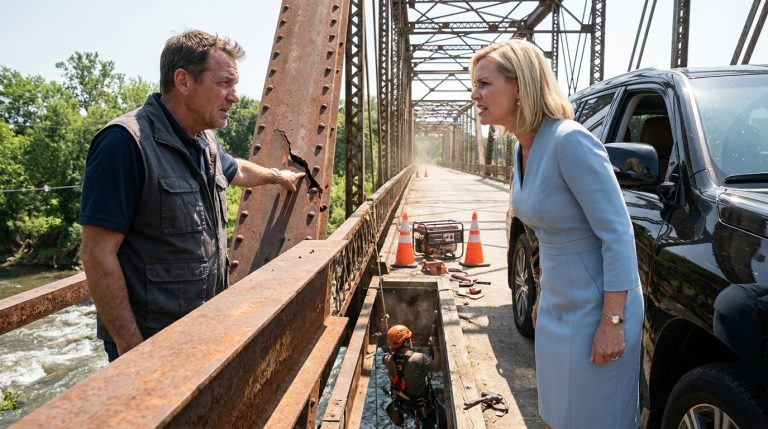
Her smile didn’t return, but her jaw tightened until the skin around her mouth went white. She stepped backward down the porch, her heel catching on a root, her fingers gripping the aluminum board until the metal groaned. “I have deep roots in the county enforcement office, Mr. Patterson,” she said, her voice dropping into a sharp, quiet threat that smelled of old salt and dry ink. “Uncooperative hermits usually find their access roads closed by the sheriff before the snow hits.”
She turned and marched toward the Mercedes, her white blazer stark against the dark green needles. David watched the SUV turn, its tires throwing up a spray of sharp grey slate that pelted his woodpile. As the red tail lights disappeared around the lower bend, he noticed something she’d dropped by the step—a small, printed plastic tag from a Denver equipment rental yard, dated three days ago, with the word Combustibles stamped across the top in faded red ink.
CHAPTER 2: THE ANATOMY OF CORRUPTED ASH
“The padlocks weren’t snapped, David. They were sheared,” Tom Bradley said. His voice was lower than the idle rumble of his diesel truck, a dry, flat sound that barely carried over the rasping mountain wind. He leaned his weight against the fender of his truck, his prosthetic leg buried to the ankle in the gray pine needles. “Somebody brought twenty-four-inch bolts cutters up here. The heavy kind. The kind that don’t bounce off case-hardened steel.”
David didn’t answer immediately. He stood in the doorway of his workshop, his boots crunching on the fine, powdery residue of what used to be four hundred board-feet of kiln-dried white pine. The lock lay on the dirt floor, its thick shackle notched with a clean, silver crescent where the blades had bitten through. It was already beginning to rust in the damp mountain air, a dark orange crust forming along the raw edge of the iron.
The air inside the shop was thick, greasy, and rancid. It wasn’t just the smell of scorched wood; it was the sharp, chemical sting of low-grade wood stain mixed with water from the garden hose that had been dragged through the window. The liquid had pooled on the concrete floor, creating a dull, iridescent rainbow that had soaked into the bottom three inches of the cedar studs. The wood had begun to warp, the grain pulling apart with faint, wet popping sounds as the fibers bloated.
“She didn’t do this alone,” David said. He bent down, his fingers brushing the cold, slimy rim of an overturned can of mineral spirits. The surface was scored with thin, parallel scratches—the kind left by heavy work gloves, not the clean fingers of a suburban property manager. “The Mercedes doesn’t have the clearance to haul the kind of weight that moved through here last night. There are dual-wheel tracks in the ditch by the culvert. Heavy utility tires.”
“Marcus,” Tom muttered. He shifted his weight, the hydraulic hinge of his prosthetic clicking with a sharp, metallic note. “The deputy’s been running the ridge road after shift. Said he was looking for illegal commercial vehicles. He’s been checking the plates on my rig twice a week.”
David stood up, wiping his hand on the thigh of his canvas trousers. The grit of the charred pine stayed beneath his fingernails, a black, oily crescent that wouldn’t shift. He looked at the rear wall where his hand tools had been systematically swept from their pegs. The chisels were buried in the wet sawdust, their edges dulled against the concrete; the hand planes lay upside down, their soles scored by intentional stone scrapes. This wasn’t a quick smash-and-grab. It was an extraction of utility. Someone wanted the workspace non-functional before the week was out.
“She’s pressing the timeline,” David said, his eyes tracking a thin line of rust running down the iron hinge of the main door. A small, notched steel shackle was wedged inside the mechanism, jammed deep into the iron sleeve as if someone had tried to force the door backward against its swing. “She knows the thirty-day notice won’t clear a standard title check if anyone digs into the original county filing. She needs the land clear of active use before the quarterly assessment.”
“Martha got her notice this morning,” Tom said, his face tightening into the desaturated gray of the granite walls behind him. “Four grand for the kid’s swing set. They’re calling it an unapproved structural hazard. She’s sitting at her kitchen table right now with a stack of papers thick enough to start a brush fire. She’s terrified, Dave. She thinks they’re going to take the house before the insurance from her husband’s settlement clears.”
David walked to the workbench, his boots dragging through the sludge of wet soot. He picked up the aluminum clipboard Elizabeth had left on his porch the day before. The paper was dry, but the edges were already curling from the humidity of the ruined room. He turned it over, examining the backing plate. There was a small, laser-etched inventory code near the rivet—M.C.D.E. 04-11.
“Milbrook County Development Enforcement,” David said, his thumb tracing the cold metal letters. “This isn’t an HOA ledger, Tom. This is county stock. She’s using Peterson’s office supplies to draft the compliance warnings.”
“Peterson’s a clerk, Dave. He doesn’t have the spine to forge a judicial header.”
“He doesn’t have to,” David said, his voice dropping into the quiet, rhythmic tone he used when reading an old docket. “He just has to leave the cabinet unlocked after five o’clock. But Marcus is the one logging the mileage. He’s not tracking me because of the noise complaints. He’s checking the land pool exclusions.”
He reached into his pocket and pulled out the printed tag he’d found by the step. The faded red ink of the rental yard was nearly identical to the stamp used on the county boundary maps. It wasn’t an arson kit tag; it was an industrial clearing permit for heavy machinery, issued to a corporate entity listed only as Red Ridge Holdings.
“She isn’t trying to collect twelve grand from me,” David said, the cold truth settling into his chest like iron ballast. “She’s trying to trigger a default clause in the 1994 Bureau land pool. If this acreage shows zero occupancy or active structure status for more than thirty days during a dispute, the title reverts to the adjacent commercial tract.”
Tom looked at the ruined studs, then down at the sheared lock in David’s hand. “And the adjacent tract is hers.”
“The adjacent tract belongs to the three properties she flipped last winter,” David said, stepping out of the shadow of the shop into the grey, slate-colored light of the afternoon. “She doesn’t want the fees. She wants the dirt. And she brought the county’s muscle to dig it out.”
He walked toward his truck, his fingers tightening around the cold steel of the sheared lock until the sharp edge bit into his palm. The friction of the rust left a dull brown stain across his skin.
“Where are we going?” Tom asked, his engine catching with a heavy, mechanical roar that shook the gravel beneath his tires.
“To Martha’s,” David said. “Before Marcus finds out her title doesn’t have an exclusion clause.”
CHAPTER 3: THE PERIMETER MATRIX
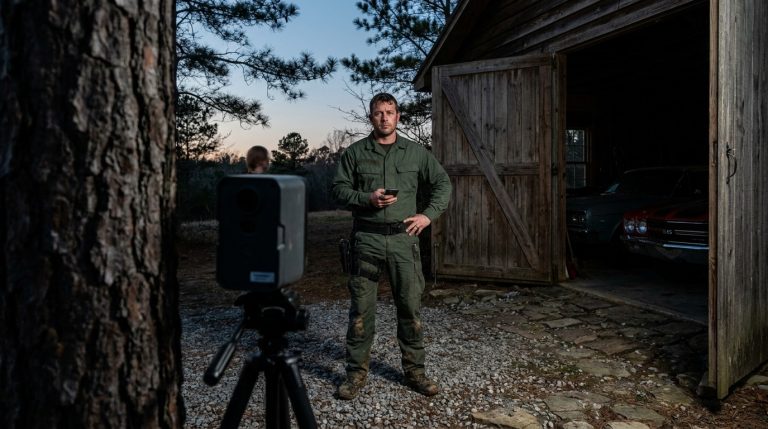
The night air felt like iron filings in the lungs. David knelt in the frozen ruts behind his tool shed, his heavy canvas coat stiff against the frost-bitten weeds. In his left hand, the thermal scope hummed, its tiny cooling fan casting a minute vibration through his palm. The screen glowed in desaturated hues of green and slate, cutting through the dense, tangled undergrowth of the boundary line.
Beside him, Tom Bradley adjusted his stance, his weight shifting onto his good leg with a soft, organic rustle of nylon. The prosthetic leg remained buried in the brittle brush, silent and rigid. Tom lowered his night-vision binoculars, the green lenses reflecting the absolute absence of moonlight.
“Nothing moving on the main approach,” Tom whispered, his breath a faint, gray cloud that disappeared instantly into the wind. “But those tire tracks by the lower culvert aren’t fresh. Someone walked them over with a brush rake. It’s too clean, Dave. Nobody cleans a ditch unless they’re hiding a grease spot.”
David adjusted the focus ring on the thermal optic. The gray shapes of the pine forest resolved into cold, solid pillars, but along the eastern edge, near the property wire, a faint streak of residual heat bled through the ground. It was an unnatural signature—a sharp, linear dissipation of warmth that suggested heavy machinery had rested there less than three hours ago.
“They’re not watching the house,” David said, his voice flat, raspy, and matching the cold crunch of the frozen dirt beneath his knees. “They’re mapping the grade. Look at the post alignment.”
He reached out and tapped a thick wooden fence post that had stood since the county survey of 1974. The cedar was split, weathered down to a pale, bone-white gray, but near the base, where the wood met the frozen earth, the ancient wire had been snipped. A new, galvanized steel tie had been twisted around the iron staple, its surface clean and unrusted. Wrapped tightly beneath the new wire was a small brass disc, stamped with a number that did not match the municipal land pool: R.R.H. MAP-4.
“Red Ridge Holdings,” Tom muttered, leaning down until his glove brushed the cold brass. “They’re pinning the line. They aren’t waiting for the thirty-day default, Dave. They’re treating the boundary as already settled.”
“They have to,” David said, standing up slowly, his knees popping like dry twigs in the quiet. “A title reversion requires a certified spatial discrepancy report filed with the state engineer before the court clerk logs the lien. If the map doesn’t show an active conflict, the system processes the transfer automatically. The clerk just hits ‘enter’ on a batch file.”
He turned back toward the workshop, his boots grinding against the grit of the gravel trail. Every piece of his old life—the years spent reviewing sterile, dry land disputes in wood-paneled courtrooms—was snapping back into alignment. The legal system wasn’t a wall; it was an engine, and if someone knew exactly which gears to grease, it could crush a man’s life without ever revealing a human face.
“Marcus isn’t Peterson’s muscle,” David said as they reached the shadow of the truck. “He’s the surveyor of record for the corporate filing. Look at his shift logs. He’s been using county fuel to verify the exclusions so Red Ridge doesn’t have to hire a private engineer.”
“That’s a felony track, Dave. If the state internal affairs group catches him using municipal rigs for private acquisition—”
“They won’t look,” David cut him off, his hand gripping the rusted handle of his truck door. The metal was cold enough to stick to his skin, the oxidized iron flaking off in dry, red scales. “Not if the property owner is classified as an uncooperative hermit who defaulted on a civil judgment. The file goes to the dead archive. It’s clean. It’s permanent.”
The sudden, distant crack of a dry branch fracturing down the ridge stopped them both.
David’s hand froze on the door. He didn’t turn his head; he let his ears track the frequency of the sound. It wasn’t the heavy, erratic stumble of a deer through the brush. It was the rhythmic, measured compression of dry pine needles under heavy rubber soles. One person. Moving parallel to the property wire, heading toward the northern drainage ditch where Martha’s land joined his line.
Tom reached down to his belt, his fingers closing around the cold tactical flashlight, but David caught his wrist. The grip was tight, hard, and unyielding.
“No lights,” David whispered. “We don’t show the trap until the steel is under the leaf line.”
He reached into the back of the truck and pulled out a heavy iron crowd bar, its long surface pitted with old rust and gray oil. The weight of the tool felt familiar, solid, and balanced—a pragmatic counterweight to the institutional rot creeping up his mountain.
“We go through the draw,” David said, his boots already turning toward the dark, narrow ravine that bypassed the main path. “If Marcus is pinning Martha’s orchard, he’s doing it with a county stamp. And I want the ink on his fingers before he clears the ridge.”
They dropped into the black shadow of the ravine, the dry mountain mud scraping against their boots as the cold wind howled through the iron pines above.
CHAPTER 4: THE LIEN AND THE GRAIN
The floorboards of the municipal gymnasium smelled of industrial linseed oil and forty years of damp winter boots. It was a cavernous, drafty space, illuminated by high-intensity sodium lamps that hummed with a low, rhythmic drone, casting a sickly amber pallor over the rows of metal folding chairs. David sat three rows from the back, his calloused hands resting flat on his knees. His heavy canvas coat was unbuttoned, the cold air from the rusted ventilation ducts filtering through his flannel shirt.
At the front of the gym, behind a folding table covered in scratched green vinyl, sat Dale Peterson from code enforcement and Deputy Marcus. Marcus still wore his uniform, the silver badge catching the amber light, but his heavy leather duty belt creaked every time he shifted his weight. To his right, Elizabeth Crawford—still operating under her neighborhood association alias—stood with her fingers resting lightly on the handle of her leather briefcase. The pristine white of her designer blazer looked entirely foreign against the water-stained plywood walls of the gym.
“This is an informational session regarding district alignment,” Peterson announced, his voice thin and distorted through the school’s aging public address system. He didn’t look at the small crowd of residents gathered in the center rows. His eyes remained fixed on a thick, black-bound ledger open in front of him. “Under county code 12-B, non-compliant structures within the designated perimeter are subject to immediate administrative evaluation. If the fees remain unpaid past the thirty-day window, the state title registry initiates an automatic structural liquidation.”
Martha Gonzalez stood up from the second row, her small frame trembling under a faded woolen shawl. “My husband’s veterans benefit cleared the mortgage five years ago,” she said, her voice catching on the dry air of the room. “The county clerk signed the deed. Now you’re telling me an association I never voted for can put a lock on my well-house?”
“The association operates under an expanded territorial mandate, Mrs. Gonzalez,” Elizabeth Crawford said, her voice smooth, rhythmic, and perfectly devoid of heat. She didn’t look at Martha; she looked at the paper she held. “The original parcel filings from 1974 contained an unrecorded boundary exclusion. Because those parameters were never formally harmonized with the regional grid, the land pools reverted to a master parcel during the winter audit. We are simply standardizing the development corridor.”
David felt the cold steel of the crowd bar he’d left in the truck lingering in his muscle memory. He stood up slowly, the iron brackets of his chair groaning against the old pine floor. The entire room went quiet as his boots tracked a slow, steady path down the center aisle.
“The 1974 survey wasn’t unrecorded, Elizabeth,” David said, his voice flat, dry, and carrying the heavy resonance of a man who had spent three decades commanding rooms exactly like this one. He stopped ten feet from the table, his eyes locked on Marcus’s hands, which had dropped instinctively toward his holster. “The exclusion was a statutory covenant tied to the Bureau land pool. It requires a manual judicial signature from a sitting circuit judge to alter the boundaries. Peterson doesn’t have the authority to log an audit, and you don’t have the legal status to receive the reversion.”
Marcus leaned forward, his elbows hitting the vinyl table with a dull thud. “Patterson, you’re an out-of-district resident running an unpermitted commercial trade on agricultural dirt. The county attorney already cleared the enforcement schedule. You’re thirty days out from a total default.”
David reached into his coat pocket and pulled out the brass disc he’d cut from the boundary fence post, along with the automated title notice he’d pulled from Martha’s ledger. He dropped them onto the green vinyl table. The metal hit the plastic with a sharp, heavy click.
“This isn’t an enforcement schedule, Marcus,” David said softly. “This is a pre-filed corporate deed. You’ve been using the code enforcement office to issue fake civil compliance notices to clear the active occupancy logs. You think if the residents believe they’re fighting an HOA, they won’t look at the state land registry until the thirty days are up and the automated reversion clears.”
Elizabeth’s smile didn’t waver, but her fingers tightened against the leather of her briefcase until the seams groaned. She leaned down, whispered something into Peterson’s ear, and then turned her gaze directly onto David.
“You’re a retired civil servant, David,” she said, her voice dropping into a razor-thin register that smelled of old ink and cold paper. “You know how the machinery works. Once the digital file is batched at the state capital, a local records dispute doesn’t halt the execution. The system doesn’t care about a hand-cut cedar porch. It cares about the filed parameters.”
She reached into her briefcase and pulled out a fresh, blue-backed document stamped with the seal of the State Department of Revenue. She slid it across the table, over the brass disc.
David looked down at the header. His breath caught in his throat, a cold knot of realization hardening in his chest. The document wasn’t an application for a lien. It was a certified Certificate of Title Reversion, already processed and dated forty-eight hours ago. It listed his coordinates, Martha’s plot, and Tom’s timberline acreage as Decommissioned Commercial Waste. The active occupancy status had been legally terminated not by a local default, but by an administrative declaration of abandonment signed by a regional director four hundred miles away.
The local scam—the fake HOA fees, the noise complaints, the harassment—was a decoy. It was a calculated screen designed to keep them focused on their properties while the real execution took place completely outside the county’s jurisdiction. The system hadn’t just been greased; the ground beneath his feet had been sold before he ever took the drawknife to the cedar.
“The workshop was logged as a hazardous industrial ruin three weeks ago, Mr. Patterson,” Elizabeth said, her eyes reflecting the amber glare of the sodium lights like two shards of yellow glass. “The county sheriff’s department is required by state mandate to enforce an administrative eviction within forty-eight hours of a registered title liquidation. We aren’t waiting for thirty days. The land belongs to Red Ridge Holdings as of midnight tonight.”
Marcus stood up, his leather belt creaking loudly in the absolute silence of the gymnasium. He reached into his pocket and pulled out a set of heavy steel transport shackles, their rusted hinges clicking as he laid them flat on the table.
“You’ve got two hours to clear your personal tools from the ridge, Patterson,” Marcus said, a dark, victorious grin spreading across his weathered face. “After that, anything left on the dirt is corporate salvage.”
David looked at the blue-backed paper, then at the rusted shackles on the table. The local law wasn’t broken; it had been completely replaced by a ledger that didn’t even know his name.
CHAPTER 5: THE PERMANENT CIRCUIT
“The corporate salvage laws don’t apply to active judicial reserves, Marcus,” David said. His voice didn’t rise, but the dry, flat rasp of it carried across the varnished lines of the gymnasium floor like the strike of a iron wedge. He didn’t look at the shackles. Instead, he reached into the breast pocket of his flannel shirt and pulled out a single sheet of grey, heavy-bond parchment. It was folded into thirds, its edges worn down from the rough canvas of his pocket, but the seal at the center was stamped in thick, dark blue state ink.
He laid it flat on the vinyl table, exactly over the Certificate of Title Reversion. The friction of the heavy paper sliding against the corporate deed sounded like sand over limestone.
“What is that?” Elizabeth Crawford asked. Her voice lost its smooth, administrative cadence for the first fraction of a second. Her eyes drifted to the signature at the bottom—not a regional director’s digital mark, but a hand-drawn, wet-ink cross-filing under Colorado Code 13-5-142.
“An emergency judicial reactivation order,” David said, his fingers remaining flat on the document, pinning it to the table. “Signed by Judge Patricia Webb at six o’clock this morning. In cases involving systemic land pool fraud and the misuse of municipal law enforcement assets, a retired circuit judge can be restored to active bench authority by a simple administrative declaration. I’m not a property owner in dispute anymore, Elizabeth. As of twelve hours ago, I’m the presiding special circuit officer for this district.”
Marcus stepped back, his heavy boots skidding a fraction of an inch on the floor wax. His right hand remained near his hip, but his fingers were frozen against the black leather of his holster. “Webb can’t issue a circuit order without a formal grand jury docket, Patterson. You’re bluffing. You’ve been out of the courthouse for three years.”
“The docket was opened when the FBI tracked the digital signatures on the land pool audit,” David said. He turned his head slightly, looking toward the heavy double doors at the back of the gymnasium. The iron handles rattled. Three men in gray wool coats stepped through the entry, their boots unhurried, their eyes sweeping the room with the diagnostic detachment of federal field agents. One of them carried a leather transport case stamped with the seal of the State Auditor.
“The local HOA was a decent screen,” David continued, his gaze shifting back to Elizabeth, whose face had settled into a hard, geometric mask of pale skin. “It kept the neighbors looking at fence heights and twelve-thousand-dollar compliance fines. It made everyone think the threat was petty, localized, and personal. But the automated title reversions you processed through Red Ridge Holdings required an internal validator at the state registry. You needed Peterson to log the land as ‘abandoned infrastructure’ so your corporate buyers could clear the valley for the rail corridor expansion.”
Peterson slammed the black-bound ledger shut, his hands shaking so violently the metal binding scraped against the vinyl. “I just logged the field reports Marcus brought in,” he stammered, his eyes darting toward the side exits. “I don’t know anything about a rail corridor.”
“The field reports were forged on county stock, Dale,” David said, his tone dry and merciless. “You left the registry cabinet keys in the lock after hours for three weeks straight. The state circuit court treats that as institutional complicity. The warrants were batched with the reactivation order.”
Elizabeth didn’t run. She stood perfectly still, her white blazer catching the amber glare of the sodium lights as she reached down to close her briefcase. “The filed deeds are already in the system, Judge Patterson,” she whispered, her voice dropping into a razor-thin hiss. “The computer processed the reversion at midnight. You can’t reverse an automated land pool liquidation with a piece of paper from a county bench.”
“The system runs on signatures, Elizabeth,” David said, his hand finally releasing the parchment. “And an active circuit judge has the power to hold the registry in an absolute statutory freeze. The deeds aren’t processed. They’re quarantined. And your corporate backing pool pulled their funding forty minutes ago when the federal wire fraud alerts hit the Denver exchange.”
The federal agent with the transport case reached the table, his fingers pulling a set of clean, chrome-plated steel restraints from his pocket. They didn’t click like Marcus’s old locks; they were heavy, silent, and precision-tooled.
Marcus looked at the gray-coated men, then down at his own uniform shirt, his breath coming in short, ragged gasps that smelled of stale tobacco and panic. He didn’t pull his weapon. He slowly unbuckled his duty belt, letting the leather and iron drop to the gymnasium floor with a heavy, hollow crash that echoed off the plywood walls.
David watched them lead Elizabeth toward the double doors. She didn’t look back at the room, nor at the rows of wooden benches where the residents of the ridge sat in stunned, absolute silence. The synthetic lavender of her perfume lingered in the drafty air for a few moments, turning stale and sour against the heavy scent of floor wax and wet cedar.
Martha Gonzalez walked up the center aisle, her small hands catching David’s sleeve. The rough wool of her shawl brushed against his canvas coat. “Is it clear, David? The house… Tommy’s yard?”
David looked down at the old survey map still lying on the table, its borders clean and uncircled under the gray mountain light. He picked up the brass disc and dropped it into his pocket, his fingers feeling the cold, hard edges of the metal.
“The line holds, Martha,” David said, his voice returning to the low, steady rhythm of the timberline. “The valley stays exactly where it’s pinned.”
He turned back toward the rear exit where Tom Bradley stood by the rusted door frame, his hydraulic leg clicking softly as he leaned against the iron. Outside, the cold mountain wind was blowing the gray ash from the chimney lines, clearing the horizon until the dark pines showed nothing but raw, unrefined rock.