The Silent Legacy: A Journey of Generational Bridges and the Echo of Forgotten Valor
CHAPTER 1: The Gate of Granite
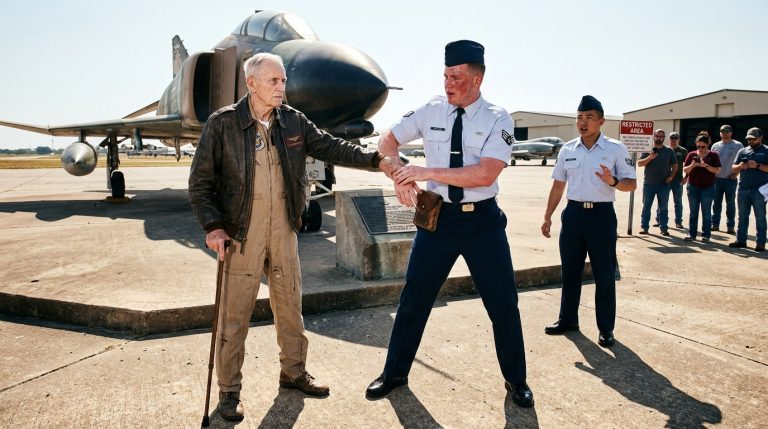
The air around Gate C was thick with the scent of mowed grass and the suffocating perfume of suburban pride, a stark, clean contrast to the humid, iron-scented memories that clung to the lining of Stanley’s windbreaker. He stood with his feet planted firmly, the fabric of his sleeves chafing against his skin. To the young lieutenant in front of him, he was merely an obstruction—a patch of gray in a world of high-definition color.
Lieutenant Finch’s uniform was a marvel of modern geometry. Not a thread was out of place; her posture was so rigid it seemed to defy gravity. “Sir, I’m going to have to ask you to leave,” she repeated, her voice a sharp, surgical instrument. She didn’t look at him; she looked through him, toward the sea of families eager to witness their own legacies take the stage.
Stanley held his ticket up, the paper damp from his palms. He didn’t want a spectacle. He didn’t want to be the reason for the tension rippling through the queue behind him. He only wanted to see Michael. He wanted to see if the boy walked with the same steady cadence he had taught him in the backyard, chasing fireflies and learning the names of constellations.
“I have my ticket, Lieutenant,” Stanley said, his voice the sound of dry leaves on pavement—quiet, yet impossible to ignore. “I’ve driven seven hours. I just want to be close enough to see the faces.”
Sergeant Miller stepped into his periphery, a wall of synthetic fabric and practiced indifference. He loomed, a tactical shadow. “General admission is back there, Pops,” Miller said, jerking his chin toward the bleachers that shimmered in the distance like a mirage. “You’re holding up the flow. We have a protocol to maintain.”
“Protocol,” Stanley murmured, the word tasting like copper.
He looked past them, his eyes finding the third company in the formation, a neat line of blue and gray. Michael was there, somewhere in that sea of indistinguishable uniforms. Stanley felt the weight of his years, the way his lower back ached with the humidity, but he didn’t feel the urge to move. The atmosphere here was brittle, fragile, and he knew that if he walked away now, he would be admitting that his place in this world had been fully erased.
He shifted his weight, and for a fleeting, terrifying moment, the roar of the crowd dipped into the silence of a deep, dark canopy. He heard the drip of water from a palm frond. He saw a shadow move across the mud, not of a parade deck, but of a forgotten ridge.
“I’m not going to the bleachers,” Stanley said, his voice steadying, grounding him in the present.
Finch’s face flushed, a tide of crimson rising from her collar. “Sergeant, remove him. Now.”
As Miller’s hand closed around his arm, the fabric of his sleeve caught on a clasp, riding up just enough. Beneath, the skin was wrinkled and thin, but the ink was as dark as the day it was etched: a curved scythe cradling three stars. The sun caught it, reflecting a faint, ghostly sheen. Miller’s hand tightened, oblivious, but in the corner of his eye, Stanley saw someone else watching—a staff sergeant named Evans, whose expression suddenly went pale, his gaze locked not on Stanley’s face, but on the mark on his arm.
CHAPTER 2: The Friction of Authority
The pressure of Sergeant Miller’s grip was not merely physical; it was a rhythmic, pulsing reminder of every time Stanley had been told to be quiet, to move along, to accept the margins of a world that preferred its heroes bronzed, static, and long dead. The sergeant’s thumb dug into the muscle of his bicep, a blunt, unthinking movement that should have hurt. But for Stanley, the pain was muffled, distant.
The sound of Miller’s heavy boots against the pavement, usually a dull thud, shifted frequency. In the back of Stanley’s mind, the sound morphed into the rhythmic crunch of jungle boots on saturated earth. He felt the phantom weight of a rucksack—the familiar, agonizing pull against his shoulders—and the biting sting of moisture in his eyes.
“You’re making a scene, old man,” Miller’s voice grated, cutting through the memory like a dull blade. The sergeant pulled harder, attempting to force Stanley to pivot toward the main road. “Keep walking. Don’t make me use force.”
Stanley kept his feet planted. His windbreaker, thin and worn at the cuffs, bunched up beneath Miller’s hand. The sergeant’s eyes were fixed on the distance, his face twisted in a look of impatient superiority. He didn’t see the man who had survived the silent storm; he saw a nuisance, a bureaucratic error that needed to be erased from the morning’s itinerary.
“I am not a scene, Sergeant,” Stanley said, his voice quiet, barely carrying over the murmur of the crowd. He felt a bead of sweat trace a path down his temple, the heat of the parade deck clinging to him like a second skin. “I am a guest. My grandson is graduating.”
“Your grandson is a cadet,” Finch interjected, stepping closer. Her voice had lost its crisp, performative edge, replaced by a low, biting irritation. She was observing the onlookers, her gaze flickering toward the murmuring crowd with a sharp, possessive anxiety. “And he’s a soldier. He wouldn’t want to see his family making a spectacle of themselves.”
The words struck with the precision of a needle. Stanley felt the old, familiar ache in his chest—the one that had nothing to do with age and everything to do with the loneliness of the survivor. He had spent fifty years learning to carry his history in silence, ensuring that the men who had been left behind were never cheapened by the noise of the public square.
As Miller yanked his arm again, the sleeve slid upward another inch. The scythe, etched in dark, faded ink, caught the blinding glare of the sun. It looked stark against the paper-thin skin of his forearm.
For a heartbeat, the world fractured. The smell of fresh-cut grass was annihilated by the smell of ozone, ash, and the damp, metallic tang of blood. He saw Dave—not the specter of a dead man, but the vibrant, laughing face of a brother, his arm firm as a pillar, his eyes reflecting the same three stars now inked into Stanley’s own flesh.
“Brotherhood,” Stanley whispered, the word escaping his lips before he could call it back.
Miller scoffed, a short, sharp sound of derision. “What are you rambling about, Pops? You’re delusional.”
Stanley blinked, and the jungle retreated, leaving him standing on the edge of the parade deck, the heat once again pressing down on his shoulders. He saw Staff Sergeant Evans, standing by the barrier a few feet away. Evans had been watching the scene with the dull, programmed posture of a soldier on duty, but when he looked at Stanley—really looked at him—the mask slipped. There was a flicker of something in Evans’s eyes: recognition, horror, and a sudden, sharp realization.
Evans shifted his weight, his hand brushing against his radio, then retreating. He was hesitating. The tension in the air felt brittle, like ice about to give way under the weight of a man. Stanley felt a strange, cold clarity settle over him. He wasn’t afraid of Miller or Finch. He was, however, deeply afraid of what would happen if the quiet dignity of this day was permanently broken.
“Listen to me,” Stanley said, his voice gaining a sudden, resonant iron. He stepped forward, forcing Miller to stumble back half a pace. The sergeant looked startled, his grip loosening just enough for Stanley to pull his arm free. “You have no idea what you are holding. You have no idea what it cost to stand where you are standing right now.”
Finch’s face tightened, her eyes narrowing. She opened her mouth to snap a command, her hand drifting toward the radio on her tactical vest, but she stopped. The crowd had fallen silent. The murmur was gone, replaced by a suffocating, heavy tension that seemed to radiate from the very spot where Stanley stood.
He didn’t move toward them, but he didn’t move away, either. He turned his head, his gaze sweeping the parade deck where the cadets stood in perfectly spaced, unmoving rows.Somewhere among them was Michael. Stanley felt the boy’s presence, the quiet, persistent pulse of his grandson’s life, and he realized with a sinking heart that the institutional armor these officers wore—their rigid rules, their polished buttons, their hollow authority—was becoming a wall he would have to tear down, stone by stone, if he wanted to see his grandson’s face.
Miller took a threatening step forward, his chest puffed out, his eyes glinting with a dangerous, unchecked frustration. “Last warning, old man. We’re done talking.”
Stanley looked at him, not with anger, but with a profound, terrifying patience. He stood perfectly still, his hands tucked into the pockets of his windbreaker, his eyes locked on the horizon. He knew that what came next would be the end of something—either his own silence, or the fragile order that Finch and Miller had fought so hard to defend.
CHAPTER 3: The Weight of Silence
Sergeant Miller’s hand remained hooked into the sleeve of Stanley’s windbreaker, the knuckles white with the exertion of maintaining control. For a long, pressurized second, the world seemed to hold its breath. The distant music of a military band began to tune up—a dissonant, brassy blare that underscored the instability of the moment. Miller’s gaze, previously fixed on the horizon, flickered down to the patch of skin now revealed by the bunched-up fabric.
“What is that?” Miller muttered, his bravado momentarily punctured by the sight of the ink. He didn’t recognize the design, but the precision of the lines, the way the constellation of three stars seemed to shimmer even in the harsh, flat morning light, disturbed him. It looked like an old wound that had never properly closed.
Stanley didn’t pull away. He stood perfectly still, his breathing measured, his heart rate slowed by the discipline of a thousand past firefights. He felt the coarse texture of the crowd barrier against his back, a modern, flimsy thing compared to the granite ridges he had once held. “It’s a mark of memory, Sergeant,” Stanley said, his voice barely a whisper, yet it possessed a gravity that seemed to pull the oxygen from the immediate vicinity. “A memory of a time when the world was much darker, and the people holding the line were much younger.”
Lieutenant Finch stepped into his personal space, her polished boots leaving sharp indentations in the gravel. She was trying to reassert the geometry of the situation, to realign the chaos of the present with the orderly blueprints of the morning’s proceedings. “You’re trespassing, sir,” she said, though her voice wavered, lacking the razor-sharp certainty it had possessed only moments ago. She looked at Miller, her eyes darting toward the crowd. “We have the power to escort you to the MPs. This isn’t a negotiation.”
Stanley watched her, noting the way her jaw muscles twitched. She was terrified—not of him, but of the disruption he represented. She was a keeper of thresholds, and he had become a breach in her wall.
“I’m not asking to negotiate,” Stanley replied, his eyes shifting to Sergeant Evans. Evans was still standing by the barrier, his posture no longer the relaxed slouch of a guard on duty. His hands were braced against his thighs, his face a mask of pale concentration. He was staring at the scythe on Stanley’s arm with an intensity that bordered on physical pain. Stanley knew that look. It was the look of a man who had glimpsed a ghost and was trying to convince himself that it wasn’t there.
“Sergeant Evans,” Finch barked, not turning her head. “Get over here and assist Sergeant Miller. This gentleman is being non-compliant.”
Evans hesitated. The silence that stretched between them felt like a physical barrier, a wall of glass that could shatter at the slightest provocation. He took one step forward, then stopped. He looked at Stanley, then back at Finch, his throat working as he swallowed.
“Ma’am,” Evans started, his voice thick. “I think… I think we need to verify the visitor’s status before we take further action. There’s a, uh, a protocol for legacy guests.”
Miller scoffed, his grip on Stanley’s arm finally loosening, though he didn’t step back. “Legacy guests? What are you talking about, Evans? It’s general admission or nothing. We don’t have ‘legacy’ protocols for people wearing thrift store jackets.”
Stanley felt the release of the sergeant’s hand, the sudden change in temperature on his skin. He smoothed the fabric of his sleeve, tucking the ink away, though the phantom weight of the mark remained. He felt the cold iron of the situation settling into place. He wasn’t just a man at a gate anymore; he was a catalyst.
“I don’t need a protocol, Sergeant,” Stanley said, his tone low and weary. He looked at the vast, sun-drenched expanse of the parade deck, where the rows of cadets were shifting in anticipation of the ceremony. He saw a cadet, third from the left, turn his head slightly as if searching the crowd. Stanley’s heart gave a sudden, painful thud against his ribs. It was Michael. He was close enough to see the boy’s shoulders—the same set, the same posture he had carried in his own youth.
The sight broke through Stanley’s stoic shell, a flicker of raw, human longing that was more dangerous than any weapon. He took a single, deliberate step toward the gate.
“Stop!” Miller shouted, his hand dropping to his side, his posture shifting into a defensive stance.
Stanley ignored him. He was no longer looking at the officers. He was looking at the path ahead, the distance between the world he had helped to build and the world that was currently turning him away.
CHAPTER 3: The Fractured Echo
The silence that followed Stanley’s words wasn’t empty; it was pressurized. Sergeant Miller’s hand, which had been gripping Stanley’s sleeve, fell away as if the fabric had suddenly turned to hot iron. He took half a step back, his face a complex map of confusion and simmering, defensive aggression. Beside him, Lieutenant Finch’s posture, usually as rigid as a surveyor’s stake, wavered. Her gaze flickered—not toward Stanley, but toward the crowd, which was now pulsing with a different kind of energy. The pity and indifference that had characterized their initial reactions had curdled into a sharp, focused curiosity.
Stanley remained motionless, his hands still deep in the pockets of his faded windbreaker. He felt the rough, worn-out lining, the familiar tactile comfort of the material that had survived years of neglect. It was his anchor. Across the perimeter, Staff Sergeant Evans remained rooted to his post, his posture rigid, but his eyes were darting back and forth, tracking the perimeter with a sudden, heightened vigilance that Stanley recognized instantly. It was the look of a man who knew the rules were about to break and was deciding which side of the wreckage he wanted to stand on.
A low, mechanical hum emanated from the security pylon to their left. Stanley glanced up, catching the movement of a high-definition camera as it swiveled, its lens tracking his position with an uncanny, predatory focus. He felt a phantom sensation against the back of his neck, the cold, prickling awareness of being observed by a command that had no context for who—or what—he was.
“We’re not going to stand here and argue with you, sir,” Finch said, her voice reclaiming its sharp, clipped authority, though a tremor of uncertainty lingered at the edges. She pulled a radio from her vest, her movements jerky and unpracticed. “Gate C is compromised. I need an update on the official party’s timeline. We have an unauthorized individual impeding access.”
Stanley didn’t wait for the radio to crackle to life. He stepped forward, his boots feeling heavy against the pristine, manicured gravel of the parade deck’s edge. “I am not impeding anything, Lieutenant,” he said, his tone low, conversational, stripped of any request. “I am waiting for my grandson. If you feel compromised, perhaps it is because you are looking at a shadow and calling it an intruder.”
Miller stepped up again, his face reddening. “Enough. You’re going to step aside, or I’m going to make sure you spend your afternoon in the brig.”
“The brig?” Stanley offered a faint, weary smile. It was a look that didn’t reach his eyes, which remained as clear and distant as a winter sky. “You speak of walls and cells as if they possess the power to hold time. I have lived in places that made your brig look like a kindergarten classroom.”
The air between them seemed to crackle. Evans, watching from the periphery, suddenly snapped his head toward the entrance road. A distant, rhythmic thrum began to rise above the ambient chatter of the graduation crowd—the distinct, deep-throated roar of a heavy-duty engine. It wasn’t the erratic whine of a civilian vehicle; it was the steady, disciplined power of a command transport.
Finch looked toward the road, her eyes widening. She clearly recognized the signature of the sound. Her hand, holding the radio, dropped to her side. “Miller,” she breathed, the authority evaporating from her voice. “Get him moved.”
But it was too late. Stanley didn’t need to look back to know what was coming. He could feel it in the way the atmosphere shifted, the sudden stillness that rippled through the nearby cadets as they sensed the arrival of high-ranking brass. He felt a sudden, sharp, and deeply inconvenient flashback—not of the jungle this time, but of the weight of a heavy, brass-bound locker key he had kept hidden in his wallet for decades. It was a physical, grounding sensation against his thigh, a reminder that the secret he carried wasn’t just a mark on his skin, but a physical key to an archive that wasn’t meant to be opened.
The vehicle—a long, black transport with flags fluttering on the fenders—broke through the line of sight, tearing toward the gate with a reckless disregard for the speed limits of the base. Miller started to move toward Stanley, his hand reaching out to grab him again, but he hesitated, caught between the urgency of his Lieutenant’s command and the terrifying proximity of the approaching transport.
Stanley stood his ground, the center of an unfolding collision between the old world and the new. He felt the cold, hard weight of the key in his pocket and knew, with a resignation that felt like breathing, that the quiet life he had cultivated for half a century was effectively over. He looked at Finch, who was visibly trembling now, and saw not an enemy, but a young woman terrified that the floor was about to drop out from beneath her.
“Take a breath, Lieutenant,” Stanley murmured, his voice barely audible over the growing roar of the transport. “The truth is a very heavy thing to carry if you aren’t prepared for the weight.”
The transport skidded to a halt just yards away, the gravel spraying in a wide, frantic arc. As the doors began to swing open, Stanley took one final, steadying look at his grandson’s company, seeing the rigid backs of young men who hadn’t yet learned that history was a living, breathing predator.
CHAPTER 4: The Witness in the Machine
The transport’s engine ticked—a sharp, metallic contraction of cooling steel—as the silence returned, heavier and more suffocating than before. Sergeant Miller was still frozen in his half-step, his hand hovering in the empty air where Stanley’s arm had been only seconds ago. Lieutenant Finch’s posture had completely disintegrated; she was staring at the vehicle’s insignia with a look of dawning, sickly comprehension. She didn’t look like a soldier anymore; she looked like a child who had realized the playground was far more dangerous than she had been told.
Stanley didn’t move. He kept his hands tucked into his windbreaker pockets, his fingers tracing the cold, jagged edge of that brass key. The air around them felt ionized, the way it did before a storm hits a ridge. He watched as the heavy rear door of the black transport groaned open.
Staff Sergeant Evans was the first to react. He snapped his posture into a salute so sharp it seemed to vibrate, his eyes fixed on a point in space behind Stanley’s head. Stanley didn’t look back. He didn’t need to. He could hear the heavy, measured thud of boots on the pavement—a cadence he had known for decades, a rhythm that was inextricably linked to the burden of command.
A figure emerged from the vehicle. General Marcus Thorne. He was taller than Stanley remembered, his uniform a tapestry of medals and ribbons that seemed to capture the morning light in a way that felt almost aggressive. His eyes, fixed with an intensity that made the surrounding air feel thin, passed over Finch and Miller as if they were nothing more than debris on the road. They locked onto Stanley.
In that instant, Stanley felt the strange, disorienting pull of dissociation. The parade deck, the bright, artificial colors of the graduation, and the trembling faces of the guards around him faded, replaced by the flickering, low-light memories of a world that existed only in the ink on his skin. He saw the General not as a commander of armies, but as a young boy, the son of the man he had once dragged to safety across a rain-slicked jungle floor. The link between them was a ghost-thread, invisible to everyone else, but heavy enough to anchor Stanley to the spot.
“Mr. Blake,” the General said. His voice was a low, guttural rumble that seemed to reverberate against the metal siding of the transport. He didn’t offer a hand. Instead, he stopped three paces away and performed a salute. It wasn’t the brisk, performative salute of the military academy, nor the stiff greeting of the parade field. It was slow, deliberate—a gesture of profound, almost religious recognition.
Stanley felt the breath leave his lungs in a long, shaky exhale. He didn’t return the salute in kind. He simply inclined his head, a gesture of weary, mutual respect.
“General,” Stanley replied. His voice sounded thin, alien to his own ears.
The silence that followed was absolute. Miller and Finch were essentially holding their breath, their faces gone the color of parchment. They were witnessing a structural collapse of their reality. The hierarchy they had spent their lives climbing had just been inverted by the simple presence of a man they had dismissed as a nuisance.
Thorne turned his head, his gaze finally shifting toward the guards. His eyes, burning with a cold, controlled fire, stripped away their rank and their training until they were just two frightened people standing in a field. “You have been operating under the assumption that this gate is your own personal kingdom,” Thorne said. His voice was quiet, dangerously calm. “You have mistaken order for understanding, and status for service.”
Finch tried to speak, her lips moving, but no sound emerged. She looked to Stanley, then to the General, her entire world-view visibly fracturing.
“We… sir, we were only following…” she started, then choked off.
“Following?” Thorne repeated, the word sounding like a verdict. He didn’t look at her again. He turned back to Stanley, his face softening with a look of such raw, unvarnished regret that it felt like an intrusion. “I have searched for you, Stanley. For years. The archives… they are sealed tight. I couldn’t reach through the red tape.”
Stanley felt the key in his pocket dig into his palm. He understood then that this wasn’t just about the graduation. The General wasn’t here to offer a ride; he was here to finish a conversation that had been left hanging in the damp, claustrophobic air of a jungle monsoon fifty years ago.
“I didn’t want to be found, Marcus,” Stanley said softly, using the General’s first name as if it were a fragile glass ornament. “Some things are meant to stay in the dark. If you bring them into the light, they tend to wither.”
Thorne’s expression tightened, the shadow of a deep, ancient pain crossing his face. “I am not here to wither them. I am here to make sure they are acknowledged.”
He looked toward the field, toward the rows of cadets. “The boy is waiting. Shall we?”
Stanley looked at the General, then at the two guards—the broken remnants of the barrier he had spent the morning navigating. He realized then that the decoy mystery—the secret unit, the classified files—was merely the shell. The truth, the Layer 2 reality he had been guarding, was the simple, heartbreaking fact that his survival had cost the General’s father his own peace, and the weight of that inheritance was now the only thing connecting them.
He moved forward, his stride steady, matching the General’s pace as they walked toward the field. He didn’t look back at the gate. He didn’t need to. He knew the echo of his presence would linger there long after they were gone.
CHAPTER 5: The Glass Threshold
The walk to the field was a descent into a different kind of combat. As they neared the VIP enclosure—a pristine, white-canvased structure that shimmered with the heat of the morning—the air grew heavy with the scent of expensive coffee, fresh-pressed wool, and the nervous sweat of high-ranking officers. General Thorne walked with a stride that carved space through the crowd, his presence acting like the prow of a ship, parting the sea of onlookers. Stanley walked at his shoulder, his windbreaker a jarring, faded contradiction against the gleaming brass and starched collars of the surrounding elite.
Every eye followed them. Stanley could feel the weight of a thousand stares, the cold, analytical scrutiny of people whose lives were governed by the very structures he had spent the morning dismantling. He felt the brass key in his pocket—a sharp, angular presence that seemed to heat up against his thigh, a tangible reminder of the ghosts he was carrying into this room of living legacies.
“Mr. Blake,” Thorne murmured, keeping his voice low, a confidential rumble meant only for Stanley. “I’ve cleared a seat. You won’t be bothered.”
“I don’t need to be insulated, Marcus,” Stanley replied, his eyes scanning the interior of the tent. It was a space of curated, artificial calm, the antithesis of the chaotic, muddy, and profoundly honest reality he had known. “I just need to see him. That’s all.”
“You will,” Thorne promised, his jaw set in a line of iron determination.
They reached the entrance, and the scene inside immediately shifted. A group of senior officers, mid-conversation about logistics and force readiness, fell silent as the General entered. The shift was visceral, a sudden vacuum of sound. Their eyes landed on Thorne, then traveled, with varying degrees of confusion and thinly veiled hostility, to the old man at his side.
A woman in a sharp, slate-gray suit—a civilian aide, her hair pulled back into a severe, utilitarian knot—stepped forward, a tablet clutched to her chest. Her eyes flicked toward Stanley, registering the windbreaker with a flicker of professional alarm. “General, sir. We have a change in the protocol for the seating arrangement. The dignitaries from the regional office have arrived, and—”
“Cancel the change,” Thorne interrupted, his voice dropping into that lethal, quiet register that made the aide flinch. “The seating stands as it is.”
“But, sir, the space is limited, and—”
Thorne didn’t let her finish. He placed a heavy, gloved hand on the back of a chair near the center of the front row, his gaze drifting to a small, laminated name card on the table. He picked up the card, his fingers folding it into a small square, and tossed it onto the grass. “I said the seating stands. Clear the room, Captain. I need a moment.”
The room emptied with a frantic, rhythmic efficiency. The aide retreated, casting one final, lingering glance at Stanley—a look of genuine bewilderment that Stanley found almost humorous. He sat, the chair feeling too rigid, too perfect, as if it had been designed to keep the occupant from truly resting.
He looked toward the open side of the tent, out toward the field. The cadets were shifting into their final formation, the sunlight glinting off their brass buttons like thousands of tiny, blinding stars. He spotted Michael. The boy was standing tall, his chin set at an angle that Stanley recognized—the stubborn, quiet resilience of the Blake line.
“He looks like him, doesn’t he?” Thorne asked, stepping up to stand beside Stanley, his arms crossed over his chest. He wasn’t looking at the cadets; he was looking at Stanley.
“He looks like himself,” Stanley corrected, his voice raspy. He reached into his pocket and touched the key again, pulling his hand out to rest on his knee. He felt the phantom ache of the jungle dampness in his joints, a persistent, rhythmic throb that kept time with the distant, slow march of the band.
“I have the files, Stanley,” Thorne said, his voice lowering until it was barely a breath. “The ones you were keeping. I found them when I took command of the region. I didn’t open them. Not once.”
Stanley felt a chill that had nothing to do with the morning breeze. He turned to look at the General, seeing the raw, exposed nerves behind the four-star facade. “Why not?”
“Because they weren’t mine to open,” Thorne replied, his gaze drifting back toward the field. “I thought, if I brought you here, if I gave you the seat you earned, you might finally decide it was time to let them be seen.”
A sudden, sharp sound—the rhythmic, metallic click of a rifle bolt being cycled in the distance—rippled through the silence, triggering a cascade of muscle memory in Stanley’s arms. He felt his shoulders tense, his perception narrowing into the high-contrast clarity of a hunter. He hadn’t been expecting that sound. It was an anomaly, a breach in the expected, polished perfection of the ceremony.
He leaned forward, his eyes locked on a pair of security personnel standing near the perimeter of the field. They were holding their weapons with a tension that was entirely out of place for a graduation morning. The atmosphere, until now just heavy with scrutiny, suddenly felt weighted with a distinct, sharp-edged malice. Stanley felt his own pulse begin to sync with the cadence of the approaching march, a deep, resonant warning drumming in his ears.
“Marcus,” Stanley said, his voice flat. “Who exactly did you invite today?”
CHAPTER 6: The Anatomy of a Threat
The click was soft, a whisper of precision-engineered steel, but to Stanley, it was as loud as a gunshot in a cathedral. He didn’t turn his head. He didn’t react with the flinch of a civilian. Instead, he allowed his gaze to drift with the practiced ease of a man who had spent his life scanning for the subtle shifts in the landscape that dictated life or death. He watched the two security guards again. Their posture was too efficient. They weren’t just standing guard; they were anchoring themselves, shifting their weight to minimize their profile. Their eyes weren’t on the crowd; they were moving in a calculated, sweeping arc that ended, almost every time, on the General and, by extension, on Stanley.
“Marcus,” Stanley repeated, his voice barely a tremor in the still air of the tent. “Who did you invite? And more importantly, who did you not invite?”
General Thorne frowned, his brow furrowing as he finally noticed the slight hitch in Stanley’s breathing. He followed Stanley’s gaze toward the perimeter. “Just the regional staff. Base command. The usual bureaucratic parade. Why?”
“Because your security isn’t here to protect the ceremony,” Stanley said, his tone devoid of judgment, stripped down to the raw mechanics of observation. “They’re holding a perimeter. Look at their feet. They’re braced for a recoil.”
Thorne’s expression shifted, the confusion being rapidly supplanted by a sharp, tactical alertness. He was a creature of command, and he knew the language of violence as well as Stanley did. He didn’t question the old man. He didn’t ask for evidence. He looked, he saw, and he understood. “My personal detail is stationed at the rear exit,” Thorne murmured, his voice tightening. “If they aren’t my men, then who…?”
“They’re clean,” Stanley noted, observing the way the guard’s uniform lacked the slight fraying of the cuffs that usually accompanied the daily grind of base operations. “Too clean. They weren’t pulled from the duty roster. They were brought in from outside.”
Stanley felt a phantom sensation—a cold, prickling shiver at the base of his neck. It was the same feeling he had endured fifty years ago, moments before the “silent storm” hit the ridge, when the air turned heavy with ozone and the birds stopped singing. He reached into his pocket, his fingers finding the key again. It was a solid, grounding presence. He realized with a jarring, absolute certainty that this wasn’t just a confrontation over a gate pass. He was being hunted. Not by the military as an institution, but by something smaller, something that had been rotting in the dark corners of the bureaucracy for decades.
“We need to move,” Thorne said, his hand moving instinctively toward the service pistol holstered under his dress coat.
“No,” Stanley said, catching the General’s arm with a grip that was surprisingly firm. “If you move now, you confirm their intent. You give them a target.”
The complexity of the moment settled over Stanley like a physical weight. He had come here to see his grandson, to stand in the sun for one final, quiet hour, and instead, he had walked into a trap that had been laid for a man who hadn’t officially existed for half a century. The Layer 1 secret—his identity, the Orion Scythe unit—was being used as the bait. They weren’t trying to silence him because he was a threat to the current mission; they were trying to silence him because he was the last remaining witness to a reality they had spent a lifetime erasing.
“What do you want to do?” Thorne asked, his voice a low, desperate hiss. He was a four-star General, but in the face of this sudden, shifting reality, he was looking to Stanley for the command.
Stanley watched the guards again. They were starting to converge, their movements subtle, like wolves circling a camp. “I want you to walk out there and take your seat,” Stanley said. “I want you to act as if you have no idea what is happening. They aren’t here for you, Marcus. They’re here for the ghost.”
“I can’t leave you,” Thorne insisted, his face hardening with a stubborn refusal.
“You aren’t leaving me,” Stanley said, the phantom memory of the jungle—the mud, the monsoon, the pact—rising to meet him. “You’re creating the distraction.”
He reached into his jacket, pulling out the faded windbreaker’s inner pocket. He touched the ink on his arm—the scythe, the stars. He felt a sudden, sharp, and deeply inconvenient wave of dissociation. The tent around him seemed to blur at the edges, the white canvas turning into the dark, rain-soaked tarp of his memories. He heard Dave’s voice—the boy from Alabama—whispering, ‘It’s just a mark, Stan. It’s just a mark to remind us who we are when the world forgets.’
The guards were moving faster now. One of them had begun to circle behind the tent, his movements fluid and predatory. Stanley felt the key in his pocket vibrate against his skin, a sharp, angular dig that reminded him that the archives Thorne had spoken of weren’t just paper. They were people. And he was the last one left.
“They’re coming for the story, Marcus,” Stanley said, his voice a dry, rasping whisper. “And the story is the only thing they can’t afford to let out.”
He stepped away from the General, moving with a sudden, fluid grace that felt entirely at odds with his years. He didn’t look back as he slipped through the side entrance of the tent, heading toward the shadows of the nearby equipment sheds. He wasn’t running; he was calculating. Every shadow, every blind spot, every line of sight—the geometry of the battlefield was flooding back into his mind, clearing away the fog of old age with the cold, merciless clarity of an active engagement.
He was going to lead them away from the field. He was going to lead them away from his grandson. And for the first time in fifty years, Stanley Blake was going to stop being a ghost and start being the nightmare they had feared.
CHAPTER 7: The Geometry of Survival
The maintenance yard was a skeleton of the base’s past, a graveyard of decommissioned machinery and tangled, rusted wiring that smelled of stale oil and damp concrete. Stanley moved through the shadows with a fluid, silent economy of motion that belied his eighty-four years. Behind him, the graduation ceremony continued—the faint, hollow music of the band drifting over the walls like a lullaby for a world that had no idea what was stirring in the dark.
He found cover behind a row of oversized, rusted crates, his breathing rhythmic and shallow. His hand drifted to the brass key in his pocket, a comforting, solid weight. He could hear them—the guards—their voices muted, their movements rhythmic and precise. They were sweeping the area with the clinical detachment of men who knew exactly where they were going.
Stanley reached the wall of a small, nondescript shed that appeared to be a relic from an earlier era of the base. The wood was gray and splintering, the iron hinges fused with rust. He checked the perimeter once, then slid inside, his eyes adjusting to the thick, stagnant gloom. The interior was packed with discarded equipment—old electrical cabinets, tangled lengths of cabling, and, set into the far wall, a terminal that looked as if it hadn’t been powered on in three decades.
He moved toward it, his fingers tracing the edge of the console. It was an archaic interface, heavy with analog switches and a monolithic, amber-lit display. He didn’t need to read the manual. He knew this architecture. He had worked on versions of this system in the very heart of the conflict, back when they were building the clandestine tunnels that officially never existed. He tapped a sequence into the keypad—a muscle memory that was older than most of the people currently on this base.
The screen flickered, a warm, pulsing amber glow illuminating his face. Lines of code scrolled by, slow and labored. It was an emergency override node. He stared at the data—a map of the base’s security grid, showing live telemetry. He saw the General’s position in the VIP tent, the troop movements near the parade field, and, blinking with an angry, pulsating red, the two guards who were currently closing in on his location.
He realized then that they weren’t just here for him; they were here to sanitize the entire incident. They weren’t soldiers. They were, in essence, cleaners.
A sharp, metallic scrape from outside the shed made him freeze. He extinguished the display with a single, practiced movement and melted into the darkness behind a stack of crates. He waited, his ears straining against the ambient hum of the distant ceremony. The door creaked—a slow, agonizing sound of rusted iron protesting against the weight of the air.
“Clear in here,” a voice hissed, cold and efficient.
“Keep looking. He’s the only one who knows how to open the archive. The boss isn’t going to be happy if we lose the key.”
The key. They didn’t even know it was sitting in his pocket, resting against the worn fabric of his trousers. To them, the “key” was a structural piece of data, a logic gate they needed to bridge. They had no conception of the human cost, the decades of silence, the brotherhood that had been forged in the mud and ink.
Stanley watched the guard pass his position, the silhouette of a tactical helmet briefly blotting out the light from the door. He was close enough to reach out and touch the man’s vest, close enough to feel the cold, synthetic menace of the gear he wore. Stanley didn’t move. He felt the cold, hard weight of the key in his pocket and knew that the final act was set.
He didn’t just have to survive; he had to be seen. If he disappeared in the dark, the story would die with him. He had to lead them back to the light, back to the General, back to the one place where they couldn’t operate in the shadows. He looked at the map one last time, his mind calculating the distance to the VIP tent, the timing of the band’s next crescendo, the precise, mathematical angle of the crowd.
He was going to finish this on his own terms. He was going to stand in the sun, one last time, and let the truth speak for itself. He slipped out of the shed, moving not away from his pursuers, but toward the open expanse of the parade deck, his shadow long and steady against the gray, weathered concrete. He wasn’t a ghost anymore. He was the foundation.
CHAPTER 8: The Final Horizon
The transition from the cool, grease-scented gloom of the shed to the blinding, unfiltered glare of the parade deck was like surfacing from deep water. Stanley stumbled, his boots crunching on the manicured gravel, the heat hitting him with a physical force. The sound of the graduation—the low, steady drone of the band, the rhythmic shuffling of hundreds of boots, the murmur of the crowd—rushed over him.
He didn’t look behind him. He knew they were there—the silent, efficient shadows he had led across the maintenance yard. He kept his stride steady, his gaze locked on the center of the field.
The two guards emerged from the maintenance yard’s gate just as Stanley stepped onto the asphalt of the parade deck. They hesitated, their eyes darting across the open space. The sight of the hundreds of cadets, the high-ranking officers, and the thousands of family members in the stands was a shock to their tactical calculus. They couldn’t move openly; the eyes of a thousand witnesses were suddenly their greatest obstacle.
Stanley saw them falter. He saw the shift in their shoulders, the way they tried to shrink their profiles. They were creatures of the dark, and here, in the full, unforgiving light of day, they were powerless.
He reached the front of the spectator section just as the command to dismiss the formation echoed across the field. The precision of the movement was breathtaking, a sea of blue and gray moving as one. And there, standing at the edge of the formation, was Michael. The boy’s face was glowing with the raw, unfiltered pride of the accomplishment.
Stanley reached into his pocket. He didn’t pull out a weapon; he didn’t pull out a key. He pulled out the small, folded photograph he had carried for fifty years—the one taken in the monsoon rain, the one that showed a brotherhood that the world had tried to burn away. He walked forward, his pace slowing until he stood directly in front of the line of cadets.
The guards were ten feet away, their hands twitching toward the weapons hidden beneath their jackets. Stanley ignored them. He walked past them, his back to their fire, his focus entirely on the boy.
“Grandfather?” Michael’s voice was a soft, disbelieving note of wonder.
Stanley stopped, the sun warming his face. He felt the General’s presence moving up behind him, a wall of protection that had finally arrived at the exact moment it was needed. Thorne stepped forward, his eyes fixed on the guards, his voice a low, commanding growl that carried over the immediate area: “Step down. Now.”
The guards froze. They were pinned by the General’s gaze, by the collective weight of the parade ground’s attention, and by the realization that the man they were hunting was currently standing in the center of the world. They turned, their faces pale, and retreated into the shifting sea of the crowd, disappearing before anyone could truly see their faces.
Stanley turned to Michael. He looked at the boy, then at the photograph, then at the ink on his own forearm. He saw the reflection of the same quiet, stubborn resolve in Michael’s eyes—the realization that the legacy he had just stepped into wasn’t just a uniform; it was a debt of character.
“You did well, Michael,” Stanley said, his voice steady and full.
He reached into his other pocket and pulled out the brass key. He held it out to the General, whose hand trembled as he took it. This was the final payoff—not a victory in a tactical sense, but the transfer of the weight. The ghosts weren’t going to haunt the archive anymore; they were going to be remembered, honored, and finally, allowed to rest.
The denouement was a quiet, slow drift into a different kind of peace. The crowd began to disperse, the high-tension reality of the morning fading into the mundane bustle of families reunited. Stanley sat on a bench near the edge of the field, the sun dipping slightly in the sky, casting long, soft shadows across the grass. He felt the weight in his chest—the one he had carried since the jungle—finally, impossibly, lightening.
General Thorne stood nearby, his hat held in his hand, a look of profound, quiet contentment on his face. Michael sat on the other side of Stanley, the boy’s hand resting on his grandfather’s arm, his fingers tracing the edge of the tattoo.
“It’s a story, isn’t it?” Michael asked, his voice soft, full of a budding, solemn respect.
“It’s a promise,” Stanley said. He looked at the General, then at the empty field where the ghosts had once stood. He felt the quiet, steady rhythm of his own heart, the physical reality of the world settling into an atmospheric, golden peace. He didn’t have to carry the burden alone anymore. The secret was out in the sun, and the sun was warm.
He reached out and closed his hand over the General’s hand, then over Michael’s. It was a simple gesture of connection, a repair of the broken link that had defined his life. There was no need for grand speeches or heroic declarations. The heroism had already happened; it was written in the ink, in the years, and in the quiet, steady breath of the afternoon.
Stanley leaned back, closing his eyes, letting the sound of the wind through the grass fill the silence. He was, for the first time in his life, exactly where he belonged.