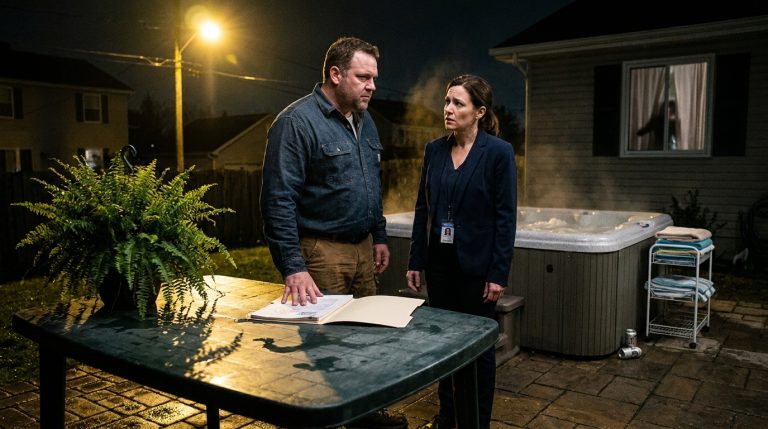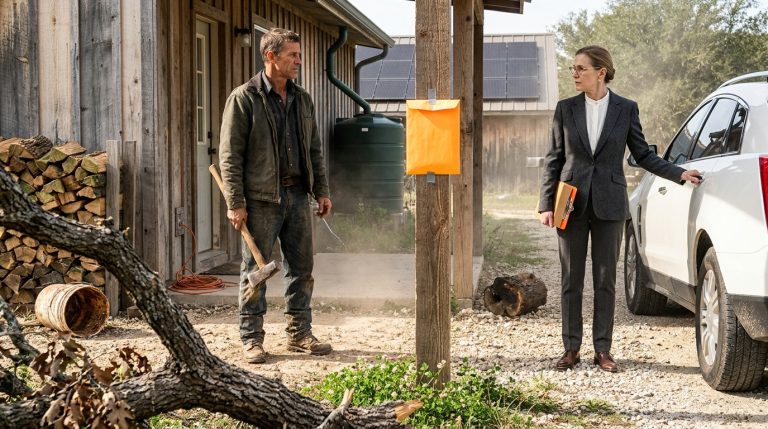
The Last Manifest: A Veteran’s War on the Asphalt as Shadows Close in on the Yard
CHAPTER 1: THE SILENT SCAN
The office door groaned on its hinges, a sound like a dry throat clicking. Mike didn’t rush. He moved with the slow, deliberate grace of a man who had spent his life waiting for the ambush that eventually arrives. The beam of his heavy-duty flashlight cut through the darkness, illuminating dust motes dancing in the air, then settling on the wreckage of his desk.
Files lay like shrapnel, tossed and sorted with a clinical, terrifying efficiency. They weren’t looking for money. They were looking for the specific manifest he’d kept of his previous military-contracted hauls—the ones that had led to the initial offer.
He scanned the perimeter of the room. The window was shattered, but the glass had fallen outward, not inward. Whoever had been here had been invited in or had a key. His heart hammered a steady, rhythmic beat against his ribs, a metronome of survival. He knelt by the desk, his flashlight beam catching the edge of the diagnostic scanner he’d used to check his rig’s engine computer earlier that afternoon.
The light hit the casing, and Mike froze.
A tiny, hairline fracture ran along the plastic seam of the scanner. Someone had pried it open and swapped the internal battery. He pulled his pocketknife, the blade clicking with a sound that felt like a gunshot in the silent office. He carefully pried the unit apart. Tucked beneath the motherboard, wedged into a space that should have been empty, sat a micro-transmitter. It wasn’t military-grade—it was too clean, too modern. It was corporate.
His hand didn’t shake, but the temperature in the room seemed to plummet. He hadn’t just been tailed; he had been tagged. Every mile he’d driven for the last forty-eight hours had been logged, tracked, and uploaded to a server he couldn’t see.
He stood up, his joints popping, and walked to the window. The black SUV was parked at the edge of the lot, engine dead, lights extinguished. But it wasn’t alone. Another set of headlights flickered to life two hundred yards down the county road—a long, low silhouette of a sedan. They weren’t hiding anymore. They were closing the perimeter.
He looked down at the transmitter in his palm, the cold metal biting into his skin. If they were this confident, they weren’t worried about being seen. They were worried about what he might have already realized. He looked at the empty space on his desk where his logbook used to be. They had taken the records, but they’d left the tracker.
A realization cold enough to stop his breath settled in his gut: they didn’t want his silence. They wanted his route.
The front gate rattled—not the wind, but the rhythmic, metallic thud of someone testing the tension of the chain. Mike stepped back into the shadows of the filing cabinet, his thumb catching the release on his flashlight. He wasn’t going to wait for them to finish the lock. He was going to give them exactly the lead they were looking for, and he was going to make sure it led them straight into a wall.
He walked to the back exit, his boots silent on the concrete. He reached for the heavy iron handle, but stopped. A faint metallic scrape echoed from the alleyway—the sound of a holster buckle hitting a brick wall.
They were already inside the perimeter.
CHAPTER 2: THE ALLEYWAY AMBUSH
The sound was faint—a microscopic friction of leather against grit—but to Mike, it was a thunderclap. He pressed his back against the cold, damp concrete of the office exterior, his breath hitching in his chest. The smell of wet soot and old oil hung heavy in the air, a familiar scent that suddenly, violently, dissolved into the memory of a blown tire in a desert gorge, the heat of a rifle barrel against his palm, and the terrifying silence before an insurgent patrol opened fire.
He shook the memory away like a drop of water. This wasn’t a war zone. This was a trucking yard in the middle of nowhere, yet the tension vibrating in the air was identical. The shadow moved along the fence line, a darker patch of nothingness against the chain-link grid. Mike didn’t reach for his shotgun; it was too cumbersome for close-quarters. His right hand dipped into his waistband, his fingers closing around the cold, textured grip of his sidearm.
Therefore, he thought, they are here to confirm the tracker. If I move, they see me. If I stay, they find me.
He waited for the next sound. It came—a soft, rhythmic tap of a bootheel, followed by the faint click of a flashlight’s bezel being adjusted. They were sweeping the area. They were methodical, professional, and entirely convinced that the “old man” inside was unarmed and unsuspecting.
Mike peered around the corner of the filing cabinet, his vision adjusting to the low light. A man stood near the rear gate, his silhouette lean and athletic. He wore a tactical vest that hugged his torso, and a radio earpiece glowed with a faint, blinking blue light. The man wasn’t just a thug; he was a operator. He held a small, handheld scanner that emitted a low-frequency hum, a sound that Mike now recognized as the “handshake” signal for the transmitter they’d planted in his diagnostic kit.
The operator turned toward the office door. Mike knew he had seconds before the man discovered the forced lock and the empty room. He needed to create a distraction that would force them to move away from the gate and toward the open ground of the lot—where the light was better and he had the advantage of knowing every pothole and pile of gravel.
He reached into his pocket and pulled out his heavy keychain. With a flick of his wrist, he tossed it toward the far corner of the alley, near the dumpster. It clattered against the metal, a sharp, jarring noise that tore through the quiet.
The operator pivoted instantly, his movements fluid and trained. “Contact,” he hissed into his comms, his voice clipped and devoid of emotion.
Mike didn’t wait. As the man turned, Mike stepped out from the shadows. He didn’t run. He moved with the low-center-of-gravity stride he’d learned in the service. He closed the gap in three seconds, his boots silent on the packed earth.
He didn’t aim for the head or the chest. He aimed for the man’s center of gravity. He drove his shoulder into the operator’s side just as the man finished his turn. The impact was sickeningly solid. The operator went down, the scanner skittering across the gravel, the screen shattering into a spiderweb of dead pixels.
The man grunted—a short, sharp exhale—and rolled, his hand moving to the weapon on his hip. Mike was already there. He kicked the man’s hand, the heavy steel of his boot catching the operator’s wrist with a sickening crunch. The gun slid away into the darkness.
“Don’t,” Mike said, his voice a low growl.
The operator looked up, his face illuminated by the faint glow of the security light. He was younger than Mike, but his eyes were ancient—filled with the same hollow, detached calculation Mike had seen in every mercenary he’d ever dealt with. He didn’t look afraid; he looked annoyed.
“You’re making a mistake, Clifford,” the man said, his voice unnervingly calm. “You have no idea what you’re pulling on.”
“I know enough,” Mike countered, his grip on his own sidearm unwavering. “You’re off the clock. You’re trespassing. And if you don’t start talking, the police are going to find you sitting in the middle of my yard with a broken wrist.”
The operator let out a cold, sharp laugh. He didn’t fight back, but his eyes drifted toward the office door. “The police? You think they haven’t already been briefed on your ‘erratic behavior’?”
Mike felt a chill snake down his spine. The confidence wasn’t a bluff. The operator wasn’t just here to track him; he was here to set a narrative. If Mike killed him, or even wounded him, he’d be the one in cuffs.
But, Mike realized, they still don’t know that I know about the transmitter.
“We’re done here,” Mike said, keeping his weapon steady. “Get up. Move toward the gate. And if I see another SUV in this lot tonight, I’m not going to be the one calling the police.”
The operator stood slowly, cradling his broken wrist. He looked at Mike with a look of genuine pity. “You’re an relic, Clifford. You’re fighting a war that ended twenty years ago. The world doesn’t care about honor anymore. It cares about efficiency.”
He turned and limped toward the gate. Mike followed him, keeping the distance, his eyes scanning the perimeter for a second man. The lot was deathly still, the wind having died down completely.
As the operator reached the gate, he paused and looked back. “The transmission was just the start, Mike. You think you’re protecting your yard? You’re just drawing a map for us.”
He slipped through the gate and vanished into the darkness of the road. Mike stood in the center of his lot, the silence returning, heavy and suffocating. He realized then that the operator hadn’t been defeated; he had been redirected. He had been sent to see if Mike would break.
Mike turned back toward the office, his chest burning with a mix of adrenaline and cold, hard clarity. He had won the skirmish, but the war had just shifted into his own backyard. He looked at the diagnostic scanner, still sitting on the desk where he’d left it. It was a beacon. And as long as it was inside his perimeter, he was never going to be alone again.
He needed to dismantle it—not just the transmitter, but the entire network they were using to monitor him. He walked to his truck, the Kenworth hulking in the moonlight like a silent, iron sentry. It was time to stop being the target and start being the one who tracked the hunters.
CHAPTER 3: THE DINER GAMBIT
Mike remained frozen in the center of his gravel lot, the image of the operator’s pitying expression burned into his mind like a sear. He could still feel the weight of his own handgun against his palm, the cold metal an anchor in a world that suddenly felt fluid and untethered. The operator’s warning—that the transmitter was merely a map—echoed in the stillness.
He didn’t move toward his office. Instead, he walked toward the Kenworth, his boots crunching loudly in the dead-quiet night. He reached the cab, opened the heavy door, and stepped inside. The interior still smelled of his last pot of coffee—sharp, burnt, and grounding. He didn’t turn on the overhead light. He sat in the driver’s seat, his back to the door, and reached beneath the dash.
His fingers found the wiring harness he’d modified years ago. He traced the lines, his pulse thrumming in his fingertips. If the transmitter was sending data, it had to be pulling power from a constant, non-switched line. He felt the cold plastic casing of the device tucked behind the diagnostic port. It was warm—unnervingly warm, as if it were alive.
He didn’t rip it out. If he killed the signal now, they would know he was onto them before he had a chance to counter-move. Instead, he pulled a small roll of lead-lined tape from his emergency kit, a remnant of his days shielding sensitive electronics from EMP bursts. He wrapped the device in three thick layers, muffling the signal, turning the “beacon” into a whisper that would be indistinguishable from background noise.
The low-frequency hum in his ears vanished, replaced by the natural, rhythmic ticking of the truck’s engine cooling down.
Mike exhaled, a long, shaky breath that misted in the cold air. He needed a distraction, something to make them believe he was still playing by their rules while he moved off the board. The diner off Highway 64 was the natural choice. It was a neutral zone, a place where information flowed through truckers like water through a cracked pipe.
He started the engine. The roar of the Kenworth was a defiant vibration that shook the night. He pulled out of the yard, the headlights cutting through the darkness, sweeping over the empty road. He didn’t look back. He knew they were watching, waiting to see which direction he’d turn, waiting to see if he’d lead them to his contact or his fear.
Forty minutes later, the neon sign of the diner flickered like a dying heartbeat. Mike pulled the rig into the back row, well away from the light. He climbed down, his knees popping, and walked toward the diner. The smell of frying grease and burnt coffee hit him the moment he opened the door.
He scanned the booths. The place was mostly empty, save for two long-haulers sleeping with their heads on the table and a solitary man sitting in a corner booth—a man Mike recognized: Henderson, a local spotter who worked for whoever paid the highest rate.
Mike didn’t head for his usual spot. He sat at the counter, pulling his hat low. He ordered a coffee, the steam rising in front of his face, and waited. He had a piece of information, a lie he’d crafted during the drive: a fake drop-off location in the industrial park three towns over. It was a dangerous play, but it was the only way to test how deep their surveillance went.
The temperature in the diner seemed to drop ten degrees. The front door creaked open, admitting a gust of wind that rattled the silverware on the tables. A man in a dark jacket stepped in—not the operator from before, but someone different, taller, with the stiff posture of a man who spent his life carrying a heavy load. He didn’t look at Mike. He walked straight to the counter, two seats away, and ordered a black coffee.
Mike watched the man’s reflection in the glass of the coffee machine. The man wasn’t watching the room; he was watching the parking lot.
Mike leaned forward, his voice a gravelly murmur. “The 402 job,” he said, loud enough for the man to hear but low enough to avoid the waitress. “The industrial park, dawn tomorrow. Sealed load. If they’re looking for a driver, tell them I’m tired of waiting.”
The man didn’t flinch. He sipped his coffee, his eyes never leaving the window. “Clifford,” the man said, his voice flat. “You’re playing a game you don’t understand.”
“Maybe,” Mike replied, his heart hammering against his ribs, a steady, rhythmic pressure. “But I’m the only one with the credentials to move the equipment they’re hauling. You want the job done, you tell them I’m in.”
The man turned his head slightly. The harsh overhead light caught the edge of his jaw, sharp and unforgiving. He didn’t answer. He simply left a five-dollar bill on the counter, stood up, and walked out of the diner.
As the door clicked shut, Mike looked out the window. A distant engine roared to life—not the soft purr of a sedan, but the heavy, guttural growl of a truck that hadn’t been tuned in years. The sound didn’t come from the parking lot. It came from the shadows of the nearby overpass, an echo that shouldn’t have been there.
Mike felt the air in the diner shift. The spotter, Henderson, was standing up, his eyes locked on Mike. He wasn’t a friend. He was a trigger.
Mike stood, his hand going to his pocket. He hadn’t just planted a rumor; he’d started a fire. And as he turned to face the room, he realized that he’d walked exactly into the trap he had been trying to set for them. The diner wasn’t a neutral zone anymore; it was an ambush.
CHAPTER 4: THE BROKEN LINK
Mike didn’t move toward the door. Instead, he pulled his coat tight against the sudden draft and pivoted toward the kitchen service window, where he could see the back of the building. He waited for the rhythm of the diner to return to normal—the clinking of spoons, the hum of the cooling fan, the desultory chatter of the long-haulers—before he made his exit.
He moved through the back hallway, his footsteps muffled by the industrial matting. Outside, the night air had turned, a fine, frigid drizzle coating the gravel in a layer of slick oil. He kept to the shadows of the dumpster, his eyes sweeping the lot. There, by the edge of the access road, sat the truck he’d heard earlier. It was a heavy-duty hauler, painted in nondescript gray, its engine idling with a rhythmic, labored chug.
He watched from behind a stack of wooden pallets. The man who had been in the diner—the one with the stiff posture—stepped out of the shadows and approached the driver’s side. He didn’t speak. He simply stood there, checking his watch, then leaned in close to the window.
Mike moved closer, his boots silent on the wet earth. He felt the cold drizzle seep through his shirt, the dampness a sharp contrast to the heat of his adrenaline. He needed a closer look at the cargo.
The driver shifted the rig into gear. As the truck pulled forward, the taillights flared briefly, illuminating the rear bumper. Mike saw it then: the license plate didn’t match the state registration sticker, and the bolt holding it in place was freshly scoured, the metal shining like raw bone. It was a transport unit, a ghost truck meant to disappear into the heavy, late-night traffic of the interstate.
Therefore, he calculated, if I follow them, I’ll find the drop-off point they think I’m expecting.
He didn’t rush. He walked back to his Kenworth, his movements measured, deliberate. He knew the syndicate would be monitoring the road, expecting him to follow their lead. He didn’t chase the gray truck. Instead, he took the long way around, cutting through the muddy service tracks that bordered the industrial park. He knew these roads better than any corporate map—he’d been hauling through this county before the interstate had even been paved.
He drove with his lights off, relying on the moonlight and his own memory. The terrain was rough, the truck swaying like a ship in a storm. He felt every bump, the chassis groan echoing the tension in his own muscles.
After twenty minutes of winding through the dense treeline, he pulled the Kenworth to a stop on a ridge overlooking the industrial park. Below, the gray truck had stopped in front of a sprawling, windowless warehouse.
He watched through his binoculars, the lenses fogging slightly from the cold. The side doors of the warehouse slid open. There were no loading docks, no signs of a logistics company. Just a team of men in plain black tactical gear, working with a speed and precision that sent a shudder through him. They weren’t moving crates. They were moving server towers—heavy, encased in protective lead shielding—and small, metallic cylinders that hissed as they were transferred into the dark maw of the building.
It’s not tech, he realized, his grip tightening on the binoculars until his knuckles ached. It’s hardware recovery.
He noticed one of the cylinders drop. It hit the concrete, and for a split second, a greenish, pulsating light flickered from a crack in the housing. One of the men in black rushed to cover it, his movements frantic, almost terrified. They weren’t just transporting equipment; they were cleaning up a failure. A high-risk, off-book failure that wasn’t supposed to exist outside of a laboratory.
Mike felt the weight of the realization pressing against his chest. Davies hadn’t just offered him a job to move freight. He had offered him a chance to be the fall guy for a disaster. If Mike had taken the load, he would have been the one driving this radioactive or toxic debris across the state line, his own logs providing the paper trail for a crime he didn’t even understand.
He lowered the binoculars. The rain had picked up, a steady drumming on the roof of his cab. The smell of ozone was faint here, carried on the wind—not from the industrial machinery, but from whatever was leaking out of those cylinders.
He started the engine, the roar barely audible over the rain. He had what he needed. Not the full truth, but the shape of the lie. They weren’t just protecting their secrets; they were desperate. And a desperate man, even one with a badge or a corporate contract, was a man who made mistakes.
He didn’t drive toward the warehouse. He turned the wheel and navigated back onto the service track. He had a call to make—not to the police, and not to his daughter. He needed to reach someone who understood the weight of the things these men were trying to bury.
As he pulled back onto the main road, the headlights of an oncoming car swept over his windshield. He ducked, his heart hammering against his ribs, but the car didn’t stop. It kept going, speeding toward the warehouse, its taillights bleeding red into the darkness. Mike didn’t follow. He knew where the road ended. And for the first time in three days, he wasn’t just reacting. He was planning.
CHAPTER 5: THE TRANSMISSION TRAP
The feedback loop was almost inaudible—a razor-thin whine that set Mike’s teeth on edge. He sat in the darkened cab of the Kenworth, the dashboard lights off, his eyes scanning the rainy expanse of the truck stop parking lot. He had intended to use the lead-lined tape to mask the signal, but the syndicate hadn’t just placed a tracker; they had installed an active, two-way diagnostic bridge.
His hand hovered over the dash panel, the plastic cold and slick under his touch. Therefore, he thought, they aren’t just watching where I go. They’re listening to everything happening inside the cab.
He realized with a sinking, heavy finality that his conversation in the diner—his attempt to feed them false information—had likely been recorded in crystal-clear audio. He had walked right into the trap. Every word, every hesitation, every secret he had murmured to himself in the silence of the rig had been broadcast back to their warehouse.
He needed to kill the power to the entire auxiliary board. It was a drastic, permanent move that would leave him without lights or radio for the remainder of the night, but it was the only way to sever the bridge. He gripped the heavy-duty wire cutter he kept in the door pocket. The tool felt weighted, purposeful.
The rain intensified, a torrential downpour that turned the asphalt into a black mirror. A pair of headlights crested the rise near the entrance, moving slowly, deliberately, between the rows of parked trucks. It wasn’t the gray hauler from earlier. This was a low-slung, unmarked vehicle, cruising with the predatory patience of a shark.
Mike didn’t wait for them to spot him. He reached under the dash, his fingers finding the main power junction. With a quick, sharp snap, he cut through the heavy-gauge cabling. The cab plunged into absolute, suffocating darkness. The hum died. The faint glow of the dash icons vanished.
In the sudden absence of the electronics, the silence was deafening. But then, a different sound emerged: the metallic scrape of boots on wet pavement, moving closer, circling his rig.
They had been waiting for the signal to drop.
Mike didn’t move. He sat perfectly still, his breath shallow, controlled. He felt the weight of his sidearm on his right hip and the shotgun resting against the passenger seat. He waited for the knock on the door, or the flash of a spotlight, or the jarring impact of a forced entry.
Minutes stretched into an hour. The unmarked vehicle circled the perimeter, its headlights sweeping over his cab, but it never stopped. They were toying with him—making sure he knew they were watching, forcing him to keep the pressure of the internal standoff alive.
But, he realized, if they are circling, they aren’t ready to breach. They’re waiting for something.
He looked out the side mirror. A flicker of movement caught his eye—the glint of a tripod being set up near the edge of the service road, maybe a hundred yards out. They were setting up visual surveillance. They weren’t coming in. They were going to keep him pinned until dawn, hoping that fatigue or a lapse in judgment would force him to react.
He reached into his bag, pulling out the small, rusted trailer hitch pin he’d kept for years—the one he’d meant to replace. He gripped it tightly, the cold, uneven surface digging into his palm. It was a small, ugly object, but it was real. In a world of sophisticated signals and invisible trackers, it was a piece of iron, and iron didn’t lie.
He knew he couldn’t stay here. The longer he sat, the more they controlled the ground. He needed to move, but not the way they expected.
He leaned across the passenger seat, his movements slow and agonizingly precise. He grabbed the heavy fire extinguisher from its mount. He wasn’t going to drive out the front gate. He was going to wait for the shadow of the next passing truck to mask his movement, and then he was going to slip out the back of the cab and disappear into the dense, overgrown brush that lined the rear of the lot.
His heart hammered against his ribs—a steady, driving cadence. Every choice he made now was a move in a game of inches. He checked his watch. 3:00 AM. The hour of lowest resolve. He waited, his eyes locked on the rhythmic sweep of the surveillance car’s lights.
The next truck rolled in, a massive refrigeration unit that roared like a hurricane. As it passed his rig, the vibration rattled the cab, and the sound was like a physical shroud. Mike didn’t hesitate. He opened the passenger door, the hinge groaning in the cold, and slid out into the rain.
He hit the mud with a silent thud and rolled, disappearing into the tall, wet grass behind the rig. The rain was freezing, soaking his jacket within seconds, but he barely felt it. He was a shadow among shadows, moving toward the edge of the lot, his senses dialed into every snap of a twig and every shift in the wind.
He reached the tree line, his chest heaving, his muscles screaming with exhaustion. He looked back at his truck, the dark, hulking shape of the Kenworth standing silent in the rain. He had left his phone, his logs, and his weapons behind. He had nothing but his own grit and the cold iron pin in his pocket.
And as he turned toward the woods, he realized that for the first time since this began, he was truly free—not because he was safe, but because he was no longer playing by their rules. He was going to find the source of those cylinders, and he was going to break it, one piece at a time.
CHAPTER 6: THE LEVERAGE POINT
Mike didn’t look back. He kept his stride rhythmic, his breathing suppressed to a shallow, silent rasp. Behind him, the sound of movement had stopped, replaced by the heavy, suffocating silence of the forest floor under the rain. He moved deeper into the thicket, toward the old service road where he knew the terrain dipped into a natural drainage basin. If they were following, he’d force them into a terrain they couldn’t control.
His mind was a storm of calculations. He needed help, but the kind of help he required didn’t come from a phone book. He reached the hollowed-out stump of an ancient oak—a place he’d used for years to stash emergency gear. He pried away the rotted wood and pulled out a heavy, canvas-wrapped bundle: a legacy radio, analog and shielded, a piece of tech the modern world had long ago labeled obsolete.
Therefore, he reasoned, if I can reach the high ground of the old transmitter tower, I can bridge the gap.
He climbed. His muscles burned, a deep, radiating fire that made his movements jagged. He pushed through briars that tore at his jacket, his focus locked onto the skeletal silhouette of the old radio tower looming against the dark, churning clouds. He reached the base, his fingers fumbling with the rusted ladder rungs. The metal was biting, slick with oil and rain, but he climbed, hand over hand, until he reached the maintenance platform sixty feet above the ground.
From this vantage point, the industrial park was a map of cold, electric light. He saw the warehouse—a dark, jagged scar on the landscape. And he saw them. Two SUVs, idling near the perimeter fence, their lights scanning the treeline. They were searching for him, but they were looking at the ground, not the sky.
He opened the canvas bundle. He hooked the radio into the emergency antenna line he’d bypassed months ago, hoping it still held a charge. He twisted the frequency dial, searching through the static. He wasn’t looking for a broadcast; he was looking for a specific, non-public signal—the secure channel his former unit used for field testing. It was a long shot, a desperate gamble that the retired Sergeant Henson he’d spoken to earlier hadn’t been lying about the syndicate’s ties to the chain of command.
Static hissed, a white-noise scream that filled his ears. Then, a click. A voice—clipped, professional, and entirely detached.
“Package recovered. Stability at 40 percent. Moving to phase two.”
Mike froze. The signal was coming from inside the warehouse. He hadn’t just found the syndicate; he had found the core of their operation. He listened, his heart hammering against his ribs, a frantic rhythm that matched the ticking of the radio’s cooling transistors.
“Negative, base,” a second voice answered. “The driver, Clifford, has gone dark. We’ve lost his tracker. Recommendation: Full site lockdown.”
Mike’s hand gripped the radio’s handset. He had the leverage, but he had no way to deploy it. He couldn’t just call the police with a recording of a private security firm talking about “stability.” They would laugh him off the line. But what if the military heard it? What if he broadcast this back onto the very frequency they were using?
But, he realized, if I broadcast, I reveal my location. I become the target.
He watched the SUVs below. They were moving closer to the treeline. The man in the diner—the one with the stiff posture—stepped out of the passenger seat, his eyes lifting toward the tower. He had a pair of high-powered optics in his hands.
The psychological phantom hit Mike like a physical blow: the image of a thermal camera mounted on a drone, the same type of tech his unit had tested in the desert, the same tech that had failed, causing a catastrophic fire. He saw the man below adjust his focus, the reflection of the lens flare cutting through the darkness like a laser pointer.
They saw him.
He had seconds. He slammed the transmission switch and keyed the microphone. He didn’t speak. He simply held the handset to the radio’s speaker and dialed the volume to maximum, forcing the broadcast from the warehouse back out into the open, over the airwaves, into the digital ether.
The sound of the warehouse team’s voices filled the woods—a high-pitched, electronic screeching of stolen, classified data being transmitted in real-time. He saw the SUVs jerk to a halt below. The man with the optics stumbled, his hands flying to his ears, the radio interference clearly causing a feedback loop in his own headset.
Mike didn’t wait to see the outcome. He shoved the radio into his coat, scrambled down the ladder, and dropped into the brush. He moved not with caution, but with the frantic, raw energy of a man who had nothing left to lose. He ran toward the swamp, toward the dense, suffocating undergrowth where the ground was soft and the world turned to gray, murky water. He had just declared war, and he knew now that the only way to win was to be the ghost they couldn’t catch.
CHAPTER 7: THE BOTTLENECK
The swamp didn’t care about his fatigue. It was a labyrinth of black water, tangled cypress roots, and shadows that seemed to swallow his very existence. Mike pushed forward, the radio handset still clutched in his hand like a talisman. Every step was a battle of physics—heaving his weight out of the muck, testing the ground, moving before the suction of the mire could pull him under.
Behind him, the noise grew. The men in black had brought in dogs—Dobermans, their barks sharp and jagged, cutting through the heavy rain. They were closing the distance. He had led them away from the warehouse, but he had also led them straight into the only exit that remained: the old bridge over the creek, a structure condemned and left to rot years ago.
Therefore, he thought, if I can reach the bridge before they catch my scent, I can force them into the one point where their numbers don’t matter.
He reached the creek bank. The water was swollen, churning with the debris of the storm. The bridge was a skeleton of rusted steel, its planks missing, its railings hanging like broken teeth. It was a death trap, but it was his only leverage. He scrambled up the embankment, his fingers tearing on sharp iron shards, and pulled himself onto the first structural beam.
He didn’t cross. He stopped at the midpoint, where the steel had rusted through, leaving a wide, terrifying gap. He pulled the heavy, rusted hitch pin from his pocket. He wedged it into a structural rivet he’d identified years ago—the bridge’s weakest point. He leaned his entire body weight into it, his muscles burning as he exerted the torque required to shift the aging support beam.
With a screech of protest that sounded like a dying beast, the rusted bolt gave way. The bridge groaned, tilting dangerously to the left.
He didn’t wait. He leaped across the gap, landing on the far side with a jarring impact that sent a spasm of pain up his spine. He turned back, watching. The syndicate team emerged from the tree line, their flashlights dancing like frantic fireflies. They saw him, and they accelerated, their tactical gear glistening in the rain.
The team lead—the man from the diner—stopped at the edge of the bridge. He looked at the gap, then at the weakened steel structure. He didn’t rush. He stood there, his posture stiff, his eyes scanning the structure with the cold, analytical gaze of a man who evaluated every risk as a probability.
“Clifford,” he shouted, his voice steady despite the roar of the creek. “You’re cutting off your only path out. You’re trapped.”
“I’m not trapped,” Mike called back, his voice ragged but clear. “I’m just waiting for the authorities to show up. And thanks to your broadcast, they’re already on the way.”
The man’s eyes flickered. He knew the broadcast was a lie—or rather, a bluff. But he also knew that if the military was monitoring that channel, they wouldn’t just be coming for Mike. They would be coming for the data. The man turned to his team, barking orders in a language Mike didn’t recognize.
They didn’t cross. They started to retreat, moving back into the treeline.
Mike stood alone on the bridge, the rain lashing against him, his lungs heaving. He had won the tactical victory, but he realized the cost. They were pulling back to regroup, to call in a higher authority, or to simply burn the site down. He looked down at the creek, the water surging beneath him. He had held the line, but the line was now a dead end.
He reached into his coat and felt the canvas-wrapped radio. It was dead. The batteries had given out during his flight. He had no broadcast, no leverage, and no backup. He stood on the shaking, rusted bridge, his silhouette a lonely, stark line against the backdrop of the dark forest. He wasn’t afraid. He was beyond that now. He was tired, a deep, bone-weary exhaustion that felt like it had been building for twenty years.
He watched the syndicate’s lights fade into the darkness. He knew they would return, and he knew that when they did, they wouldn’t be playing games. He turned and began the long, slow climb down the other side of the creek bank. He was going to walk out of this swamp, he was going to reach the highway, and he was going to finish what he had started—not with a radio or a broadcast, but with the only thing he had left: his own, unbreakable will.
CHAPTER 8: THE FINAL LOG
Mike emerged from the tree line just as the first gray light of dawn touched the horizon. He was covered in mud, his clothes heavy and cold, but his eyes were clear. He walked toward the main road, not with the frantic pace of a man running away, but with the steady, inexorable stride of a man returning to claim his ground.
He reached the highway, the asphalt gleaming like a wet ribbon. A cruiser—state patrol—was parked at the edge of the access ramp, the officer inside finishing a report. Mike didn’t wave. He walked directly to the window and tapped on the glass. The officer looked up, startled, then frowned as he saw the battered, mud-caked man standing in the rain.
“I need to speak to a senior detective,” Mike said, his voice raspy but steady. “And I need you to contact the regional command center. Tell them I have the evidence they’ve been looking for regarding the warehouse incident.”
He reached into his pocket, not for a weapon, but for the rusted hitch pin—the object he’d used to trigger the bridge’s collapse. He placed it on the hood of the cruiser. “And tell them to check the structural logs of the bridge over Creek Road. They’ll find the syndicate’s transport unit abandoned and trapped under the debris.”
The officer’s eyes widened. He recognized the name; the alert had been circulating for hours. Within the hour, the road was closed. By midday, a full tactical team had descended on the industrial park. Mike watched from the backseat of the patrol car as they systematically dismantled the warehouse. It wasn’t a raid; it was an autopsy. They weren’t just finding weapons; they were finding the records of the firm’s failed experiments, the logs of every “lost” shipment, and the internal memos detailing the systematic purging of the independent drivers.
He saw Davies being led out in cuffs, the salesman mask finally, irrevocably shattered. Davies didn’t look at Mike. He looked at the ground, his body language that of a man who realized he had been nothing more than a disposable line item in a balance sheet that had just been erased.
The payoff was cold and absolute. The syndicate had been defeated not by a grand gesture, but by the weight of their own arrogance. They had tried to turn a trucker into a ghost, but in doing so, they had given him the very leverage they couldn’t afford to be exposed.
The “Cool Down” came in the form of a quiet, sterile office at the regional headquarters. The general from the base—Whitaker—was there, looking at the logs. He didn’t offer a medal. He offered a nod—a silent, veteran-to-veteran acknowledgement of the cost.
“You did the right thing,” Whitaker said, closing the folder. “The firm is done. Every executive, every contractor involved in the cover-up is being processed. It’s over.”
Mike looked at his hands. They were raw, shaking slightly as the adrenaline finally left his system. He thought of Kelly, waiting at home. He thought of Earl and the shop. He stood up, feeling the weight of the last four days finally lifting. He had lost his rig—it was being held as evidence—and his yard was a wreck. But he was alive.
He left the station and walked into the parking lot. The sun was out now, a soft, pale warmth that felt like an apology. He reached the curb and saw Kelly’s car pulling in. She didn’t say a word. She just stepped out and pulled him into a hug that held all the fear and relief of the last week.
He reached into his pocket and pulled out the only thing he’d kept: the rusted pin. He handed it to her. “I need to fix that gate,” he said, a small, tired smile touching his lips. “It’s been rattling for years.”
Kelly looked at the iron pin, then back at him. She didn’t ask about the warehouse or the firm or the lies. She just nodded. “Let’s go home, Dad.”
As they drove, Mike leaned his head against the window, watching the landscape roll by. The road was the same as it had always been, yet everything was different. The asphalt wasn’t a trap; it was just a path. He closed his eyes, the rhythm of the car humming against his spine. The war was over, and for the first time in a long time, the silence didn’t feel like an ambush. It felt like peace.