The Echo of the Ridge: A Veteran’s Quiet Return to the Craft of Meaning and Connection
CHAPTER 1: The Rattle of Styrofoam
The hall was a cathedral of ghosts. Faded photographs of men in crisper uniforms than any modern tailor could produce lined the walls, their eyes watching the room from behind glass that hadn’t been polished in years. Walter sat in the corner, his back to the wall, his coat hanging off his frame like a memory of a larger man.
He lifted the coffee. It was lukewarm, the kind of bitterness that coated the tongue, but he held it with both hands. Even so, the tremor—a fine, high-frequency vibration that lived in his tendons—made the cup tap-tap-tap against the table. It was a rhythmic, pathetic sound, at least to the uninitiated.
“Looks like grandpa’s had a few too many before the fundraiser,” a voice cut through the ambient hum.
It was a young man—Donovan, judging by the name tape—leaning against the refreshment table with the kind of loose-limbed arrogance that only comes from never having been truly terrified. His friends snickered, their laughter a sharp, jagged noise that grated against the quiet dignity of the space.
Walter didn’t look up. He didn’t tighten his grip, nor did he offer a defensive glare. He simply pulled the cup toward him and took a sip, the liquid sloshing dangerously close to the rim.
He knew the sound of those laughs. He had heard them in other halls, in other lives, before the desert, before the ridge, before the silence of the North that still echoed in his joints when the weather turned. They were the sounds of people who mistook a lack of display for a lack of depth. They were the sounds of the surface-dwellers.
He set the cup down. Tap.
He looked toward the center of the hall, where the M24 sniper weapon system lay disassembled on a felt-covered table. It was a skeletal thing, stripped of its soul, its components arranged with the clinical coldness of a laboratory. Most of the attendees moved past it with a casual, respectful nod. But Walter saw the headspace, the alignment of the bolt, the slight wear on the action—the physical scars of a weapon that had been through cycles of fire.
The tremor in his hands didn’t stop, but his pulse slowed, shifting into the deep, rhythmic beat of a man who had once counted his life in seconds. He stood up, his knees popping like dry wood. He didn’t care about the young men at the table. He cared about the rifle. And as he began to walk toward it, he felt the heavy, suffocating weight of the truth he had carried for six years—the truth that he had never actually left that ridge, not in his mind, and certainly not in his hands.
The air in the room seemed to thin as he approached the display, and for a fleeting second, the noise of the VFW hall vanished, replaced by the howling wind of a mountain peak he would never name.
“Hey, old-timer,” Donovan called out, his voice now a challenge. “You look like you’re searching for something. You sure you know what that thing is?”
Walter paused. He didn’t turn around yet. He felt the cold, hard reality of the rifle components calling to him, a siren song of purpose that hit him harder than any hunger. He knew the young soldier was trying to provoke a reaction, but the soldier didn’t know that Walter was already miles away, looking down the length of a barrel at a world that hadn’t yet realized its own fragility.
He turned, the faint rattle of his hands betraying nothing of the stillness in his soul. “I know exactly what it is,” Walter said, his voice barely rising above the murmurs of the hall. “But do you?”
CHAPTER 2: The Geometry of a Challenge
The air in the VFW hall was thick, saturated with the smell of floor wax and the underlying, metallic tang of the weapons on the display table. Donovan’s face had flushed—a faint, rapid change in skin tone that spoke of pride meeting an unexpected obstacle. His friends, however, were still, their bravado leaking out of them as they realized the room had turned. The silence wasn’t the empty void of confusion; it was the expectant, heavy quiet of an audience waiting for a master to speak.
Walter remained motionless. He didn’t lean into the challenge; he didn’t need to. He simply held Donovan’s gaze with the steady, detached focus of a man who had long ago traded his ego for raw, functional necessity. His hands, though trembling, were tucked into the pockets of his worn jacket, the tremor hidden from view but still vibrating against his own palms.
“I asked a question, Specialist,” Walter said, his voice flat and devoid of malice. “Do you know what this is?”
Donovan looked down at the disassembled M24. The parts lay like bones on the dark, felt-covered surface: the barrel, the bolt, the trigger guard, the scope. To anyone else, it was a mess of metal. To Walter, it was a map. He had disassembled and reassembled this specific system in monsoon rain, in suffocating heat, and in the freezing, thin air of high-altitude ridges where breathing felt like inhaling powdered glass.
“It’s an M24,” Donovan said, his voice regaining its footing, though it lacked the casual edge of seconds ago. “I told you. Remington action. 7.62 NATO. I’ve assembled it a dozen times this week.”
“Then do it,” Walter replied. He didn’t move toward the table yet. He stood in the narrow gap between the younger men and the goal. “Show me the sequence. Show me how you treat a tool that was designed to carry life and death in a single click.”
The crowd had shifted. People had stopped hovering near the punch bowl and the donation bins. A circle had formed, a human perimeter that tightened as the gravity of the encounter increased. Among them, Harrison, the older veteran, watched with a narrowed, calculating intensity. He was no longer just observing; he was gauging. He knew the specific, idiosyncratic steps required for a true field-strip and assembly of the M24—a sequence that wasn’t taught in standard manuals, but in the sterile, high-pressure environments of specialized schools.
Donovan hesitated, his fingers twitching toward the rifle components. He knew he was being watched, not just by his buddies, but by the entire hall. If he backed down now, he would be the boy who played with toys. If he proceeded, he was opening himself to a judgment he hadn’t prepared for.
He reached out, his movements stiff. He began to align the barreled action with the stock, his thumbs pressing against the cold steel. His technique was by the book—textbook, really. Precise, clean, and entirely devoid of intuition. He worked as if he were assembling a puzzle, checking the instructions in his mind, pausing to ensure the tolerances were flush.
Walter watched him, not with contempt, but with a weary, patient recognition. He saw the way Donovan’s eyes darted to the crowd to verify his performance, how he worried about the friction of the screws rather than the balance of the system. He was a good armorer, likely a capable one, but he was a mechanic, not an operator. He treated the rifle as an object, not as an extension of his own physical presence.
As Donovan worked, the hall’s atmosphere grew tight. A woman from the auxiliary dropped a serving tray, the crash of plastic echoing like a gunshot, but the group around the table didn’t even flinch. The collective attention was fixed on the movement of Donovan’s hands.
“The action,” Walter prompted, his voice cutting through the silence like a low-frequency hum. “Check the lug seating.”
Donovan paused, his hand hovering over the bolt. “It’s seated, old-timer. I know how to check a lug.”
“Do you?” Walter stepped a fraction closer. He didn’t invade Donovan’s space; he simply exerted a pressure of presence. “Or are you just hoping it’s seated because that’s where the diagram says it belongs?”
The challenge hung in the air, a physical weight. Donovan’s face hardened. He pulled the bolt back, checked the seating with a sharp, aggressive movement, and slammed it home with a satisfying click. He straightened up, his chest out. “Finished. One minute, forty seconds. Clean.”
He turned to Walter, his eyes daring the older man to find a fault. The young soldiers behind him let out a breath, their faces brightening with the relief of a perceived victory.
Walter looked at the rifle. It was assembled. It looked perfect. But he could see the slight, microscopic misalignment in the scope base—a flaw that wouldn’t matter on a firing range, but would cause a drift of inches at eight hundred meters.
“It’s assembled,” Walter conceded, his tone neutral. “You’ve built it well, Specialist. It would fire, and it would likely hit a target in a controlled environment.”
Donovan smirked, though it was thinner than before. “See? I told you.”
“But,” Walter continued, stepping past the young man and placing his hand directly onto the rifle’s stock, “you built it for a range. You didn’t build it for the field.”
He felt the cold temperature of the metal, a grounding sensation that raced up his arm and settled into his chest, momentarily steadying his tremor. He looked at Donovan, seeing not an enemy, but a reflection of the arrogance he himself had needed to shed decades ago.
“Now,” Walter said, his voice dropping into a register that made the hair on Harrison’s neck stand up. “Let me show you how it’s done when the air is too thin to breathe and the distance is a secret you keep from yourself.”
CHAPTER 3: The Ritual of the Blindfold
Donovan’s smugness had not yet fully vanished, but it was eroding, replaced by a twitching uncertainty around his mouth. He stepped back, gesturing to the disassembled rifle with a flourish that looked significantly less confident than his earlier display. “Be my guest, old-timer. The parts are all there. If you’re so keen on the field-strip technique, let’s see you put it back together without looking at what you’re doing.”
Walter didn’t reply. He focused his attention on the table, his movements deliberate, slow, and eerily controlled. He didn’t reach for the rifle yet. Instead, he reached into his coat pocket and pulled out a clean, slightly frayed bandana. It was a simple piece of fabric, faded at the edges, the kind of object that had served a dozen purposes over the years, from cleaning a lens to wrapping a wound. He held it up, the fabric catching the dim light of the overhead fluorescent tubes.
Harrison, the Vietnam veteran who had been watching from the sidelines, finally moved. He took the bandana from Walter’s hand, his expression serious. “You want me to do it?”
Walter nodded once. The tremor in his hand was still there, a constant, flickering disturbance, but as he closed his eyes and leaned forward to accept the blindfold, the movement of his head was as precise as a pendulum.
The darkness arrived instantly, a suffocating, familiar weight that blotted out the hall, the snickering soldiers, and the flickering lights. But in the black, the world gained a different kind of clarity. The smell of the gun oil—sharp, mineral, and clean—filled his nostrils. The cold metal components on the table became topography, a landscape he had memorized in the deepest, loneliest hours of his career.
He didn’t just know where the parts were; he could feel the ghost of them.
His hands rose. They were shaking—a rhythmic, involuntary pulse—but as they hovered over the table, he allowed his mind to descend into the muscle memory of the task. He didn’t fight the tremor. He utilized it, letting the vibration guide him into the familiar, tactile rhythms of the M24. His right index finger touched the stock first, the wood-composite finish feeling smooth and slightly cold against his calloused skin. He pulled it toward him, finding the exact center of the table.
He heard a breath hitch in the crowd. Someone whispered, “He’s doing it.”
He didn’t care about the crowd. He was listening to the components. He picked up the barreled action, his fingers dancing across the serrations of the bolt handle. His movements weren’t the hurried, frantic motions of a technician trying to prove a point; they were the fluid, economical gestures of a shadow moving through a room. He fitted the action into the stock, the metal sliding against the composite with a soft, resonant thrum that told him the alignment was perfect down to the micron.
“He’s fast,” someone murmured, their voice hushed with disbelief.
Walter ignored them. He was in the rhythm now. The trigger assembly slid into its housing; the screws went in, tightened with a torque he had calibrated in his own nerves over thousands of cycles. Each piece found its home. He didn’t fumble. He didn’t hesitate. The internal map of the weapon was so vivid that the darkness felt irrelevant. He was no longer in a VFW hall; he was in a supply tent in a rainstorm, or a bunker overlooking a valley, the weight of the rifle’s history leaning into his own.
He reached for the scope. This was the final step—the critical piece that turned a rifle into a tool of precision. He felt the mounting rings, the cold steel clicking into place with a definitive snap. It was a sound of absolute finality.
He paused, his hands hovering over the now-assembled weapon. He could feel the cold of the metal seeping into his fingertips, the temperature slowly matching his own skin, as if the rifle were drawing the heat from his body. For a heartbeat, the tremor in his hands vanished, silenced by the sheer, overwhelming familiarity of the task. He breathed out, a slow, steady release that emptied his lungs and grounded him completely.
He reached up, found the knot of the bandana, and pulled it away.
The world rushed back in—the harsh, yellow light of the hall, the faces of the people crowded around the table, their expressions shifting from amusement to something approaching awe. Donovan was staring at the table, his mouth slightly parted, his gaze fixed on the rifle that stood fully assembled, its scope perfectly aligned, its bolt locked into position.
Walter didn’t look at Donovan. He looked at the rifle. It was a beautiful machine, but it was just a machine. He wiped his hands on his coat, the tremor returning instantly as the focus of the task faded.
Harrison leaned in, his eyes wide as he looked at the assembly. “Forty-one seconds,” he whispered, his voice trembling slightly. He looked at Walter, and for the first time, he saw something in the old man that made him take a half-step back, as if realizing he was standing too close to a fire he hadn’t fully understood. “I’ve seen that sequence before. I’ve only ever seen that sequence at the schoolhouse.”
The silence in the hall was profound. It wasn’t the silence of people waiting for a joke; it was the silence of people watching an anchor drop into the center of their shallow world. Walter looked at Harrison, seeing the recognition dawn in the older man’s eyes, and felt a quiet, exhausted ripple of relief.
He didn’t need to say it. He didn’t need to explain why his hands shook or why he was sitting in a corner with a cup of lukewarm coffee. The rifle, assembled in the dark, had done the talking for him. He turned to Donovan, who was still staring at the table, the arrogance on his face having been completely stripped away, leaving only a raw, naked confusion.
“It’s not just about the parts, Specialist,” Walter said quietly, his voice carrying clearly across the still room. “It’s about the memory. When you stop looking at the weapon and start feeling the weight of the air around it, you’ll understand why the hands shake.”
He turned away from the table, his knees aching as he walked toward his seat. He felt the weight of every eye in the room on his back, but he didn’t care. He was done proving things to the surface-dwellers. He just wanted to finish his coffee, sit in the quiet, and wait for the world to stop vibrating.
CHAPTER 4: The Shadows Recognition
Walter’s knees ached with the peculiar, deep-seated stiffness that only came after hours of standing on unforgiving concrete. He took a slow, measured step, his movements deliberate. Every muscle in his body felt tightened, coiled, and ready to snap back into the stillness of the past. As he retreated, the crowd didn’t just part; it seemed to dissolve around him, leaving a vacuum of silence that felt heavier than the ambient noise of the VFW fundraiser.
He didn’t make it to his corner. Before he could reach the folding chair that had become his only sanctuary, Harrison intercepted him. The Vietnam veteran moved with the deceptive agility of a man who still practiced the discipline of his service, even if his frame had softened over the decades. He stood in Walter’s path, his face etched with a complex mixture of curiosity and a dawning, heavy realization.
“You’re not going to sit down, are you?” Harrison asked. His voice was low, stripped of the bravado that had fueled the room only minutes ago. “I know that assembly pattern. I’ve seen it once, in a briefing room at Bragg, three years after I got out. They showed us a video. They didn’t show us the face of the man doing it, just the hands.”
Walter stopped. He felt the tremor in his fingers—a rapid, insistent vibration—and he shoved his hands deep into the pockets of his coat. He looked at Harrison. The man’s eyes were bloodshot, weary, and incredibly sharp. He wasn’t looking for a story; he was looking for a ghost.
“I was a lot of things,” Walter repeated, his voice raspy. “Most of them forgotten. Most of them better left that way.”
“The schoolhouse doesn’t forget,” Harrison said, stepping slightly to the side to block the view of the younger soldiers, who were still hovering in the distance like moths to a dying lamp. “They don’t just teach that sequence to anyone. It’s for a specific kind of engagement. The kind that ends with a single round and no witnesses.”
Walter looked past Harrison, toward the flag-draped wall. He could see his own reflection in the glass of a picture frame—a graying, hunched man who looked like he belonged on a park bench, not behind a scope. The discrepancy between what he saw and what he felt caused a sharp, sudden pang in his chest. “I’m just an old man trying to get through the night without spilling his coffee, Harrison. Don’t go digging for things that have been buried for a reason.”
“Buried?” Harrison laughed, a dry, coughing sound. “You think because the record is sealed, the history is gone? You’re not a ghost, Walter. You’re a resource. And there’s a hell of a lot of people in that organization who would have paid a fortune to know you were sitting in a VFW in this neighborhood.”
Walter felt the cold again, the phantom temperature of the ridge. He noticed a smudge on the floor—a scuff mark from a boot, a tiny, imperfect detail in the otherwise sterile environment of the hall. It reminded him of the gravel he had crawled over to reach his position in Kandahar. The detail was so sharp, so real, that he could almost hear the sound of the wind, even here in the climate-controlled air of the hall.
“It’s not a resource you want,” Walter said. “It’s a weight. And I’ve carried it long enough.”
Harrison reached out, hesitating before placing a hand on Walter’s shoulder. His grip was firm, a soldier’s grip. “I’m not trying to drag you back into the fire. I’m just saying… you don’t have to be a shadow here. Not when the people around you are looking for a light.”
Walter flinched, not from the touch, but from the word light. It felt alien, a concept that didn’t fit into the lexicon of a man who had made his career by fading into the dark. He looked at Donovan, who was watching them from across the room, his face pale and his posture slumped. The young man looked like he was suffering from a crisis of identity, the kind of breakdown that happened when the foundation of one’s world was suddenly revealed to be built on sand.
“He needs to learn,” Walter muttered, nodding toward Donovan. “But not from me. He needs to learn that the things he thinks make him a soldier—the tech, the arrogance, the confidence—are just the shell. They aren’t the heart.”
“Then teach him,” Harrison pressed. “The outreach program needs more than just donors. It needs someone who knows how to survive the silence after the fighting stops.”
Walter looked down at his hands, pulling them from his pockets. They were shaking violently now, a physical manifestation of the stress of the encounter. He watched them for a long moment, the rhythm of the tremor finally starting to slow, syncing with the beating of his own heart. He realized then that he couldn’t walk away, not because he owed Harrison, and not because he felt a sudden surge of nobility.
He stayed because for the first time in six years, someone had seen him. Really seen him. Not as a homeless man with a tremor, and not as a classified asset, but as a person who was still capable of choice.
“I’ll talk to him,” Walter said, his voice quiet. “But only if he’s willing to listen to the parts of the job that aren’t in the manual.”
Harrison nodded, a slow, satisfied smile spreading across his face. “I think he’ll be very willing, Walter. In fact, I think he’s terrified of not listening to you now.”
Walter took a deep breath, the stale air of the VFW hall finally beginning to taste like the beginning of something else. He turned toward the refreshment table, where Donovan was still hovering, looking like a man waiting for a sentencing. The tremor in his hands was still there, but as he moved, he felt the heavy, suffocating mantle of the ‘shadow’ begin to shift, replaced by the lighter, more fragile burden of a teacher.
He walked toward the young soldier, every step a deliberate movement away from the ridge and into the room. He didn’t know if he could bridge the gap, but he knew he had to try. For the first time in a long time, the silence didn’t feel like a threat. It felt like an opportunity.
CHAPTER 5: The Paper Trail of Ghosts
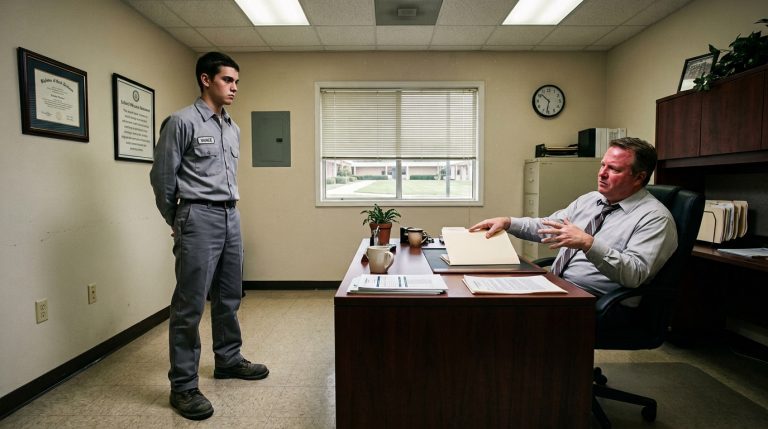
The VA office was a stark, aggressive contrast to the warmth of the VFW hall. Here, the air didn’t smell of gun oil or floor wax; it smelled of dry toner, carpet cleaner, and the slow, grinding erosion of hope. Walter stood before a laminate-topped desk, his hands buried deep in his pockets to suppress the tremor that always seemed to worsen under the fluorescent glare of government lighting.
Harrison sat across from a clerk who looked as though she had been aged by the very machinery she operated. She was pushing a thick stack of manila folders across the desk, her fingers rhythmic and tireless.
“The records are sealed, Mr. Briggs,” the clerk said, not looking up. Her voice was thin, devoid of any inflection that might suggest she cared about the man standing before her. “Even with Mr. Harrison’s intervention, these files are deep-storage. The level of clearance required to even look at them… it’s not something we can process on a Thursday afternoon.”
Walter felt the familiar, heavy pressure in his temples—the onset of the same headache he’d had on that ridge in 2008, when the cold was so intense it felt like his skull was contracting. He looked at the folders. They weren’t just paper; they were the ledger of his life, the evidence of every mission he’d taken and every life he’d spared. Seeing them stacked there, so carelessly, felt like a violation.
“I didn’t ask for the records,” Walter said, his voice quiet, steady. “I asked for the benefits to be processed. The error in the initial intake is a matter of administrative oversight, not historical clearance.”
“The oversight is tied to the service history,” she countered, finally looking up. Her eyes were tired, weary, but not unkind. “If the system shows a gap in your service that coincides with a ‘classified’ designation, it flags an automatic security hold. I can’t bypass that. Nobody in this building can.”
Harrison leaned forward, his hands flat on the desk. He was trying to be the hammer, but Walter could see the frustration beneath his measured tone. “We’ve got a letter of support from the local chapter. We have the technical evidence of his service—evidence that’s been verified by active-duty personnel. This man is a decorated operator, and he’s been sleeping on a cot because this system can’t figure out how to process a file.”
Walter stopped listening. He was looking at a small, framed photo on the clerk’s desk—a child in a school uniform. For a split second, the image warped. The child’s face became the face of the target he had been ordered to eliminate in Kandahar—the target he had spared, the target whose survival had cost him his clearance, his unit, and eventually, his life in the field.
The sound of the office—the hum of the copier, the ringing of the phone, the scratching of a pen—dropped away, replaced by the biting silence of the mountain air. He was back on the ridge. He was looking through the scope, his finger on the trigger, the wind whistling through the scrub. The weight of the rifle, the physical toll of the cold—it all hit him with such vivid, tactile intensity that he gripped the edge of the laminate desk until his knuckles turned white.
“Walter?” Harrison’s voice was distant, coming from somewhere miles away.
Walter blinked. The office snapped back into focus. The clerk was looking at him with concern now, her hand hovering over the stack of files.
“Are you all right?” she asked.
Walter pulled his hands away from the desk. He felt the cold sweat on his forehead. “I’m fine,” he said, the words tasting like ash. “Just… tired.”
He realized then that the fight wasn’t going to be won in this room. The paper was a wall, and the people behind the wall were just as trapped by the system as he was. He wasn’t being denied because of malice; he was being denied because of inertia. The system was designed to keep people out, and it was doing its job perfectly.
“We’ll come back,” Harrison said, standing up and tucking the folder under his arm. He looked at Walter, his expression softened by a sudden, sharp realization of what had just happened. “We’ll get the necessary signatures. We’ll find a way.”
Walter nodded, though he wasn’t sure he believed it. He walked out of the office, the automatic doors sliding open with a soft, synthetic hiss. Outside, the world was bright, loud, and aggressively normal. The traffic on the nearby street roared, a chaotic, disorganized sound that felt like a sensory assault compared to the claustrophobic silence of the building.
He headed toward his small, sparse apartment, his feet dragging slightly on the pavement. He thought about Donovan. He thought about the young soldier’s arrogance and the inevitable, painful lesson he was about to receive. He had promised to teach him, but as he walked, Walter wondered if there was anything left in him to give.
He was a relic, a piece of hardware from a different era, trying to function in a world that had rewritten the code. He reached the entrance of his apartment building, the metal railing cool under his hand. He gripped it, feeling the rough, oxidized texture of the iron.
He was still here. That was the only thing that mattered. He wasn’t a shadow, and he wasn’t a file in a government drawer. He was Walter Briggs, and if he had to dismantle this entire bureaucracy one piece at a time, he would. He unlocked the door, the heavy thud of the frame closing behind him, and stepped into the small, dim space that he finally, tentatively, called home.
He had to get ready for the sniper school visit. He had to prepare his mind, not for the target, but for the truth. He reached for a glass, the tremor in his hands feeling less like a failure and more like a warning.
CHAPTER 6: The Architect of Silence
The sniper school facility was a sterile, climate-controlled box designed to maximize focus and minimize human distraction. As Walter stepped through the airlock-style doors, the immediate drop in temperature made the skin on his forearms prickle. It was a calculated chill, intended to keep the recruits alert, but to Walter, it was the exact atmospheric pressure of the year 2008. He felt the phantom weight of the M24 slung across his back, though he carried nothing but a worn leather bag containing his tools.
Donovan was waiting near the primary briefing table. The Specialist looked different—his posture was no longer the loose, arrogant stance of the fundraiser. He stood at attention, his shoulders set with a rigid, almost painful precision. When he saw Walter, he didn’t smirk. He didn’t offer a greeting. He simply nodded, his eyes scanning Walter’s hands—the trembling hands—with a look of intense, almost academic curiosity.
“The instructors are ready, sir,” Donovan said, his voice quiet. He used the title without hesitation, a sign that the transformation from arrogance to apprenticeship was well underway. “They’ve given us an open block. They want to see the sequence. Not the one in the manual. The one you did at the VFW.”
Walter walked toward the center of the room. The floor was polished concrete, a dull, gunmetal gray that absorbed the overhead light. As he walked, he felt the familiar sensation of the floor beneath his boots, a hard, unyielding surface that offered no cushion. He was in the heart of the machine now. This was where the next generation was being forged, where the complexities of modern engagement were distilled into standardized, repeatable actions.
“Manuals are for conditions that exist on paper,” Walter said, his voice echoing slightly in the vast space. “The field rarely reads the manual.”
He approached the long, stainless-steel table where three different rifle systems were laid out: the M24, the Mk13, and the more modern M110. The sight of them—the precise, modular geometry of the equipment—felt like an intrusion. He could see the flaws in the layout, the way the equipment was arranged for convenience rather than combat readiness.
His tremor was pronounced, a rapid, rhythmic shaking that made the fabric of his sleeves dance. He felt the eyes of the instructors—three men standing in the back of the room, their faces shadowed—tracking his every move. They weren’t looking for a veteran. They were looking for a anomaly.
He reached for the M24. The moment his fingers brushed the cold, matte-finish metal, the room seemed to tilt. The scent of ozone and floor wax vanished, replaced by the thin, metallic taste of high-altitude air. He saw the target—not the cardboard cutout at the end of the range, but the man on the far side of the ridge, the man he had been tasked to remove.
Don’t look at the eyes, he told himself, the old training mantra surfacing through the haze of his memory. Look at the center of mass. Look at the variables. Look at the wind.
He began the sequence. His hands shook, but the motion was absolute. He stripped the action, his fingers finding the tolerances with a fluidity that made the instructors shift in their positions. He wasn’t just performing a mechanical task; he was conducting a symphony of friction, tension, and release.
“He’s not checking the seating,” one of the instructors muttered, his voice barely audible. “He’s feeling the pressure.”
Walter ignored them. He was in the rhythm now, the same rhythm that had carried him through those nine hours in the freezing dark. He felt the weight of the rifle as if it were a physical extension of his own body. When he reached the scope mount, he hesitated—not because of the mechanical complexity, but because of a sudden, sharp intrusive thought: What if the target had turned? What if he had moved? What if I hadn’t made the choice to hold?
The room around him blurred. For a split second, the bright, white light of the schoolhouse turned into the gray, grainy shadow of a pre-dawn sky. He felt the cold of the ridge biting through his layers of clothing, a deep, persistent ache in his joints that hadn’t left him for eighteen years. He was at the tipping point—the moment where the professional decision to engage collided with the human weight of the consequence.
He snapped back. He tightened the final screw, the turn of the wrench feeling like a closing of a door. He pushed the rifle forward, the assembly complete.
“The windage,” Walter said, his voice coming out as a raspy, controlled rasp. “You’ve got it set for a flat trajectory. But you’re going to be engaging at an angle. If you don’t compensate for the air density, you’ll be off by at least two inches at eight hundred.”
The room was silent. One of the instructors stepped forward, his boots clicking sharply on the concrete. He reached for the rifle, his eyes narrowed as he inspected the settings. He looked at the scope, then back at Walter, his expression a mix of skepticism and growing respect.
“We’ve been running these simulations for weeks,” the instructor said. “We hadn’t accounted for the density factor in the canyon profiles.”
“Then you’re training for a range,” Walter said, his hands finally dropping to his sides, the tremor still evident, still real. “Not for the field.”
He looked at Donovan. The young man was watching him with a new kind of intensity—not the academic curiosity of earlier, but the intense, searching look of a student who was starting to realize that the subject matter might be something he couldn’t survive.
“Your turn,” Walter said, gesturing to the disassembled Mk13. “Show me what you’ve learned.”
Donovan stepped up, his hands steady, his face grim. He began to work, but Walter could see it—the hesitation, the doubt. He wasn’t just assembling a rifle; he was trying to emulate the ghost. And as he watched, Walter realized that he hadn’t just come here to teach a technique. He had come here to show them the cost.
The silence between them wasn’t empty. It was filled with the weight of everything they didn’t know—the weight of the things that, if they were lucky, they would never have to experience. He stood back, his hands tucked into his pockets, and watched the young man struggle with the weight of the steel, the cold, and the sudden, terrifying realization that there were secrets in this craft that could never be taught in a room this bright.
CHAPTER 7: The Weight of the Unseen
The whiskey bottle stood between them, a dark, amber cylinder catching the dim light of Walter’s apartment. It was a good bottle—the kind Donovan had clearly purchased with a sense of ceremony, though now, as it sat half-empty, the ceremony had dissolved into something much more raw. The apartment was quiet, save for the low, rhythmic ticking of a clock that seemed to measure time in heartbeats rather than seconds.
Donovan sat on the edge of the hard wooden chair, his posture rigid. He kept his hands clasped tightly, his knuckles white—a physical mirror to the tension that Walter had lived with for nearly two decades.
“I couldn’t do it,” Donovan said, his voice barely a whisper. He wasn’t talking about the assembly. He was talking about the gap—the space between his technical knowledge and the intuition Walter had displayed in the schoolhouse. “I followed every step, I checked every torque setting, and when you asked about the air density… I hadn’t even thought to calculate the gradient. I was so focused on being right that I didn’t see the reality of the shot.”
Walter leaned back, the chair creaking under his weight. He watched the young man, seeing the first real cracks of maturity appearing in the armor of his arrogance. It was a painful, ugly process, and Walter knew it was only the beginning.
“The rifle is the easiest part, Donovan,” Walter said, his voice gravelly, softened by the whiskey. “It’s a machine. You can learn its language in a few weeks if you’re dedicated. But the weight… the weight of the air, the wind, the slope of the earth, and the choice you make when the target is in your crosshairs? That isn’t math. That’s a conversation with your own conscience.”
Donovan looked up, his eyes wide and searching. “Is that what happened to you? On that ridge? You talk about it like it’s a physical thing, like it’s still happening.”
Walter felt a flicker of pain—a sharp, sudden jolt behind his eyes. He saw it again: the morning light on the Afghan valley, the sight of the target, and that split-second decision that had derailed everything he had been trained to be. The memory was so vivid that the smell of the room seemed to change, the scent of stale apartment air giving way to the cold, sharp scent of mountain dust.
“I made a choice,” Walter said, his voice dropping into a low, resonant register. “I was a sniper. I was trained to be a cold, efficient instrument of an objective. But when the moment came, I realized that the objective wasn’t as absolute as the manual said it was. I had a target. I had the shot. I had the confirmation from my command. But I looked through that scope and I saw something that wasn’t in the intel packet.”
He paused, his hands shaking—the familiar tremor pulsing through his fingers as he reached for his glass. He didn’t spill a drop.
“I saw a person,” Walter continued. “And in that moment, I realized that if I pulled that trigger, I wouldn’t just be fulfilling a mission. I would be becoming the very thing I was supposed to be protecting people from. So, I waited. I held position. I let them move. And in that silence, I broke the most fundamental rule of my profession. I placed my morality above my orders.”
Donovan sat in stunned silence. The room felt smaller, the air tighter. He had come here expecting a lesson on marksmanship; he had received a confession that fundamentally altered his understanding of what it meant to serve.
“You lost everything because of that,” Donovan said, his voice thick with a new kind of respect. “They didn’t just discharge you. They erased you.”
“A ghost doesn’t have a record,” Walter replied, a faint, sad smile touching his lips. “I didn’t lose everything, Donovan. I lost the illusion that I was a tool. Once you lose that, you can’t ever go back to being a machine. You have to be a person. And that… that is the hardest part of the job.”
Donovan stood up slowly, the transition from arrogance to something approximating humility finally complete. He looked at Walter, and for the first time, he didn’t see an old, broken man. He saw a survivor.
“What do I do now?” Donovan asked. “Now that I know I’m not a machine?”
“You start paying attention,” Walter said, gesturing toward the door. “You stop looking at the rifles and start looking at the world. You learn that the tremor in your hands isn’t a flaw—it’s a reminder. It’s a reminder that you’re still human, and that as long as you can feel the world, you’re capable of making a choice that matters.”
Donovan nodded. He moved toward the door, his steps sure, his posture balanced. He paused at the threshold, looking back at the old man sitting in the dim, amber light.
“I’ll see you at the schoolhouse tomorrow, sir,” Donovan said.
Walter nodded once. As the door clicked shut, the silence returned to the apartment, but it was different now. It didn’t feel heavy. It felt like a space where he could finally breathe. He stood up, the ache in his knees still present, and walked to the window. He looked out at the city lights, the glowing, restless geometry of the world below. He had spent years running from his own history, but as he stood there, he realized he wasn’t running anymore. He was waiting for the next shot, but this time, he wasn’t aiming at a target. He was aiming at a future.
CHAPTER 8: The Stillness After the Storm
The VFW Hall was quiet, filled only with the soft, ambient hum of a late afternoon. Dust motes danced in the shafts of sunlight that cut through the tall, narrow windows, illuminating the rows of commemorative plaques and photographs that lined the walls. Walter stood before the central display case, his hands resting on the cool glass. Inside, the M24 he had assembled that night sat in permanent repose, a relic of a life that felt, for the first time, like something he owned rather than something that owned him.
Beneath the rifle, the new plaque Harrison had commissioned gleamed with polished brass. It told a truth that had been hidden for nearly two decades. It didn’t list the targets or the kill counts; it simply stated: Assembled by a soldier whose hands never stopped shaking and never stopped serving.
Walter traced the lettering with his index finger. The tremor in his hand was still there—a faint, persistent vibration—but as he looked at the rifle, he realized it no longer felt like a failure of his nerve. It felt like a heartbeat. It was a physical marker of the choice he had made on the ridge in 2008, the choice to spare a life and, in doing so, to preserve his own humanity. The nerve damage wasn’t just a physical scar; it was the price of his soul, a price he had paid willingly, even if he hadn’t known it at the time.
Harrison walked up beside him, his boots clicking softly on the floor. He didn’t say anything at first, just stood there, looking at the display. He had been the one to secure the official recognition, to navigate the labyrinths of the VA and the service records to ensure that Walter’s history wasn’t just erased into a classified void.
“They’re calling it the ‘Kandahar Engagement’ in the training manuals now,” Harrison said, his voice quiet. “They don’t mention your name—that’s still too deep for the records—but they teach the decision. They teach the hold. They’re calling it the most technically perfect engagement in the history of the unit.”
Walter felt a strange, light sensation in his chest. The weight he had carried for six years—the isolation, the shame of the ‘ghost’ status, the feeling of being a relic in a world that had moved on—was finally dissipating. He looked at Harrison, the Vietnam veteran who had seen through the surface and demanded to see the truth.
“It doesn’t matter if they know my name,” Walter said. “It matters that they know the choice. That’s all that counts.”
The door to the hall opened, and Donovan walked in. He was in uniform, his posture relaxed but professional. He stopped when he saw them, offering a nod of respect that was no longer forced or performative. He walked over to the case, looking at the rifle with a gaze that had been tempered by the weeks of training they had shared. He had become a different kind of soldier—not one who looked for the easiest path or the loudest glory, but one who understood the silence of the craft.
“The instructors are asking for you at the schoolhouse, Walter,” Donovan said. “They want to know if you’ll come back next week to run the final certification.”
Walter looked at the rifle, then at the two men standing with him. The VFW hall, once a place where he had gone for free food and a corner to hide in, had become a center. He had repaired the damage—not just by navigating the bureaucracy of the VA, but by repairing the connections he had let wither. He thought of the small apartment he now lived in, the quiet morning rituals, and the students who were finally learning that the steadiest hands weren’t always the ones that appeared still.
He reached into his pocket and pulled out his old, worn bandana. He folded it neatly, a small, ritualistic act of closure. The past—the ridge, the cold, the darkness—was a part of him, but it was no longer the entirety of him.
“I’ll be there,” Walter said.
As they walked out of the hall together, the late afternoon sun hit the pavement, warming the air. Walter didn’t look back. He didn’t feel the need to verify the shadows. He walked with a steady, measured gait, his hands in his pockets, his heart beating in sync with the world around him. He had spent his life as an architect of silence, but as he stepped out into the light, he realized he was finally ready to be a part of the noise.
He was home. The tremor in his hand was just a rhythm, a small, constant reminder of a life earned, a life lived, and a peace that had been hard-fought and fully, finally, achieved.