The Iron Boundary: A Veteran’s Stand Against Suburban Tyranny and Corporate Conquest
CHAPTER 1: THE FIRST SALVO
The smell of burnt diesel and wet earth vanished, replaced by the suffocating reek of synthetic lilac perfume.
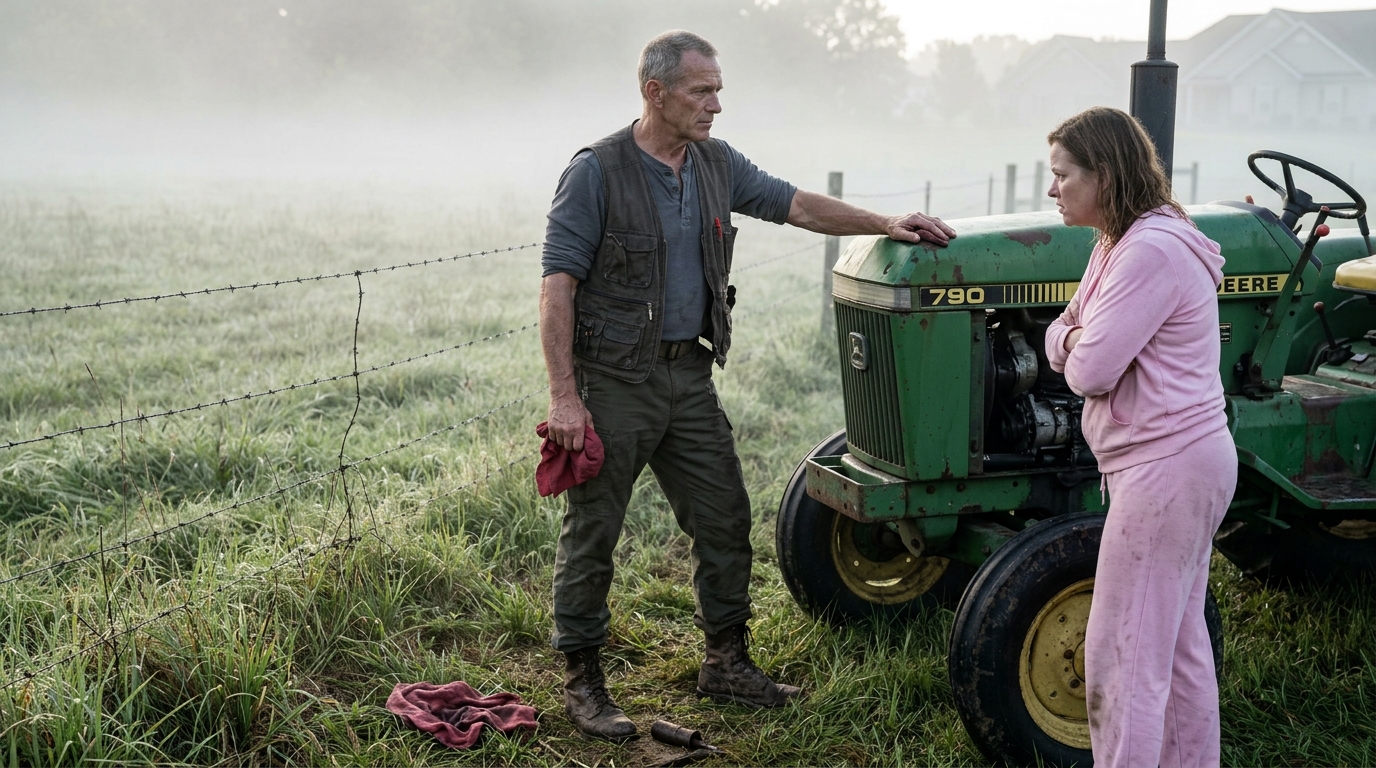
I didn’t turn around immediately. I kept my right index finger inside the cylinder head of the John Deere 790, feeling for the microscopic scoring along the iron wall. Twenty-five years in the Marines teaches you one fundamental truth about ambushes: the moment you react to unexpected noise, you surrender the high ground.
“That machine is a public nuisance.”
The voice was sharp, thin, and brittle as dried pine needles.
“If I see you start it one more time, I will have it seized and sold for scrap. You’ll be footing the bill for the impound fees.”
I slowly withdrew my finger from the block. I picked up a red shop rag—strained dark with grease and mineral spirits—and began edging it across my knuckles. One joint at a time. Methodical. Deliberate.
I stood up and turned around.
She stood precisely six inches past the three-strand barbed-wire fence marking my eastern boundary. Her pastel pink tracksuit strained against her frame, catching the damp morning dew at the cuffs. Her arms were locked across her chest so tight her shoulders hunched toward her ears. Her eyes weren’t looking at me. They were fixed on the green iron of my engine bay with pure, unadulterated venom.
“You’re standing on my clover,” I said. My voice was low, flat, and stripped of tone.
“This entire perimeter is subject to environmental order,” she snapped, stepping further into the tall grass. “I am Karen Miller. President of the Oakridge Homeowners Association. That noise registers well past acceptable residential decibels.”
I didn’t argue. I didn’t cite decibel limits. I looked at her shoes—brand-new white walking sneakers already caked in the thick, black Virginia clay of my unpaved tractor lane.
“You’ve got dirt on your rubber,” I noted, folding the greasy rag into a tight, dense square.
“Don’t you dare dismiss me,” she barked, her jaw shifting sideways. Her thumb twitched against her forearm, furiously picking at a loose thread on her sleeve while her chin remained thrust high. “You think because you put up a rusty fence you’re exempt from community standards? Look behind you, Mr. Callahan.”
I didn’t need to look. Behind her lay Oakridge Estates: two hundred identical beige double-gables, manicured lawns cut to precisely two inches, and mailboxes cast from the same black aluminum mold. Ahead of me lay thirty acres of untamed oak, rolling hayfields, and forty years of farm dust.
Between us ran a twenty-foot strip of packed gravel—the emergency fire access road.
“I know where the line is,” I said, stepping toward the fence. “And I know your covenants stop at that gravel.”
“That road belongs to Oakridge,” she lied without blinking. Her pupils were dilated, fixed on mine with the cold confidence of a petty tyrant used to total obedience. “And starting tomorrow, any heavy machinery operating within sight of our properties will be cited. Two hundred dollars a day.”
She turned on her heel, her sneakers squelching in the mud as she marched back toward the manicured turf of the subdivision.
I watched her cross the gravel track. I didn’t yell. I didn’t slam the tractor hood down. I stood in the quiet morning air, folded the red rag into my back pocket, and picked up my torque wrench.
She thought she was dealing with a retired old man with a noisy hobby. She didn’t know that to a Sergeant Major, an enemy who reveals their intentions early has already lost the war.
CHAPTER 2: PAPER WEAPONS
The steel handle of the torque wrench felt ice-cold against my palm, its ratcheting head locked at forty foot-pounds. I didn’t set it back on the tractor wing. I held it at my thigh, watching the pink streak of Karen’s tracksuit vanish between two manicured Leyland cypresses on the far side of the fire road.
The low, three-cylinder thrum of the John Deere settled back into the morning air. It was a good idle—clean, steady, no tick in the valves. But the air smelled wrong now. The damp grass and fresh diesel had been choked out by that synthetic flower scent, lingering in the humid air like chemical fallout.
I turned back to the engine bay, wiped the torque wrench clean with the greasy red rag, and lowered the green sheet-metal hood until the latch clicked into place.
I didn’t rush. Rushing in a confrontation means you’re reacting, and reacting means you’re letting the enemy set the tempo.
Seventy-two hours passed before her next move landed.
It arrived on a Thursday morning, delivered not by the regular postal carrier in his battered Grumman truck, but by a commercial courier driving a unmarked white van with a commercial registration tag from Richmond. The driver didn’t walk up the gravel drive. He stayed on the public asphalt, marched three paces onto my grass, dropped a thick, legal-sized envelope straight into my rural mail chute, and drove off without waiting for a signature.
I watched it happen from the barn doorway, a cup of black coffee cooling in my left hand.
When I reached the mailbox, the white envelope was sitting crooked in the galvanized box. The return address didn’t say Oakridge Homeowners Association. It was stamped in heavy black block lettering: Office of Compliance & Asset Protection. Beneath it, in smaller, lighter ink, was a file tracking code: Vanguard-009-B.
I tucked the envelope under my arm, walked back to the house, and laid it flat on the pine kitchen table beside my grease log.
I didn’t use a letter opener. I slid my thumb under the flap, tearing the heavy bond paper cleanly down the spine. Inside was a four-page document, crisp, bright white, and smelling faintly of fresh toner.
FORMAL NOTICE OF TRANSGRESSION AND CEASE-AND-DESIST DEMAND.
I leaned over the table, resting my hands on the wood, and read.
Violation One: Noise Ordinance 7.4b – Operation of heavy industrial, commercial, or agricultural machinery within five hundred feet of a primary residential zoning boundary outside approved maintenance windows. Fine: $500.
Violation Two: Unapproved Vehicle Storage, Article 9.2A – Maintaining an unsightly, non-operational, or unregistered heavy utility vehicle within direct line-of-sight of primary HOA residential parcels. Fine: $500.
Violation Three: Aesthetic Blight & Nuisance Multiplier, Section 12 – Failure to maintain perimeter vegetation and agricultural debris to baseline community standards, resulting in localized property value devaluation. Fine: $1,000.
Total fine accrued: $2,000. Payment due within fourteen calendar days. Failure to remit would result in an automatic 100% penalty escalation every thirty days, culminating in a statutory lien placed against the title of the adjacent real property.
I let out a slow breath through my nose.
The audacity was impressive. It was a classic administrative carpet-bombing—throw enough obscure numbers, legal jargon, and heavy threats at an untrained civilian until their knees buckle and they pull out a checkbook just to make the noise stop.
I turned to page three. At the bottom, highlighted with a sharp, yellow marker line, was a excerpt from what claimed to be the master covenant map. My thirty acres—deeded under county agricultural registry as Parcel-9—was shaded in light gray, with a cross-hatched border extending straight across the gravel fire road and fifty feet into my front pasture.
I stared at that cross-hatching for a long minute.
I pulled my coffee cup over, took a sip, and picked up a red ballpoint pen.
They weren’t just trying to shut down the John Deere. They were testing the perimeter. They wanted to see if I would panic, if I would call a lawyer I couldn’t afford, or if I would sign something in a hurry to negotiate the debt down.
I opened my file drawer, pulled out the manila folder containing the original 1984 deed to my land, and spread the land survey maps flat across the table. I laid the HOA notice right beside the county plat.
The lines didn’t match. Not even close.
The HOA map showed their authority swallowing the fire road entirely. My county map showed a thirty-foot public access easement with shared maintenance rights explicitly carved out between the original farm deed and the county road board.
Karen wasn’t enforcing rules. She was manufacturing jurisdiction out of thin air, using a legal threat to build a paper trail against my title.
I picked up the red pen, uncapped it with my teeth, and drew a thick, precise circle around the file code at the top of her letter: Vanguard-009-B.
“Alright, Karen,” I whispered to the empty kitchen. “Let’s see what else you’ve got in that binder.”
CHAPTER 3: GROUND RECONNAISSANCE
The red pen stayed uncapped between my knuckles as I stared at the file code Vanguard-009-B.
I slid the certified 1984 county survey map underneath the yellowed property deed, locking the corners down with four heavy iron sockets from my tool bench. The line was indisputable. Parcel-9 didn’t just touch the gravel track; its legal description extended straight across to the center line of the fire lane, granting an unencumbered ingress and egress right that predated the first bulldozer that broke ground on Oakridge Estates.
I capped the pen with a distinct plastic snap, pulled my boots on, and walked out into the morning air.
If you want to understand an opposing unit, you don’t read their propaganda from behind your own wire. You walk their perimeter. You look for the soft spots, the sagging fences, and the people living on the front edge who are tired of taking orders from someone who doesn’t carry a pack.
The gravel fire road crunched under my soles as I crossed the boundary line. The sun was rising over the eastern ridge, catching the dew on the manicured berms of the development. Up close, the uniformity of Oakridge Estates wasn’t serene; it was sterile. The grass was forced into an unnatural, chemical green, cut to a uniform two inches, every blade leaning the same direction like grass in an architectural model.
I turned down Willow Creek Lane, keeping my pace slow, steady, and unhurried—a three-mile-an-hour march that gave me time to take in the details.
Every mailbox was black cast aluminum, bolted to a square post, painted with matching gold house numbers. Every driveway was swept clean of gravel. But beneath the gloss, the friction was visible if you knew where to look.
Fifty yards down, a woman in a faded denim jacket was on her knees in a flowerbed, hacking at a root system with a small hand trowel. Her movements were sharp, frustrated, her knuckles red from the cold dirt. Behind her stood a sprawling, beige two-story house with identical white shutters—except the front left shutter was missing two mounting screws, sagging half an inch below the lintel line.
I stopped at the edge of her lawn, keeping my feet firmly on the public asphalt.
“Root rot?” I asked quietly.
She jumped, her shoulders pulling up as her hand instinctively pulled the trowel back toward her chest. She looked around the empty cul-de-sac first—a quick, involuntary glance toward the second-story windows of the houses across the street—before her eyes finally met mine.
“Wisteria,” she said, her voice dropping an octave. “It spreads under the lawn. If it creeps into the turf, it’s a Class B citation.”
“Jack Callahan,” I said, giving her a small, respectful nod. “From across the fence.”
Her hand paused on the trowel. Her thumb rubbed against the wooden handle, smoothing a rough splinter down over and over. “I know who you are. Karen mentioned you in the weekly update bulletin.”
“I bet she did.”
“She said you were operating unpermitted heavy industrial equipment.” The woman stood up slowly, wiping her dirty palms on her thighs. She was in her late fifties, eyes tired, lines etched deep around her mouth. “I’m Eleanor. Eleanor Gable.”
“It’s an eighty-horsepower farm tractor, Mrs. Gable. I use it to pull stumps and brush the pasture.”
She let out a dry, breathy sound that wasn’t quite a laugh. “My husband had a small utility trailer. A six-foot folding tilt deck he used to haul mulch for the church garden. Karen had it towed from our driveway on a Sunday afternoon while we were at service. Said it violated Section 4 on commercial storage. Cost us six hundred dollars to get it out of the impound yard.”
“Did the board review the citation?”
Eleanor looked away, her gaze drifting toward a low gray sedan crawling down the main thoroughfare. “There is no board, Mr. Callahan. There’s Karen, and there are three people who don’t want their mailboxes painted pink if they vote against her. My husband passed two years ago. I don’t have the energy to fight her over six hundred dollars.”
“You shouldn’t have to,” I said softly.
A few houses down, a garage door hummed open. A man in a gray fleece zip-up was wiping down the hood of a silver sedan with a microfiber cloth. He saw me standing near the curb with Eleanor, paused, and set the cloth down on his workbench. He walked toward us, hands buried deep in his pockets, his eyes scanning the quiet street.
“Jack?” he asked as he reached the property line. “Jack Callahan?”
“That’s right.”
“Tom Mercer.” He offered a hand across the grass line. His grip was firm, but his knuckles were raw—the skin around his nails picked raw down to the quick. “I saw your John Deere near the treeline this morning. Nice restoration job on the sheet metal.”
“Thanks. Still tuning the governor.”
Tom glanced toward Eleanor, then leaned in slightly. “Did you get one of her white envelopes yet? The compliance notice?”
“Two thousand dollars,” I said flatly. “Claiming my pasture is subject to their architectural standards.”
Tom let out a bitter chuckle, his teeth clicking together. “She fined me seven hundred and fifty bucks last month because my garage door paint was half a shade too bright. Sent me a letter on stationery from some outfits out of Richmond threatening a lien on my title if I didn’t match the original builder’s color chip.” He paused, his jaw tightening. “I had to track down the contractor who poured these foundations ten years ago just to get the paint formula.”
“Richmond?” I asked, my mind locking onto the detail instantly. “Was the letter marked with a code at the top?”
Tom frowned, his thumb digging into the seam of his fleece pocket. “Yeah. Something weird. A string of numbers and letters.”
“Vanguard?”
Tom’s eyes narrowed, a flash of genuine surprise breaking through his frustration. “How did you know that? It was printed right under the header. Vanguard Compliance Services.”
I looked past Tom, toward the rising spine of the ridge behind Oakridge Estates. The land behind their backyards didn’t belong to the subdivision. It was a five-hundred-acre timber tract labeled on county maps as Project Blackwood—a parcel that had been sitting in probate for a decade.
“Because,” I said, adjusting the cuffs of my sleeves, “Karen isn’t using an HOA printer to write those letters. She’s using someone else’s paper.”
I turned back toward the fire road. My thirty acres lay across the gravel, green, quiet, and solid under the morning light. The perimeter wasn’t just a fence line anymore; it was an axis of attack.
CHAPTER 4: THE IRON BARRICADE
My work boots were still heavy with limestone dust from the suburban street as I stepped onto the gravel track. I didn’t get five paces before the toe of my left boot struck cold metal.
I stopped. The fire road hadn’t been empty when I crossed it an hour ago.
Driven straight into the center of the two-foot gravel lane were two five-foot steel T-posts, their green paint fresh, their heavy spade plates pounded flush into the hardpack with a sledgehammer. Stretched taut between them was a heavy galvanized chain, six millimeters thick, coated in a dull gray zinc finish that hadn’t seen a day of weather.
Hanging from the middle link by two twist-ties was a stiff aluminum sign, reflective red lettering screaming against a white background: NO TRESPASSING. PRIVATE PROPERTY OF OAKRIDGE ESTATES HOA. VIOLATORS WILL BE PROSECUTED.
The barricade sat precisely twelve inches onto the gravel—blocking the exact radius my tractor needed to swing out from the barn driveway.
I stood completely motionless in the center of the road. My heart rate didn’t spike. My pulse stayed at a flat sixty beats a minute. In infantry terms, this wasn’t a defense; it was an obstacle belt planted without covering fire. A juvenile maneuver designed to provoke a kinetic response. She wanted me to take an angle grinder to the zinc chain so she could call the county sheriff for destruction of private property.
I leaned down and touched the steel T-post. The vibration was still settling in the soil. The dirt around the base was fresh, damp clay turned up from six inches below the gravel surface.
I didn’t reach for my bolt cutters. I reached into my coat pocket, pulled out a small steel measuring tape, and hooked the brass tongue over the top of the westernmost post.
I pulled the tape out thirty feet across the track, straight to the oak trunk where my boundary marker was blazed with weathered red paint.
Thirty-two feet.
The post sat two feet inside the recorded easement corridor established in the 1984 county register.
A soft rustle of dry grass came from behind the Leyland cypresses thirty yards up the incline. I didn’t turn my head, but I caught the movement in my peripheral vision—a flash of light reflecting off the double lens of a digital camera held behind a porch railing. Karen was watching through the foliage, waiting for the old sergeant major to lose his temper.
I let the measuring tape snap back into its chrome housing with a sharp, metallic clack.
Instead of walking back to the barn to grab a sledgehammer, I walked slowly over to the fence post near my tractor shed. I picked up my phone, brought up the camera app, and began filming.
I didn’t talk for the audience. I spoke for the record, my voice monotone, precise, and devoid of heat.
“Location: Eastern boundary of Parcel-9, fire access road corridor. Date: October 14th. Time: 0915 hours. Obstruction erected across non-exclusive emergency access corridor. Galvanized chain, steel post installation depth approximately eighteen inches into roadbed. Impairing vehicle clearance for agricultural and municipal access.”
I took three steps back, panning the camera up to capture the angle of the sun, the position of the oak trees, and the clear line of sight straight to the rear elevations of the Oakridge properties.
Then I lowered the phone and looked directly at the gap in the cypress hedge.
“You dropped your line two feet short, Karen,” I said, loud enough for the wind to carry the words across the gravel.
I turned my back on the chain, walked into my barn, and sat down at the wooden workbench.
I pulled out the manila folder containing the easement agreement. I didn’t look at the map this time. I turned to page four, section eight—the paragraph detailing the legal maintenance obligations of the adjacent parcel owners.
Party A (Oakridge Estates Association) and Party B (Parcel-9 Title Holder) shall maintain equal, unobstructed access rights to the thirty-foot corridor for fire, rescue, and agricultural logistics. Any unilateral structural alteration or obstruction of said corridor shall constitute a material breach of the covenant, subjecting the initiating party to immediate injunctive relief and regulatory code enforcement.
I drew a tight red box around the word unilateral.
Karen thought she had put up a wall to trap my tractor. She had no idea she had just locked herself into a public safety trap with the county government.
I picked up the desk phone, dialed a nine-digit landline number I hadn’t used in five years, and waited three rings until a raspy, familiar voice answered on the line.
“Jensen,” the voice growled over a background hum of printing paper.
“Dave,” I said, setting the red ballpoint pen flat on the desk log. “It’s Jack. I need a JAG officer who knows how to tear up an HOA charter.”
CHAPTER 5: THE JAG PROTOCOL
“Jack?” Dave’s raspy growl rattled through the small plastic speaker of the desk phone. “It’s been five years, Sergeant Major. You calling from a ditch or did somebody finally try to steal your tractor?”
“Someone put a chain across my easement, Dave,” I said, my thumb tracing the worn wood grain of the desk. “And they sent me a two-thousand-dollar fine on paper with a tracking code.”
A sharp rustle of papers echoed through the line, followed by the clink of a ceramic mug hitting a desk. “Give me the code.”
“Vanguard-009-B,” I read directly off my notes. “Header says Office of Compliance & Asset Protection. The sender is an HOA president named Karen Miller. She’s claiming authority over my eastern boundary.”
Dave let out a low, dry cough that turned into a chuckle. “Asset Protection? An HOA doesn’t have an Asset Protection division, Jack. That’s corporate language. Hold on.”
The line went silent except for the rhythmic clack-clack-clack of Dave’s mechanical keyboard. Three minutes passed. I didn’t fill the space with small talk. I sat still, watching the shadow of the barn door stretch across the pine floorboards as the sun climbed higher.
“Alright,” Dave said, his tone shifting instantly from old friend to courtroom prosecutor. “Oakridge Estates Homeowners Association is registered as a non-profit corporation in Virginia. But Vanguard Compliance Services isn’t a state-registered law firm. It’s an LLC incorporated out of Delaware sixteen months ago. Registered agent is a mail drop box in Richmond.”
“She’s using a shell entity to send official-looking fines,” I said.
“Worse,” Dave replied, his keyboard clicking again. “If she’s issuing financial penalties under a fake corporate entity without board disclosure, that’s not administrative oversight. That’s wire fraud and extortion. Now tell me about the chain.”
I detailed the physical footprint: two six-foot steel T-posts, six-millimeter galvanized chain, zinc finish, two feet inside the thirty-foot county easement corridor, blocking the radius for agricultural and emergency vehicles.
“She blocked a designated fire access road?” Dave asked, his voice dropping an octave into pure predatory focus. “Tell me you took photos.”
“High-res stills and video. Measure-taped from the oak blaze to the post. Thirty-two feet from my line, two feet inside the right-of-way.”
“Jack,” Dave purred, “you just handed me a target-rich environment. Here’s what we do. We don’t file a civil suit yet. A suit gives her time to hire a neighborhood lawyer and hide behind the HOA insurance policy. We’re going to execute a precision strike on her leadership structure.”
“Spell it out.”
“I’m drafting five separate cease-and-desist demand letters,” Dave said, the paper shuffling again. “One for Karen. Four for the rest of her board members—addressed directly to their home street addresses, certified mail, signature required. We attach the 1984 county easement grant. We attach your photos of the obstruction. And we cite Virginia Fire Code Section 4, Paragraph 2B regarding illegal obstruction of emergency access routes.”
“What about the fines?”
“We demand immediate, unconditional retraction of all compliance notices issued against Parcel-9. We issue a formal litigation hold—meaning if they delete an email, shred a document, or clear a hard drive related to your property, they’re committing spoliation of evidence.” Dave paused, a slow grin audible in his breath. “And then I add the finisher.”
“The personal liability clause.”
“Precisely,” Dave said. “I inform individual board members that while the HOA charter shields them from ordinary negligence, acting outside their legal territorial jurisdiction to enforce fake fines through an unlisted Delaware shell company voids their indemnification. If they don’t remove that barricade in seventy-two hours, I name every single one of them personally in a federal lawsuit for civil rights violations and clouded title.”
I looked out the barn window toward the gravel track. The galvanized chain glinted under the hard morning light, two T-posts standing like cheap fence stakes in the Virginia mud.
“Send them,” I said. “Five envelopes. Certified.”
“They’ll hit their mailboxes by Tuesday morning,” Dave said. “And Jack? Call the county fire marshal’s office. Don’t lodge a complaint about your property line. Just report an illegal physical barrier on a designated emergency route. Let the government do your heavy lifting.”
“Understood.”
“I’ll bill you for two hours, Sergeant Major,” Dave grunted. “Consider it a discount for giving me the easiest case of my quarter.”
I hung up the phone. The plastic receiver hit the cradle with a solid, definitive click.
I pulled a fresh sheet of white paper from the drawer, uncapped my red pen, and drafted a three-paragraph notice to the County Fire Marshal’s Office. I didn’t mention Karen. I didn’t mention Oakridge Estates. I gave the precise GPS coordinates of the T-posts, attached a printed photograph of the zinc chain, and signed my name at the bottom.
The paper cost me two cents. The postage cost sixty-eight cents.
I slipped the letter into a stamped envelope, walked out to my truck, and fired the engine. The war had moved out of the pasture and onto the white paper of county record.
CHAPTER 6: FRACTURES IN THE RANKS
The brass key turned in the ignition, and the V8 engine rumbled to life, sending a fine vibration through the worn vinyl seat. Before I could pull the gear lever into drive, my phone buzzed against my hip—a harsh, persistent rattle on the plastic console.
I picked it up without checking the display.
“Callahan.”
“Is this… Mr. Jack Callahan?” The voice was thin, breathless, and rattling with static.
“Speaking.”
“My name is George Swell,” the man said, lowering his voice until it was almost lost beneath the engine hum. “I’m the treasurer for the Oakridge Board. I… I just signed for a certified letter from a law firm in Richmond.”
I didn’t answer. I rested my forearm on the steering wheel, watching a postal truck make its slow way down the far side of the fire road.
“Mr. Callahan, are you there?” George’s breathing was shallow. “The letter says we’re being held personally liable for a commercial easement violation. It says… it mentions federal court. It names me personally. My home address.”
“It does,” I said flatly.
“I didn’t authorize that chain!” George’s voice cracked, rising half an octave before he caught himself and choked it back down. “Karen told us the road was private HOA land! She brought a resolution to the board meeting three weeks ago claiming an illegal tractor was damaging our drainage berm. She said our legal counsel approved the notice!”
“Your legal counsel is a Delaware shell company named Vanguard,” I said. “And the road is a county-recorded emergency easement granted to Parcel-9.”
A long, heavy silence stretched over the line. I could hear the faint click of a ceiling fan turning in George’s kitchen.
“Vanguard?” George whispered. “She told us… she said Vanguard was the compliance management firm assigned by our insurance carrier. We’ve been approving monthly vendor disbursements to them out of the reserve account. Four thousand dollars a month for the last six months.”
I leaned back against the headrest. The decoy was coming unspooled.
“George,” I said, my voice steady as an iron bar. “You’re the treasurer. Who signs the checks?”
“Karen signs primary,” he stammered, his knuckles likely white on his receiver. “I co-sign the digital portal… but she provides the supporting invoices. She said they were for legal oversight and perimeter security.”
“She lied to you,” I said. “And every document she generated under that name is sitting on my attorney’s desk. You have forty-eight hours before the Fire Marshal clears that access lane.”
“Wait—please—”
I disconnected the line. I didn’t block his number. I let the phone sit on the console, screen dark.
Twenty minutes later, as I pulled back into the driveway after dropping the Fire Marshal’s notice in the county collection box, a silver crossover was parked at the edge of the gravel road. A woman in a navy tailored jacket was standing near the galvanized chain, her arms crossed tight over her chest, her leather heels sinking half an inch into the soft mud.
She didn’t look like Karen. She looked terrified.
I cut the truck engine, stepped out into the damp chill, and let the door latch click shut behind me.
“Mr. Callahan?” She took two fast steps toward my side of the road, stopping precisely at the gravel edge. “I’m Maria Santos. Board secretary.”
“Ms. Santos.”
She pulled a folded sheet of white paper from her coat pocket—Dave’s certified demand letter, the tracking label still attached to the corner. “I just spoke with George. He told me what you said about Vanguard.”
“It’s on the corporate registry,” I said, walking toward the rear tailgate. “Delaware filing. No licensed attorneys on staff in Virginia.”
Maria’s chin trembled slightly, though her eyes were hard with cold anger. She reached down and picked at a torn piece of tape on the corner of the envelope, her thumb rubbing the raw paper until it frayed. “She told us you were hostile. She said you threatened her at the fence line when she tried to give you a neighborly warning about the noise.”
“I was greasing my tractor,” I said.
Maria looked at the zinc chain stretched between the green T-posts. She reached out, caught one link between two fingers, and let it drop. The metallic clatter echoed sharply against the oak trees.
“She used our legal defense fund,” Maria said, her voice dropping into a tight whisper. “She told the board we had to secure the perimeter because your parcel was slated for rezoning. She showed us a map with cross-hatching…”
“The cross-hatching was hand-drawn,” I said.
Maria reached into her jacket again and pulled out a small, carbon-copy receipt slip—a vendor voucher pulled straight from an HOA file folder. “She left this in the community center copy room this morning. It’s a legal filing fee receipt for a preliminary easement assessment.”
She handed it across the boundary wire.
I didn’t take my eyes off her face as I reached out and took the paper. It was a receipt from the County Clerk’s office, stamped forty-eight hours prior.
Fee Paid: $150.00. Application for Title Boundary Variance – Parcel-9 / Vanguard Development Group.
The breadcrumb was right there on the thermal paper.
“She isn’t trying to keep my tractor out, Ms. Santos,” I said, folding the receipt once and slipping it into my shirt pocket. “She’s trying to cloud my title so I can’t transfer the land.”
Maria swallowed hard, her hand dropping back into her pocket. “What are you going to do?”
“I’m going to let the Fire Marshal do his job tomorrow morning,” I said. “And then I suggest you call a special board meeting before my attorney names you in the primary suit.”
She didn’t argue. She turned, her heels clicking fast against the asphalt as she ran back to her car.
I stood by the tailgate, pulled the receipt out of my pocket, and looked at the faint blue ink at the bottom. The transaction hadn’t been charged to an HOA account card. It was billed directly to an account number labeled Project Blackwood Escrow.
The perimeter was cracking, and the real enemy was finally showing its armor.
CHAPTER 7: THE FIRE MARSHALS HAMMER
The blue ink on the county receipt was still cold under my thumb when the gravel at the turnoff groaned under heavy tires.
A white, long-bed utility truck with a gold county seal painted on the door rolled down the fire access road, its suspension creaking as it negotiated the drainage rut. The driver didn’t rush. He pulled up six feet short of the galvanized chain, shifted into park, and let the V8 idle with a deep, rhythmic thrum.
The door opened with a solid mechanical latch. A man in a crisp tan uniform shirt with heavy brass collar pins stepped down into the mud. His boots were shined, but the leather at the toes was scuffed down to the steel cap from years on inspection sites.
He didn’t look at me first. He looked at the two green T-posts driven into the center of the roadbed.
“Sergeant Major,” Chief Miller said, giving his brimmed cap a quarter-inch nod.
“Chief,” I replied, staying near my tailgate.
He walked to the chain, pulled a pair of heavy leather work gloves from his belt, and hooked two fingers into the middle link. He lifted it slightly, testing the tension. The zinc links clattered with a dull, heavy ring.
“Eighteen-gauge galvanized,” he muttered, pulling a digital measuring wheel from the utility bed. He set the rubber wheel against the steel post and walked straight across to the blazed oak tree on my boundary line.
The digital counter ticked off numbers with a steady beep.
“Twenty-eight feet, six inches,” Miller said, recording the readout on a ruggedized tablet. “Corridor’s platted for thirty. That puts this post sixteen inches inside the statutory right-of-way.”
Before he could pull his stylus back, a front door slammed across the street.
Karen marched across her manicured lawn like a commander whose forward trench had just been breached. Her pink tracksuit was gone, replaced by a dark windbreaker, but her jaw was set in the same rigid line. Her sneakers squelched in the soft turf as she crossed the property line, her eyes locked on Chief Miller’s badge.
“Can I help you, officer?” she demanded, her voice cutting through the damp air. “This is private property belonging to the Oakridge Homeowners Association.”
Miller didn’t turn his head immediately. He finished saving his digital entry, tapped the screen twice, and slid the stylus into its slot before facing her.
“Ma’am, I’m Chief Inspector Miller with County Fire and Rescue,” he said, his voice flat, neutral, and heavy with authority. “Are you the party responsible for installing this physical barrier?”
“I am the president of the board,” Karen snapped, her thumb digging into the zipper of her windbreaker. “And that chain was placed there to secure our perimeter against unauthorized commercial vehicles crossing from that agricultural lot.” She jabbed a finger toward my barn.
“Ma’am,” Miller said, taking a half-step forward until he stood directly over the steel post. “This gravel track is designated on the county master plat as Emergency Access Corridor 4-B. It serves as a primary ingress route for engine companies responding to the rear elevations of your development, as well as access for Parcel-9.”
“It’s private land!” Karen raised her voice, her throat reddening above her collar. “Our covenants give us full jurisdiction over access!”
“Your covenants don’t override the Virginia Fire Prevention Code,” Miller replied smoothly. He tapped the screen of his tablet. “Section 503.4. Unapproved obstructions on designated fire apparatus access roads constitute a Class 1 misdemeanor.”
Karen’s mouth opened, but no sound came out for two full seconds. Her chin twitched, her eyes flicking past Miller toward the curtained windows of the houses behind her. I could see the blinds shifting on Tom Mercer’s second floor.
“I have legal counsel,” she spat, her hands trembling as she pulled her phone from her pocket. “Vanguard Compliance has filed a title variance with the county clerk.”
Miller’s left eyebrow hitched up a fraction of an inch. “I don’t care if you filed a variance with the Supreme Court, ma’am. Until a judge vacates this easement, this chain is an illegal obstruction. You have twenty-four hours to pull these posts.”
“Or what?” she demanded, stepping closer to the chain. “You’re going to fine a private community?”
Miller didn’t raise his voice. He reached into his breast pocket, pulled out a yellow carbon-copy citation book, and pressed it against the hood of his truck to write.
“If this chain is still standing at 0900 hours tomorrow,” Miller said, his pen scratching loudly against the paper, “a county crew will remove it with a hydraulic cutter. The HOA will be billed twelve hundred dollars for equipment mobilization, and you personally, as the named party asserting authority over the installation, will be issued a summons to General District Court.”
He tore the yellow sheet from the pad with a sharp, tearing sound and extended it across the chain.
Karen didn’t take it. Her hand froze halfway to her pocket, her knuckles pale, her chest heaving under the dark windbreaker.
“Take the paper, ma’am,” Miller said softly. “It’s official notice.”
She snatched the yellow carbon, crumpled it into a ball in her fist, and turned on her heel. She didn’t march this time. Her boots slipped twice in the damp mud as she hurried back toward her driveway, her head down, her phone already pressed tight against her ear.
Chief Miller watched her go, then turned back to me. He pulled a pair of heavy bolt cutters from his truck bed and laid them on the tailgate.
“She won’t pull those posts, Sergeant Major,” he said quietly.
“I know,” I said, looking at the fresh yellow receipt still tucked in my shirt pocket—the one marked Project Blackwood Escrow. “She’s not working for the HOA anymore.”
Miller gave a single nod, climbed into his cab, and backed the utility truck out down the gravel lane.
I stood alone by the fence line, picked up my red pen, and marked the calendar in my pocket. The clock had officially started.
CHAPTER 8: THE PAPERWORK AUDIT
The exhaust haze from Chief Miller’s long-bed truck dissolved into the humid air, leaving only the smell of crushed clover and damp earth. I slid my pocket calendar back into my coat, turned my back on the zinc chain, and walked into the barn.
By nineteen hundred hours, the rain had settled over the valley, a steady, needle-thin drizzle tapping against the tin roof of the Oakridge community center.
I didn’t enter through the main glass doors. I walked through the side service entrance, my boots making no sound on the commercial entryway mat. Inside, thirty folding metal chairs had been set up in three tight arcs on the stained industrial carpet. The room smelled of old floor wax, damp wool coats, and cold drip coffee.
Tom Mercer stood near a portable folding table at the front, holding a manila folder thick with printed bank ledgers. Eleanor Gable sat in the second row, her small hands resting flat on her denim-covered knees, her gaze fixed on the blank whiteboard behind the podium.
When the side latch clicked shut behind me, sixteen heads turned simultaneously. No one spoke for three seconds.
“Jack,” Tom said, his voice dropping into a low, echoing pitch. He gestured to an empty metal chair near the wall. “We’ve got twenty-two lot owners represented. Four more on speakerphone.”
I walked over, pulled the steel chair back two inches, and sat down. “Did George bring the ledgers?”
George Swell stepped out from the utility closet near the kitchen pass-through. His eyes were bloodshot, his collar unbuttoned at the throat, his blue tie loosened until it hung crooked across his chest. He set three heavy cardboard storage boxes onto the table with a dull, hollow thud.
“Eighteen months of bank statements,” George said, his hands trembling as he smoothed his palm over the top box flap. “I pulled them directly from the bank’s online portal using my administrative key. Karen didn’t know I had the secondary authorization.”
“What did you find?” Eleanor asked from the second row, her voice small but piercingly clear.
George pulled a thick stack of printed spreadsheets from the top box and slid them across the laminate table toward Tom.
“For the last five quarters,” George said, his thumb picking at a torn corner of the printout, “the operating account shows twenty-four separate electronic wire transfers totaling sixty-eight thousand dollars to an entity named Vanguard Compliance Services LLC.”
A sharp, collective intake of breath rustled through the metal chairs.
“What were the invoices for?” Tom asked, his jaw tightening as he scanned the line items.
“Legal consultation, perimeter boundary enforcement, and land development assessment,” George read, his voice cracking on the last word. “Every single voucher was approved solely under Karen’s signature. She flagged them as confidential administrative expenses related to border security for Parcel-9.”
Tom looked up, his eyes locking onto mine across the aisle. “She didn’t just fine you, Jack. She used our monthly maintenance dues to fund her filings against your title.”
“It gets worse,” George added, pulling a second sheet from his jacket pocket. “I called the accounting firm that prepares our annual state tax filing. The CPA on record told me he hasn’t seen an audit ledger from Oakridge in three years. Karen provided him with pre-compiled summary sheets signed by a third-party reviewer.”
“Who was the reviewer?” I asked, leaning forward, resting my forearms on my knees.
George looked down at the paper. “A firm called Blackwood Advisory Group. Address listed in Richmond.”
The room went completely quiet except for the hum of the overhead fluorescent ballasts.
Eleanor stood up slowly, her denim jacket stiff around her shoulders. She looked around the circle at her neighbors—young couples with mortgages, retirees holding fixed incomes, people who had paid two hundred dollars a month for decade-old beige paint standards.
“She took sixty-eight thousand dollars of our money,” Eleanor said, her voice shaking with quiet, cold fury. “And she used it to build a wall against a man who was just fixing his tractor.”
“She didn’t build a wall for the HOA,” I said, my voice cutting through the room like an iron wedge. “She built a paper trail for someone else.”
Tom stood up, pulled a black dry-erase marker from his pocket, and uncapped it. He walked to the whiteboard and wrote three numbers in heavy, thick strokes: 68,000, Vanguard, and 72 Hours.
“Under Section 8 of our bylaws,” Tom said, turning to face the room, “a thirty-percent petition of lot owners forces an immediate emergency recall of the board president and orders an independent forensic audit. We have twenty-two signatures in this room right now. That’s forty-five percent.”
“Do it tonight,” Eleanor said flatly.
“I’ll deliver the petition to her front door at eight tomorrow morning,” Tom replied. He looked at me, the marker balanced across his knuckles. “What about the chain, Jack?”
“The Fire Marshal’s deadline expires at 0900,” I said, standing up from the metal chair. “She can pull the posts herself, or the county will cut them down. Either way, the road stays open.”
I turned and walked out the service door into the cold Virginia rain, leaving them to sign the petition sheets. The decoy of the noisy tractor was dead. The neighborhood was armed with their own ledgers, and the battle lines were officially drawn across their own front yards.
CHAPTER 9: THE TOXIC LEAK
The rain had turned the gravel track into a slick sheet of gray slurry by the time my boots hit the fence line.
I didn’t head straight for the porch. I walked along the eastern wire with my heavy flashlight, the beam cutting through the wet mist. The zinc chain still hung between the two green T-posts, but forty yards further south—where my pasture met the dense wall of pine timber belonging to the old probate tract—something else had moved.
The flashlight beam caught a white ribbon fluttering against a low oak branch.
I climbed over the three-strand wire and stepped into the tall grass. A square wooden survey stake had been driven six inches into the soft dirt, its top painted neon pink. Tied to the lathe was a strip of surveyor’s plastic marking tape.
I knelt down in the mud. The dirt around the stake was fresh, turned up within the last three hours despite the downpour. Pressed into the mud beneath a low briar bush was a crumpled sheet of laminated paper, discarded or dropped by whoever had hammered the pine stake.
I picked it up, wiped the black clay off with my thumb, and snapped my flashlight beam over the print.
It wasn’t a standard land survey. It was a civil engineering site plan titled State Route 14 Bypass Expansion & Commercial Feeder Connector.
Across the center of the blueprint ran a thick red corridor labeled Project Blackwood Transit Rights. The line started in the timber tract, cut directly through the eastern edge of Parcel-9, and tied into the state road right through the exact twenty-foot fire access lane where Karen had hung her chain.
At the bottom right corner, inside the legal box, were three corporate seals: Vanguard Land Acquisitions LLC, Blackwood Development Group, and Oakridge HOA Asset Management.
My thumb pressed hard into the laminated plastic.
Karen hadn’t been fighting over a forty-year-old John Deere tractor. She hadn’t even been trying to enforce suburban beige paint codes. She was using the HOA’s bank account to cloud my title, intentionally running up thousands of dollars in fake compliance fines to trigger an involuntary lien against Parcel-9.
If a lien locked my title, I couldn’t sell, transfer, or fight an eminent domain easement variance. Vanguard would step in at the county tax auction, clear the encumbrance for pennies on the dollar, and hand the commercial right-of-way over to the regional highway expansion.
The sixty-eight thousand dollars stolen from Eleanor Gable, Tom Mercer, and the rest of Oakridge wasn’t just embezzlement. It was the seed money for a corporate land grab.
A twig snapped in the dark woods twenty feet past the survey stake.
I didn’t jump. I snapped the flashlight off instantly, letting the pitch-black woods swallow my outline. I stayed low in the wet grass, listening.
The sound of rubber boots slipping on wet pine needles came from behind a thick cedar trunk. Someone was standing in the timber, holding their breath, waiting to see if the flashlight beam would return.
“You dropped your map,” I said into the dark. My voice was low, flat, and echoed through the dripping branches.
The footsteps accelerated—fast, heavy, scrambling uphill through the brush toward the access road behind the development. A car door slammed fifty yards up the ridge, followed by the wet whine of tires spinning against gravel before catching asphalt and speeding away.
I clicked the flashlight back on, slid the laminated blueprint into my coat pocket, and stood up.
The decoy secret—the petty embezzling president hiding behind HOA bylaws—was completely dead. The real threat was leaking out from the pine timber, and it had a corporate name, a state contract number, and a deadline that ended at 0900 hours tomorrow morning.
I walked back to my barn, pulled the heavy sliding door shut against the storm, and picked up the landline to call Dave.
“Jack?” Dave answered on the first ring, his voice sharp. “I was just looking at the court docket.”
“I have the site map, Dave,” I said, leaning against the cold iron frame of the John Deere. “It’s not an HOA dispute. It’s a commercial feeder corridor for Project Blackwood. Vanguard is the acquisition shell.”
Dave was silent for three seconds. When he spoke, the tiredness was gone from his voice, replaced by the cold, metallic tone of a prosecutor setting a trap.
“They’re trying to trigger a default judgment before the county board votes on the bypass plan next month,” Dave said. “If you hold that title clean, their feeder route is dead in the water. They can’t force an easement across agricultural zoning without a three-year environmental impact review.”
“They have a special board meeting at the clubhouse tomorrow night,” I said, looking at the green hood of my tractor. “And the Fire Marshal’s deadline expires in twelve hours.”
“Get some sleep, Sergeant Major,” Dave grunted over the line. “Tomorrow we stop defending the perimeter and start taking ground.”
CHAPTER 10: THE TRIBUNAL
Shadows stretched across the barn floor as the rain finally stopped, and twelve hours compressed into the crisp ring of metal hitting metal at precisely 0900.
Chief Miller’s bolt cutters made short work of the zinc chain. The links fell into the mud with a wet, heavy thud. Karen didn’t come out to watch. Her blinds stayed shut, but by eighteen hundred hours, every seat in the Oakridge community clubhouse was occupied.
The air inside was thick, warm, and smelled of wet rubber boots and cheap coffee. Forty homeowners sat in hard folding chairs. At the front table sat the board, but Karen wasn’t sitting behind her nameplate. She stood near the side wall, her navy blazer zipped to her throat, her right hand picking furiously at her thumbnail.
Tom Mercer tapped the microphone at the podium. The feedback whined sharply through the room before settling into a low hum.
“This special meeting was called under Section 8 of the bylaws,” Tom said, his voice level, carrying cleanly over the crowd. “We have forty-two verified lot owners present or represented by proxy. The first item on the agenda is the forensic financial report prepared by George Swell.”
George stood up from his chair. His hand shook slightly as he adjusted his glasses, but his voice didn’t falter. “Over the past eighteen months, sixty-eight thousand dollars was transferred from our capital reserve account to a single vendor listed as Vanguard Compliance Services. These disbursements were signed unilaterally by Karen Miller.”
A wave of sharp, angry whispers rolled through the rows.
“Every invoice was classified as perimeter boundary enforcement,” George continued, holding up a yellowed printout. “Specifically, legal filings targeting the adjacent parcel—Parcel-9.”
Karen took three fast steps toward the front table. Her knuckles were white as she slammed her palm against the laminate wood.
“This board authorized perimeter security!” her voice shrilled, cracking on the second word. “That agricultural land is a blight on our border! If we don’t enforce our covenants along the fire access lane, property values drop by ten percent across the entire development!”
“We don’t own the fire access lane, Karen,” Tom said, pulling a blue-stamped document from his folder. “And Parcel-9 isn’t part of this HOA. You spent sixty-eight thousand dollars of our money fighting a war against a neighbor who was within his legal rights.”
“He was operating industrial machinery!” Karen pointed a trembling finger toward the back row where I sat against the wall. “He was disrupting this community!”
I stood up slowly. I didn’t raise my voice. I didn’t reach for an angry word. I walked down the center aisle, the heels of my boots thudding firmly against the carpet. In my right hand, I held the laminated blueprint pulled from the mud near the survey stake.
I laid the sheet flat on the podium, directly under the overhead projector lamp.
The image hit the white wall behind Tom in high contrast: red lines cutting through Parcel-9, extending down the fire access lane, titled State Route 14 Bypass Expansion & Commercial Feeder Connector.
“She didn’t spend your money to protect your lawn colors,” I said, my voice cutting through the room like a cold blade. “She spent your money to cloud the title on Parcel-9 so Vanguard Land Acquisitions could force an involuntary tax lien. Vanguard is the shell company buying up parcels for Project Blackwood.”
The room went dead silent.
Tom leaned over the projector, staring at the corporate seals stamped at the bottom right corner of the printout. “Oakridge HOA Asset Management… signed by Karen Miller as regional agent.”
Eleanor Gable stood up from her chair in the second row, her face pale, her hands gripped tightly over her handbag. “You were selling our access road to a highway developer?”
Karen’s head snapped toward Eleanor, her breathing shallow, her eyes wide and bloodshot. “It was a commercial agreement! The HOA would have received a three-hundred-thousand-dollar payout for the easement transfer! It would have lowered dues for five years!”
“It would have put a four-lane feeder road thirty feet from my back fence,” Tom said, his voice dropping into a dangerous, quiet register.
George Swell picked up his pen, dipped it into the ledger, and looked at the rest of the board members. “All those in favor of the immediate recall of Karen Miller as board president and the referral of these accounts to the State Police Financial Crimes Unit, raise your hand.”
Every hand on the board went up. Every hand in the audience followed.
Karen didn’t wait for the vote count. She snatched her coat off the back of the chair, her face a blotchy red, her breath coming in ragged gasps.
“You think you won?” she hissed, looking directly at me as she reached the side exit door. Her hand hovered on the brass push-bar. “The county board votes on the Blackwood corridor tomorrow at noon. The easement variance is already on the docket. You’re holding a piece of paper, Callahan. Vanguard holds the state option.”
She slammed the bar down, the heavy door swinging shut behind her with a booming echo that rattled the windows.
I stepped up to the podium, picked up my laminated map, and looked at Tom.
“She’s right about one thing,” I said, slipping the map into my jacket. “The county board meets at noon. And we’ve got sixteen hours to make sure the clerk has the real deed on file.”
CHAPTER 11: WEAPONIZED RECORDS
Sixteen hours compressed into the cold ring of a brass clock chiming eleven-thirty inside the County Administration Building.
The rain had cleared, leaving a harsh midday sun beating through the two-story glass facade of the hearing room. At the raised wooden bench sat five county commissioners, their microphones flicking from red to green as the clerk called the docket items.
Karen sat in the second row of the gallery, flanked by a man in a dark charcoal suit who carried a leather locking briefcase. He didn’t look like a local attorney; his posture was rigid, his cufflinks heavy gold, his eyes scanning the room with the practiced arrogance of a corporate fixer.
“Item 14,” the clerk announced, her voice echoing off the marble floor. “Application for Title Variance and Public Corridor Access, Parcel-9, submitted by Vanguard Land Acquisitions LLC.”
The man in the charcoal suit stood up immediately, stepping to the podium with three bound leather folders.
“Members of the board,” he began, his voice smooth, resonant, and entirely unhurried. “My name is Arthur Vance, representing Vanguard. We are asking the board to ratify a preliminary infrastructure variance across the eastern corridor of Parcel-9 to facilitate the State Route 14 bypass feeder for Project Blackwood. The adjacent homeowner association has already entered into an administrative agreement, and the property owner has defaulted on statutory maintenance compliance.”
He reached into his pocket, pulling out a white envelope stamped with the tracking code Vanguard-009-B.
“We have filed a notice of encumbrance based on outstanding compliance liens totaling two thousand dollars,” Vance continued, laying the envelope flat on the wood. “Under county ordinance, an encumbered agricultural boundary subject to active litigation may be assigned temporary easement rights for regional public utility.”
It was a masterclass in legal misdirection—smooth, fast, and engineered to pass before anyone in the room realized the ground had been stolen.
“Objection to the record, Mr. Chairman.”
Dave Jensen’s raspy voice cut through the sound system as he walked down the center aisle, his worn leather briefcase swinging at his side. I walked two paces behind him, wearing a dark suit jacket over a clean work shirt, carrying a thick manila folder under my arm.
The chairman raised an eyebrow, his gavel hovering an inch over the strike pad. “State your name for the record.”
“David Jensen, counsel for Jack Callahan, fee-simple owner of Parcel-9.” Dave set his briefcase on the table with a loud, wooden thud. “And we are handing the clerk three certified documents that make Mr. Vance’s application a legal nullity.”
Vance didn’t flinch, but his eyes narrowed as Dave slid the first document across the marble counter to the clerk.
“Document One,” Dave said, his voice flat and brutal as iron. “A certified copy of the 1984 County Land Grant establishing Parcel-9 as an unencumbered agricultural tract with a permanent, non-exclusive thirty-foot emergency access easement. Said easement cannot be severed, assigned, or altered without the express written consent of the title holder.”
The chairman leaned forward, pulling the paper toward his spectacles.
“Document Two,” Dave continued, handing over the second sheet. “A formal audit report from the Oakridge HOA Board, executed last night, confirming that the compliance notices referenced by Vanguard were generated without board authority, using embezzled funds, and under a fraudulent shell corporation incorporated in Delaware.”
Vance’s hand twitched toward his leather briefcase, his thumb digging into the brass latch. “Mr. Chairman, internal HOA disputes are civil matters that have no bearing on regional infrastructure—”
“Document Three,” I said, stepping up beside Dave. I didn’t wait for permission. I laid the third sheet flat on the clerk’s desk—the blue-ink receipt from the County Clerk’s office marked Project Blackwood Escrow.
“That’s a direct payment receipt from Vanguard to Mrs. Karen Miller,” I said, looking Vance straight in the eye. “Paying for an illegal variance filing against my title forty-eight hours before she placed a physical chain across a designated fire road. A chain that was cut down yesterday morning by County Fire Inspector Miller under threat of a Class 1 misdemeanor citation.”
The hearing room went so quiet you could hear the hum of the air handlers in the ceiling.
The chairman looked from the blue receipt to Karen, who was sitting frozen in the second row, her jaw slack, her face draining of color until she matched the white drywall behind her.
“Mr. Vance,” the chairman said, his voice dropping three octaves into cold, bureaucratic thunder. “Is Vanguard currently asserting a lien against Parcel-9 based on notices generated by an unauthorized third party?”
Vance cleared his throat, his posture stiffening as he snapped his leather briefcase shut. “We… we were operating on representations made by local administrative representatives, Mr. Chairman. If the board authority is in question, Vanguard will withdraw the variance request pending internal review.”
“You won’t withdraw it, Vance,” Dave said, leaning across the podium. “Because we’re filing a notice of lis pendens against Project Blackwood within the hour for tortious interference and clouded title. If a single bulldozer touches the timber line behind Parcel-9, you’ll be defending a federal injunction in Richmond.”
The chairman didn’t hesitate. He brought the brass gavel down with a sharp, heavy CRACK that echoed off the marble walls like a gunshot.
“Application for Variance on Parcel-9 is denied with prejudice,” the chairman ruled. “The clerk is directed to forward these exhibits to the Commonwealth’s Attorney for review of potential land fraud.”
Vance turned on his heel, picking up his briefcase without looking at Karen. He walked out the heavy rear doors of the chamber, his polished leather shoes clicking fast against the floor until the sound vanished down the hall.
Karen sat alone in the row, her hands folded in her lap, staring at the empty wooden bench where Vance had stood five minutes ago.
I picked up my manila folder from the table, tucked it under my arm, and looked down at her as I passed her row.
“The fire road is clear, Karen,” I said quietly. “And my tractor starts at six tomorrow morning.”
She didn’t look up. She didn’t say a word. She just sat there in the empty gallery, wrapped in her navy coat, watching the clerk file the real deed into the county record.
CHAPTER 12: GROUND IRON
The morning shadows stretched long and thin across the eastern pasture as six o’clock chimed on the mantle inside the farmhouse.
I stood on the gravel fire access road, a cold cup of black coffee in my left hand, watching the morning fog lift off the clover. The two hole-marks where the green T-posts had been driven were already collapsing under yesterday’s rain, filled with soft brown silt and crushed pine needles.
Across the gravel track, the beige rear elevation of Karen’s house sat quiet in the early light. A small white FOR SALE sign had been driven into the lawn near her driveway late last night, its wooden stake tilted three degrees off vertical. Her pink tracksuit was gone. Her garage door stayed firmly down.
The gravel crunch came from the north end of the lane.
Tom Mercer walked down the road wearing his work boots and a flannel shirt, a thermos tucked under his arm. Eleanor Gable followed three paces behind him, carrying a small cardboard box wrapped in a clean dish towel.
“Morning, Jack,” Tom said, stopping two feet short of my boundary fence. He didn’t look at his watch. He looked at the open, unobstructed gravel track extending all the way down to the state highway.
“Tom. Eleanor,” I nodded.
Eleanor set the box on the top rail of the three-strand fence. Inside were six warm blueberry muffins, steam still rising off the paper cups. “My husband planted those bushes twenty years ago,” she said, her hands smoothing the apron tied over her jeans. “The HOA used to fine us if the branches touched the fence wire. I think they taste better when the fence doesn’t belong to a corporation.”
“They do,” I said, taking one while it was still warm.
“The board met at seven last night,” Tom said, leaning his hip against the fence post. “George signed the paperwork transferring the legal defense fund to a state restitution account. The state police financial investigator took four boxes of Karen’s personal logs out of her garage at sunset.”
“And Vanguard?” I asked.
“Vanguard pulled their site survey stakes off the timber parcel before midnight,” Tom said with a dry, quiet laugh. “Dave Jensen filed the lis pendens on the county land index at eight this morning. Project Blackwood is officially rerouted two miles north through commercial industrial zoning. They won’t be touching Parcel-9, and they won’t be touching Oakridge.”
I took a bite of the muffin, the tart taste of fruit and butter settling over the bitter morning coffee.
“What about the covenants?” I asked.
“We voted out the paint color chart,” Eleanor said, a small, genuine smile breaking through the tired lines around her eyes. “Tom’s garage door is staying half a shade bright. And my wisteria can grow as far onto the turf as it wants.”
We stood there in the quiet morning air for ten minutes, three neighbors sharing a fence line without a legal notice, a fine, or a camera hidden in the cypress hedge between us. When Tom and Eleanor turned to walk back to their houses, the sun had cleared the top of the ridge, painting the green sheet metal of my tractor in brilliant, warm light.
I walked over to the barn, pulled the sliding timber door wide, and climbed onto the high spring seat of the John Deere 790.
I didn’t turn the key right away. I picked up the red shop rag, wiped a single drop of condensation off the green hood, and folded the cloth neatly into my back pocket. I checked the throttle lever—set flat at baseline idle. I checked the gear selector—neutral.
I turned the brass key.
The starter motor clicked once, turned two heavy revolutions, and the three-cylinder diesel engine fired with a deep, contented, low-frequency thrum that vibrated cleanly through the iron frame, through my boots, and straight into the soles of my feet.
Seventy-five decibels. Agricultural idle. Unobstructed, perpetual, and fully permitted under the sky.
I let the engine warm for three minutes, pulled the throttle lever down three notches until the exhaust settled into a steady, rhythmic pulse, and engaged the rear PTO shaft. The rear grader blade dropped onto the gravel fire road with a sharp, heavy metallic clatter.
I eased the clutch pedal out.
The green iron tractor moved forward, its heavy rear tires gripping the damp stone, the steel blade smoothing the gravel track flat and clean, clearing the drainage rut for every emergency truck, every neighbor, and every farm rig that would ever drive this boundary line.
I didn’t look back at the beige houses. I kept my eyes fixed on the open road ahead, my hands firm on the wheel, listening to the solid, unyielding iron thrum of peace.