The Concrete Canopy: A Chronicle of Soil, Sovereignty, and the Rusted Margin of Law
CHAPTER 1: THE LIMESTONE EDGE
The white Cadillac SUV didn’t belong on the ridge road, and the sound it made coming up the rise was all wrong. It wasn’t the low, low-end rattle of Theo’s flatbed or the heavy, ground-chewing crawl of the delivery trucks. It was a smooth, insulated hum that sounded like money trying to ignore the gravel underneath it.
Garrett didn’t stop swinging the maul. He let the head drop, the weight of the eight-pound iron split an eight-inch block of green red oak with a clean, dry thwack that echoed off the cedar siding of the cabin. The smell of fresh sap and damp earth rose between his boots. He wiped his palms on his canvas trousers and waited by the woodpile, watching the white bumper clear the crest of the limestone track.
The vehicle stopped twenty feet short of his porch, its tires kicking up a fine gray skiff of dust that settled instantly on the wild clover. The engine died with a soft, electronic click. For thirty seconds, nobody moved. The glass was tinted dark enough to turn the afternoon sun into a dull leaden reflection of the tree line, but Garrett could see the shape behind the wheel—upright, still, and perfectly unbothered by the silence of the woods.
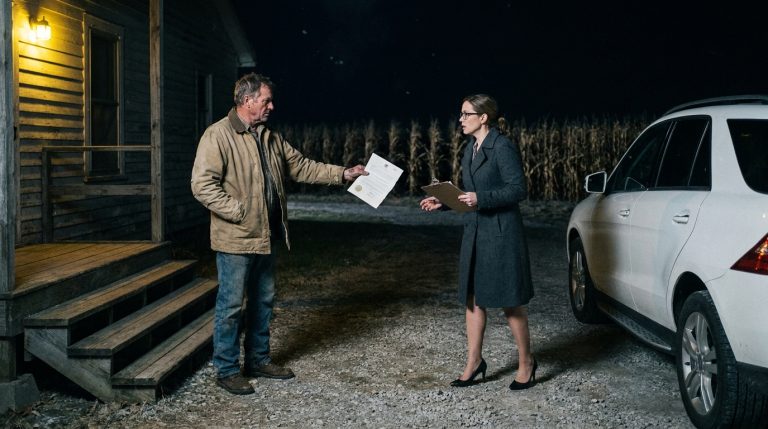
When the driver’s side door opened, the hinge gave a small, expensive hiss. Constance Aberfoil stepped out onto the dirt, her leather shoes thin-soled and unsuited for the gravel. She didn’t look at Garrett first. She looked at the six-kilowatt solar array mounted thirty yards out in the clearing, its black tempered faces angled forty-five degrees south toward the gap. Then she looked at the green poly skin of the three-thousand-gallon rainwater cistern tucked under the eaves of the wrap-around porch.
“This doesn’t belong here,” she said. Her voice had the dry, laminated edge of someone who spent thirty years reading municipal ledger entries out loud in windowless rooms. “And neither do you.”
Garrett didn’t lean on the maul. He kept his right hand wrapped around the hickory handle, the wood smoothed by three winters of sweat and linseed oil. “The county gave me the occupancy permit in November, Mrs. Aberfoil. Electric exemption’s filed. Septic’s signed off by the state agent.”
“The county doesn’t govern the Ridge covenants,” she said, her fingers snapping a legal-sized clipboard out from under her arm. The plastic board was bright neon orange—the kind of color meant to be seen from a highway distance. “The Pinecrest Ridge Association expanded its jurisdiction four years ago. This parcel is under Article Seven. No unpermitted permanent structures. No un-linked utility generation. No raw cedar siding without architectural variance.”
She stepped forward, her shoes crunching against a stray shard of split kindling, and slapped the orange envelope against the rough-sawn cedar post nearest the door. A strip of heavy packing tape was already pre-cut on her thumb. She smoothed it down with two sharp, rhythmic strokes of her palm.
“Twenty-four hundred dollars,” she said, already turning back toward the Cadillac before the tape had fully set against the wood. “Itemized by the board. You have fourteen days to submit your variance application or the late fees compound daily.”
“I don’t have a contract with your neighborhood cluster,” Garrett said. His voice didn’t rise; it stayed down in his chest, level with the steady tick of the wood boiler behind the cabin.
Constance stopped with her hand on the chrome door handle of the SUV. The wind blew through the dry oaks, rattling the dead leaves from the previous autumn against her windshield. She gave him a short, unblinking look over the top of her gold-rimmed reading glasses—a look that estimated his worth down to the penny of his monthly pension check and found the balance lacking.
“The title recorder says otherwise, Mr. Winslow,” she said. She climbed in, the door shutting with the dead, heavy thud of a vault lock, and the Cadillac backed down the limestone track without another word, leaving nothing but two clean tracks in the dust and the smell of hot rubber.
Garrett walked over to the porch post. The orange paper was heavy, legal-grade stock. He didn’t tear it down. He pulled his pocketknife, slipped the small blade under the edge of the tape, and sliced it free from the cedar. The wood beneath was pale, untouched by the weather, a small square of clean pine hidden away from the mountain air.
CHAPTER 2: THE HOLE IN THE LEDGER
The green screen of the county records terminal didn’t refresh so much as it bled into view, line by rhythmic line, humming with a high-pitched drone that vibrated right through the laminate desk and into Garrett’s forearms. The air in the basement of the Dunmore Falls Public Library smelled exactly like the inside of an unvented breaker panel—scorched dust, static electricity, and old paper that had turned yellow and brittle before the turn of the century.
Garrett kept one thumb locked down on the rusty trackball of the terminal. His eyes, map-strained and burning from two hours under a bare fluorescent tube, tracked the digital scan of the 2019 Pinecrest Ridge HOA Annexation Resolution.
“Come on,” he muttered, his voice flat, lost in the crawl space beneath the building’s floorboards.
He wasn’t looking at the legalese. He was an electrician; he knew that if a circuit was blowing, you didn’t look at the warning label on the panel door—you looked for the spot where the wire insulation had rubbed down to raw copper. He bypassed the clauses about setbacks, the definitions of architectural harmony, and the boiler-plate descriptions of common easements. He skipped straight to the signature addendum on page twelve.
The county clerk had stamped it with a heavy purple ink that had bled through the digital scan like an old bruise. Total Registered Residential Parcels: 74. Total Ballots Cast in Favor of Annexation: 51. Total Ballots Cast in Opposition: 24.
Garrett sat back, the metal folding chair groaning beneath his weight. He took a short, sharp breath of the basement air.
Fifty-one plus twenty-four was seventy-five.
He leaned back toward the screen, his calloused index finger tracing the pixels of the certified summary. In the bottom right corner, a tiny notation—scrawled in a tight, mechanical hand that didn’t match the clerk’s loose script—read: Exhibit D-1: Auxiliary Vote Ledger adjusted per management certification.
“Dwight,” Garrett said to the empty room.
The name felt heavy, like a dropped tool. Elevate Community Solutions hadn’t just filed the paperwork; they had scrubbed it. Under Pennsylvania property code, an annexation required a strict two-thirds majority of the total voting pool present at a certified quorum. If the pool was seventy-four, two-thirds was forty-nine point three—meaning fifty votes were needed to pass. If the pool was seventy-five, the target shifted to exactly fifty. With fifty-one votes recorded, the expansion had cleared the legal threshold by a single, solitary scrap of paper.
He pulled a yellow legal pad across the laminate surface. The wood grain of the desk was peeling at the corners, revealing the coarse, gray particle board underneath—dry and flaking like old bone. He drew a hard line down the center of the paper, listing the numbers with the same blunt precision he used when calculating voltage drops on an industrial run.
There was a noise from the staircase behind him—the slow, heavy scuff of thick leather soles on concrete.
Garrett didn’t turn around. He closed his fingers over the edge of the legal pad, his thumb smoothing down the top page until the paper creased with a sharp, white edge.
“The terminal’s supposed to log out at four,” a voice said. It was Theo Brackett. He was leaning against the painted cinderblock wall at the foot of the stairs, his green oilskin jacket still damp from the mist coming off the ridge. His gray beard looked like steel wool under the flickering ballast overhead, and his knuckles were dark with grease from the steering linkage of his truck. “The girl upstairs said there was a guy down here who looked like he was trying to drill through the monitor with his eyes.”
“The math doesn’t check out, Theo,” Garrett said, his hand gesturing to the green glow of the screen. “Look at the tally. They counted seventy-five properties in a seventy-four-home development.”
Theo walked over, the floorboards above their heads creaking as someone moved near the fiction section. He stopped three feet away, smelling of diesel exhaust, wood smoke, and cold rain. He leaned down, his eyes narrowing as he read the resolution summary. He didn’t speak for a long time, his large hand coming down to rest on the rusted corner of the terminal housing.
“They annexed the ridge parcels to get the numbers,” Theo said, his voice dropping into a low rumble that felt level with the masonry. “But they counted the ridge ballots before the ridge was legally inside the line.”
“No,” Garrett said, his pen tapping the auxiliary notation on the screen. “The ridge owners didn’t get ballots. I checked the certified mail log on file with the recorder of deeds. My parcel didn’t get a notice. Neither did yours. This extra vote came from inside the cluster.”
“A ghost,” Theo said.
“A signature,” Garrett corrected. He stood up, his joints popping in the small, stone-walled room. He clicked the trackball, sending a command to the ancient matrix printer across the table. The machine woke with a high, metallic shriek, its ribbon ribbon-driver rattling like a loose drive belt as it began to stitch the digital image onto a continuous roll of perforated paper. “Someone signed for a lot that didn’t have a kitchen or a roof. And they used it to pull fourteen acres of my mountain into their pocket.”
He tore the page off the feed rollers, the paper dry and stiff against his fingers.
“Where’s that lawyer Theo mentioned?” Garrett asked, folding the sheet into thirds until the creases were hard enough to cut. “The one in Harrisburg.”
“Vivian,” Theo said, his eyes still fixed on the dying green screen of the monitor. “She’s sharp, Garrett. But she don’t work for cordwood, and she don’t take cases just because the math looks funny on a municipal scan.”
“She’ll take this one,” Garrett said. He reached into his pocket and pulled out the orange envelope Constance had taped to his porch. He laid it flat on the desk, right next to the printed scan. “Because this isn’t a zoning dispute. It’s a collection agency with a badge.”
He pointed to the bottom of the fine sheet, where a small, six-point font note sat directly beneath the payment instructions: All processing and compliance management executed under contractual assignment by Elevate Community Solutions, LLC. Administrative fees apply.
“Let’s go,” Garrett said, turning off the terminal switch. The screen died with a tiny, white snap of static in the center of the glass. “The light’s dropping on the ridge, and I’ve got four more cords of oak to split before the ground freezes.”
CHAPTER 3: THE COLD ARCHIVE OF THE RIDGE
“The law doesn’t care about your sore hands, Mr. Winslow,” Vivian Storch said. She didn’t look up from the three-ring binder she was leafing through. Her fingers, long and tipped with unvarnished nails, turned the heavy bond pages with a rhythmic, dry snap. “It cares about entry dates, recorded liens, and corporate assignment provisions.”
The office smelled of old paper and the bitter oil she used to lubricate her manual typewriter—a heavy green Underwood that sat on the corner of her desk like a block of unmachined iron. Outside the window, the Harrisburg morning was a dull slate gray, the light dying before it hit the brick alleyway below.
Garrett sat across from her on a wooden armchair that had been built for utility, not comfort. His work coat felt stiff against his shoulders, still holding the faint scent of timber dust and woodsmoke from the ridge. Between his boots sat his canvas tool bag, the heavy steel zippers pulled open just enough to reveal a pair of brass wire-strippers and a grease-stained copy of the county ledger scan.
Theo Brackett was leaning against the heavy oak doorframe, his hands jammed deep into his oilskin pockets. “The math is dirty, Vivian. You don’t need a degree to see seventy-five votes don’t come out of seventy-four front doors.”
“Math is just an opinion until it’s filed under penalty of perjury,” Vivian said. She finally closed the binder, the black vinyl cover coming down with a dull thud that sent a small puff of dust across her blotter. She looked at Garrett over her glasses. “You’re an electrician. If you find an ungrounded neutral in a commercial box, you don’t call the paper and complain. You trace the wire back to the meter. Who runs the ledger for Pinecrest Ridge?”
“Elevate Community Solutions,” Garrett said. “Dwight Feeney’s the property supervisor. But Constance is the name on the envelope.”
“Constance Aberfoil is a symptom,” Vivian said, leaning back. The springs of her chair screamed in protest—a short, sharp rasp of ungreased metal. “She’s a retired administrative manager with a high pension and a low tolerance for variations in trim color. But she doesn’t draft a twelve-page jurisdictional expansion on her kitchen table. Look at the font on the fee addendum.”
She slid the orange notice back across the desk. Her thumb pressed against the tiny six-point type at the bottom.
“This is boilerplate from an entity called Elevate Management Services Corporation, registered in Delaware but operating out of Camp Hill,” Vivian continued, her voice dropping into a hard, clinical rhythm. “They don’t get paid a flat fee by the neighborhood. They take a percentage. It’s listed right here under ‘administrative processing costs.’ Twelve percent of every penalty dollar collected goes directly to the corporate treasury. They aren’t enforcing code, Mr. Winslow. They’re mining your land for yield.”
Garrett picked up the paper. The orange stock felt thick and coarse between his calloused fingers. “Twelve percent.”
“Minimum,” Vivian said. “The more you fight, the more notices they send. Every notice carries a sixty-dollar processing surcharge. If you don’t pay, they place the lien. Elevate charges four hundred dollars to file the lien, and another four hundred to release it when you settle. The HOA board thinks they’re protecting their grass heights. The corporation knows they’re building an asset sheet.”
Theo moved from the doorframe, his heavy boots making the floorboards flex. He reached into his coat and dropped a small, heavy object onto the desk. It rolled twice before stopping against Vivian’s brass paperweight.
It was a small circular disc made of tarnished brass, no larger than a silver dollar, with a single screw hole in the center. Stamped into the metal were the letters P.R.H.A. 2019 and a three-digit string: 075.
“Found it tacked to the oak tree by my eastern survey pin,” Theo said, his voice flat as iron. “Not the county marker. A fresh one. Fresh as four years ago.”
Garrett picked up the piece of brass. It felt cold against his palm, the stamped edges sharp enough to catch the skin of his thumb. “This isn’t an official survey tag.”
“No,” Vivian said, her eyes narrowing as she looked at the number 075. “The county uses aluminum discs with seven-digit state tracking numbers. This is a private locator tag. A ghost marker.”
She stood up, walked to a metal filing cabinet in the corner, and pulled a yellowed map from the top drawer. The paper unrolled with a dry, crackling protest as she pinned the edges down with two heavy law books. It was the 2019 county plat map for the Dunmore Falls section.
“The development cluster has seventy-four platted residential lots,” Vivian said, her finger tracing the grid of identical rectangles before moving out toward the jagged, uneven line of the ridge. “But look at the boundary line where it hits your fourteen acres. There’s a wedge. A half-acre strip of old logging trail that belongs to the utility company’s defunct easement. It was never absorbed by the original developer.”
She tapped the wedge.
“If Elevate listed that easement as an independent residential parcel during the 2019 vote, they get their seventy-fifth ballot,” Vivian whispered, the subtext of her words hanging in the cold office air like frost. “And if they controlled that ballot because the utility company had abandoned the tract, they had the one extra vote they needed to cross the two-thirds threshold. They didn’t just annex you, Garrett. They built a bridge out of a ditch to come get you.”
Garrett looked at the brass tag in his hand, the number 075 catching the dull gray light from the window. The friction of the metal felt real, heavy, and completely transactional. They hadn’t made a mistake in the ledger. They had laid a trap four years before he ever cleared the first cedar tree for his foundation.
“Can you break it?” Garrett asked.
“In court? Eventually,” Vivian said, her hand coming down on the map. “But a petition to void an annexation takes nine months just to get a hearing date. In nine months, Dwight Feeney will have three liens on this cabin, and Constance will have a sheriff’s order to fence off your access road. They don’t have to win the lawsuit, Garrett. They just have to out-spend your lifetime.”
“We don’t have nine months,” Theo said.
“Then you don’t fight them in the courtroom,” Vivian said, looking straight at Garrett. “The annual board election is in six weeks. The bylaws say any owner of record within the active jurisdiction can run for a seat if they file twenty days prior. Right now, they claim you’re in their jurisdiction to fine you. That means you’re in their jurisdiction to replace them.”
She pulled a fresh stack of white paper from her drawer and slid it across the table toward Garrett, along with a black ink pen that had a cracked plastic barrel.
“Sign the declaration of candidacy, Mr. Winslow,” she said. “Let’s see how Constance likes the math when the ledger votes back.”
Garrett took the pen. The plastic felt cheap and thin compared to the iron maul or the brass wire-strippers in his bag, but when he pressed the point to the paper, his hand didn’t shake.
CHAPTER 4: THE STORMWATER GAMBIT
The clipboard clicked against the galvanized iron casing of the cistern with a sharp, echoing snap that made the water inside reverberate against the dark poly lining. Garrett stood on the gravel under the wrap-around porch, his fingers tight around the handle of a crescent wrench. A cold spring mist was drifting off the ridge, turning the hemlocks into black, jagged silhouettes against a desaturated sky.
The man holding the clipboard wore a brown county utility jacket that smelled of wet canvas and damp soil. His name tag read V. Miller, Stormwater Management Division. He didn’t look like Constance; he didn’t look like he owned a Cadillac or cared about the exact shade of trim on a front door. He looked like someone who had spent twenty years measuring ditch depths and checking grade slopes in the pouring rain.
“Someone filed a formal code complaint three days ago,” Miller said, his boots crunching on the wet limestone gravel as he stepped around the side of the three-thousand-gallon tank. “Unauthorized impoundment under the municipal stormwater ordinance. Alleging that your roof runoff system is altering the natural drainage course of the seasonal creek down the slope.”
Garrett looked down at the creek. The water was running fast and clean over the gray fieldstones, swollen by the late April melt but completely contained within its banks. “The tank has an automatic overflow bypass, Miller. It feeds directly back into the culvert line I cleared last spring. It doesn’t alter a thing.”
“I see the pipe,” Miller muttered, leaning down until his knees clicked against the damp earth. He tapped the PVC line with the edge of his ruler. “Three-inch schedule forty. It’s solid enough. But the complaint wasn’t about the pipe. It was about the volume. The paperwork says you’re holding municipal resource water without a retention waiver.”
“It’s rainwater,” Garrett said, his voice flat, matching the gray stone beneath his boots. “The Pennsylvania Clean Streams Law explicitly permits residential harvesting under five thousand gallons. This tank holds three. I filed the county exemption waiver with the building inspector in twenty-one. It’s in the courthouse records on the second floor.”
Miller didn’t answer right away. He flipped the top page of his orange folder, the paper damp and limp from the mist. He adjusted his glasses, his eyes scanning a printed spreadsheet that didn’t carry the county seal. It was an internal administrative template with a small corporate emblem stamped in the upper margin—three interconnected boxes under the name Elevate Community Solutions.
Garrett stepped closer, his boots leaving dark prints in the wet gravel. His hand remained down by his side, but his eyes locked onto a small line item on the sheet. It wasn’t a standard county inspection code. It was a billing reference marked Enforcement Escrow Recovery: Code 109.
“Who gave you that printout, Miller?” Garrett asked.
Miller sighed, a cloud of pale breath rising between them and vanishing into the hemlocks. He let the clipboard drop against his hip. “Look, Mr. Winslow. I don’t draw up the schedules. I get the work orders from the administrative clerk. The clerk said a private community governance representative called in a public safety risk regarding the cistern structural stability. They provided the parcel identification data.”
“Constance,” Garrett said.
“The board president, yeah,” Miller said, shaking his head. He pulled a heavy metal flashlight from his utility belt, the lens scratched and yellowed by age, and clicked the beam onto the brass intake valve of the UV filtration assembly. He gave the copper coupling a hard, physical shake with his bare hand. “Everything’s tight. The pump’s grounded. The county codes don’t touch residential rain systems under five thousand unless there’s a visible structural failure. This thing’s cleaner than the water line at the township building.”
He stood up, his canvas jacket scraping against the cedar post where Constance had taped the original fine notice six weeks ago. He pulled a thick blue form from his pouch, filled out three lines in a quick, mechanical hand, and tore it from the carbon pad with a clean rip.
“This is a zero-violation clearance certificate,” Miller said, handing the blue copy to Garrett. The paper felt wet and heavy. “The system’s fully compliant under the state exemption. But you should know something. The county office charges an inspection dispatch fee whenever a private entity submits an unverified public safety complaint. It’s designed to stop neighbors from using us to settle grudges.”
Garrett unfolded the blue paper. “How much?”
“One hundred and seventy-five dollars,” Miller said, turning back toward his mud-streaked utility truck parked at the edge of the clearing. “The bill goes directly to the complainant of record. In this case, that’s Constance Aberfoil’s office at the primary cluster clubhouse. I don’t think she’s going to enjoy the mail on Monday.”
Garrett watched the truck back down the ridge road, its tires spinning once in the wet clay before finding traction on the limestone base. He looked at the blue form in his hand, then looked back at the small invoice code he’d spotted on the administrative sheet: Code 109.
His thumb moved over the crescent wrench in his tool bag. Constance hadn’t just filed a complaint; she had used an Elevate corporate template to do it. The corporate management company was driving the enforcement actions, using the municipal county offices as a secondary lever to break his financial endurance before the board election could take place.
He walked inside the cabin, the heavy timber door shutting out the cold mist. On the kitchen table, spread across the raw black walnut slab, were the certified copies of the 2019 board minutes Vivian had pulled from the repository the day before. Beside them lay a fresh certified letter that had arrived in his mailbox that morning while he was up on the ridge checking the solar lines.
He picked up the letter. It wasn’t another fine. It was an official notice of administrative exclusion, signed by Constance Aberfoil on behalf of the executive board.
Due to ongoing jurisdictional litigation regarding your parcel, your membership status within the Pinecrest Ridge Homeowners Association is currently suspended pending final adjudication. Consequently, your candidacy filing for the upcoming board election on June 20th has been deemed invalid under Article Three, Section Two of the community bylaws. You are hereby notified that your name will not appear on the official ballot.
Garrett sat down in the quiet of the cabin, the wood stove ticking softly as the heat expanded the iron plates. The letter was a direct strike, timed perfectly to hit twenty days before the annual meeting—the exact deadline for ballot corrections. They hadn’t just changed the rules; they had locked the door from the inside and taken the keys.
He reached for the black telephone on the counter, his fingers dialing Theo’s number by memory. His eyes remained fixed on the blue county clearance form, the one hundred and seventy-five dollar charge against Constance a small, isolated victory in a war that was rapidly expanding beyond the boundaries of his fourteen acres.
“Theo,” Garrett said when the line clicked open. “Get Vivian on the radio. They just dropped the ballot box in the river.”
CHAPTER 5: THE SEATED QUORUM
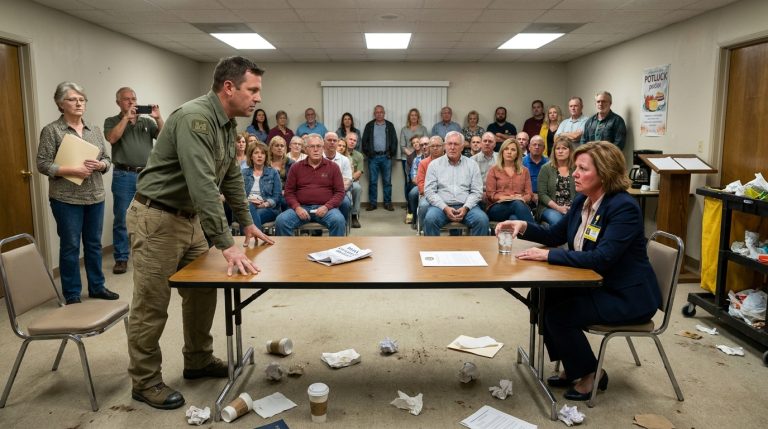
“The vote is barred, Mr. Winslow,” Constance Aberfoil said. She didn’t drop her head to look at him. Her fingers, covered in thin gold bands that clicked against the laminate table, smoothed down a stack of certified member registries. The room smelled of old linoleum, industrial pine cleaner, and the heavy, sour steam of thirty people packed into the clubhouse basement under a rain-streaked window. “You’re a non-member in a contested status. Step away from the ballot collector.”
Garrett didn’t drop the clipboard. The heavy pine board felt solid against his ribs, his fingers anchoring the cold iron clip where Vivian’s emergency temporary restraining order was pinned. The paper was crisp, bearing the raised seal of the Court of Common Pleas—a sharp, circular indentation that felt like an industrial stamp under his thumb.
“The judge didn’t think so, Constance,” Garrett said. His voice stayed level, traveling through the low ceiling joists of the beige clubhouse room. “The order says every parcel within the expanded boundary has a vote until the court clears the title challenge. That’s twenty-three ridge owners standing by the door. We’re checked in, we’re verified by the election monitor, and we’re holding the ballots.”
Beside the registration desk, Walter Drummond sat in a metal folding chair that groaned every time the retired magistrate shifted his weight. His white hair caught the blue glare of the buzzing fluorescent tube overhead. He didn’t look up from his ledger, but his hand—thick-fingered and stained with fountain pen ink—tapped the brass clasp of his leather briefcase.
“The court’s directive is specific, Mrs. Aberfoil,” Drummond said, his tone carrying the slow, unhurried cadence of a man who spent forty years watching local boards run out of road. “If you refuse the ballots, the election is uncertified on site. I’ll file the non-compliance report with the district magistrate before the grease cools on your coffee machine.”
A sharp, metallic murmur went through the rows behind Garrett. Theo Brackett was there, his green oilskin coat slick with gray mountain rain, his shoulder blocked against the metal doorframe to keep the exit clear. Next to him stood Paulette Greer, her phone held level at her chest, the small glass lens recording the room with a steady, unblinking green light.
Constance’s face didn’t break. It went stiff, the skin around her jaw tightening until the tiny veins near her ears turned a dull, leaden purple. She looked past Garrett toward the back of the room, where a young man in a polyester company blazer sat on a stack of folding chairs. His name tag read Percival, Elevate Community Solutions. He was staring down at his phone, his thumbs moving with a frantic, jerky momentum that looked like a machine losing its timing.
“Dwight’s not coming, Constance,” Garrett said, leaning his palm against the edge of the registration table. The laminate was peeling, showing the gray, granular glue beneath the faux-wood finish. “I called the Camp Hill office at eight. The secretary said he was on administrative leave. Something about a regulatory filing with the Attorney General’s Consumer Protection Division.”
Percival looked up from his phone, his face pale under the industrial lights. He cleared his throat—a short, dry rattle that didn’t carry past the third row of chairs. “The company’s position… the company’s position is that the 2019 contract allows for administrative adjustments to the quorum requirements during disputed title sessions.”
“The company doesn’t vote,” Vivian Storch’s voice cut through from the center aisle. She stood with her arms crossed over her canvas trench coat, her fingers tapping the leather strap of her document case. “The residents vote. And right now, fifty-four people are signed into the ledger. That’s more than double your quorum. If you don’t call the roll, the monitor calls it for you.”
Constance stood up. Her chair scraped back against the linoleum with a scream of ungreased metal that made the young clerk beside her flinch. She reached for the master registry binder—a heavy three-ring monstrosity with the Elevate corporate logo stamped into the spine.
“This meeting is adjourned,” she said, her voice rising just enough to catch the vibration of the exhaust fan in the wall. “The board will review the court’s filing in executive session next month. Ballots are voided for today’s line item.”
“Sit down, Constance,” Walter Drummond said. He didn’t raise his voice, but he opened the leather briefcase with two heavy, synchronized clicks of the brass locks. He pulled a yellowed copy of the 1994 association charter from the interior pocket. “Article Twelve, Section Two. The president doesn’t hold the adjournment lever once a quorum has been verified by an independent monitor. If you walk out that door, the majority elects a temporary chairman and the ballot proceeds without you.”
She stopped with her hand on the vinyl binder. The room went so quiet that Garrett could hear the rain hitting the galvanized window well outside—a rhythmic, hollow drumming that sounded like small stones hitting an empty drum.
From the third row, a residential cluster owner named B. Strickland stood up. Her winter coat was worn at the cuffs, the gray tweed fraying into small nests of white thread. “I’ve paid six hundred dollars in fines since November, Constance. For a trash can lid that didn’t lock down after the wind took it. I want to know who got that money. Did it go into the road fund or did it go to Camp Hill?”
Percival shrank back into the folding chairs, his thumb completely still on the screen of his phone.
“The allocations are confidential under the management agreement,” Constance said, her eyes fixed on the wall above Strickland’s head.
“They aren’t confidential on a tax return,” Vivian said, dropping a fresh packet of white papers onto the table right in front of Constance’s binder. “That’s the 2019 consulting ledger. Elevate billed the reserve fund fifteen hundred dollars to draft the annexation resolution. They paid themselves to expand their own collection boundary, and they used an unrecorded utility easement to get the seventy-fifth vote. It’s right there on page four.”
Garrett watched Constance look down at the packet. For three seconds, she didn’t move. Her right hand remained hovering over the vinyl binder, her gold rings shaking just enough to trace a tiny circle against the plastic cover. She didn’t look at Garrett. She didn’t look at the press reporter sitting by the water cooler with a notepad on her knee. She looked at the numbers—the cold, dry, unyielding math that had finally come up the ridge to find her.
“Collect the ballots, Walter,” Garrett said, turning his back to the table.
The crowd didn’t wait for Constance to sit. Theo moved first, his large hand dropping the white paper sheets into the wooden ballot box Walter had placed on the clerk’s desk. One by one, the ridge owners and the cluster neighbors stepped into the narrow lane between the metal chairs, the paper slips falling with a soft, dry rustle through the slit in the oak lid.
When the final tally came down twenty minutes later, the silence in the room had the weight of wet limestone. Walter Drummond stood up, his silver pen tracing the final line of his ledger before he closed it with a solid, definitive snap.
“Five seats contested,” Drummond announced into the glare of the tubes. “Winslow, Brackett, Greer, Okafor, Voss. Fifty-one votes registered for the slate. Eleven votes registered for the incumbent board.”
Garrett looked back at the table. Constance was still standing, her coat buttoned to the throat, her leather purse gripped in both hands like a shield. She didn’t stay for the motion to review the contract. She didn’t look at Percival as he scrambled to pack his files into a plastic crate. She walked down the center aisle, her thin shoes making a small, dry clicking sound on the linoleum until the heavy iron fire door shut behind her with a dull, echoing thud.
Theo leaned over the table, his shoulder brushing against Garrett’s canvas sleeve. “We’re in the log now, Garrett. What’s the first pull?”
Garrett reached down and picked up the black ink pen Constance had left behind on the registration sheet. “We terminate the corporate assignment before the bank opens on Monday.”
CHAPTER 6: THE SIGNED MARGIN
The nib of the black ink pen made a dry, scratching scrape against the bond paper, the sound cutting through the absolute quiet of the cabin like a knife through dry kindling. Garrett didn’t look up until the final loop of his signature crossed the margin line.
The kitchen table was cold beneath his wrists. He had built it himself from a massive, raw slab of black walnut he’d hauled out of the lower draw three years ago. The dark wood still held the faint, deep scent of tung oil and the rough, uneven ridges where his hand planer had taken down the high grain. Outside the south-facing windows, the October light was dropping fast behind the ridge line, casting long, desaturated shadows that turned the yellowing oaks into gray silhouettes against the limestone ledge.
The paper in front of him was a formal contract termination notice addressed to Elevate Community Solutions. It was a single sheet, unadorned by corporate clip art or orange borders.
“That’s the last loop,” Theo said. He was sitting on the wooden bench across from Garrett, cleaning the brass threads of an old water coupling with a stiff wire brush. The rhythmic, metallic scratch of the wire against the brass kept time with the steady ticking of the wood stove in the corner. “The certified mail truck passes the Dunmore Falls post office at four. If we drop it now, Feeney gets the notification before his morning coffee on Monday.”
“He’s already got it,” Garrett said, blotting the wet ink with the edge of his hand. His skin was rough, a deep, semi-permanent stain of copper grease tracing the lines of his knuckles. “Vivian delivered the court order to their legal counsel in Camp Hill yesterday afternoon. The annexation is fully struck down. Void from the inception. That means every fine they wrote under the 2019 boundary expansion is just waste paper.”
He stood up, his joints making a dry, cracking sound in the silent room. He walked to the window, looking down the gentle slope toward the seasonal creek. The water was running low and clear over the limestone gravel, its soft murmur completely unbothered by the administrative wreckage left behind in the clubhouse basement.
The fight had taken thirty days from the first orange envelope to the election count, but the cleanup had crawled through the four months of summer like a heavy machinery run through thick clay. Dwight Feeney had resigned from the management firm before the June leaves had fully darkened. The state Attorney General’s office had pushed through a negotiated settlement that stripped the performance-based enforcement fees out of every HOA contract in the commonwealth—a three-hundred-and-forty-thousand-dollar restitution fund that Hargrove Finch was already tracking on a fresh spreadsheet with a three-foot rule.
“Constance sold the place,” Theo said, dropping the brass coupling back into his canvas bag with a heavy, solid clink. “Paulette told me the moving truck cleared the primary cluster driveway on Tuesday. Some retirement village down in South Carolina. No unapproved fences. No gravel roads.”
“I hope they keep good ledgers down there,” Garrett said.
He looked at the corner post of his porch, where the pale square of wood remained visible against the weathered cedar siding—the exact spot where the orange notice had been taped. The raw timber was darkening slowly under the mountain air, absorbing the damp autumn mist until the edges began to blend into the gray grain around it.
He hadn’t built this cabin to change the rules of a township he barely visited. He’d built it because after twenty-eight years of running commercial wire through concrete shafts and watching the city turn gray around him, he needed to know that his own hands could still produce something that didn’t depend on a city grid or an administrative signature to exist. He had built it in memory of Denise, under the simple logic that the most honest work was the kind that left a callus on your palm and a roof over your children’s heads.
The land trust paperwork was sitting on the counter next to the solar batteries, ready for the November registry filing. Twenty-two acres of Theo’s plot, fourteen of his own, and three other ridge parcels bound together into a single, permanent conservation easement that no corporate expansion could touch. The land would stay wild, the trees would stay un-trimmed, and the cedar siding would turn gray at its own pace.
Garrett folded the termination notice into a clean white envelope and smoothed down the adhesive strip with his thumb. The glue felt dry and functional.
“You want a ride down to the post office?” Theo asked, swinging his tool bag over his shoulder.
“No,” Garrett said, reaching for his canvas work coat hanging by the wood stove. The lining was frayed at the cuffs, the wool thin where his tool belt had rubbed against the fabric for a decade. “The air’s sharp enough to walk it. I want to hear the creek before the freeze sets in.”
He walked out onto the porch, the heavy oak door closing behind him with a solid, unyielding click that echoed off the timber framing. The mountain air was clean, free of the hot rubber and synthetic leather that had climbed the rise four months ago. He stepped off the limestone edge of the drive and started down the track, the envelope tucked deep into his pocket, his boots striking the gray gravel with a steady, rhythmic cadence that matched the slow darkening of the ridge.