The Structural Truth: Engineering Justice in a World of Crumbling Foundations and Silent Burdens
CHAPTER 1: The LoadBearing Lie
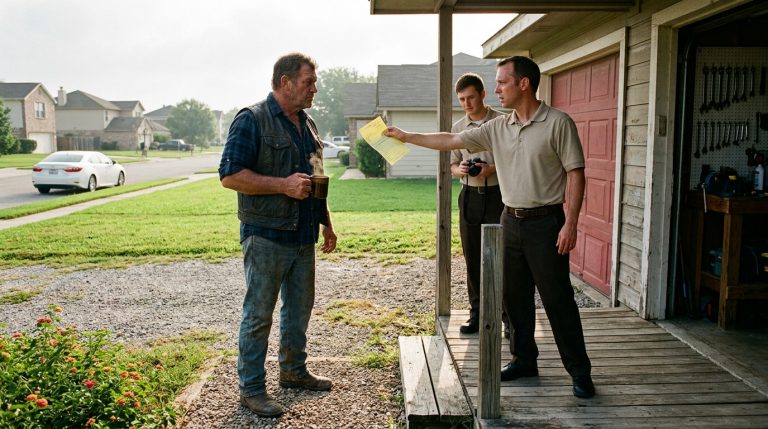
The orange plastic drums didn’t belong on the south approach. They were cheap, hollow, and utterly insufficient, but the two men dragging them across the gravel acted like they were sealing a blast door. Karen DeLancey stood ten yards back, her posture a practiced study in suburban authority, a walkie-talkie clipped to her belt like a sidearm. She was directing traffic at a checkpoint that didn’t exist, on property that didn’t belong to her, with a confidence born of thirty-five years of unchecked assumption.
I kept the truck in park. The engine heat bled through the floorboards, a dry, metallic warmth that felt like grit in my throat. I didn’t roll down the window to shout. I didn’t get out to argue. My hands rested on the steering wheel, my grip firm enough to feel the texture of the leather, measuring the distance, the angle, and the structural impossibility of what was happening in front of me.
She was building a barricade to keep the owner off his own land. It was a fascinating case study in failure.
I reached for the camera on the passenger seat—a Nikon with a shutter speed fast enough to freeze the motion of their incompetence. Three shots. Clear, digital evidence of unauthorized obstruction on a private easement-free approach. I watched them struggle with the final drum, the uneven gravel forcing them to heave and curse. They weren’t just blocking a road; they were tampering with the integrity of the approach slab. The drainage there was already failing, water pooling against the abutment in a way that had been etching mineral stains into the concrete since before I was born.
They were sealing a tomb, unaware that the floor was already giving way.
When the last drum clicked into place, Karen checked her watch, signaled the men with a sharp, bird-like flick of her hand, and turned back toward the bridge. She caught my eye then. She didn’t flinch. She gave me a small, tight, patronizing smile—the kind you’d offer a delivery driver who took the wrong turn—and then turned her back to walk toward the safety of the Briarstone side.
I shifted the truck into reverse. The gravel crunched with a sound like grinding teeth as I backed away, giving them the illusion of retreat. I had the photos. I had the deed. I had the quiet, heavy knowledge of what happens when a structure is subjected to loads it wasn’t rated to carry, whether that load was steel, concrete, or the collective, unearned arrogance of a gated community.
As I pulled away, my phone buzzed in the cup holder. Don. I didn’t pick it up. I already knew what he’d found in the county records. The bridge wasn’t just my property; it was a ticking clock. And as I turned onto the main road, leaving the barricade to sit in the heat, I realized the most disturbing part of the morning wasn’t Karen’s attempt to claim the bridge. It was the way the south abutment had visibly shifted—just a fraction of an inch—when the lead man had dropped the heavy orange drum, a tremor that rippled through the limestone base like a warning I was the only one in the county equipped to understand.
CHAPTER 2: The Paper Trail of Rust
The gravel road back to the cabin felt longer than usual. My hands were still mapped to the steering wheel, my grip slightly tight, holding onto the phantom vibration of that shifted south abutment. Every time I crested a rise, I caught the reflection of the sun on the windshield of the truck behind me—a dark, modern SUV that kept pace with my speed. I didn’t slow down, and I didn’t speed up. I just watched it in the rearview mirror until it veered off toward the main highway, leaving me to the silence of the timberland.
When I reached the cabin site, I didn’t get out. I grabbed my phone and dialed Don Shepherd. He picked up on the second ring, his voice already carrying that dry, measured tone of a man who spent his life sifting through the wreckage of other people’s assumptions.
“Mitch,” he said, not greeting, just acknowledging. “I assume the barricade was successful.”
“They’re playing soldier, Don. Orange plastic, vest-clad ‘security,’ and Karen herself acting like she’s defending the Alamo. They’ve blocked the south approach.”
There was a silence on the other end, the kind where you can practically hear the man flipping through mental files. “Hostile interference with a private property owner’s access. That’s a predictable escalation. Did you document it?”
“Photos, three of them. Clean shots.”
“Good. Keep them in a file. Don’t engage. If they want to play the HOA game, let them—it’s a rigged casino. I’ve been digging into the original Briarstone plat. You know, Paul Winstead was clever back in the eighties, but he was also lazy. He filed the subdivision boundaries without a single mention of the bridge’s physical easement. It was all ‘access via existing private structure’—a nebulous phrase that doesn’t actually grant a legal right of way.”
I stared out at the treeline, watching the way the late spring light filtered through the dense canopy, creating patterns of sharp contrast on the floor. “And the HOA? They’ve been collecting dues for maintenance for thirty-five years. If they don’t have an easement, what have they been maintaining?”
“That’s the beauty of it, Mitch,” Don replied, his voice sharpening. “They’ve been maintaining their own belief system. I’ve requested the maintenance logs for the bridge. If they don’t produce a signed document from the original owners—the Tanners or the timber company—they’ve been spending association funds on private property without authorization. That’s a fiduciary disaster.”
“I saw the south abutment today, Don. There’s fatigue. The drainage is shot. I saw a shift in the concrete when a truck drove over it. It’s not just about ownership; it’s about a structural failure they’re literally pouring asphalt over.”
“Then we have them on two fronts,” Don said. “Legally and operationally. Keep your head down. I’m going to draft a formal notification of ownership. It’ll state the facts: you hold fee simple title, there is no recorded easement, and they are essentially trespassing on private infrastructure. We don’t ask for permission. We inform them of reality.”
“Karen won’t like the reality check.”
“Karen is going to find out that the world doesn’t function on bylaws and newsletters.”
I hung up and stepped out of the truck. The air smelled of iron and damp earth, the scent of the creek below. I walked to the edge of the ridge, looking down toward where the bridge would be, hidden by the density of the oaks. My pulse finally slowed. I wasn’t just a retired engineer looking for peace; I was a man who understood that every failure, no matter how grand, starts with the unnoticed, tiny crack—the one hidden beneath the paint, the one dismissed by those who didn’t want to look too closely.
I turned back to the truck, but stopped. My boot hit something that didn’t belong in the leaf litter. I bent down and brushed away the dirt. It was a metal stake—an old survey marker, rusted to the point of flaking away in my fingers, stamped with a date that didn’t match the county records I’d studied. It was buried deep near the tree line, sitting exactly where the property line shouldn’t have been according to the GIS overlay. A discrepancy. A small, physical contradiction. I tucked it into my pocket, the cold weight of the metal biting into my palm.
The game had started.
CHAPTER 3: The Geometry of Extortion
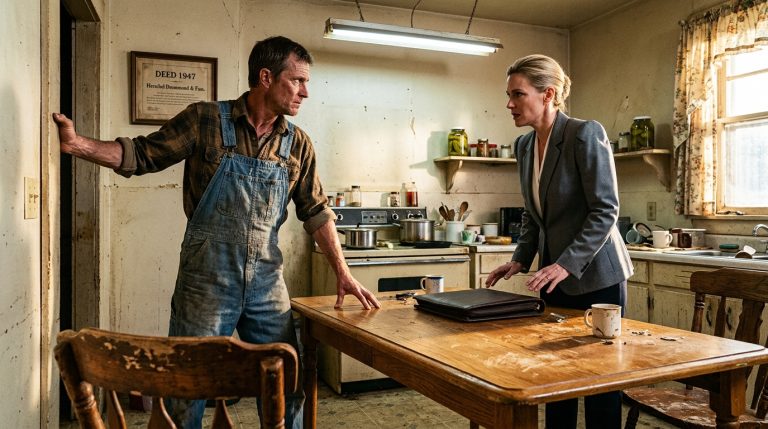
The envelope sat on my kitchen table like a dead weight. It was three pages of HOA-letterhead arrogance, each sentence carefully constructed by Karen DeLancey to sound like legal doctrine while functioning as a ransom note. She didn’t just reject my ownership; she accused me of a conspiracy, a pre-meditated strike on the sanctity of Briarstone Ridge.
“Read page two, paragraph four,” Don said, his voice coming through the speakerphone with a tinny, detached quality. He was in his office in Athens, surrounded by the smell of old paper and the quiet hum of a firm that had seen every kind of land-use war imaginable.
I flipped to the page. “It says here that I’m attempting to ‘extort’ a residential neighborhood by weaponizing infrastructure.”
“Weaponizing infrastructure,” Don echoed, a dry chuckle following. “They aren’t just doubling down, Mitch. They’re hallucinating. She’s trying to establish a narrative of victimhood before we even move to filing a declaratory judgment. She knows the title is clean, but she’s banking on the hope that if she screams loud enough, the court will mistake volume for validity.”
I looked out the window toward the ridge. The sky was bruising over, the light turning that flat, metallic gray that precedes a heavy mountain storm. “She’s not just talking to a court, Don. She’s talking to the neighborhood. She wants them to believe I’m the villain so they don’t look at the maintenance logs. If they’re angry at me, they aren’t looking at the fact that they’ve been driving over a bridge that’s never been load-rated.”
“Exactly. It’s a classic deflection maneuver. If the HOA admits the bridge is your property, they have to admit they’ve been maintaining—or failing to maintain—a structure they had no right to touch. It’s an admission of liability they can’t afford.”
I ran my finger over the edge of the letter. It was crisp, expensive paper, meant to intimidate. Underneath it, I still had the rusted survey stake I’d pulled from the tree line yesterday. I’d placed it on the table earlier. Its iron surface was pitted with deep, jagged orange corrosion, a physical manifestation of time and neglect.
“I have a meeting with the structural team next week,” I said. “Anand is coming out. We’re going to do a full ultrasonic test on the gusset plates.”
“Good. Keep it technical. The more hard data we have, the harder it will be for their ‘community rights’ argument to hold water. I’m going to draft a formal response to this three-page fairy tale. I’ll keep it brief—factual, dispassionate, and firm. We don’t need to debate her character. We just need to define the boundaries of the property.”
“She’s already escalated, Don. She’s claiming the community has a historical right. She’s building a case for adverse possession.”
“They all do,” Don said. “They think twenty years of walking their dogs across a piece of steel makes them the legal owners. But they forget the ‘hostile’ part of the law. They’ve been using it with permission—or at least, without objection—from the timber company for decades. Permission is the death of a prescriptive easement. If I can find just one record of the previous owners acknowledging the bridge use, their entire defense collapses.”
“I’ll look through the property archives again. There’s something wrong with the original 1988 survey maps. The geometry doesn’t align with the creek’s current path. It’s like they were drawing the lines based on a fantasy instead of the limestone.”
“Check the original field notes,” Don suggested. “Surveyors often write down what they see, not what they’re told to see. If there’s a discrepancy there, that’s your lever.”
I hung up. The storm finally broke, the rain lashing against the metal roof of the cabin with a rhythmic, percussive force that drowned out the world. I pulled the 1988 plat out of my file and set it beside the survey I’d commissioned. I pulled out a fresh sheet of drafting paper and started measuring again, my hands moving with a mechanical familiarity that bypassed the anxiety of the situation.
There it was. A three-degree variance on the north abutment point. A deliberate, or perhaps careless, shift to exclude the bridge from the development footprint. They had built a gated community on the assumption that the bridge was a doorway, but they hadn’t bothered to check who owned the wall it was attached to.
I sat there as the rain intensified, tracing the line of the creek with my pencil. I wasn’t just measuring distance anymore. I was measuring the distance between their assumption of control and the hard, rusted truth of the title. Karen DeLancey wanted a war of narratives. I was going to give her a war of measurements.
CHAPTER 4: The Sound of Fatigue
The ultrasonic probe felt cold against my palm, a stark, clinical contrast to the humid heat rising from Tanner Creek. Dr. Anand Krishnamurthy was ten feet below me, suspended in a climbing harness beneath the bridge deck, his voice tinny and rhythmic as he called out readings over the walkie-talkie.
“Section four, cross-member B. Ultrasonic scan indicating subsurface porosity,” he shouted, his voice echoing against the limestone bluffs. “Mitch, the corrosion isn’t just surface-level. The moisture intrusion has been working on this steel for decades. It’s like a slow-motion rot.”
I stood on the bridge deck, the surface vibrating under my feet with every gust of wind that whistled through the trusses. I looked down at the upstream gusset plate—the critical junction I’d marked weeks ago. To the untrained eye, it looked like a bit of weathered iron. To me, it was a roadmap of failure. The paint was flaking off in curled, blackened strips, revealing the jagged, lightning-bolt fracture of fatigue cracking beneath.
“Anand, check the gusset at node 3A. I’m seeing linear separation.”
A silence followed, heavy and pregnant with the kind of dread that engineers know better than anyone. Then, a dull metallic tapping sound drifted up—Anand’s hammer hitting the steel.
“You’re right,” he said, his voice dropping an octave. “It’s not just a surface fissure. It’s propagating through the plate. If this node fails, the load distribution shifts entirely to the downstream trusses. This bridge is operating on borrowed time and a very thin margin of safety.”
I stepped back, my boots scraping on the treated lumber that Karen DeLancey’s HOA had convinced itself was ‘community infrastructure.’ They didn’t see the fatigue. They didn’t see the way the bridge groaned under its own weight, a low-frequency hum that signaled the structural stress. They saw a shortcut, a convenience, a permanent feature of their comfortable existence.
I pulled out my notebook and began sketching the stress lines, my pencil moving with a clinical, detached precision. The HOA’s claim of maintenance was a fabrication—they’d spent their dues on paving the approaches and painting the guardrails, purely cosmetic work that actually exacerbated the drainage issues. They’d been dressing a corpse in a Sunday suit.
As I worked, a black Lexus slowed to a crawl at the north entrance, the driver—Karen, naturally—hesitating as she saw the orange cones and the rope-suspended inspector beneath her. She rolled down the window, her face a portrait of indignant confusion.
“Mr. Holloway! What do you think you’re doing? You’re obstructing the thoroughfare!”
I didn’t look up from the sketch. I let the silence stretch, the only sound being the rush of the creek below and the occasional tap of Anand’s hammer. “I’m conducting a structural integrity assessment, Karen. The bridge is in a state of advanced fatigue. I’d suggest you advise your residents to find an alternate route until we establish a load-bearing threshold.”
She leaned out the window, her eyes flashing. “This is community property! You have no authority to perform any inspections, let alone close the road. I’ve already spoken to our attorney, and he’s preparing an injunction. You are harassing this neighborhood!”
“I’m measuring, Karen,” I said, finally meeting her eyes. “There’s a difference between a feeling and a fact. And right now, the facts are telling me that this bridge is failing.”
She stared at me, the confusion flickering into something sharper—fear, perhaps, or just the visceral anger of a person who has never been told no by the world. She slammed the car into gear and accelerated, the tires spitting gravel against the side of my truck.
I watched her go, then looked down at the gusset plate again. The crack was visible now, a tiny, jagged line that seemed to be vibrating in time with my own pulse. The decoy secret—the lack of maintenance records—was just the surface. The deeper truth was the failure of the structure itself, and the fact that 109 families were essentially driving over a landmine. I had the facts, the survey, and now the engineering data. But the bridge wasn’t just a physical object anymore; it was a weight that was beginning to feel permanent.
I picked up the walkie-talkie. “Anand, we’re done for today. Get out of the harness. We have enough to justify a formal weight restriction, and I think we’ve just ensured that the next time the HOA speaks, they’ll have to do it in a courtroom.”
The rust, the fatigue, the silent decay—it was all finally being accounted for. The bridge was a problem, but it was a problem that could be measured, calculated, and, eventually, dismantled. And that was the only kind of peace I knew how to build.
CHAPTER 5: The Archive of Omissions
The county archive basement smelled of wet dust and the acidic tang of rotting paper. It was a place where things went to be forgotten, which made it the only place to find the truth. I had been here for three hours, my flashlight beam cutting through the gloom, scanning the rows of grey metal filing cabinets that stretched into the darkness like a necropolis of administrative failures.
My hands were stained with the carbon-black of old ink ribbons. I pulled another file, the folder for the 1987 Briarstone Ridge development permit. My heart hammered against my ribs, a sharp, irregular cadence. Don was waiting, but I needed this—the original application, the one filed by Paul Winstead before he’d handed the maintenance responsibility to the HOA.
I thumbed through the documents. There it was: The Certificate of Infrastructure Sufficiency. It was a one-page document, signed by an engineer whose name I recognized—a man who had lost his license for fraudulent testing in the early nineties. My breath hitched. I scanned the document, looking for the bridge certification. It was there, but the signature on the structural load-rating section was not a signature at all. It was a stamp. A rubber stamp of a name, with no initials, no seal, no professional engineer’s license number.
It was a phantom document. A forgery of bureaucratic convenience.
“Mitchell?”
I jumped. A voice echoed from the staircase. I turned, my flashlight beam sweeping across the damp concrete walls. It was Gene, the retired county clerk, her silhouette framed by the dim light of the entrance. She had helped me navigate the indexing system, but she wasn’t supposed to be down here.
“Gene? What are you doing down here?”
She stepped into the light, her expression tight. “I saw your truck in the lot. You’ve been down here for hours, and the Sheriff’s deputies were just asking about you at the front desk.”
“The Sheriff?”
“Someone called in a trespass complaint. They said someone was ‘rummaging’ through restricted files. Karen isn’t playing a legal game anymore, Mitchell. She’s weaponizing the local precinct.”
I looked down at the forged certificate in my hand. The ink was faded, the paper brittle, but the lie it contained was as fresh as the day it was created. This wasn’t just a missing easement; it was a criminal omission. The developer had built the entire neighborhood on a foundation of fake signatures, and the HOA had been carrying that lie for thirty-five years, unknowingly defending a void.
“If the Sheriff shows up, tell them I’m a property owner conducting due diligence on my own title,” I said, my voice steady, though my mind was racing. “But I need you to listen. This isn’t just a civil dispute. This certificate is forged. If I bring this to the state licensing board, the entire Briarstone infrastructure status is revoked instantly. The whole bridge—the liability, the maintenance, the access—it all goes back to zero.”
Gene looked at the document, her face pale. “If you do that, the neighborhood becomes uninsurable. The residents won’t have a legal way to get to their homes. The bank will call their mortgages.”
“They’re already uninsurable, Gene. They’ve been driving over a deathtrap for three decades. They just don’t know it yet.”
The sound of footsteps on the concrete stairs grew louder—heavy, rhythmic, authoritative. Deputies. Karen had pulled the trigger on the police, hoping to intimidate me into silence, but she had miscalculated the mechanism. She had only succeeded in driving me deeper into the vault where the truth was kept.
I stuffed the documents into my satchel, my movements efficient and practiced. I wasn’t the prey here. I was the architect of the reality they had tried to bury.
“The back exit,” I whispered. “Is it still unlocked?”
“Yes, but they’ll know where you went.”
“Let them,” I said. “Let them follow me to the courthouse. I have an audience for this now.”
I moved through the darkness toward the emergency exit, the weight of the forged certificate in my bag feeling heavier than any steel beam. The decoy secret—the lack of records—was gone. The absolute reality was a structure that legally didn’t exist, serving a community that was about to find its foundation dissolved by a single, rubber-stamped lie. I pushed the door open, the cold night air hitting my face like a reprieve, and stepped out into the rain. The game had shifted from a property dispute to a controlled demolition.
CHAPTER 6: The Weight of the Alarm
The community center was a monument to late-eighties optimism—stone veneer, cathedral ceilings, and a parking lot currently packed with the cars of people who were beginning to realize their property values were written in sand. I stood by the side entrance, the satchel with the forged certificate feeling like a lead weight against my hip. Don was beside me, his suit jacket rumpled, his eyes scanning the crowd with the focused intensity of a man watching a landslide begin.
“You’re sure about the Fire Chief?” Don asked, his voice low enough to be lost in the murmur of the crowd. “He hasn’t returned my calls all morning.”
“Cartwright is a pragmatist,” I said. “He knows that if he stands up there and tells them the bridge is a liability, he’s effectively shutting down their lifeblood. But he’s also a chief. He won’t gamble with a fire engine’s weight against a failing gusset plate.”
The doors swung open. Karen DeLancey stepped out, flanked by Martin Caldwell. She looked like she had just stepped out of a boardroom—polished, controlled, and utterly insulated by the bubble of her own importance. She didn’t look at me. She didn’t look at the crowd. She looked at the horizon, as if expecting the cavalry to arrive and dissolve the reality we were about to confront.
“Mitchell,” a voice called out. I turned. Chief Cartwright was walking toward us, his uniform impeccable, his face a mask of tired gravity. He didn’t offer a handshake.
“Chief,” I acknowledged. “You’re here.”
“I’m here to speak to the safety of this neighborhood, not the ownership of the bridge,” Cartwright said, his voice flat. “But I need to know something. If I go in there and declare the bridge unfit for heavy equipment, are you prepared for the fire safety vacuum that follows? Because I’m not going to leave these people without a response plan.”
“I have a plan,” I said, my voice steady, though the irony of it bit at me. “But it requires them to acknowledge the bridge is private, and it requires them to authorize the repairs. If they don’t, the bridge closes tonight.”
Cartwright studied me, his eyes searching for a crack in my composure. “You’re a hard man, Holloway. You’re playing with their roofs to prove a point about property lines.”
“I’m playing with reality, Chief. If I don’t, that bridge is going to fail while a fire truck is crossing it. That’s not a point. That’s a catastrophe.”
He let out a long, ragged breath, the sound of a man who had seen enough burning houses to know the difference between a tragedy and a choice. “I’ll tell them the truth. The bridge, as it stands, is a threat to my department’s operations. I won’t sign off on a load rating above five tons.”
“That’s all I need.”
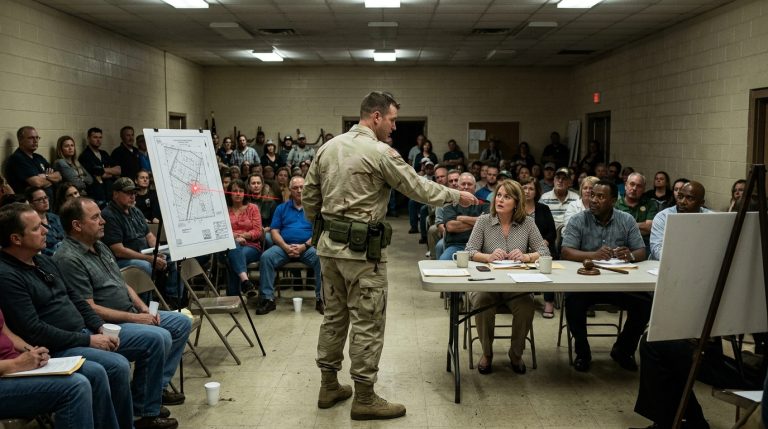
The doors opened fully, and the crowd surged into the hall, a collective murmur of anxiety and misplaced anger. Karen took the stage, the microphone feedback creating a high, shrill whine that made the room flinch. She began her speech, a polished, practiced performance of suburban victimhood, weaving a narrative of ‘predatory speculators’ and ‘malicious intent’ that was clearly designed to drown out the structural data in the packets we had distributed.
She was winning, too—the room was tilting toward her, the comfortable, familiar lie of their status quo proving more seductive than the cold, rusted truth of the ledger.
Then I saw Gene in the third row, catching my eye and giving a slight, nearly imperceptible nod. The packets were open. People were looking at the survey, the photos of the fatigue cracking, and the forged 1987 certificate. The momentum in the room began to shift, a subtle, physical tension that rippled through the chairs like a vibration before a collapse.
Karen stopped, her eyes widening as she realized the room was no longer hers. She looked at the crowd, then at the document in a resident’s hands, and for a fleeting second, the mask of the Sovereign Protector slipped, revealing the terrified, cornered woman underneath.
“The bridge is a privilege,” she began, her voice rising in a frantic, losing bid for control. “It is not a right, and we will defend—”
“Karen, sit down,” someone shouted from the back.
The room held its breath, the silence absolute. This was the moment—the structural failure of the lie. I stepped toward the aisle, my hand hovering over the satchel, knowing that once I opened it, there was no going back to the way things were. The bridge, the neighborhood, the lives—everything was about to be reclassified, and the weight of that reality was the only thing I could feel.
CHAPTER 7: The Fracture of Consensus
The room didn’t just go quiet; it became hollow. I walked to the front of the hall, the weight of the forged certificate in my satchel pressing against my thigh like a physical accusation. Karen was still standing, her mouth half-open, the microphone dangling from her lapel like a dead weight. She looked at me, and for the first time, I saw the genuine, unvarnished fear in her eyes—not the fear of losing an election, but the fear of being seen for what she was: a guardian of a vacuum.
“The document in your packets,” I said, my voice cutting through the silence without needing the microphone, “is a forgery. It is a fake certificate of structural sufficiency filed in 1987 to bypass the very safety codes that keep your families safe today. Your HOA has been defending a ghost, and they’ve been billing you for the upkeep of a lie.”
I laid the document on the projector. The grainy, rubber-stamped signature appeared on the screen, enormous and accusing. “Look at it. There is no engineer’s seal. There is no license number. There is nothing but a name, stamped by someone who didn’t even have the courage to sign their own fraud.”
A murmur erupted from the back—a low, discordant rumble of realization. A man in the front row, someone I’d seen walking his dog past the bridge every morning, stood up. He was holding the packet, his hands shaking slightly. “You’re saying we’ve been paying dues for a bridge that doesn’t legally have a safety rating? That our homes have been accessible by an illegal structure this whole time?”
“I’m saying,” I replied, “that you were sold a neighborhood on a foundation of air, and for thirty-five years, you’ve been doing the maintenance on a tragedy waiting to happen. The bridge is failing. The gusset plates are cracking. And as of this morning, it is structurally deficient by every standard recognized by the state of Tennessee.”
Karen found her voice then, a shrill, brittle sound. “He’s lying! He’s trying to seize the bridge to extort us! Don’t listen to him—this is a hostile takeover by a man who hates this community!”
But the momentum was gone. The residents weren’t looking at me, and they weren’t looking at Karen. They were looking at their own hands, holding the evidence of their own complicity. They had all, in one way or another, looked at the bridge and decided not to ask questions because the convenience of the shortcut was worth the ignorance of the risk.
“I’m not here to take the bridge, Karen,” I said, my voice dropping to a low, cold register. “I’m here to stop the collapse. You have two options tonight. You can vote to accept the easement, authorize the emergency repairs, and bring this structure up to code. Or, you can vote to maintain your position, in which case I will file this forgery with the state licensing board and the Department of Transportation tomorrow morning. If I do that, the bridge is condemned. And when the trucks stop coming, you’ll find out exactly how much a gated community is worth when it’s an island.”
The threat hung in the air, heavy and absolute. I didn’t need to shout. The truth, once exposed, had its own gravity.
The vote was a scramble—a chaotic, messy affair that felt more like a panic than a democratic process. People were arguing, phones were ringing, and the secretary, Trevor, was frantically trying to record the tally. When the final count was read—ninety to thirteen in favor of the easement—it wasn’t a victory. It was a concession.
As the room began to clear, the silence that followed was different. It wasn’t the silence of peace; it was the silence of people realizing they had spent decades living in a house of cards. Karen didn’t wait for the motion to adjourn. She walked out of the room, her shoulders hunched, her carefully cultivated aura of power dissolved by the simple, brutal geometry of the facts.
I stayed near the front, watching them leave. They didn’t make eye contact. They were hurried, anxious to get back to their homes, to check their driveways, to see if the world was still as solid as they had believed it to be.
Don walked up to me, his expression grim. “You realize what you’ve done, Mitch? You’ve given them a solution, but you’ve taken away their innocence. They’ll never look at that bridge the same way again.”
“Good,” I said, feeling the rust-pitted survey stake in my pocket. “An engineer’s job isn’t to make people comfortable. It’s to make sure the structure holds when the wind blows.”
But as I stepped out into the night, the weight didn’t lift. I had the vote, the easement, and the repair schedule. I had the victory. But looking at the dark silhouette of the bridge in the distance, I couldn’t shake the feeling that the crack in the gusset plate was still there, widening, a structural reality that no amount of voting could ever truly fix. The bridge was safe for now, but the ground underneath it had shifted, and I was the one who had cleared the path for the fall.
CHAPTER 8: The LoadBearing Peace
The construction equipment had long since departed, leaving behind a silence that felt different than the one I had found when I first bought the land. It was no longer a silence of isolation or potential; it was a silence of maintenance. The new bridge spanned Tanner Creek with a clean, functional geometry—steel grating that hummed under the tires of the school bus, fresh concrete abutments that glowed white in the morning light, and a drainage system that finally allowed the water to flow past the limestone bluffs without pooling.
I stood on the south bank, my coffee cup warm against my palms, watching the ridge. The Smokies were a soft, bruised purple on the eastern horizon, fading into the mist. My work here was done. The legal battles were archived, the easement was recorded, and the HOA was currently preoccupied with the mundane task of managing a budget that finally included a line item for bridge safety. They were quiet, and for once, the quiet felt earned.
My phone vibrated in my pocket. It was Ellie. I answered, hearing the familiar, stubborn rasp of her voice.
“You really did it, didn’t you, Dad? You built the cabin, you fixed the bridge, and you made them look at the math. Are you happy?”
I looked at the steel truss, the way it held steady against the weight of the morning. “I’m satisfied, Ellie. There’s a difference.”
“Is the bridge holding?”
“It’s holding more than just weight,” I said. “It’s holding a community that finally understands that if you don’t pay the price for the ground you stand on, you don’t actually own it. Not the bridge, not the property, not the life you’ve built.”
She was quiet for a moment, and I could hear the wind rustling through the oaks on her end of the line. “I’m proud of you, Dad. You didn’t just fight for the land. You fought to make sure there was something worth standing on.”
I hung up and walked toward the cabin. The porch was finished, the post-and-beam construction solid and honest. I sat in the Adirondack chair, the wood cool against my back, and watched a red-tailed hawk spiral over the valley. The survey stake I’d pulled from the tree line—the catalyst for the entire collapse of the HOA’s delusion—sat on the porch railing. It looked small now, an insignificant scrap of rusted iron that had been enough to topple a thirty-five-year lie.
I realized then that the bridge hadn’t been the enemy. The engineering, the fatigue, the concrete—those were just variables. The enemy had been the collective refusal to measure. They had lived for decades in a state of grace they called ownership, never realizing that ownership is an active, demanding process, not a passive entitlement. I had been the one to pull the measurement, but the collapse had been inevitable.
I took a sip of my coffee, the warmth spreading through my chest. The ridge was quiet, the creek was clear, and the conservation easement ensured that this place would remain exactly as it was—a quiet, enduring legacy that didn’t depend on who held the deed or who directed the traffic at the barricade. I was a structural engineer; I had spent my life calculating the points at which things break. But here, for the first time, I felt the satisfaction of watching something endure because it had been built on something real.
The bridge rattled as a car crossed it, a sound of transit and connection. It was a sturdy, reliable sound. I closed my eyes and let the morning sun wash over the porch, the smell of damp earth and iron finally settling into the background, no longer a warning, but a reminder. I was home. The ground was solid. And for the first time in a very long time, I didn’t need to measure anything at all.